
Specs are compiled from manufacturer listings and verified buyer reviews and can change over time — please confirm the key details on the product page before buying.
A humidity dome is the simplest way to create a tiny greenhouse for your seeds, trapping warmth and moisture so germination is fast and consistent. But not all domes are equal — thin plastic warps, vents stick, and low domes crush seedlings before they are ready. The right dome saves weeks of trial and error by delivering consistent germination on the first try.
I’m Rikta — the founder and writer behind Lawn Gear Lab. This guide is built by comparing the manufacturers’ published specifications and the patterns across verified customer reviews, so you get each pick’s real strengths and trade-offs instead of marketing spin.
Starting tomato seeds on a windowsill or filling a basement with propagation trays? The best humidity dome for seedlings depends on plastic thickness, vent control, dome height, and how many trays you actually need.
Our Picks at a Glance

How To Choose The Best Humidity Dome For Seedlings
Picking the right humidity dome kit is less about brand and more about matching three things: the physical space you have, the number of seeds you plan to start, and how much you value reusability. A cheap, thin dome often cracks by the second season — investing in a thicker one upfront saves you the repurchase.
Dome Thickness and Material
A thicker dome resists warping under grow lights and withstands repeated cleanings without cracking. A standard clear plastic dome is about 1mm thick, but heavy-duty options go up to 3mm. Thicker plastic also insulates better, keeping the internal temperature more stable for your seedlings.
Ventilation Control
Adjustable vents let you gradually reduce humidity as seedlings mature, preventing damping-off disease without removing the dome. Look for domes with at least four vent holes — more vents give finer control over airflow.
Height and Extensions
Tall domes or kits with extension panels let seedlings grow taller before you need to harden them off. If you are starting fast-growing plants like tomatoes or peppers, a dome under 4 inches will force you to transplant earlier than you might want.
Cell Count and Tray Size
Standard 10×20 inch trays fit most shelf setups, while smaller 7×5 inch trays are easier to move and fit under compact grow lights. Cell count matters — 72 cells give more variety in one go, while 48 cells leave more room for root development. Matching the kit to your space prevents clutter and wasted soil.
Quick Comparison
| Model | Best For | Dome Thickness | Total Cells | Height | Amazon |
|---|---|---|---|---|---|
| AC Infinity Humidity Dome★ Best Overall | Heavy-duty propagation | 3mm | 40 | Extendable | Amazon |
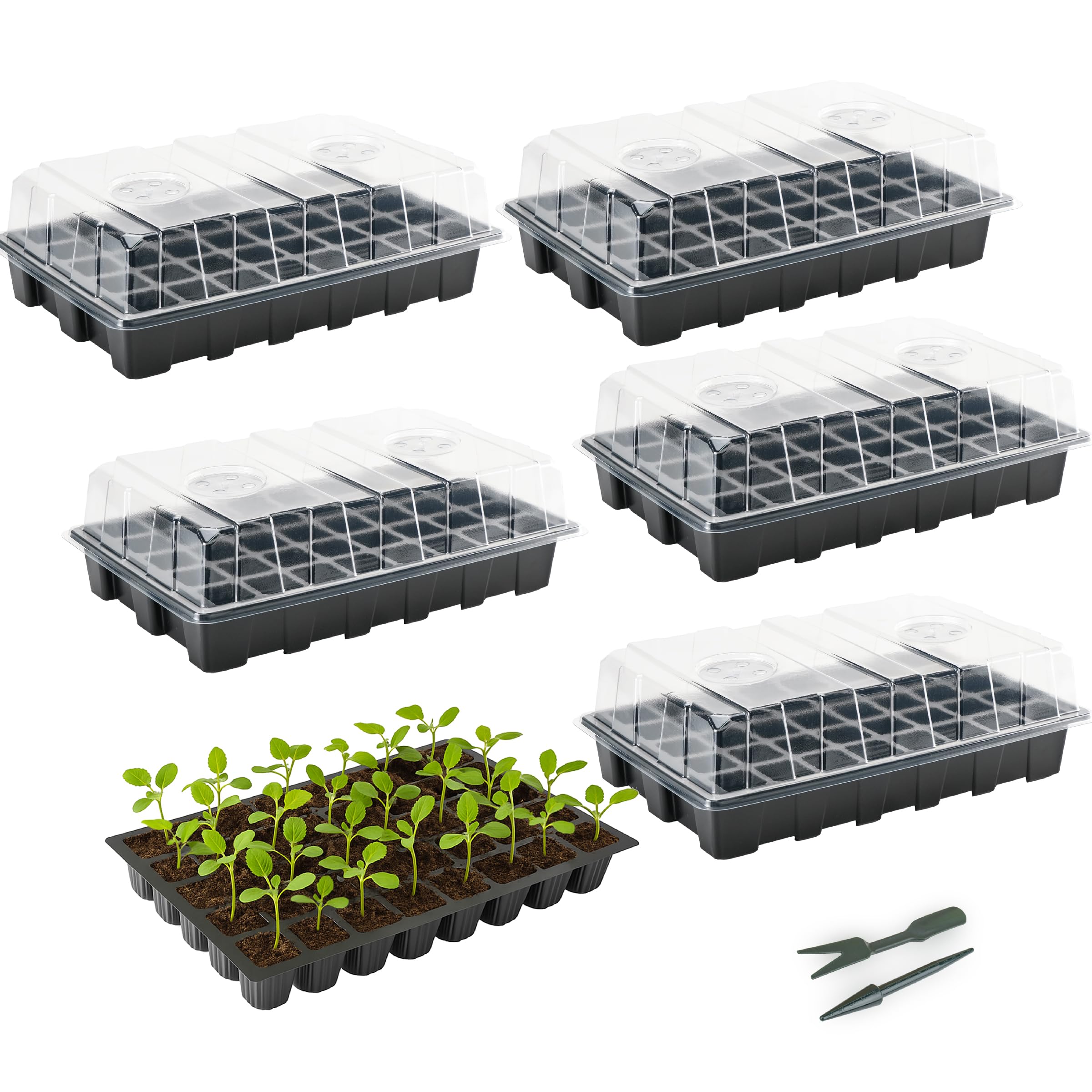
| Mr. Pen Seed Starter TraysBest Value Multi-Pack | Best value multi-pack | Standard | 200 | 4.3 inch | Amazon |
| Guioiby Seed Starter w/ LightAll-in-One System | All-in-one grow system | Standard | 120 | 7 inch | Amazon |
| VIVOSUN 6-Pack Starter Trays | Budget bulk start | Standard | 72 | 5.12 inch | Amazon |
| DJGINRO 12-Pack Kit | High volume / Many small trays | Standard | 144 | 4.9 inch | Amazon |
| VPQZUPG 10-Pack Kit | Budget multi-pack / Beginners | Standard | 120 | 4.5 inch | Amazon |
| Gardzen 10-Pack Starter | Small-space / Compact cells | Standard | 120 | 4.8 inch | Amazon |
| Living Whole Foods Domes | Replacement domes for 1020 trays | Standard | — | 2 inch | Amazon |
In‑Depth Reviews
1. AC Infinity Humidity Dome, Heavy-Duty Germination Kit
Our pick — over 4.5★ from 600+ verified ratings; the strongest balance of quality and price.
The dome is built to survive seasons of wet soil and rough handling without cracking.
This kit is the undisputed heavyweight champion of seedling domes. The 3mm thick plastic is rigid — you can stack trays without worrying about buckling. The bundled height extension panels raise the dome as your seedlings stretch, so you do not need to rush the hardening-off process for tall peppers or tomatoes.
For propagation and cloning, the adjustable vents on the extension panels let you dial in humidity at two heights instead of one. Buyers report the build is so sturdy it feels like “an evolution of starter domes,” though the 40-cell capacity means you are paying for quality rather than sheer volume. At 16 ounces the kit is heavier than budget alternatives, but that weight translates directly into durability.
The crowd favorite — 4.8 stars across 600+ ratings — makes it the clear winner on both score and trust. The trade-off? It carries a sticker price that some call overpriced, but the unanimous verdict is that it is worth it for anyone who starts seeds year after year and wants one buy that lasts.
What wins people over
- 3mm thick dome resists warping under heat mats and grow lights
- Height extension panels let tall seedlings keep growing under cover
- Multiple adjustable vents provide fine humidity control at two levels
The honest caveat
- Only holds 40 seedlings per tray — not ideal for large-scale starting
- Premium price means beginners on a tight budget may hesitate
The long-haul pick: This is the dome for the dedicated home propagator or cloning enthusiast who wants one tough, reusable system that never needs replacing.
Who should pass: If you need to start 120+ seeds in a single cycle, the smaller cell count here will require buying multiple kits — check the bulk options lower on this list instead.
2. Mr. Pen Seed Starter Tray Kits, 5 Set
A five-pack that gives you 200 cells without the premium price of a single heavy-duty tray.
Mr. Pen stacks the deck with five independent sets — each with its own tray, dome, and base — totalling 200 cells across all five. That is a vast capacity advantage over the AC Infinity kit above (200 cells vs 40 cells). The clear vented domes allow you to manage airflow per tray, which matters when you are starting different species with different humidity needs side by side.
The plastic handles bottom watering without cracking, and owners mention these trays feel “high quality, not flimsy — worth double the price.” The trade-off: the domes slide off easily because there is no locking mechanism, so carrying a full tray needs two hands and care. Each set includes a small shovel and scoop, so you skip a trip to the garden shed.
At 4.7 stars across 288 ratings, this kit punches well above its price tier. The honest trade-off is that the AC Infinity kit (600 ratings) has more than double the social proof, but Mr. Pen holds a score advantage over many similarly priced packs here.
Why it stands out
- Five complete kits offer 200 cells for serious multi-variety starting
- Sturdy water-catching base trays support bottom watering without leaks
- Vented domes give per-tray humidity control for different seed types
What to watch
- Domes slide off easily — no locking latch for secure transport
- Some owners note the 40-cell and 15-cell inserts have different hole sizes
Smart buy for volume: Grab this five-pack if you start a wide variety of seeds each spring and want dedicated domes for each tray rather than one big kit.
Think twice if: You need a single rugged dome for year-round cloning — the fixed-height domes and standard plastic won’t match the AC Infinity’s 3mm thickness.
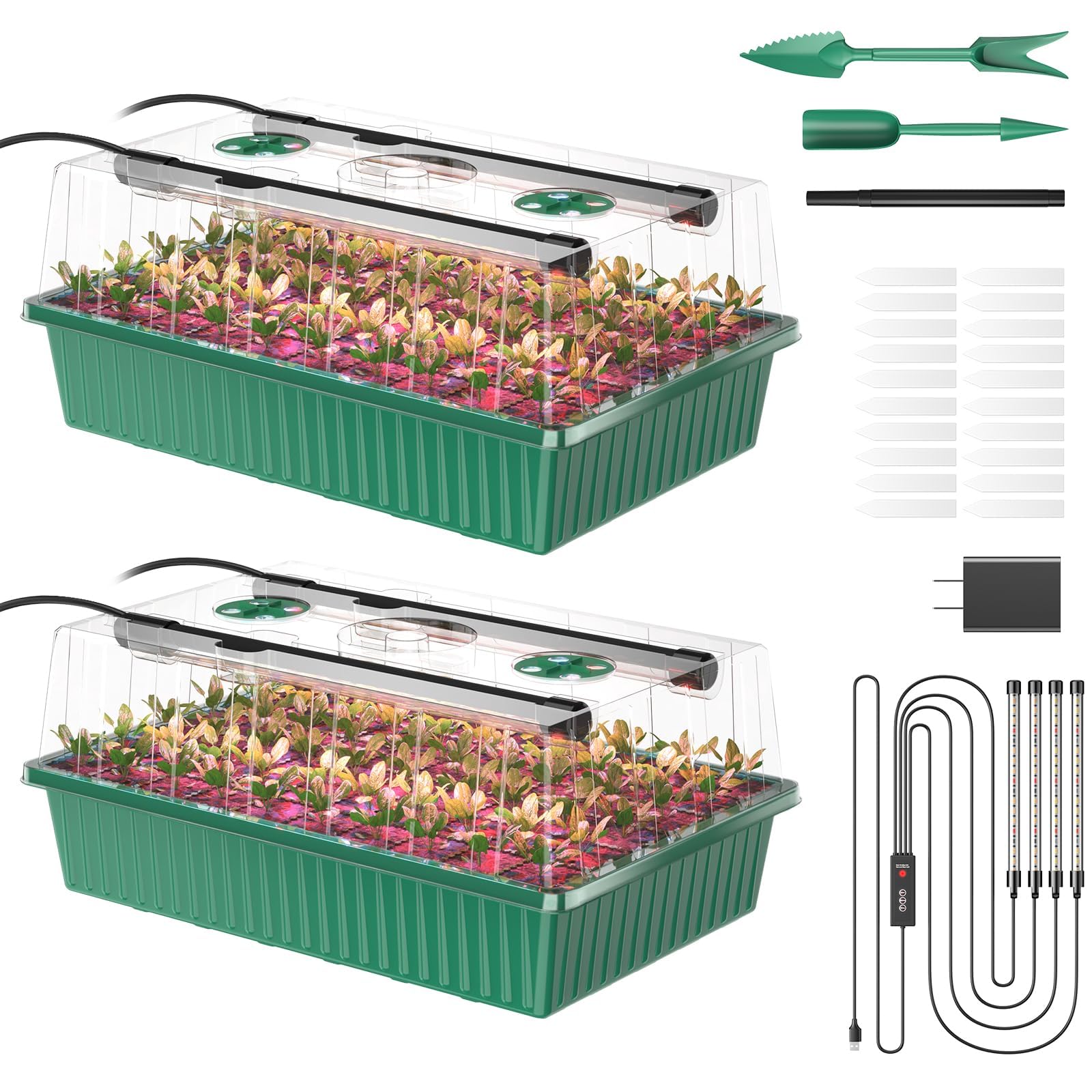
3. Guioiby Seed Starter Tray with Grow Light, 120-Cells
A complete indoor nursery that bundles lights, domes, and trays into one tidy package.
This kit skips the guesswork for indoor gardeners who lack a sunny windowsill. The grow light bars offer full-spectrum LEDs with 5 brightness levels and 3 auto-timer settings (3H, 6H, or 12H), so seedlings get consistent light without you having to remember to flick a switch. The humidity domes are tall — about 7 inches — giving plenty of headroom for growth before transplant.
The silicone bottoms on each cell are a standout design: push up from underneath and the whole seedling pops out intact, roots undisturbed. It is a trick that makes transplanting nearly easy. While the kit includes 120 cells, it is spread across two trays of 60 cells each, which fits neatly under the included light bars. The air valves on the domes can be slightly fiddly to install, and some owners find the dome height excessive for typical short-season vegetables.
With a 4.5 rating across 610 ratings, this is the most popular all-in-one system on the list. The catch is that the fixed grow light bars mean you cannot reposition them independently, but for a beginner or apartment gardener, this removes the hassle of buying a separate light setup.
What makes it unique
- Full-spectrum grow lights with 5 brightness levels and 3 timer modes
- Silicone cell bottoms let you push seedlings out without root damage
- Tall 7-inch humidity domes accommodate fast-growing stems
Limitations
- Air vent valves are tricky to install correctly
- Domes may be too tall for low-profile grow light setups
Grab-and-go system: Perfect for the indoor gardener who wants lights, domes, and trays in one shipment — just add soil and seeds.
Not ideal for: Growers who already own quality grow lights and just need replacement domes or trays on their own.
4. DJGINRO 12 Pack Seed Starter Tray, 144 Cells

Twelve complete kits make this the ultimate buy for the serious home nursery.
If you want volume, this is the biggest bundle by unit count — 12 trays, 12 humidity domes, 12 base trays, 144 cells total. Each kit includes plant tags and two mini gardening tools, so you are ready to go with zero trips to the hardware store. The dome has 4 ventilation holes for adjustable airflow, and each cell has a drain hole at the bottom to prevent overwatering. The trays are compatible with heat mats up to 120°F.
Buyers call the quality “sturdy and durable enough for years,” though a recurring comment is that the lids do not lock on securely. That means moving a full tray risks the dome sliding off. One owner solved it by adding a tape tab for easy lifting. The individual tray size is small at 7.4 x 6.3 x 4.9 inches, which is an advantage for fitting on crowded shelves but means lower soil volume per cell than a standard 10×20 flat.
At 4.5 stars across 354 ratings, this is the crowd favorite for volume buyers. The 144-cell count beats the Mr. Pen kit (200 cells) but across 12 trays instead of 5, so each tray is smaller and more manageable.
The big draw
- 12 complete kits give you 144 cells — enough for a full backyard garden start
- Compatible with heat mats up to 120°F for faster germination
- Small individual tray size fits tight shelf spaces
The catch
- Dome lids do not snap shut securely — risk of sliding during transport
- Small cells mean less root room for large-seeded vegetables
Volume king: Buy this if you are starting seeds for a full vegetable garden and want the most individual kits per dollar — the 12-pack means you can stagger start dates easily.
Not for: Gardeners who need heavy-duty plastic that survives rough handling year after year; the standard-gauge plastic here is good but not as tough as the AC Infinity.
5. VPQZUPG 10 Packs Seed Starter Tray, 120 Cells
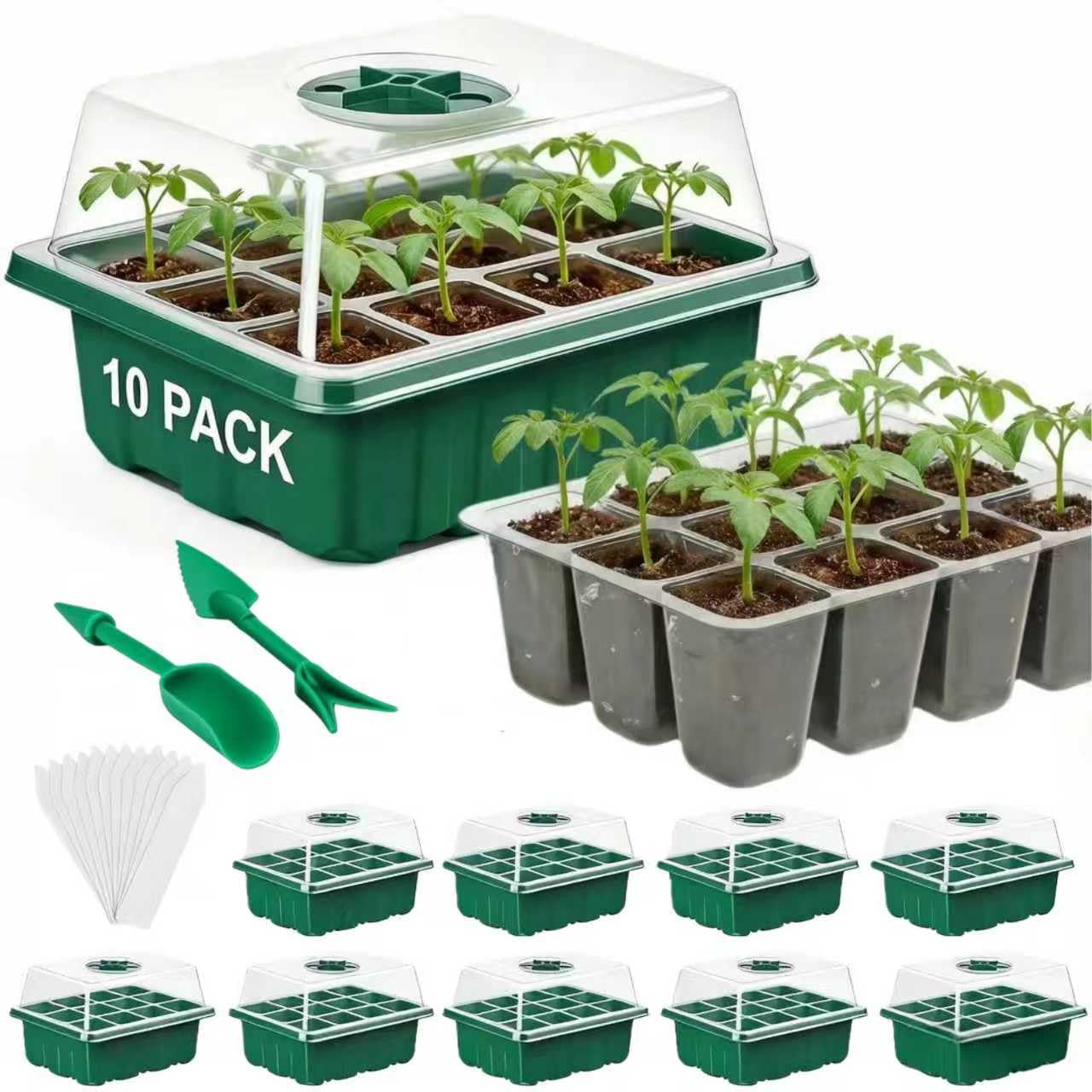
A ten-pack that balances cost and cell count for the budget-conscious grower.
This 10-pack from VPQZUPG provides 120 cells across 10 individual kits — each with a tray, humidity dome, and base. That is 20% more kits than the DJGINRO 12-pack? No, it is actually 2 fewer kits, but the same cell-per-kit ratio (12 cells each). The adjustable humidity dome uses 4 ventilation holes, and each cell has bottom drainage holes. The included 20 plant labels and two gardening tools add convenience without extra cost.
Customers note seeds “sprout within 6 days” and appreciate that the trays break down flat for storage. The dome lids lack a locking latch, and some owners wish the plastic was thicker, but the general consensus is a solid 4.6 stars across 192 ratings. At 7.1 x 5.5 x 4.5 inches per kit, these are compact enough for tight shelves, though the smaller size gets mixed feedback.
A fair starting pack: This is a no-regret entry point for a beginner who wants multiple kits without overspending — the high rating and low price make it a low-risk trial.
Best for beginners: If you are new to seed starting and want to try multiple kits without a big investment, this 10-pack is a safe bet.
Upgrade if: You are a seasoned grower who needs thicker plastic and taller domes for large seedlings — the 4.5-inch height here is relatively short.
6. Gardzen 10 Pack Seed Starting Tray, 120 Cells

Tiny, manageable cells ideal for microgreens and compact seed starts.
The Gardzen kit uses cell inserts measuring 1.5 x 1.5 x 2.25 inches — noticeably smaller than typical starter cells. That works beautifully for microgreens, herbs, and small flowers, but for large-seeded crops like squash or cucumbers you will find the root space limiting. The trays are made from PET plastic, which has a slight flexibility that some owners call sturdy and others describe as thin. The adjustable vents on the humidity domes provide airflow control.
The biggest complaint involves the vent covers — a few reviewers point out the small vents falling off during handling. On the plus side, the clear dome lets you see germination progress from all angles, and the 10-pack gives you 120 cells to play with. Rated 4.3 out of 5 across 427 ratings, this is a reliable but not exceptional choice for casual seed starting.
Best for small seeds: If you mostly grow lettuces, herbs, and flowers, the compact cell size is actually an advantage — less wasted soil per seed.
Reach for this if: You want a cheap bulk kit for microgreens or fine seeds where small cells are a feature, not a flaw.
pass on it if: You need deep cells for tomatoes or peppers — the short 2.25-inch depth will limit root development before transplant.
7. VIVOSUN 6-Pack Seed Starter Trays, 72 Cells
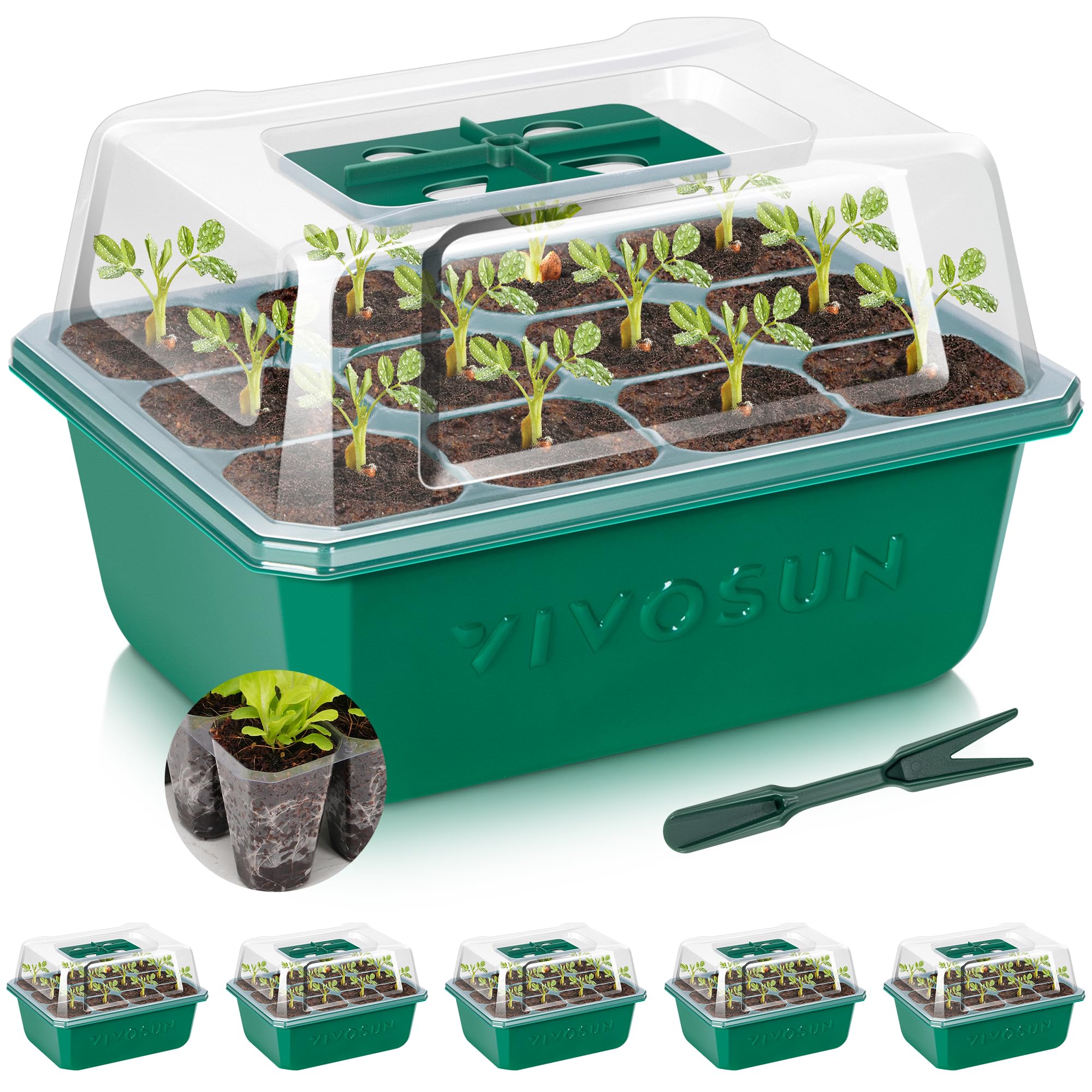
Six kits for less than the price of a fast-food meal — but the quality holds up.
VIVOSUN’s 6-pack is often the first purchase for new seed starters. Each kit includes a 12-cell tray, base tray, and humidity dome with a single adjustable vent. The trays are compatible with heat mats operating up to 120°F, which is standard for most seed-starting setups. The kit also throws in a pack of garden tools and 10 garden labels — small touches that reduce friction for first-timers.
The plastic feels sturdy enough for multiple seasons, though some owners note the dome does not close flush, creating a spill risk when moving trays. Over 900 ratings give this a 4.4-star average. The biggest concern is that direct sun above 65°F can overheat seedlings inside the dome, so placement matters. One owner notes a 75% germination rate after two weeks, which is solid for budget gear. The 72-cell total is modest compared to the 120+ cell packs above, but the cost per kit is very low.
What works
- Inexpensive entry point with 6 complete kits for multi-variety starting
- Compatible with standard heat mats up to 120°F
- Comes with bonus garden tools and plant labels
The honest downsides
- Dome lid does not lock in place — risk of spill when carrying
- Single vent per dome offers less airflow control than multi-vent domes
The beginner’s pack: If you have never started seeds indoors before and want to test the waters cheaply, this 6-pack is the lowest-risk way to learn without frustration.
Level up if: You already know you will start hundreds of seeds annually — the plastic here is good, but it will not withstand the abuse that the AC Infinity or Mr. Pen kits will.
8. Living Whole Foods Plant Tray Clear Plastic Humidity Domes: Pack of 10

A low-profile dome pack that replaces worn-out covers for standard 1020 propagation trays.
These are not a complete kit — they are replacement humidity domes designed to fit standard 10×20 inch germination trays. At only 2 inches tall, they are intentionally low-profile, which is great if you use grow lights that sit close to the trays. The pack of 10 gives you enough domes for even a serious propagation operation.
The plastic is clear and durable, with buyers saying they are “far more durable than the jiffy domes” and fit Sunpack heavy-duty 1020 trays perfectly. However, the domes measure about 1/8 inch larger than the advertised 10×20 size, so they may sit slightly proud on some standard flats, requiring care to avoid bumping seedlings. The low height means you will need to remove the dome or transplant quickly as seedlings grow — this is a starting cover, not a long-term growing enclosure.
Rated 4.6 stars across 345 ratings, this is a niche solution for anyone who already owns 1020 trays and just needs fresh domes without buying the entire tray again.
For the modular system builder: If you already have a stack of 1020 trays, buying these replacement domes in bulk is more economical than purchasing new kits.
Buy these if: You operate a propagation setup with standard 10×20 trays and your old domes are cracked or cloudy.
Skip if: You are starting from scratch — you still need to buy separate trays, cells, and bases to use these domes.
Understanding the Specs
Dome Thickness
Measured in millimeters (mm), this determines how rigid the dome stays under heat mats and grow lights. Standard domes are around 1mm — they flex and can warp after a season or two. A 3mm dome like the AC Infinity kit resists deformation and insulates better, holding a more stable internal temperature for your seedlings.
Cells and Tray Size
The number of cells (usually 12, 48, 72, or 120 per tray) sets how many seeds you can start in one go. But bigger is not always better — taller cells with more soil volume let roots develop before transplant. A standard 10×20 inch tray holds about 72 standard cells, while compact trays around 7×5 inches max out at 12 cells but fit on tight shelves.
Ventilation
Adjustable vents on the dome let you gradually reduce humidity as seedlings grow, preventing damping-off disease without lifting the entire cover. More vents mean finer control — four small vents are better than one large opening because you can open only what you need to dial in airflow.
Height and Extensions
Dome height matters for how long you can leave seedlings under cover before they touch the plastic. Standard domes are 2–4 inches tall. Taller domes (5–7 inches) or kits with extension panels let you keep the humidity tent up for fast-growing stems, reducing transplant shock from a premature removal.
FAQ
Do I need a heat mat with a humidity dome?
How tall should a humidity dome be for seedlings?
Can I reuse humidity domes and trays?
How many cells do I really need?
What does a thicker dome do for my seeds?
How do I use the vents on a humidity dome?
Are silicone seed starter trays better than plastic?
Will a humidity dome fit my existing grow light setup?
What size tray do most humidity domes fit?
Final Thoughts: The Verdict
For most buyers, the best humidity dome for seedlings is the AC Infinity Humidity Dome. Its 3mm thick plastic, height extension panels, and precision venting let it outlast other kits — backed by a 4.8-star rating from hundreds of owners. If you want maximum cell count without spending premium money, choose the Mr. Pen 5-Set for 200 cells across five independent kits. For a complete indoor setup that includes grow lights and silicone transplant cells, the Guioiby Seed Starter with Grow Light removes the guesswork of buying separate components. Whichever you pick, match the dome height and cell count to your crops and space — a good start begins with the right cover.
How We Picked
We do not accept paid placement. Every pick is matched to a real buyer and a real use-case; we do not hands-on test units.
Sources & Methodology
Specifications: manufacturer listings and product documentation. Review insights: verified customer reviews, as of July 2026. Pricing: not shown on this page (it changes often); check the current price via the retailer link.
As an Amazon Associate, Lawn Gear Lab earns from qualifying purchases. This does not affect which products we feature.