
Specs are compiled from manufacturer listings and verified buyer reviews and can change over time — please confirm the key details on the product page before buying.
Picking an insecticide for your garden is about finding the one tool that actually matches the pest you are fighting, without nuking your plants or keeping the family off the grass for a week. Some formulas nuke everything on contact, others sneak into the plant’s system to kill bugs from the inside, and a few rely on bacteria that only target caterpillars. The biggest mistake is grabbing a bottle that sounds powerful but kills your tomatoes as fast as the aphids.
I’m Rikta — the founder and writer behind Lawn Gear Lab. This guide is built by comparing the manufacturers’ published specifications and the patterns across verified customer reviews, so you get each pick’s real strengths and trade-offs instead of marketing spin.
Japanese beetles are shredding your roses, and mosquitoes are driving you off the patio. This guide matches the best insecticide for garden to your exact problem, not just the loudest label on the shelf.
Our Picks at a Glance

How To Choose The Best Insecticide For Garden
Insecticides are not one-size-fits-all. The spray that saves your squash might kill your pollinators. The key is matching the active ingredient to the pest and the setting.
Contact vs. Systemic Killers
Contact insecticides (like Bifenthrin or Pyrethrins) kill bugs only when they are directly hit or crawl over a wet surface. They are great for a quick knockdown but wash off in rain. Systemic products (like the Bonide concentrate) are absorbed into the plant — insects eating any part of the plant get poisoned, which is perfect for hidden pests like scale or borers.
Organic and Pollinator Safety
If you grow vegetables or keep bees, look for OMRI Listed products (like the Spinosad and B.t. options) that comply with organic standards. Even then, timing matters — spray early morning or late evening when bees are not foraging, and let the product dry completely before letting pets or kids near treated areas.
Concentrate vs. Ready-to-Use
Ready-to-use sprays are grab-and-go convenient for small gardens or spot-treating. Concentrates (like the Monterey Spinosad concentrate or the Sevin gallon) mix with water in a sprayer and stretch much further, making them more economical for large yards or heavy infestations.
Quick Comparison
| Model | Best For | Active Ingredient | Volume | Form | Amazon |
|---|---|---|---|---|---|
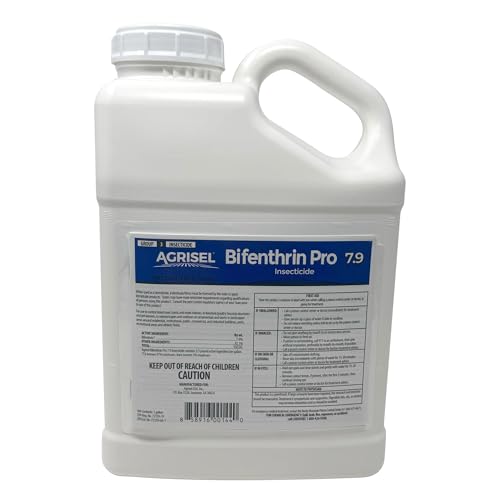
| Agrisel Bifenthrin Pro | Broad-spectrum yard defense | Bifenthrin 7.9% | 1 Gallon | Liquid Concentrate | Amazon |
| Earth’s Ally 3-in-1 | Organic houseplant & garden care | Thyme/Rosemary/Clove/Peppermint Oil | 32 fl oz | Ready-to-Use Oil | Amazon |
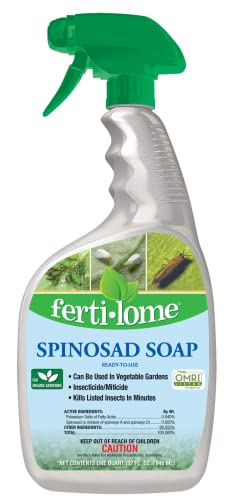
| Ferti-lome Spinosad Soap | Caterpillars & chewing insects | Spinosad + Potassium Salts | 32 fl oz | Ready-to-Use | Amazon |
| Monterey Spinosad Concentrate | Organic concentrate for large gardens | Spinosad | 8 fl oz | Liquid Concentrate | Amazon |
| Cyonara Lawn & Garden RTS | Mosquito & general lawn pest control | Lambda-cyhalothrin | 32 fl oz | Ready-to-Spray | Amazon |
| Bonide Systemic Insect Control | Hard-to-kill sap-sucking pests | Imidacloprid | 16 fl oz | Liquid Concentrate | Amazon |
| Monterey B.t. Concentrate | Caterpillars & organic vegetable gardens | Bacillus thuringiensis (B.t.) | 32 fl oz | Liquid Concentrate | Amazon |
| Garden Safe Fungicide3 | All-in-one fungicide, insecticide, miticide | Neem Oil | 128 fl oz | Ready-to-Use | Amazon |
| Sevin GardenTech Concentrate | Massive pest list & vegetable patches | Zeta-Cypermethrin | 1 Gallon | Liquid Concentrate | Amazon |
In‑Depth Reviews
1. Agrisel Bifenthrin Pro 7.9 Insecticide, 1 Gallon
Our pick — over 4.5★ from 400+ verified ratings; the strongest balance of quality and price.
The heavy hitter that turns your yard into a no-fly zone for three weeks straight.
If you are tired of monthly professional sprays that leave your wallet lighter and your mosquitoes just as hungry, this one-gallon concentrate is the alternative that actually delivers. The active ingredient is Bifenthrin 7.9%, a broad-spectrum synthetic pyrethroid that knocks down over 125 listed insects — from ants and fleas to stink bugs and mole crickets. The low usage rate means a single gallon stretches across large areas, saving money in the long run.
The household verdict is clear: “Effective for mosquitoes and carpenter ants in wooded areas,” say buyers, and the residual effect lasts roughly three weeks between applications. The formula is safe for pets after it dries (about 1–2 hours), so you are not locking the dog inside all summer. Just note it cannot be shipped to Hawaii or New York, and the heavy weight (9.2 pounds) means the jug is a workout to carry.
At 4.6 stars across hundreds of owners, this is the crowd favorite for a reason — it simply works on the stuff that bites, crawls, and destroys your garden.
What Wins Owners Over
- Kills 125+ pest types — one jug replaces a shelf of specialty sprays
- Lasts ~3 weeks after application, so you spray less often
- Safe for pets once the foliage dries completely
Who Should Think Twice
- Cannot be sold in Hawaii or New York due to state restrictions
- Heavy jug (9.2 lb) requires a sturdy sprayer or pump
Reach for it if: you want one concentrated product to knock out most lawn and garden pests, including mosquitoes, ants, and carpenter ants, for weeks at a time.
Look elsewhere if: you need an OMRI Listed organic option for a vegetable patch — this is a synthetic pyrethroid, not certified organic.
2. Earth’s Ally 3-in-1 Plant Spray, 32 Oz
A botanical oil spray that kills aphids overnight and respects the bees.
Earth’s Ally is the go-to for any gardener who wants a non-chemical weapon against soft-bodied pests like aphids, spider mites, whiteflies, and mealybugs. The ready-to-use formula blends thyme oil, rosemary oil, clove oil, and peppermint oil — no synthetic poisons, no harsh residue. It also doubles as a fungicide, tackling common plant diseases in the same pass. As buyers put it: “Killed all aphids on an orange tree overnight.”
The trade-off is that it demands persistence. In rainy climates like Florida, multiple applications are needed because the oil washes off, and some buyers report spotting live aphids after the first spray. The mixed feedback on plant damage (with 33 mentions across reviews) means you should test on one leaf before going all-in. The herbal scent is a bonus for most, though it is not a favorite for everyone.
This is the pick for indoor houseplants, organic vegetables, and anyone who wants to spray without worrying about their cat or pollinator population.
The bottom line: It works brilliantly on light infestations and soft-bodied pests, but you should expect to reapply after rain. skip it if you need a single-application miracle on a heavy infestation.
Best for: houseplant enthusiasts and organic gardeners who want a bee-safe, ready-to-use spray that controls both pests and fungus.
pass on it if: you are battling a heavy infestation in a rainy climate — it requires frequent reapplication to stay effective.
3. Fertilome Spinosad Soap Insecticide RTU, 32 oz
The ready-to-use bottle that stops caterpillars and beetles on contact, no mixing required.
For anyone who hates lugging a sprayer around, Fertilome’s ready-to-use Spinosad Soap delivers immediate knockdown on chewing insects — caterpillars, bagworms, tent caterpillars, Colorado potato beetles, and leafminers. The formulation combines Spinosad (0.005%) with Potassium Salts of Fatty Acids (0.94%), which breaks down the insect’s outer layer on contact. Because it is OMRI Listed, you can use it right up to harvest on vegetables fruits and citrus.
Real-world experience tells a consistent story: one owner on Cleveland Pear trees stopped caterpillars and beetles in two applications, while another saw “no reoccurrence after 2 weeks” on leaf miners. The catch is that insects can build resistance if you overuse it, so alternating with a neem-based product keeps it effective. At 32 fluid ounces, it covers a decent garden but runs through quickly on large trees.
This is the grab-and-go solution for small-to-medium gardens where convenience matters more than raw volume.
How it compares: It offers 32 fluid ounces of ready-to-use protection, while the Monterey Spinosad concentrate is 8 fl oz, but the Monterey concentrate goes further when mixed.
Grab it if: you want a simple, ready-to-use spray for vegetable gardens that handles caterpillars, beetles, and leafminers without mixing.
Pass if: you have a large yard or many trees — this runs out fast compared to a concentrate.
4. Monterey Spinosad Insecticide Garden Spray, 8 oz
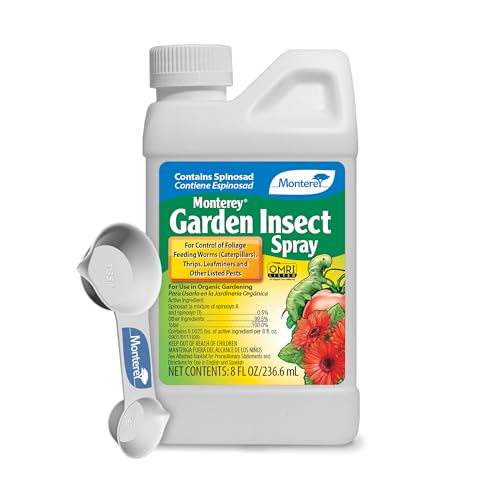
A tiny bottle with huge reach — one 8-ounce concentrate treats caterpillars, thrips, and borers across the whole garden.
Monterey’s Spinosad is a concentrate that punches above its size. Just 8 fluid ounces of this liquid, mixed with water in a sprayer, covers an impressive area against caterpillars, codling moths, tent caterpillars, leafminers, thrips, and fire ants. The active ingredient is naturally occurring bacteria (Spinosad), so it is fast-acting and completely odorless — you do not smell like a chemical plant after spraying.
The reviews break in favor of organic gardeners who appreciate the non-harsh formula. It saved roses from sawfly caterpillars and kept tomatoes, peppers, and flowers growing normally. Because it is a concentrate, “a little goes a long way,” according to one experienced grower. The downside is its limited volume: at 8 fluid ounces, compared to the Fertilome ready-to-use’s 32 fl oz, but with mixing ratios it actually treats a larger area overall. You will need a separate sprayer, which is worth factoring in.
This is the right pick for anyone who already owns a sprayer and wants the most economical organic option for a large garden.
Why It Stands Out
- OMRI Listed for organic gardening — safe for vegetables up to day of harvest
- Odorless formula — no strong chemical smell during or after application
- Effective against a wide range of caterpillars, thrips, and borers
The Catch
- Requires a separate sprayer — not ready to use out of the bottle
- Small bottle (8 fl oz) can be easy to misplace in the shed
Choose it if: you are an organic gardener with a sprayer who wants an odorless, effective concentrate for a large vegetable patch or fruit trees.
Consider something else if: you prefer a grab-and-go spray bottle and do not want to mix your own.
5. Control Solutions Cyonara Lawn & Garden RTS, 32 oz

The ready-to-spray bottle that delivered a mosquito-free Texas summer through heavy rain.
Cyonara Lawn & Garden is the pick for homeowners whose priority is reclaiming the backyard from mosquitoes. It comes as a ready-to-spray (RTS) concentrate that attaches directly to a garden hose — you spray the entire lawn without mixing or pumping. The active ingredient (Lambda-cyhalothrin) is a powerful synthetic pyrethroid that kills on contact and leaves a residual barrier. One buyer in Texas called it “AMAZING” even with all the rain, reporting zero mosquitoes after treatment.
Beyond mosquitoes, owners mention it works on springtails, sod webworms, and general lawn pests, though one reviewer noted it took heavier dosing for springtails specifically. The price is notably lower than store-bought equivalents, but opinions on value are mixed — a minority felt it did not stretch far enough for a large property. The product weighs just 2 pounds, making it easy to handle and store.
This is your best bet if mosquitoes are the main enemy and you want the easiest application method possible.
In a nutshell: A hose-end spray that turns the whole lawn into an insect barrier with zero measuring or mixing. it’s not for you if you need an organic-certified product — this is a synthetic solution.
Perfect for: homeowners who want a fast, easy mosquito treatment without buying a separate sprayer.
Not for: organic gardeners or anyone needing a product for edible crops.
6. Bonide Systemic Insect Control, 16 oz Concentrate
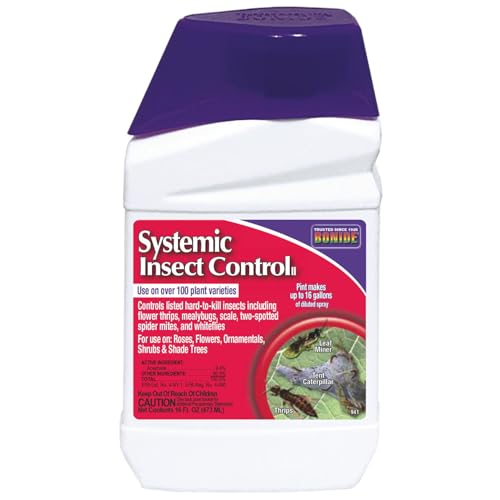
The one that gets inside the plant so you kill the bugs you cannot see.
Bonide Systemic Insect Control works differently from contact sprays. Instead of just coating the leaves, it is absorbed by the plant’s roots and tissues, making the entire plant toxic to insects that feed on it. This makes it ideal for hard-to-kill pests like thrips, mealybugs, scale, spider mites, and whiteflies — the kind that hide under leaves or inside stems. A single 16-ounce concentrate makes up to 16 gallons of spray, which is excellent value for money.
The catch is infamous: the odor. Almost every review warns it “smells like actual poop,” strong enough to think the dog had an accident indoors. It is effective — customers note that fungus gnats vanished days after the first dose — but you will want to treat plants in the garage or a well-ventilated area for at least a few weeks. Also, this is not labeled for edible plants; it is for flower beds, roses, shrubs, and ornamentals only.
If you are growing ornamentals and need a low-maintenance option for persistent sap-sucking pests, the systemicity here is unbeatable.
What Makes It Unique
- Systemic action kills pests that hide in stems, roots, and undersides of leaves
- Makes 16 gallons of spray from a 16-ounce bottle — excellent value for area coverage
- Fast results — fungus gnats often gone within 2–3 days
The Real Trade-Off
- Powerful, unpleasant odor that lingers for weeks
- Not safe for use on vegetables or fruit plants — ornamentals only
Choose it if: you have ornamentals, roses, or shrubs plagued by thrips or scale that contact sprays never seem to wipe out.
Avoid it if: you grow vegetables or cannot tolerate a strong, persistent smell near your living spaces.
7. Monterey B.t. With Measuring Spoon, 32 oz
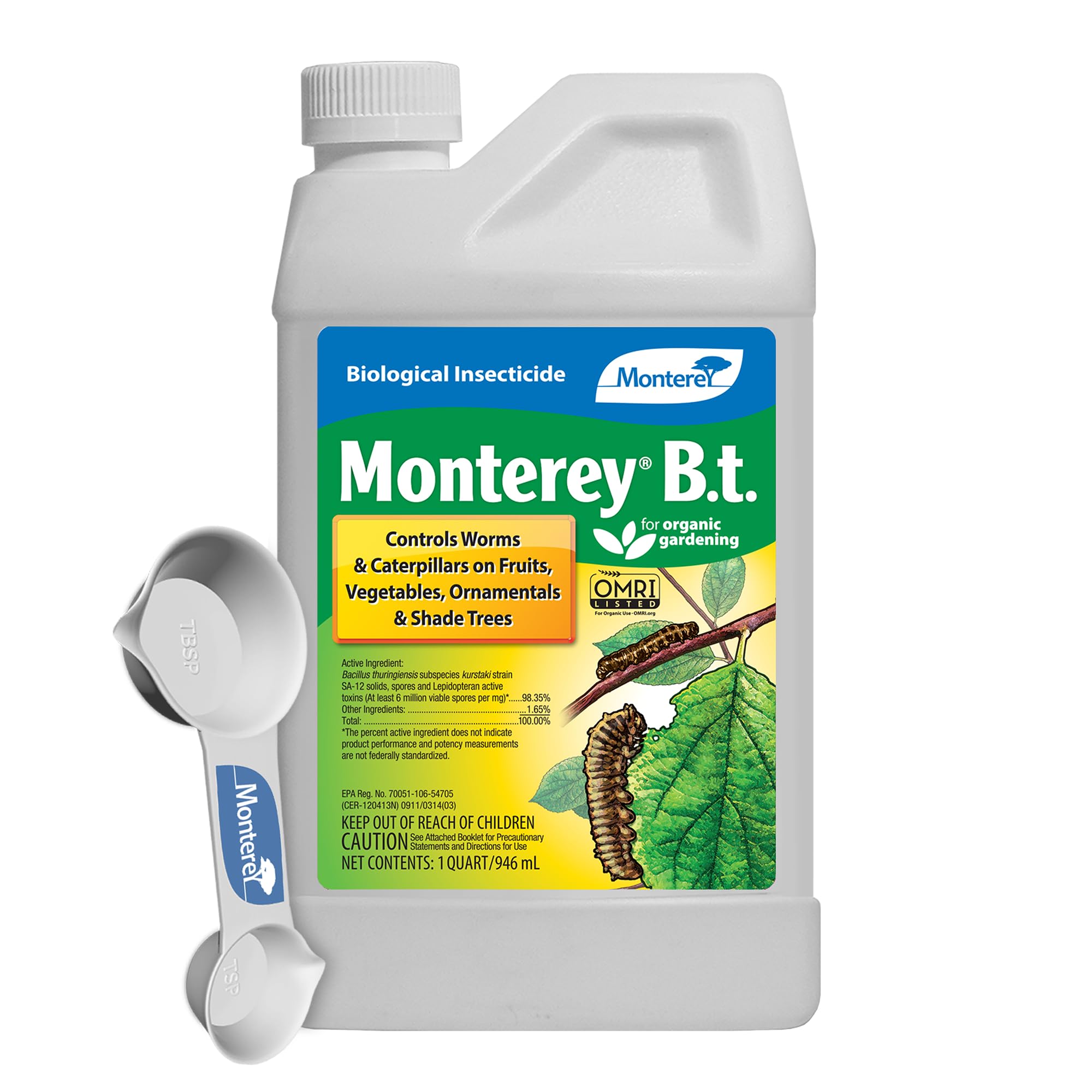
A bacterial spray that only targets caterpillars and leaves the honeybees alone.
Monterey B.t. is the most surgical tool in this lineup. Its active ingredient is Bacillus thuringiensis (B.t.), a naturally occurring soil bacteria that produces a protein toxic only to caterpillars and worm-type insects (cabbage looper, bagworm, gypsy moth, fall cankerworm). When larvae eat treated foliage, the bacteria releases a toxin in their gut and stops feeding within hours. It is OMRI Listed and, when used correctly, has no effect on birds, earthworms, honeybees, or ladybugs.
Buyers with vegetable beds swear by it — it “controlled pickleworm” on cucurbits and stopped caterpillars dead on tomatoes. The bottle includes a measuring spoon, mixes instantly with water, and covers a lot of ground. The main limitation is that B.t. breaks down quickly in sunlight, so you must apply late evening and mix only what you need for one night. At 4.6 stars from hundreds of reviews, it is widely considered worth the premium price for the precision it offers.
If your problem is exclusively caterpillars and worms, this is the cleanest, most targeted solution you can buy.
How it compares: Unlike broad-spectrum killers, Monterey B.t. spares all beneficial insects. The price is higher per bottle than some, but it “doesn’t take much” according to owners, so the bottle lasts.
Reach for it if: you have a caterpillar or worm problem on vegetables, fruit trees, or ornamentals and want to protect pollinators.
Look elsewhere if: you need to control a mix of pests (aphids, beetles, mites) — this only works on caterpillars and worm-type insects.
8. Garden Safe Fungicide3 With Neem Oil, 1 Gal
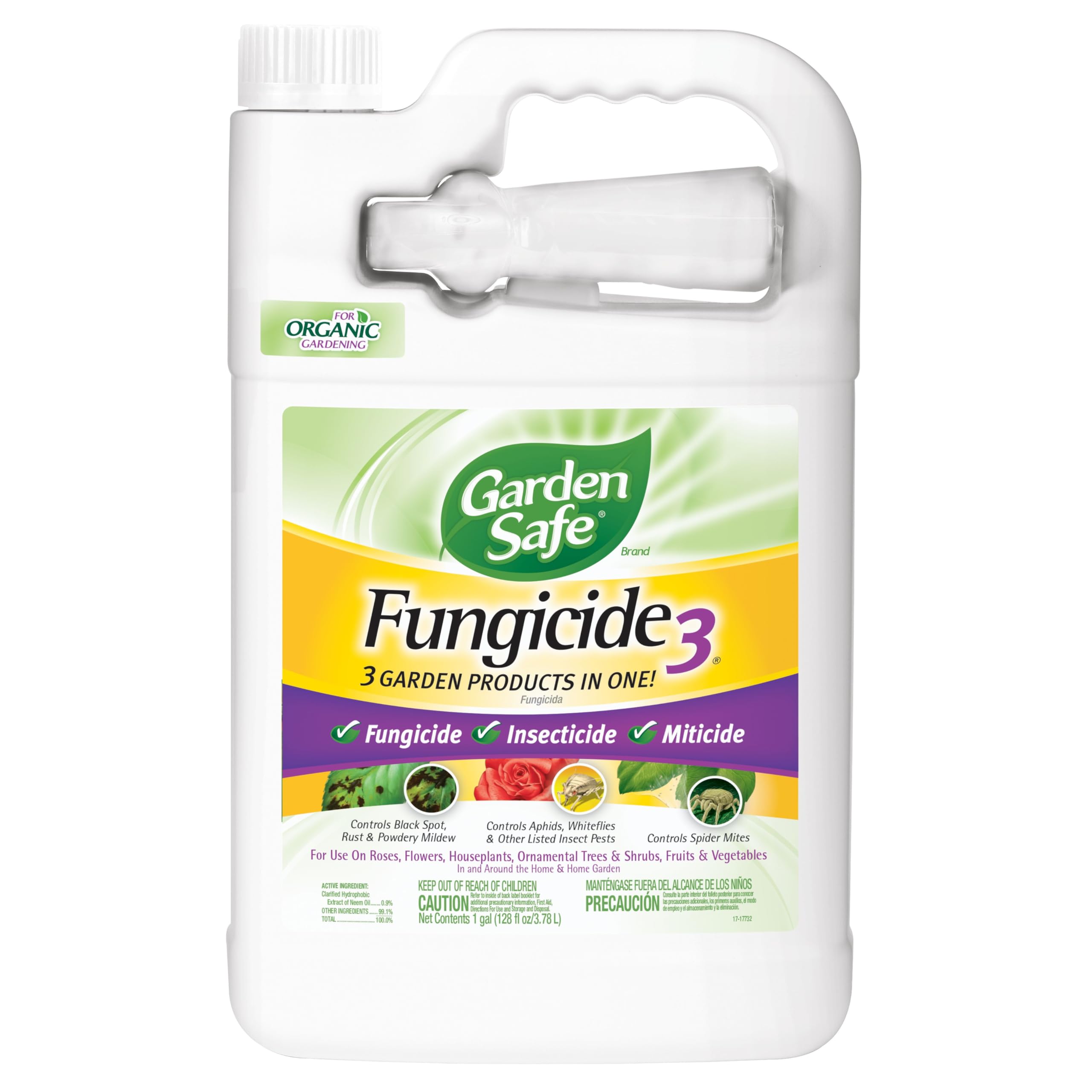
One gallon that fights fungus, insects, and mites without synthetic chemicals.
The feedback is overwhelmingly positive, but there is a learning curve. The built-in sprayer is widely criticized as frustrating (short hose, prone to clogging), and the product can burn tender foliage if applied in direct sun or at full strength. Experienced users recommend using less than half the label dose and spraying only in the early morning or evening. It also does not kill squash bugs or grubs, so you may need a separate product for those.
The sprayer feels clunky, but you get 128 fluid ounces of organic fungicide-insecticide-miticide (a single product that fights fungus, bugs, and mites) in one bottle — a value that is tough to top.
Why Gardeners Love It
- Triple action controls black spot, powdery mildew, aphids, whiteflies, and spider mites
- Large 128 fl oz ready-to-use bottle — grab and go for a whole season
- Neem oil base is suitable for organic gardening on fruits and vegetables
The Frustrating Details
- Built-in sprayer has a short, coiled hose that is awkward to use on tall plants
- Can burn leaves if applied in daytime sun or at full strength
Best for: organic rose growers, orchid enthusiasts, and vegetable gardeners who want one bottle for fungus, mites, and soft-bodied insects.
look elsewhere if: you prefer a concentrate (this is ready-to-use) or you need a product that kills squash bugs and grubs.
9. Sevin GardenTech Insect Killer Concentrate, 1 Gal

The industry standard that wipes out over 500 pests on 250 different fruits and vegetables.
Sevin is the name most home gardeners recognize, and this gallon concentrate of Zeta-Cypermethrin (a synthetic insecticide that targets the pest’s nervous system) justifies the reputation. It kills over 500 listed pests — including Japanese beetles, squash bugs, ants, roaches, and spiders — and is labeled for use on over 250 types of vegetables and fruits. The flexibility is class-leading: you can spray it on tomatoes, peppers, berries, grapes, and leafy greens up to one day before harvesting, so you stop bugs without stopping your harvest.
Owners rave about the results: “first season in 15 years that I had close to zero worms in my apples.” It is effective, easy to mix, and widely considered safer than older Sevin formulations. The main trade-off is that it leaves a white residue on treated surfaces (though rain washes it off), and at a higher price point than most, it is an investment. The pure gallon of concentrate treats an enormous area, so for a small garden it may feel like overkill.
This is the solution for serious gardeners with large plots who want a single product that handles everything from Japanese beetles to apple worms.
The deciding factor: If your garden is big enough to justify the price and you hate switching between multiple bottles, the Sevin gallon is the last insecticide you will buy for the season.
Choose it if: you have a large vegetable garden or fruit orchard and want a single concentrate that covers nearly every pest.
Pass if: you only have a few flower pots or a small raised bed — the volume and price are overkill for light use.
Understanding the Specs
Active Ingredient
This is the chemical or biological compound that actually kills the pest. Synthetic pyrethroids like Bifenthrin and Zeta-Cypermethrin work fast and last long but are broad-spectrum, meaning they can harm beneficial insects. Biological options like Spinosad or B.t. target specific pest groups and break down faster, making them better for organic gardens. Botanical oils (neem, thyme, rosemary) smother pests and also fight fungal disease, but they wash off easily in rain.
Form: Concentrate vs. Ready-to-Use
Concentrates (like the Monterey Spinosad and Sevin) are mixed with water before spraying. They are more economical for large areas and allow you to control the strength. Ready-to-use formulas (like Earth’s Ally and Garden Safe Fungi3) come pre-mixed in a spray bottle — you pay a premium for convenience, and they run out faster, but they are ideal for small gardens or indoor plants. Ready-to-spray (RTS) products attach to a hose and dilute automatically.
FAQ
Can I use these insecticides on vegetables I plan to eat?
How long do these sprays last after application?
Are these products safe for bees and other pollinators?
What is the difference between Spinosad and B.t.?
How do I know if I need a systemic insecticide vs. a contact killer?
Can I mix different insecticides together?
Why does the Bonide Systemic smell so bad?
Will these products harm my pets if they walk on the grass after spraying?
Final Thoughts: The Verdict
The insecticide for garden that earns the top spot is the Agrisel Bifenthrin Pro — it delivers three weeks of broad-spectrum control against over 125 pests, including mosquitoes, and stays safe for pets after drying. If your garden is organic and the main issue is caterpillars on your vegetables, grab the Monterey B.t. for surgical precision that spares the bees. For the best all-in-one value that also fights fungus, the Garden Safe Fungicide3 with neem oil covers insects, mites, and powdery mildew in one convenient gallon.
How We Picked
We do not accept paid placement. Every pick is matched to a real buyer and a real use-case; we do not hands-on test units.
Sources & Methodology
Specifications: manufacturer listings and product documentation. Review insights: verified customer reviews, as of July 2026. Pricing: not shown on this page (it changes often); check the current price via the retailer link.
As an Amazon Associate, Lawn Gear Lab earns from qualifying purchases. This does not affect which products we feature.