
Specs are compiled from manufacturer listings and verified buyer reviews and can change over time — please confirm the key details on the product page before buying.
Nothing kills a backyard barbecue or a quiet evening on the patio quite like the buzz of a wasp. You want them gone, but you also do not want to spray harsh chemicals around your kids, pets, or vegetable garden. A hanging trap solves that — it lures them in and locks them away without you ever touching a poison. The trick is picking the right design for the size of your property and the type of pest you are after, and that is exactly what this guide is for.
I’m Rikta — the founder and writer behind Lawn Gear Lab. This guide is built by comparing the manufacturers’ published specifications and the patterns across verified customer reviews, so you get each pick’s real strengths and trade-offs instead of marketing spin.
Whether you are dealing with a few yellow jackets near the trash cans or a full-blown nest under the deck, the right gear makes all the difference. This is the clearest look at every type of hanging wasp trap on the market, from disposable bags to solar-powered UV light catchers, so you can choose with confidence.
Our Picks at a Glance
How To Choose The Best Hanging Wasp Trap
Not every trap works the same way, and buying the wrong style means wasted time and a yard full of wasps that never take the bait. Here is what separates the traps that fill up fast from the ones that just hang there.
Disposable vs Reusable — the real trade-off
Disposable bag traps are the lowest-fuss option. You add bait, hang it, and when it is full you toss the whole thing in the trash — no touching dead bugs, no scrubbing. The downside is you buy replacements every season. Reusable traps, usually made of rigid plastic with a screw-off bottom, cost more upfront but you empty and wash them. They are better if you have a chronic wasp problem that runs all summer.
Bait compatibility — the difference between a full trap and an empty one
Most traps do not come with bait. You add your own, and what you choose matters. Yellow jackets are strongly attracted to beer, meat, and fruit vinegar. Wasps and hornets lean toward honey, sugar water, and sweet juice (grape juice is a common winner). A trap with wide bait versatility — meaning it works with both protein and sweet baits — covers more species. Check the product description carefully; some traps are tune for sweet baits only.
Solar power and UV light — when and why it matters
A solar-powered trap uses a small panel to charge a battery during the day, then powers a blue UV light at night. That light attracts nocturnal insects like certain hornets and flying moths that ignore daytime bait traps. If your wasp problem is worst at dusk or you are dealing with European hornets, a solar trap pulls double duty. If your issue is purely daytime yellow jackets, bait alone is plenty and solar adds unnecessary cost.
Quick Comparison
| Model | Best For | Type | Count | Power Source | Amazon |
|---|---|---|---|---|---|
| Wasp Traps Solar Powered (4 Pack)★ Best Overall | Nighttime & daytime catch | Reusable plastic | 4 | Solar + UV | Amazon |
| 2 Pack Reusable Trap (Orange)Top Performer | High-volume yellow jackets | Reusable plastic | 2 | Manual / Bait | Amazon |
| 4 Pack Disposable Bags | Low-mess seasonal use | Disposable bag | 4 | Manual / Bait | Amazon |
| 2 Pack Solar Wasp Trap | Smaller yards at night | Reusable ABS | 2 | Solar + UV | Amazon |
| 8 Pack Disposable Bags | Maximum coverage per buy | Disposable bag | 8 | Manual / Bait | Amazon |
In‑Depth Reviews
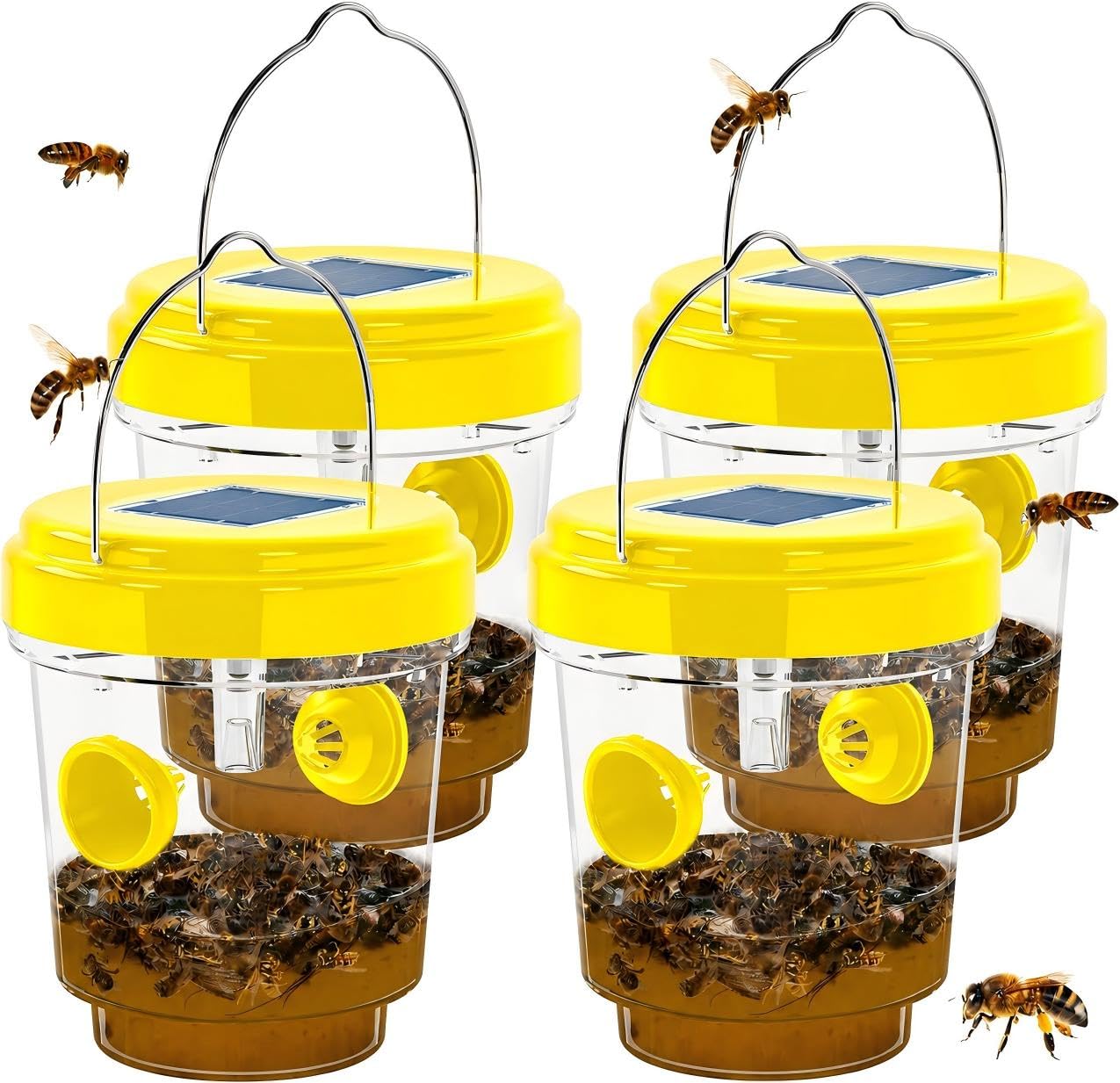
1. Wasp Traps Outdoor Hanging, Wasp Trap Solar Powered, 4 Packs
Our pick — 4.5★ from 150+ verified ratings; the strongest balance of quality and price.
Solar panels and UV light trap wasps day and night without bait refills.
This is the only pick in the lineup that runs on sunlight. During the day the solar panel charges the internal battery, and at night a blue UV light automatically glows to attract flying insects that skip a simple sugar-water trap. The result is round-the-clock coverage — daytime wasps go for the bait you add (sugar water or honey), and night-active hornets get drawn by the light. It is made from PP plastic and stainless steel, so rust is not an issue even after a wet season.
The trap has double-entry tunnels, one on each side, which give more access points than a single-hole design. It is also the tallest trap in the comparison at 8 inches high, giving it a noticeable presence in the garden. Buyers report that the bait mixture is the key — honey and a piece of fruit in the bottom works as “a magnet,” with one owner catching over 20 wasps and yellow jackets in the first 24 hours. Another noted catches of 15-plus wasps per day using water, honey, and small fruit pieces.
One real-world trade-off surfaces in the reviews: a bird once entered a trap and escaped unharmed, making some owners hesitant to reuse the same unit. That is a rare event, but worth knowing if you have bird feeders nearby. The build quality and dual-attraction system (bait + UV light) make this the most versatile trap for anyone who wants to cover both day and night shifts.
Day-and-Night Coverage
- Blue UV light attracts wasps after dark — bait-only traps cannot do this
- Stainless steel parts resist rust in outdoor weather
- Double-entry tunnels let more wasps in from both sides
The Real Catch
- Rare bird-entrance incident reported — may need a mesh guard if birds are common
- Bait liquid is not included; you supply sugar water or honey
Who it fits: The clear winner if you have wasps active at different hours and want a single tool that works around the clock without plugging into an outlet.
Think twice if: Your property is very bird-heavy and you cannot risk a bird flying into the entry tunnel — that is the one scenario where a solid bait-only trap is safer.
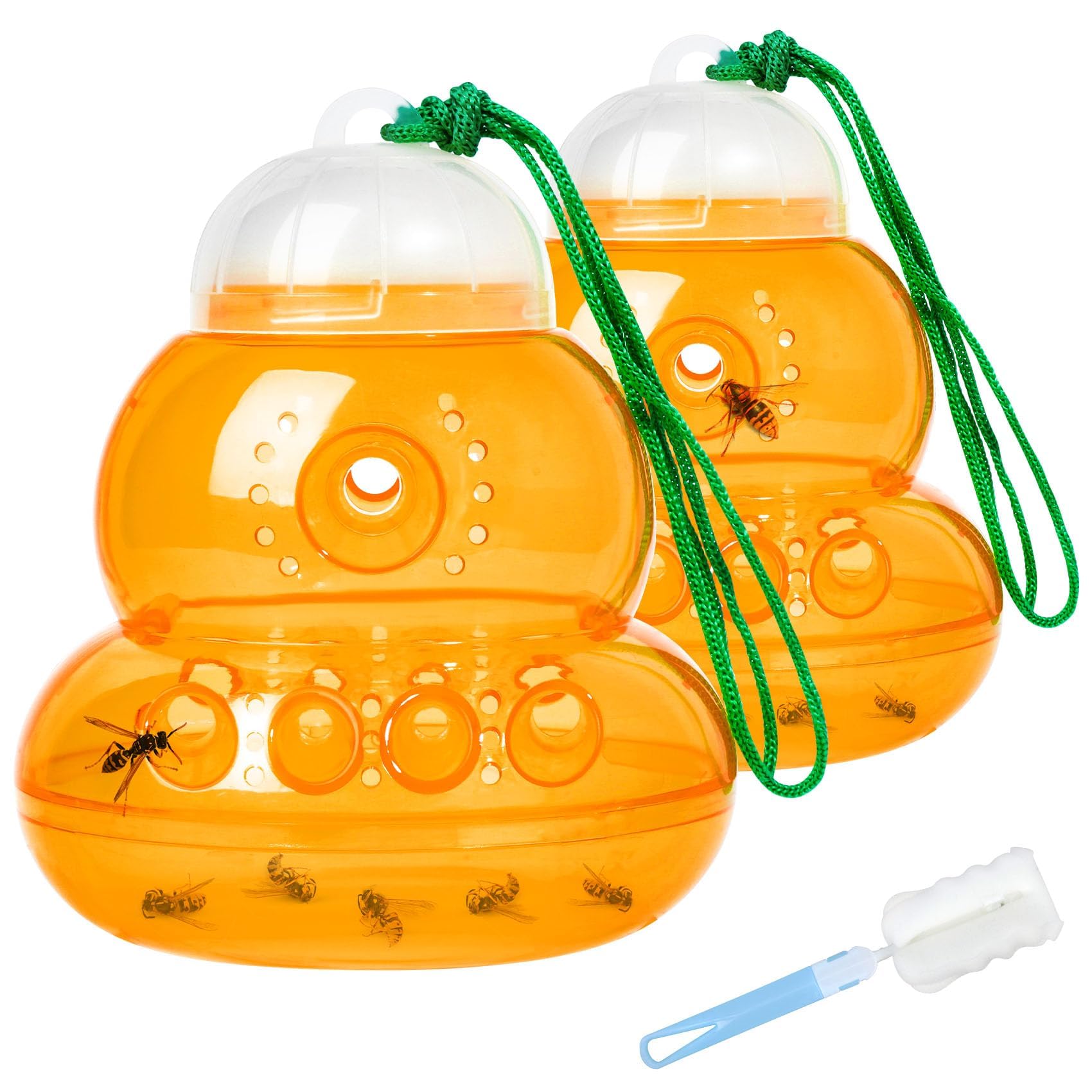
2. 2 Pack Reusable Wasp Traps Outdoor Hanging | Yellow Jacket Trap
A rugged reusable that targets five stinging species with one bait mix.
This orange-colored trap is built for the long haul — it is rated for carpenter bees, wasps, yellow jackets, Asian wasps, and even flies. The integrated bottom can be unscrewed for emptying, so you are not cutting open a bag every time. At 11.2 ounces it is the heaviest trap in this review, which gives it a solid feel when hanging, but that also means it is a bit more substantial on a branch or hook.
The real story here is bait flexibility. Because it is a reusable design, you can experiment with beer, fruit vinegar, honey, or orange juice until you find what works in your yard. One owner reported using honey and orange juice (instead of apple juice) and did not see a wasp near the shed for weeks afterward. The multiple tunnels let wasps enter from all directions, and the funnel shape stops them from finding the exit. The crowd-sourced consensus lands on effectiveness as the top trait — far and away the most-discussed feature across hundreds of reviews.
Durability gets a more mixed reaction; some owners notice the plastic could be thicker. Dropping one on a hard surface can crack it, so handle it during cleaning. But if you want a trap that stays in service all season and accepts nearly any bait you have in the kitchen, this is the most feature-complete reusable for the price.
Why Owners Stick With It
- Unscrew bottom makes emptying and cleaning straightforward
- Targets five insect species — one of the widest compatibility ranges on this list
- Honey-and-orange-juice bait worked for weeks without wasp activity, per real-world feedback
One Weak Point
- Plastic can crack if dropped on concrete; handle gently when washing
Best for: Anyone with a multi-species wasp problem (yellow jackets plus carpenter bees) who wants a no-chemical, reuse-all-summer solution with easy cleaning.
Not for: Those who need a trap that survives rough handling or falls — the hard plastic demands care.
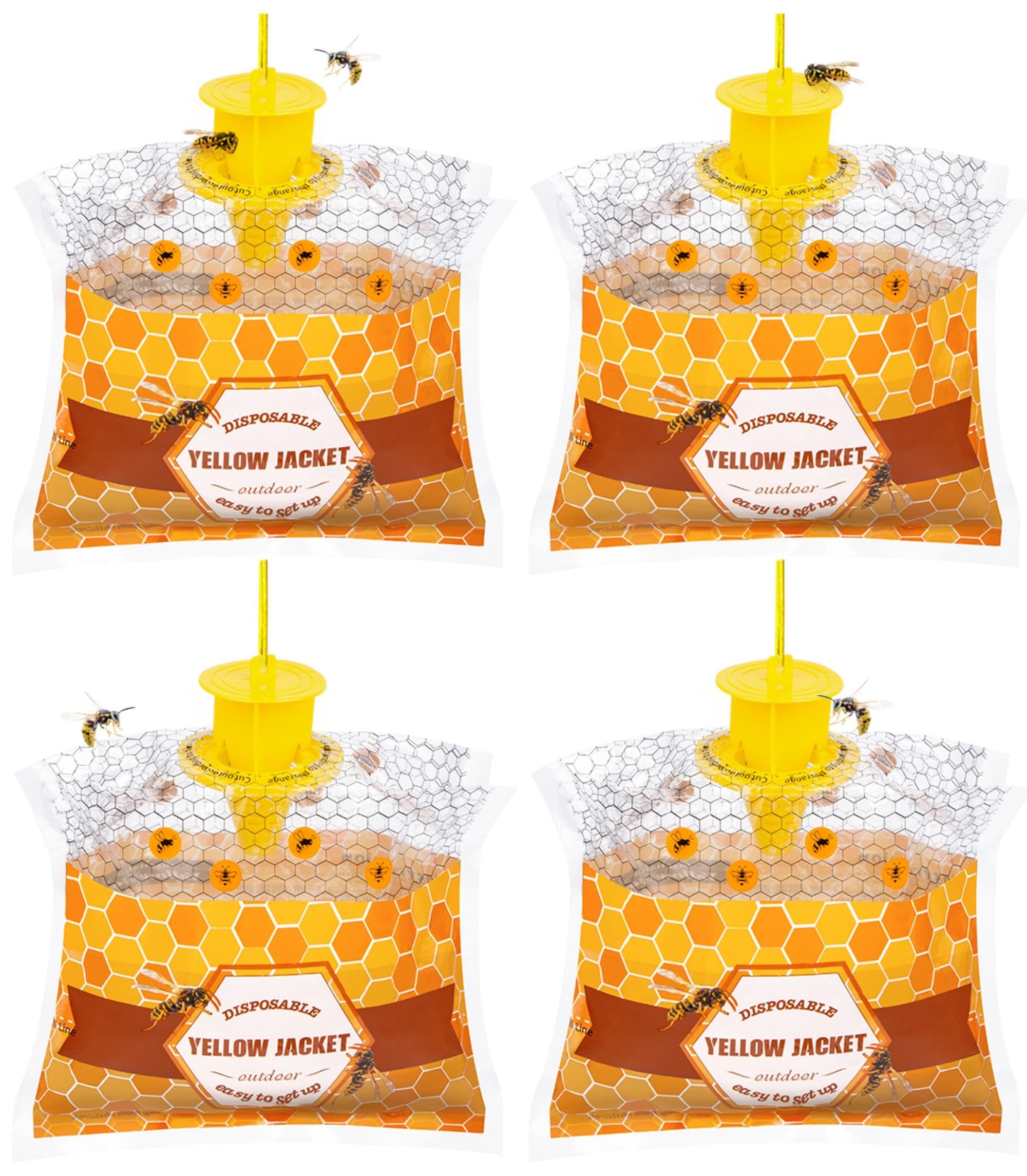
3. 4 Pack Disposable Wasp Traps Outdoor Hanging Bags
A disposable four-pack that cuts cleanup to zero and catches yellow jackets reliably.
If the idea of emptying a trap full of dead wasps makes you queasy, this bag-style disposable is your answer. Each bag measures 7.8 x 9.5 inches — the same size as the 6 and 8-pack versions from the same brand — and comes with ties for hanging. You cut the entrance, add bait (beer or fruit vinegar works best for yellow jackets), and when it is full you toss the whole bag. No scrubbing, no touching. The four-pack covers a medium-size yard or equestrian property without overwhelming you with spares you never use.
The color is yellow — a deliberate choice because wasps and yellow jackets are scientifically drawn to it. That is backed up by real buyers: the effectiveness earns the most mentions by a wide margin, and the adhesive surface (the inside of the bag) also gets strong praise for holding insects once they enter. The funnel at the top locks them in, so they cannot crawl back out. A few owners note that no bait is included, which is standard for this category — you always supply your own lure.
The trade-off is that these are not weatherproof forever. The bag material is plastic, and while it handles rain and wind for a season, a hard freeze can make it brittle. If you only need a few months of coverage and want zero mess, this is the most direct route.
The Clean Hands Approach
- Throw the whole bag away when full — no contact with insects
- Yellow color attracts wasps and yellow jackets naturally
- Four bags suit a medium yard; ties included for hanging
One Shortcoming
- No bait in the package — you must supply beer, fruit vinegar, or honey
Reach for this if: You want the lowest possible effort — cut, hang, bait, and discard when full. Ideal for seasonal use around a patio or garden.
Look elsewhere if: You need a trap that lasts through winter or you want to avoid creating plastic waste every season.
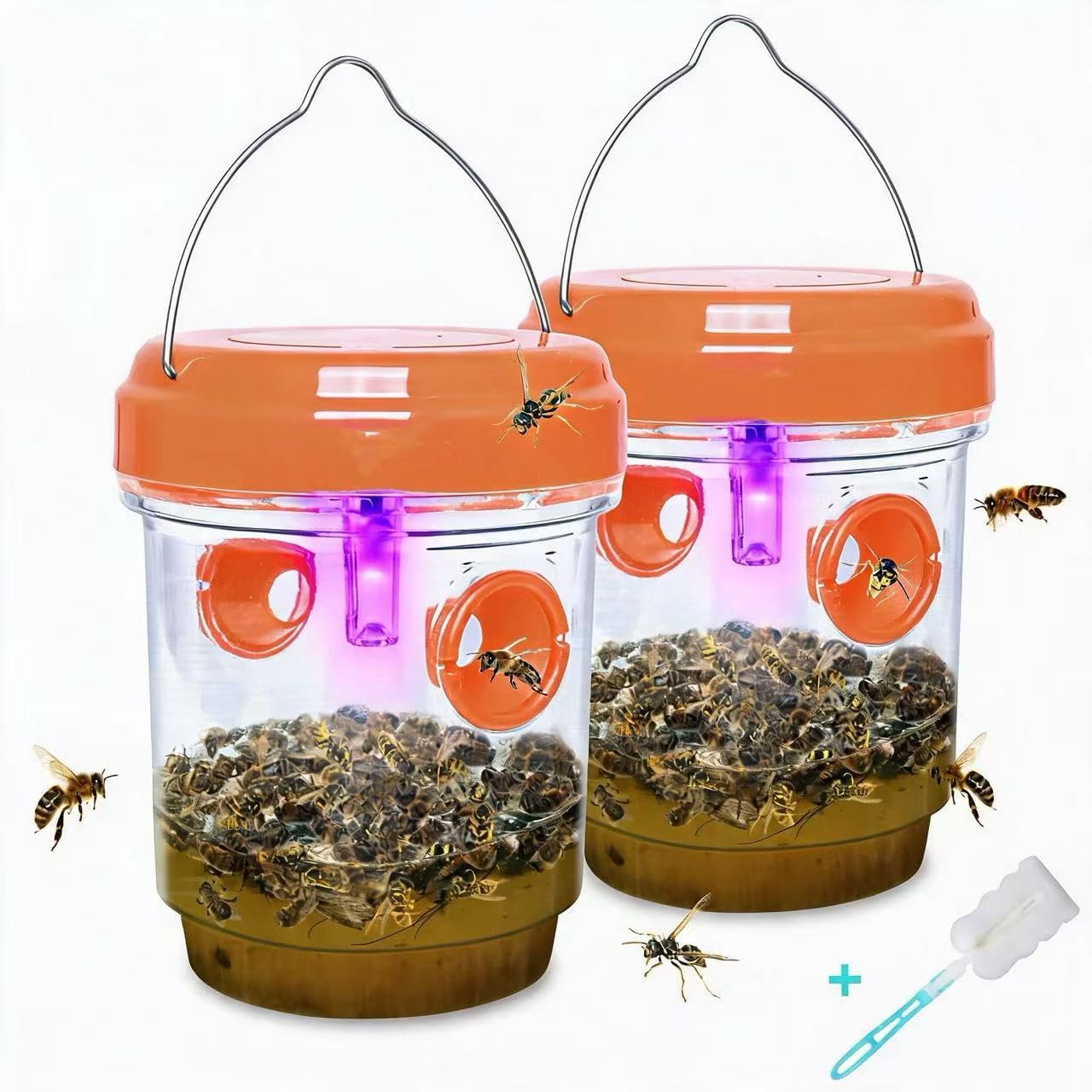
4. 2 Pack Solar Wasp Traps Outdoor Hanging, Reusable Bee Catcher
A compact solar trap that weighs just 4.16 ounces and fits tight spaces.
This is the smallest solar-powered option in the roundup — 3.94 inches on each side and only 4.16 ounces. That makes it easy to hang on a thin branch or a fence hook without weighing it down. Like the top pick, it uses a solar panel to charge during the day and then powers a blue UV light at night to attract flying insects. The material is ABS plastic (a tough engineering plastic) with stainless steel components, so it resists rust and heat better than standard polyethylene traps.
The dual entry tunnels use an outer opening that is larger than the inner opening, a design trick that makes it easier for wasps to enter but harder for them to navigate back out. Real owners mention strong daytime results — one filled the bottom a third full with honey and sugar water and caught over 20 wasps and yellow jackets within 24 hours. Another saw 15-plus wasps per day with water, honey, and small fruit pieces. The crowd conversation around effectiveness is split, however: some owners say it works fantastically, while a vocal minority report no catches at all.
The UV light also attracts non-stinging night fliers like moths, so if you are trying to target purely wasps and yellow jackets during daylight, a bait-only trap may give you a cleaner result. But for a tiny package that works without any wiring, this is a smart secondary trap for corners of the yard the bigger traps miss.
Small but Mighty
- Very lightweight at 4.16 oz — hangs from delicate branches easily
- Solar panel powers a UV light for nighttime catch
- ABS plastic and stainless steel handle weather well
Mixed Owner Results
- Effectiveness varies widely by bait and placement; some owners saw no catches at all
Best for: Small spaces or supplemental coverage — tuck it into a corner of the garden where a larger trap does not fit.
Not for: A primary defense in a heavy-infestation area; the mixed reports suggest it pairs better with a more proven trap.
5. 8 Pack Disposable Hanging Wasp & Yellow Jacket Traps Outdoor

The biggest disposable count — eight bags for full-yard saturation.
Eight traps in one purchase gives you enough to station traps around every likely entry point: the shed, the patio, the barn, the garden fence, the compost pile. At 7.8 x 9.5 inches each, you get the same form factor as the 4-pack and 6-pack but nearly double the volume. That is useful for a first-time user who wants to test multiple bait types simultaneously — fill four with beer and four with honey water, and see which side fills first.
The overall rating is slightly lower than the 4-pack (4.0 vs 4.2), and the owner feedback follows a similar pattern: the traps work well for many, but a vocal minority report zero catches. One owner said sparkling concord grape juice worked immediately — “it captured many wasps for a week” — while another used beer, sugar water, soda, and honey across different bags and saw no wasps after seven days. The crowd highlights effectiveness and ease of use as the top positive themes, while stickiness and value for money get mixed reviews. The convenience of not cleaning is the consistent bright spot: when they are full, you toss them.
If you are managing a large property and do not mind that some bags may underperform depending on bait, the eight-pack gives you the raw count to compensate. Just keep the receipt and test one or two before deploying all eight.
Maximum Quantity
- Eight traps let you saturate every corner of a large yard or farm
- No-cleaning disposal — the whole bag goes in the trash
- Ties included for quick hanging on branches or fences
Hit-or-Miss Performance
- Some owners see no wasps after a week — bait choice is critical and not guaranteed
Best for: Property owners who want maximum coverage per purchase and are happy to test different baits across multiple traps.
Not for: A single-trap solution — with 4.0 stars and mixed effectiveness, you are buying volume to compensate for variability.
Understanding the Specs
Solar Power vs Manual — Which Do You Need?
Solar-powered traps come with a small photovoltaic panel that charges a battery during daylight hours. At night, that battery powers a blue UV light that attracts nocturnal wasps and hornets. Manual traps rely entirely on bait — you add beer, honey, or fruit juice and the smell does the work. If your wasp problem is purely daytime (yellow jackets at lunch), manual bait traps cost less and work fine. If you see hornets at dusk or want 24-hour coverage, solar is worth the bump in price.
Disposable vs Reusable — The Sanity Trade-Off
A disposable bag trap is a single-use plastic bag with a built-in funnel. You bait it, hang it, and when it is full you throw the entire bag in the trash — no touching spent bait or dead insects. A reusable trap has a hard plastic body with a screw-off or snap-off bottom. You empty the contents, rinse it, and reuse it for years. The upfront cost is higher but the per-season cost is lower. The deciding factor is whether you can stomach cleaning out a trap full of dead wasps.
Bait Type — Protein vs Sweet
Yellow jackets are scavengers — they go for protein baits like meat, fish, and beer. Wasps and hornets prefer sweet baits like honey, sugar water, and fruit juice. Some traps work with both, but many are tune for one type. If you do not know what species you have, start with a sweet bait (grape juice or honey water catches the broadest range) and switch to beer or meat if the trap stays empty. No trap comes with bait; you always supply it.
Count and Coverage Area
Count refers to how many traps come in the package, not the number of insects it catches. A 4-pack covers a medium suburban yard (roughly a quarter-acre). A 6-pack or 8-pack suits larger rural properties, farms, and barns. Spacing them 15–20 feet apart gives you the best coverage because wasps patrol overlapping territories. Putting all the traps in one spot wastes their potential.
FAQ
What is the best bait for a hanging wasp trap?
Will a hanging wasp trap attract honeybees?
How often should I empty a reusable wasp trap?
Can I use a hanging wasp trap indoors?
How long does a disposable bag trap last before it needs replacing?
Do solar wasp traps work in cloudy or rainy weather?
What is the difference between a hanging wasp trap and a ground spike trap?
Can a wasp trap catch birds or other non-target animals?
Is it safe to hang a wasp trap near a vegetable garden?
How high should I hang a wasp trap for best results?
Final Thoughts: The Verdict
If you want one dependable pick, the hanging wasp trap winner is the Wasp Traps Solar Powered 4 Pack because its dual bait-and-UV-light system covers day and night without needing an electrical outlet. If you want a heavy-duty reusable that handles five different stinging species with easy cleaning, grab the 2 Pack Reusable Wasp Traps. And for the lowest-mess, zero-cleanup approach to seasonal wasp control, the 4 Pack Disposable Wasp Traps is the one to reach for.
How We Picked
We do not accept paid placement. Every pick is matched to a real buyer and a real use-case; we do not hands-on test units.
Sources & Methodology
Specifications: manufacturer listings and product documentation. Review insights: verified customer reviews, as of July 2026. Pricing: not shown on this page (it changes often); check the current price via the retailer link.
As an Amazon Associate, Lawn Gear Lab earns from qualifying purchases. This does not affect which products we feature.