
Specs are compiled from manufacturer listings and verified buyer reviews and can change over time — please confirm the key details on the product page before buying.
You want a pot big enough for a mature Monstera or a tomato plant, but thin plastic that cracks in the sun is the real headache. A pot’s longevity depends on wall thickness, sidewall rigidity, and drainage design. This guide compares nine sets of large plastic grow pots — from decorative self-watering planters to workhorse nursery buckets — using the real specs owners actually rely on.
I’m Rikta — the founder and writer behind Lawn Gear Lab. This guide is built by comparing the manufacturers’ published specifications and the patterns across verified customer reviews, so you get each pick’s real strengths and trade-offs instead of marketing spin.
if you need a pot with a reservoir for vacation watering or a simple 12-inch planter with a saucer that doesn’t crack in winter, the right large plastic grow pots save you time, money, and wilted plants.
Our Picks at a Glance
How To Choose The Best Large Plastic Grow Pots
Large plastic pots are a lot more varied than they look. The material, the wall thickness, the drainage setup, and even the shape of the rim all affect how long the pot lasts and how happy your plant stays. Here are the three factors that matter most.
Wall Thickness & Material Grade
Plastic wall thickness is the top predictor of a pot cracking after a season outdoors. Pots made from recycled PP (polypropylene) with a sidewall of 6 mm or more feel rigid and hold their shape when you lift a fully-soaked plant. Thinner nursery-grade plastic is flexible and stackable, but it can deform under heavy soil and is more likely to split if bumped in cold weather.
Drainage: Holes, Trays, and Reservoirs
Drainage design separates healthy roots from root rot, the most common killer of potted plants. Basic pots have a few holes at the bottom, while better designs use a raised bottom with side drainage slots or a “multi-mesh” pattern that keeps the root zone from sitting in a puddle. Self-watering pots use a reservoir below the soil that feeds water upward through a wick — great for consistency, but poor for plants that prefer dry soil between waterings.
Volume vs. Top Diameter
A 12-inch top diameter sounds large, but a pot that is 12 inches wide and only 7 inches tall holds significantly less soil than one that is 12 inches wide and 10 inches tall. Shallow pots are fine for succulents and annuals with small root balls. Deep-rooted plants like tomatoes, peppers, and houseplants such as fiddle-leaf figs need the extra depth to prevent the roots from coiling at the bottom.
Quick Comparison
| Model | Best For | Top Diameter | Volume | Weight | Amazon |
|---|---|---|---|---|---|
| WSMKSZ 12 in (Blue Green)★ Best Overall | Decorative display with porcelain look | 12 in | 2.6 gal | 0.68 kg | Amazon |
| Meowell 12 in (Black)Top Performer | Weather-resistant outdoor planter | 12 in | 2.6 gal | 0.75 kg | Amazon |
| WSMKSZ Self-Watering (Black)Best Self-Watering | Vacation-proof indoor watering | 12 in | — | 0.86 kg | Amazon |
| montresor 12 in (Black) | Beginner-friendly wick system | 12 in | — | — | Amazon |
| Quarut Diamond Pattern 4-Pack (Grey) | Matching multiple plants on a budget | 12 in | 2.6 gal | 1.05 kg | Amazon |
| Cotta Planters 1.5 gal 10-Pack (Green) | Seedling propagation and up-potting | 7.5 in | 1.5 gal | 1.33 kg | Amazon |
| NNARRE 4-Pack 13 in (Dark Gray) | Shallow pots for surface-rooting plants | 13 in | 2.6 gal | 1.61 kg | Amazon |
| Huvai 5 gal 12-Pack (Black) | Large-scale vegetable and tree growing | 12.8 in | 5 gal | — | Amazon |
| RAOOKIF 7 gal 10-Pack (Black) | Flexible large containers for season use | 12.8 in | 7 gal | 2.0 lb | Amazon |
In‑Depth Reviews
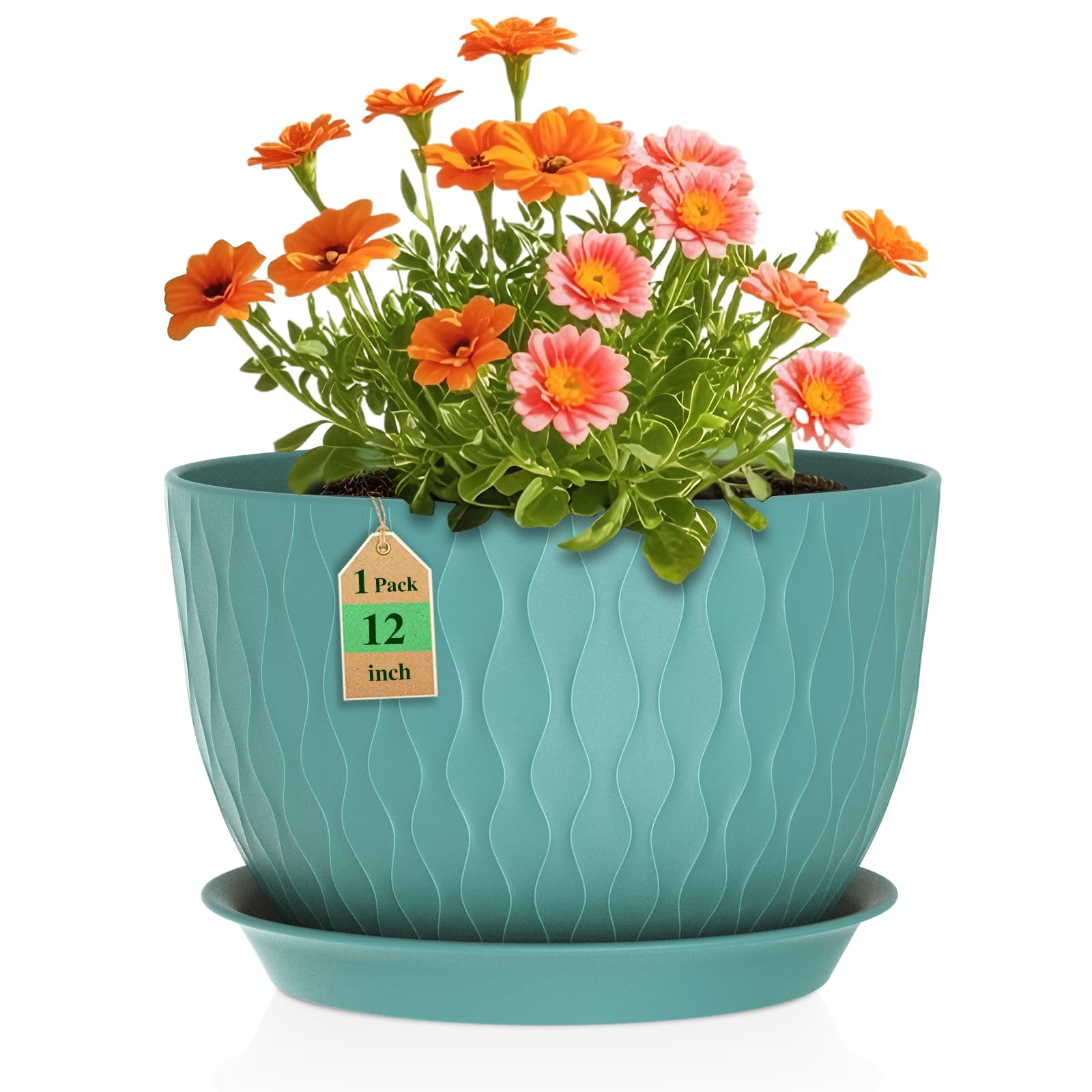
1. WSMKSZ 12 Inch Large Plant Pots (Blue Green)
Our pick — over 4.5★ from 650+ verified ratings; the strongest balance of quality and price.
The best-balanced pot for anyone who wants a 6 mm wall that won’t buckle.
You get plenty of room for a large pothos or a grouping of stems — the 12-inch diameter and 7.6-inch height mean a 2.6-gallon capacity that handles medium to large plant sizes well. The PP (polypropylene) material uses a 6 mm sidewall, which is notably thicker than standard nursery plastic, so the pot resists squeezing or deforming when you move it full of wet soil. Buyers report that the “good thickness” and “nice drainage holes” make it feel sturdy, and the color options — especially the speckled white — give it a matte, porcelain-like look that fits both living room and patio decor.
The thing owners praise most is the overall quality, and the water-ripple texture hides scratches better than a smooth gloss finish. The saucer included catches overflow neatly, and the fact that the plastic is recyclable adds a practical touch. Compared to the Meowell pick below, this one weighs 0.68 kg versus the Meowell’s 0.75 kg while offering the same 12-inch diameter, making it slightly easier to lift.
The only consistent note is that the “muted mint green slightly bluer than pictured” — check the product images closely if color accuracy matters to you. The gray variant, however, gets called “almost like porcelain” by owners who wanted a heavier look without the weight.
Top-Tier Value: Thicker plastic and a matte finish that looks far more expensive than it is, backed by quality that over 60 owners call out specifically.
One Real Trade-off: The blue-green shade runs a touch bluer in person — order the gray or white if exact color matching is critical.
Reach for this if: You want a decorative pot that can live indoors year-round or on a covered patio without degrading.
Better choices exist if: You need a self-watering reservoir — the solid bottom with drainage holes and tray is manual watering only.
2. Meowell 12 inch Large Plant Pots (Black)
The outdoor pot that blends a stone look with serious weather resistance.
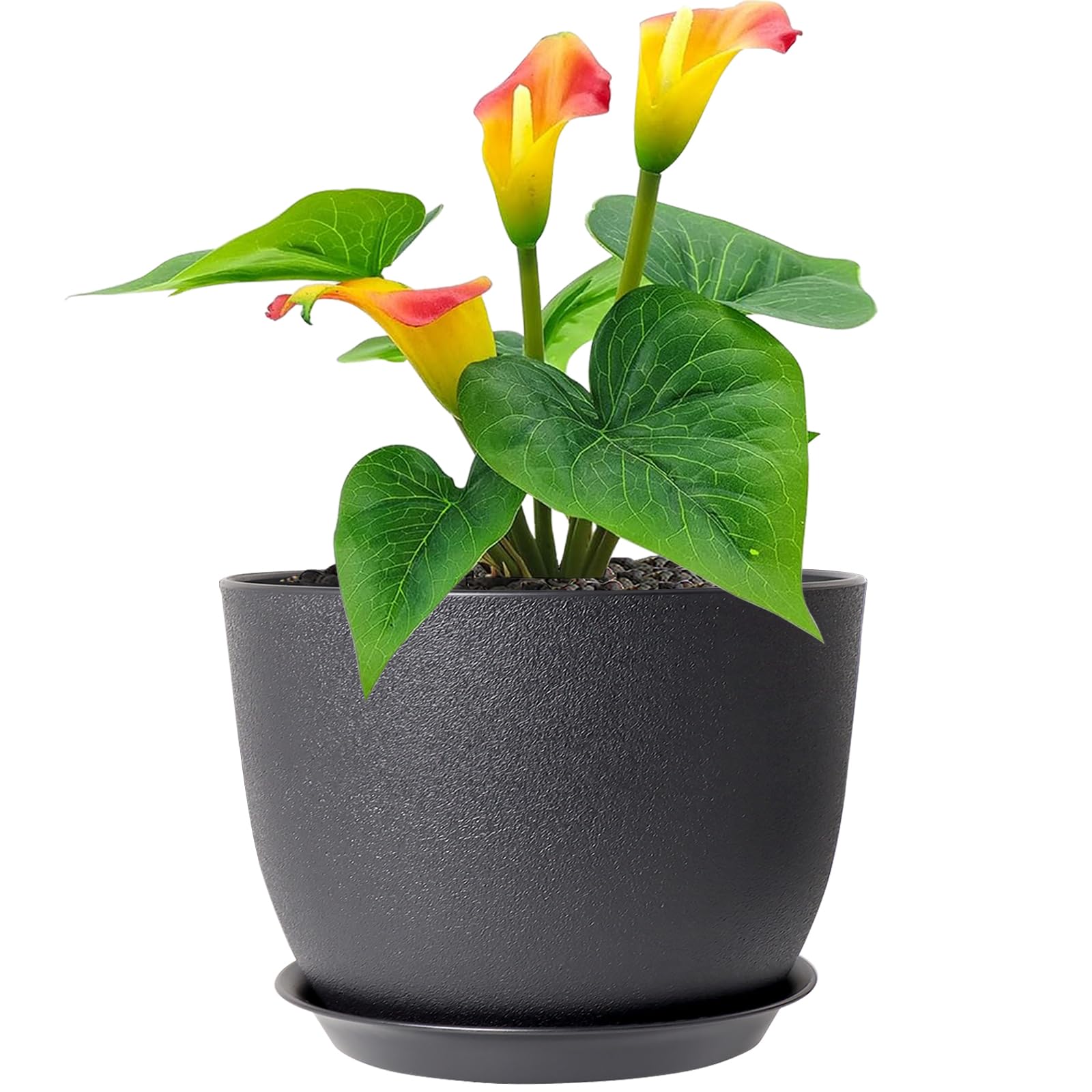
The Meowell planter trades the glossy look for a matte finish with a textured, stone-like surface that owners mention makes it “look uptown” even when kept in a living room. The 12-inch diameter and 8-inch height (slightly taller than the WSMKSZ pick at 7.6 inches) give the black variant a slightly deeper soil column for plants that need a bit more root depth. The premium plastic is built to “endure time and weather even placed outdoor” without getting brittle in the sun — owners confirm it holds up well after six months exposed outdoors.
What stands out here is the drainage system: well-positioned holes at the bottom keep water flowing, and the included saucer catches the overflow. The 0.75 kg weight (0.07 kg heavier than the WSMKSZ) still feels light enough to move one-handed. Customers note that the speckled color options help hide dust and soil splashes between cleanings.
The self-watering feature on the bottom base is noted as optional — some plants, like money trees, do not like wicking moisture from below, and one owner simply skips using that feature. That flexibility is a real plus: you get a reservoir if you want it, but can treat it as a standard pot if you do not.
Best for Outdoor Use: The UV-stable plastic and matte texture weather better than glossy finishes — reviewers point out it looks “like new after 6 months.”
One Real Trade-off: The textured surface is harder to wipe clean than a smooth gloss pot if mineral deposits build up from hard water.
Grab this for: Sunny patios, porches, or entryways where the pot needs to look good year-round and survive rain and heat.
skip it if: You want a pure self-watering system — the wicking tray is optional, not the primary design.
3. WSMKSZ 12 inch Large Self Watering Pots (Black)
A deep reservoir keeps plants hydrated for up to two weeks of neglect.
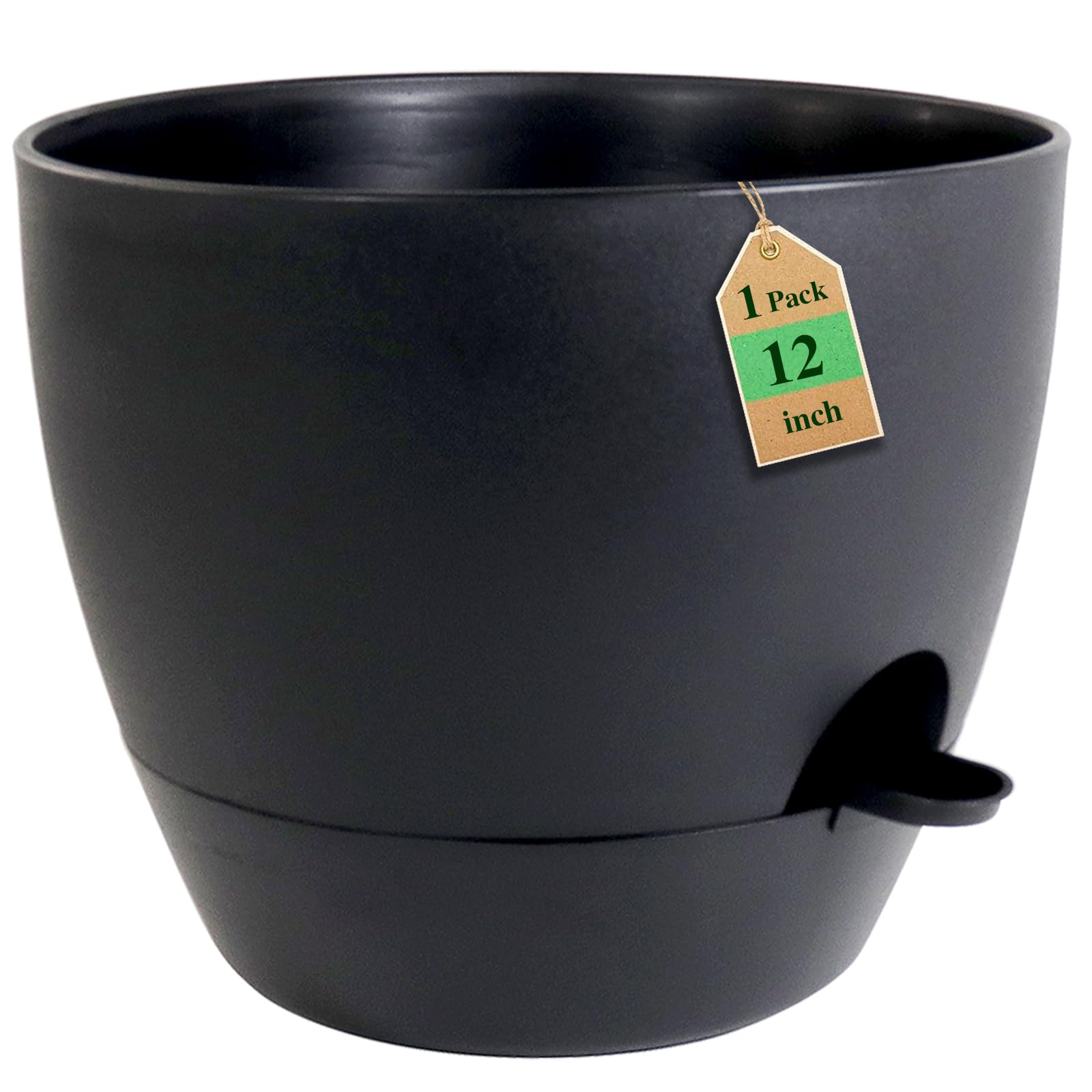
This self-watering design uses a removable reservoir at the bottom and a cotton rope wick that pulls moisture upward as the soil dries. The 12-inch diameter and 10-inch height (noticeably taller than the standard WSMKSZ pot at 7.6 inches) means the root zone has more vertical space, and the reservoir itself holds 10 cups of water. Shoppers say that the “lock-on design prevents spills” when you carry it, and the clear water-level window makes it obvious when a refill is needed.
The PP plastic body is 0.86 kg — the heaviest of the 12-inch decorative pots in this list — but that extra weight comes from the reservoir structure and the thicker walls needed to support it. The self-watering mechanism suits busy plant parents: the consensus is that it prevents both overwatering and underwatering, which is especially useful for forgetful gardeners or weekend trips.
The matte white finish is described as “bright white” and “clean” by buyers who pair it with trailing pothos. A small but consistent note: the watering lip (the little spout used to fill the reservoir) could be more secure — a few owners find it loose. If you plan to move the pot while the reservoir is full, handle it by the main body, not the spout.
What Owners Love
- Reservoir holds 10+ cups for 1–2 weeks of hands-off watering
- Lock-on wick design prevents leaks and spills when moving
- Minimalist white matte finish blends with most decor
The Fine Print
- Watering spout is not as securely attached as the rest of the pot
- Polished finish may scuff easier than the matte decorative version
Ideal for: Frequent travelers, office plants, or any situation where daily watering is impossible.
Not for: Succulents or cacti that need dry soil between waterings — the wick maintains consistent moisture.
4. montresor Self Watering Pots 12 Inch (Black)
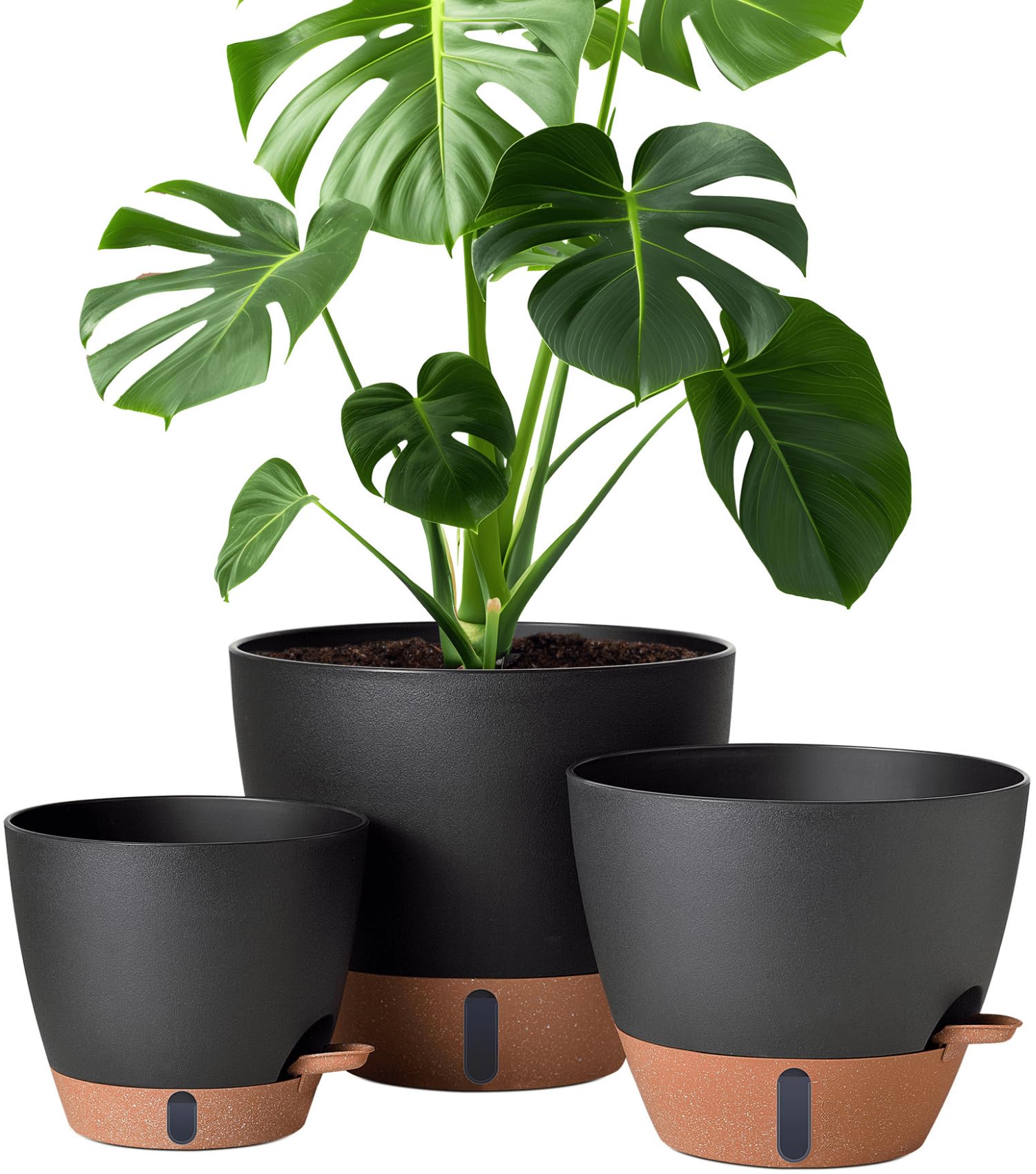
A transparent water window takes the guesswork out of watering entirely.
This montresor design uses cotton wicks that auto-feed moisture from a detachable reservoir, and the clear water-level window lets you see exactly how much water is left without lifting the pot or poking fingers into the soil. The PP (polypropylene) plastic is described as “thin but durable” — the trade-off is a lighter pot that is easier to move, but one that flexes slightly when full. Owners note the “soil is always moist” with this system, and that assembly is simple enough for a beginner.
The 12-inch size is part of a triple-size set (8, 10, and 12 inches), so you can match pot size to plant size across a collection. The multi-vent drainage holes and detachable locking tray prevent the soil from sitting in standing water, while the spill-proof design protects floors and surfaces. Buyers who were skeptical of the wick design report that even a ZZ plant — known for being drought-tolerant — is thriving in this system.
The “bottoms are bit tricky to get together” is a minor assembly friction point that a few owners flag. The plastic is not the thickest in this list, so handle it with care when moving it full of heavy soil.
Best for Plant Newbies: The visible water gauge prevents the two biggest mistakes — under and overwatering — without needing any experience.
One Real Trade-off: The plastic is thinner than the WSMKSZ self-watering pot, so it flexes more when full; not ideal for frequent repositioning.
Perfect for: First-time plant owners, dorms, or offices where a no-fuss watering system is the priority.
Think twice if: You need a single very large pot — the 12-inch is the max size available in this set.
5. Quarut 12 Inch Pots for Plants 4-Pack (Grey)
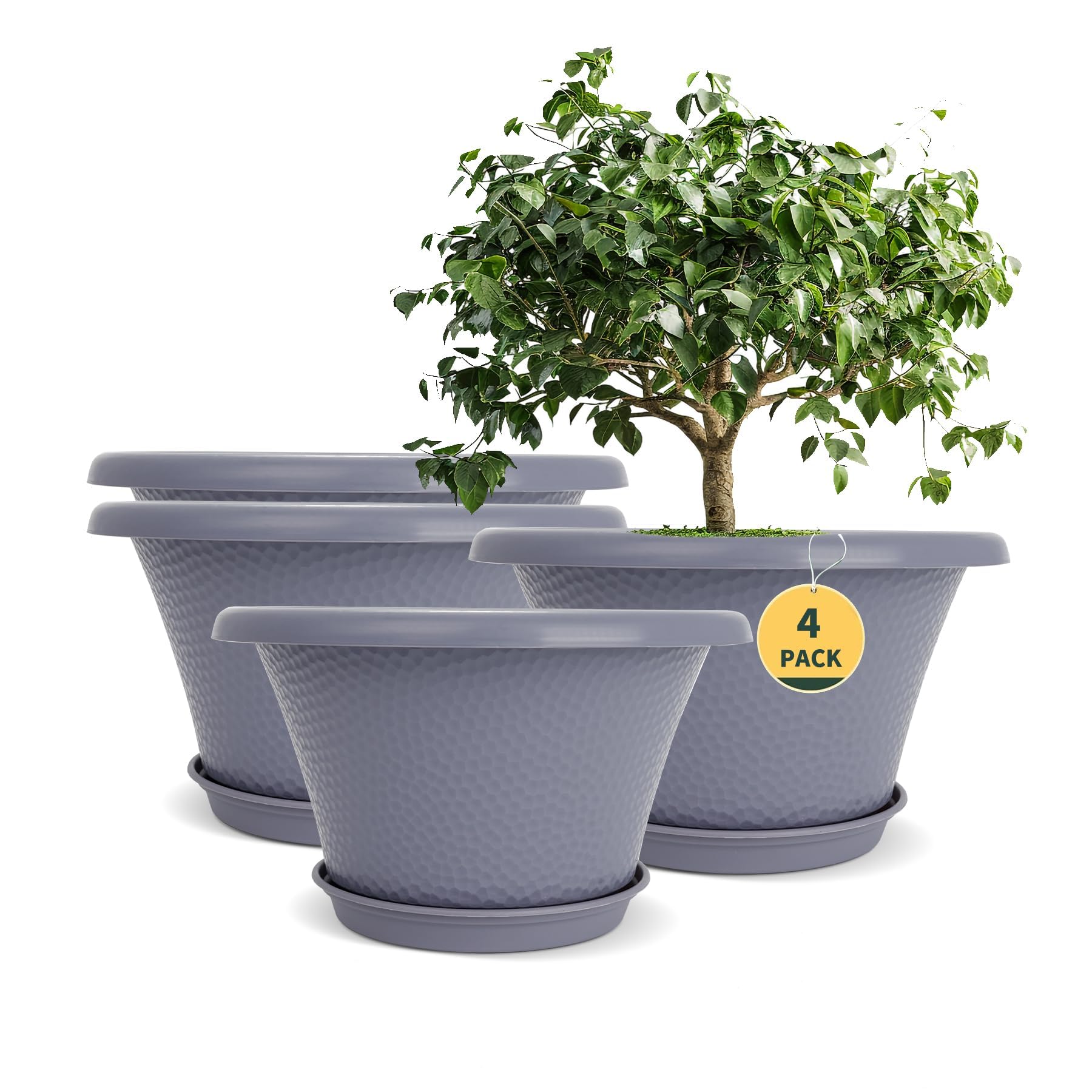
Four 2.6-gallon pots with a diamond pattern that mimics resin for the price of plastic.
The Quarut set delivers four 12-inch pots and four saucers in one box, each holding 2.6 gallons of soil — enough for medium to large houseplants like majesty palm, aloe, or peace lily. The diamond-pattern finish and the black antique stain give the grey plastic a resin-like appearance that owners call “beautiful” and “sturdy and nice to look at.” The polyethylene construction is UV and weather resistant, which means the pots can sit on a deck or balcony without fading after a few months of sun exposure.
Each pot has four drainage holes at the bottom to prevent waterlogged soil, and the rolled rim makes it easier to grip when you lift or drag the pot. At 1.05 kg (about 2.3 lb) per pot, these are heavier than the single-piece WSMKSZ or Meowell pots, but that weight comes from the denser resin-blend material. Buyers who repotted aloe and monstera plants report that the plants adapted well and are thriving.
The honest caveat: a few owners are waiting to see how the material holds up over multiple seasons — “the jury is still out about their durability,” as one buyer put it. The price per pot is lower than buying individual decorative pots, but the long-term UV resistance is less proven than the premium-grade plastic used in the picks above.
Great for: Planting a matching set of four large houseplants or creating a uniform look on a patio without spending on ceramic.
One Real Trade-off: The resin-blend material is heavier than standard nursery pots, so moving them full of soil requires more effort.
Best if: You need multiple matching large pots at a reasonable per-unit cost and prefer a non-plastic look.
Look elsewhere if: Long-term outdoor durability is your primary concern — the premium single pots above use more proven plastics.
6. Cotta Planters 1.5 Gallon Nursery Pots 10-Pack (Green)

A 10-pack of tough nursery pots built to survive the propagation cycle.
These 1.5-gallon pots are made from heavy-duty BPA-free recycled plastic that owners describe as “thick” and “heavier than typical nursery pots.” The 8-inch tall, 7.5-inch top diameter design uses a unique raised bottom with drainage holes on both the sides and the bottom, which prevents the pot from creating a water seal on a flat surface — a common issue with standard nursery pots. Buyers use them for tomato and tomatillo seedlings, reporting that they are “sturdier than solo cups” and that the strength allows for multiple seasons of washing and reusing.
The rolled edge makes carrying and stacking easier, and the tapered shape allows the pots to nest neatly when empty. At 1.33 kg for the 10-pack, each pot is roughly 0.13 kg — very lightweight for the capacity. The value-to-durability ratio is the strong point here: you get a full set of work pots that handle more abuse than the single-use black nursery bags you find at garden centers.
Quality control is the consistent note: some units arrive with small chips or cracks (buyers report 2 of 10 or 3 of 10 pots showing damage), and roughly half of the drainage holes may be partially blocked by a plastic film that needs a quick knife-slice to open. If you are using them strictly as pot liners inside decorative planters, these chips do not matter at all.
Best for: Seed starting, up-potting seedlings, or lining decorative cachepots — the raised bottom and superior drainage prevent root rot.
One Real Trade-off: Incoming QC is inconsistent — about a quarter of owners mention chipped pots on arrival, so inspect the whole box immediately.
Reach for these if: You want a reusable propagation pot that survives multiple seasons of washing and handling.
Skip if: You need a decorative pot for permanent display — these are functional nursery greens, not living-room decor.
7. NNARRE Large Flower Pots 4-Pack 13 Inch (Dark Gray)

The widest standard pot in this line-up at 13 inches — but only 6.3 inches tall.
This set of four delivers a top diameter of 13 inches (the largest in this guide), making it ideal for plants that spread horizontally rather than deep down. Each pot holds 2.6 gallons despite the shallow 6.3-inch height, and the rolled rim helps you grip and lift the pot without the edge digging into your hands. The polyethylene material is recreational-grade: odorless, heat and cold resistant, and light enough at 1.61 kg (3.5 lb) for the 4-pack that each individual pot is roughly 0.4 kg (about 0.88 lb) — easy to move even with soil.
Customers note using them for amaryllis bulbs (planting three per pot), strawberry plants, and mini-herb gardens. The dark gray color is described as neutral and presentable, not like shiny plastic. The multiple drainage holes at the bottom keep the soil from staying soggy, and the included saucers catch excess water.
The recurring note here is the saucer size: the tray is barely larger than the pot’s bottom, so it does not provide much room for water overflow during heavy watering. If you tend to water generously, the saucer will fill up fast and may spill onto the surrounding surface. Also, several owners wish the planter were deeper — at 6.3 inches, it is too shallow for deep-rooted plants like tomatoes or large fiddle-leaf figs.
Best for: Amaryllis, strawberries, succulents, or any plant that spreads roots horizontally over a wide area.
One Real Trade-off: The saucers are small for the pot size — plan to water moderately or place the pots on a tray if you tend to overwater.
Ideal for: Creating a low-profile, wide planting bed on a tabletop or patio shelf without deep pots overwhelming the space.
Not for: Deep-rooted houseplants like fiddle-leaf fig, tomatoes, or snake plants that need vertical root depth.
8. Huvai 5 Gallon Nursery Pots 12-Pack (Black)

Twelve 5-gallon buckets with bonus plant tags — the quantity buy for serious vegetable growing.
This 12-pack of 5-gallon nursery pots is the highest-volume set in the guide, designed for up-potting small trees, growing tomatoes, or starting a large vegetable garden. The 12.8-inch top diameter and 8.9-inch height give each pot a 5-gallon label (the manufacturer notes that compacted soil will fit at 5 gallons, while actual liquid volume is 3.4 gallons — so expect a true soil capacity closer to 4 gallons). The soft, thick plastic is described as “flexible but not easily broken” and rebounding after being compressed, making the pots reusable across multiple seasons.
The 20 small drain holes at the bottom allow good airflow and drainage, and the raised rim makes it easy to stack empties for storage. The bundle also includes 20 waterproof T-Type plant tags and a 2-piece transplanting mini-tool set — practical extras that save a separate purchase if you are labeling a big garden. Owners who grow tomatoes report the “durability is very good” and that the pots are “everything you need to grow your tomatoes.”
The honest assessment: this is a nursery-grade product with thin, flexible walls — the same material that makes them stackable also means they collapse under their own weight when empty. A few owners note the plastic is “extremely flimsy and thin” and that the sides collapse if you pick them up from the rim with one hand. Fill them with soil and they hold their shape fine, but do not expect rigid walls like a decorative planter.
Why Gardeners Choose These
- 12 pots at a proven 5-gallon capacity for large-scale planting
- Soft plastic bounces back after compression — no permanent creasing
- Bonus T-type tags and transplanting tools included
What to Expect
- Thin, flexible walls collapse when empty — they are designed to be filled
- Not a rigid decorative pot — best for yard/greenhouse use
Perfect for: Starting a tomato patch, up-potting young fruit trees, or running a large home nursery with labeling needs.
Think twice if: You need a single decorative pot or planter with rigid walls that can stand upright empty.
9. RAOOKIF 7 Gallon Nursery Pots 10-Pack (Black)
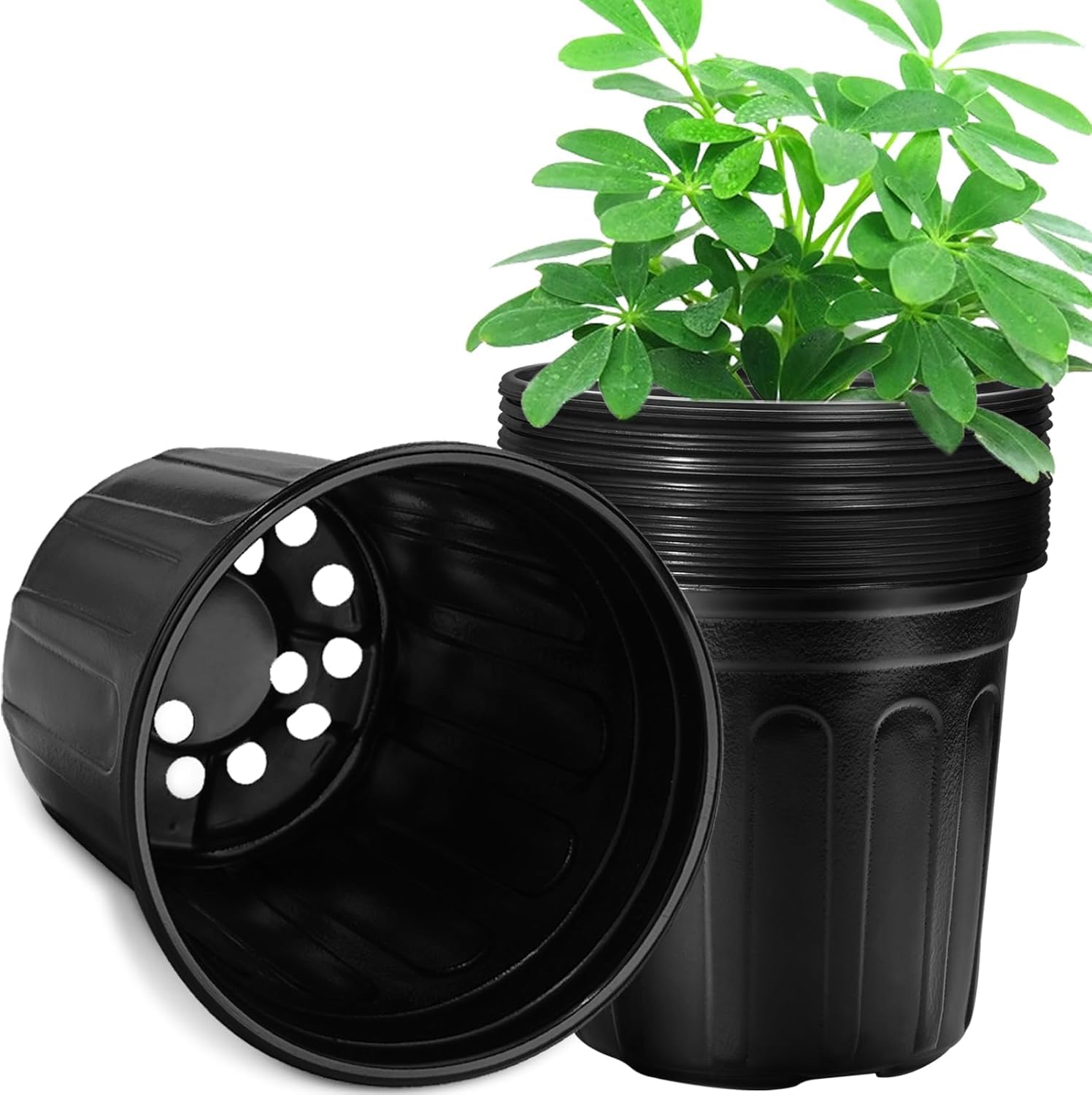
The biggest nominal capacity in this list — but seasoned gardeners question the volume.
These RAOOKIF pots claim a 7-gallon capacity with a 12.8-inch opening and 9-inch height, making them the tallest-of-the-tall nursery pot in this guide. The plastic is deliberately light and flexible — the 10-pack weighs only 2 pounds (roughly 0.09 kg per pot) — which makes them easy to ship and stack, and the material is designed to be reused for “2-3 seasons” according to the owner consensus. The drain holes at the bottom are adequate for ventilation and preventing soggy soil.
Buyers who grow hot peppers and marigolds report that the material is “durable yet flexible” and that the pots have held up across several growing seasons. The flexibility is a double-edged sword: the pots do not crack when you bump them, but they will deform if you try to lift them by the rim when full. The value-for-money angle is the main draw — the per-pot cost is lower than any other large-volume pot in this guide.
The most-discussed aspect here is the size claim: multiple experienced gardeners note that the “7 gallon” label is misleading. One owner measured the volume and estimated the true capacity is closer to 4 or 5 gallons, calling the pots “more squat and wide” than the listing photos show. If you need an exact 7-gallon capacity for a specific recipe (soil calculations, fertilizer dosing), these pots will under-deliver. Treat them as 5-gallon pots for practical purposes and you will not be disappointed.
Best for: Budget-conscious gardeners who need a large number of flexible containers for seasonal seedlings and annual vegetables.
One Real Trade-off: The volume is off by roughly 2 gallons — treat these as 5-gallon pots rather than 7-gallon for soil planning.
Great if: You want cheap, large, and replaceable pots that you can toss after 2-3 growing seasons without feeling it.
Not if: You need an accurate 7-gallon volume for precise soil mixes or you want a rigid, decorative pot for a living space.
Understanding the Specs
Wall Thickness and Material
Thicker plastic resists cracking when lifting a full pot or bumping it against a railing. Pots made from PP (polypropylene) with a 6 mm sidewall — like the WSMKSZ decorative line — are noticeably sturdier than standard nursery pots that can flex and crease. Recycled plastics are fine for containers that stay put, but they may be more brittle in freezing temperatures than virgin polypropylene.
Drainage Holes and Root Health
Multiple drainage holes around the bottom edge outperform a single center hole. A raised bottom design — where the pot sits on small feet — allows water to drain freely even when the pot rests on a flat surface or tray. This prevents the root zone from sitting in a waterlogged puddle, which is the fastest way to suffocate the roots of most houseplants.
FAQ
Can I leave large plastic grow pots outside in winter?
What is the difference between a self-watering pot and a regular pot with a saucer?
How do I know if a pot is large enough for my plant?
Are plastic pots safe for vegetables?
Is a 1.5-gallon pot considered “large”?
Can I drill extra drainage holes in a plastic pot?
How long should a large plastic pot last outdoors?
Do all the pots in this guide come with a tray or saucer?
What is the difference between a “planter” and a “nursery pot”?
Why do some 12-inch pots have different gallon capacities?
Final Thoughts: The Verdict
For most people, the large plastic grow pots winner is the WSMKSZ 12 Inch Pot because it combines the thickest sidewall (6 mm), a matte porcelain-like finish, and a reliable drainage-and-saucer system in one balanced package. If you want self-watering convenience for travel or office plants, grab the WSMKSZ Self-Watering Pot with its deep reservoir. And for bulk vegetable growing that demands maximum capacity per dollar, the Huvai 5-Gallon 12-Pack is the one to reach for.
How We Picked
We do not accept paid placement. Every pick is matched to a real buyer and a real use-case; we do not hands-on test units.
Sources & Methodology
Specifications: manufacturer listings and product documentation. Review insights: verified customer reviews, as of July 2026. Pricing: not shown on this page (it changes often); check the current price via the retailer link.
As an Amazon Associate, Lawn Gear Lab earns from qualifying purchases. This does not affect which products we feature.