
Specs are compiled from manufacturer listings and verified buyer reviews and can change over time — please confirm the key details on the product page before buying.
If your greenhouse feels like a wind tunnel every time the temperature drops, you are losing heat (and money) through the walls. The fix is simpler than you think: a layer of insulation bubble wrap traps air against the glazing (the glass or plastic panes), stopping drafts cold without turning your greenhouse into a dark cave. The trick is picking the right thickness and foil type for your climate, your frame material, and if you want to see through it or block light altogether.
I’m Rikta — the founder and writer behind Lawn Gear Lab. This guide is built by comparing the manufacturers’ published specifications and the patterns across verified customer reviews, so you get each pick’s real strengths and trade-offs instead of marketing spin.
So which roll actually delivers on the promise without tearing on the first gust? Here is a practical breakdown of every best greenhouse insulation bubble wrap worth your time.
Our Picks at a Glance

How To Choose The Best Greenhouse Insulation Bubble Wrap
Not all bubble wrap is created equal for a greenhouse. The stuff you use for packing a mug will sag, drip condensation (water that collects on the inside of the glass), and let cold air whistle through. Here are the three specs that separate a good greenhouse insulator from a waste of money.
Bubble Size: Large vs. Small
Large bubbles (around 1/2-inch) trap more dead air (air that does not move), which is what actually stops heat from escaping through the glass. Small packing bubbles have much less insulating value. For a greenhouse, you want the big stuff — it is the single biggest difference between a decent DIY fix and a product designed for this job.
Foil Backing vs. Clear Material
Clear bubble wrap lets light through, so your plants still get sun, but it does less to reflect radiant heat (heat that travels as waves, not by contact) back inside at night. Foil-faced wrap reflects up to 95% of radiant energy, which is a huge help in both winter (keeping heat in) and summer (blocking solar gain — the heat from the sun). The trade-off is darkness — foil turns your greenhouse into a shaded space, so it is best for non-growing structures or for use on just the north-facing wall.
Roll vs. Folded Delivery
A roll unwraps flat and ready to cut. A folded sheet arrives with creases that can be annoying to flatten on glass. If you are covering large, flat panes, a roll saves frustration. For smaller panels where you will cut around a frame anyway, a folded sheet works fine and often costs less.
Quick Comparison
| Model | Best For | Material | Bubble Thickness | Roll Length | Amazon |
|---|---|---|---|---|---|
| MRPAPA 48″ x 10 Ft★ Best Overall | Budget-friendly reflective barrier | Double Aluminum Foil | — | 10 feet | Amazon |
| UCINNOVATE 39″ x 137″ | Best Overall greenhouse insulation | Double Reflective Foil | 3 mm | 137 inches | Amazon |
| ValueMailers 1/2″ x 125ft | Large clear bubble for windows | Clear Plastic | 1/2 inch | 125 feet | Amazon |
| ToLanbbt 24-Panel Kit | Garage and large door panels | Reflective Aluminum Foil | 6 mm | 48 inches per panel | Amazon |
In‑Depth Reviews
1. MRPAPA Double Reflective Insulation Foam, 48″ x 10 Ft
Our pick — 4.5★ from 500+ verified ratings; the strongest balance of quality and price.
An affordable reflective foil wrap that punches above its price for drafty windows.
This is the most economical entry point into foil-backed greenhouse insulation. The sheet measures 47.2 inches wide by 10 feet long, and it is made from double-sided aluminum foil bonded to a polyethylene bubble layer (the plastic bubble material). The B2 fire-protection rating (a European fire safety standard) is a nice safety bonus, especially if you mount it near a heater or grow light. The manufacturer claims it reflects 95% of radiant energy (heat that travels as waves), and the owner feedback validates that: customers note that it reduced summer heat load enough to lower their AC usage and electric bill. The included 70 self-adhesive pads (sticky circles to attach it) help you fix it to a window frame without buying extra supplies.
The honest trade-off is the packaging. This sheet is folded, not rolled, so it arrives with crease lines that some buyers found frustrating to work on large window panes. Buyers describe it as “thinner than expected” but confirm it did the job for greenhouse winter insulation. The adhesive pads work best on flat, smooth surfaces — textured or dirty glass may require tape backup. If you are covering a single greenhouse window, a cold-frame lid (a small glass or plastic box for starting plants), or a small hoop house (a tunnel made of hoops and plastic), the folded delivery is a minor annoyance. For a full greenhouse with big glass panels, the creases may bug you enough to spring for a rolled product.
Where it shines
- Double foil construction reflects heat on both sides
- B2 fire rating adds safety near heat sources
- 70 adhesive pads included — no separate purchase needed for small jobs
Areas to be realistic about
- Folded delivery leaves creases that are hard to flatten completely on glass
- Some buyers found it thinner than expected — best for moderate climates
Perfect for: a single greenhouse window, a small cold frame, or an RV window where the low cost and fire rating justify the folded creases.
Not the best fit for: a full greenhouse where smooth, crease-free coverage matters and you need to see through the glass.
2. UCINNOVATE Bubble Reflective Insulation Roll, 39’’ x 137’’
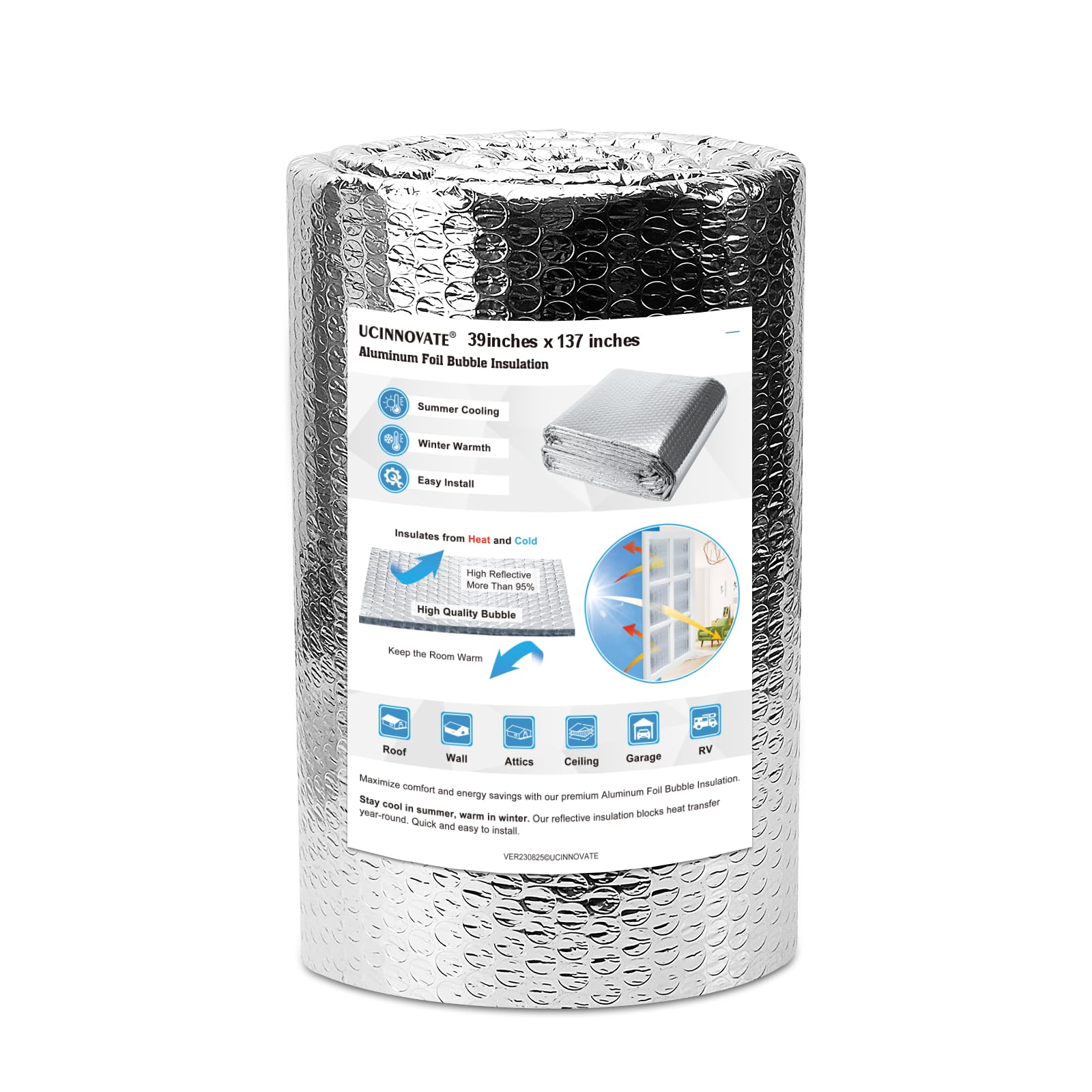
The roll that arrives flat, cuts clean, and reflects 95% of radiant heat (the heat that travels through air, not by touch).
The biggest headache with greenhouse insulation is getting the stuff to lie flat. This UCINNOVATE roll ships rolled up, not folded, so you do not fight creases across your glass panes. It measures 39 inches wide by 137 inches long, giving you a coverage area of 5,323 square inches — room for several standard greenhouse windows. The double-sided aluminum foil layers sandwich a 3-millimeter bubble core, which is the exact recipe for blocking both summer heat gain and winter heat loss. The manufacturer claims it reflects up to 95% of radiant energy (heat emitted as waves, like from the sun or a heater), and the owner feedback backs that up: buyers report using it on windows to keep cold out and on RV bunks to cut drafts.
What really sets this one apart is how easy it is to install. The material is lightweight and cuts with scissors without tearing. Owners mention sticking it up with a simple spray of water on the glass (the foil sticks to smooth surfaces when wet) or taping it in place. For a greenhouse, that means you can put it up in late fall and pull it down in spring without residue. The reflective coating holds up well even in harsh sun, which is a common failure point on cheaper foil wraps.
What wins people over
- Rolled delivery means zero creases to wrestle with
- Double foil reflects radiant heat in both directions
- Lightweight but thick enough to deaden wind noise
The honest trade-off
- Foil backing blocks light — not ideal for greenhouses relying on winter sun
- At 39 inches wide, very large greenhouse sections may need two strips side by side
Reach for this if: you want a no-crease, reflective barrier that stops heat loss and keeps summer glare down without a complicated install.
Look elsewhere if: your greenhouse needs full winter sunlight — the foil layer will dim the interior noticeably.
3. ValueMailers 1/2″ x 125ft x 24″ ROLL (Large Bubbles)

A 125-foot clear roll built for winter windows and single-glazed greenhouses (greenhouses with just one layer of glass).
If your goal is to trap dead air (air that does not circulate) against the glass without losing a single ray of sunlight, this is the one. The bubbles are a full 1/2-inch across — the large size that actually makes a meaningful difference in insulation value compared to the small packing bubbles most people try first. The roll is a full 125 feet long and 24 inches wide, enough to cover an enormous amount of glass. Owners mention using it on five large windows and still having material left over. In one account, a 22°F outside temperature paired with a heater set to 65°F kept the interior at 55°F — a 33-degree swing (the difference between outdoor and indoor temperature) that would be impossible with uninsulated glass.
The installation trick that keeps coming up is spraying the window with a fine mist of water and pressing the bubble side against the wet glass — the wrap sticks immediately and stays put all winter. The clear plastic means you can still see out, which matters if your greenhouse doubles as a sitting area or if you like checking on plants without going outside. The catch, mentioned repeatedly, is that the perforation lines (the tear marks meant to make it easy to rip off pieces) are basically useless. Tearing along them pops bubbles in the adjacent row. Just cut it with scissors and skip the perforation entirely. A few buyers mention that the bubbles can pop under pressure, so handle the edges carefully when cutting.
Why it stands out
- 125 feet covers a huge greenhouse or multiple windows in one go
- 1/2-inch large bubbles provide real insulation, not just a thin layer
- Clear material lets full daylight through for growing plants
Potential drawbacks
- Perforation lines pop adjacent bubbles — cut by hand instead
- No reflective foil means less radiant heat retention at night compared to foil wraps
Best suited for: greenhouses and sunrooms where visibility and sunlight matter more than radiant reflection.
Think twice if: you want a foil barrier to block summer heat gain (the sun’s heat coming in) — this is for winter cold only.
4. ToLanbbt Garage Door Insulation Kit 24-Panel, 6mm Thick

Double the thickness of standard wraps with a dedicated panel system and 240 adhesive tapes (tape strips to attach it).
This is not a continuous roll — it is a kit of 24 pre-cut panels, each 24 inches by 48 inches, with a thickness of 6 millimeters. That is 6 mm thick (versus 3 mm for typical reflective wrap), which translates to noticeably better temperature control. The three-layer design puts aluminum foil on both sides of a bubble core, so you get the reflective benefit plus the air-trapping thickness. Owners who installed it on garage doors report the interior dropping from 85°F to 75°F in 100°F outside heat — a 10-degree difference that lets an air conditioner cycle off instead of running nonstop. For a greenhouse, that kind of barrier on a north wall or a door can make a serious dent in heating costs.
The included 240 adhesive tapes (small strips of sticky material) make installation straightforward: cut each panel to size, peel the tape, and press it onto the frame or glass. Most buyers finished a two-car garage in about two hours. The recurring note is that the included tape may not hold reliably on bare metal or painted surfaces — a few owners switched to heavy-duty double-sided tape for a permanent bond. The panels arrive folded, so expect some creases that relax over a week or two. For a greenhouse, this kit works best on large flat surfaces like sliding doors, end walls, or roof panels where you want maximum insulation in a single layer.
The real strengths
- 6mm thickness (versus 3mm standard) — noticeable temperature difference
- Comes with 240 adhesive strips — no separate tape purchase for most installs
- Pre-cut panels reduce measuring and cutting time
What to watch for
- Included adhesive may struggle on bare metal or textured surfaces
- Folded delivery leaves creases that take time to relax flat
Go with this if: you are insulating a garage door, a large greenhouse door, or a wall panel where raw thickness beats every other spec.
skip it if: you need a continuous smooth cover — the panel edges are visible and may let small drafts through if not taped well.
Understanding the Specs
Bubble Size & Thickness
This is the single most important spec for greenhouse insulation. Small packing bubbles (1/8-inch) provide very little insulation value. Large bubbles (1/2-inch) trap a larger pocket of dead air (air that does not move), which is what actually stops heat from moving through the glass. Thickness matters too — a 6-millimeter panel (versus a 3-millimeter sheet) blocks more heat transfer. For a greenhouse that sits in freezing wind, go for the thickest large-bubble option you can fit on your frame.
Foil vs. Clear Material
Foil-backed wrap reflects radiant heat (heat traveling as waves) back into the greenhouse at night and blocks solar heat (heat from the sun) during summer. The trade-off is that it blocks all light, so plants cannot photosynthesize (use light to make energy) through it. Clear bubble wrap lets daylight through, which is essential for over-wintering plants (plants kept alive through winter), but it does very little to reflect heat back into the structure after dark. The smart move for most greenhouse owners is clear bubble wrap on the south-facing side for light and foil on the north side for reflection.
FAQ
Will bubble wrap really keep my greenhouse warm in winter?
How do I attach bubble wrap to greenhouse glass without damaging it?
Can I use regular packing bubble wrap for greenhouse insulation?
What is the difference between folded and rolled insulation wrap?
How long does greenhouse bubble wrap insulation last?
Will reflective foil insulation keep my greenhouse cooler in summer?
Can I install bubble wrap on the inside of my greenhouse roof?
Will the adhesive tapes damage my greenhouse frame or paint?
Final Thoughts: The Verdict
For the majority of shoppers, the best greenhouse insulation bubble wrap winner is the UCINNOVATE 39″ x 137″ Reflective Roll because it arrives flat, reflects 95% of radiant heat, and gives you the best mix of coverage and ease of install without fighting creases. If you need to keep sunlight streaming in for over-wintering plants (plants you keep alive through winter), grab the ValueMailers 1/2″ x 125ft Clear Roll — the large bubbles and 125-foot length are unbeatable value per square foot. And for a garage door, a greenhouse door, or a big wall panel where raw thickness matters most, the ToLanbbt 6mm Panel Kit is the one to reach for.
How We Picked
We do not accept paid placement. Every pick is matched to a real buyer and a real use-case; we do not hands-on test units.
Sources & Methodology
Specifications: manufacturer listings and product documentation. Review insights: verified customer reviews, as of July 2026. Pricing: not shown on this page (it changes often); check the current price via the retailer link.
As an Amazon Associate, Lawn Gear Lab earns from qualifying purchases. This does not affect which products we feature.