
Specs are compiled from manufacturer listings and verified buyer reviews and can change over time — please confirm the key details on the product page before buying.
A crisp line between your lawn and a flower bed is the single biggest visual upgrade you can make in an afternoon. But dragging a gas trimmer along the border kicks up dust, drowns out the birds, and usually leaves a ragged edge anyway. The right hand-powered edger sidesteps all that noise — literally — and gives you a clean, deep cut with nothing more than your own weight on a foot plate.
I’m Rikta — the founder and writer behind Lawn Gear Lab. This guide is built by comparing the manufacturers’ published specifications and the patterns across verified customer reviews, so you get each pick’s real strengths and trade-offs instead of marketing spin.
The tools below are the ones that consistently deliver sharp borders without the hassle of fuel or cords, sorted to help you find the right mulch bed edger for your yard and your body.
Our Picks at a Glance


How To Choose The Best Mulch Bed Edger
Buying a manual edger is simpler than buying a power tool, but a few details make the difference between a tool you reach for every weekend and one that sits in the shed. Focus on these three things.
Blade Design: Straight, Half-Moon, or Saw-Tooth
A straight blade is the simplest but often the hardest to push through compacted soil. A half-moon blade — curved like its name — concentrates your step force into a narrower arc, making it easier to create that crisp vertical wall along a bed. Saw-tooth blades add an aggressive bite; the teeth grab roots and dense turf instead of just sliding over them. If your soil is mostly soft loam, a half-moon is plenty. If you are fighting tree roots or clay, look for a saw-tooth or serrated edge.
Handle Height and Grip Comfort
A tool that makes you bend is a tool you will stop using. Look for a handle that reaches at least your hip so you can stand upright while you work. T-shaped grips give you two-handed leverage for twisting and rocking the blade loose. D-shaped or doughnut handles let you pull up with one hand while pushing down with your foot. The best ergonomic choice matches your height and how much upper-body strength you want to use.
Foot Plate Width and Weight
The foot plate is where your stepping force meets the blade. A wider plate (around 6 inches or more) distributes pressure comfortably across the sole of your boot, letting you put full body weight down without pain. Overall tool weight matters too: a heavier edger (over 4 pounds) drives itself into the ground with less effort but gets tiring to carry from bed to bed. A lighter one (3 pounds or less) is easier to maneuver but may require more stomping to reach depth. Match the weight to the size of your yard and your own comfort.
Quick Comparison
| Model | Best For | Blade Type | Weight | Handle Style | Amazon |
|---|---|---|---|---|---|
| Radius Garden 25602★ Best Overall | Overall Precision | Carbon Steel Half-Moon | 4 lb | Doughnut Grip | Amazon |
| Root Slayer 22611Top Performer | Tough Roots | Carbon Steel Serrated | 4.8 lb | Ergonomic D-Grip | Amazon |
| Bully Tools 92251Longest Reach | Heavy-Duty Reach | 12-Gauge Steel Round | 3.69 lb | Steel T-Style | Amazon |
| CKLT 40in | One-Piece Simplicity | Serrated Spring Steel | 5.24 lb | Blue Rubber | Amazon |
| Colwelt Manual Edger | Deep Cuts | V-Shape Serrated Steel | 4.38 lb | Soft T-Grip | Amazon |
| Byhagern Professional Edge | Versatile Value | Saw-Tooth Half-Moon | — | Ergonomic Rubber | Amazon |
| BARAYSTUS Height Adjustable | Shorter Users | Saw-Tooth Steel | 3 lb | Adjustable T-Grip | Amazon |
| Yard Butler EDGE-180 | Budget Durability | Alloy Steel Straight | 4.5 lb | Cushioned Long Handle | Amazon |
| Amazon Basics Corded | Power-Edging Speed | 7.5″ Double Edge Steel | 6.49 kg | Adjustable Auxiliary | Amazon |
In‑Depth Reviews
1. Radius Garden 25602 Pro-Lite Carbon Steel Edger
Our pick — over 4.5★ from 500+ verified ratings; the strongest balance of quality and price.
The crowd favorite that turns edging from a chore into a satisfying one-step slice.
The first thing you notice is the doughnut-shaped handle. It looks unusual, but it lets you grip from any angle and pull upward while your foot drives the carbon steel blade down. The extra-wide forward step gives you a stable platform — you are not wobbling or fighting for balance. At 4 pounds and 40.25 inches long, it feels solid but not exhausting to carry from bed to bed.
Buyers talk about how it outpaces a shovel for creating new flower bed lines. “This tool has been such a help creating a smooth and professional edge to my flower beds and yard,” one owner reports. The heat-treated carbon steel blade measures about 9 x 5 inches, so each cut covers a meaningful section of border. The fiberglass shaft handles heavy digging without flex, and the blade stays sharp through repeated use if you wipe it clean after each job. The brand backs it with a lifetime guarantee in the continental US.
The honest trade-off is depth. For very compacted clay or deep-rooted bermudagrass, you may need to make two passes or wet the ground first. Some owners wish the edge came slightly sharper from the factory, though it improves with use. This is the best choice for anyone who wants a single tool that does crisp borders and light trenching without overthinking it.
Carbon steel blade: You pull this edger naturally, like you would a wagon, thanks to its doughnut-shaped handle — most edgers force you to push or chop instead. The carbon steel blade (a hard, long-lasting metal) stays sharp through many uses, and the 4-pound weight is heavy enough to cut through soil but light enough to carry easily. Buyers report it creates “smooth and professional” edges with noticeably less effort than a standard shovel.
Reach for this if: You want a manual edger that the largest group of owners agrees is the best mix of sharpness and comfort. The lifetime guarantee means you won’t need to replace it if the blade or handle ever fails.
Think twice if: You have thick, root-heavy St. Augustine grass or hardpan clay — you will need to work in damp soil or sharpen the blade to its maximum bite.
2. Root Slayer 22611 Serrated Garden Edger
A 4.8-pound brute that chews through roots without complaint.
Where the Radius Garden is a precision scalpel, the Root Slayer is a dedicated root-buster. Its half-moon blade has an inverted V cutting tip with aggressive serrated teeth that grip and saw through compact soil and shallow roots rather than just pushing them aside. The blade is powder-coated carbon steel, and at 4.8 pounds its weight works for you, driving the blade deeper with each step.
Owners note the tool feels sturdy enough to stand on like a shovel — which is exactly what you do to cut a clean curb line. The fiberglass shaft (a lightweight, strong material) has a resin-encased steel core inside that resists bending, and the ergonomic non-latex grip stays comfortable during longer edging sessions. The brand offers a lifetime warranty, and the effectiveness score in owner feedback is the highest of any edger here, with more than 100 buyers calling it out positively. One owner says it “cuts right through the ground to define your landscape beds” and calls it “a must have landscaping tool.”
At 4.8 pounds, this is definitely the heavier end of the spectrum. A few owners do mention the weight as a downside for longer use. If you have tough soil or existing roots along your beds, the extra heft is an advantage — but if you prefer a lighter tool for quick touch-ups, you may want to go with the Radius Garden instead.
Serrated edge cuts: The inverted V tip and serrated teeth turn root-cutting from a struggle into a single-step operation. It’s the top choice for anyone who has to re-establish an overgrown border or fight through compacted ground.
This is for: Anyone whose existing edging has been overtaken by roots or who works in heavy clay. The weight and sharpness deliver a clean line where lighter tools would just bounce.
Look elsewhere if: Yard work leaves you sore after 15 minutes — the 4.8-pound heft is noticeable, and some owners call it “too heavy” for extended use.
3. Bully Tools 12-Gauge Manual Lawn Edger
An absurdly tall edger that saves your back by letting you stand bolt upright.
At 61.5 inches overall, the Bully Tools edger is dramatically longer than the typical 40-inch model. That extra reach is a lifesaver if you are tall or tired of hunching over. The design is a round 12-gauge extra-thick steel blade with a steel T-style grip, purpose-built for edging along sidewalks, garden beds, and driveways. The detachable head measures 36 inches long and 3.5 inches wide, which makes storage easier than you would expect for a tool this size.
Every component is all-steel and proudly made in Steubenville, Ohio. The brand backs it with a limited lifetime warranty. Owners describe it as sharp from the factory and solid-feeling, especially in damp soil. One buyer who had replaced a similar tool from a big-box store twice in three days found the Bully version durable enough to recommend. It also works well for trenching, not just edging.
The most common critique is the handle. The rubber grips on the T-bar are not permanently attached; they can loosen and twist off after 10-15 minutes of steady use. Several owners fixed this with a dab of adhesive. The 12-gauge blade is built to last, but the handle assembly is the weak link you should plan to address.
Durable 12-gauge: The 61.5-inch length saves your back by letting you stand bolt upright, reducing back strain noticeably. The 12-gauge steel blade (extra thick) resists bending even when you hit roots or compacted soil. It is the only serious option here for tall gardeners or anyone with back issues who still wants a manual tool.
Best suited for: Taller users who need to edge without stooping. The extra reach gives you leverage that makes up for the moderate 3.69-pound weight.
One caveat: Expect the handle grips to need securing with adhesive shortly after purchase — a minor fix for an otherwise durable 100% USA-made tool.
4. CKLT 40in Manual Edger with Spring Steel Blade

A one-piece tool that arrives ready to work, no wrench required.
The CKLT lands on your doorstep fully assembled, which is a bigger deal than it sounds — no wrestling with bolts, no alignment issues. The entire tool is a single piece of manganese steel tubing 1.18 inches in diameter, topped with a blue rubber handle. The blade is serrated spring steel, a material known for resisting deformation and holding its edge even when you hit rocks or roots. A protective strip slides over the blade when you are done, a thoughtful safety touch.
At 5.24 pounds, this is the heaviest manual edger on the list, and that heft translates into serious cutting power. Owners say it cuts through sod and roots “like butter,” with several mentioning that a 63-year-old or a 70-year-old can still use it comfortably in damp soil. The 40-inch length is standard, but the combination of spring steel flexibility and the tube’s weight gives it a unique feel — you use body momentum instead of just leg force. Functionality and durability are the two most-praised aspects.
Weight again is the trade-off. At over 5 pounds, carrying it around the yard for a full afternoon will tire your arm. The blue rubber handle is comfortable but not as ergonomic as a T-grip for two-handed leverage. This is a tool you reach for when you want to knock out a single long border in one go, not for quick touch-ups between weeding sessions.
Spring steel blade: The one-piece, no-assembly construction and spring steel blade make it the most “ready to go” edger here. It’s built to last a lifetime, and owners praise its construction as “top notch.”
Reach for this if: You want the most durable, just-open-the-box-and-use-it edger available. The spring steel resists bending better than standard carbon steel.
Have in mind: At 5.24 pounds, it is the heaviest pick here. Test the weight before committing if you have a large yard or limited upper-body strength.
5. Colwelt Manual Edger Lawn Tool

Digs 5.5 inches deep — far beyond what most half-moon edgers can manage.
The Colwelt’s V-shape serrated blade reaches 5.5 inches down, which is enough to break through deeper roots and create a trench that actually holds mulch in place. The blade is thick solid steel with a sawtooth edge. The anti-slip foot tread measures 6.3 inches wide and 6.7 inches high — wide enough for any boot and tall enough to step onto without scraping your shin.
Functionality and ease of use are the most-praised aspects. One owner calls it “excellent for creating clean edges and digging topsoil for new flower beds,” noting it was instrumental for planting blueberry plants and dahlias. Another found it saved time and back strain trenching around a pool deck. The cushioned T-handle gives you solid two-handed grip for rocking and levering the blade loose after each step.
The common complaint is that the blade arrives not as sharp as it could be. Several owners sharpened it with a file or angle grinder before it performed at its best. The handle bolts also protrude slightly, which some find annoying on the grip. For the price, it is a capable deep-digging tool, but budget a few minutes for initial sharpening.
Budget-friendly pick: The 5.5-inch cutting depth is 1 to 3 inches more than typical manual edgers, making it the best choice for establishing a new border or cutting a deep mulch-retention trench.
Grab this for: Creating deep, defined edges that actually hold bark mulch or river rock in place. The extra depth also handles root systems that would stop a standard half-moon blade.
But be ready to: Spend a few minutes with a file to get the blade factory-sharp. A few owners mention it needs that initial touch-up.
6. Byhagern Professional Edge Lawn Tool
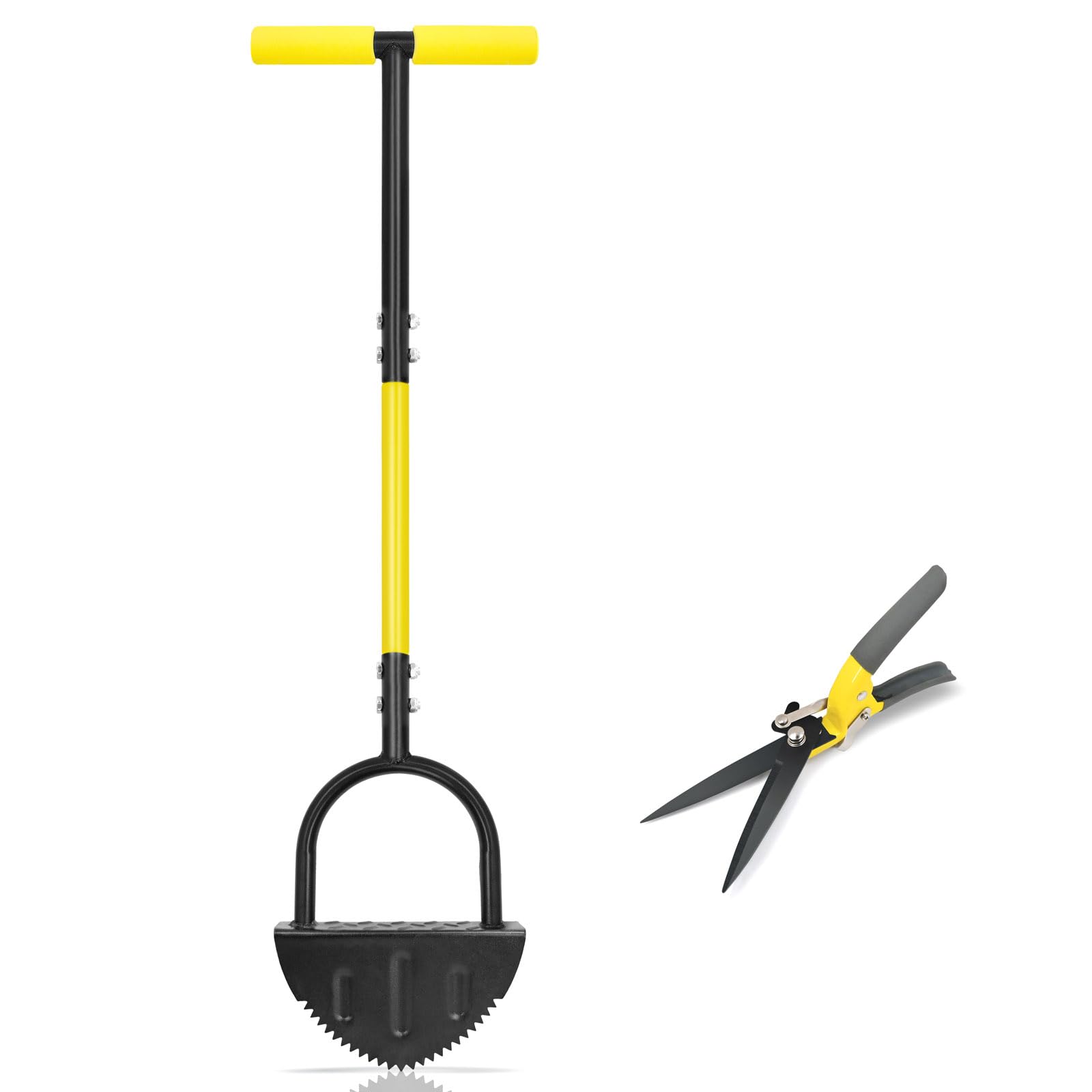
A saw-tooth blade and padded grips at a price that leaves room in the budget for gloves.
The Byhagern uses a curved half-moon blade lined with saw teeth — they bite and cut through turf rather than just pushing down like a straight blade. The long handle reduces bending, and the non-slip grip stays secure even with wet hands. The wide footplate accommodates all shoe sizes and provides enough leverage to drive the blade through dense soil. Assembly is simple, and many owners mention the tool delivers professional-looking lines on the first try.
Effectiveness is the most-praised aspect, with over 50 owners calling it out positively. Quality and ease of use follow closely. The carbon steel construction resists rust, and the quiet manual operation means no fuel or electricity. One owner describes “crisp and professional edges without the hassle.” Another used it successfully in clay soil after rain, noting it pulls weeds by the root as it cuts.
Sharpness gets mixed feedback. Some owners find the blade very sharp from the start, while others say it is too thick at almost 1/8 inch for cutting lawn edges cleanly. A few took a grinder to the teeth to narrow them like a knife blade, which worked well on heavy turf. Durability also gets a mixed response, with dirt sticking to the blade being a minor but common complaint. For the price, it is a solid performer, just be aware you may want to sharpen it.
Professional feel: The saw-tooth design gives you an edge in dense turf that a plain half-moon blade lacks, and the positive feedback on effectiveness is backed by the largest count of satisfied owner mentions.
Best suited for: Someone who wants a capable saw-tooth edger at a budget-friendly price and does not mind light sharpening work. Effectiveness and ease of use are the standout traits.
Keep in mind: If you have heavy clay or thick St. Augustine, plan to spend time with a file or grinder to thin the blade’s edge for a cleaner cut.
7. BARAYSTUS Height Adjustable Garden Edger

The only edger here that grows with the user — two height settings in one tool.
Most manual edgers lock you into one handle height. The BARAYSTUS gives you two precise settings — 37 inches and 41 inches — so it fits shorter and taller users without anyone having to hunch. The soft, non-slip T-shaped handle reduces hand fatigue, and the half-moon saw-tooth blade is made of heat-treated cast iron with rust-resistant properties. The head is 7.9 inches wide, covering more ground per step than most competitors.
The blade combines a sharp smooth edge with serrated teeth, supporting a 10 to 180-degree trimming range for tackling roots and compacted soil. The reinforced wide foot platform transfers your full body weight directly to the blade. At 3 pounds, it is easy to carry and maneuver. (The Radius Garden weighs 4 pounds, the CKLT weighs 5.24 pounds.) “Works great! I’m seventy years old and appreciate how well it works to maintain clean edging without a weed wacker,” one buyer reports.
The lighter weight is a double-edged sword. In very dry or compacted soil, the tool may not drive as deep on the first step, and you might need to rock it more. A few owners also note the blade is thin, which helps it cut easily but may not hold up as well against buried rocks. Assembly requires two included wrenches and takes just a few minutes.
Adjustable height: The adjustable height is unique — no other manual edger on this list offers a choice of handle lengths. At 3 pounds, it is also the lightest cast-iron option here, ideal for users who want maneuverability over pure mass.
Reach for this if: Multiple people of different heights will use the same edger, or you want the lightest possible tool that still has a serious saw-tooth blade. The adjustability is a rare and useful feature.
Consider the trade-off: The lighter 3-pound build means you will apply more body force on hard soil. It works best in damp ground or after a rain.
8. Yard Butler Step Edger EDGE-180

A straightforward steel edger built to a price that has won over hundreds of owners.
Sometimes you just want a simple steel blade on a long handle with a foot bar. The Yard Butler delivers that without frills: a long-handled step edger with cushioned grips and a powder-coated steel body that resists rust. The design is a traditional foot-operated edger — you align the blade, step on the bar, and push forward. At 4.5 pounds with an alloy steel construction, it feels sturdy enough to last for years in regular use.
Owners find it versatile beyond edging. One 74-year-old used it to dig a 3-inch wide, 4-inch deep trench between the lawn and sidewalk to prevent water runoff and avoid a city fine — and called it easy. Another used it to bury fiber optic cable in hard clay. The tool is effective enough that a few owners say it is “worth every penny” and appreciate the lifetime warranty. The cushioned handles reduce vibration and provide a comfortable grip even when the tool is muddy.
The recurring limitation is sharpness. In thick St. Augustine grass or dry, compacted soil, the blade struggles to cut through cleanly. A 240-pound owner noted they still had difficulty in dense areas. Several buyers recommend using it after rain or running a sprinkler first. For routine lawn edging on a large property, a power edger is likely a better choice. The Yard Butler shines as a budget-friendly tool for smaller borders and occasional trenching.
Step-on design: The simple, durable design backed by a lifetime warranty at a value that has made it a popular choice. It is a proven workhorse for border maintenance and light trenching.
Best for: Occasional edging on smaller lawns or for creating shallow trenches for wiring and irrigation. The cushioned handles and lifetime warranty add reassurance.
Not ideal for: Thick St. Augustine grass or routine large-scale edging — owners consistently report the blade is not sharp enough for dense turf without pre-soaking the ground.
9. Amazon Basics 12 Amp Corded Electric Lawn Edger

When your yard is too long for stomping, this corded edger does the work in minutes.
Not every border needs a manual tool. If you have a large lawn or multiple sidewalks, the Amazon Basics corded edger is a different category altogether — a powered alternative that spins a 7.5-inch double-edged blade at 4420 RPM to cut through turf fast. The 12 amp motor runs on a standard extension cord and operates at 94 dB, which is loud but manageable with hearing protection. It functions as both an edger and a trencher for burying wires or irrigation lines.
The adjustable auxiliary handle improves comfort during operation, and the blade digs up to 1.5 inches deep for precise results. Assembly is straightforward, and owners find it effective along driveways and sidewalks. One buyer mentions it has “good power” at a “reasonable price.” The blade is easy to find and replace, which is a practical advantage over less common sizes. The tool weighs about 6.49 kg (14.3 pounds), which is significant but expected for a corded machine.
Durability receives mixed feedback — some owners have had theirs for years while others report issues, though the 5-year Power Tool Warranty covers the motor. The cord is a limitation if your beds are far from an outlet. This is not a direct replacement for the manual edgers above; it is a companion for the homeowner who wants powered speed for the main lines and a hand tool for precision around flower beds.
Powerful electric: The 12 amp motor and 4420 RPM blade speed make quick work of long borders. It is the only powered option here, and it doubles as a trencher for wiring projects.
Get this for: Large lawns, long driveways, or anyone who wants to finish edging in half the time of a manual tool. The 7.5-inch blade covers ground fast.
Stick with manual if: Your beds are small or far from an outlet. The cord is restrictive, and the 14.3-pound weight makes it less portable than any hand edger here.
Understanding the Specs
Blade Material & Construction
Carbon steel is the standard — it holds a sharp edge well but needs to be wiped clean after use to prevent rust. Spring steel, used in the CKLT, is more flexible and resists deformation if you hit rocks, but it is harder to sharpen. The 12-gauge rating on the Bully Tools edger refers to the thickness of the steel; a lower gauge number means thicker, more durable metal.
Cutting Depth & Blade Shape
Half-moon blades create the classic crisp vertical wall along a bed and concentrate your stepping force into a smaller arc. Serrated or saw-tooth blades add cutting teeth for roots. The cutting depth — usually 2 to 5.5 inches — determines how deep your border trench will be. Deeper cuts (4+ inches) are better for holding mulch or creating planting trenches. Shallower cuts (around 1.5 inches) are sufficient for routine edge maintenance along sidewalks.
Handle Style & Ergonomics
T-shaped handles give you two-handed leverage for rocking the blade loose and are common on heavier-duty tools. Doughnut or D-shaped handles let you pull upward with one hand while pushing down with your foot, which is useful for dislodging the blade. Long handles (over 40 inches) reduce back strain but add weight. Adjustable handles, like the BARAYSTUS, accommodate multiple users. Cushioned grips reduce vibration and fatigue during longer sessions.
Weight & Foot Plate Design
Heavier edgers (4.5 pounds or more) drive deeper with less effort from you but are tiring to carry. Lighter edgers (under 4 pounds) are easier to maneuver but may require more stomping force. The foot plate width directly affects comfort — a plate at least 6 inches wide distributes your weight evenly across the sole of your boot. A plate that is too small or too narrow can cause foot fatigue and reduce the force you can apply.
FAQ
Is a manual mulching edger better than a gas-powered one?
How deep should a mulch bed edge be?
Can I use a manual edger in clay soil?
How often do I need to sharpen a manual edger?
What is the difference between a half-moon and a straight blade edger?
How do I maintain a manual edger?
Can a manual edger cut through tree roots?
What length handle do I need for my height?
Is it better to edge before or after mulching?
How do I edge a straight line with a manual tool?
Final Thoughts: The Verdict
Across the board, the mulch bed edger winner is the Radius Garden 25602 Pro-Lite because its doughnut handle, carbon steel blade, and 4-pound weight deliver the most satisfying blend of sharpness, ergonomics, and owner satisfaction — the reviews are emphatic. If you need to cut through stubborn roots and compacted soil, grab the Root Slayer 22611; its aggressive serrated blade is the most effective option for tough conditions. And for a powered approach to long driveways or large properties, the Amazon Basics Corded Electric Edger is the one to reach for — it is fast, powerful, and surprisingly affordable for the speed it delivers.
How We Picked
We do not accept paid placement. Every pick is matched to a real buyer and a real use-case; we do not hands-on test units.
Sources & Methodology
Specifications: manufacturer listings and product documentation. Review insights: verified customer reviews, as of July 2026. Pricing: not shown on this page (it changes often); check the current price via the retailer link.
As an Amazon Associate, Lawn Gear Lab earns from qualifying purchases. This does not affect which products we feature.