
Specs are compiled from manufacturer listings and verified buyer reviews and can change over time — please confirm the key details on the product page before buying.
A dripping hose for irrigation sounds simple — you turn it on and the plants get wet. But the difference between a hose that waters evenly for years and one that clogs, bursts, or leaves dry patches depends on pressure compensation, emitter spacing, and material. This guide cuts through the dozens of options to find the ones that actually deliver slow, steady water right to the roots without wasting a drop.
I’m Rikta — the founder and writer behind Lawn Gear Lab. This guide is built by comparing the manufacturers’ published specifications and the patterns across verified customer reviews, so you get each pick’s real strengths and trade-offs instead of marketing spin.
Whether you’re tending raised beds, a vegetable patch, or a row of thirsty shrubs, the right dripping hose for irrigation will save water, time, and frustration — and every pick below has the owner feedback to back it up.
Our Picks at a Glance


How To Choose The Best Dripping Hose For Irrigation
A dripping hose seems straightforward, but three specs separate the season-long workhorses from the frustration. The first is pressure compensation — a built-in mechanism that keeps every emitter delivering the same water volume whether you are a foot from the faucet or fifty feet away. Without it, the far end of the hose runs dry while the first section floods. The second is emitter spacing: six-inch emitters give a continuous wet strip ideal for row crops, while twelve-inch spacing suits wider-spaced plants like tomatoes or shrubs. The third is maximum operating pressure — most drip tubing operates between 8.5 and 60 psi, while soaker hoses typically need 30 to 60 psi. Run too much pressure through a soaker and it will burst seams; run too little and you get no flow at all.
Pressure Compensation Matters More Than You Think
If you have ever seen a soaker hose where the last ten feet stays bone-dry, you have seen what happens without pressure-compensating emitters. These tiny diaphragms inside the tubing open and close to maintain a steady dribble regardless of the water pressure feeding them. The Rain Bird ET256-50S, for instance, compensates across a range of 8.5 to 60 psi, meaning the very last emitter in the line puts out the same 0.8 gallons per hour as the first. That uniform flow is what keeps your cucumber row from becoming a swamp on one end and a desert on the other.
Soaker Hose vs Drip Tubing — They Are Not The Same
A flat soaker hose (like the LINEX or Secbulk) is essentially a fabric tube that weeps water along its entire surface. It is great for winding around trees or laying under mulch because it moistens a broad area. But soaker hoses depend entirely on water pressure — too high and they split, too low and they barely seep. Drip tubing (like the Rain Bird, the Cokacot kit, and the Thiswing kit) uses discrete emitters that deliver precise droplets. You get less surface wetting but far better control over exactly where the water goes. For a vegetable bed with rows, drip tubing wins. For a winding flower border or a ring around a tree, a soaker hose is faster to lay.
Wall Thickness and Material Dictate Lifespan
Cheaper soaker hoses use thin PVC that can oxidize in the sun and split after one season. More durable options use a vinyl or recycled-vinyl cover with UV resistance, or a rubber core that handles heat without cracking. The Secbulk flat soaker hose uses a dual-layer design — a PVC core covered with extra-strength fabric. The Rain Bird tubing is made from plastic with a 0.04-inch wall thickness that resists punctures from garden tools. If you plan to bury the hose under mulch, look for a model that explicitly mentions it can be submerged without degrading.
Quick Comparison
| Model | Best For | Type | Length | Pressure Range | Amazon |
|---|---|---|---|---|---|
| Rain Bird ET256-50S★ Best Overall | Uniform row watering | Drip Tubing | 50 ft | 8.5–60 psi | Amazon |
| Cokacot 49.21Ft KitTop Value Kit | Customizable spray coverage | Drip Kit | 49.21 ft | Standard | Amazon |
| Thiswing 50FT KitPremium Build | High-flow raised beds | Drip Kit | 50 ft | Water Pressure-driven | Amazon |
| LINEX 25ft Soaker | Mulch-covered beds | Flat Soaker | 25 ft | 60 psi max | Amazon |
| Secbulk 50ft Soaker | Eco-friendly row gardens | Flat Soaker | 50 ft | 40–90 psi | Amazon |
| Hlinker 75ft Soaker | Long runs in large beds | Flat Soaker | 75 ft | 85 psi max | Amazon |
| Premillow 100ft Soaker | Budget long-length coverage | Flat Soaker | 100 ft | Standard | Amazon |
| Winisok 100ft Sprinkler | Wide spray for lawns | Sprinkler Soaker | 100 ft | 20–60 psi | Amazon |
| Suneed 10ft 4-Pack | Tight raised beds | Flat Soaker | 10 ft each | 30–60 psi | Amazon |
In‑Depth Reviews
1. Rain Bird ET256-50S Drip Irrigation Tubing
Our pick — over 4.5★ from 900+ verified ratings; the strongest balance of quality and price.
The precision drip tubing that waters every plant evenly from start to finish
The thing that wins people over here is the pressure-compensating emitters — each one delivers exactly 0.8 gallons per hour, and they are spaced 6 inches apart along the entire 50-foot roll. That means a 2-foot-by-4-foot raised bed gets a uniform moist stripe with no dry spots at the far end. The tubing has a unique micro-porous connection that seals ultra-tight against 1/4-inch barbed fittings, so you are not chasing leaks after installation.
Buyers report that the stiff tubing can be tricky to lay when it is cold — letting it warm in the sun softens it enough to snake around corners. The dual emitter holes sit 180 degrees apart, so you get a double drip on each side of the line. Compared to the soaker hoses further down this list, the Rain Bird is maintenance-free: it does not clog because the emitters are built into the wall rather than relying on a porous fabric that can get gummed up by mineral deposits.
Why the crowd loves it
- Functionality and quality are the top praise — over 900 ratings average 4.6 stars, and the even water distribution is the standout real-world result
- No clogging required: the micro-porous connection keeps the seal tight season after season
- Operates across a wide pressure range from 8.5 to 60 psi, so it works on weak spigots and strong mains alike
The honest trade-off
- The tubing is stiff when cold — some owners heat it in the sun before installation
- Requires separate 1/2-inch supply line and 1/4-inch barbed fittings (sold separately) so it is not a turnkey kit
Best for precision row watering: gardeners who want zero-maintenance, uniform drip across a fixed bed without worrying about clogged fabric. You need to buy a separate supply line and fittings.
Think twice if: you want an all-in-one kit that connects directly to a garden hose with no extra parts — this is tubing only.
2. Cokacot 49.21Ft Drip Irrigation Kit
The bendable nozzle kit that waters hanging baskets, greenhouse trays, and rows from one line
This kit uses 360° bendable mist nozzles instead of fixed emitters — you twist each nozzle right where you need it. The brass nozzles offer three adjustment modes (small, medium, large) so a single line can mist a delicate seedling tray and then blast a thirsty tomato root ball. The 49.21-foot 5/16-inch tubing splits into 45 pieces total, including 10 fix stems to hold the line above ground or stake it down.
Owner feedback consistently calls it easy to install, especially with the included hose cutter and plenty of adapters. One buyer explicitly compared it to a previous Rain Bird kit and said the Cokacot was “so much better” thanks to the movable heads and reliable connectivity. The minor shortfall is that some owners wish the included zip ties were longer and stronger, but the system itself is leak-free when properly assembled. If you need a complete kit that does not require hunting for extra fittings, this is the one.
Setup highlights
- Rated 4.6 stars with nearly 700 ratings — ease of use is the #1 praise, called out by over 170 owners
- Three flow modes let you adjust from a fine mist to a heavier spray without swapping parts
- No power source needed — purely water-pressure driven, so no electricity costs
What to know
- No printed instructions included (some owners watched online guides to get started)
- The included zip ties are short — you may want to supply your own for securing long runs
Reach for this if: you want a turnkey kit with adjustable nozzles that can handle everything from greenhouse misting to container watering. The 10 fix stems keep the line off the ground.
Look elsewhere if: you need a buried soaker hose — the nozzles work best above ground.
3. Thiswing 360° Adjustable Drip Irrigation System
Higher-flow tubing with copper nozzles that spray across wider beds and greenhouses
Thiswing goes a step beyond the Cokacot with 5/16-inch tubing that has a larger inner diameter than the standard 1/4-inch lines — significantly increasing water flow so the far end of a 50-foot run still has strong pressure. The 16 included nozzles are made of solid copper rather than plastic, giving them a dense atomization that creates a fine mist when you need it or a concentrated stream when you twist the head. The quick-connect fittings use a pneumatic tee connection that clicks together without glue or clamps.
The setup earns raves for being genuinely easy solo — owners describe laying the tubing and clicking fittings into place in under an hour. The copper nozzles are stiff enough to hold their angle but still adjustable with firm finger pressure. The main caution from reviews: the included hose-bib connection is shallow, and a few owners experienced leaking at that single point. If you have a non-standard faucet thread, you may want to swap in a brass quick-connect adapter.
What stands out
- Solid copper nozzles outlast plastic ones and resist UV cracking
- Larger tubing diameter ensures even pressure across the full 50 feet, avoiding the drop-off common with 1/4-inch hose
- Rated 4.6 stars with over 770 ratings — easy setup is the #1 praise
One caveat
- The plastic quick-connect at the hose bib can leak if not tightened perfectly — some owners replace it with a brass fitting
- No timer included — you will need to add one for automated watering
Standout for wide coverage: the 5/16-inch tubing and copper nozzles make this the best choice for large raised beds and greenhouse rows where every nozzle needs full flow. The quick-connects click together fast.
Heads up: budget for a brass hose-bib adapter if your faucet threads are shallow.
4. LINEX Garden Flat Soaker Hose 1/2″ x 25 ft
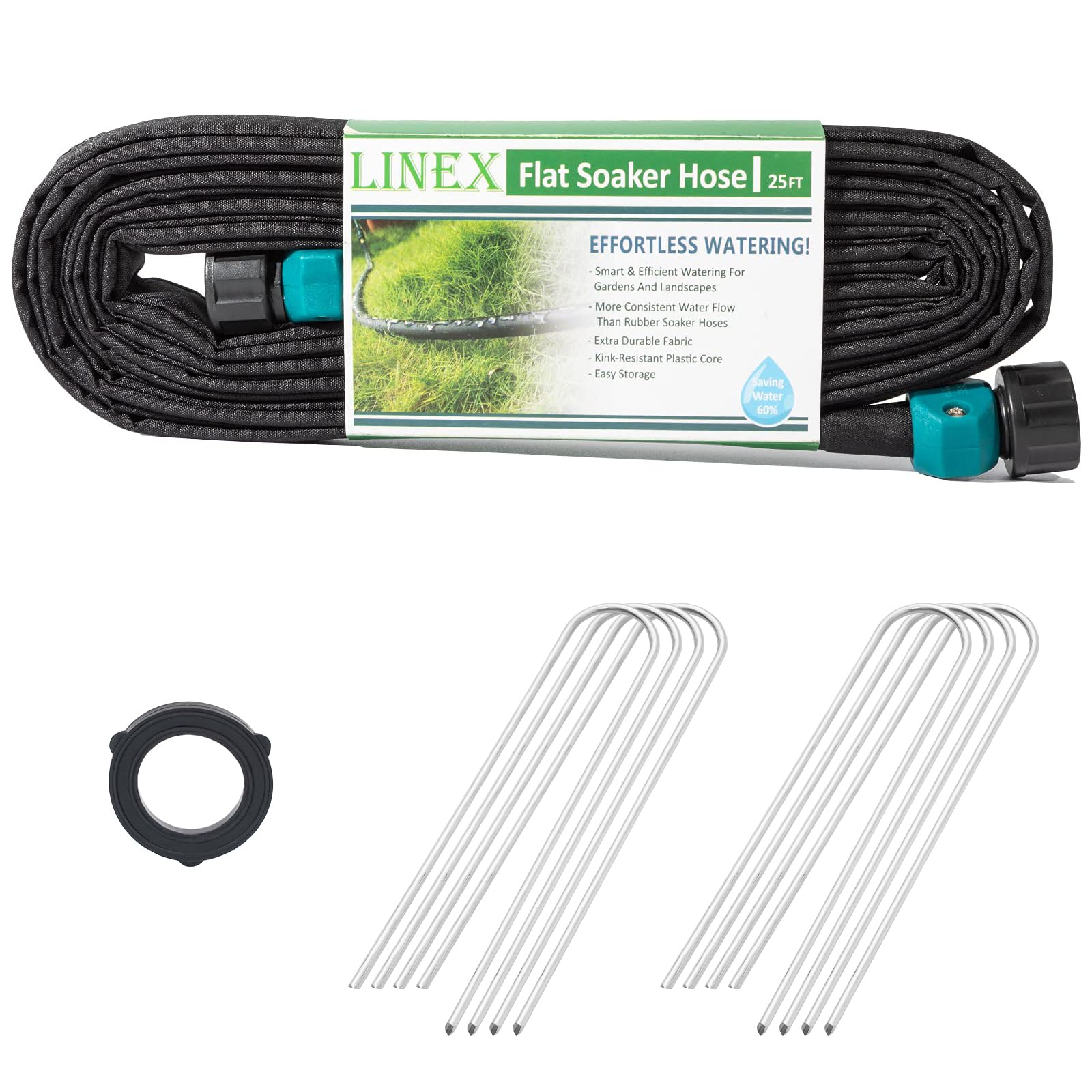
The budget flat soaker that has been quietly soaking flower beds for two years straight
At 1.3 pounds and 25 feet long, this is the lightweight, low-fuss option that you can bury under mulch and forget. It leaks water at a rate of 1.8 gallons per minute at 50 psi — a fast enough seep to keep a flower bed hydrated during a dry spell without pooling water on the surface. The inner plastic core has two ridges that resist kinking, so when you roll it up for storage it does not develop permanent crimps. Multiple owners confirm it works well buried in flower beds under mulch, eliminating the need to drag a heavy hose around the yard.
What makes this pick stand out from cheaper soakers is the 2-year guarantee. A few owners who had seam splits well after a year reported that LINEX honored the warranty and replaced the hose at no charge. That kind of long-term support is rare at this tier. The trade-off is that it is a basic soaker — no adjustable nozzles, no emitters, just consistent weeping along the fabric. If you need targeted drip for specific plants, the Rain Bird or Cokacot kits above give more control.
Why owners stick with it
- Proven two-year durability — multiple owners mention the same hose working through multiple seasons
- Fast 1.8 GPM flow rate at 50 psi waters a bed quickly compared to slower drip tubing
- Flat design rolls up compact for storage and stays kink-free
Keep in mind
- No flow adjustment — you get the full seep along the whole length
- Runs best at 50 psi; too much pressure and the fabric can strain
Grab this if: you want a set-and-forget soaker for a flower bed or tree ring that you can hide under mulch and reconnect each spring.
Not for you if: you need separate drip zones or adjustable spray patterns.
5. Secbulk 50 ft Flat Soaker Hose
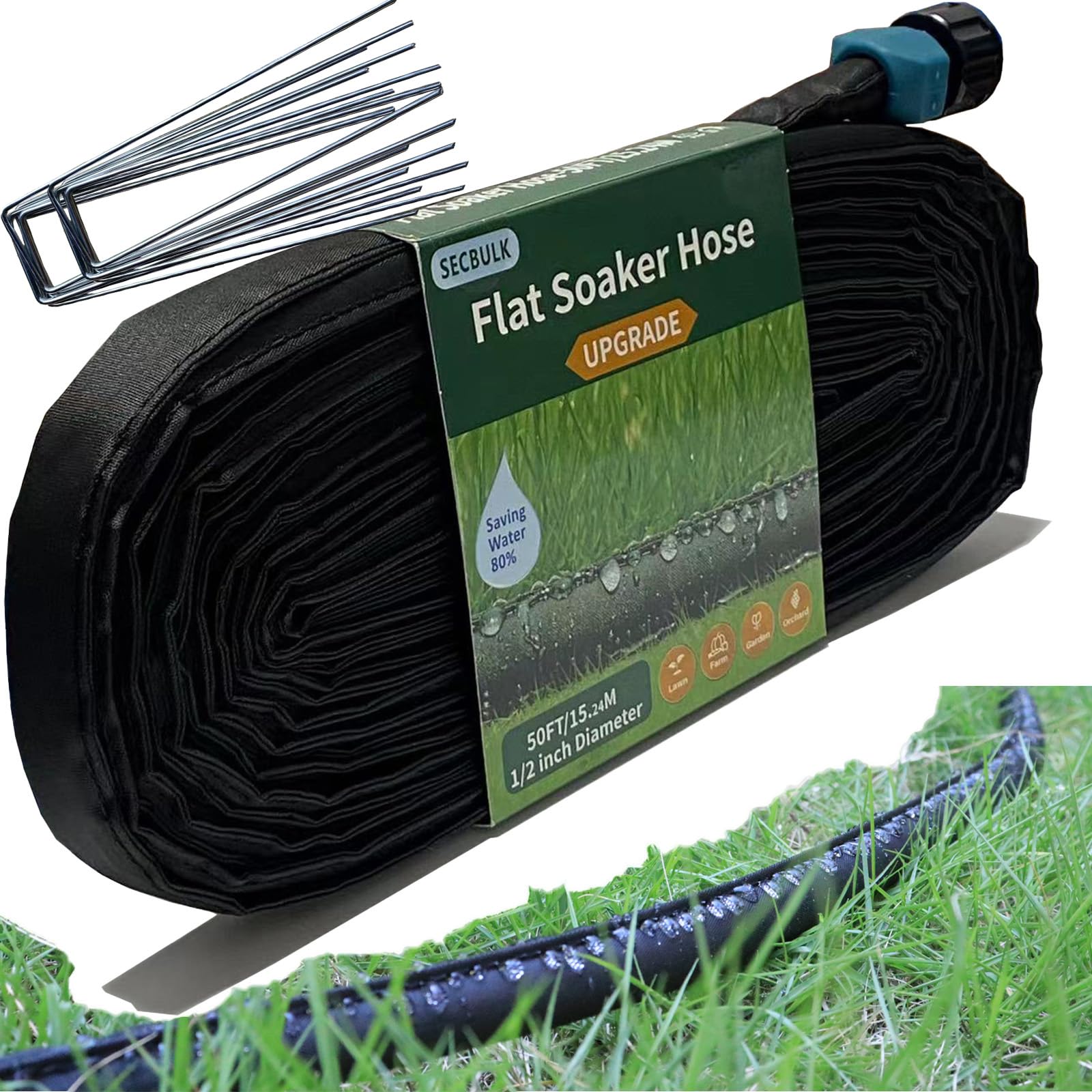
A dual-layer soaker made from recycled vinyl that passes CA65 safety standards for edible gardens
The Secbulk stands out because it is made from 100% environmentally-friendly recycled vinyl and has passed the CA65 test — meaning the water that seeps through it is safe for vegetable gardens, herbs, and other edible plants. The dual-layer construction wraps a PVC core with an extra-strength fabric cover that protects the vinyl from sun damage better than a single-layer rubber hose. With a maximum pressure of 90 psi, it is one of the few soakers that can handle a strong municipal water supply without bursting.
Owners find it simple to snake around raised beds and connect multiple sections because the end cap is removable and the fittings are standard garden-hose threads. The flat design folds up easily when the season ends. The honest caveat from reviews: durability is mixed. A few customers note that after a few months the fabric cover can separate from the core, causing uneven weeping. It works best with a pressure regulator to keep the flow slow and consistent.
The selling points
- CA65-tested recycled vinyl is safe for vegetable beds — the water does not leach harmful chemicals
- 90 psi maximum pressure handles high-pressure homes without immediate rupture
- Linkable design lets you chain multiple hoses for longer runs
Real-world durability
- Some reviewers point out seam separation after a single season — gentle pressure and careful winter storage extend the life
- One-year warranty covers defects, but some replacements had the same issue
Best for organic gardeners: the recycled vinyl and CA65 certification make this the pick if you are watering vegetables and want zero chemical concerns.
Manage your expectations: treat it as a reliable seasonal hose rather than a multi-year investment.
6. Hlinker 75 ft Flat Soaker Hose
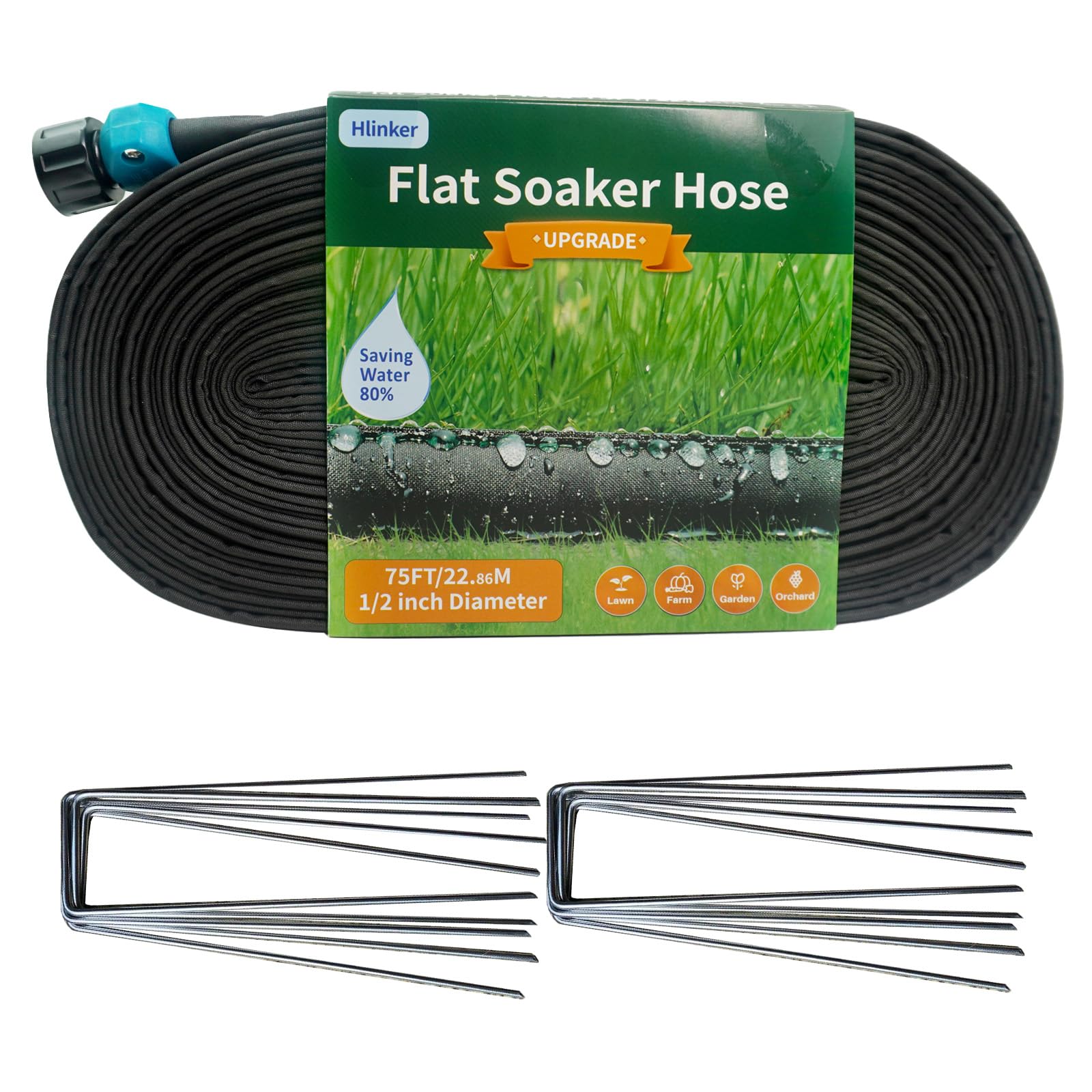
The 75-foot rubber soaker that waters a long border or a row of trees without running multiple hoses
At 75 feet, this is the longest single soaker hose in the roundup, and it is made from premium UV-resistant rubber rather than PVC. That rubber construction means it is less prone to cracking in direct sun and stays flexible enough to coil around tree trunks. It delivers a slow, steady drip along the entire length — ideal for a long flower border or a row of foundation shrubs where you do not want to piece together multiple shorter hoses.
One recurring observation from owners: the hose works best when you use a pressure reducer and allow at least 30 minutes of run time. The rubber material can kink if you bend it sharply around corners, so laying it in gentle curves is the trick. The black color blends into dark soil and mulch, keeping the garden looking tidy. Overall, most buyers find it does exactly what it promises as a low-tech, set-and-remember soaker.
Length advantage
- 75-foot continuous run covers large beds without multiple connections that can leak
- UV-resistant rubber survives summer sun better than standard PVC soakers
- Comes with restrictors to control the flow rate
The catch
- Prone to kinking if you lay it with sharp turns — keep the path gentle
- Water distribution at the far end is weaker than at the start; a splitter helps balance flow
Best for long, straight runs: if your garden bed runs 75 feet along a fence line, this hose waters it in one piece.
Not ideal for: tight serpentine layouts around individual plants — the kinking risk makes it better suited to sweeping curves.
7. Premillow 100ft Flat Soaker Hose

A 100-foot PVC soaker for covering a large vegetable patch on a tight budget
The Premillow delivers 100 feet of watering coverage in two 50-foot sections stitched together, each a half-inch in diameter. The PVC material is flexible enough to snake through rows of plants and wear-resistant enough to handle being dragged across soil. The big idea here is value: you get a hundred feet of soaker without paying for a premium brand.
Buyers confirm that it works well with moderate water pressure — a low setting on the spigot delivers steady weeping without puddling. But the durability revelations matter: several owners found that after a season of storage, the stitched seams can burst, causing gushing leaks that rob the far hose of pressure. It is best treated as a single-season workhorse. If you are covering a temporary bed or a new garden where you expect to rearrange the layout next year, this makes sense. For a permanent installation, one of the dual-layer or rubber options above will last longer.
Pure bang for the buck
- 100 feet of coverage for under twenty dollars — the cheapest per-foot cost in the roundup
- Flexible PVC material is easy to cut and reposition
- Works with low water pressure on a gentle setting
Durability warning
- Stitched seams are a weak point — a few shoppers say burst seams after one season
- No pressure regulator included; high pressure can destroy the weak seams quickly
Use it for: a temporary garden plot or a new bed where you want 100 feet of soaker on a single spool without a big investment.
Plan to replace: treat it as a seasonal hose — expect to buy a new one next year rather than counting on multi-season life.
8. Winisok Upgrade Flat Sprinkler Soaker Hose 100FT
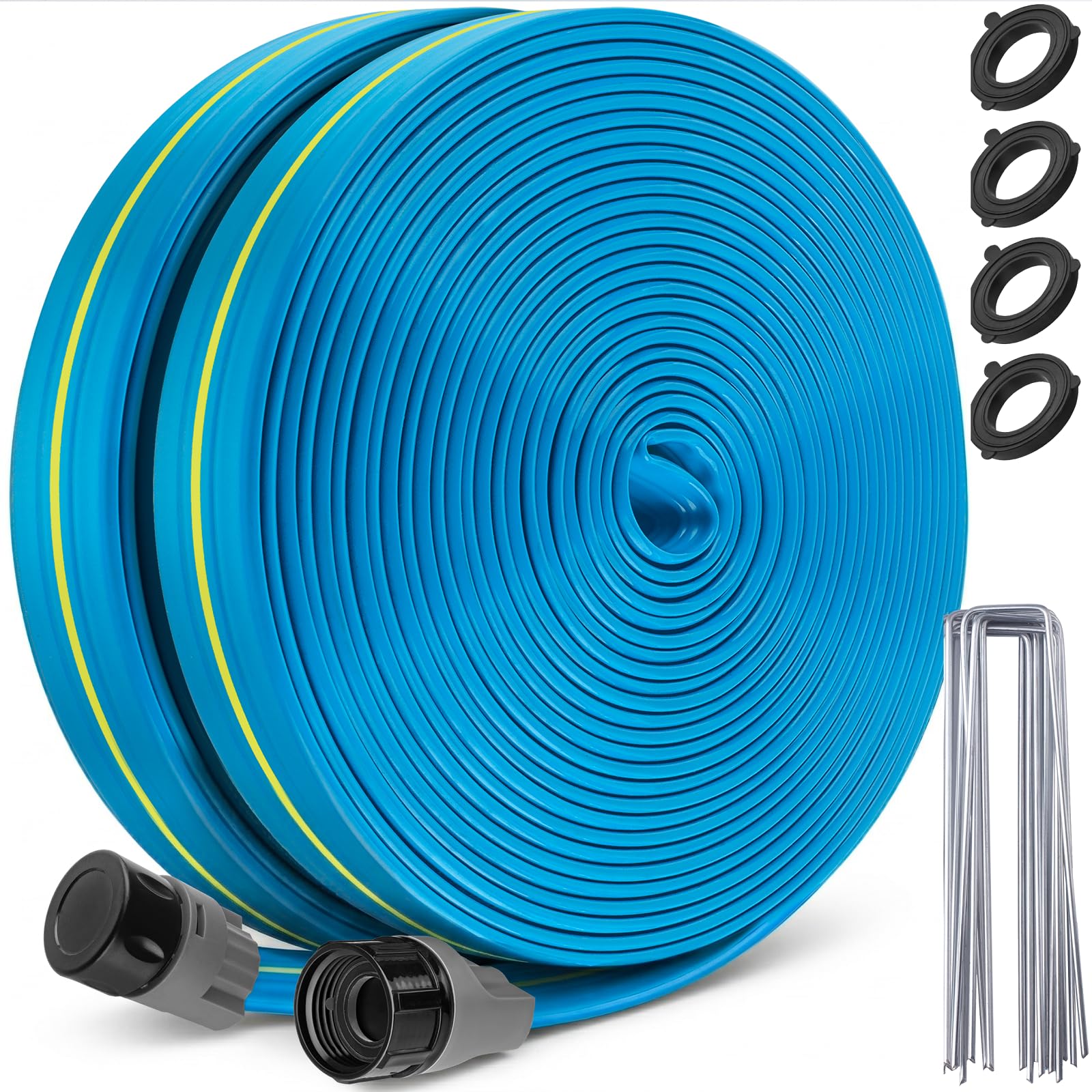
A hybrid sprinkler-soaker that sprays upward into a 1.8-meter arc for lawn edges and wide beds
Unlike the other soakers in this list that weep along the ground, the Winisok is designed to spray upward — the striped side faces up and the hose launches water 1.0 to 1.8 meters high across a 1.2 to 2.4 meter wide band. That makes it better suited for lawn strips, shrub borders, and ground-cover beds than for deep root watering. It comes with 40 landscape staples to pin the hose flat so the spray pattern stays consistent.
The main distinction is that this is not a drip hose in the traditional sense: it sprays rather than seeps. Owners note that water flow drops off as the line gets longer, so the far end of a 100-foot run gets noticeably less spray than the faucet end. The included staples and extra washers are a nice touch. One practical note from buyers: the PVC material has a strong chemical smell when first unrolled — a few hours in the open air takes care of it.
Clear use case
- Sprays a wide arc — good for lawn edges, ground cover, and flower borders that need overhead watering
- Comes with 40 staples and extra sealing washers, so you are ready to pin it down immediately
- Two 50-foot sections connect easily with standard garden-hose threads
Trade-offs
- Spray weakens at the far end — the first 20 feet gets the most coverage
- Strong PVC odor from the start requires airing out before installation
Pick this if: you need a sprinkler-style soaker for a lawn border or a wide ground-cover area where ground-level drip would be wasted.
Not for deep watering: this is a surface sprayer — for deep root hydration, use a ground-level soaker or drip tubing instead.
9. Suneed 10FT Flat Soaker Hose 4-Pack

Four short 10-foot soakers that snake individually through tight raised beds and narrow borders
Instead of one long hose, you get four modular 10-foot sections that you can place separately or daisy-chain into longer runs. The short length makes them ideal for box gardens where you want to snake a hose through a single row without watering the path between rows. The flat vinyl design lies flush against the soil and stays put once positioned — owners say it is “trouble-free and stays where you put them.”
The key thing to know: these hoses are meant for low-pressure use within 30–60 psi. At higher pressure, the seams can split — a few owners reported splitting within a month. Others found that the hose worked well on flat or gently sloping beds but struggled on steep inclines. The advantage of the 4-pack is flexibility: put one hose in each of four small beds, or connect all four for a 40-foot run.
Why it works for small spaces
- Four separate 10-foot sections let you water multiple beds without running one long line across the yard
- Flat design integrates easily under existing plant growth without lifting stems
- Includes flow washers to help even out water distribution
Watch the pressure
- Seam splits reported at higher pressure — stay within the 30‑60 psi range and consider a regulator
- Not ideal for steep or uneven terrain where water pools at low points
Perfect for multiple small beds: if you have four separate raised beds or narrow borders, you can drop one hose in each without cross-contamination between rows.
Not for long continuous runs: if your goal is a single 40-foot straight bed, one continuous hose with fewer connections is less leak-prone.
Understanding the Specs
Pressure Compensation
A pressure-compensating emitter uses a flexible diaphragm inside the tubing that opens and closes to keep the drip rate constant even when water pressure fluctuates. Without it, the first few emitters flood while the last few dribble — or stay dry. The Rain Bird ET256-50S compensates across a wide 8.5 to 60 psi range, so the 0.8 GPH rate is identical at every emitter regardless of slope or distance.
Emitter Spacing
Emitter spacing — typically 6 inches, 12 inches, or 18 inches — determines how close the wet spots are to each other. Six-inch spacing (as on the Rain Bird) creates a continuous wet band ideal for densely planted row crops like lettuce or carrots. Twelve-inch spacing works for tomatoes, peppers, and squash that sit farther apart. For a soaker hose, the spacing is effectively continuous because the entire tube weeps.
PSI (Pounds per Square Inch)
This is the water pressure your faucet delivers. Most drip tubing operates from 8.5 to 60 psi, while flat soaker hoses prefer 30 to 60 psi. If your home has a pressure regulator at the spigot, you can run drip tubing directly. If you have high-pressure municipal water (over 60 psi), you need a pressure reducer to avoid bursting a soaker hose. Several picks like the Secbulk can handle up to 90 psi, but gentler pressure always extends the life.
GPH (Gallons Per Hour)
GPH tells you how much water each emitter delivers in an hour. The Rain Bird’s built-in 0.8 GPH emitters put out a trickle suitable for slow deep watering. The LINEX soaker flows much faster at 1.8 gallons per minute (108 GPH across the whole hose), which is better for quickly saturating a flower bed before you leave for work. Lower GPH means longer run times but less risk of overwatering heavy clay soil.
FAQ
Can I bury a dripping hose under mulch or soil?
How long should I run a dripping hose each day?
What happens if my water pressure is over 60 psi?
Can I connect multiple soaker hoses together?
How do I prevent a soaker hose from kinking?
Do I need a filter on my drip irrigation system?
How do I store a soaker hose in winter?
Is a soaker hose better than a drip irrigation kit?
Final Thoughts: The Verdict
For most gardeners, the best dripping hose for irrigation is the Rain Bird ET256-50S because its built-in pressure-compensating emitters deliver a precise 0.8 GPH at every spot along the 50-foot line, giving you uniform, clog-free watering season after season. If you want an all-in-one kit with adjustable spray nozzles that can handle both a greenhouse and a raised bed, grab the Cokacot 49.21Ft Kit. And for organic vegetable growers who want a long, eco-friendly soaker hose they can bury under mulch, the Secbulk 50ft Soaker is the safest choice for edible plants.
How We Picked
We do not accept paid placement. Every pick is matched to a real buyer and a real use-case; we do not hands-on test units.
Sources & Methodology
Specifications: manufacturer listings and product documentation. Review insights: verified customer reviews, as of July 2026. Pricing: not shown on this page (it changes often); check the current price via the retailer link.
As an Amazon Associate, Lawn Gear Lab earns from qualifying purchases. This does not affect which products we feature.