
Specs are compiled from manufacturer listings and verified buyer reviews and can change over time — please confirm the key details on the product page before buying.
You want a single bag or bottle that kills the dandelions and clover choking your yard while also making the grass thicker, greener, and healthier. That is the whole promise of a feed and weed product — one pass, two jobs. But not every formula is the same, and picking the right one depends on your grass type, the weeds you actually have, and how much time you want to spend applying it.
I’m Rikta — the founder and writer behind Lawn Gear Lab. This guide is built by comparing the manufacturers’ published specifications and the patterns across verified customer reviews, so you get each pick’s real strengths and trade-offs instead of marketing spin.
Whether you are tackling a patchy front yard or a full acre, the right feed and weed product turns a weedy mess into a thick green carpet that chokes out future invaders. Read on for the full breakdown of the very best feed and weed for lawns available right now, including which one is the crowd favorite and which budget bottles actually deliver.
Our Picks at a Glance


How To Choose The Best Feed And Weed For Lawns
A feed and weed product is a two-in-one: fertilizer to feed the grass and a herbicide to kill broadleaf weeds. The key is matching the type and timing to your specific lawn. First, identify your grass type (cool-season like fescue or bluegrass or warm-season like Bermuda or St. Augustine) because some formulas can damage certain grasses, especially Floratam St. Augustine. Second, look at the weed list on the label — if you have creeping Charlie, wild onion, or tough perennials like ground ivy, you need a stronger herbicide blend. Third, decide how you want to apply: granules need a spreader and watering-in, liquids use a hose-end sprayer for spot or full coverage.
Granular vs. Liquid: Which Delivery Method Is Right For You?
Granular feed and weed products (like Scotts Turf Builder Weed and Feed or Jonathan Green Green-Up) rely on the granules sticking to weed leaves that are wet from morning dew. You spread them with a broadcast or drop spreader across the whole lawn. Liquids (like Spectracide Weed & Feed or Bonide Liquid Weed & Feed) mix with water from your garden hose and spray on as a fine mist. Liquids coat the leaf surface more evenly, so they often work faster on established weeds, but you have to be careful to avoid spraying flower beds. Granules usually provide slow-release nitrogen that feeds the lawn over 6 to 8 weeks, while liquids give a quick nitrogen boost but require more frequent reapplication.
Understanding the NPK Ratio: The Numbers on The Bag
The three numbers on a fertilizer bag (for example 20-0-0 or 26-0-4) stand for the percentage by weight of nitrogen (N), phosphorus (P), and potassium (K). The first number — nitrogen — is the most important for a feed and weed product because it drives the green-up and leaf growth of your grass. A higher first number (like 26 in GreenView or 24 in The Andersons Premium) means you get a more powerful nitrogen kick, which thickens the lawn to naturally crowd out weeds. Products with potassium help with root strength and drought tolerance. Avoid a high-phosphorus (middle number) product unless a soil test tells you your lawn is low, since phosphorus runoff is regulated in some states.
Pre-Emergent vs. Post-Emergent Weed Control
Most feed and weed products are post-emergent, meaning they kill weeds that have already sprouted and are visible above the soil. The weed killer (typically 2,4-D, MCPP, dicamba, or a blend) works by disrupting growth in broadleaf weeds like dandelion, clover, and chickweed. A few products (like GreenView Crabgrass Control Plus Lawn Food) include a pre-emergent herbicide that stops crabgrass seeds from germinating in the first place. If your main problem is crabgrass, you need a pre-emergent applied in early spring before soil temperatures hit 55°F. If you already see broadleaf weeds, a standard post-emergent feed and weed is the right tool. You cannot use most feed and weed products at the same time as seeding a new lawn — the weed killer can damage young grass seedlings.
Quick Comparison
| Model | Best For | Coverage (sq ft) | NPK Ratio | Item Form | Amazon |
|---|---|---|---|---|---|
| Scotts Turf Builder Weed and Feed 3★ Best Overall | Dandelion & Clover Control | 5,000 | Not listed | Granule | Amazon |
| GreenView Crabgrass Control PlusBest for Crabgrass | Crabgrass Prevention | 5,000 | 26-0-4 | Granule | Amazon |
| The Andersons Premium Weed and FeedPremium Pick | Deep Greening + Iron | 5,000 | 24-0-16 | Granule | Amazon |
| Bonide Liquid Weed & Feed | Small Lawns, Easy Spray | 2,500 | 20-0-0 | Spray | Amazon |
| Spectracide Weed & Feed | Large Coverage Liquid | 7,500 | 20-0-0 | Spray | Amazon |
| Jonathan Green Green-Up Weed & Feed | Fine Particle, 3-Month Feed | 5,000 | 21-0-3 | Granule | Amazon |
| Scotts Liquid Turf Builder Plus 2 | Fast Liquid Action | 6,000 (warm) / 4,000 (cool) | Not listed | Liquid | Amazon |
| The Andersons Professional Surge | Large Acreage, Tough Weeds | 16,000 | 16-0-9 | Granule | Amazon |
In‑Depth Reviews
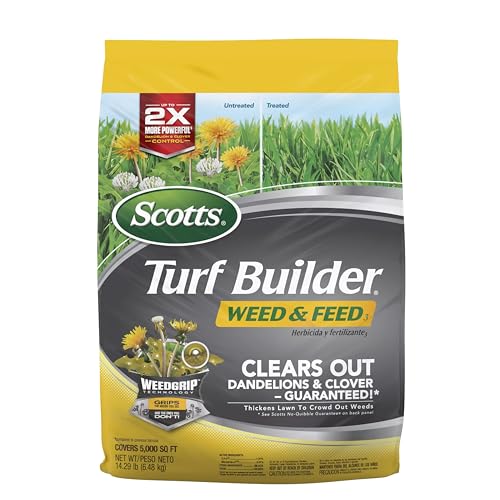
1. Scotts Turf Builder Weed and Feed 3, 5,000 sq. ft.
Our pick — over 4★ from 36,500+ verified ratings; the strongest balance of quality and price.
The crowd-tested all-rounder that tackles dandelions, clover, and dollar weed in one pass.
This 14.3-pound bag of granules covers 5,000 square feet and delivers what Scotts calls “Weedgrip Technology” — a formula that grabs the weeds you see and the ones you do not yet see sprouting. The crowd favorite — with well over 30,000 owners backing it — reports that plantain, dollar weed, and clover start dying in two days to one week, though Japanese clover takes about two weeks. As buyers report: “Effective on plantain, dollar weed, clover (dies in 2 days to 1 week); Japanese clover takes ~2 weeks.”
The trick to making it work is in the prep. You need to water your lawn so the weeds are wet before spreading, then leave the granules undisturbed for two to three days — no watering, no walking on the treated areas — to avoid burn spots. A few owners note that it does not kill actively growing crabgrass, so if crabgrass is your primary enemy, look at a pre-emergent product instead. The fertilizer side feeds the grass to thicken and crowd out future weeds, which is the long-term win.
Compared to the Spectracide liquid below, this granular formula weighs 14.3 pounds versus the Spectracide’s 2.8 pounds, which means a serious arm workout if you are doing a large lawn by hand — though a spreader makes it easy work. For a yard with mixed broadleaf weeds and a desire to feed simultaneously, this is the most tested and reliable entry point in the category.
The must-know timing: Apply when weeds are actively growing and make sure the leaves are damp. Do not water for 48 to 72 hours after — a rain shower counts, so check the forecast before you spread.
Reach for this if: you have a typical suburban lawn with dandelions, clover, and plantain and want a single-product solution backed by tens of thousands of real-world applications.
Think twice if: your yard is infested with crabgrass or you are seeding new grass — the weed killer can harm young seedlings, and this product does not stop crabgrass that is already growing.
2. GreenView Crabgrass Control Plus Lawn Food, 13.5 lb.
The pre-emergent specialist that stops crabgrass before it starts while feeding the lawn for eight weeks.
This is not a standard post-emergent weed killer — it is a combination of a pre-emergent herbicide (crabgrass preventer) and a fertilizer with a 26-0-4 NPK ratio. The GreenSmart Enhanced Efficiency technology provides slow-release nitrogen that feeds the lawn continuously for up to eight weeks, which means fewer applications and a steadier green. The thing buyers praise most is the effectiveness at controlling crabgrass — 35 owners single it out, and another 23 specifically mention crabgrass prevention.
The catch is that this product targets crabgrass and little else. One owner reported that it caused a dandelion explosion in their lawn because the pre-emergent does not affect broadleaf weeds already present. You need to apply it in early spring before crabgrass germinates (when soil temperatures hit about 55°F), and you will likely need a separate broadleaf weed killer for dandelions and clover later. But for the specific job of preventing crabgrass all season long while feeding the grass, this is the most focused tool in the list.
At 13.5 pounds covering 5,000 square feet, one owner said: “Weeds died in 1 day and grass is growing.” That is unusually fast for a granular, indicating the nitrogen hit is immediate while the pre-emergent does its long-term work below the surface.
The honest trade-off: It prevents crabgrass beautifully but will not kill dandelions or clover that are already growing. Pair it with a post-emergent spray for complete yard coverage.
Grab this if: crabgrass took over your lawn last summer and you want to stop it at the source while feeding the grass.
Look elsewhere if: you already have broadleaf weeds popping up — this product is not designed to kill them, and you will be disappointed in the lack of weed kill.
3. The Andersons Premium Weed and Feed 24-0-16, 18 lb.
The heavy hitter with iron for the deepest green you will see all season.
This 18-pound bag of granules covers 5,000 square feet and delivers a 24-0-16 NPK formula that includes both quick-release and slow-release nitrogen. The immediate green-up comes from the fast nitrogen, while the slow-release keeps feeding for weeks. The addition of iron (a micronutrient that deepens green color without excess leaf growth) is what sets this apart — one owner switched from Scotts and reported seeing a noticeable difference in grass color and health after using this.
The Andersons claims this controls over 250 broadleaf weeds including dandelions, and it works on a wide range of grass types: bahia, Bermuda, bluegrass, centipede, fescue, rye, St. Augustine, and zoysia. Do not use it on dichondra or carpet grass. A few owners had trouble with effectiveness on tougher weeds after two applications, and one noted that nutsedge was not controlled (which is typical — most standard feed and weed products do not handle nutsedge).
For someone willing to spend a bit more for a premium blend that includes potassium for root strength, better color, and a broader weed kill list, this is the best upgrade from the basic bags. It is not sold in New York, Florida, California, or Indiana due to local fertilizer regulations.
The standout spec: The 24-0-16 NPK plus iron means you get a richer green than standard 20-0-0 products, and the potassium helps the lawn handle summer heat and drought better.
Buy it for: a lawn that needs a color boost and extended feeding without multiple reapplications — the dual-release nitrogen does the work.
skip it if: you live in NY, FL, CA, or IN (it is restricted there), or if you have a small lawn and want a cheaper liquid option.
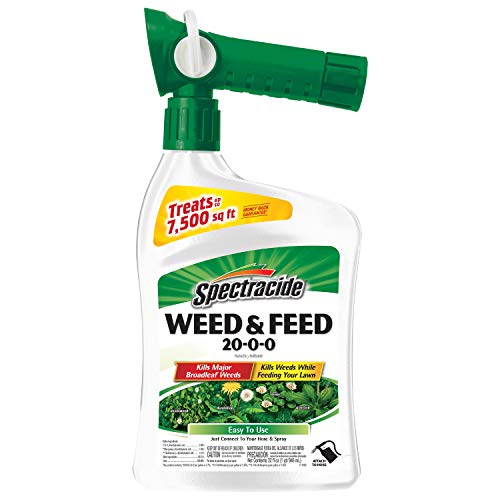
4. Spectracide Weed & Feed 20-0-0 (Ready-to-Spray) 32 fl oz
The lightweight liquid that covers 7,500 square feet per bottle.
At just 2.8 pounds per bottle, this liquid spray covers 7,500 square feet, while the Scotts granular covers 5,000 square feet. That coverage-to-weight ratio makes it the best option if you are treating a large yard and do not want to haul heavy bags. The 20-0-0 nitrogen formulation feeds the lawn while the weed killer handles dandelion, chickweed, knotweed, plantain, clover, mallow, and purslane.
The QuickFlip sprayer is simple: connect your garden hose, grip the lever, and spray. Owners say to avoid applying when temperatures go above 85°F to prevent the weed killer from stressing the grass. The main trade-off is that some tough weeds like lawn violets may require multiple treatments — one owner noted they needed three passes for violets, which are notoriously stubborn. There is also a distinct salty smell that some owners mention lingers for a few days after application.
One owner who compared it to professional lawn services summed it up: “Far cheaper than lawn service and works.” If you hate dragging a spreader around or have a St. Augustine lawn (this product is labeled as safe for St. Augustine), the hose-end liquid is the easiest path to a treated lawn.
Why it wins for large lawns: The coverage per ounce is the highest on this list — 7,500 square feet from a single small bottle that weighs less than three pounds.
Best for: anyone with a lawn between 5,000 and 7,500 square feet who wants a quick hose-end application and does not want to deal with a spreader.
Consider something else if: you need to kill violets or creeping Charlie in one shot — those may require a second or third application, and a granular product with a stronger herbicide blend might be more effective.
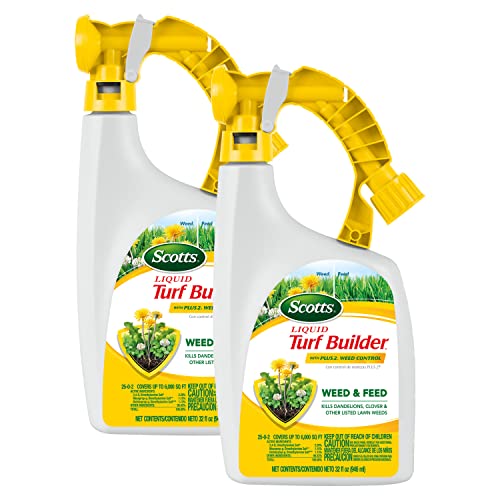
5. Scotts Liquid Turf Builder with Plus 2 Weed Control, 32 oz (2-Pack)
The liquid that kills broadleaf weeds visibly in four to five days — the fastest die-off in this roundup.
This two-pack of 32-ounce bottles is a liquid weed killer plus fertilizer that you hook directly to your garden hose. The easy-click sprayer automatically regulates the mix — you just turn on the water, squeeze the lever, and spray. Owners using it in Central Missouri on a mix of fescue and Bermuda report that yard weeds die in about four to five days and stay gone for months. It targets a long list of broadleaf weeds including buckhorn, chickweed, ground ivy, henbit, knotweed, lambsquarters, oxalis, pigweed, plantain, poison ivy, ragweed, and spurge.
The coverage is split: 6,000 square feet for warm-season lawns and 4,000 square feet for cool-season lawns. One owner noted that it does not kill nutsedge (a common limitation for standard feed and weed products), and some stubborn weeds may need a second dose. But the speed is the headline — one owner said: “Last year, this product rid my backyard of weeds within ten days of application. Simply attach your garden hose to the bottle and turn on the water. The bottle automatically regulates the amount of product released.”
Compared to the granular Scotts Turf Builder above, this liquid version works faster (days instead of a week or two) and targets a wider range of weed species, but the 2-pack is pricier per square foot. If speed of visible results is your priority, this is the one to beat.
The real-world speed: Owners consistently report visible weed die-off in 4 to 5 days, with some seeing a clean lawn in 10 days. That is twice as fast as many granular products.
Choose this if: you want visible weed kill in under a week and like the simplicity of a hose-end applicator that does the mixing for you.
Pass on it if: nutsedge is your primary weed, or if you need the slow-release feeding that a granular product provides over several months.
6. Bonide Liquid Weed & Feed 20-0-0, 32 oz Ready-to-Spray

The entry-level liquid for a small patch of lawn that needs a targeted broadleaf weed spray without mixing.
Bonide’s liquid spray comes in a ready-to-spray bottle that connects to your garden hose with no measuring or mixing required. A single quart treats up to 2,500 square feet, making it the smallest-coverage product on this list — ideal for a postage-stamp front yard or a narrow side strip. The 20-0-0 nitrogen formula feeds the grass while the weed killer controls a solid list of common weeds: black medic, clover, common chickweed, dandelion, dock, English daisy, knotweed, lambsquarters, mallow, mouseear chickweed, oxalis, pigweed, plantain, purslane, and ragweed.
One owner who switched from professional lawn services said: “This is a great product. I used chem lawn services and true green which cost me hundreds of dollars. I spray this product on my lawn twice from spring and towards the end of the summer. Grass is plush, green and weed free.” Another owner with a small lawn noted: “I used this on my small lawn. It worked just as advertised.” The main limitation is coverage — at 2,500 square feet per bottle, you will need multiple bottles for a standard half-acre lot, which makes it less economical than larger-coverage options like the Spectracide or granular bags.
For the price of a budget meal out, you get a simple solution that works on many common warm-season and cool-season grasses including bentgrass, Bermuda, Kentucky bluegrass, fescues, perennial ryegrass, and St. Augustinegrass. The trade-off is that you may need a second application if the heat wave hits before the weeds fully die — one owner paused for an excessive heat wave and planned a follow-up when temperatures dropped.
The honest fit: Best for lawns under 2,500 square feet where you want a quick, cheap, no-mistake application. For larger lawns, the cost per square foot of the bottle climbs quickly.
Reach for this if: you have a small yard or a narrow strip of grass and want to avoid the expense and bulk of a 14-pound bag of granules.
Think twice if: your lawn is larger than 2,500 square feet — you will need multiple bottles, and a granular product designed for 5,000+ square feet gives better value for money.
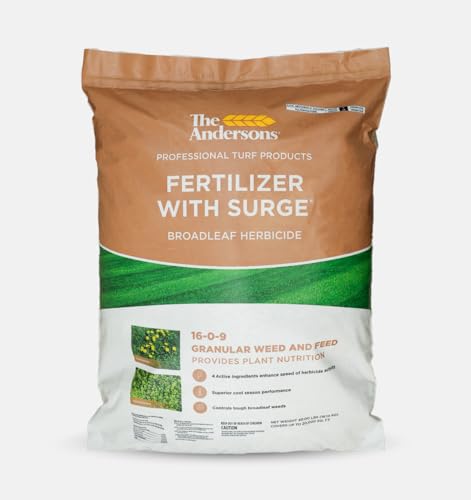
7. The Andersons Professional Surge Weed and Feed 16-0-9, 40 lb.
The professional-grade beast that covers 16,000 square feet — enough for three average suburban lawns in one bag.
This 40-pound bag is a full four-way weed and feed that tackles over 250 common weeds including dandelions, clover, chickweed, and plantain. The coverage is massive at 16,000 square feet, which means you can treat a full acre-sized property without buying multiple bags. The small particle size is designed for more coverage per square inch and superior activation — more granules contact the weed leaves, so the herbicide works faster and more thoroughly.
The split in feedback is instructive: 17 owners praise the greening effect, saying it makes lawns look better than ever. But effectiveness is more mixed — 69 owners have weighed in with mixed results, and 13 specifically call out the value for money as a negative. One owner who switched from Scotts said: “We used Scott’s for years and was not happy with it so we tryed Anderson and we are super happy with it killed the weeds fast.” Another who killed creeping Charlie (a notoriously tough weed) said this product finally worked where pre-emergents failed. However, several owners found no noticeable difference from cheaper brands and would not spend the premium again.
Do not use this on Floratam St. Augustine grass, dichondra, carpetgrass, creeping bentgrass, or turf containing desirable clovers, and it is not sold in New Hampshire or Washington state. For a large property where you want the quality of The Andersons’ professional line and the convenience of a single giant bag, this is the most efficient option. But if you are not sure the extra cost buys better results for your specific weed mix, a smaller-sized product from the same line (the Premium Weed and Feed above) is a safer first test.
The honest trade-off: Massive coverage and professional-grade formulation, but not every owner sees a visible difference over cheaper alternatives — read the mixed reviews before committing to the premium.
Best for: large lawns or small farms (over 10,000 square feet) where a single bag application saves time and the premium price is justified by scale.
Pass on this if: you have Floratam St. Augustine grass, a small yard under 5,000 square feet, or if you are budget-conscious — the value-for-money reviews are the weakest on this list.
8. Jonathan Green Green-Up Weed & Feed 21-0-3, 15 lb.

The fine-particle specialist that feeds for up to three months but gets mixed reviews on weed kill.
Jonathan Green’s Green-Up Weed & Feed uses a fine particle size that the company says is perfect for feeding desirable grass longer while weeds gradually disappear. The 21-0-3 NPK includes potassium for root health, and the slow-release formula feeds for up to three months from one application. It controls over 250 broadleaf weeds including dandelions, chickweed, clover, wild onions, thistle, and poison ivy. The 15-pound bag covers 5,000 square feet when applied with a rotary, drop, or hand-held spreader.
The mixed feedback is the main story here. Out of 19 mentions of effectiveness, the reviews are split — some customers note the lawn looking the best on the street, while others say it did not kill any weeds at all. One owner who applied as directed said: “Applied as directed and noticed the lawn to get nice and green..but so did the weeds! Didn’t kill any weeds…which is what I needed! Disapointing.” Another called it the best fertilizer but acknowledged the bag was small and contained clumps. The greening effect gets 6 positive mentions, which aligns with the general feedback that the fertilizer side works well even if the weed killer side does not always deliver.
At its price point, this competes directly with the Scotts Turf Builder above. The fine particle size is a genuine advantage — more particles per square inch means more even coverage and better contact with weed leaves. But the inconsistency in weed control makes it a risk for someone whose primary goal is eliminating existing broadleaf weeds rather than feeding the lawn. If greening is your main concern and you have minor weed pressure, this is worth trying. If you have a serious dandelion or clover infestation, the Scotts or Spectracide options offer more reliable kill data.
The key insight: The fine particles are a smart design for feeding, but the inconsistent weed kill reviews mean this is a better fertilizer than it is a weed killer. Buy it for greening, not eradication.
Choose this if: your lawn has mild weed pressure and you primarily want a three-month feeding that happens to include some weed control as a bonus.
pass on it if: your yard is dominated by dandelions, thistle, or clover — the weed kill results are too inconsistent to rely on for a full cleanup.
Understanding the Specs
NPK Ratio (The Three Numbers)
The three numbers on any fertilizer bag — like 20-0-0 or 26-0-4 — represent the percentage by weight of nitrogen (N), phosphorus (P), and potassium (K). For a feed and weed product, the first number (nitrogen) drives the green-up and leaf growth of your grass. A higher first number means a stronger nitrogen kick, which thickens the lawn to naturally crowd out weeds over time. The last number (potassium) helps with root strength and drought tolerance. Most feed and weed products have zero phosphorus (the middle number is 0) because lawns typically do not need additional phosphorus unless a soil test says otherwise, and many states restrict phosphorus in fertilizers to reduce runoff.
Active Ingredients in the Weed Killer
The active ingredients in most feed and weed products are phenoxy herbicides like 2,4-D and MCPP (as in the Scotts Turf Builder Weed and Feed 3, which contains 2,4-D at 1.220% and Mecoprop at 0.081%). These chemicals mimic natural plant growth hormones and cause broadleaf weeds to grow themselves to death — they curl, twist, and die over one to three weeks. They are selective, meaning they target broadleaf plants (dandelions, clover, chickweed) while leaving most lawn grasses untouched. The fine print matters: some products with a wider weed list (like Jonathan Green’s 250+ weeds) contain additional active ingredients like dicamba for tougher species like poison ivy or wild onion. Always check the label to confirm it lists the specific weed you are fighting.
Coverage Area and Bag Size
Coverage is listed in square feet and tells you how large a lawn one bag or bottle will treat. The Andersons Professional Surge covers 16,000 square feet from a 40-pound bag, while a bottle of Bonide Liquid covers just 2,500 square feet from 32 ounces. The rule of thumb: measure your lawn’s square footage (length times width of your property minus the house and driveway) and divide by the coverage number to figure out how many units you need. A 5,000-square-foot lawn needs exactly one bag of Scotts Turf Builder Weed and Feed or one 2-pack of the Scotts liquid (warm-season coverage). A granular bag at 14 pounds is heavy to carry but often gives better value per square foot than a liquid bottle.
Safety Intervals: People, Pets, and Watering
Every feed and weed product requires a specific safety interval — usually 24 to 48 hours — after application before people or pets can walk on the treated area. During that window, the weed killer is bonding to the weed leaves and any foot traffic can track the product onto sidewalks or into the house, or cause the granules to burn the grass if they are disturbed before they dissolve. For granular products, the weeds must be wet from morning dew or light watering before you spread, then you must not water again for 2 to 3 days to avoid washing the granules off the weed leaves. Liquids usually require that you do not water for 24 hours post-spray. Always check the label for your specific product’s dry time and pet re-entry interval.
FAQ
Can I apply feed and weed when I am seeding new grass?
How long does it take to see weeds die after applying feed and weed?
Is feed and weed safe for St. Augustine grass?
Can I use feed and weed on a wet lawn?
Will feed and weed kill crabgrass?
How often should I apply feed and weed to my lawn?
What is the difference between feed and weed and plain fertilizer?
Can feed and weed damage my flower beds or vegetable garden?
Do I need to water in granular feed and weed after application?
Is feed and weed safe for pets?
Final Thoughts: The Verdict
For the majority of shoppers, the feed and weed for lawns winner is the Scotts Turf Builder Weed and Feed 3 because it has the highest volume of real-world owner feedback and consistently reliable results against the most common lawn weeds — dandelions, clover, and dollar weed — while feeding the grass to thicken up naturally. If you want a faster-acting liquid with broader spray coverage, grab the Spectracide Weed & Feed for its 7,500-square-foot bottle and easy hose-end application. And for the largest acreage or the deepest professional-grade green-up, the The Andersons Professional Surge covers 16,000 square feet in a single pass and includes iron for a visibly richer color that four-season lawn lovers appreciate. No matter which you choose, the single most important step is reading the label for your grass type and following the dry-time and watering instructions — skipping that step is the number one reason a feed and weed fails.
How We Picked
We do not accept paid placement. Every pick is matched to a real buyer and a real use-case; we do not hands-on test units.
Sources & Methodology
Specifications: manufacturer listings and product documentation. Review insights: verified customer reviews, as of July 2026. Pricing: not shown on this page (it changes often); check the current price via the retailer link.
As an Amazon Associate, Lawn Gear Lab earns from qualifying purchases. This does not affect which products we feature.