
Specs are compiled from manufacturer listings and verified buyer reviews and can change over time — please confirm the key details on the product page before buying.
If your hibiscus has gone from a tropical showpiece to a leafy green blob with zero blooms, you are not alone. The right fertilizer is the one thing that flips that switch back — but with granular, liquid, and spike options all claiming to be the best, it is easy to pick the wrong one and watch your plant yawn. This guide cuts through that noise so you can match the exact formula to what your plant actually needs.
I’m Rikta — the founder and writer behind Lawn Gear Lab. This guide is built by comparing the manufacturers’ published specifications and the patterns across verified customer reviews, so you get each pick’s real strengths and trade-offs instead of marketing spin.
Every product here was chosen because it delivers measurable results for the good fertilizer for hibiscus that transforms tired leaves and stubborn buds into the lush, flower-packed plant you were promised.
Our Picks at a Glance

How To Choose The Best Good Fertilizer For Hibiscus
Hibiscus are famously hungry plants. They burn through nutrients fast, especially when they are pushing out those dinner-plate-sized blooms. Feed them the wrong balance, and you get lush leaves with zero flowers. Feed them right, and the plant goes into overdrive.
N-P-K Ratio — The Bloom Decoder
The three numbers on a fertilizer bag tell you everything. Nitrogen (the first number) drives leaf and stem growth. Phosphorus (the middle number) fuels root development and flower formation. Potassium (the last number) supports overall health and disease resistance. For hibiscus, you want a middle number that is high relative to the first — a “bloom booster” formulation — because that phosphorus is what triggers bud set. A ratio like 17-7-10 or a balanced blend with improve phosphorus will produce more flowers than a high-nitrogen lawn food ever will.
Granules vs Liquid vs Spikes — How You Feed Matters
Granular fertilizers are the low-maintenance option. You sprinkle them on top of the soil, and they break down slowly with each watering, feeding the roots over weeks. Liquids give you speed — they are absorbed almost immediately, making them the go-to for a plant that is struggling or needs a mid-season boost. Spike-style capsules offer the easiest application of all: just push them into the soil near the roots and water. The best choice depends on your schedule. If you want to fertilize once and walk away, pick granules. If you want to see results in days, pick a liquid.
Organic vs Synthetic — What Your Soil Actually Gets
Organic fertilizers feed the soil biology first — the microbes, fungi, and worms that then break down nutrients into forms the plant can use. This builds long-term soil health and is harder to overdo (it is very difficult to “burn” a plant with organics). Synthetic fertilizers feed the plant directly and fast, but they do little for the soil itself and can cause salt buildup or leaf burn if over-applied. Neither is “better” — it is a choice between instant speed and long-term soil vitality. Many experienced hibiscus growers keep a synthetic granular on hand for the main season and use an organic liquid for spot-treatments.
Quick Comparison
| Model | Best For | Form | Weight / Size | N-P-K Ratio | Amazon |
|---|---|---|---|---|---|
| BGI HIBISGAIN 10lb★ Best Overall | Heavy-Duty Feeding | Granules | 10 pounds | — | Amazon |
| Fertilome 17-7-10 1.5lbTop Performer | Mid-Season Bloom Boost | Granules | 1.5 pounds | 17-7-10 | Amazon |
| TPS Nutrients 32 oz Liquid | Quick Rescue & Pot Feeding | Liquid | 32 fl oz | — | Amazon |
| Great Big Plants 32 oz Booster | Multi-Plant Gardens | Liquid | 32 fl oz | — | Amazon |
| Dr. Earth 1 lb Organic | Organic & Pet-Safe Gardens | Powder | 16 ounces | 5:5:2 | Amazon |
| HiThrive 16 oz Liquid | Entry-Level Portable Feed | Liquid | 16 fl oz | — | Amazon |
| EarthPods 100 Capsules | Mess-Free Consistent Care | Capsules | 100 count | — | Amazon |
In‑Depth Reviews
1. BGI Fertilizers HIBISGAIN 10lb Bag
Our pick — over 4.5★ from 400+ verified ratings; the strongest balance of quality and price.
The king-sized bag that commercial growers in Homestead, FL, have relied on for years.
This is the heaviest hitter on the list. The BGI HIBISGAIN is a 10-pound bag. Liquid bottles are 16 ounces and granular bags are 1.5 pounds. It is a granular formula developed specifically for hibiscus growing habits, and it is the same stuff commercial growers in Florida use. You apply it directly on top of the soil and mulch — zero mixing required — and it releases steadily with every watering. The bag itself is practical, with a resealable top and a cut-out handle that makes hauling it around the yard genuinely easier. Buyers report that a single dose turned plants around completely. After using it, one person described their plant as having “exploded in growth and is covered with flowers.” Another said that after their hibiscus stopped blooming and leaves turned yellow, this brought it right back. The only catch is the smell — it is a natural organic fertilizer, and it smells like it. One buyer put it plainly: “It is Stinky but It Works.” That is the trade-off for something this potent.
What wins people over
- Double-digit pound bag that lasts all season — a 5-star bargain per feeding
- No mixing or measuring, just sprinkle and water
- Effectiveness is the most-praised quality by a huge margin — it actually produces the flowers
The real trade-off
- The natural ingredients give it a strong odor that not every gardener loves
- Granular action is slower than liquid for a quick turnaround on a sick plant
The crowd-pleaser: If you want a no-mix, high-volume fertilizer that turns your hibiscus into a bloom factory, this is the one.
Think twice if: You need immediate results on a struggling plant — a liquid would hit faster, but you lose the bulk value.
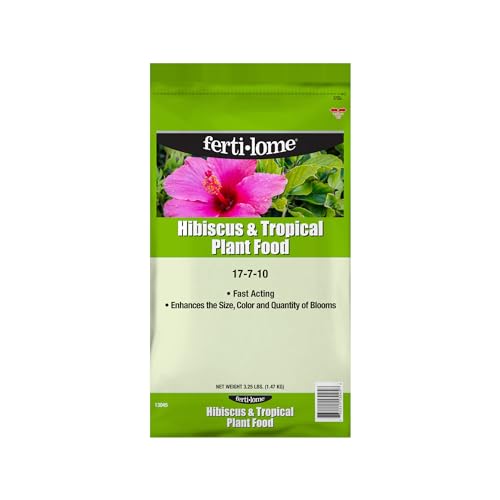
2. Fertilome 17-7-10 3.25 lbs
The fast-acting granule that one long-time owner says produced a decade’s best blooms.
Fertilome brings a specific, ratio-driven approach to feeding. The N-P-K is 17-7-10 — that is 17% nitrogen for leaf vigor, 7% phosphorus for root and bloom support, and 10% potassium for overall plant health. The high nitrogen lets it give leaves a deep green color while the phosphorus keeps the flowers coming. The routine is straightforward: apply every other week until you see blooms, then switch to once per month during the blooming period. The results are striking. One buyer who had owned their hibiscus for ten years said they “saw more blooms this year than I have in 10 years after using this fertilizer” and noted the flowers were huge and the plant was very green. That kind of long-term perspective carries weight. The bag is 3.25 pounds — not as massive as the 10-pounder above, but still enough to carry several months of feeding for a potted plant or a small hibiscus bush. On the downside, while effectiveness gets the top praise, opinions on value for money are mixed. Some feel the smaller bag size does not justify the price point compared to bulk alternatives.
Best for routine feed: If you follow a calendar schedule and value a proven ratio that keeps both leaves and flowers thriving, this granular is tough to top.
Watch out for: The bag size is modest — heavy feeders with multiple large hibiscus may run out faster than expected, making the price per feeding higher than a bulk bag.
Grab this if: You want a straightforward, fast-acting granule with a clear feeding schedule that makes your hibiscus “very green and healthy” with huge flowers.
skip it if: You need a single bag to cover a large number of in-ground plants all season — you would be better off with a larger bulk quantity.
3. TPS Nutrients 32 oz Liquid
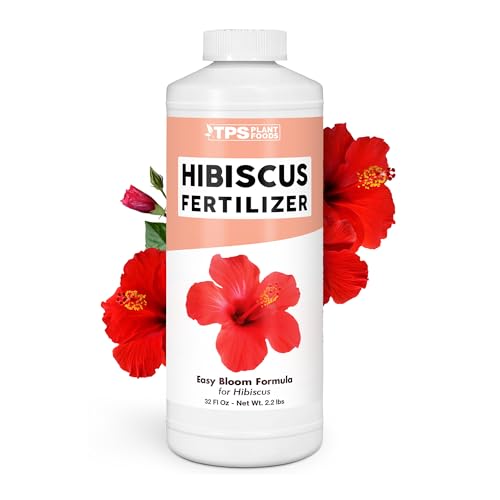
The liquid that saved a bare hibiscus tree and had it blooming in three weeks.
TPS Nutrients makes a concentrated liquid that you mix with water at a 1:28 ratio — that is one part fertilizer to 28 parts water, so a 32-ounce bottle goes a long way. It is formulated specifically for tropical flowering plants, and its biggest strength is speed. While granules take days to break down, this liquid reaches the roots within hours. The results come fast. One owner described how a bare, sickly hibiscus tree had new buds in three weeks and was covered in leaves and buds by week four or five. Another with a braided hibiscus that had buds but refused to bloom saw it “bloom the day after applying.” The bloom category is the top positive aspect by far — owners see flowers, fast and big. The catch is that mixed opinions exist on value for money. A few owners feel the price per bottle is high when you consider the application frequency suggested (every 1-2 weeks in spring and summer). Still, for a potted hibiscus on a patio, a single bottle covers the entire season.
Why it is a favorite
- Works in days — a perfect rescue tool for a plant dropping buds or refusing to bloom
- Easy to mix and measure; no scooping or digging
- Also effective on Bougainvillea, Texas Star Hibiscus, and other tropicals
The honest nitpick
- The cost per ounce is higher than granular, so feeding a large in-ground garden gets expensive
- A few owners think the manufacturer’s recommended frequency is too aggressive for the price
Best for pot plants: If you grow your hibiscus in a container on a deck or patio, this liquid is the ideal quick-feed partner that keeps flowers coming.
Not for bulk feeding: Use this for a few special plants, not for heavily feeding a whole hedge of in-ground hibiscus.
4. Great Big Plants 32 oz Booster
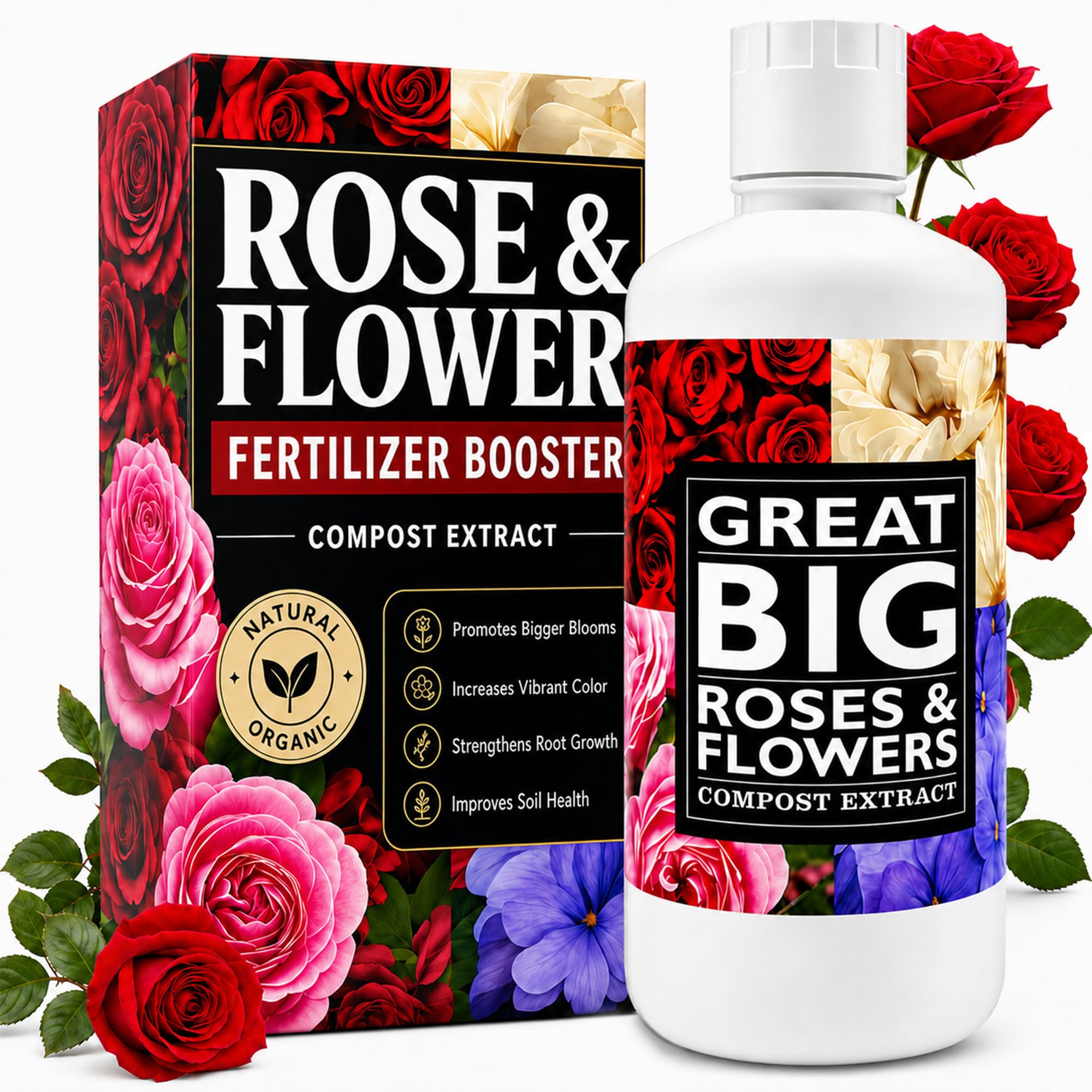
The broad-spectrum booster that open up nutrients across your entire garden.
This one does not act like a typical fertilizer. It is a soil activator that delivers humic acids, seaweed, and over 70 chelated trace minerals into the root zone — converting soil nutrients that are already sitting there into forms the plant can use. Think of it as open up the potential of your existing fertilizer program, not just piling on more N-P-K. It works across a wide range of plants: roses, hydrangeas, citrus, fruit trees, and hibiscus. The manufacturer recommends mixing 4 ounces per gallon of water, meaning the 32-ounce bottle makes about 8 full applications. The effectiveness is the most-praised quality by a huge margin — the crowd favorite. One owner with years of experience said it “transformed small bushes into large, healthy ones” with abundant blooms. The downside is clear: the value for money is the most-mentioned negative aspect, and the bottle design (a wide mouth) makes measuring into a watering can messy — one buyer called it a “terrible jug” and described cringing every time they spilled it.
Perfect for multi-plant gardens: If you have roses, hibiscus, citrus, and hydrangeas all in the same space, this single product replaces several separate feeds.
Be aware of: The bottle pours poorly, and the price raises eyebrows — but for owners who have used it, the results make it a staple.
Reach for this if: You want to improve your entire garden’s soil health, not just throw nutrients at one plant.
Think twice if: You only need a basic hibiscus feed and do not want to pay extra for the soil-building extras.
5. Dr. Earth 1 lb Organic
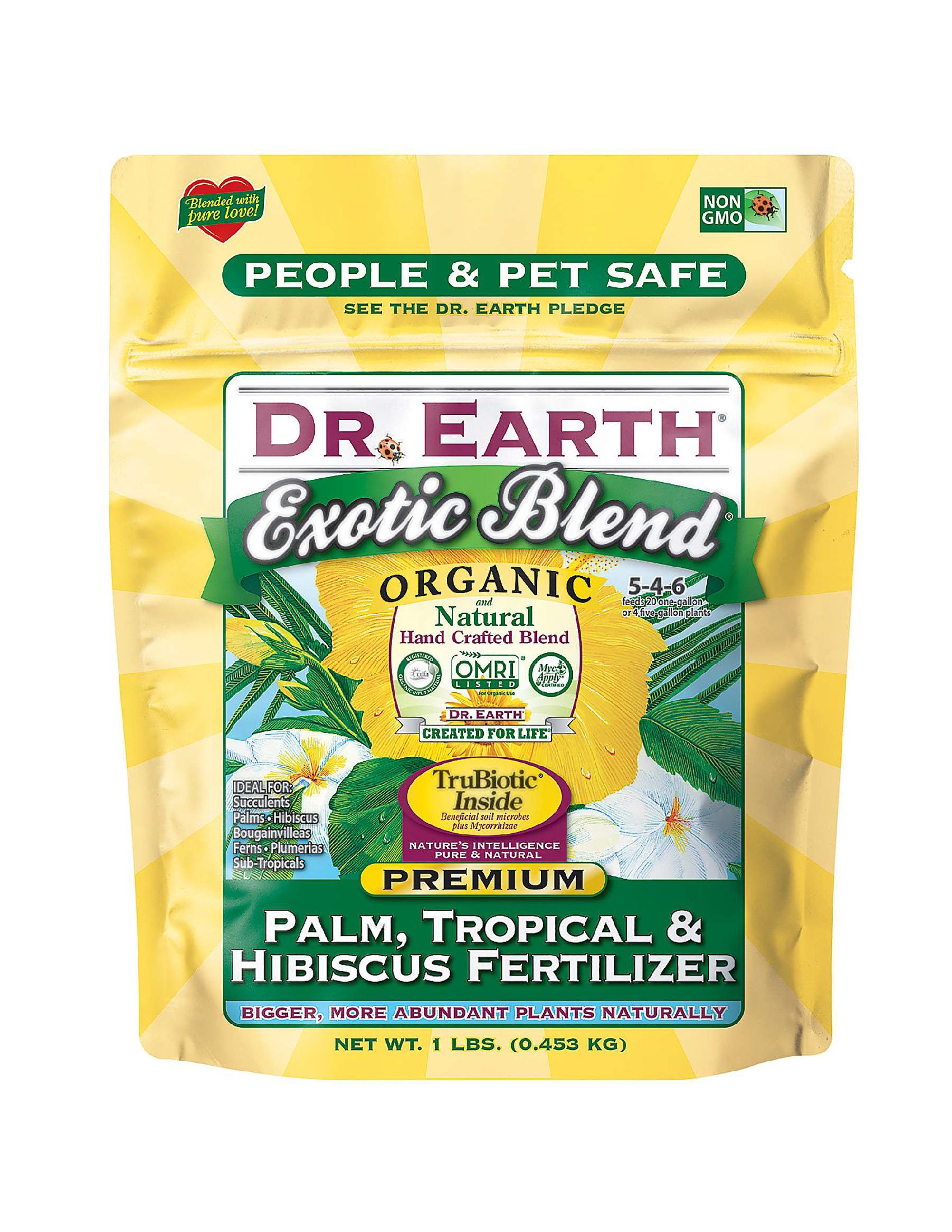
The Non-GMO Project Verified organic that is safe for people and pets.
Dr. Earth’s Exotic Blend takes a completely different approach. It is a powder that carries the OMRI (Organic Material Review Institute), CCOF, and Non-GMO Project Verified seals — the highest level of organic transparency. It is handcrafted from human and feed grade ingredients with no synthetic chemicals, no GMO-infested chicken manure, and no toxic ingredients. The formula is a 5:5:2 N-P-K, which is quite low compared to the synthetic options, because this product’s purpose is to feed the soil. It enriches the soil biology with multi-minerals, proteins, carbohydrates, humic acids, and trace elements. Results are not overnight — this is a slow, gentle approach — but one owner said their bougainvillea “started to bloom one week after using.” Another was so impressed they “refuse to use any other brand.” The consistency is powdery and light, however, and a few owners note it can blow away easily if you apply it on a breezy day or on top of dry soil. It also looks like sawdust, which throws some people off at first. The bottle is just 1 pound, so covering a large hibiscus hedge with it takes multiple units.
What stands out
- Certified organic and completely safe for kids, cats, and dogs — no chemical worry
- No odor — a rare thing for organic plant food
- Gentle enough that it is nearly impossible to burn a plant with it
The trade-off
- The 5:5:2 ratio is low — you will need to feed more frequently than with a synthetic
- The powder can fly away in the wind or wash away before it soaks in
Perfect for organic gardeners: If you never want synthetic chemicals touching your soil or your family, this is the most verified clean option on the list.
pass on it if: You need fast, dramatic results on a tired plant — this is more of a long-term soil health play than a bloom emergency fix.
6. HiThrive 16 oz Liquid
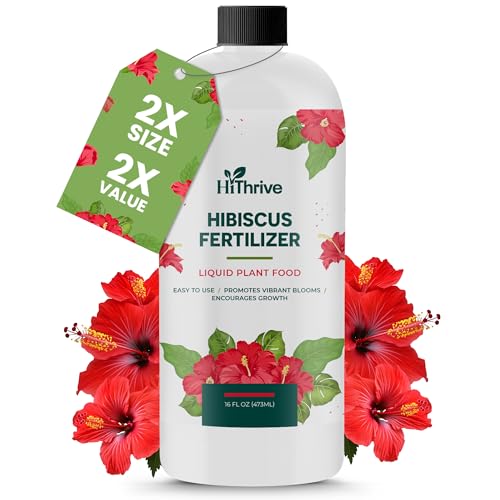
The lightweight liquid that turns yellowing leaves around in a single week.
This is the entry-level, low-commitment pick for someone who just wants to see if a hibiscus-specific fertilizer makes a difference. The HiThrive 16-ounce bottle makes 16 gallons of feed when mixed with water — a 1:128 dilution that means the bottle punches well above its size. It is a liquid, so it hits the roots fast. One owner described their situation perfectly: “My hibiscus were getting yellowish and they refused to bloom. I used this fertilizer and they shaped up in a week or so.” Another said a dying plant “came back to life and it is flowering.” The effectiveness gets the most praise, followed closely by blooming. The formula is balanced with nitrogen for leaves, phosphorus for roots, and potassium for flowers, plus micronutrients. At 16 ounces, the bottle is small and light (1.3 pounds) — easy to store and easy to carry out to the garden. The occasional complaint is that for heavy feeders with multiple hibiscus plants, the bottle does not last long. But for a few patio pots or a single specimen plant, this is a budget-friendly way to get results.
Great for beginners: If you are new to feeding hibiscus and want a low-risk, fast-acting option that costs less than a lunch out, this is your starter kit.
The limit: For a hedge of hibiscus or a large garden, you will run through this bottle quickly and end up buying something bigger.
Grab this if: You have one or two hibiscus plants that have lost their color and you want to see if a targeted feed fixes it.
it’s not for you if: You need bulk volume for a whole garden bed — the larger 32-ounce version or a granular bag would serve you better.
7. EarthPods 100 Capsules
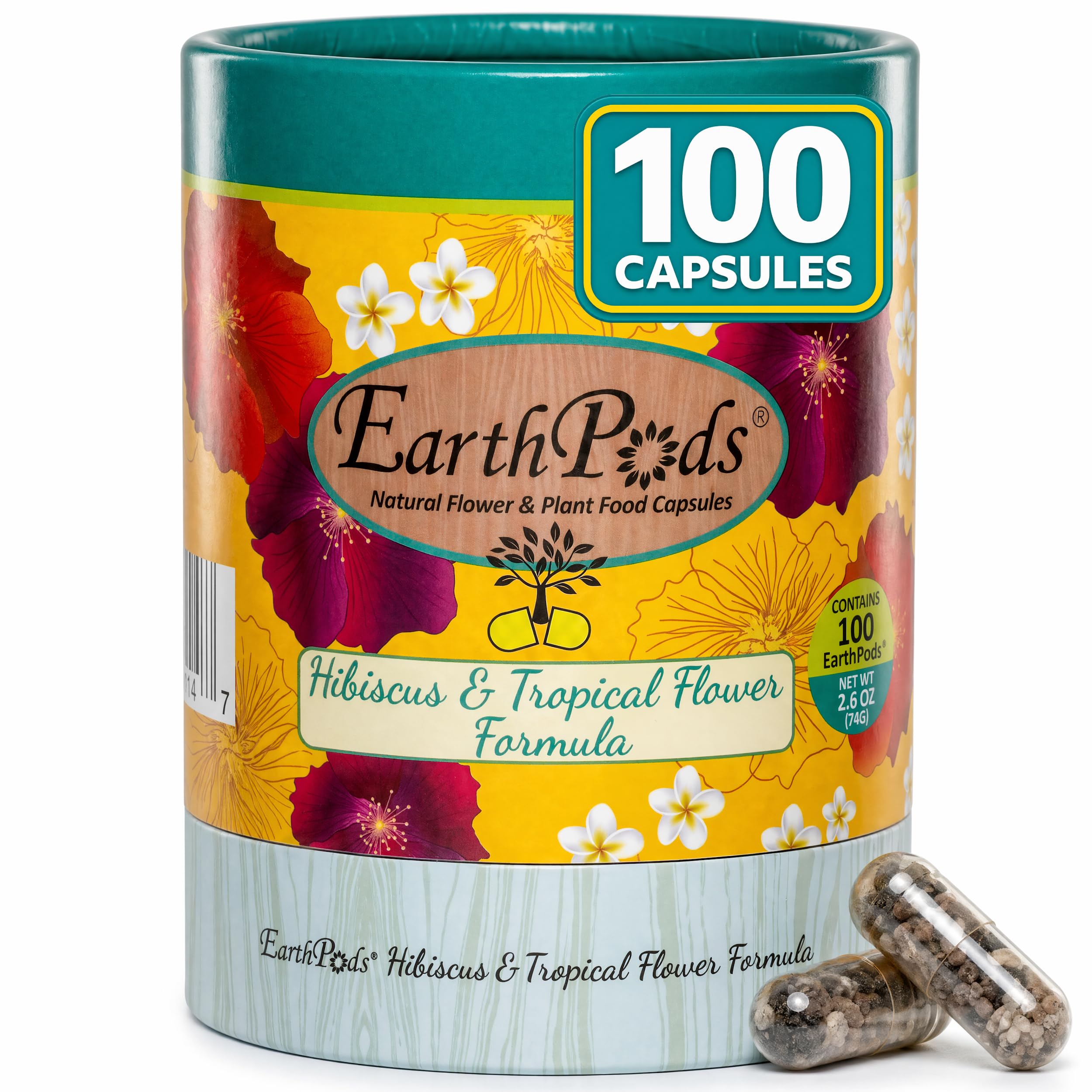
The push-in capsule that delivers slow-release food with zero mess or smell.
EarthPods are a completely different format: capsules you push directly into the soil near the stem. No measuring, no mixing, no liquid pouring, and no smell. Each tube contains 100 capsules, which the brand says is a 4-year supply for one hibiscus. You use 1-2 capsules for small pots, 2-4 for medium, and 4-8 for large patio plants, repeating every 2-3 weeks in the growing season. The capsules are made from worm castings, humic acids, kelp, rock minerals, and beneficial soil biology. They dissolve slowly, so the roots get a steady, gentle supply of nutrients without the risk of salt burn. One owner noted a “visible improvement in 2-4 days” after applying. Another watched a hibiscus with bud drop and yellow leaves turn around in two weeks. The application is so simple that one person with no gardening confidence said “I definitely do not have a green thumb and they are thriving.” The most common caution is the price — the upfront cost is higher than a bag of granules. But for someone who hates measuring and mixing or who has a sensitive plant that burns easily, the convenience is worth it. The tube is also recyclable paperboard with zero single-use plastic.
Why people love them
- No measuring — push into soil, water, done
- Slow-release format prevents root burn even on sensitive plants
- Odorless, vegan-friendly, and packaged without plastic
The honest drawback
- The cost per feeding is higher than granules — you pay for the engineering of the capsule
- Large in-ground hibiscus may need 4-8 capsules per feed, which eats through the 100-count faster
Best for the forgetful gardener: If you want a “feed a plant in 5 seconds” solution that protects against over-fertilizing, the EarthPods are a standout.
Not for budget bulk: If you are feeding a large garden of hibiscus, you will save money with a granular bag rather than pouring individual capsules into each pot.
Understanding the Specs
N-P-K Ratio
This is the three-number code on every fertilizer bag (e.g., 17-7-10). Nitrogen (first number) drives leaf and stem growth — too much and you get a lush green plant with no flowers. Phosphorus (middle number) fuels root growth and flower formation — this is what you want high for hibiscus. Potassium (last number) supports overall plant health and disease resistance. A “bloom booster” typically has a middle number that is at least half the first number.
Granular vs Liquid
Granular fertilizers are dry pellets you sprinkle on the soil. They break down slowly with water, feeding the plant over weeks. They are the best choice for a “low-maintenance” routine. Liquid fertilizers are concentrated solutions you mix with water. They are absorbed immediately by the roots, making them ideal for a quick rescue or a mid-season boost when your plant is actively blooming. The trade-off is that liquids require more frequent application.
Slow Release vs Fast Acting
Slow-release fertilizers (often coated granules or capsules) break down gradually, feeding the plant over 4-8 weeks. They are forgiving — you cannot accidentally overfeed. Fast-acting fertilizers (most liquids and some uncoated granules) hit the roots in hours or days. They are powerful for a quick turnaround but carry a risk of root burn if you over-apply. The best hibiscus growers often keep a slow-release granular for the main feed and a fast-acting liquid for the bloom push.
Organic vs Synthetic
Organic fertilizers (worm castings, kelp, bone meal, etc.) feed the soil microbes first. The microbes then break down the nutrients into forms the plant can absorb. This improves long-term soil health and is very difficult to overdo. Synthetic fertilizers feed the plant directly with manufactured mineral salts. They work faster but do not improve soil biology and can leave salt residues that burn roots if applied too heavily. For hibiscus, many owners use a synthetic granular for the growing season and supplement with organic liquid for a boost.
FAQ
What is the best N-P-K ratio for hibiscus plants?
Should I use granular or liquid fertilizer for my hibiscus?
How often should I fertilize my hibiscus during the growing season?
Can I use rose fertilizer on hibiscus?
Will a liquid fertilizer burn my hibiscus if I use too much?
How long does it take to see results from a new fertilizer?
What fertilizer works best for potted hibiscus versus in-ground plants?
Does organic or synthetic fertilizer make a difference in flower size?
Final Thoughts: The Verdict
For the majority of shoppers, the good fertilizer for hibiscus winner is the BGI Fertilizers HIBISGAIN 10lb Bag because its 10-pound bulk value, no-mix application, and proven results on even the most stubborn plants make it the crowd favorite across hundreds of owners. If you want a fast-acting liquid that turns a struggling plant around in days, grab the TPS Nutrients 32 oz Liquid. And for a completely mess-free capsule that protects against root burn and lasts for years, the EarthPods Tropical Fertilizer Spikes are the one to reach for.
How We Picked
We do not accept paid placement. Every pick is matched to a real buyer and a real use-case; we do not hands-on test units.
Sources & Methodology
Specifications: manufacturer listings and product documentation. Review insights: verified customer reviews, as of July 2026. Pricing: not shown on this page (it changes often); check the current price via the retailer link.
As an Amazon Associate, Lawn Gear Lab earns from qualifying purchases. This does not affect which products we feature.