
Specs are compiled from manufacturer listings and verified buyer reviews and can change over time — please confirm the key details on the product page before buying.
Forget the frustration of uneven stripes across your lawn. Whether you are seeding a new patch, feeding an existing lawn, or de-icing a walkway in winter, the right spreader determines whether you get a lush, even green or a blotchy mess of clumps and missed spots. The choice boils down to three decisions: body-slug vs handheld vs walk-behind, manual vs battery power, and how much weight your back can handle.
I’m Rikta — the founder and writer behind Lawn Gear Lab. This guide is built by comparing the manufacturers’ published specifications and the patterns across verified customer reviews, so you get each pick’s real strengths and trade-offs instead of marketing spin.
Here is how to find your match among the nine top-rated options for this season. We walk through every competitor to help you confidently pick the best garden fertilizer spreader for your yard size, your body, and your specific material.
Our Picks at a Glance


How To Choose The Best Garden Fertilizer Spreader
The spreader you choose dictates how evenly your seed lands and how much your arms ache afterward. Here are the three factors that separate a great day in the yard from a frustrating chore.
Match Hopper Capacity to Your Yard Size
A 5-lb handheld spreader keeps you nimble for small patches but means constant refills on a half-acre lawn. A larger walk-behind with a 40-lb or 50-lb hopper covers vast ground fast but is a heavy machine to push around. Balance capacity against your total square footage.
Manual Crank vs Battery Power
A hand-crank spreader gives you total feel — you can speed up or slow down the rate by turning faster or slower — but it demands constant arm motion. A battery-powered spreader lets you pull a trigger and walk, which is a standout if you have a bad back or a large area to cover, though it means owning a compatible tool battery.
Spread Pattern: Broadcast vs Drop
A broadcast spreader flings material in a wide arc (5 to 12 feet wide), covering ground quickly but throwing some product onto driveways or flower beds. A drop spreader deposits material straight down in a narrow path, making it ideal for precise, edge-to-edge application in narrow strips or near garden borders.
Quick Comparison
| Model | Best For | Weight | Hopper Capacity | Power & Drive | Amazon |
|---|---|---|---|---|---|
| Solo 421★ Best Overall | Bulk feeding on medium-large lawns | 5.5 lb | 9 kg | Manual crank, enclosed metal gearbox | Amazon |
| Brinly 5lbBest Lightweight | Precise spot spreading in tight spaces | 1.59 lb | 5 lb | Manual crank, enclosed gears | Amazon |
| Jonathan Green Hand BroadcastBest Ergonomics | Bare-spot seeding in small yards | — | 5 lb | Manual crank, ergonomic handle | Amazon |
| Uniqwamo Power Spreader | Fast power-driven covering on small-medium lawns | 2.81 lb | 3 L | Battery-powered (DeWalt/Milwaukee) | Amazon |
| Rozlchar Power Spreader | Switch-free power spreading up to 5,000 sq. ft. | — | — | Battery-powered (DeWalt 20V/60V) | Amazon |
| Amazon Basics Fertilizer Spreader | Efficient walk-behind coverage at low cost | 8.86 lb | 33 lb | Push, multi-gear system | Amazon |
| Garden Tailor Compost Spreader | Spreading peat moss and compost over bare lawns | 27.3 lb | 30 inch basket | Push, metal mesh roller | Amazon |
| EarthWay 2600A-PLUS | Residential lawn with rough terrain | 15 lb | 40 lb | Push, 3-hole drop system | Amazon |
| EarthWay 2150 Commercial | Heavy-duty commercial-grade applications | 25 lb | 50 lb | Push, 3-hole drop, enclosed gearbox | Amazon |
In‑Depth Reviews
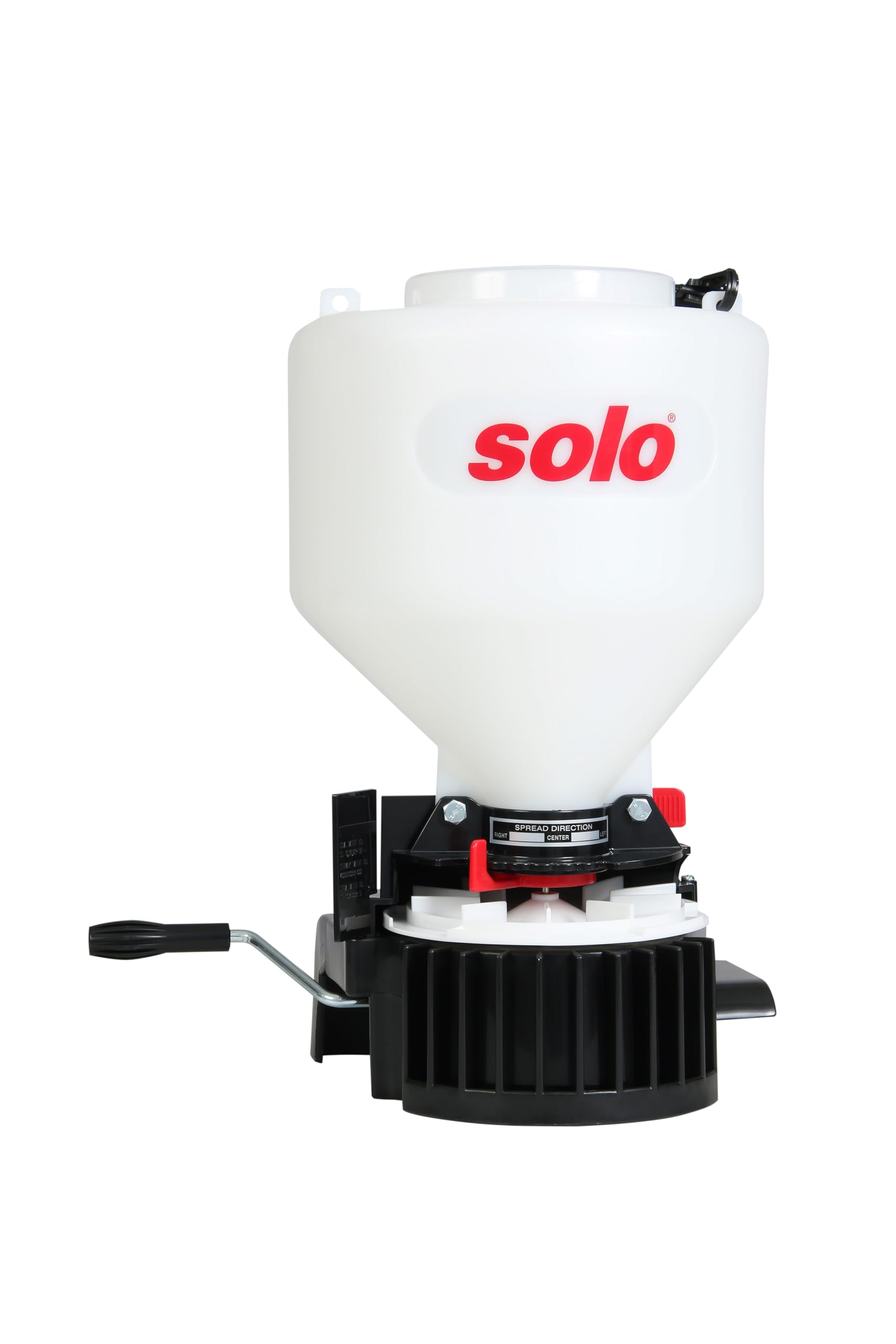
1. Solo 421 9 kg Capacity Manual Spreader
Our pick — over 4.5★ from 250+ verified ratings; the strongest balance of quality and price.
The body-slung workhorse that does not bog down, no matter what you toss in the hopper.
If you have a medium-to-large lawn and hate stopping to refill, the Solo 421 is your machine. Its 9 kg capacity is a league apart from the tiny handheld options, and the secret to its reliability is the fully enclosed gearbox packed with lubricated metal gears. That metal-on-metal design means the crank turns smoothly season after season, unlike plastic gears that crack. Buyers report using it for everything from grass seed to “long acting ant killer” and find it “easy to use smooth movement and holds a lot of seed.”
The adjustable strap lets you sling the 5.5-pound hopper cross-shoulder, distributing the weight evenly rather than hanging off one hand the way a 5 lb handheld does. The difference is night and day — at 5.5 lb, it is just over three times heavier than the 1.59 lb Brinly, but because it hangs from your shoulder, you actually feel less fatigued over a full session. A 6-inch screw-on cap keeps material sealed from rain, and the adjustable drop rate and direction give you fine control over the pattern.
Why it wins
- Massive 9 kg hopper for fewer refills
- Lubricated metal gearbox lasts years
- Adjustable shoulder strap for balanced carry
A fair trade-off
- At 5.5 lb, hopper is heavy on its own — do not overfill the silo to protect your neck
Grab this if: you want one spreader that can handle several seasons of feeding, seeding, and even ant-killer duties without the motor dying or the crank jamming.
Look elsewhere if: your yard is a tiny city strip under 500 sq ft — the 9 kg hopper and slung design are overkill for a quick scatter on a townhouse patch.
2. Brinly 5lb All-Season Handheld Spreader
The handheld featherweight that disappears in your hand for edge work.
You can scoop fertilizer straight from the bag and spread it one-handed along sidewalks and tight side-yard strips, thanks to the Brinly’s reinforced contoured lip and its 1.59-pound weight — a full 3.5x lighter than the Solo 421’s hopper alone. That light weight lets you maneuver it with one hand where a walk-behind cannot fit. It holds up to 5 lb of material and flings it in a 5-ft variable flow pattern. Owners mention it is a solid replacement for crankier models, noting one “replaced another handheld seed spreader that was clumsy and inconsistent.”
The big catch is weight distribution. At full capacity, a 5-lb load plus the 1.59 lb unit means you are carrying over 6.5 pounds in one hand. The 3-hole drop shut-off and adjustable flow gate work reliably for seed and fertilizer, but some owners find the spread pattern uneven — product “builds up and drop straight down” on the left side, according to a few users. Stick to this for small precision patches, not an entire lawn.
What works
- Extremely light at 1.59 lb — easy to carry and store
- Contoured scoop lip for fast filling
- Extra-long crank and ergonomic trigger handle
Keep in mind
- Spread pattern can be uneven on the left side with certain materials
- 5-lb full load feels heavy in one hand after extended use
Reach for this when: you need a precise spot-spreader for edging, flower beds, or de-icing a single walkway — the light weight makes one-hand operation easy.
skip it if: your main job is covering a full lawn, where the uneven left-side drop and hand fatigue will slow you down.
3. Jonathan Green (10947) Hand Broadcast Spreader
The broadcast spreader that saves your shoulder with a smart forearm brace.
Jonathan Green solved the problem of hand-crank fatigue with an ergonomic handle that transfers the weight to your forearm rather than dangling from your fingers. This makes the 5-lb capacity feel much lighter during a full lawn pass. The broadcast pattern covers a generous 10-ft width, so you can walk a pattern and fill bare spots fast. A full hopper covers up to 1,500 sq ft per load — enough for small to mid-sized yards without constant trips to the bag. Owners think it is “easy to hold and doesn’t fatigue your hand or arm” and love that it handles both grass seed and granular fertilizer without clogging.
The material quality is solid, with a plastic hopper and handle that clean up easily with a hose. Like many handhelds, the 5-lb capacity limits it to smaller tasks. But for the homeowner who wants a comfortable spot-seeder that does not cause back strain, this is the most thoughtful design at this price.
Best for: the weekend warrior with a small-to-medium lawn who wants to treat bare spots without the pain of a dangling hand-crank — the forearm support really works.
Think twice if: your yard requires more than two full hopper loads per session, where a walk-behind or slung unit saves time.
4. Uniqwamo Handheld Power Spreader (for Dewalt)

The battery-powered spreader that makes crank-arms a thing of the past.
If you already own Dewalt or Milwaukee tool batteries, the Uniqwamo transforms spreading from a manual arm workout into a walk-and-squeeze cruise. It fits Dewalt 20V/60V batteries (DCB200, DCB203, etc.) and also works with the M18 platform — buyers confirm it “works with Milwaukee M18 (also Dewalt/Makita).” The 3-liter hopper is compact, but the power is where this shines: 6 speed adjustments for the spinning disc and 8 control settings for the drop chute, plus a 125-degree adjustable sowing disc that lets you steer material away from patios. One owner covered 13,000 sq ft with just 1 lb of tiny white clover seed, reporting it is “fantastic for small seeds.”
The machine is relatively small at 10 x 6 x 9 inches, so it fits in a garage shelf. A couple of customers note that with damp material, the flow can cake and need a shake to resume — not a deal-breaker but note in humid climates. Battery and charger are not included, so this is a tool-only purchase for those already in the ecosystem.
Strengths
- Zero hand-cranking — just pull the trigger and walk
- Compatible with Dewalt 20V/60V and Milwaukee M18 batteries
- Two-control precision: drop chute and motor speed work independently
Weaknesses
- Small 3L hopper requires frequent refills on larger lawns
- Damp material can cake inside and need manual shaking to resume flow
Perfect if: you have a Dewalt or Milwaukee battery collection and want to skip the cranking for fast, precise seeding and fertilizing.
Pass if: you need a big hopper for all-day coverage or you have no compatible tool batteries — adding a battery and charger pushes the total cost higher.
5. Rozlchar Power Spreader (for Dewalt)

The trigger-driven spreader built for a full season of fertilizing without the arm ache.
The Rozlchar shares the same battery-powered concept as the Uniqwamo but adds an edge-protection paddle dial that stops material from hitting non-lawn areas like flower beds. It works exclusively with Dewalt 20V/60V batteries (not included) and covers up to 5,000 sq ft per charge. The 8 seed-release settings and 6 speed adjustments give you a lot of control, and owners praise the even, controlled discharge. One user reports “great battery life (2mAh lasts whole yard)” and calls it “lightweight and easy to carry.” Another, using a cane, says it is a “standout” for spreading without pushing a heavy machine.
The hopper size is the main compromise. Several owners wish it were 30-50% larger, and the throat-opening adjustment can feel sticky from the start. A few units have reported the motor stopping just after the 6-month warranty, so longevity is unproven. But if you want a walk-along trigger spreader for your Dewalt batteries and a medium lawn, this delivers.
Pros
- Edge-protection dial prevents overspray onto patios and driveways
- 8 seed-release settings for precise application rates
- Battery-powered — no cranking required
Cons
- Hopper size feels too small for larger lawns
- Some units have reported motor failure after warranty expires
Best if: you own Dewalt batteries and want an easy, edge-guard-equipped spreader for a medium lawn under half an acre.
pass on it if: you need a larger hopper or have concerns about long-term reliability beyond a single season.
6. Amazon Basics Fertilizer Spreader (Walk-Behind)
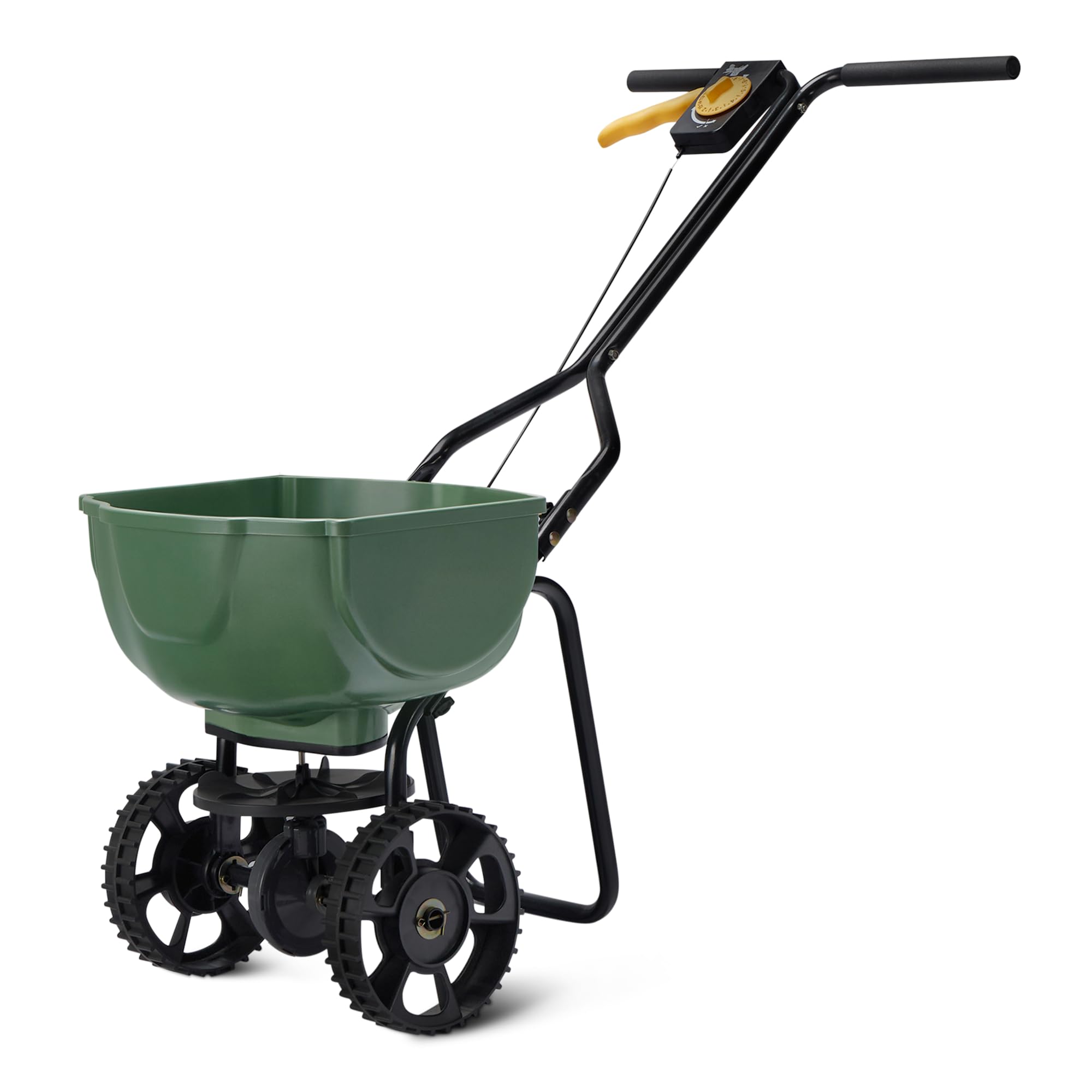
The walk-behind that offers push-spreader coverage at handheld-spreader prices.
For anyone graduating beyond a handheld unit, the Amazon Basics spreader is the gateway to walk-behind efficiency without the premium price. Its 33-lb capacity holds about 0.53 cubic feet of material, covering up to 5,000 sq ft per load — a massive step up from the 5-lb handhelds above. The steel frame and plastic bin are built for all-season use, and reviewers point out 5-minute tool-free assembly with the release cable already in place. One owner says it “outperforms previous name-brand spreader,” zipping through 5,000 sq ft in under 10 minutes, and the wide wheels roll smoothly “over uneven lawn” and stay “stable on slopes.”
The multi-gear system gives you precision control over the flow rate, but here is the honest trade-off: not every unit leaves the factory perfect. A small number of buyers received a spreader where the spinner plate failed to rotate, leaving them unable to spread fine salt or fertilizer. This is a quality-control gamble you accept at the budget price point. If you get a good one, it is a genuine steal.
Where it excels
- Covers 5,000 sq ft per load with a 33-lb hopper
- Tool-free assembly in minutes
- Smooth, wide wheels handle uneven terrain well
Where it stumbles
- Quality control varies — some units arrive with non-spinning spinner plates
- The overall build feels less sturdy than the EarthWay models
Best for the budget-minded: the buyer who wants walk-behind capacity for a quarter-acre lawn and is willing to spend a few minutes checking the spinner works from the start.
Pass if: you cannot risk a dead spinner for a commercial deadline or you need a spreader that is guaranteed reliable from day one.
7. Garden Tailor 30-Inch Compost Spreader
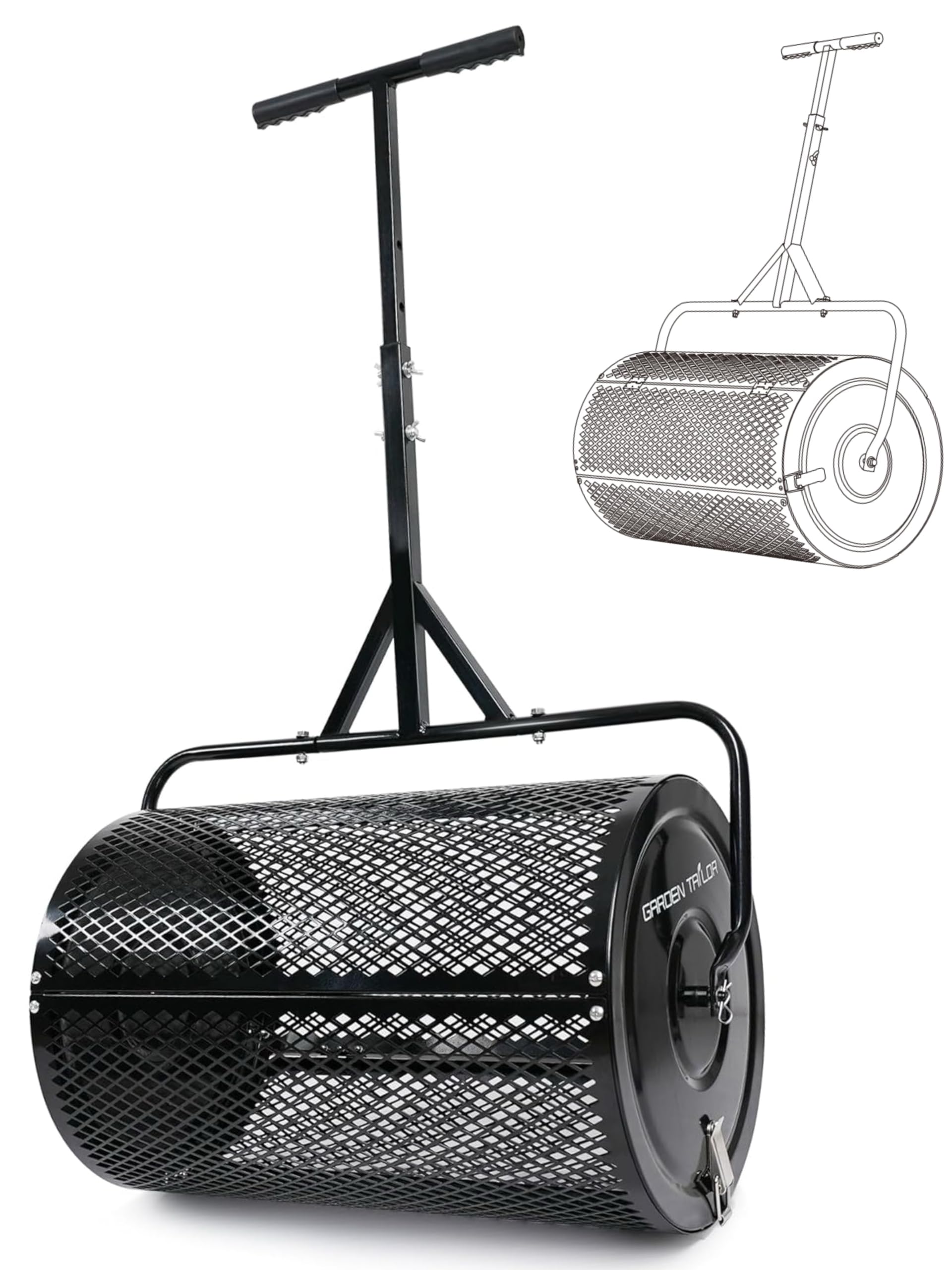
The mesh roller that turns lumpy compost into a fine, even top-dressing.
This is a specialist tool for a specific job: spreading uncomposted material like peat moss, topsoil, or manure across an existing lawn. The 30-inch metal mesh basket crushes clumps and separates rocks and large debris as you roll it across the yard — the good soil falls through the 1/2 x 3/4 inch mesh while the chunks stay inside. It cuts spreading time by 75% compared to doing it by hand.
The assembly is doable alone in about 15-30 minutes, and the adjustable T-handle accommodates different user heights. The stand has changed from metal to cardboard in recent shipments, which some owners find less durable. At 27.3 lb, it is the second-heaviest tool here, designed for rolling, not carrying. The mesh basket is rust-resistant and powder-coated, but it is not meant for granular fertilizer — save that for the broadcast units above.
Great for
- Spreading peat moss, compost, manure, and topsoil evenly without clumps
- Filtering rocks and debris out of lumpy soil while spreading
- Adjustable height T-handle suits different users
Not great for
- Heavy — 27.3 lb — and not meant for carrying or small spaces
- Stand has shifted from metal to cardboard in some units
Use this for: revitalizing a tired lawn with a thin layer of compost, peat moss, or filtered topsoil — nothing else does the job faster.
Leave it if: you only need a fertilizer or seed spreader; this is specifically for bulky, uncomposted organic material.
8. EarthWay 2600A-PLUS Fertilizer Spreader

The all-terrain walk-behind with air tires that conquer bumpy ground.
The EarthWay 2600A-PLUS leaves the budget spreaders in the dust with pneumatic tires that roll easily over ruts, slopes, and soft turf. It carries a 40-lb hopper built from rust-proof polypropylene on an epoxy-coated steel frame — a combination that laughs at rain and winter salt. The 3-hole drop shut-off system gives you precise control over the spread pattern, and the solid linkage means the lever feels positive and predictable compared to cheaper cable systems. Owners say it is a “significant upgrade from Scotts” and praise the “even pattern, easy operation.”
The assembly is not quick — it takes about 35 minutes to an hour with tools — and the instructions can be confusing. The 15-pound weight is noticeable when pushing uphill, and a few owners find the feeding of the last bit of product can be poor, leaving a small pile in the hopper. Still, between the all-terrain tires, the commercial-grade construction, and the repeatable settings, this is the residential standard-setter for a reason.
What it does well
- All-terrain pneumatic tires roll smoothly over rough, bumpy ground
- Rust-proof polypropylene hopper and epoxy-coated steel frame
- 3-hole drop shut-off provides an even, adjustable spread pattern
The downsides
- Assembly is time-consuming and the instructions are not intuitive
- Poor feeding of the last remaining product in the hopper
Ideal for the serious homeowner: the one with a rough half-acre lawn who wants a sturdy, reliable machine that rolls smoothly over uneven ground without needing to push it up a bumpy hill.
Not for the impatient: if you hate assembly and want to spread within 10 minutes of opening the box, look at the Amazon Basics instead.
9. EarthWay 2150 Commercial 50 LB Broadcast Spreader

The heavy-duty professional that laughs at big acreage and rough terrain.
For the largest jobs — think an acre lawn, a sports field, or a farm plot — the EarthWay 2150 is built to be the last spreader you buy. The 13-inch high-flotation pneumatic stud tires with rust-proof poly rims glide over rough ground without sinking, and the 50-lb hopper means you can cover massive areas between refills. The 3-hole drop system with side-spread control promotes an even, feathered edge pattern, while the enclosed gearbox keeps working even in damp conditions. Owners call it a “definite upgrade” and note “even, wide coverage (~9 ft)” with a comfortable long handle that keeps you walking upright.
The catches: the actual usable capacity is closer to 35 lb than the advertised 50 lb, and the flow rate cannot be fine-tuned to zero — it runs fast even on the lowest setting. Some owners resort to custom modification or careful walking speed to avoid over-application. The assembly instructions are famously bad, but customer service is excellent and will guide you through it. At 25 lb and with a 5-year limited warranty, this is the commercial pick for those who need it.
Professional strengths
- Massive 50 lb hopper and 13-inch stud tires for large, rough terrain
- Enclosed gearbox with 5-year limited warranty
- Effective edge-guard and 9-ft broadcast width
Professional caveats
- Real capacity is ~35 lb, not the full 50 lb
- Flow rate cannot be fully stopped at low settings — product trickles even when closed
- Assembly instructions are very poor; rely on YouTube videos
Get this for: large acreage, commercial use, or anyone who wants a sturdy machine that will last for years under heavy use with a 5-year warranty to back it.
Buy something else if: you need precise granular settings for a small, manicured lawn — the flow-rate issue makes fine control tricky.
Understanding the Specs
Hopper Capacity & Weight
Hopper capacity tells you how much material you can spread before refilling. A 5-lb handheld is fine for spot-seeding a few hundred square feet, while a 33-lb to 50-lb walk-behind can do a full quarter-acre in one go. But bigger capacity means more weight to carry or push. A slung spreader like the Solo 421 distributes its 5.5 lb across your shoulder, while a handheld Brinly at 1.59 lb (plus 5 lb of fill) hangs off one hand — the heavier the full load, the faster your arm tires. Match the capacity to your stamina and your yard’s square footage.
Spread Pattern: Broadcast vs Drop
A broadcast spreader uses a spinning disc to fling material in a wide arc, typically 5 to 12 feet wide. This is fast and great for covering open lawns, but it scatters material onto driveways and flower beds unless you have an edge guard. A drop spreader releases material straight down through holes in a tube, making it very precise for edges and narrow strips but much slower for open areas. Choose broadcast for speed and drop for delicate placement near gardens or patios.
Manual Crank vs Battery Power
A hand-crank spreader connects your turning speed directly to the spinning disc — go faster to throw further, slower to keep it tight. This gives you feel and control but requires constant arm motion. A battery-powered spreader uses a motor to spin the disc at a set speed; you just pull a trigger and walk. This is far easier on your body, especially for large areas or anyone with hand/wrist issues. The trade-off is you need a compatible tool battery (usually Dewalt or Milwaukee), and the motor can fail outside of a short warranty window.
Frame & Gear Material
Plastic gearboxes are cheaper but can crack under heavy use, especially with dense material like salt or wet fertilizer. A fully enclosed gearbox with lubricated metal gears, like in the Solo 421 and the EarthWay commercial models, will last for years without slipping or jamming. The frame itself should be rust-resistant — steel frames need an epoxy or powder coating, while polypropylene hoppers do not rust at all. If you plan to spread ice melt or iron-based fertilizer, you absolutely want rust-proof materials.
FAQ
Can I use a fertilizer spreader for grass seed?
How do I adjust the spreader for different materials?
How much area will a handheld spreader cover?
How do I keep the spreader from rusting?
What does “broadcast width” mean in a spreader?
Can a battery-powered spreader handle ice melt?
Is the Solo 421 spreader shoulder strap comfortable for long sessions?
How long does a battery-powered spreader battery last?
Do I need to calibrate my spreader?
Are walk-behind spreaders hard to push on steep slopes?
Final Thoughts: The Verdict
For most buyers, the garden fertilizer spreader winner is the Solo 421 because it combines the largest useful hopper (9 kg) with an enclosed metal gearbox and a comfortable shoulder strap, making it the best balance of capacity, durability, and everyday carry for a medium to large lawn. If you want battery-powered convenience and already own Dewalt Milwaukee tools, grab the Uniqwamo Power Spreader. And for the most rugged, heavy-duty walk-behind performance for large acreage or commercial use, the EarthWay 2150 Commercial is the one to reach for — its 50-lb hopper and 5-year warranty make it the final spreader you will own.
How We Picked
We do not accept paid placement. Every pick is matched to a real buyer and a real use-case; we do not hands-on test units.
Sources & Methodology
Specifications: manufacturer listings and product documentation. Review insights: verified customer reviews, as of July 2026. Pricing: not shown on this page (it changes often); check the current price via the retailer link.
As an Amazon Associate, Lawn Gear Lab earns from qualifying purchases. This does not affect which products we feature.