
Specs are compiled from manufacturer listings and verified buyer reviews and can change over time — please confirm the key details on the product page before buying.
Crushing a stem instead of slicing it cleanly shortens vase life before the bouquet reaches water. A quality flower stem cutter slices cleanly to open water channels, keeping roses, hydrangeas, and lavender fresh longer. The best flower stem cutter balances blade sharpness, grip comfort, and size for your typical stems.
I’m Rikta — the founder and writer behind Lawn Gear Lab. This guide is built by comparing the manufacturers’ published specifications and the patterns across verified customer reviews, so you get each pick’s real strengths and trade-offs instead of marketing spin.
Whether you are arranging weekly bouquets or processing hundreds of stems for a wedding, these eight models represent the top-tier options in the flower stem cutter category — tested by thousands of buyers for sharpness, comfort, and real-world endurance.
Our Picks at a Glance


How To Choose The Best Flower Stem Cutter
Every florist and home arranger needs a tool that cuts cleanly without mashing the stem. The Sakagen pair leads with 633 ratings and a near-perfect score, setting the benchmark. The best pick depends on volume: weekend gardeners need different features than wedding florists processing dozens of bunches.
Blade Material and Sharpness
High-carbon steel blades hold an edge far longer than basic stainless steel. The ARS models and the Kimura pair both use carbon steel, and reviewers report years of sharp use without needing to resharpen. A PTFE coating, like the one on the Kimura shears, reduces sap build-up and rust, so the blades glide through stems rather than sticking.
Handle Comfort and Grip
For cutting sessions over 30 minutes, handle shape and material reduce hand fatigue. The Sakagen scissors are praised specifically for being “comfortable for 8-hour floral work, no hand fatigue.” TPR (thermoplastic rubber) and vinyl-coated handles give you a non-slip hold even with damp hands. A spring-loaded opening, like the one on the Fiskars pruner, reduces the effort each time you squeeze.
Blade Length and Stem Capacity
Short blades around 2 inches are perfect for delicate stems and deadheading in tight spots. Longer blades, such as the 8-centimeter blade on the Cyrus shears, give you more leverage for thicker, woody stems. If you mainly cut roses, hydrangeas, or lavender, check the cutting width spec — some pruners top out at half an inch, while bench-mounted guillotines handle 1-inch thick branches.
Quick Comparison
| Model | Best For | Blade Material | Blade Length | Weight | Amazon |
|---|---|---|---|---|---|
| Sakagen Hand Creation F-170★ Best Overall | All-day professional arranging | Metal / Iron Alloy Steel | 4.2 cm | 128 g | Amazon |
| Cyrus Blue Floral ShearsBest for Roses | Rose pruning with thorn removal | Stainless Steel | 8 cm | 170 g | Amazon |
| ARS HP-130DX PrunerCompact Pick | Small hands, intricate tasks | High Carbon Steel | 2 in | 0.13 kg | Amazon |
| Fiskars Floral Pruning Shears | Deadheading and light pruning | Ground Steel | — | 0.16 kg | Amazon |
| Modern Sprout Pruning Shears | Herbs and fine-stemmed plants | High Carbon Steel | — | — | Amazon |
| ARS Needle Nose HP-SE45 | Tight spot deadheading | Stainless Steel | 46 mm | 0.09 kg | Amazon |
| Kimura 8″ Pro Scissors | Heavy-duty garden pruning | Japanese SK5 Steel | — | — | Amazon |
| Larksilk 14-Inch Guillotine | High-volume flower processing | Stainless Steel | 14 in | 7.6 lb | Amazon |
In‑Depth Reviews
1. SAKAGEN HAND CREATION 205478Sakagen Flower Scissors Hand Creation F-170 (Violet)
Our pick — over 4.5★ from 600+ verified ratings; the strongest balance of quality and price.
The 4.9-star Japanese icon that florists call “perfect” and buy as backup pairs.
Quality is the thing owners praise most — 35 separate mentions of it. The 4.2-centimeter blades are made from a metal alloy with fluororesin processing that resists rust, and the handles contain iron inside for a balanced feel. Buyers report these scissors are “comfortable for 8-hour floral work, no hand fatigue,” and one owner says they lasted nearly three years without needing sharpening. The “Good Design” award from Japan backs up the build.
At 128 grams, the F-170 is noticeably lighter than the Cyrus shears (170 grams) — a difference you feel during a long arranging session. The cutting performance draws 16 positive mentions, with reviewers loving how cleanly the blades slice branches up to 1 inch thick. The violet color and floral design add a touch of personality to the tool belt.
The main trade-off: the blades are short at 4.2 centimeters, so very thick or woody stems require more passes than a longer-bladed pruner. But for everyday flower work, this is the pair owners reach for first.
Why It Wins
- Owners call it the most comfortable cutter for all-day use — no hand fatigue after hours of work.
- Fluororesin coating blocks rust, and the blades stay sharp for years.
- Won Japan’s “Good Design” award for build quality.
The One Caveat
- Short 4.2 cm blade struggles with very thick, woody stems you might find in heavy landscaping.
Who it fits: The professional florist or avid home arranger who spends hours cutting stems and wants a tool that disappears in the hand.
Think twice if: You regularly cut branches thicker than a pencil — you will want a longer blade or a heavier-duty pruner.
2. Blue Stainless Steel Floral Shears with Integrated Stab Remover | Cyrus
The shears that pair a wide, comfortable handle with a built-in thorn remover for rose lovers.
The Cyrus shears earn their keep with an 8-centimeter stainless steel blade — nearly twice the length of the Sakagen pair — and a 4.2-inch cutting width that handles larger stems in one snip. Quality and sharpness are the top aspects owners mention (20 and 13 mentions respectively). What sets these apart is the integrated thorn-removing hole, a detail that buyers find genuinely useful: you pass a rose stem through it and slide to strip thorns without switching tools.
Buyers describe the short blades and large handles as providing “ample finger room, no pinching.” The TPR (thermoplastic rubber) resin handles offer a non-slip grip even with wet hands, and the one-piece molding makes the structure tough. At 170 grams, these have the heaviest feel among the hand-held picks here — a trade-off for the extra stability.
Some owners mention the handles suit small hands best; larger grips may feel bulky for bigger fingers. The blade sharpness, however, gets consistent praise for cutting small and woody stems with one snip.
What Stands Out
- Built-in thorn remover saves a separate tool when working with roses.
- 8 cm blade and 4.2-inch cutting width power through medium stems efficiently.
- TPR handles with a finger notch reduce hand fatigue during repetitive cuts.
What to Check
- The larger handle shape may feel bulky if you have larger or long-fingered hands.
Reach for these if: You regularly prune and de-thorn roses and want a single tool that does both jobs.
Look elsewhere if: You need an ultra-lightweight cutter for precision work on tiny stems — the Fiskars or ARS needle nose will suit you better.
3. ARS HP-130DX 7-Inch Ideal Light Pruner
A 2-inch carbon steel blade that fits small hands and pockets while staying razor-sharp for years.
The ARS HP-130DX pulls in 105 mentions for quality — the highest count of any single aspect in this entire guide. The high-carbon tool steel blade is precision-ground with a single bevel edge, and customers note it maintaining its edge for three years of regular use. The soft PVC handles are designed to fit small hands, and the 7-inch by 2-inch body slips into a pocket easily. Reviewers point out it works “excellent for branches up to 0.5 inch” and handles floral tasks with smooth, one-handed operation.
Sharpness gets 78 mentions, and cutting performance gets 67 — both overwhelmingly positive. The built-in latch keeps the blade locked when closed, so it is safe to carry. One owner who has used them for three years for wedding flowers calls them “favorite floral snips I have ever had.”
The honest limit: the 2-inch blade and right-hand orientation mean it is less versatile for large stems or left-handed users. Larger hands may find the handle a bit thin, but for precise flower work, this is a top contender.
Strengths
- Carbon steel blade stays sharp for multiple seasons without rusting.
- Compact enough for pocket carry and perfect for small hands.
- Over 800 ratings and a 4.6-star score prove consistent owner satisfaction.
Consider This
- Right-hand only design — left-handed users will find it awkward.
- Struggles with branches larger than half an inch; it is a light pruner by design.
Best for: The gardener or florist with small hands who needs a precise, durable pruner for daily flower cutting and deadheading.
skip it if: You are left-handed or frequently cut branches thicker than your index finger.
4. ARS Needle Nose Pruner HP-SE45, Orange

A featherlight 0.09 kg needle nose that reaches into the tightest spots without pinching fingers.
The ARS HP-SE45 is built for precision deadheading. Its 46-millimeter stainless steel blades taper to a needle point, letting you snip spent blooms without damaging nearby buds. Owners call it the “best flower dead-heading tool EVER,” and the consensus is that it requires “no pressure when cutting flowers.” The streamlined nose reaches tight spots that standard pruners miss.
At just 0.09 kg, this is the lightest pruner in the lineup — you barely feel it in your hand. The ergonomic grip prevents pinching, and buyers with arthritic hands report that it saves wrist pain. The blade stays sharp for a long time, and the lock mechanism keeps it safe in storage. One owner notes it “outperforms Fiskars” and never sticks.
The trade-off: as a needle nose pruner, it is best for moderate use. Thick, woody stems can dull the blade faster than a heavier-duty model. The right-hand orientation also limits left-handed users, though the comfortable grip and light weight are universal wins.
Why It Shines
- Needle nose design gets into dense plant clusters without crushing adjacent stems.
- At 0.09 kg, it causes minimal hand fatigue during long sessions.
- Owners with arthritis praise the comfortable, non-pinching grip.
The Limit
- Best for moderate use — heavy woody stems can dull the slender blades.
Reach for this if: You precision-prune perennials, deadhead daily, or have hand pain that makes heavy pruners a chore.
pass on it if: Your main task is cutting thick, woody branches — reach for the Kimura or Cyrus instead.
5. Modern Sprout Pruning Shears – Sage
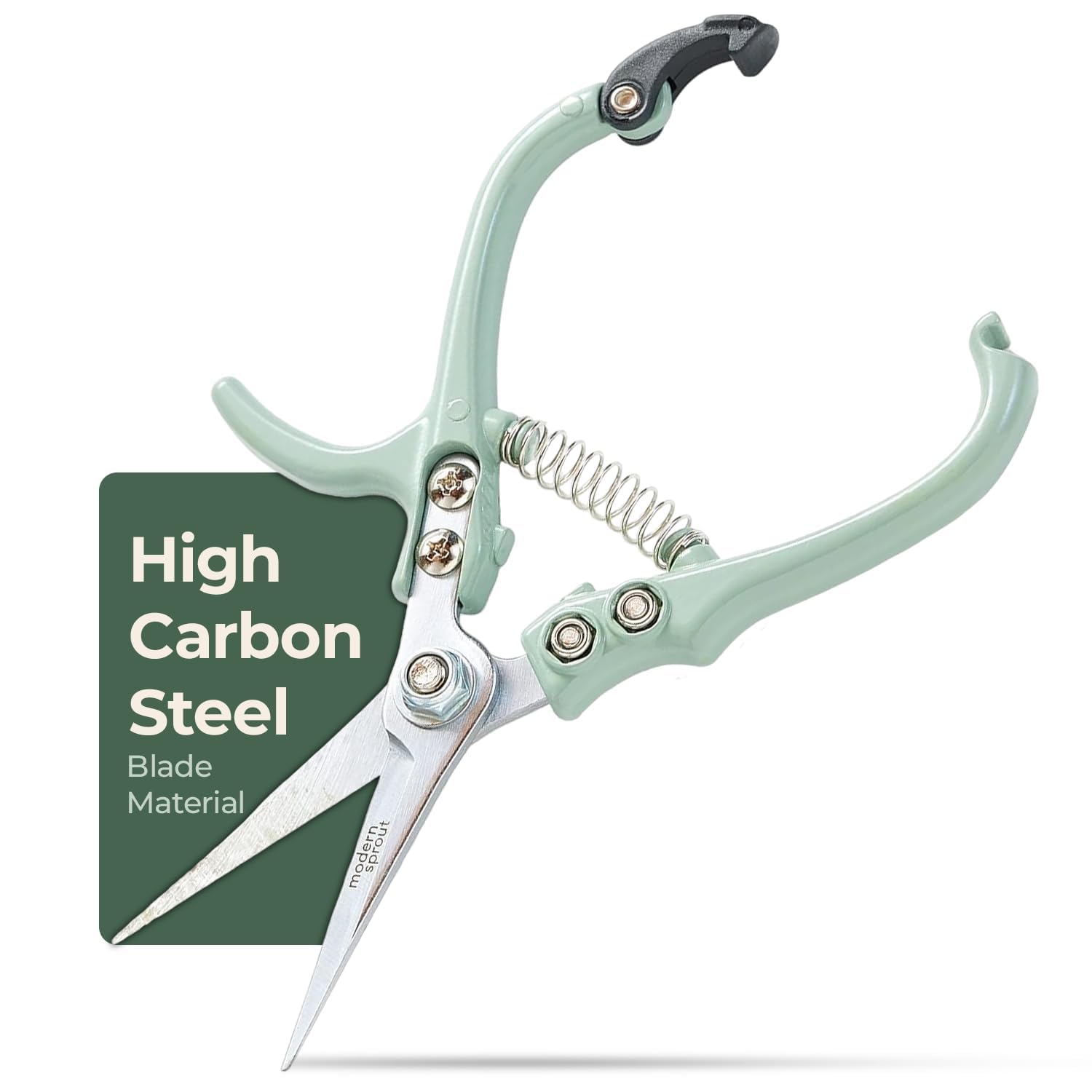
High-carbon steel needle-nose shears built for herbs, houseplants, and delicate stems.
The Modern Sprout shears are the crowd favorite for fine-stemmed plants. Quality gets 133 mentions and sharpness gets 102 — both dominant positives. The high-carbon steel blades have a needle-nose tip that reaches into tight pots and between leaves without damaging neighboring growth. Owners describe the design as “sleek” and “satisfying to use,” requiring little pressure to snip basil, mint, and slender blooms.
The ergonomic aluminum handles with a comfortable palm fit reduce hand strain during long trimming sessions. The safety lock keeps the blades closed for safe storage in a drawer or garden bag. One buyer who uses them in an industrial setting says they perform well day after day. The 6-inch by 3-inch size makes them highly portable.
The honest caveat: these are purpose-built for fine stems and delicate work. Thick, woody branches will stress the slender blades. If your garden has a mix of soft herbs and heavy branches, you will need a second, heavier tool.
What Wins People Over
- Needle-nose tip provides precise cuts in tight spaces without damaging nearby leaves.
- High-carbon steel blades stay sharp and rust-resistant through heavy use.
- Lightweight aluminum handles reduce fatigue during long trimming sessions.
Keep in Mind
- Designed for fine stems only — thick woody branches will dull the blade faster.
Ideal for: The indoor gardener, herb grower, or houseplant enthusiast who needs precision on delicate stems.
Not for: Heavy garden pruning or cutting branches thicker than a stem of basil.
6. Fiskars Floral Pruning Shears, Rose Petal Pink
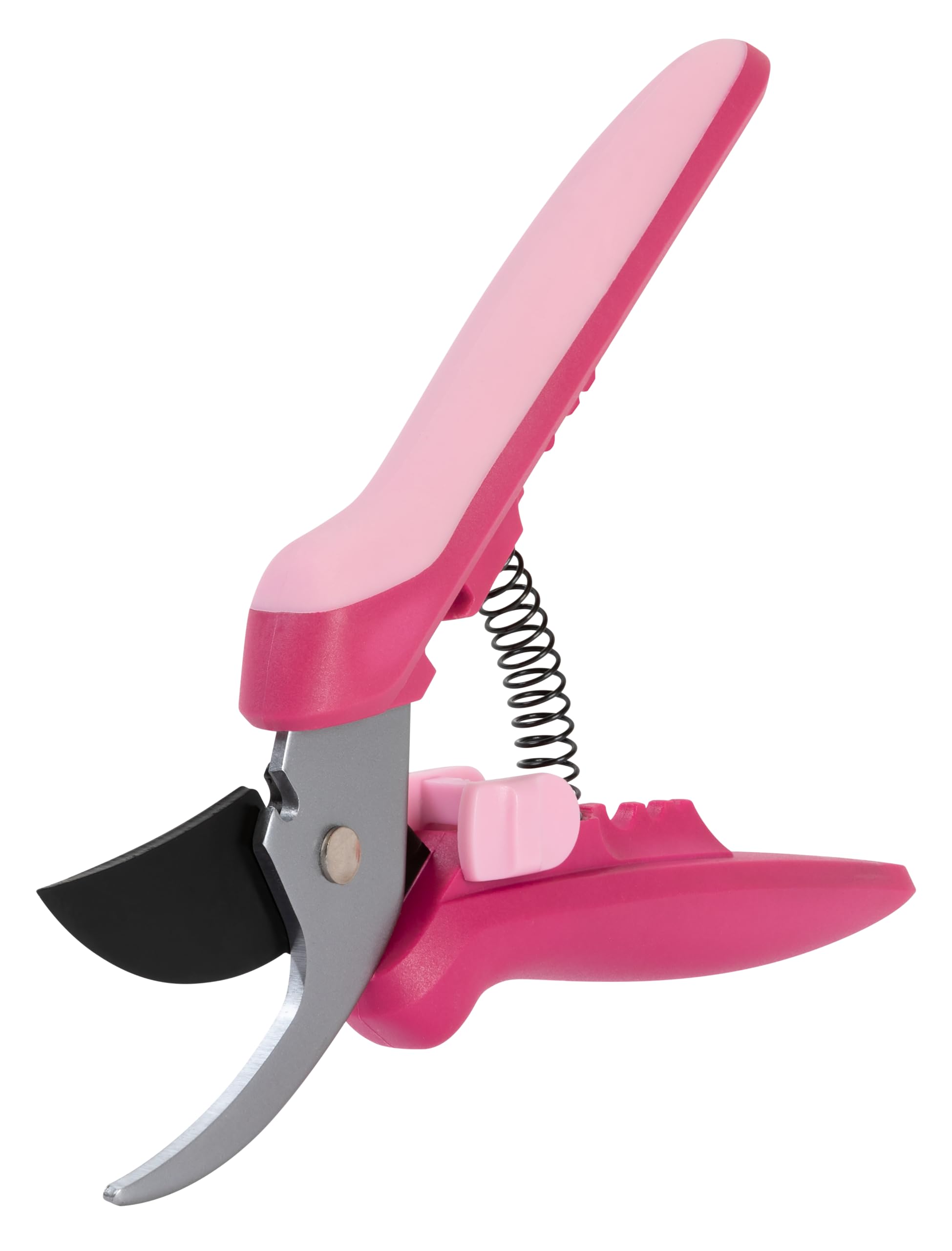
A spring-loaded bypass pruner that reduces hand strain with Softgrip touchpoints and a 0.5-inch cut capacity.
Fiskars is a name trusted in gardens, and this floral pruner delivers on that reputation. The bypass blade design cuts up to 0.5-inch thick stems cleanly, and the low-friction coating prevents sap from gumming up the blade. The Easy Action spring gently pushes the blades open after each cut, so your hand does not have to do the work. Cutting performance gets 12 positive mentions, and multiple reviewers call it “perfect for the flowers that need to be deadheaded daily.”
Buyers with arthritis find these shears comfortable because of the contoured handles and Softgrip touchpoints. The bright Rose Petal Pink color makes it easy to spot in the garden — one owner jokes it helps them avoid losing it in the yard waste bin. The built-in stem stripper and wire cutter add extra versatility.
The catch: the cut capacity of 0.5 inches is the smallest in this lineup. It handles flower stems and thin branches beautifully, but thicker woody growth will require multiple passes or a different tool. It is a specialist for light, daily pruning.
Best Bits
- Spring-loaded Easy Action reduces hand strain — ideal for arthritis or weak grip.
- Low-friction coating keeps the blade clean and prevents sticking.
- Bright pink color is easy to find if you drop it in the garden.
Limitation
- 0.5-inch cut capacity means it is best for light pruning and deadheading only.
Best for: Gardeners with hand fatigue or arthritis who need an easy-squeeze tool for daily deadheading and light pruning.
Look elsewhere if: Your garden has thick, woody branches — the Kimura or Cyrus will handle them better.
7. Kimura 8″ Pro Pruning Scissors

Japanese SK5 steel blades heat-treated to 59 HRC that slice through thick branches with zero effort.
The Kimura 8-inch pruning scissors earn 68 mentions for quality and 53 for sharpness — both clear signals of a well-made tool. The Japanese Hi-Carbon SK5 steel blades are forged in Japan and heat-treated to 59 HRC (a measure of hardness), which means they hold an edge far longer than standard steel. The PTFE coating reduces friction and prevents sap and rust from building up. Owners say the blades are “extremely sharp” and make “clean, precise cuts with little effort.”
The vinyl-coated aluminum handles are lightweight and ergonomic, designed for people with arthritis or carpal tunnel. The non-slip grip is comfortable even during repetitive trimming. The locking strap is easy to operate with a light push. Buyers use these for everything from garden pruning to cutting kitchen herbs, and one owner notes they can cut thick blackberry canes without issue.
The honest trade-off: the straight blade design can sometimes crush softer stems instead of slicing cleanly — bypass blades are gentler on delicate flowers. And while the build is premium, some buyers with very small hands find the 8-inch length a bit long for fine work.
Why It Stands Out
- Japanese SK5 steel at 59 HRC delivers exceptional edge retention and hardness.
- PTFE coating prevents rust and sap build-up for smooth cutting.
- Ergonomic vinyl handles are comfortable for users with stiff or arthritic hands.
Note
- Straight blade can crush soft flower stems — bypass blades are better for delicate work.
Who it suits: The serious gardener who cuts a mix of thick branches and medium stems and wants a heavy-duty tool that lasts.
Not ideal for: Florists who exclusively work with soft, delicate flower stems — the Sakagen or Modern Sprout will serve you better.
8. Larksilk 14-Inch Fresh Flower Stem Cutter — Guillotine
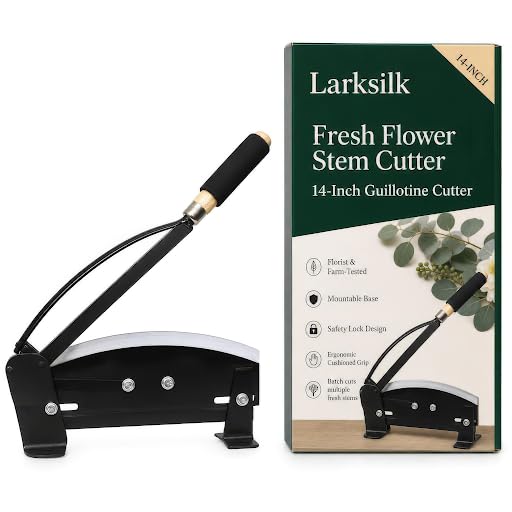
A bench-mounted guillotine that cuts 24 roses or 150 lavender stems in a single pull.
This is not a hand pruner — the Larksilk is a 14-inch guillotine blade that mounts to your workbench and powers through bunches of flowers in one motion. Florists report cutting up to 24 roses, 150 lavender stems, or a full bunch of eucalyptus with a single pull. The hardened stainless steel blade delivers a clean, even cut that preserves water absorption for longer vase life. Unlike hand pruners that can crush stems, the guillotine action slices through cleanly.
Cutting performance and quality each draw 40 positive mentions. Shoppers say the tool is “sturdy when bolted” and “remains sharp after hundreds of bunches.” The safety latch keeps the blade locked when not in use, protecting fingers in busy work spaces. It handles branches up to 1 inch thick, including woody hydrangea canes. The 7.6-pound weight and 26-inch by 16-inch dimensions mean it needs permanent bench space, but owners who process hundreds of stems daily call it a “major timesaver.”
The honest caveat: mounting hardware is sold separately, and the tool is designed for fresh stems only — wire or artificial flowers will dull the blade. The mixed value-for-money feedback (9 mentions) reflects that this is an investment for serious volume, not casual arrangers.
The Big Win
- Cuts entire bunches at once — 24 roses or 150 lavender stems in one pull.
- Guillotine action prevents stem crushing, improving water uptake and vase life.
- Built to last: florists report 5+ years of rust-free service cutting 1,200+ stems.
Reality Check
- Requires bench mounting and permanent workspace — not portable.
- Not for casual home use; best for high-volume commercial florists and farms.
Reach for this if: You process hundreds of stems daily for a flower farm, wedding business, or large-scale floral studio.
it’s not for you if: You are a home arranger cutting a few stems at a time — a hand pruner will be more practical and affordable.
Understanding the Specs
Blade Material: Carbon Steel vs. Stainless Steel
Carbon steel blades, like the high-carbon steel in the ARS and Kimura models, hold an edge significantly longer than basic stainless steel. They can be sharpened at home and stay razor-sharp through hundreds of cuts. Stainless steel, used in the Cyrus and Larksilk, resists rust better from the start but may need more frequent sharpening. If you cut wet stems daily, stainless steel’s corrosion resistance is a real benefit. If you want a blade that stays sharp for seasons, choose carbon steel.
Bypass vs. Straight Blades
A bypass blade (like the one on the Fiskars and ARS HP-130DX) works like scissors — two blades pass each other to make a clean, scissor-like cut. This is gentler on soft flower stems and helps prevent crushing. A straight blade or anvil-style cutter (like the Kimura) brings the blade down onto a flat surface. It exerts more force, making it better for tough, woody branches, but it can crush delicate stems. For flower arranging, bypass is usually the better choice.
Weight and Ergonomics for Hand Fatigue
Every gram matters when you are cutting stems for an hour or more. The ARS HP-SE45 weighs just 0.09 kg and feels nearly weightless, while the Cyrus shears come in at 170 grams. Heavier tools provide more stability and leverage for thick stems, but lighter tools let you work faster with less fatigue. Look for handles with TPR, vinyl, or Softgrip material — they prevent slipping and absorb shock. A spring-loaded opening, like the one on the Fiskars pruner, halves the effort per cut.
Bench-Mounted Guillotine vs. Hand Pruners
If you cut more than a few dozen stems at a time, a guillotine cutter like the Larksilk is a productivity leap. It cuts up to 24 stems in one pull, delivering perfectly even cuts that improve water absorption. Hand pruners are portable, affordable, and better for precision work. The choice depends on volume: home arrangers and small-flower gardeners should stick with hand pruners, while commercial florists and flower farms will see the guillotine pay off quickly in saved time and better stem quality.
FAQ
What is the best blade material for a flower stem cutter?
How often should I sharpen my flower stem cutter?
Can a flower stem cutter handle woody branches?
What is the difference between bypass and straight blade cutters?
Is a left-handed flower stem cutter available?
How do I clean and maintain my flower stem cutter?
What is the safest way to store a flower stem cutter?
Should I buy a bench-mounted guillotine or a hand pruner for home use?
Can I use a flower stem cutter on artificial or wired stems?
What does PTFE coating on pruning shears do?
Final Thoughts: The Verdict
If you want one dependable pick, the flower stem cutter winner is the Sakagen Hand Creation F-170 because it combines a near-perfect 4.9-star rating with a design owners genuinely love for all-day comfort and clean cuts. If you want the built-in thorn remover and a longer blade for roses, grab the Cyrus Blue Floral Shears. And for high-volume commercial processing, the Larksilk 14-Inch Guillotine is the one to reach for — it cuts entire bunches in a single pull and is trusted by professional florists.
How We Picked
We do not accept paid placement. Every pick is matched to a real buyer and a real use-case; we do not hands-on test units.
Sources & Methodology
Specifications: manufacturer listings and product documentation. Review insights: verified customer reviews, as of July 2026. Pricing: not shown on this page (it changes often); check the current price via the retailer link.
As an Amazon Associate, Lawn Gear Lab earns from qualifying purchases. This does not affect which products we feature.