
Specs are compiled from manufacturer listings and verified buyer reviews and can change over time — please confirm the key details on the product page before buying.
Keeping a greenhouse warm through a bitter winter night doesn’t have to mean a sky-high electric bill or a complicated ventilation system. The best propane greenhouse heaters let you sidestep those problems entirely, running on bottled fuel with zero wiring and no need for a chimney. The catch in this category is choosing between a radiant heater that warms objects directly and a forced-air or blue-flame model that heats the air — and getting the BTU output right for the exact size of your greenhouse.
I’m Rikta — the founder and writer behind Lawn Gear Lab. This guide is built by comparing the manufacturers’ published specifications and the patterns across verified customer reviews, so you get each pick’s real strengths and trade-offs instead of marketing spin.
The right heater keeps your plants safe and your wallet intact, whether you are fighting frost in a small hoop house or a large commercial greenhouse. That is what this guide to the best propane greenhouse heater is designed to help you find.
Our Picks at a Glance

How To Choose The Best Propane Greenhouse Heater
Choosing the right propane heater for your greenhouse depends on space size, heat type, and safety features.
Match BTU Output to Your Greenhouse Size
The most critical specification on any propane heater is its BTU rating — British Thermal Units per hour, measuring raw heat output. A small 10×10 greenhouse might only need 10,000 BTU to stay frost-free on a cold night, while a 20×40 commercial space could require 30,000 BTU or more. Undershooting the BTU rating will freeze your plants. If you overshoot, you waste propane and risk overheating the space.
Radiant vs. Blue Flame vs. Forced Air
Radiant heaters warm the objects and plants directly in front of them, which is great for spot-heating a bench. Blue flame heaters warm the air instead, creating a more even temperature throughout the space. Forced-air heaters use a fan to push the hot air across a larger area, but they are louder and can create drafts that dry out plants. Ventless (or vent-free) models are popular in greenhouses because they don’t require a chimney, but they release moisture and carbon dioxide into the air — which is actually a benefit for plants, as they breathe in CO₂.
An oxygen depletion sensor (ODS) is mandatory in an enclosed greenhouse. It automatically shuts off the heater if oxygen levels drop too low. Tip-over shutoff is equally critical for any portable unit. Choose heaters with these standard safety features to prevent tragedy, especially during overnight or thermostat-controlled use.
Quick Comparison
| Model | Best For | BTU Output | Coverage | Weight | Amazon |
|---|---|---|---|---|---|
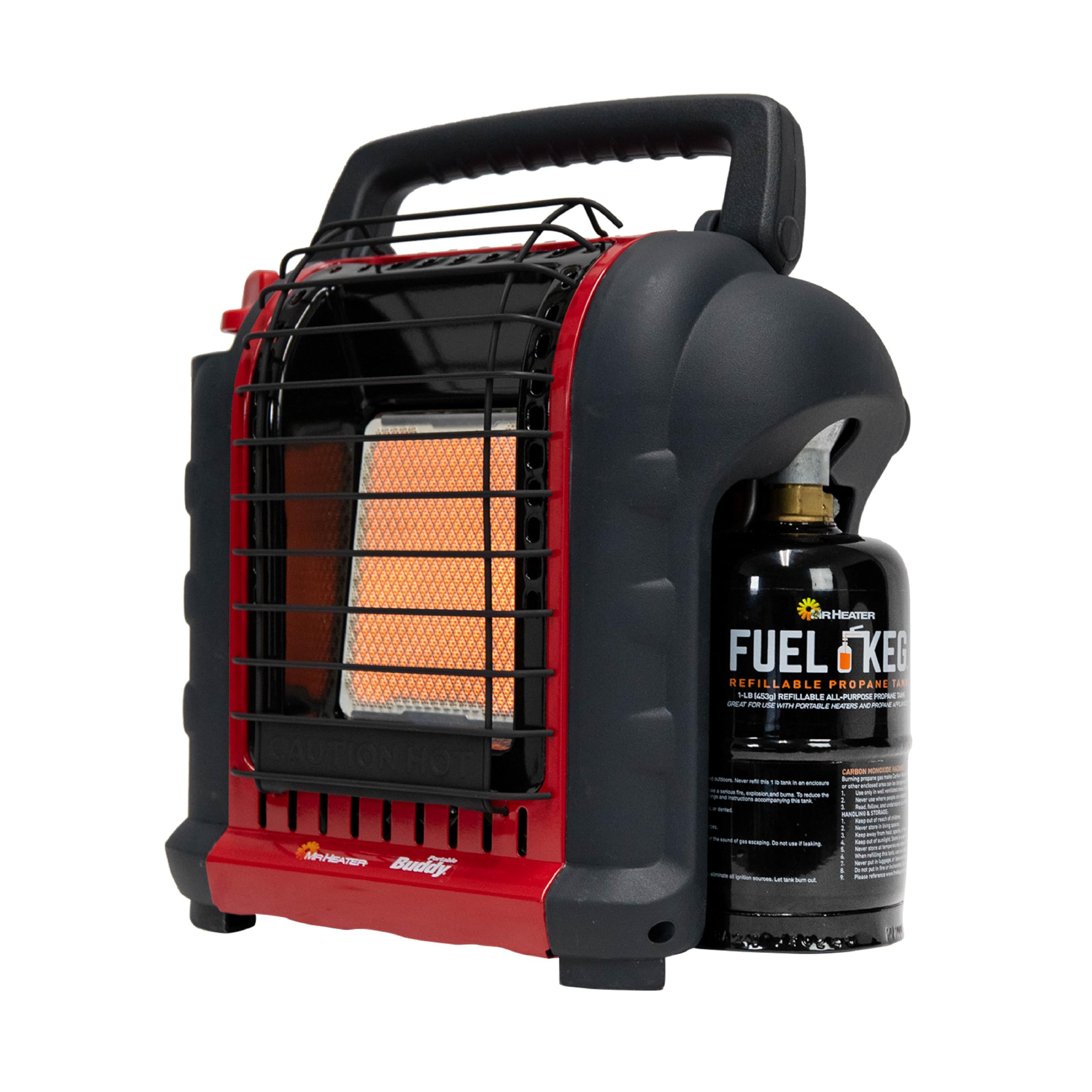
| Mr. Heater 9,000 BTU Portable Buddy★ Best Overall | Small greenhouses & camping | 9,000 BTU | 225 sq. ft. | 7.1 lbs | Amazon |
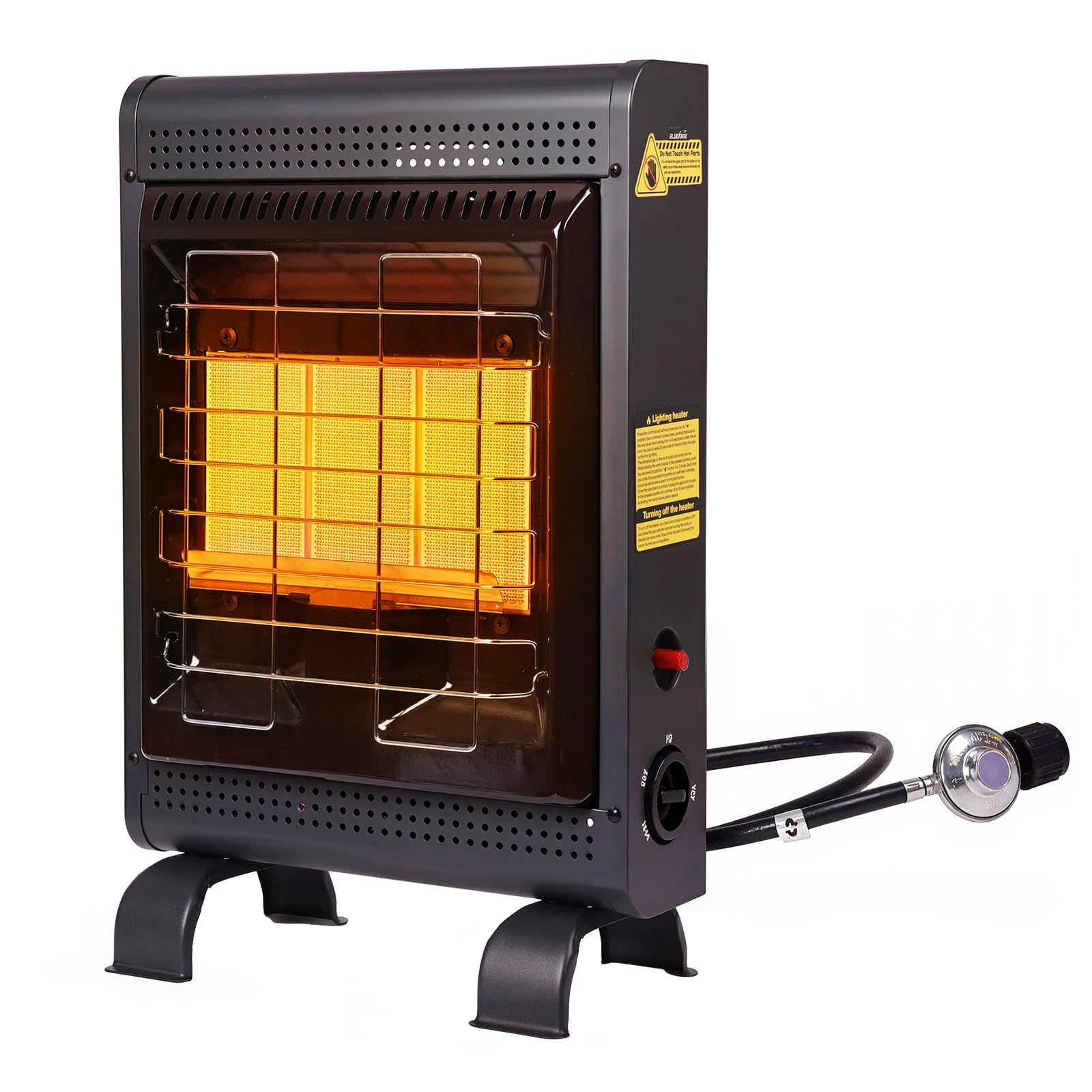
| VEVOR 18,000 BTU Cabinet HeaterTop Performer | Mid-sized garages/greenhouses | 18,000 BTU | 450 sq. ft. | 13.5 lbs | Amazon |
| Ruasveltan 18,000 BTU Patio HeaterBudget Champion | Budget-friendly 450 sq. ft. | 18,000 BTU | 450 sq. ft. | 13.8 lbs | Amazon |
| ProCom ML100HPA-B (Thermostat) | Thermostat-controlled greenhouses | 10,000 BTU | 500 sq. ft. | — | Amazon |
| ProCom ML300HBA-B Blue Flame | Extra-large spaces up to 1400 sq.ft. | 30,000 BTU | 1,400 sq. ft. | 26 lbs | Amazon |
| Mr. Heater 20,000 BTU Vent Free | Medium greenhouses with thermostat | 20,000 BTU | 700 sq. ft. | 19.6 lbs | Amazon |
| Dyna-Glo 150,000 BTU Forced Air | Very large shops & greenhouses | 150,000 BTU | 3,500 sq. ft. | 20.1 lbs | Amazon |
| Rinnai FC510P Ventless | Premium small-space heating | 10,000 BTU | 285.7 sq. ft. | — | Amazon |
In‑Depth Reviews
1. Mr. Heater 9,000 BTU Portable Buddy Radiant Heater (Canada)
Our pick — over 4.5★ from 2,500+ verified ratings; the strongest balance of quality and price.
The portable heater that keeps your small greenhouse toasty on a camping trip or in a power outage.
This Mr. Heater Buddy is the crowd favorite for a reason — it delivers up to 9,000 BTU of radiant heat and covers a space up to 225 square feet. That is enough to protect a modest 12×18 greenhouse from freezing, and the radiant heat warms the plants directly rather than just the air. It runs on a standard 1-pound propane bottle, and as one owner notes, “on low the portable propane tank will last a good 6 hours or more,” making it a strong choice for overnight frost protection.
The auto shut-off is triple-layered — it kicks in if the heater tips over, if the pilot light goes out, or if it detects low oxygen levels. That last sensor (ODS) is critical for a sealed greenhouse because it prevents dangerous oxygen depletion. It weighs only 7.1 pounds and the fold-down handle makes it genuinely portable, so you can move it between greenhouse benches or take it camping. The trade-off is that 225 square feet is a hard ceiling — this won’t keep a professional greenhouse warm, and buyers with larger spaces quickly hit its limit.
What Owners Rave About
- Heat output is the most-praised feature — buyers report it heats a tent in the snow or a car in winter easily.
- Reliability is the top aspect mentioned; owners trust it for emergency backup heat year after year.
- Lightweight and easy to start; the piezo ignition fires on the first button press.
The Honest Caveats
- Propane combustion means a faint fuel smell — buyers recommend pairing it with a carbon monoxide detector.
- The 225 sq. ft. coverage is not enough for a greenhouse larger than a small hobby setup.
- Durability gets mixed feedback; the unit is built well for the price but not indestructible.
Reach for it if: You need a portable, safe, 9,000 BTU radiant heater for a greenhouse under 225 sq. ft. or for camping and emergency backup.
Think twice if: Your greenhouse is larger than 225 sq. ft. — you will outgrow the Buddy’s output on the first hard freeze.
2. VEVOR 18,000 BTU Propane Cabinet Heater
The cabinet-style heater that doubles the coverage of the Buddy with three heat settings.
When 225 square feet is not enough, the VEVOR cabinet heater steps up to cover double that — 450 square feet — with 18,000 BTU of adjustable heat. You can select low, medium, or high (6k/12k/18k BTU) to match the outside temperature, which is a feature you won’t find on simpler portable units. At 13.5 pounds, it is noticeably heavier than the Buddy, and the 23-inch height means it takes up floor space in a greenhouse aisle.
The safety package is comprehensive: low oxygen protection, tip-over shutoff, and flameout protection. The high-strength carbon steel body resists rust, which is important in the humid environment of a greenhouse. Buyers who use it in a garage or fifth wheel consistently praise the fast heat-up and stable design. The main downside is that the instructions are poorly organized, and some owners note that the 73-hour runtime claim assumes the lowest setting — realistic use on medium or high drains the tank faster. As one buyer put it, “runs 2 hours each session, not while sleeping.”
Why It Works
- Three heat settings (6k/12k/18k BTU) let you dial in exactly the amount of heat your greenhouse needs.
- Triple safety protection (low oxygen, tip-over, flameout) covers all the bases for overnight use.
- Pre-assembled and ready from the start — no complicated setup.
Where It Falls Short
- Instructions are sparse and poorly written; you will need to figure out some assembly details on your own.
- At 13.5 lbs and 23 inches high, it is bulkier than smaller radiant units.
Best for: Greenhouse owners with a space between 225 and 450 sq. ft. who want the flexibility of multiple heat settings without jumping to a premium price point.
Not ideal if: You need a heater that can sustain overnight runs without intervention — the lack of a thermostat makes it a manual operation.
3. Propane Heater Indoor/Outdoor (Ruasveltan) 18,000 BTU
The ultra-thin cabinet heater with a claimed 69-hour runtime and three heat modes.
This Ruasveltan heater is the most affordable way to cover 450 square feet with adjustable heat, offering the same 6k/12k/18k BTU modes as the VEVOR but in a thinner package. The 6.9-inch depth is a real advantage — it can sit against a greenhouse wall without blocking the aisle. It features a piezoelectric ignition and is built to run on a standard 20-pound propane tank with no electricity required.
The ODS (oxygen depletion sensor) and tip-over shutoff are both standard, so safety is covered. The front windscreen helps when you place it near a greenhouse vent or door. However, owners mention mixed ease of setup and fuel economy — while the label claims 69 hours on low, not every owner experiences that. One owner said, “if I burn it on low the propane will last a week,” while another had the knob fail after a month. The 4.1-star rating across 100+ reviews is solid but reflects a slightly higher rate of minor issues than the top picks.
The Smart Bet: This is a strong budget-friendly option for a greenhouse between 200 and 450 sq. ft. where you want a thin profile and three heat levels, as long as you are comfortable with a heater that has occasional quality-control quirks.
Choose it for: A tight budget and a greenhouse under 450 sq. ft. The thin 6.9-inch depth frees up valuable floor space.
Skip if: You want a high-reliability heater for unattended overnight use — the mixed early-failure reports make that a gamble.
4. ProCom ML100HPA-B Infrared Plaque Heater (Manual Control)

The thermostat-equipped plaque heater that let a 20-foot camper stay at 72°F in 2°F weather.
Take the infrared heating of the ML100HPA and add a three-setting thermostat (High/Medium/Low), and you get the ML100TPA-B — a small heater that punches far above its size. One owner with an 85-year-old 20-foot camper reported that this 10,000 BTU unit kept the interior at 72 degrees while it was 2 degrees outside with 15 mph winds, and the carbon monoxide alarm never registered anything. That is a convincing test for greenhouse use, where consistent overnight temperature is critical for plant survival.
The thermostat is the key upgrade here. Instead of running the heater at full blast until you manually shut it off, the thermostat cycles the heat to maintain your chosen temperature. This saves propane and prevents overheating your greenhouse during a warm afternoon. The ODS sensor, tip-over shutoff, and no-electricity operation are all present. However, installation is not simple — the warranty requires a certified technician, and several buyers struggled to find the right hose adapter (the manufacturer specifies a high-quality regulator at 3.5 psi max). The lowest thermostat setting still produces enough heat to feel too warm in a very small room.
Why It Stands Out: The thermostat makes this the most efficient choice for a greenhouse where you need hands-off temperature management. The heat output is genuinely impressive for the size — buyers with campers and outbuildings report cutting their propane bill significantly.
Choose it for: A greenhouse up to 500 sq. ft. where you want thermostat-controlled infrared heat and you are willing to handle the more involved gas-line setup.
skip it if: You need a simple plug-and-play installation — this heater demands careful regulator selection and possibly professional help.
5. ProCom ML300HBA-B Blue Flame Heater (30,000 BTU)

The 30,000 BTU beast that warms up to 1,400 sq. ft. — enough for a small commercial greenhouse.
With 30,000 BTU and coverage for 1,400 square feet, this ProCom blue flame heater is the most powerful ventless option in the lineup. It is designed for serious spaces: large garages, workshops, and sizable greenhouses. The three heat settings let you dial it back on milder days, and the ODS sensor provides automatic shutoff for low oxygen. It also weighs 26 pounds, so it is not portable in the way the Buddy is — you will mount it on the wall or place it permanently on the floor.
One owner with a 20×24 foot uninsulated workshop (with a 20-foot ceiling) reports that the heater keeps the space at a comfortable 70°F, though it goes through propane at a predictable rate. The ventless design and quiet operation are consistent wins for buyers who use it in a greenhouse. The catch is that this unit requires black pipe for the gas connection — not the standard LP grill hose — which means a more involved installation that may call for a professional gas fitter. A few buyers also note a slight odor during operation, which requires leaving some ventilation open.
Pros
- Powerful 30,000 BTU output handles large greenhouses better than most residential furnace options.
- Three heat settings and ventless operation make it versatile for different weather conditions.
- Heats large uninsulated spaces better than a forced-air furnace, according to owners.
Cons
- Requires black pipe gas connection — a standard propane grill hose will not work.
- Produces a slight combustion odor that demands ventilation.
- At 26 lbs and 29 inches wide, it takes up significant wall space.
Reach for it if: You have a greenhouse between 1,000 and 1,400 sq. ft. and want a powerful ventless blue flame heater that runs on propane without electricity.
Look elsewhere if: You are not prepared to run a black pipe gas line or need a simple hose-and-regulator hookup.
6. Mr. Heater 20,000 BTU Vent Free Blue Flame Propane Heater
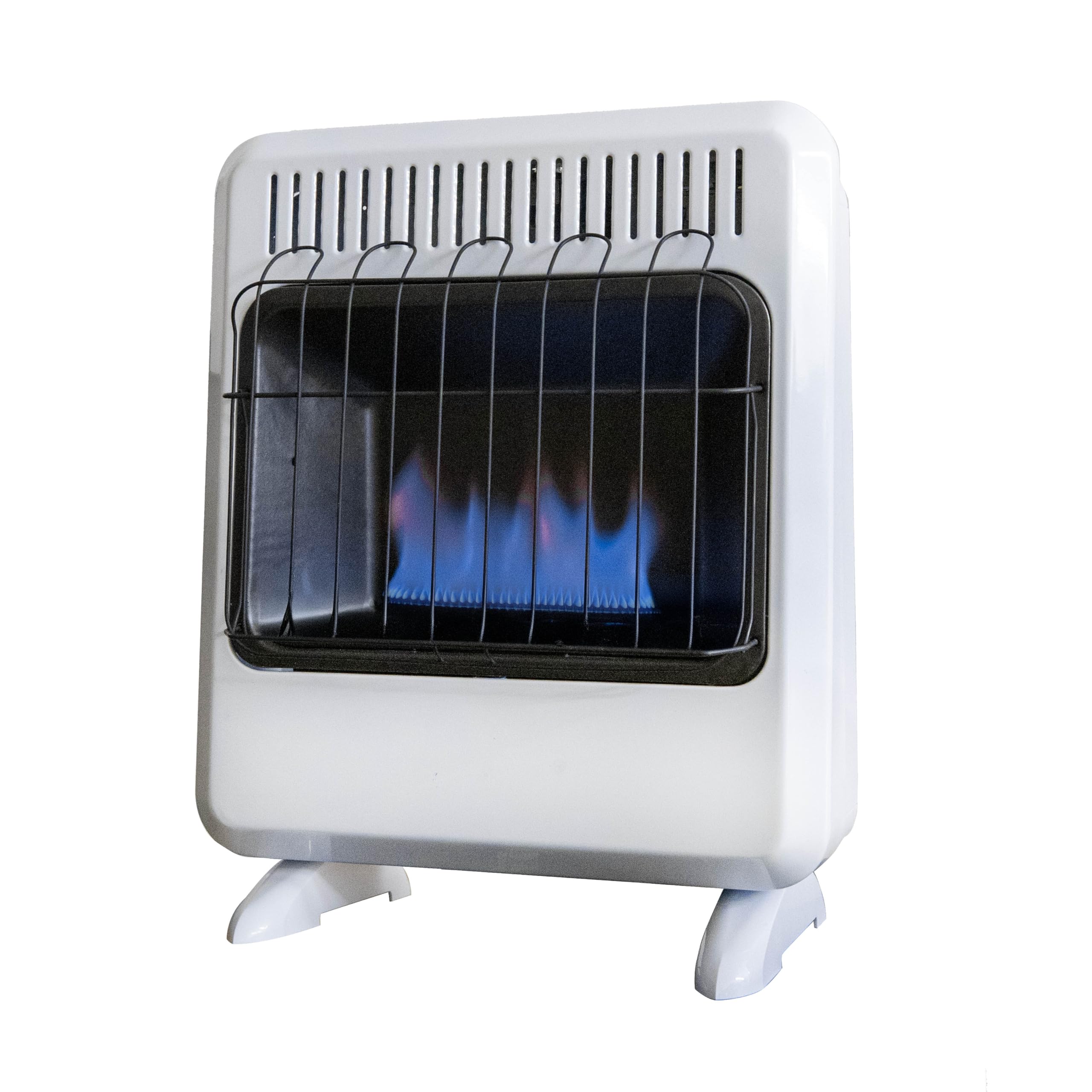
The Mr. Heater vent-free blue flame heater with a thermostat that kept a 750 sq. ft. home comfortable at -38°F.
This is the big brother of the Portable Buddy, but it is a very different animal. The 20,000 BTU output heats up to 700 square feet, and it comes with a five-setting thermostat that allows true set-and-forget behavior. The battery-operated electronic ignition uses a single AAA battery (included), so there is still no need for electricity. One owner in extreme cold reported that it kept a poorly insulated 750-square-foot space comfortable at -38°F, burning about 1 pound of propane per hour on high.
The performance aspect is the most-discussed by a huge margin — 357 owners rate it positively — and heat output is praised by 211. That is a strong consensus that this heater reliably delivers warmth. However, the pilot light is a mixed topic; some reviewers point out it stays lit perfectly, while others find it finicky. A slight propane odor is normal for ventless propane heaters, but one owner who described it as “ticking noise” and “similar to an oven/stove” considers it manageable. The unit requires a hose, regulator, and 90-degree fitting that are not included, so the initial hookup is more involved than the portable Buddy.
The Smart Bet: For a medium-to-large greenhouse (up to 700 sq. ft.), this Mr. Heater offers the best balance of BTU output, thermostat control, and brand trust. The 20,000 BTU output is almost a 2x step up from the Buddy, and the five thermostat settings make overnight frost protection truly hands-off.
Best for: A greenhouse up to 700 sq. ft. where you want thermostat control, no-electricity operation, and proven performance in extreme cold.
Think twice if: The mixed pilot-light reliability or the need to source a separate hose/regulator kit is a deal-breaker for you.
7. Dyna-Glo RMC-FA150DGD 150,000 BTU Forced Air Heater

The forced-air monster that heats a 3,500 sq. ft. greenhouse in 15 minutes — like a jet engine for frost.
This is not a heater for a hobby greenhouse. The Dyna-Glo forced-air unit delivers an extraordinary 120,000 to 150,000 BTU and covers up to 3,500 square feet — about the size of a small commercial greenhouse or a large fabrication shop. The forced-air design uses a fan to push hot air across the entire space, which means it can raise the temperature in an oversized two-car garage from freezing to comfortable in 15 minutes.
It runs on liquid propane and includes a 10-foot hose and regulator. Safety features include overheat auto-shutoff protection and continuous electronic ignition, which prevents the dangerous delayed ignition that can occur with older designs. The noise level is the biggest trade-off — owners describe it as sounding like a jet engine. It is also a fuel hog; buyers strongly recommend pairing it with a 40-pound or larger propane tank, as a standard 20-pound bottle will deplete quickly. There is no thermostat, so you must monitor it manually.
What It Does Uniquely
- Heats 3,500 sq. ft. — more than 15 times the coverage of the smallest heaters on this list.
- Continuous electronic ignition prevents dangerous delayed firing.
- Variable 120K-150K BTU output lets you dial in the exact power level for the weather.
What It Costs in Practice
- Very loud — owners use words like “jet engine” and “sounds like it is taking off.”
- Fast propane consumption; requires a large tank (40+ lbs recommended) to avoid constant refills.
- No thermostat means you must be present to adjust or shut it off manually.
Choose it for: A commercial greenhouse or a very large workshop (up to 3,500 sq. ft.) where raw heat output and speed matter more than silence or fuel economy.
pass on it if: You have a small greenhouse or you need a quiet, thermostat-controlled heater that can run unattended.
8. Rinnai FC510P Ventless Propane Heater

The premium wall heater that outperformed a 32,000 BTU stove in a real-world cold test.
The Rinnai FC510P is the most technologically refined heater on this list, and its price reflects that. It delivers 10,000 BTU and covers 285.7 square feet, but it uses a forced-air fan to circulate heat across the floor, making it far more effective at distributing warmth than a passive radiant model. One owner with a 12×16 sun porch reported that it raised the temperature from 41°F to 51°F in 30 minutes while the outdoor temp was 28°F with 15 mph winds — outperforming a 32,000 BTU stove they previously used.
The programmable thermostat with digital adaptive control is the star feature. It adjusts the heat output based on your needs, and the self-diagnostics make maintenance straightforward. Safety includes a flame failure device, overheat switch, oxygen depletion sensor, and tilt switch. The child-safe cabinet stays cool to the touch, and the cabinet lock adds confidence. Professional installation is strongly recommended, and the unit does not work at altitudes above 9,200 feet — a critical detail if you live in a high-elevation area. The initial purchase price is the highest in the guide, but owners who have run it 24/7 for five years say it pays for itself in reliability.
Why It Commands the Price: The combination of a programmable thermostat, forced-air circulation, and a build quality that owners trust for 5+ years of continuous use makes this the set-and-forget solution for a small greenhouse or sunroom. The 10,000 BTU output is modest, but the intelligent heat distribution means it uses that heat more effectively than a passive unit.
Best for: A small greenhouse (up to 285 sq. ft.) where you want the most sophisticated thermostat control, forced-air circulation, and a proven long-term track record.
Not for: Buyers on a tight budget or anyone living at high altitude — the unit will not operate reliably above 9,200 feet elevation.
Understanding the Specs
BTU Output (British Thermal Units)
This is the most important number in a greenhouse heater. It measures how much heat the unit can produce per hour. A 9,000 BTU heater works well in a space up to 225 square feet, while a 30,000 BTU model can handle up to 1,400 square feet. If you overshoot the BTU for your greenhouse, the heater will cycle on and off more often but waste less fuel. If you undershoot, your plants freeze. A rough rule is to need about 40-50 BTU per square foot for a greenhouse in a cold climate, but that varies with insulation and outdoor temps.
ODS (Oxygen Depletion Sensor)
This is a small safety device built into most ventless propane heaters. It constantly monitors the oxygen level in the room. If the oxygen drops too low — which can happen in a sealed greenhouse — the sensor triggers an automatic shutoff of the gas valve. This prevents a dangerous environment from developing. Any heater you run in an enclosed greenhouse should have an ODS sensor as a standard feature.
Ventless vs. Vented Heaters
Ventless (or vent-free) heaters do not require a chimney or flue pipe, which simplifies installation dramatically. They release combustion byproducts — primarily carbon dioxide and water vapor — directly into the greenhouse. For most plants, the CO₂ is actually beneficial for photosynthesis, and the humidity can help in a dry winter greenhouse. However, you still need some ventilation to maintain oxygen levels for people and pets who enter the greenhouse. Vented heaters are safer for occupied spaces but require a permanent flue installation.
Blue Flame vs. Radiant Heating
Blue flame heaters burn propane to produce a clean blue flame that heats the air in the entire room. They are better for even temperature distribution across a larger greenhouse. Radiant (infrared) heaters warm objects and surfaces directly in their path, not the air. This makes them faster at warming plants and soil, but they create hot spots and cooler zones. For a greenhouse, radiant heaters are good for spot-heating a propagation bench, while blue flame heaters are better for maintaining consistent air temperature across the whole space.
FAQ
Can I leave a propane greenhouse heater on overnight?
What size propane heater do I need for my greenhouse?
Is it safe to use a ventless propane heater in a greenhouse?
How long will a 20 lb propane tank last in a greenhouse heater?
Will a propane heater add too much moisture to my greenhouse?
How do I connect a propane heater to a 20 lb tank?
Will a propane heater produce carbon monoxide in a greenhouse?
Can I use a propane heater designed for outdoor use in my greenhouse?
What is the difference between a blue flame and a radiant heater for plants?
Final Thoughts: The Verdict
For most buyers, the best propane greenhouse heater is the Mr. Heater 9,000 BTU Portable Buddy because it combines proven reliability, a strong safety package, and genuine portability in a package that handles a small greenhouse easily. If you have a larger space up to 700 square feet and want thermostat control, grab the Mr. Heater 20,000 BTU Vent Free Blue Flame Heater. And for a commercial-scale greenhouse or workshop, the Dyna-Glo 150,000 BTU Forced Air Heater is the one to reach for when speed and raw heat output matter more than quiet operation.
How We Picked
We do not accept paid placement. Every pick is matched to a real buyer and a real use-case; we do not hands-on test units.
Sources & Methodology
Specifications: manufacturer listings and product documentation. Review insights: verified customer reviews, as of July 2026. Pricing: not shown on this page (it changes often); check the current price via the retailer link.
As an Amazon Associate, Lawn Gear Lab earns from qualifying purchases. This does not affect which products we feature.