
Specs are compiled from manufacturer listings and verified buyer reviews and can change over time — please confirm the key details on the product page before buying.
Planting a garden by hand means hours hunched over, dropping tiny seeds one by one into holes you just made with a stick or a trowel. A dedicated seeder changes that: you walk upright, the tool opens the furrow, drops the seed at a consistent spacing, covers it, and moves on. The real question is which tool actually delivers on that promise without jamming, breaking, or leaving bare patches.
I’m Rikta — the founder and writer behind Lawn Gear Lab. This guide is built by comparing the manufacturers’ published specifications and the patterns across verified customer reviews, so you get each pick’s real strengths and trade-offs instead of marketing spin.
Whether you are planting a few rows of beans or a whole kitchen garden, the right tool can turn a morning’s work into an hour. After studying how real owners use these in their own yards, these are the seed planters that earn their place in the shed. Read on for the complete breakdown of best garden seed planter options for every garden size and budget.
Our Picks at a Glance


How To Choose The Best Garden Seed Planter
The first split is between handheld jab-planters and rolling push seeders. Jab tools suit smaller gardens, raised beds, and individual bulbs where you want to place each seed or plug. Push seeders are for rows: you roll the wheel, a plate picks up seeds from a hopper, and a plow covers them. If you plan more than a couple of 50-foot rows, a push seeder saves huge time.
Seed Plates Are the Heart of the Machine
A push seeder uses a rotating seed plate with differently sized holes to pick up single seeds and drop them at a set interval. More plates mean more seed types the tool can handle. The trick is matching the plate to the seed: a plate for corn will drop multiple tiny carrot seeds and clog. Good seeders include 6 to 7 plates that cover up to 20 or 38 seed varieties. If you plant many different crops, look for a model with a wide plate selection and the ability to buy extras.
Build Quality: Steel vs Aluminum vs Plastic
The frame material determines how long the seeder lasts. Powder-coated steel is the heaviest and most durable, handling rocky or compacted soil without flexing. Aluminum frames are much lighter and rust-proof, which makes them easier to push for long sessions, but they can feel flimsy in heavy ground. Plastic hoppers are fine — they resist rust — but the frame and plow blade need to be metal for real longevity. For occasional use, aluminum or plastic works. For a lifetime tool, go steel.
Soil Conditions Matter More Than You Think
Every push seeder requires well-tilled, soft soil to work properly. Hard-packed or rocky ground prevents the plow blade from cutting a consistent furrow, and seed plates can skip or jam. Jab planters are more forgiving because you manually push them into the soil, but even they struggle in dry, compacted clay. Always water and till the bed before planting — the tool is only as good as the soil it runs through.
Quick Comparison
| Model | Best For | Type | Seed Plates | Frame Material | Amazon |
|---|---|---|---|---|---|
| ProPlugger 5-IN-1★ Best Overall | Bulbs and plugs | Handheld | — | Carbon Steel | Amazon |
| Hoss Garden SeederAlso Great | Versatile lifetime use | Push Seeder | 6 | Powder-coated Steel | Amazon |
| Agri-Fab Push Garden SeederLightweight Row Planter | Lightweight row planting | Push Seeder | 7 (up to 20 seed types) | Aluminum | Amazon |
| EarthWay 10001 | Large gardens with varied crops | Push Seeder | 7 (up to 38 seed types) | Aluminum | Amazon |
| Chapin 8701G | Durable push seeder for larger seeds | Push Seeder | 6 (up to 20 seed types) | Powder-coated Steel | Amazon |
| Altdorff Bulb Planter | Bulb planting on a budget | Handheld | — | Iron with Powder Coating | Amazon |
| DYRABREST Manual Seeder | Small-scale row seeding with fertilizer | Handheld | — | Plastic | Amazon |
| Varomorus Precision Seeder | Precision seeding of small vegetables | Push Seeder | Interchangeable nozzles (nozzle set included) | Metal (Stamped Steel) | Amazon |
| Seed Sower | Corn and large seed planting | Handheld | — | Galvanized Material | Amazon |
In‑Depth Reviews
1. ProPlugger 5-IN-1 Lawn Tool and Garden Tool
Our pick — over 4.5★ from 7,500+ verified ratings; the strongest balance of quality and price.
The handheld workhorse that dug 35 Zoysia plugs in 25 minutes.
If your garden work is more about bulbs, plugs, and weeding than row seeding, the ProPlugger is the tool that every serious gardener should own. It is a 5-in-1 tool: bulb planter, sod plugger, weeder, annual planter, and soil tester. You step on the foot rest, twist, and pull out a 2 and 1/8 inch diameter plug of soil. Depth rings let you dig consistently at 2, 4, or 6 inches deep. The all-welded carbon steel construction and 4-pound weight mean it stands up to years of abuse.
What wins people over is how fast it makes plugging. As owners put it, “Transplanted 35 Zoysia plugs in 25 minutes.” It is also praised for being easy on the back and knees, working from a standing position. The main real-world caveat: it jams in dry soil and the metal can deform on gravel. Keep the soil moist before use and it works flawlessly. The steel is sharp, so avoid overly wet ground where the soil won’t hold shape.
Why Gardeners Love It
- 5 tools in one: plant, plug, weed, test, and fertilize without switching gear
- Depth rings for 2, 4, or 6 inch holes ensure consistent planting depth
- Made in the USA from all-welded carbon steel; built to last
The Honest Downside
- Jams in dry soil and deforms on gravel — only use in moist, soft ground
- Physically more demanding than a push seeder for large areas
Reach for this if: you are planting bulbs, sod plugs, or ground cover and want one tool that does it all from a standing position.
Look elsewhere if: all your planting is long rows of vegetable seeds — a push seeder will be faster for that job.
2. Hoss Garden Seeder
The walk-behind seeder built like a piece of farm equipment.
This is the one that stops the search. The Hoss seeder is a rarity in this category: a powder-coated steel frame with adjustable hardwood handles, built in the USA. It plants everything from tiny lettuce seed to large beans with reliable accuracy, covering a planting depth range from a quarter inch to one and a half inches deep. The 6 pre-drilled seed plates handle a wide range of vegetable seeds, and the removable hopper lets you dump excess seed without spilling — a small detail that saves aggravation in the middle of a row.
The consensus among owners is that it simply works. Reviews call it “built like a tank” and note it plants okra at six-inch spacing without the usual thinning. The main adjustment period is learning to match the plate to the seed: a few buyers report needing to modify a plate for irregular seeds like spinach, which is normal for any precision seeder.
Why It Leads the Pack
- Powder-coated steel frame with hardwood handles for a lifetime of service
- Adjustable planting depth from 1/4″ to 1 1/2″ covers almost every garden seed
- Removable hopper makes emptying and switching seed easy
What to Know Before You Buy
- Some seed shapes (like spinach) may require plate modification for perfect singulation
- Premium price reflects true durability — it is not an impulse buy
Your best pick if: you want a single seeder that will outlast your garden, handles any seed size, and is backed by American manufacturing.
Think twice if: your garden is under 100 square feet and a small push seeder or hand jabber is all you need.
3. Agri-Fab Push Garden Seeder Planter
A lightweight push seeder that shines on larger seeds like peas and corn.
Agri-Fab brings its lawn and garden reputation to a push seeder that is notably easy to handle. The aluminum frame keeps the whole unit light enough to push one-handed, and the 3 lb poly hopper holds plenty of seed for multiple rows. The 7 interchangeable seed plates accommodate up to 20 seed types, and the adjustable row marker ensures even spacing across the bed. Owners consistently note how much it saves the back and speeds up planting compared to hand seeding.
The honest trade-off: this planter works best with larger seeds. Small seeds like carrot or lettuce tend to dispense unevenly and can clog the seed plates. The instructions recommend well-tilled soil, and owners agree, noting it performs poorly in hard-packed ground. The handle is also on the short side for gardeners over 6 feet tall.
Where It Wins
- Lightweight aluminum frame reduces fatigue during long planting sessions
- 7 seed plates cover up to 20 seed types with easy changeout
- Rust-resistant plow blade and adjustable row marker for organized rows
Where It Falls Short
- Small seeds dispense unevenly, limiting its versatility
- Handle too short for taller users; requires well-tilled, soft soil
Reach for this if: your garden is mostly corn, beans, and peas and you want a light push seeder that saves your back.
Look elsewhere if: you plant a lot of fine seed like carrot, lettuce, or onion, where a more precise seeder is necessary.
4. EarthWay Products 10001 Precision Garden Seeder

The crowd-favorite push seeder that covers 38 seed types.
The EarthWay 10001 is the most popular precision garden seeder on the market, and for good reason. With 7 seed plates that handle 38 seed types — from sweet corn to beets to okra — this aluminum-frame seeder is a workhorse for the serious home gardener. The 30-inch row marker keeps rows straight, and the rustproof poly hopper resists corrosion season after season. Owners mention planting 500 feet of beets in under 10 minutes, which changes what you think is possible in a home garden.
The thing everyone raves about is how much time it saves. Even in rocky soil, owners find it easy to use and note it uses a third less seed than hand planting. The catch is finding the right seed plate for each seed type — test plates on a table before heading to the field. Also, seeds like peas can bind under the plate; a quick spray of Armor All on the hopper fixes that. It works best with bulk seed; small packets won’t fill the hopper properly.
What Makes It a Favorite
- 7 seed plates cover 38 seed types, one of the widest ranges available
- Lightweight aluminum frame is practical for long rows
- Fast and consistent planting; 500 ft of beets in under 10 minutes is the benchmark
What to Watch For
- Seed selection is trial-and-error; carry extra plates to the field
- Small and flat seeds (carrots, cucurbits) can struggle with accuracy
Best for: the home gardener with a half-acre or more who plants a wide variety of crops and values speed.
skip it if: your garden is small and you prefer hand-sowing, or you want a steel frame for heavy soil.
5. Chapin 8701G Garden Push Seeder Planter
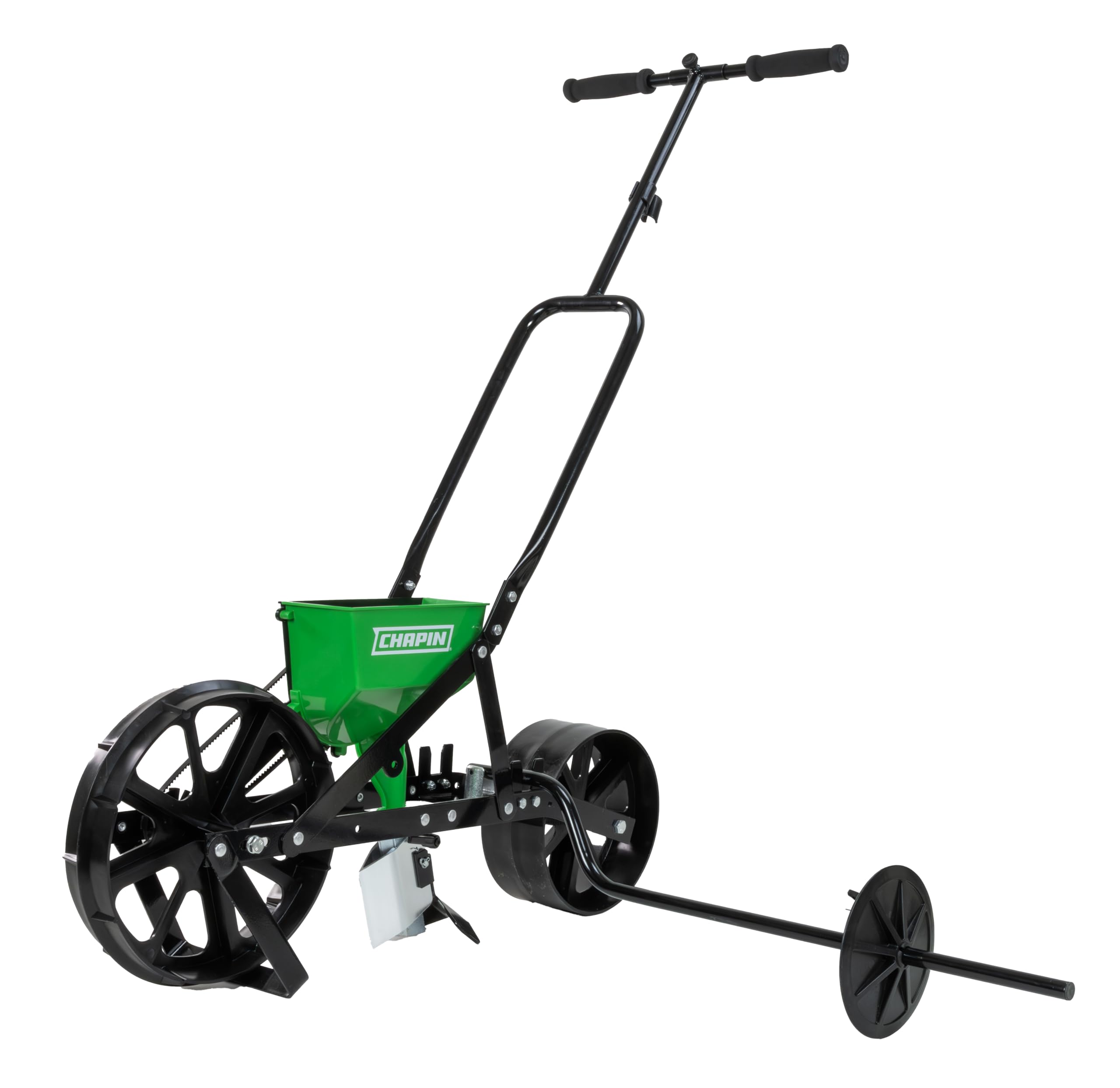
A steel-framed push seeder that is sturdy but finicky with small seeds.
The Chapin 8701G brings a powder-coated steel frame to the push seeder category, which gives it real heft and stability in the garden. The 1.5 liter poly hopper holds enough seed for multiple rows, and the 6 interchangeable seed plates cover up to 20 vegetable varieties. The adjustable rotating wheel marks consistent row widths, and cushioned handle grips reduce hand fatigue during long sessions. Owners who use it for sweet corn and beans say it saves significant time and they regret not buying it sooner.
The mixed feedback centers on the seed plates. About half of owners find the plates do not pick up seeds consistently, with some seeds jamming and others dropping in clusters of 2-3. This is especially true for small or irregular seeds. The planter is best for larger seeds like corn and beans; for delicate seeds, expect to hand-finish some spots. The steel frame is a plus for durability but does not solve the plate accuracy issue.
Where It Excels
- Sturdy powder-coated steel frame for reliable season-after-season use
- 1.5 liter rust-resistant hopper and 6 seed plates for up to 20 seed types
- Cushioned grips and row marker reduce fatigue and keep rows straight
Where It Struggles
- Seed plates inconsistently pick up small seeds, requiring manual correction
- Mixed owner experience means you might need to experiment with plate selection
Best for: the gardener who wants a heavy-duty steel frame and primarily plants larger seeds like corn and beans.
Think twice if: you need reliable small-seed planting; the EarthWay or Hoss are more consistent for that.
6. Altdorff Bulb Planter Tool Long Handle

A budget-friendly 5-in-1 planter that works best in soft soil.
The Altdorff planter is a direct alternative to the ProPlugger, with a 39-inch T-handle that lets you plant bulbs and plugs from a standing position. It creates a 3.5-inch diameter hole with two pedals: one to push down, one to release the soil. The iron frame weighs 3 pounds and has a powder coating for rust resistance, with two rows of bolts for added stability. It is a solid choice for the occasional bulb planter who wants to avoid the more expensive carbon steel tools.
Owners praise its effectiveness for removing wild onions and planting bulbs in soft ground. However, the recurring gripe is that the main pole can twist after about an hour of use, misaligning the foot holds but not affecting the digging function. It is good value for light use, but not heavy duty enough for frequent sod plugging or hard soil.
What Works
- 5 tools in one at a budget-friendly price point
- Serrated edges cut clean 3.5-inch holes; two pedals for easy operation
- Powder-coated iron resists rust and weather
What to Expect
- Main pole can twist over time; not for heavy-duty or frequent use
- Only effective in soft, moist soil; hard ground can damage the foot tab
Best for: the casual bulb planter who wants a standing tool without spending on premium steel.
pass on it if: you plan to dig more than 100 plugs per season; the ProPlugger is tougher for that workload.
7. DYRABREST Manual Seeder

Seeds and fertilizer go in the same pass with this handheld tool.
The DYRABREST is a dual-hopper manual seeder that injects seed and fertilizer into the soil at the same time. The seed box holds 1.1 kg, the fertilizer box holds 2.7 kg, and the machine separates the two by 5 centimeters with the fertilizer one centimeter deeper than the seed. This design eliminates the step of fertilizing separately, which saves real time in a vegetable patch. It is a plastic-bodied tool with adjustable depth and seed amount.
Customers note it works well for large seeds like corn, beans, squash, and for broadcasting fertilizer. The single biggest frustration: it arrives with no instructions. Multiple owners note this, and finding a demo video takes some digging. The metal screws and springs can rust if the tool is not kept dry, and the plastic construction feels less durable than metal alternatives.
The Upside
- Simultaneous seed and fertilizer injection with separate depth control
- Adjustable seed and fertilizer amounts for different crops
- Eliminates bending for small-scale row planting
The Downside
- No instructions included; set-up requires online research
- Plastic body and metal fasteners may rust; needs dry storage and lubrication
Best for: the gardener who plants large seeds like corn and beans and wants to combine fertilizing with seeding.
it’s not for you if: you prefer a tool with clear instructions and are planting small or fine seed that this tool does not handle well.
8. Varomorus Precision Seeder
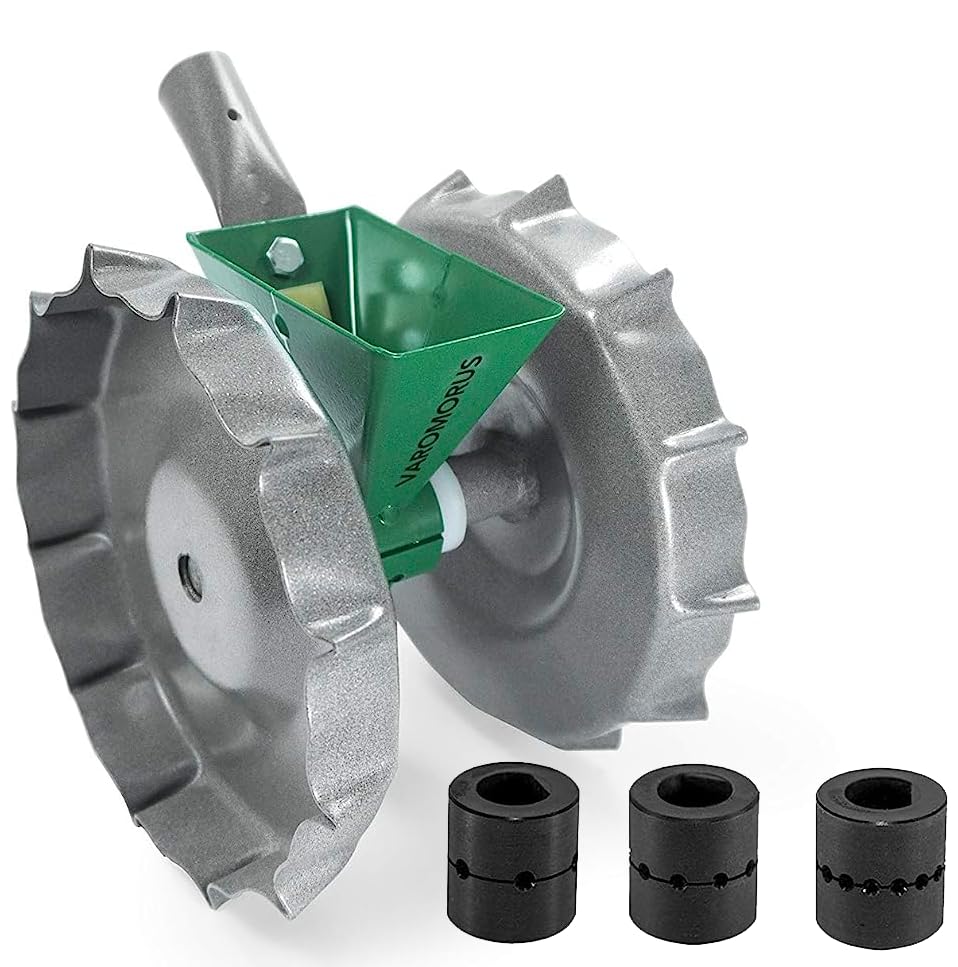
A compact push seeder for precision placement of small vegetables.
The Varomorus is a pull-type seeder built for precision on small crops like radishes, beets, carrots, and onions. It is made of stamped steel and arrives fully assembled, requiring only the connection of a handle. The rotating sowing drum places seeds into calibrated deepenings, and the included nozzle set enhances accuracy for smaller seeds. It is a niche tool designed for the gardener who wants to avoid hand-sowing fine seed.
The honest read from owners is mixed. It works well in a 48-foot by 52-foot garden and maneuvers through raised beds. But the included seed wheels are limited — one buyer found only 1 of 62 seed varieties fit through the wheels. Changing the seed selector requires disassembling the axle with a 1/4-inch ratchet and 10mm socket. It also needs soft, loose soil; wheels slip on hard-packed ground and the tool has no depth gauge. This is a tool for dedicated small-seed gardeners willing to dial in the setup.
Where It Shines
- Metal construction is durable for a compact seeder
- Nozzle set improves precision for small seeds like radish and carrot
- Fully assembled; connects to a handle and is ready to go
Where It Falls Short
- Seed wheels fit very limited seed sizes; custom wheels needed for most varieties
- No depth gauge; requires soft, loose soil to function
Reach for this if: you only plant small round seeds like radishes and beets and want a metal push seeder.
Look elsewhere if: you plant a diverse mix of seeds; the EarthWay or Hoss offer better plate variety.
9. Seed Sower Gardening Tools Manual Seeder
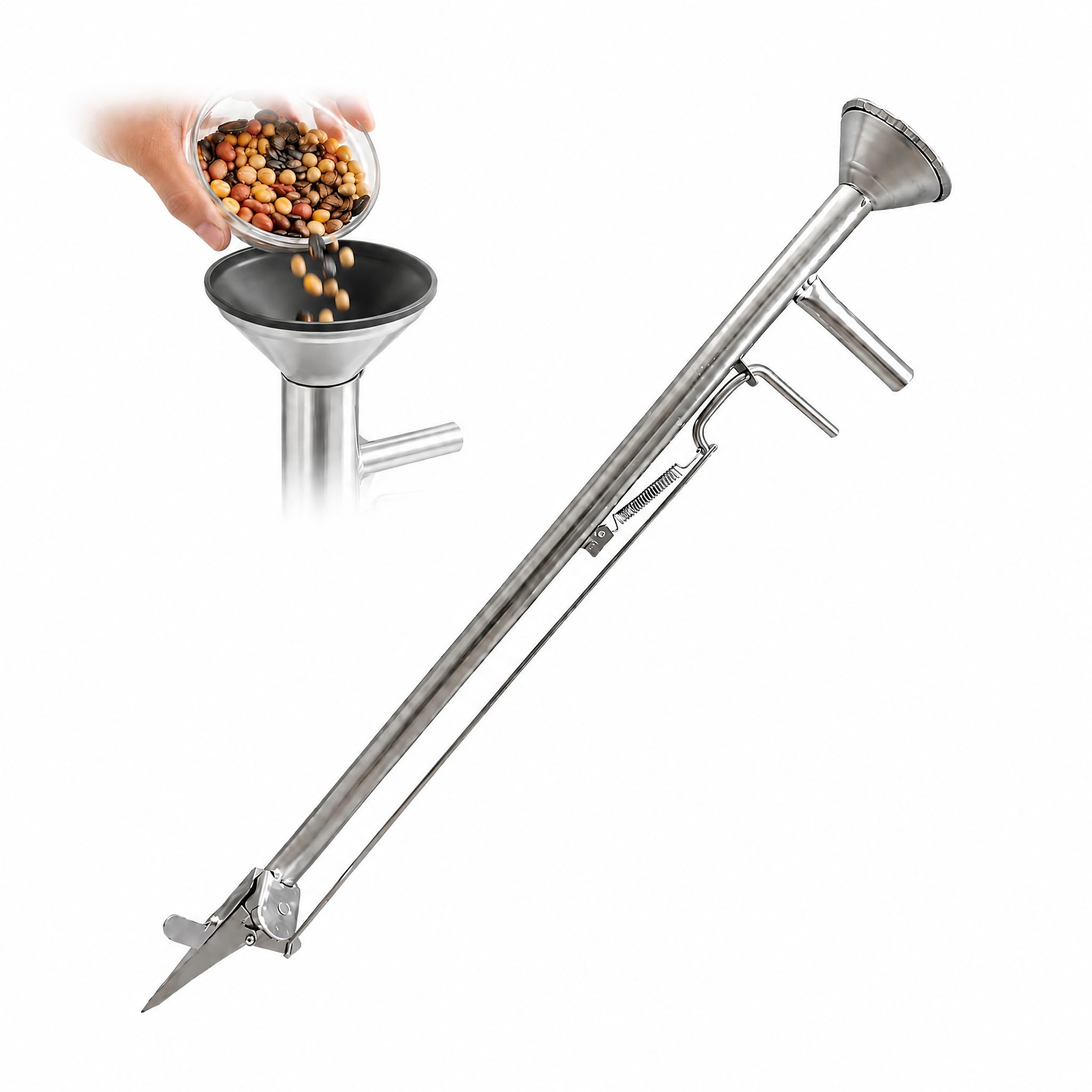
A simple handheld planter for corn, beans, and other large garden seeds.
This Seed Sower is a straightforward jab-style planter made from galvanized material. You push it into the soil, drop a seed down the tube, squeeze the handle like a brake, and the seed drops into the hole. It is designed for large seeds like tomato, watermelon, pumpkin, pepper, cucumber, peanut, corn, and cabbage. The 36-inch length keeps you upright, saving the knees and back that normally suffer from hand-seeding.
Buyers confirm it helps avoid bending over, which is the main draw. The catch: it has no metering system, so it releases seeds all at once or not at all. Owners note they have to open the seeder and drop just one or two seeds at a time, which defeats the speed advantage. The build quality is also a concern, with reports of sharp welding wire and thin material. It works on soft ground but requires gentle handling. For the price, it is a functional entry-level tool for the occasional gardener.
What It Does Well
- Keeps you standing upright, saving your back and knees during planting
- Galvanized material resists rust for seasonal use
- Simple operation for large seeds and seedlings
What It Lacks
- No seed metering; shells out multiple seeds or none, requiring manual adjustment
- Build quality is inconsistent; thin material and sharp welds reported
Best for: the very occasional gardener who only plants large seeds like corn and pumpkins and wants to avoid kneeling.
look elsewhere if: you want a tool that meters seeds accurately or will last more than a few seasons of regular use.
Understanding the Specs
Seed Plates
The rotating disc inside a push seeder that picks up individual seeds from the hopper and drops them at a set interval. More plates mean the tool can handle more seed sizes. The holes are sized for specific seeds: a plate that works for corn drops a single large kernel, while a plate for carrot has very small holes. If you plant many different crops, 7 plates that cover 20 or 38 seed types is a good range. Some seeders, like the Hoss, let you buy additional plates separately.
Planting Depth
How deep the seed is placed in the soil. Most push seeders let you adjust this via a depth wheel or plow adjustment. The Hoss covers 1/4 inch to 1 1/2 inches deep, which covers the range for most vegetable seeds. Handheld jab planters use depth rings (like the ProPlugger’s 2, 4, and 6 inch marks) so you can push to the same depth each time. Correct depth is critical for germination: too shallow and the seed dries out, too deep and it cannot reach the surface.
FAQ
Does a garden seed planter work in hard or rocky soil?
Can I use a push seeder for very small seeds like carrot or lettuce?
What is the difference between a handheld planter and a push seeder?
How many seed plates do I need?
Is a steel or aluminum frame better for a push seeder?
How do I clean and maintain a garden seed planter?
Can a garden seed planter be used for fertilizing?
What size garden justifies buying a push seeder?
Are garden seed planters easy to assemble?
What is the best seeder for a beginner gardener?
Final Thoughts: The Verdict
Across the board, the best garden seed planter is the Hoss Garden Seeder because its powder-coated steel frame, hardwood handles, and 6 seed plates cover every seed size with accuracy that owners describe as “built like a tank.” If you want a lightweight push seeder for large seeds like peas and corn, grab the Agri-Fab Push Garden Seeder. And for bulb and sod plug planting where a push seeder will not work, the ProPlugger 5-IN-1 is the one to reach for.
How We Picked
We do not accept paid placement. Every pick is matched to a real buyer and a real use-case; we do not hands-on test units.
Sources & Methodology
Specifications: manufacturer listings and product documentation. Review insights: verified customer reviews, as of July 2026. Pricing: not shown on this page (it changes often); check the current price via the retailer link.
As an Amazon Associate, Lawn Gear Lab earns from qualifying purchases. This does not affect which products we feature.