
Specs are compiled from manufacturer listings and verified buyer reviews and can change over time — please confirm the key details on the product page before buying.
A crisp edge between your lawn and the flower bed is the single biggest difference between a yard that looks good and one that looks loved. But dragging a gas-powered machine around for a few feet of sidewalk border feels absurd, and a shovel leaves a ragged, crooked trench that fills back in after one rain. The smart answer is the right tool for the job: a garden edger tool built to give you a sharp, clean line with one firm step, no fuel or extension cord required.
I’m Rikta — the founder and writer behind Lawn Gear Lab. This guide is built by comparing the manufacturers’ published specifications and the patterns across verified customer reviews, so you get each pick’s real strengths and trade-offs instead of marketing spin.
Whether you are facing overgrown Bermuda grass along a driveway or fresh soil for a new bed, choosing the right garden edger tool means balancing blade sharpness, handle length, weight, and the kind of soil you dig most often — and these nine picks cover every scenario from light touch-ups to heavy trenching.
Our Picks at a Glance

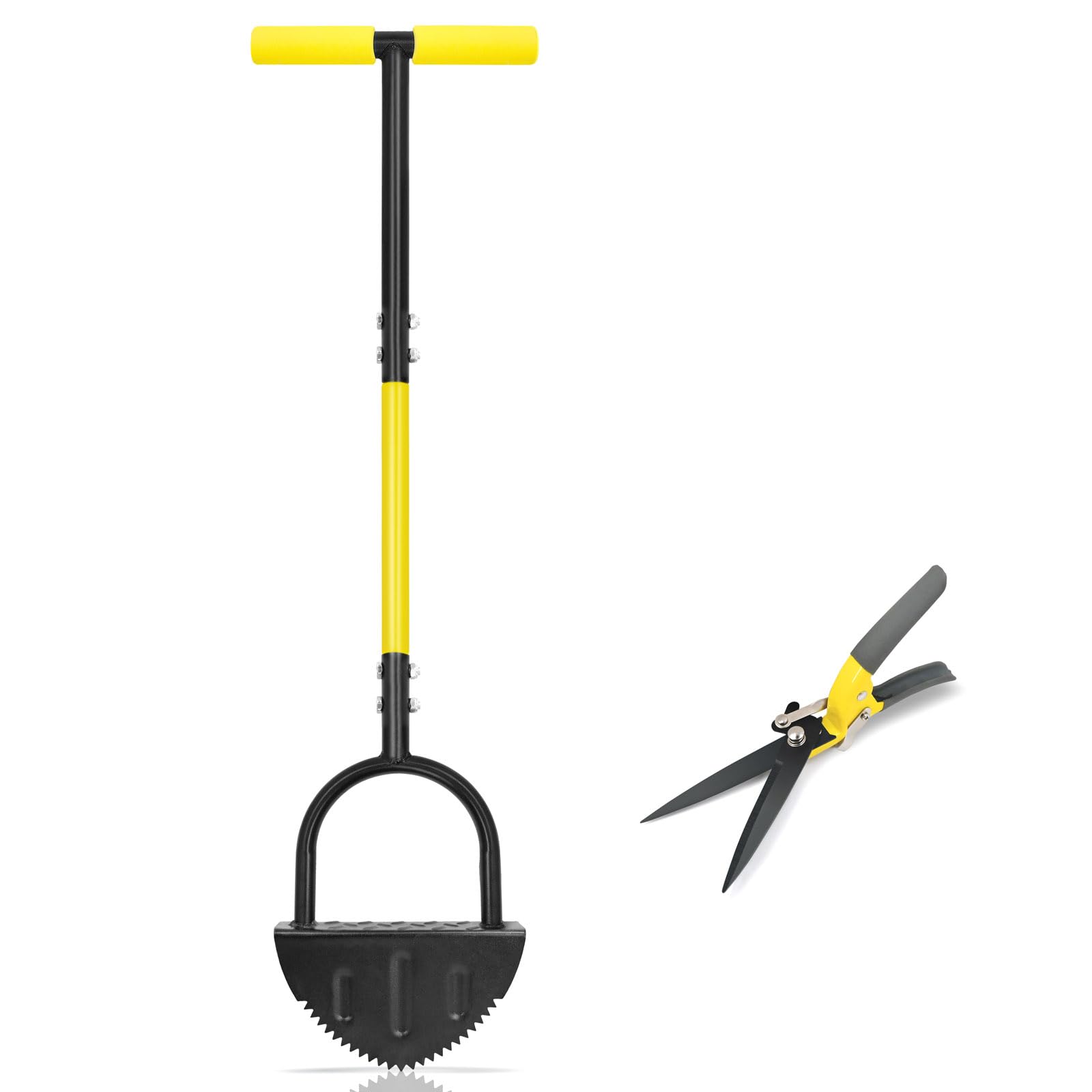

How To Choose The Best Garden Edger Tool
The right edger depends on your yard size, soil type, and how much muscle you want to spend. Manual tools are quiet, cheap, and precise — electric models save sweat on long runs. Here are the three specs to look at first.
Blade Shape and Material
A half-moon blade creates a crisp vertical cut and is ideal for soft to average soil. A serrated or saw-tooth blade grips the soil and chews through dense turf and shallow roots more aggressively. Carbon steel holds an edge longer than standard steel but needs wiping after each use to prevent rust. Spring steel offers a flexible, durable edge that resists deforming.
Handle Design and Weight
A longer handle (40 inches or more) saves your back by reducing how much you bend. Look for a padded or ergonomic grip that stays secure whether your hands are dry or sweaty. Weight matters too — a 4-pound tool is comfortable for a full session, while a 5.24-pound edger delivers more downward force with less arm effort but can tire you out faster.
Step Platform vs. Arm Force
A step edger has a wide footbar you push with your boot, transferring your body weight into the cut. This is the easier option for hard or clay-packed soil. An arm-push edger (half-moon style) relies on upper-body strength and works best in loose, moist, or sandy ground. If you have tough soil, a step platform is a must.
Quick Comparison
| Model | Best For | Blade Type | Handle Length | Weight | Amazon |
|---|---|---|---|---|---|
| Radius Garden Pro-Lite★ Best Overall | Best Overall | Half-moon carbon steel | 40.25 in | 4 lb | Amazon |
| Professional Edge Lawn ToolBest Value | Best Value | Saw-tooth half-moon steel | Long (ergonomic) | — | Amazon |
| CKLT One-Piece EdgerNo-Assembly Pick | No-Assembly Pick | Serrated spring steel | 40 in | 5.24 lb | Amazon |
| Bully Tools 12-Gauge Edger | Heavy-Duty Edging | Round 12-gauge steel | 39.25 in | 3.69 lb | Amazon |
| Yard Butler Step Edger | Step Edging | Straight steel | 37 in | 4.5 lb | Amazon |
| Root Slayer 22611 | Root Cutting | Serrated half-moon carbon steel | 39.25 in | 4.8 lb | Amazon |
| Amazon Basics Corded Edger | Electric Edging | 7.5 in double-edge | 60.2 in overall | 14.3 lb | Amazon |
| CRAFTSMAN CMEED400 | Corded Power | 10.6 in blade | 14.39 in (head) | 11.5 lb | Amazon |
| WORX WG898 | Cordless Freedom | 7 in streamlined | 57.9 in overall | 7 lb (no battery) | Amazon |
In‑Depth Reviews
1. Radius Garden 25602 Pro-Lite Carbon Steel Edger, Green
Our pick — over 4.5★ from 500+ verified ratings; the strongest balance of quality and price.
The lightweight half-moon that delivers crisp lines without rattling your joints.
At just 4 pounds (the CKLT one-piece model weighs 5.24 pounds), you feel the difference after the first ten cuts — your arms stay fresher longer. The carbon steel blade is heat-treated and measures roughly 9 x 5 inches, cutting a clean, deep trench through clay and turf alike. Owners describe it as “a light weight and user friendly tool for edging,” and the extra-wide step platform gives you solid leverage without the back strain of a shovel.
The ergonomic doughnut-shaped handle is the standout design detail — it gives you a secure, comfortable grip and doubles as a handy hook for storage. The fiberglass shaft is strong enough for heavy-duty digging, and the 40.25-inch overall length means you stand nearly upright as you work. The trade-off is that the blade needs a wipe after each use to prevent rust, a small ritual for a tool owners say “will last decades.”
What the praise says: The rounded handle and lightweight feel get the biggest cheers — owners call it “so much better than trying to use a shovel” and note it cuts clean and deep with no joint flex even in heavy clay.
One honest note: The blade arrives factory-sharp but some found it slightly less aggressive on thick grass; pairing it with a flat-edge shovel for the first pass solves that.
Reach for this if: you want a comfortable, long-lasting manual edger that handles regular garden-bed touch-ups and light trenching without wearing you out.
Think twice if: you regularly cut through deep, dry clay or thick St. Augustine runners — a serrated blade cuts that kind of turf more efficiently.
2. Professional Edge Lawn Tool, Heavy Duty Steel Half Moon & Saw-Tooth Blade
A saw-tooth blade that bites through tough turf where a straight edge just skids.
The defining feature here is the row of teeth lining the bottom of the curved half-moon blade. Instead of pushing down and hoping for a clean cut, the teeth grab the grass, roots, and soil and slice through — owners say it “works good in soft ground” and cuts cleanly through dense turf. The long handle reduces bending, and the non-slip grip stays secure even when your hands are wet, which is exactly when you are most likely to be edging after a rain.
The footplate is wide enough to accommodate any shoe size, so you can put your full weight behind each step. The steel welded construction with a carbon steel blade is weather and rust resistant. One owner did note the blade arrived nearly 1/8 inch thick and needed a quick pass with a grinder to narrow the teeth for heavy turf — a 10-minute fix. But the effectiveness is the most-praised aspect by a wide margin, and the overall feedback is that it delivers professional-looking lines without the noise or fuel of a power tool.
Why owners grab it: The saw-tooth design is the star — it pulls weeds out by the roots and leaves a clean, straight line that looks like it was done with a power edger, but in total silence.
The main catch: A handful of owners found the blade not sharp enough from the factory; a quick file touch-up transforms it into a beast on heavy turf.
Best for: anyone with dense, rooty, or clay soil who wants a manual edger that actually rips through the tough stuff without needing gas or a battery.
Look elsewhere if: you want a tool that is razor-sharp from the start with zero prep — some light sharpening may be needed.
3. One-Piece 40in Manual Edger Lawn Tool with Spring Steel Blade | Mangan
Arrives fully assembled with a spring steel blade that refuses to go dull.
This is the tool you pull from the start and step on immediately — no assembly required. The 1.18-inch diameter manganese steel tube and inserted thick metal handle give it a stout, solid feel, and at 5.24 pounds it is the heaviest manual edger on this list. That extra weight works for you: it drives the serrated spring steel blade into the ground with less effort from your leg, making it ideal for compacted or clay-heavy soil. Owners say “I love love this tool! So easy to use” and mention that a 70-year-old woman found it easy in damp soil with clay.
The spring steel blade is the real story here — spring steel is known for resisting deformation and holding its edge much longer than standard steel. The serrated design cuts through sod and roots smoothly, and the 40-inch length keeps you standing upright. A supplied protective strip slides over the blade for safe storage, a detail that matters when you are hanging it in a crowded garage. The functionality and durability are the most-praised aspects, with owners calling it “built well, this will last a lifetime.”
What wins people over: It comes ready to use and the spring steel blade bites into tough ground without needing constant resharpening — owners call it “top notch” quality for the money.
The real trade-off: At 5.24 pounds it is noticeably heavier than the 4-pound Radius Garden, so if you have a very large yard or limited arm strength, the extra heft could tire you out faster.
Reach for this if: you want a no-fuss, one-piece tool with a blade that stays sharp season after season, especially in damp or clay-heavy soil.
skip it if: you have a small frame or need the lightest possible tool — the Bully Tools or Radius Garden weigh less and move faster.
4. BULLY TOOLS 12-Gauge Manual Lawn Edger, 61.5″ Steel T-Style Grip

A 12-gauge steel brute that takes the abuse landscapers dish out and asks for more.
At 3.69 pounds, this is surprisingly light for a tool built with 12-gauge extra-thick steel — the same gauge used in commercial-grade garden tools. The round blade is engineered for sod cutting, trenching, and defining edges along sidewalks and driveways, and the all-steel construction resists warping and bending season after season. Owners praise it as “sturdy and easy to use,” noting it edges a driveway or sidewalk quickly and efficiently. The steel T-style grip provides excellent leverage and reduces hand fatigue during long sessions.
The detachable blade extends the tool’s life significantly — you can replace just the blade instead of the whole tool when it eventually wears. The wide footrest provides solid leverage, and the 39.25-inch overall length is comfortable for most heights. One recurring note: the rubber grips on the handles are not permanently attached and can loosen and twist off after about 10-15 minutes of use. A dab of adhesive sorts it out, but it is an annoyance on an otherwise tank-like tool. Bully Tools are 100% made in the USA by a family-owned company in Steubenville, Ohio, backed by a limited lifetime warranty.
The thing everyone raves about: It works as well as expensive power edgers for a fraction of the cost and handles both edging and trenching without breaking a sweat — owners call it “well worth the price.”
One honest catch: The rubber handle grips are not fixed firmly and may spin off during use; a little super glue or electrical tape solves it permanently.
Best for: heavy-duty users who edge large properties, cut sod, or dig trenches regularly and want a tough, repairable tool that is made domestically.
Look elsewhere if: you want a tool with permanently attached grips that you never have to tinker with — the Radius Garden or CKLT have one-piece handles.
5. Yard Butler Step Edger – Handy & Durable Gardening Tool

The foot-operated edger that lets your body weight do the hard work for you.
Instead of pushing down with your arms, you place your foot on the sturdy steel foot bar and step — your body weight drives the blade into the ground. This makes the Yard Butler a favorite for anyone with hard, clay-packed soil or anyone who wants to avoid back strain. The powder-coated steel resists rust, and the cushioned handles keep your grip comfortable even after an hour of steady work. At 4.5 pounds, it is mid-weight in this lineup but feels solid underfoot.
Owners have used this tool for everything from edging sidewalks to burying fiber optic cable — one couple in their 80s dug 100 feet of trench in 2 days by working 2 hours a day after rain. The versatility is a real strength. But the blade does have a limitation: it is not sharp enough for thick, dry grass or St. Augustine runners. Owners note that even a larger person struggles with dry turf, and the tool works best after rain or sprinklers. The blade profile is better suited for trenching than for slicing a fine edge along concrete.
Why owners buy it: It is simple, sturdy, and effective for creating trenches and edging in damp soil — the step platform makes it easy on the back and the powder coating resists rust beautifully.
The main limitation: The blade is not aggressive enough for dry or thick grass; you will want to edge after a rain or run a sprinkler first to soften the ground.
Reach for this if: you have tough, clay-packed soil or a bad back and want a step-operated edger that transfers your weight into a clean cut with minimal arm effort.
Think twice if: you need a precision half-moon blade for crisp edges along concrete in dry conditions — a sharper serrated tool works better there.
6. Root Slayer 22611 Serrated Garden Edger, Red

A serrated blade with an inverted V tip that chews through roots like they are not there.
The Root Slayer lives up to its name. The half-moon blade features a sharpened V-shaped point and aggressive serrated teeth that cut through compact soil, turf, and shallow roots with noticeably less effort than a straight edge. At 4.8 pounds, it is heavier than the Radius Garden but lighter than the CKLT, and that weight helps drive the teeth into stubborn ground. The fiberglass shaft is resin-encased and capped with a comfortable non-latex grip, providing stability and control during extended edging work.
Effectiveness is the most-praised aspect by far — owners say it “cuts right through the ground to define landscape beds” and that it handles reasonable tree roots without any trouble. The powder-coated carbon steel blade is designed for corrosion resistance, and the manufacturer backs it with a lifetime warranty. A few owners note the weight as a mixed point: one person borrowed it and said it was too heavy for her to use, while another called it “light weight despite what some reviews state.” It is a sturdy, stand-on design that works great for outlining flower beds and cleaning up along curbs and driveways.
What wins people over: The aggressive serrated teeth and V tip cut through roots and tough turf that stops a standard half-moon blade cold — owners say it is a “must have landscaping tool.”
The honest trade-off: At 4.8 pounds, it is on the heavier side, which gives it power but may be too much for someone with a smaller frame or less upper-body strength.
Best for: gardeners and homeowners who deal with shallow roots, compact soil, or overgrown edges and want a manual edger that genuinely cuts through the hard stuff.
Look elsewhere if: you are very petite or have limited arm strength — the 4-pound Radius Garden offers a lighter, still-effective alternative.
7. Amazon Basics 12 Amp Corded Electric Lawn Edger

A 12-amp corded beast that spins at 4420 RPM and never needs a battery recharge.
When the manual tools are not cutting it — literally — this Amazon Basics edger brings serious power. The 12-amp motor delivers 4420 RPM on a 7.5-inch double-edged blade, digging up to 1.5 inches deep for a clean, precise cut. It also doubles as a trencher for burying wires, cables, or irrigation lines. The spring-assist front wheel lets you adjust the blade depth easily, and the adjustable auxiliary handle improves control during operation. Owners say it is “easy to assemble and works well” for driveway and sidewalk edging, and note the blade is easy to replace and find for purchase.
At roughly 14.3 pounds, it is significantly heavier than any manual edger, but the wheels and motor do the work — you just guide it. The corded operation means unlimited runtime, but you are limited by extension cord reach. The 94 dB maximum noise level means ear protection is a good idea. Some owners found it heavy to maneuver, and opinions on long-term durability are mixed. The functionality and quality are the most-praised aspects, and the value-for-money rating is strong.
Why owners buy it: The raw power is the draw — it cuts through thick grass and tough soil quickly, and the price is tough to top for a corded electric edger with a 12-amp motor.
The main caveat: It is cord-only, so your range is tied to an extension cord, and the weight makes it less nimble than a manual tool for small, detailed edges.
Reach for this if: you have a large driveway, long sidewalks, or tough turf that laughs at manual tools, and you already own a long extension cord.
pass on it if: you only need to edge a few flower beds or small borders — a manual edger is faster to grab and requires zero setup.
8. CRAFTSMAN Lawn Edger Tool, Corded, 12 Amp (CMEED400)

The CRAFTSMAN 12-amp workhorse with three depth settings for detailed control.
CRAFTSMAN brings its familiar red-and-black build to the edging category with a 12-amp high-torque motor that chews through thick turf without bogging down. The 10.6-inch cutting width is noticeably wider than the Amazon Basics’ 7.5-inch blade, covering more ground per pass. Three blade-depth settings let you dial in exactly how deep you cut — useful when you want a light trim along a sidewalk versus a full trench for a garden border. The line cutting guide provides precision when edging along hard surfaces, and the adjustable auxiliary handle gives you a customized grip.
Performance is the most-praised aspect — owners say it “cuts through thick weeds with ease” and creates “clean straight lines.” At 11.5 pounds, it is lighter than the Amazon Basics model but heavier than any manual tool. The VERSATRACK hook on the handle lets you hang it on a CRAFTSMAN VERSARACK system for neat storage. A few owners note mixed experiences with assembly and one pointed out that the long extension cord and screws through the tubing risk puncturing the wiring if not routed carefully. Overall, it gets high marks for power and value, with owners calling it “easy to put together and easy to use.”
Why owners choose it: The 12-amp motor handles thick, overgrown grass without hesitation and the three depth settings give you real control over the cut — it goes from trim to trench in seconds.
The honest gripe: A small number of owners found the assembly instructions unclear and noted the cord routing takes care to avoid pinching the wire against the metal tubing.
Best for: homeowners who want a powerful, no-nonsense corded edger with adjustable depth that makes quick work of long driveways and walkways.
Look elsewhere if: you are put off by corded tools or have a very large yard — the cordless WORX below gives you more freedom.
9. WORX Cordless Lawn Edger, 7” Grass Edger with 3 Depth Settings, 20V Trencher
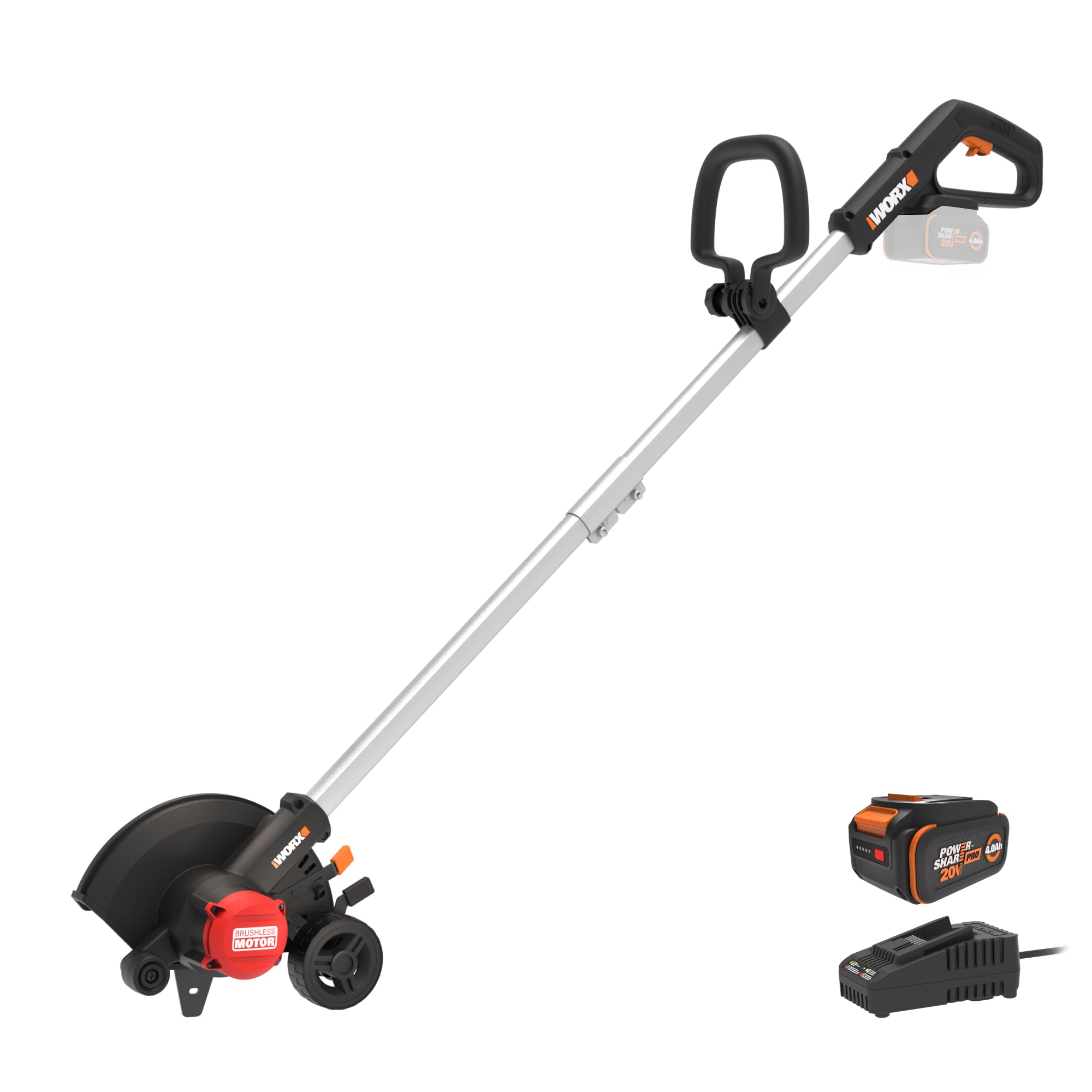
A battery-powered edger that cuts the cord without cutting power — up to 2,800 feet of edging per charge.
The WORX WG898 is the clear choice if you want to edge without dragging an extension cord across the lawn. The brushless motor is efficient and quiet, and the 20V 4.0 Ah lithium battery delivers up to 2,800 feet of edging per charge — enough for a large yard. The 7-inch streamlined blade is designed to create clean, crisp edges, and the 3 depth settings let you adjust from a light touch-up to a deeper trench. At just 7 pounds without the battery, it is lighter than both corded models and easier to maneuver. Owners say it is “easy to handle” and an 81-year-old found it “lightweight and powerful” enough to use comfortably.
The dual wheels keep the tool balanced and tracking straight along the edge. The WORX PowerShare battery system means the 20V battery works across any WORX tool — expand your 20V, 40V, or 80V arsenal without buying new batteries. A few owners note that battery life is shorter than expected when cutting deep or hard soil, and one owner had a dull blade from the factory that needed replacement. If you have more than 500 feet of edging, you may want a second battery. Overall, the performance and lightweight design earn the most praise, making it a strong candidate for anyone who values convenience and cordless operation.
Why owners love it: The freedom of cordless operation combined with real power — it digs deep trenches and edges flower beds with the same ease, and the battery swaps with other WORX tools.
The honest trade-off: The battery life can feel short in hard soil or deep cuts, and an occasional blade arrives less sharp than expected; checking and touching up the edge before first use is wise.
Reach for this if: you want cordless convenience, have a medium-to-large yard, and already own or plan to buy into the WORX PowerShare battery system.
Think twice if: you edge in very hard or rocky soil where a corded motor or manual step edger delivers more sustained torque.
Understanding the Specs
Blade Material and Edge Life
Carbon steel holds a sharp edge longer than standard steel but requires wiping after each use to prevent rust. Spring steel is more flexible and resists deformation, making it ideal for rocky or root-filled soil. Serrated teeth help the blade grip the ground and cut through turf that would deflect a straight edge. The blade thickness — measured in gauge — also matters: a lower gauge number (like 12-gauge) means thicker, tougher steel that resists bending but weighs more.
Step Platform vs. Arm-Push Design
A step edger has a wide footbar that transfers your body weight into the cut. This is the better choice for hard, compacted, or clay-heavy soil because your leg is stronger than your arm. An arm-push edger (typically a half-moon shape) relies on upper-body strength and works best in loose, moist, or sandy soil. If your soil is heavy, a step platform is not a luxury — it is a necessity for getting the blade deep enough on the first try.