
Specs are compiled from manufacturer listings and verified buyer reviews and can change over time — please confirm the key details on the product page before buying.
Tired of your flower beds looking like a messy blur every time the grass sneaks over? You want a sharp, clean line between your lawn and your garden — something that keeps mulch in place, blocks creeping weeds, and actually looks good doing it. The right edging does all of that with almost zero daily fuss.
I’m Rikta — the founder and writer behind Lawn Gear Lab. This guide is built by comparing the manufacturers’ published specifications and the patterns across verified customer reviews, so you get each pick’s real strengths and trade-offs instead of marketing spin.
You want a clean border between your lawn and flower beds without spending a weekend on installation. The best garden liner edge for you depends on your soil type, your preferred look (stone, steel, or no-dig plastic), and how much time you want to spend putting it in.
Our Picks at a Glance

How To Choose The Best Garden Liner Edge
Garden edging boils down to three things: the material (metal, plastic, or resin), how you install it (dig a trench or no-dig), and how tall it needs to be to stop your specific grass or mulch. Skip any of those and you will be redoing that border within a year.
Material Shapes the Longevity
Metal edging (steel or corrugated iron) is the heavy lifter. It takes a beating from a weed eater and stands up to weather without warping. Plastic and HDPE (high-density polyethylene) coils are lighter, cheaper, and easier on curves, but they can get wavy in heat and crack in deep freezes if the plastic is too thin. Resin blocks (like the Beuta pick below) mimic real stone and are thick enough to shrug off weather, but they cost a tier above coiled plastic.
Height and Stake Count Matter More Than You Think
If you bury a 4-inch tall edging halfway, only about 2 inches stays above ground — that holds mulch but won’t stop aggressive bermuda grass from creeping over. You need a 6-inch or 8-inch exposed height to block roots. Stakes matter just as much: a kit with only 10 stakes for a 40-foot run leaves big gaps, so either buy extra stakes or choose a product that includes plenty (like 50 stakes for 33 feet).
Quick Comparison
| Model | Best For | Material | Total Length | Height (Above Ground) | Amazon |
|---|---|---|---|---|---|
| Beuta Greystone★ Best Overall | Stone look without the dig | Resin | 48″ per section | 2.25″ | Amazon |
| GTSABWAY Pre-RustedBest Heavy Duty | Heavy root barrier | Metal | 40 ft | 6″ | Amazon |
| Master Mark Terrace Board 4″Best Value Coil | Budget coil, clean curves | HDPE Plastic | 40 ft | 4″ | Amazon |
| Master Mark Terrace Board 5″ | Added root defense | HDPE Plastic | 40 ft | 5″ | Amazon |
| shsyue Flexible Edging | No-dig curves, large kit | HDPE Plastic | 33 ft | 4″ | Amazon |
| AGTEK Coil Kit | Roof to patio coverage | PE Plastic | 60 ft | 4″ | Amazon |
| Jorvila No Dig Kit | Low profile, simple install | Plastic | 100 ft | 1.5″ | Amazon |
| Thealyn Decorative Fence | Ornamental borders, small pets | Wrought Iron | 9.17 ft | 18″ | Amazon |
| EcoBorder Recycled Rubber | Mower-friendly L-shape | Recycled Rubber | 24 ft (6 pc box) | 2.75″ | Amazon |
In‑Depth Reviews
1. Beuta Landscape Edging Greystone
Our pick — over 4.5★ from 900+ verified ratings; the strongest balance of quality and price.
The only pick that makes resin look exactly like quarried stone from a few feet away.
Each six-brick section is 47.5 inches long and 2.25 inches tall, and a single box holds four sections — so you get roughly 16 feet of perimeter per order. The interlocking design snaps together without mortar, and the included securing spikes are the detail buyers report most: three spikes per six-brick piece, according to the reviews. The appearance alone draws the most praise by a wide margin — owners constantly mention how much it dresses up a raised bed or a pathway.
What wins people over is the easy DIY install. You spread the sections in your bed shape, push the spikes through the pre-set holes, and you are done. The resin holds its color through all four seasons, and the Greystone finish blends into natural or modern landscapes equally well. A few owners note that the height is noticeable only from up close — at a distance it simply looks like a low stone wall.
The trade-off people talk about most is the entry cost. It is the most expensive option here, and a couple of owners openly wish it cost less. But as the crowd favorite among nearly a thousand buyers at 4.6 stars puts it: it looks like you paid for stone pavers when you actually paid for resin.
Stone-look durability
- Genuine stone texture that stays looking sharp in all weather
- Tight interlocking connections keep sections aligned
- Three spikes per six-brick piece keep it anchored in soft soil
Limited color options
- Higher price point than coiled plastic or steel
- 2.25 inch height is better for shallow beds than deep-rooted grass barriers
Natural aesthetic: your main goal is a clean, polished border — especially around flower beds, pathways, or raised gardens — and you want the look of stone without the mortar.
Uniform look: you are edging a huge yard on a strict budget or need a tall physical barrier against invasive grass like bermuda.
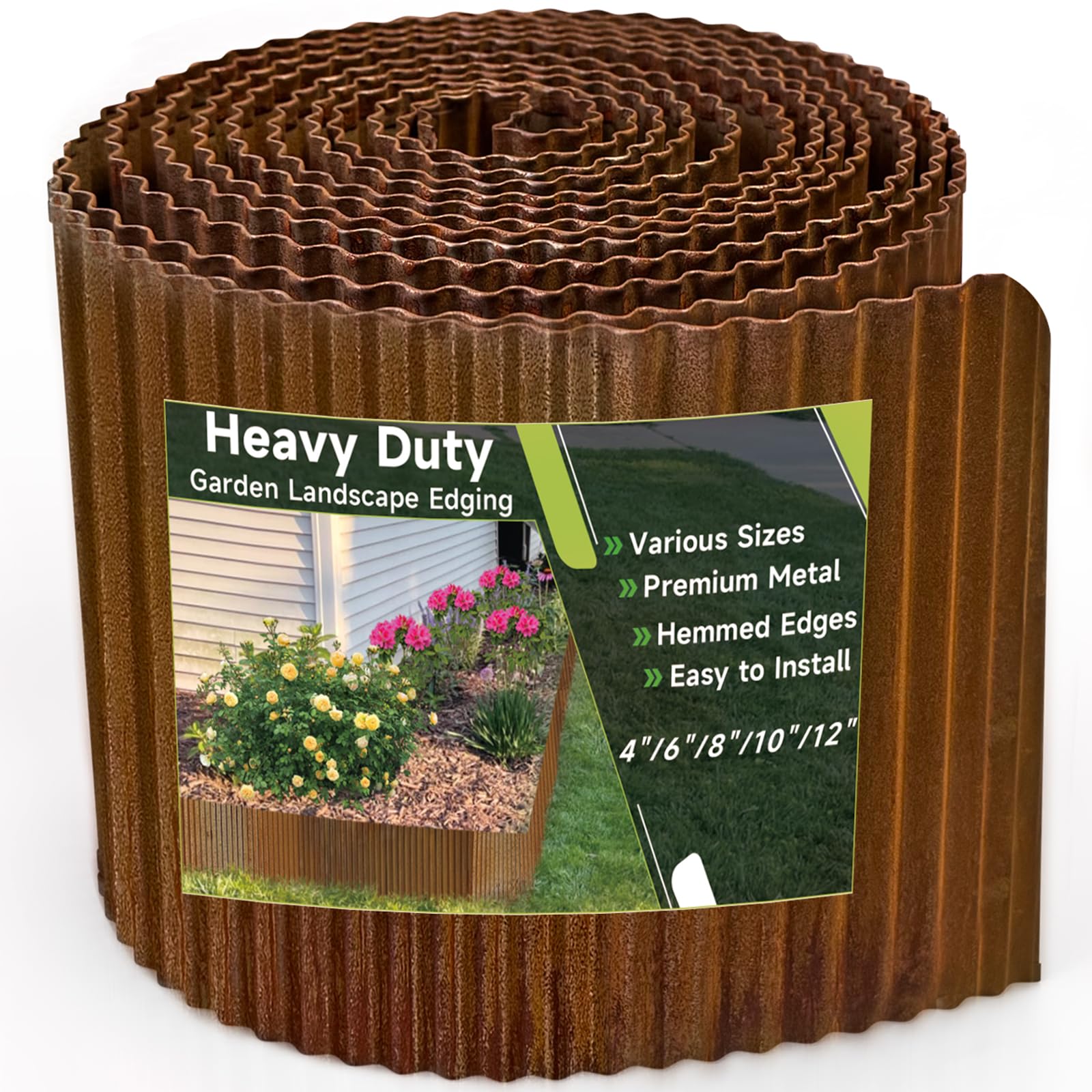
2. GTSABWAY Pre-Rusted Corrugated Garden Edging
The steel coil that laughs at bermuda roots and keeps mulch tight all season.
The 40-foot run stands 6 inches tall, which owners mention is enough to keep out aggressive bermuda grass roots if you weed-eat outside the line. The GTSABWAY coil is 480 inches long while the Beuta section is 48 inches long, and the single-piece coil means fewer joints to push through. The pre-rusted finish develops a natural patina over time, so you skip the waiting game for a rustic look.
Installation is straightforward: wet the soil or dig a narrow trench and push the steel in. The material is heavy-duty galvanized steel, so it bends into curves or straight runs without cracking. Owners consistently mention that the no-dig route works fine in soft ground, though rocky soil calls for the trench method. Those rounded top edges are a thoughtful safety touch — the corrugated metal has no sharp lips catching your shins.
The only gotcha is that the rolled edges look clean but the pre-rust color can vary from the photo. If you need an exact match on patina tone, check recent owner pictures. For raw stopping power against invasive grass, this is the one.
Rustic weathered finish
- Galvanized steel thickness keeps it from flimsy bending after rain
- 6-inch effective height stops deep-rooted grass like bermuda
- Rounded rolled top edges feel safer than raw metal
Sharp edges possible
- Pre-rusted finish may not match the product photo tone exactly
- Metal edges get hot to the touch in direct summer sun
Vintage charm: invasive grass runners drive you crazy — this is the most aggressive root barrier in the list.
Safety concerns: you want a purely decorative border that grows with patina over many years (the pre-rust is instant, not natural aging).
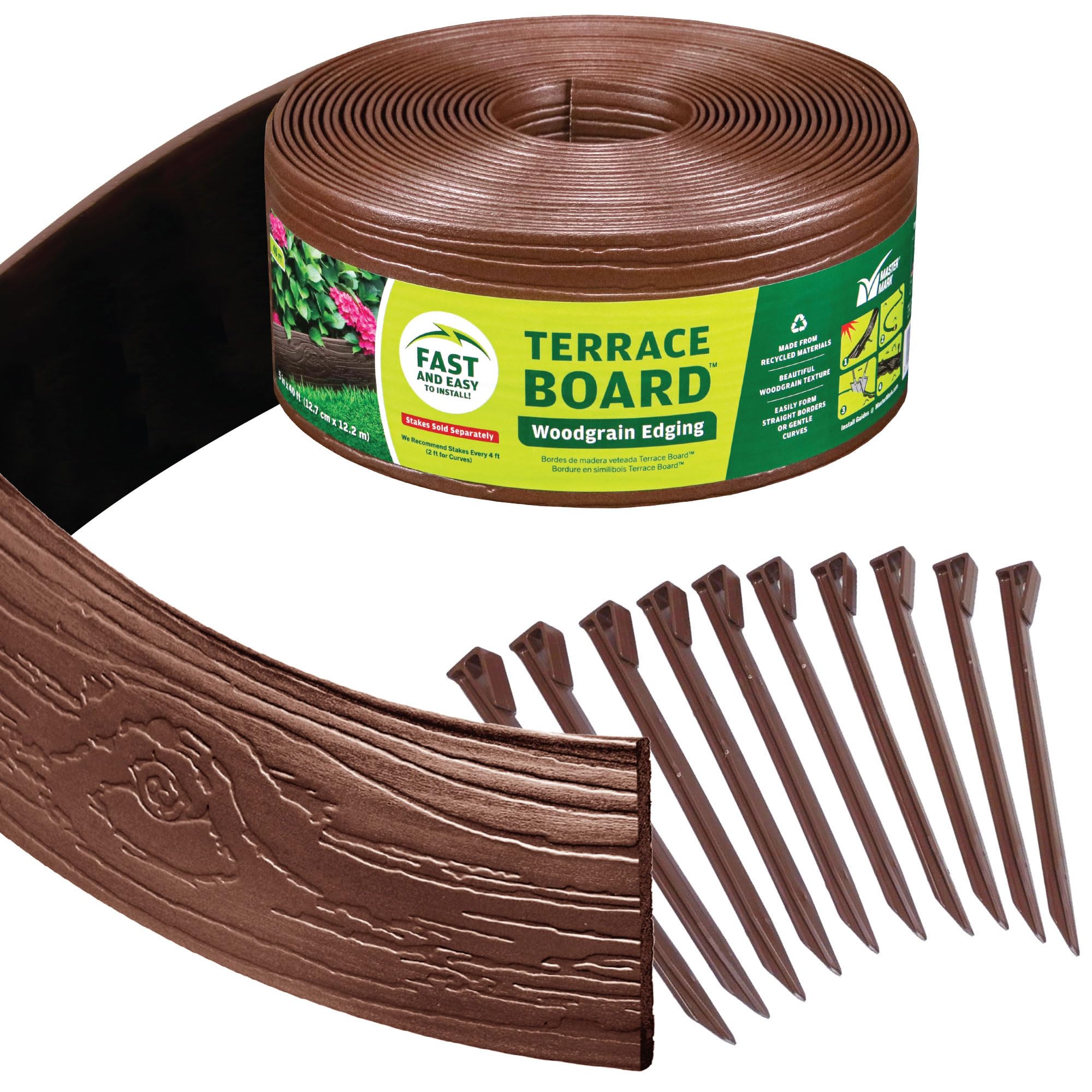
3. Master Mark Terrace Board, 40 ft x 4 in.
A 40-foot roll of HDPE that beats steel on price and wins on flexibility.
The wood-grain textured finish gets the most praise — customers note it looks like real painted wood from a normal viewing distance, but it is actually recycled HDPE (a durable plastic that will not rot, chip, or peel). At 40 feet long and 4 inches tall, this coil covers a medium flower bed or a straight driveway border. The 10 included stakes work for a simple straight run, but reviewers widely agree you will need extra stakes for curves or longer edges.
Where this edging really shines is in the “flexible after sun exposure” trick. If you lay the coil flat in the sun for 20 minutes, the plastic relaxes and unrolls flat, losing its coil memory. That makes it dramatically easier to trench and hammer in than a stiff new roll. Owners use hedge clippers to trim it to length, and several report ordering a third roll after finishing their first yard.
One quirk worth noting: the color shade can vary between rolls. Two rolls from different batches might look slightly different side by side. For most single-run installations it is invisible, but if you have a continuous border across a wide front yard, batch variation can show.
Low-profile flexibility
- Wood-grain HDPE looks like painted wood, costs a fraction of lumber
- Heat the coil for 20 minutes and it flattens into a straight line
- 5/32 inches thick, so it holds shape without cracking
Narrow width
- Only 10 stakes for 40 feet — you will likely need to buy more
- Color shade can vary between production batches
Tight curves: budget-conscious landscapers who want a flexible, rot-proof border that needs only basic tools and a sunny afternoon.
Wide borders: you expect a uniform look across multiple large borders — batch variation might bother you.
4. Master Mark Terrace Board, 40 ft x 5 in.

The same HDPE formula but an extra inch of height for better weed blocking.
At first glance this is the same Master Mark DNA — HDPE plastic, 40 feet long, wood-grain texture, 10 included stakes. The critical difference is the 5-inch height instead of 4 inches. That extra inch gives you more room to bury it 1.5 inches into the soil (as the manufacturer recommends) while still leaving a strong above-ground face to block creeping grass and hold mulch. The quality score in reviews is the top praised aspect — 66 owners single it out, calling it good quality across the board.
Owners who have installed it multiple times say it stays put once the stakes are in, and it works well for quick borders. The material is HDPE, meaning it resists fading and cracking over many seasons. A useful trick: lay the coil flat in the sun to warm it before installation, which helps it straighten and makes the stakes behave.
There are two patterns that come up repeatedly. First, the edging can appear slightly wavy if you rush the installation — it needs a straight trench and firm backfill to look perfect. Second, the 10 stakes feel sparse for the length; many owners buy additional stakes. If you work it carefully, flattened in the sun, you get a clean black border that blends into the soil and looks like a hidden retaining ribbon.
Extra height coverage
- 5-inch height gives that extra buried depth for root blocking
- Black color fades into dark soil and mulch for a clean look
- HDPE won’t chip, rot, or peel in sun and rain
Harder to bend
- Wavy appearance if you skip the sun-warming step
- More stakes are almost mandatory for a long, straight run
Tall beds: medium-height borders where you need to bury the edging deep without losing above-ground presence.
Shallow edges: you want a fully straight, architectural edge — this rewards patience more than the snap-together resin options.
5. shsyue Flexible Lawn Edging Kit
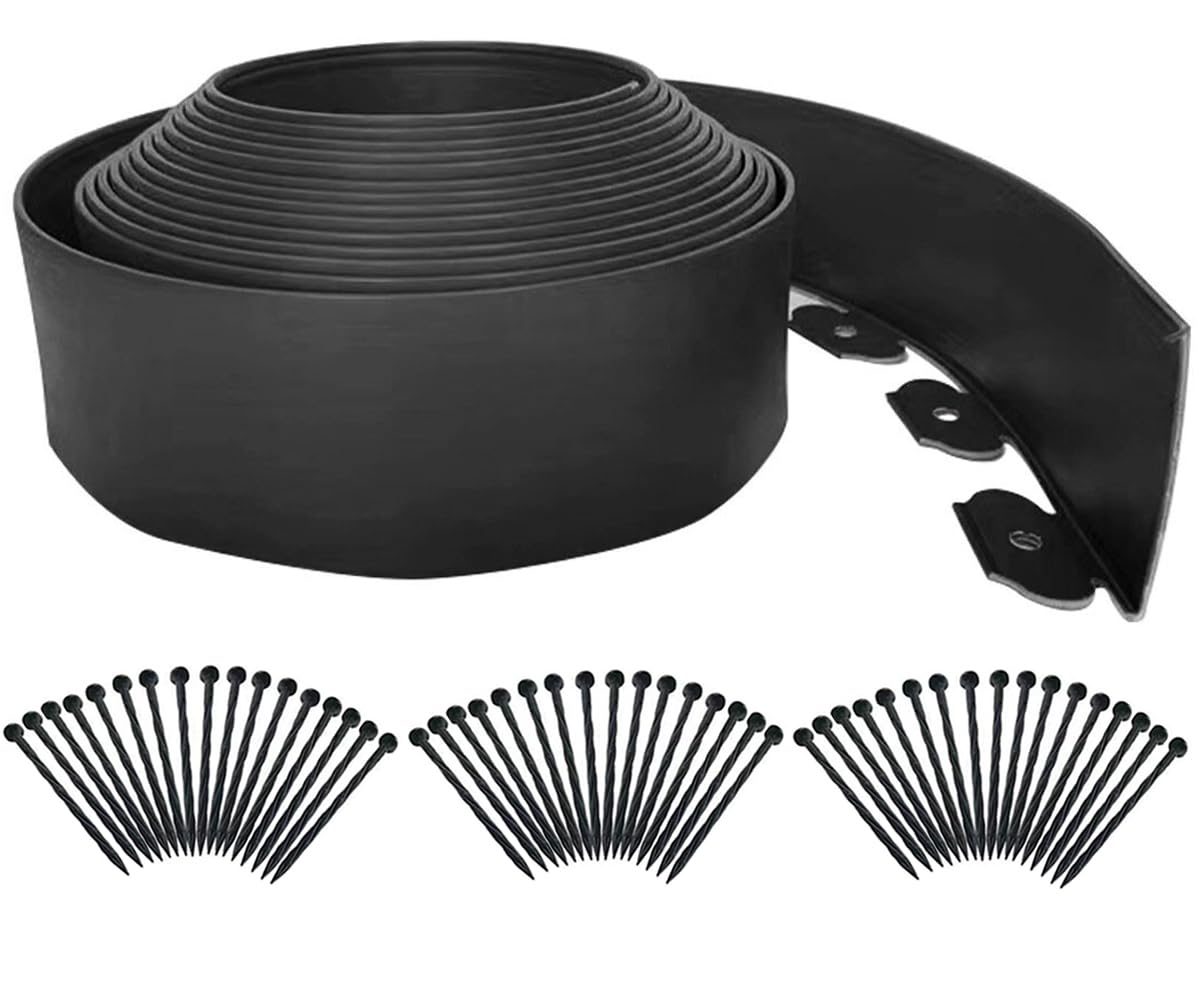
A 33-foot no-dig run that bends into circles and snakes around trees without trenching.
This kit suits a yard with lots of curves. The 4-inch tall HDPE (recycled plastic) border comes rolled into a 33-foot strip, and the standout feature is the 50 spiral spikes included — far more than the Master Mark coils give you, so you can stake every few inches for maximum stability. The no-dig installation is simple: lay the strip flat, shape it to your bed, and hammer the stakes straight through into the soil. It works on uneven and sloping ground if you take your time installing it.
The flexibility is what owners praise most — the PE material (polyethylene) bends into tight circle beds or long flowing curves without kinking. It also cuts clean with scissors or a utility knife if you need a custom length. Quality and ease of installation are the top two praised aspects, with 66 buyers calling it easy to install. The black finish is neutral enough to disappear into the background, leaving the plants as the focus.
The biggest caveat reported by owners is the plastic stakes themselves. Several note that the stakes can break if you hammer them too aggressively into hard or rocky soil. The fix that works: pre-drill guide holes with a smaller metal stake or a screwdriver, then drive the plastic stakes gently. A few extra stakes come in the kit, so a couple of breakages are usually absorbable.
Easy snap assembly
- 50 stakes — far more than most coils — for frequent, stable anchoring
- Bends into any curve including full circles around trees
- No trenching required if your soil is soft enough
Thin plastic
- Plastic stakes snap under hard hammering; pre-drilling helps
- Not tall enough for aggressive soil retention against deep-rooted grass
Quick install: for anyone with lots of curves, tree rings, or irregular bed shapes — the flexibility and hardware count make it painless.
Heavy use: straight rigid borders that need a crisp architectural line — this is a soft, flowing shape tool.
6. AGTEK 60FT Plastic Landscape Edging Coil Kit
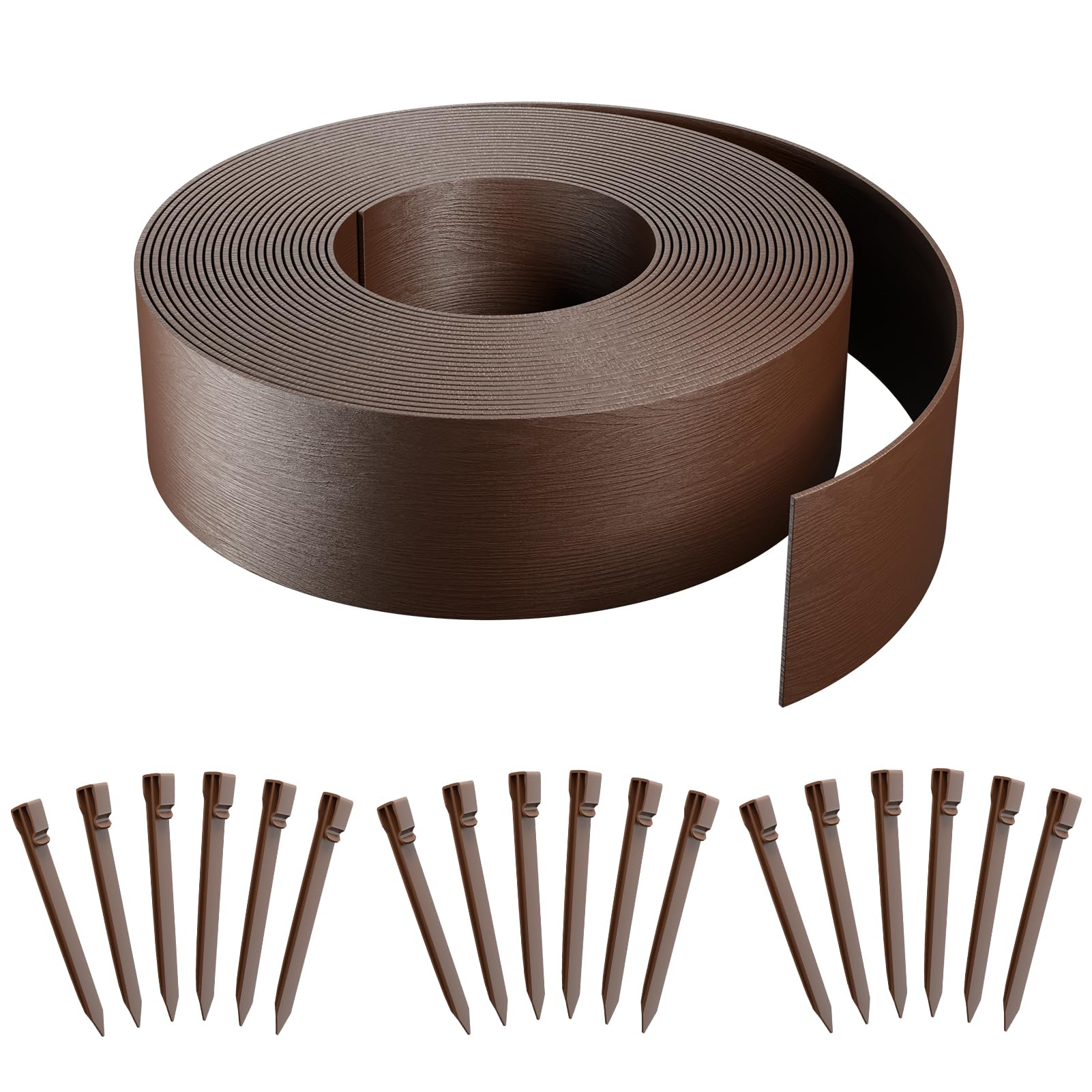
The longest single coil on the list — 60 feet of brown plastic that handles straight runs and curves alike.
If you have a large yard with long, unbroken bed lines, the AGTEK 60-foot coil reduces the number of splices you need. It is made from PE (polyethylene), which is softer than HDPE but also more flexible — you can push it into gentle curves without fighting strong coil memory. The 4-inch height is standard for above-ground mulch retention and basic grass blocking. It comes with 18 stakes, which means a stake roughly every 40 inches along the 60-foot length.
The quality and appearance are the two aspects owners mention most. In practice, the brown color blends well with soil and wood mulch, so the edging fades into the background rather than standing out as a plastic line. The dual function — above-ground barrier plus below-ground root wall — is a feature people appreciate. It works well around flower beds, tree rings, and sidewalks.
The recurring feedback is about durability concerns. A noteworthy number of owners say the plastic can break if you flex it too sharply or if it freezes hard in winter. This is the price of the longer, softer PE material: you get more length per dollar, but the plastic wall is thinner than a premium HDPE or a metal edge. If you live in a region with deep freezes, pre-thaw the coil before bending it.
Long continuous coil
- 60-foot single coil — fewer connectors needed for long runs
- Flexible enough for gentle curves without kinking
- Brown color disappears into soil and bark mulch well
Prone to kinking
- Thinner PE plastic can snap in extreme cold if bent too tight
- 18 stakes at 60 feet is sparse for windy or sandy areas
Straight runs: long straight flower bed edges and sidewalk borders where you want one smooth strip without joints.
Curved paths: metal or reinforced HDPE if your winters are below freezing and the edging will get bumped regularly.
7. Jorvila No Dig Landscape Edging 100 ft

A 100-foot plastic ribbon with 120 metal spikes — the extreme surface area value.
This kit pushes the no-dig concept to its logical extreme: 100 feet of black plastic edging paired with 120 metal U-shaped spikes. The stakes are made of metal rather than plastic, which directly addresses the breakage complaint common on cheaper kits. The design is simple — just 1.5 inches tall — so it works best as a subtle ground-level separator rather than a tall barrier. It is ideal for situations where you want to physically separate a walkway from a flower bed without building a visible wall.
The sheer stake count is the standout feature. Most coils give you one stake every 4 to 5 feet; this gives you enough to place a stake every 12 inches if you choose, making it much harder for animals or wind to lift the edge. The plastic material itself is flexible enough to bend into curves and cut to length with scissors. The value for money is a top-rated aspect in the customer feedback.
The height is the one factor you must consider carefully. At just 1.5 inches above ground, this edging is best suited for light-duty jobs — separating gravel from soil, defining a low lawn border, or creating a crisp edge where grass meets a pathway. It is simply not tall enough to contain 2 inches of mulch or block aggressive grass roots. Buyers whose soil grade or mulch height is above 1.5 inches report they had to add extra grading to keep the edging effective.
No-dig installation
- 120 metal spikes — far more and stronger than the plastic stakes on most kits
- 100 feet of material covers large perimeter areas
- No digging necessary if your soil is reasonably soft
Stakes loosen
- Only 1.5 inches tall — insufficient for holding mulch deeper than a light layer
- More suitable as a subtle separator than a pronounced border
Soft soil: defining pathways, tree rings, and light mulch containment where height is not critical.
Clay ground: boxing in deep flower beds or stopping creeping bermuda grass — you need at least 4 inches for that.
8. Thealyn Decorative Metal Garden Border Fence

An 18-inch wrought iron fence panel that dresses up borders and keeps small pets out of the flowers.
This is not a hidden barrier — it is a decoration. Each panel stands 18 inches tall and 22 inches wide, and the set of five panels creates a total length of 9.17 feet. The wrought iron is coated with a durable powder finish that reviewers point out withstands snow and rain without rusting, even after being left out all winter. It is sturdy enough to double as a small animal barrier for dogs or rabbits.
Installation is just pressing the pointed stakes into the soil — no tools, no digging. The panels link together with side rings, and you can curve them into gentle arcs. The appearance is the top praised aspect, drawing the most owner mentions by a wide margin. Buyers consistently say it looks expensive and adds a modern touch to yards, path edges, and patios.
This is not a barrier against roots or deep grass. Its job is visual — to create a pretty, physical boundary that is more about style than containment. The panels are somewhat fragile if you try to bend them aggressively, and a handful of reviews mention receiving units with bent finials from shipping. It also covers far less linear distance than any coil edging, so for a large yard you would need multiple sets.
Decorative wrought-iron style
- Powder-coated wrought iron looks premium and resists rust through the seasons
- Full 18-inch height acts as a small pet barrier
- No-dig installation in seconds per panel
Rusts over time
- Only 9.17 feet of coverage per set — needs multiple sets for a large yard
- Shipping can occasionally damage the decorative finials
Garden accent: curb appeal is the priority — you want a visible, elegant fence border that also keeps small pets out.
Long-term rust: you need to cover a large perimeter or stop invasive roots; this is style-first, not function-first.
9. EcoBorder Recycled Rubber Lawn Edging

The L-shaped rubber strip that lets a mower wheel ride over it without chipping a blade.
Six pieces of 48-inch black recycled rubber give you a total 24-foot run. The L-shape design is the real innovation here — the flat horizontal piece sits on the ground under the mower wheel while the vertical lip hides against the soil. The result: you run the mower right over the edge with no damage to the edging or the blade, and the rubber never chips, rusts, or splinters like plastic or metal can.
The durability ranks just behind ease of installation as the most praised aspect — 81 owners call it durable, and the heavy rubber stands up to tractors, snow plows, and regular mower passes. The recycled material feels dense and solid, and the black color blends into the soil. The installation involves digging a shallow trench, placing the L-shape, and hammering in the plastic stakes that come with it. Owners who have done it say it takes about one to one and a half hours for each six-section box on level ground.
The recurring frustration is the plastic joining pins and stakes. Many shoppers say that the pegs snap on the final hammer hit, especially in dense soil. The fix people use is to swap in 3/16-inch dowel rods for joining and use metal stakes or pre-drill the holes. Once installed, the edging is effectively permanent — it weighs enough to stay put, and the joining design holds sections tight. The effective height of the vertical lip is around 2.75 inches, making it best for standard lawn-to-bed separation rather than deep root barriers.
Recycled rubber resilience
- L-shaped mower lip means you never fight with trim line again
- Recycled rubber won’t rust, crack, or fade like plastic and metal
- Heavy enough to stay put after installation — resists shifting
Strong odor initially
- Plastic stakes and joining pins break easily — metal replacement recommended
- Premium pricing vs. a simple plastic coil
Play areas: homeowners who mow their own lawn and want a permanent, low-maintenance edge that the mower handles itself.
Fragrant gardens: you want a tall decorative border or an ultra-low-cost solution for a large area.
Understanding the Specs
Material Type
Garden edging falls into three main material families. Metal (like the GTSABWAY steel) is the most durable and handles weed eater hits without damage, but it can be harder to shape into tight curves. HDPE plastic coils (like both Master Mark options) strike a good balance — flexible after sun warming, resistant to rot, and budget-friendly. Resin blocks (the Beuta) mimic stone but at a higher cost per linear foot. Recycled rubber (EcoBorder) is the only option that a mower can ride over safely.
Edging Height
Height is measured from the bottom to the top edge. You typically bury about 1 to 1.5 inches, so a 4-inch edging leaves roughly 2.5 to 3 inches visible. For mulch containment and basic grass separation, 4 inches is enough. For aggressive grass like bermuda or zoysia, aim for 6 inches or more exposed height. The 1.5-inch style (Jorvila) works only as a subtle visual boundary, not a functional root or mulch barrier.
FAQ
Can I install garden edging without digging a trench?
Which material lasts the longest outdoors?
How many stakes do I really need?
Will plastic edging get brittle and crack in winter?
Can I cut metal edging to a custom length?
How do I keep my edging from looking wavy?
What is the difference between landscape edging and a garden border fence?
Can I use garden edging on a sloped yard?
How do I connect two sections of coil edging together?
Final Thoughts: The Verdict
For the majority of shoppers, the garden liner edge winner is the Beuta Greystone because it gives you the look of real stone, snap-together installation, and the highest owner satisfaction in the category. If you want a heavy root barrier that stops invasive bermuda grass, grab the GTSABWAY Pre-Rusted Corrugated Steel. And for the cleanest mower-friendly edge that practically maintains itself, the EcoBorder Recycled Rubber is the one to reach for.
How We Picked
We do not accept paid placement. Every pick is matched to a real buyer and a real use-case; we do not hands-on test units.
Sources & Methodology
Specifications: manufacturer listings and product documentation. Review insights: verified customer reviews, as of July 2026. Pricing: not shown on this page (it changes often); check the current price via the retailer link.
As an Amazon Associate, Lawn Gear Lab earns from qualifying purchases. This does not affect which products we feature.