
Specs are compiled from manufacturer listings and verified buyer reviews and can change over time — please confirm the key details on the product page before buying.
If your flowers are sparse, your tomatoes are small, or your lawn looks tired no matter how much you water, the missing ingredient is likely potassium. This one nutrient is the engine behind root strength, fruit size, and a plant’s ability to handle heat, cold, and drought. You do not need more nitrogen or phosphorus — you need a dedicated source of K, and the right one depends on whether you are feeding a lawn, a vegetable bed, or a sensitive fruit tree.
I’m Rikta — the founder and writer behind Lawn Gear Lab. This guide is built by comparing the manufacturers’ published specifications and the patterns across verified customer reviews, so you get each pick’s real strengths and trade-offs instead of marketing spin.
Whether you are fighting blossom end rot on tomatoes or coaxing a mango tree into a heavy bloom, this breakdown of the best fertilizers high in potassium will help you pick the right formula and form for your garden.
Our Picks at a Glance


How To Choose The Best Fertilizers High In Potassium
The biggest mistake gardeners make is grabbing a balanced 10-10-10 fertilizer when their plants are crying out for potassium alone. By understanding the NPK ratio, the form, and the chemistry, you can target exactly what your plants need.
NPK Ratio: The Third Number Is Everything Here
In a bag labeled 0-0-60, the zeroes mean no nitrogen or phosphorus — just a massive wallop of potassium. That is the whole point of a high-potassium fertilizer. You use it to correct a confirmed deficiency or to push a plant into flowering and fruiting mode without encouraging leafy growth.
Muriate of Potash (MOP) vs. Sulfate of Potash (SOP)
MOP, or potassium chloride (0-0-60), is the most concentrated and affordable source of K available. But it contains chlorine, which can harm sensitive crops like beans, strawberries, and many houseplants. SOP (0-0-50) supplies potassium plus sulfur and has very low chlorine levels — it is safer for sensitive plants and often preferred for organic gardening.
Liquid vs. Granular: Speed vs. Staying Power
Liquid potassium fertilizers, like the 0-0-25 formulation, deliver a rapid boost through the leaves or roots — perfect for a mid-season rescue or a quick push before bloom. Granular forms (0-0-60 or 0-0-50) break down slowly in the soil and feed the plant over weeks or months. The trade-off is speed versus convenience: liquids require mixing and spraying more often, while granules need only a sprinkle and some water.
Quick Comparison
| Model | Best For | Potassium (K₂O) | Form | Size | Amazon |
|---|---|---|---|---|---|
| Cz Garden Muriate of Potash★ Best Overall | General K boost & fruit trees | 0-0-60 | Granules | 5 lb | Amazon |
| The Grow Co Muriate of PotashTop Performer | Drought protection & turf | 0-0-60 | Granules | 5 lb | Amazon |
| Espoma PotashPremium Pick | Trusted brand for all-purpose use | 0-0-60 | Granules | 6 lb | Amazon |
| Southern Ag Sulfate of Potash | Sensitive crops (avocado, citrus) | 0-0-50 | Granules | 5 lb | Amazon |
| Simple Lawn Solutions Potassium | Large lawn area spray | 0-0-25 | Liquid | 32 oz | Amazon |
| Cz Garden Organic Sulfate of Potash | Organic & hydroponic gardening | 0-0-50 | Powder | 3 lb | Amazon |
| TPS Nutrients Potassium | Small garden & container feeding | K supplement | Liquid | 32 oz | Amazon |
| Greenway Biotech Potassium Chloride | Hydroponics & fast root growth | 0-0-62 | Powder | 3 lb | Amazon |
| TPS Nutrients Phosphorus & Potassium | Bloom boosting with phosphorus | P & K blend | Liquid | 32 oz | Amazon |
In‑Depth Reviews
1. Cz Garden Muriate of Potash 0-0-60
Our pick — over 4.5★ from 900+ verified ratings; the strongest balance of quality and price.
The concentrated K kick that turned barren fruit trees into producers overnight.
This is as pure a potassium punch as you can buy at 0-0-60, meaning every grain is working toward thicker stems, bigger flowers, and heavier yields with no extra nitrogen or phosphorus in the picture. It comes in a 5 lb resealable pouch, so you can pour what you need and stash the rest without worrying about moisture getting in.
Buyers report that this stuff works on dirt that “is not so good for fruit trees” — one owner finally got fruit after switching to this. The general consensus is that it boosts plant health, root development, and makes the garden more resilient to heat stress. The 0-0-60 concentration is strong; a little goes a long way, so start with small applications.
The main thing that sets this apart is customer satisfaction — the crowd favorite by a wide margin. It holds the highest rating in its class, and the real-world stories of first-time harvests on struggling trees speak for themselves.
Straightforward power: If you need a simple, highly-concentrated potassium source for fruit trees, tomatoes, or a general soil amendment, this is the one that consistently delivers.
Reach for this if: your soil test shows low K, or you want to push flowering and fruiting without extra N and P.
Think twice if: you are growing chlorine-sensitive crops like beans or strawberries — the Muriate form carries chlorine, so those plants prefer a sulfate-based option.
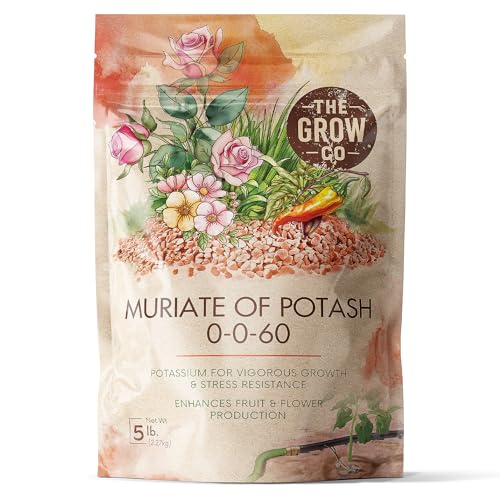
2. The Grow Co Muriate of Potash 0-0-60
The crystal-form potash that builds drought-proof cell walls and greener turf.
Unlike some granular potash fertilizers, The Grow Co uses a crystal form of muriate of potash that is concentrated at 0-0-60. The idea is to help the plant form and transfer sugars and nutrients more efficiently, which translates to stronger stems and bigger harvests. It also claims to reduce moisture loss by building thicker outer cell walls — good news if you live in a dry climate.
One owner used it on tomato beds that were “depleted from last year’s crop” and reported the soil amendment made all the difference. Another applied it on mango, avocado, and citrus trees to stop fruit drop and said the trees were “holding fruit strongly.” The main drawback is that the instructions are a bit generic — for smaller pots or specific plant sizes you may need to do your own math.
Turf and tree specialist: This is a strong pick for lawns and fruit trees, particularly if drought protection is a priority.
Best if: you need a uniform crystal formula that dissolves evenly and you are covering a large area or many trees.
skip it if: you want detailed instructions for small container gardens — the rates are left broad.
3. Espoma Potash 0-0-60
The 6 lb resealable bag that needs no mixing and has a century of trust behind it.
Espoma is a household name in organic gardening, and this 0-0-60 potash is exactly what you expect: a no-fuss granular that you apply directly to the soil around the drip line of the plant and water in. There is no mixing required, and you can use it in spring or fall — the bag says any time in the growing season works fine. The 6 lb bag is slightly bigger than the standard 5 lb, so you get a little more for your money.
The feedback is overwhelmingly positive, with over 40 owners praising its effectiveness specifically. One buyer noticed “vegetables flowering or fruiting slowly” and saw a difference “within a few days” after applying this. Another called it the “best product to improve fruiting.” The only minority opinion came from one buyer who felt it was expensive and had no noticeable effect after a year — but given the 4.7 rating, that is an outlier.
Try-and-trust reliability: For someone who wants a brand they already know and a product that simply works without measuring or spraying.
Choose this if: you value a trusted brand and want the simplest possible application — sprinkle, water, done.
pass on it if: you are budget-hunting and willing to try a less established brand with a similar formula.
4. Southern Ag Sulfate of Potash 0-0-50

The sulfate form that protects sensitive plants from chlorine burn while feeding them potassium.
This is a granular 0-0-50 sulfate of potash (SOP), which means it delivers potassium and sulfur while keeping chlorine levels very low. That makes it the right choice for crops like avocado, beans, corn, cherries, grapes, and roses — plants that react poorly to the chloride in standard Muriate of Potash. The application rate is 0.5 lb per 100 sq ft, and you simply spread it over the soil and water it in.
The biggest success story here is a mango tree: one owner applied 5 lbs and saw “thousands of flowers in January” compared to a sparse bloom the prior year. Another buyer notes it dissolves well and works fine, but cautions that despite the “sulfate” name it does contain about 2% chlorine, so ultra-sensitive plants still need care. The pebble size of the granules gets mixed reactions — some find it a bit large, but nobody reports it failing to work.
Sensitive-crop specialist: This is the one to grab if you grow avocados, grapes, or any plant that burns easily with standard potash.
Reach for this if: your garden includes chlorine-sensitive fruit trees or you prefer a sulfate-based potassium source.
Think twice if: you need a 0-0-60 concentration — this is slightly lower at 0-0-50, and the pebble texture may be less uniform than some granular products.
5. Simple Lawn Solutions High Potassium Lawn Food 0-0-25
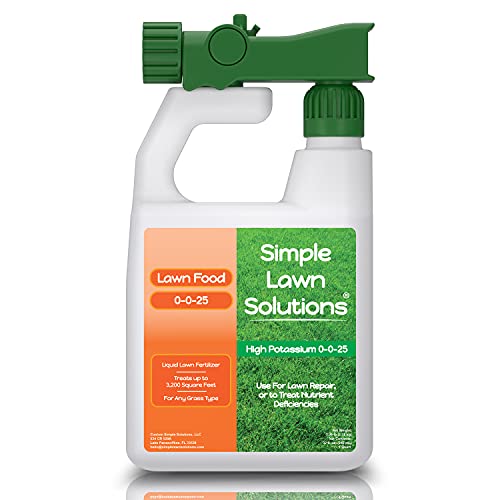
The hose-end sprayer that makes feeding 3,200 sq ft of turf feel like watering.
This is a liquid 0-0-25 formulation that comes with a ready-to-use hose-end sprayer — you attach it, turn on the water, and cover up to 3,200 square feet without measuring or mixing. The idea is to prepare your lawn for summer heat or fall dormancy by strengthening cell walls and root systems. It works on any grass type including Bermuda, Kentucky Bluegrass, Zoysia, and Fescue.
One owner says their “lawn is stronger than ever” after using it, and another notes it is especially convenient for large areas. The main complaint is value: even those who saw results felt the liquid is overpriced compared to granular options. One buyer’s unit arrived with a defective tube that took a weekend call to replace, but the company’s service was praised. For a quick seasonal boost to hardiness, this is the easiest option on the list.
Turf ease: If you have a large lawn and want to boost potassium without dragging out a spreader, the sprayer attachment makes this easy.
Best for: homeowners with a standard-size lawn who want a simple spray-on treatment for summer stress or fall prep.
Look elsewhere if: you are on a tight budget — this is more expensive per pound of K than granular, and a few owners were not convinced it made a visible difference.
6. Cz Garden Organic Sulfate of Potash 0-0-50
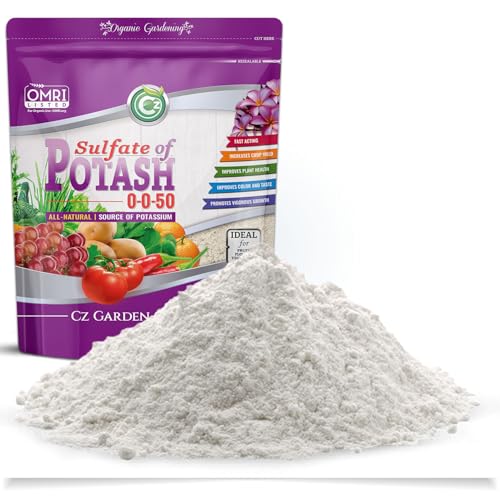
The water-soluble powder that earned OMRI certification for certified organic production.
This is a 0-0-50 Sulfate of Potash listed by the Organic Materials Review Institute, so it is allowed in certified organic growing. It is a fine, pH-neutral powder that dissolves fully in water — that makes it suitable for hydroponics, drip irrigation, and foliar feeding, not just soil drenching. The low chlorine content (less than 0.5%) means it is gentle on sensitive crops that cannot tolerate high salts.
One buyer used it after a soil test showed low potassium and applied it on carrot rows. The carrots survived a 5-week drought and “germinated well and are thriving.” Another owner reports that their “flowers and tomatoes are lookin good” but cautions not to use too much. The only real drawback is the smaller 3 lb bag size compared to the 5 lb granular options — if you have a large garden, you will burn through it faster.
Water-soluble organic power: For strict organic growers or anyone using a fertigation system, this is the cleanest, most versatile high-K option available.
Choose this if: you need an OMRI-listed, water-soluble potassium that works in soil, hydro, or as a foliar spray.
it’s not for you if: you want a bigger bag for the money — the 3 lb size means more frequent reordering for large plots.
7. TPS Nutrients Potassium Fertilizer

The small-format liquid that keeps container plants blooming without a giant bag to store.
At 32 oz, this is a quart-sized liquid supplement for gardeners who do not need a 5 lb bag sitting around for years. The mixing ratio is 1-2 teaspoons per gallon of water, so a little goes a long way. It is formulated to support budding, flowering, and fruit production, and works well on vegetables, flowers, and shrubs.
One owner specifically bought it because “I didn’t want a larger bottle sitting around for years” and has had good results with shrubs and container plants. Another used it to “boost the growth of my plants with very good results.” The simple fact is that for a small garden or a few potted plants, a big bag of granular potash is overkill — this liquid is easier to dose and store.
Small-garden perfect: If you grow primarily in containers or have a small bed, the 1-quart size and low dose rate make this the least wasteful option.
Best for: anyone who wants a compact liquid K source for potted plants, shrubs, or a small vegetable patch.
Not for: large lawns or big vegetable gardens where the cost-per-ounce of liquid is far higher than granular.
8. Greenway Biotech Potassium Chloride 0-0-62

The 0-0-62 powerhouse with 100% water solubility for hydroponics and soil alike.
This Muriate of Potash clocks in at 0-0-62 — slightly higher K than the standard 0-0-60 — and it is 100% water soluble, meaning it dissolves completely for use in soil, hydroponics, and foliar applications. The mixing ratio is 1 teaspoon per gallon of water, which is easy to remember. It is marketed for root development, nutrient transport, and improved yield quality.
The results are fast: one owner used it at half strength and said “my flowers doubled in size over night it seems like.” Another used it to solve a pomegranate redness issue that had failed for two years — the potassium chloride finally did the trick. It also works on lawns; one reviewer noted it “worked wonders for my newly seeded Fescue lawn.” The only thing to remember is that this is a concentrated powder, so start at quarter-strength and work up to avoid burning plants.
Speed and solubility: For anyone using drip irrigation, a sprayer, or a hydroponic setup, the dissolving power and slightly higher K content give this an edge.
Reach for this if: you need the highest K percentage available and water solubility for precise feeding.
look elsewhere if: you have chlorine-sensitive crops — this is Muriate of Potash, so use SOP instead for beans, strawberries, or grapes.
9. TPS Nutrients Phosphorus & Potassium Fertilizer
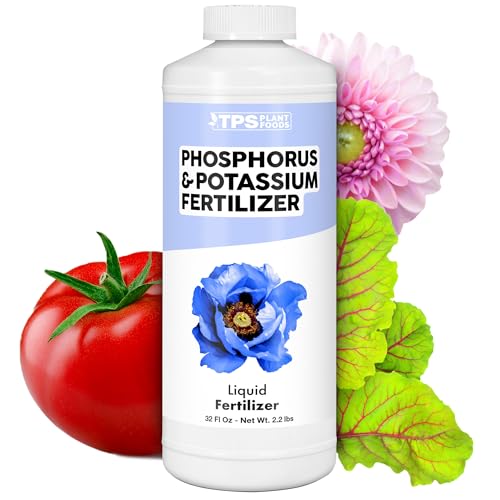
The liquid duo of phosphorus and potassium that pushes flowers out fast.
Unlike the other picks that focus purely on potassium, this one delivers both phosphorus and potassium for targeted bloom and root support. It is designed for flowering and fruiting plants — vegetables, fruits, and ornamentals — and comes as a ready-to-use liquid in a 32 oz bottle. The idea is that P and K work together: phosphorus for root development and bloom initiation, potassium for fruit quality and stress resistance.
One owner says their vegetable plants “flowered within days of application” and expects their “largest-ever tomato yield.” The product extended the blooming period for another user. The main downsides are the lid closure (some buyers received it with a leaky cap) and the value-for-money argument: one owner points out that a granular fertilizer that lasts longer would be more cost-effective than this liquid. For a quick liquid boost before bloom, though, it does the job.
Dual-action boost: This is the only pick that combines P and K in one bottle, making it a complete bloom booster for fast results.
Best for: gardeners who want a quick, visible flower push and do not mind reapplying liquid every week or two.
Not for: budget-conscious buyers or anyone who prefers a low-maintenance granular approach — the liquid runs out faster and costs more per dose.
Understanding the Specs
NPK Ratio
The three numbers on a fertilizer bag stand for Nitrogen (N), Phosphorus (P), and Potassium (K). For high-potassium fertilizers, the third number is the largest. A 0-0-60 means zero nitrogen, zero phosphorus, and 60% available potassium by weight. That concentration is what makes these products so effective at targeting fruiting and flowering without making plants grow more leaves.
Muriate of Potash (MOP) vs. Sulfate of Potash (SOP)
MOP (0-0-60 or 0-0-62) is potassium chloride — the cheapest, most concentrated source of K. SOP (0-0-50) is potassium sulfate, which adds sulfur and keeps chlorine low. SOP is preferred for chlorine-sensitive plants like beans, strawberries, and many fruit trees, and it is more likely to be OMRI-listed for organic use. The trade-off is a slightly lower K percentage and a higher price.
FAQ
What does high potassium fertilizer do for plants?
Can I use 0-0-60 on my lawn?
Which is better: liquid or granular potassium fertilizer?
What is the difference between 0-0-50 and 0-0-60?
Can I use high potassium fertilizer on tomatoes?
Is Muriate of Potash organic?
How do I apply granular potassium fertilizer?
Can high potassium fertilizer burn my plants?
Will potassium fertilizer make my flowers bloom more?
What plants benefit most from high potassium?
Final Thoughts: The Verdict
For most people, the best fertilizers high in potassium winner is the Cz Garden Muriate of Potash 0-0-60 because it combines the highest concentration (0-0-60) with a strong 4.7-star rating from nearly a thousand owners — real proof that it turns struggling plants into producers. If you need a low-chlorine option for sensitive crops, grab the Southern Ag Sulfate of Potash 0-0-50. And for a quick liquid boost to your lawn before summer hits, the Simple Lawn Solutions 0-0-25 is the one to reach for.
How We Picked
We do not accept paid placement. Every pick is matched to a real buyer and a real use-case; we do not hands-on test units.
Sources & Methodology
Specifications: manufacturer listings and product documentation. Review insights: verified customer reviews, as of July 2026. Pricing: not shown on this page (it changes often); check the current price via the retailer link.
As an Amazon Associate, Lawn Gear Lab earns from qualifying purchases. This does not affect which products we feature.