
Specs are compiled from manufacturer listings and verified buyer reviews and can change over time — please confirm the key details on the product page before buying.
St. Augustine grass is a finicky, thirsty beast for a Southern lawn—too little food and it yellows, too much and you risk a nitrogen scorch that sets you back weeks. The right fertilizer for St. Augustine grass balances quick greening with slow-release safety and potassium for heat and foot traffic tolerance. This guide breaks down nine proven formulas, from spot-treatment liquids to full-yard granular programs, to match a specific ratio to your grass’s needs and soil test results.
I’m Rikta — the founder and writer behind Lawn Gear Lab. This guide is built by comparing the manufacturers’ published specifications and the patterns across verified customer reviews, so you get each pick’s real strengths and trade-offs instead of marketing spin.
Whether you are nursing a patchy new sod or maintaining a mature emerald carpet, this breakdown of the best fertilizer for st augustine grass covers every key ratio and format so you can feed with confidence and see real results within a couple of weeks.
Our Picks at a Glance

How To Choose The Best Fertilizer For St Augustine Grass
St. Augustine grass has a specific appetite. It needs steady nitrogen for color and growth, moderate phosphorus (or none at all if your soil test shows enough), and a solid dose of potassium to build heat- and drought-tolerance through the hot months. The wrong high-nitrogen blast can trigger a rapid flush that invites large patch fungus, while too little potassium leaves the grass pale and thin under summer stress.
Understand the NPK Ratio
The three numbers on the bag stand for Nitrogen (N), Phosphorus (P), and Potassium (K). For St. Augustine, a ratio like 15-0-15 or 16-4-8 works well in spring and summer—nitrogen drives leaf growth, and potassium builds root resilience. A high-first number formula (28-0-0) is best as a targeted green-up boost, not a steady diet, because too much nitrogen without enough potassium invites disease.
Liquid vs. Granular
Liquid fertilizers feed fast—you see greening in a few days—but they wash through the soil quickly, so you apply every two to four weeks. Granular options release nutrients over a longer period, usually eight to twelve weeks, making them ideal for a slow, steady feeding program. For St. Augustine, many lawn care experts prefer a granular base program with liquid supplements for a quick color pop when the grass looks tired.
Check Your Soil First
Before you buy any bag or bottle, run a simple soil pH and nutrient test. St. Augustine thrives in soil with a pH between 6.0 and 6.5. If your phosphorus level is already adequate or high, choose a phosphorus-free formula (0 in the middle) to avoid runoff and imbalance. A test also tells you if you need extra iron—many St. Augustine blends include iron precisely because this grass shows iron deficiency quickly as yellowing between the veins.
Consider the Season
Feed St. Augustine in late spring after it greens up fully, then again in mid-summer, and a lighter application in early fall. Stop fertilizing six to eight weeks before the first expected frost—feeding too late pushes tender growth that winter cold will kill. The fertilizer label usually includes seasonal guidance, but following this three-feed rhythm gives you a thick, healthy lawn without the disease pressure of constant feeding.
Quick Comparison
| Model | Best For | NPK Ratio | Coverage (sq ft) | Form | Amazon |
|---|---|---|---|---|---|
| Simple Lawn 0-0-25★ Best Overall | Potassium-only supplement | 0-0-25 | 3,200 | Liquid | Amazon |
| Advanced 16-4-8Also Great | Overall balanced feeding | 16-4-8 | Full (concentrated) | Liquid | Amazon |
| Fertilome 15-0-15Top Performer | Slow-release granules | 15-0-15 | 5,000 | Granules | Amazon |
| Simple Lawn 15-0-15 | Phosphorus-free liquid | 15-0-15 | Full (concentrated) | Liquid | Amazon |
| Simple Lawn 28-0-0 | Fast green-up boost | 28-0-0 | Full (concentrated) | Liquid | Amazon |
| TPS St. Augustine Fertilizer | Specialized St. Aug formula | Unspecified | Low | Liquid | Amazon |
| Commercial Lawn Energizer | Large coverage iron boost | 6-0-0 | 12,000 | Liquid | Amazon |
| Extreme Grass Growth Booster | New sod & seed starter | 6-18-0 | 3,200 | Liquid | Amazon |
| SeedRanch 24-2-11 | Granular high-iron program | 24-2-11 | 12,000 | Granules | Amazon |
In‑Depth Reviews
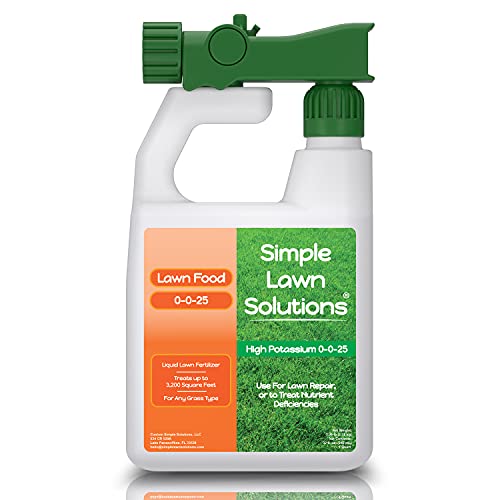
1. Simple Lawn Solutions – High Potassium Lawn Food Liquid Fertilizer 0-0-25 (32 Ounce)
Our pick — 4.5★ from 600+ verified ratings; the strongest balance of quality and price.
The potassium-only solution that toughens St. Augustine against heat stress and winter dormancy.
Potassium is the nutrient that makes St. Augustine resilient—it helps the grass handle temperature swings, drought, and foot traffic. This 0-0-25 formula is pure potassium with no nitrogen or phosphorus, making it a targeted supplement for summer and fall applications when you want to harden off the lawn before winter without pushing tender leaf growth. The 32-ounce bottle includes a hose-end sprayer and covers up to 3,200 square feet.
Owners consistently note that the product is effective at improving root growth and overall grass health, especially going into fall and coming out of winter. The application is straightforward—just hook up the sprayer and walk the yard. The main feedback from buyers is that the visual response is subtle because potassium does not green up the lawn the way nitrogen does—it works below the soil level on root strength and stress tolerance. Some owners felt the price was high for what appeared to be minimal visible change. But for those who understand that potassium is the key to winter survival and summer heat tolerance, this is an essential part of a complete St. Augustine feeding schedule.
The unseen work: Potassium does not make grass greener—it makes it tougher. One owner summed it up: “I didn’t see a lot of difference in the yard overall, but I am sure it has helped the grass root system.” That is exactly the point.
Best for: Late-summer and fall feeding when you want to strengthen St. Augustine roots for winter without pushing nitrogen-driven leaf growth that would get killed by frost.
Think twice if: You expect a visible green-up—this is a root and stress-tolerance supplement, not a color booster. Combine it with a nitrogen-containing fertilizer if you want both color and strength.
2. Advanced 16-4-8 Balanced NPK – Lawn Food Quality Liquid Fertilizer – Simple Lawn Solutions (32 Ounce)
This crowd-pleaser thickens St. Augustine in under two weeks using seaweed and fish emulsion.
This is the bottle most St. Augustine owners reach for when they want a reliable green-up and thicker growth across the whole season. The 16-4-8 ratio delivers a complete macronutrient profile—16% nitrogen for color and leaf density, 4% phosphorus for root support, and 8% potassium to toughen the grass against heat and drought—all blended with seaweed and fish emulsion that add organic matter to the soil. Buyers report seeing greener, healthier grass in about ten days, and the concentrated formula mixes with a hose-end sprayer for even coverage on small to medium lawns.
The biggest praise is effectiveness—it has well over 600 positive mentions from owners who saw bare spots shrink and density improve even during dry spells. One reviewer noted that after a soil test showed low phosphorus, this liquid corrected the deficiency and raised their pH to 6.0 over a season. The catch is that some owners feel the 32-ounce bottle runs out fast on larger properties, so if you have an acre or more, you will want the gallon size or a granular program. But for the typical suburban lot, this is the balanced, fast-acting formula that delivers visible results with minimal fuss.
The unanimous verdict: If you want a single liquid product that handles spring feeding, summer maintenance, and even a phosphorus deficiency fix, this 16-4-8 blend is the most trusted option by a wide margin. The combination of fast visual results (greening in under a week) and root-building potassium makes it a genuine all-rounder.
Best for: Any homeowner with a small to mid-size St. Augustine lawn who wants a fast, visible green-up plus long-term root health from a single bottle.
Think twice if: Your soil test already shows high phosphorus—in that case, you want a zero-phosphorus formula like the 15-0-15 below to avoid nutrient runoff.
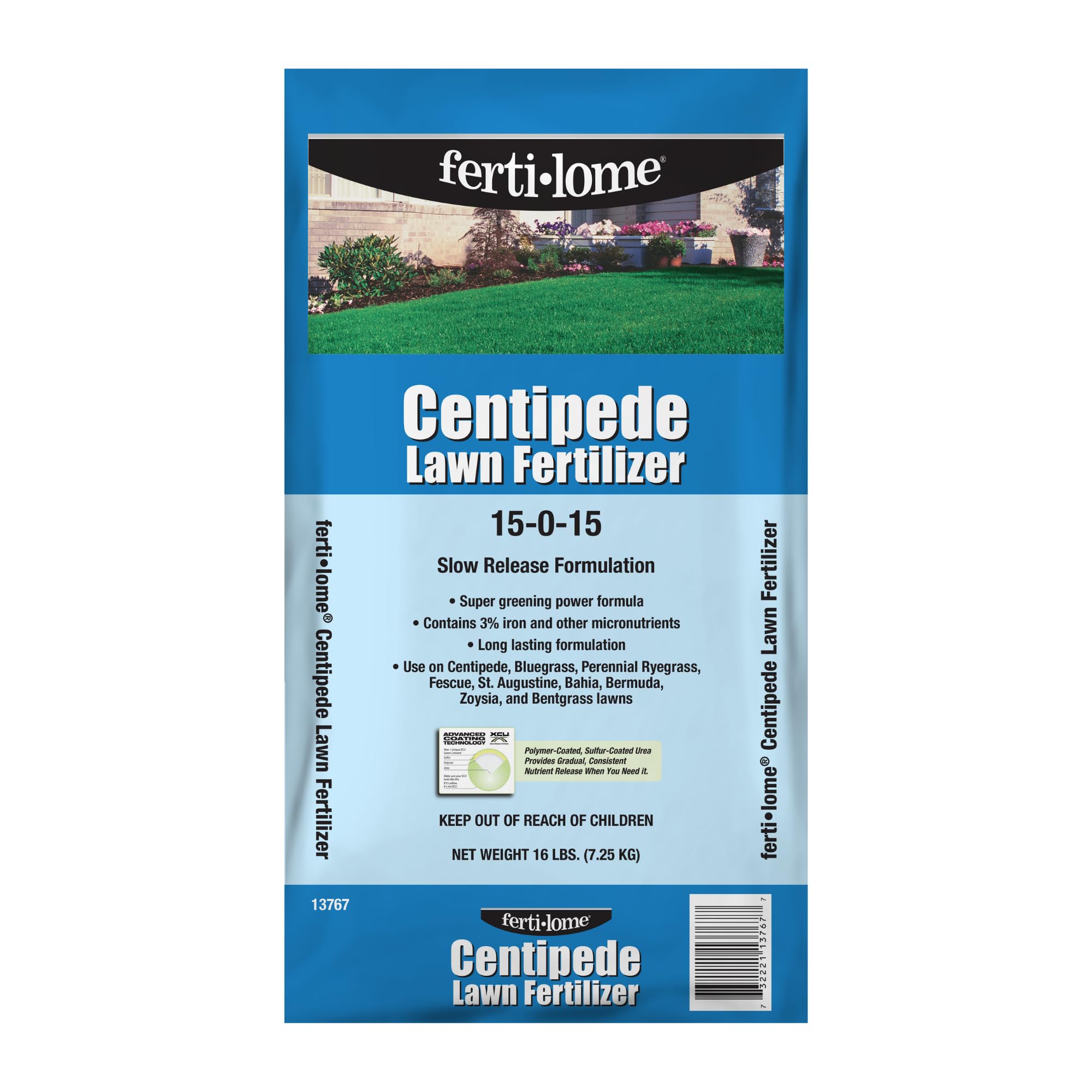
3. Fertilome (13767) Centipede Lawn Fertilizer 15-0-15, 16 lbs
This granular choice feeds for weeks and includes iron to correct yellowing St. Augustine.
If you prefer a low-maintenance granular program, this 15-0-15 formula from Fertilome is the standout choice for warm-season grasses, including St. Augustine. The 16-pound bag covers up to 5,000 square feet, and the slow-release nitrogen reduces the risk of leaf burn while providing steady color for several weeks. The high iron content specifically targets the yellow foliage that St. Augustine is notorious for when iron is low in alkaline soils.
Owners in hot climates—including North Carolina’s July heat—report that it made their grass “thick, lush, and deep green,” filling in bare spots and strengthening roots to the point where the lawn visibly outperformed neighbors’ yards. The consensus from owners is that germination and overall quality are the strongest points, with the phrase “be ready to mow” appearing more than once as a sign of vigorous growth. The trade-off is that it is formulated for centipede grass first, so the 15-0-15 ratio is ideal for St. Augustine only if you need zero phosphorus—check your soil test first. If your soil needs phosphorus, the 16-4-8 liquid above is a better match.
The granular advantage: One application lasts weeks longer than any liquid, making this the lower-maintenance option for owners who want to apply once and then just water in between mowings.
Reach for this if: You have a medium lawn (up to 5,000 sq ft) and you want a slow, steady feed with iron to correct yellowing—no mixing, no measuring, just spread and water.
Look elsewhere if: Your soil test shows low phosphorus—with a middle number of 0, this will not correct a phosphorus deficiency.
4. Superior 15-0-15 Liquid Fertilizer Nitrogen & Potash Lawn Food – Simple Lawn Solutions (1 Quart)

A phosphorus-free 15-0-15 liquid that feeds green color and hardiness without adding phosphorus.
This is the right bottle when your soil test says “phosphorus is fine, give me nitrogen and potassium.” The 15-0-15 ratio delivers exactly that—15% nitrogen for green color and growth, 15% potassium for heat tolerance and root density, and zero phosphorus so you do not push levels higher. It also includes humic acid derived from leonardite, which helps the grass absorb nutrients more efficiently and improves soil structure over time.
Owners in South Texas—who face 100°F+ summers—report that this formula, used as part of a comprehensive lawn care routine, transformed their St. Augustine from “ugliest to one of the best on the block.” The feedback from buyers is that results are not instant; it takes a few months of regular applications to see the full effect because the nitrogen releases slowly into the soil. Some users pair it with a granular program for a quick liquid boost every two weeks. At roughly the same price point as the 16-4-8 but with zero phosphorus, this is the budget-friendly pick for anyone who already has adequate phosphorus in their soil.
The honest trade-off: This is a slower-acting formula than the 16-4-8—owners mention it “takes a few months to see full results” because the nitrogen releases into the soil gradually. Patience pays off with deep, lasting green rather than a one-week spike.
Best for: Homeowners who have tested their soil, confirmed adequate phosphorus levels, and want a safe, slow-building liquid feed that builds heat tolerance without the risk of nutrient overload.
skip it if: You have a phosphorus deficiency or want a fast overnight green-up—the slow-release nature means you will not see dramatic results in the first week.
5. Commercial Grade Lawn Energizer – Grass Fertilizer Booster with Nitrogen, Iron, Micronutrients – Simple Lawn Solutions (1 Gallon)

A high-iron gallon that delivers an overnight dark green across a full acre of St. Augustine.
When your St. Augustine looks pale or yellow between the veins, that is an iron deficiency—and this Lawn Energizer is the fastest fix on the list. The 6-0-0 formula is built around 5% iron (chelated iron, to be precise), which directly fuels chlorophyll production so the grass darkens visibly within a day or two. The gallon bottle covers up to 12,000 square feet, making it the most economical choice for large properties where a 32-ounce sprayer would run out halfway through the yard.
Owners on St. Augustine in warm California weather report “overnight greening” with an almost artificial dark green look, and the hose-end attachment is the easiest application method in this lineup—just connect, spray, wait 15 minutes, then water in. The effectiveness is the top praise point, with well over 300 positive mentions. The one catch: this is a supplement, not a complete fertilizer. It has zero potassium, so you still need a balanced feed with potassium for root health and stress tolerance. Use it as a mid-season booster between your regular 16-4-8 or granular applications for a fast color pop when the lawn looks tired.
The iron advantage: For pale, yellowing St. Augustine on alkaline soil, this single application produces a darker green than any high-nitrogen product because it targets the actual deficiency—iron availability—rather than just pushing more leaf growth.
Reach for this if: You have a large lawn (up to 12,000 sq ft) that looks pale or yellow, and you want a quick, even darkening without switching to a full high-nitrogen program.
Look elsewhere if: You need a complete fertilizer—this is an iron booster only, so pair it with a balanced 15-0-15 or 16-4-8 for overall lawn health.
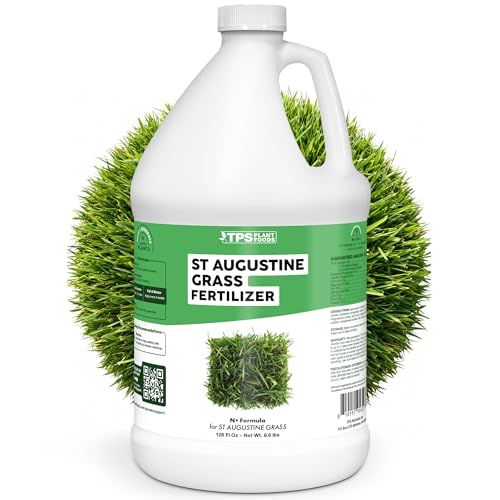
6. St Augustine Grass Fertilizer – Liquid Lawn Food for Thicker Growth, New Runners & Rich Green Color, 1 Gallon
A St. Augustine-dedicated liquid that encourages new runners and deep green color in four to five days.
This is the only fertilizer on the list that is formulated specifically for St. Augustine grass—every other product labels itself for “all grass types” or warm-season blends. The fast-absorbing liquid formula is designed to support new runner production (stolons) and deep root systems, which is exactly what St. Augustine needs to fill in bare patches and thicken up. The one-gallon size gives you plenty of coverage for multiple spot treatments or a full lawn feed.
Customers note visible greening in about four to five days on St. Augustine, and several noted that it works well for spot areas where a granular spreader would be clumsy. The consensus among users is that it is a simple to use way to feed this finicky grass without the risk of burning. One owner waters it down and applies twice as often to reduce the need for watering, getting the same dark green color at a slower pace. The trade-off is that the NPK ratio is not listed on the spec sheet, so you are trusting a proprietary blend rather than a transparent number—if you prefer to know exactly how many units of each nutrient you are applying, choose a product with a full N-P-K label.
The specialized edge: Being formulated exclusively for St. Augustine means the nutrient ratios and uptake enhancers are tailored to this grass’s specific biology—owners who struggled with other fertilizers often see results from this one on the first application.
Best for: Owners of finicky St. Augustine lawns who have tried general fertilizers without success and want a species-specific formula that targets runner growth and deep root development.
Think twice if: You need a transparent NPK ratio to match a precise soil test result—this product does not disclose its exact numbers on the label.
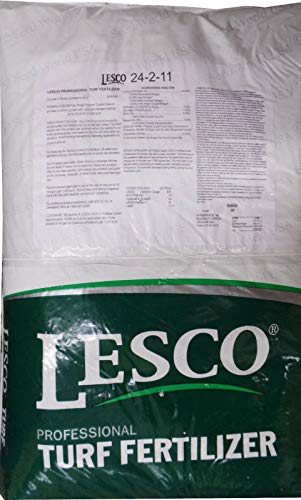
7. SeedRanch St. Augustine Lawn 24-2-11 Fertilizer – 50 Lbs.
A 50-pound granular powerhouse with 6% iron that feeds an acre of St. Augustine for months.
For owners with a serious St. Augustine lawn—half an acre or more—this 50-pound bag of 24-2-11 is the most cost-effective granular option per square foot. The 24-2-11 ratio is heavy on nitrogen for strong growth and color, with 6% iron included to prevent the yellowing that St. Augustine often shows on alkaline soils. The bag covers up to 12,000 square feet, matching the coverage of the commercial Lawn Energizer above but in a slow-release granular form that feeds for eight to twelve weeks.
Buyers in California who applied it before a week of heavy rain saw their St. Augustine “grow vigorously with dark green color” once the weather warmed up. The formula is specifically labeled for St. Augustine, so you do not have to guess whether the ratio matches your grass type. The one drawback is the bag size—at 50 pounds, it requires a broadcast spreader and some muscle to haul around the yard. The price point also puts it in a higher tier, but per application it works out to a fraction of what you would spend on multiple liquid bottles over a season.
The value math: 50 pounds at 12,000 sq ft coverage means you apply roughly 4 pounds per 1,000 sq ft, giving you a season’s worth of feeding from a single bag—compare that to buying six or more 32-ounce liquid bottles for the same lawn size.
Reach for this if: You have a large St. Augustine lawn (8,000+ sq ft) and want a single, heavy-duty granular application that lasts for months without re-mixing or re-spraying.
Look elsewhere if: You only have a small lawn or prefer the convenience of a hose-end sprayer—this 50-pound bag is overkill for anything under 5,000 sq ft.
8. Maximum Green & Growth- High Nitrogen 28-0-0 NPK- Lawn Food Quality Liquid Fertilizer – Simple Lawn Solutions (1 Quart)

A high-nitrogen 28-0-0 blend that turns yellowing St. Augustine dark green literally overnight.
When your St. Augustine is pale, thin, and clearly nitrogen-starved, this 28-0-0 formula is the fastest corrective tool in the shed. The 28% nitrogen is split into 70% quick-release for immediate absorption and 30% slow-release to keep feeding between applications, so you see greening in a day or two without the grass crashing back to yellow after a week. Reviewers point out that yellowing lawns and even dead patches showed new grass sprouting within days, with seed germination accelerated noticeably.
The catch is the same thing that makes it powerful: 28-0-0 is extremely high in nitrogen and has zero potassium, so it is not a complete diet for St. Augustine. Use it as a one-time green-up booster in spring or after a stress period—not as your regular fertilizer. Owners who used it as their main feed without potassium supplements saw less impressive long-term results. The bottle is also on the smaller side at 32 ounces, so for larger lawns you will want a gallon or a granular alternative. But for the price, this is the best spot-treatment for yellow patches and rapid spring recovery.
The danger zone: A 28-0-0 ratio with zero potassium can push rapid leaf growth that makes St. Augustine more susceptible to large patch fungus if applied during hot, humid weather—use it only in spring or early fall when temperatures are moderate.
Best for: A quick, dramatic green-up on nitrogen-deficient St. Augustine in early spring, or as a spot treatment for pale yellow patches that need immediate color.
pass on it if: You need a balanced maintenance feed—the zero potassium means your grass will lack the stress tolerance it needs for summer heat and foot traffic.
9. Extreme Grass Growth Lawn Booster- Liquid Spray Concentrated Starter Fertilizer with Humic Acid- Simple Lawn Solutions (32 oz. w/Sprayer)

A high-phosphorus starter that helps new St. Augustine sod and seed establish roots fast.
If you are laying new St. Augustine sod or trying to fill a patchy area with plugs, you need a fertilizer heavy on phosphorus—the middle number—because phosphorus drives root development. This 6-18-0 formula delivers 18% phosphorus along with humic acid for nutrient uptake, making it ideal for establishing new lawns or giving an existing thin lawn a root-growth boost. The hose-end sprayer covers up to 3,200 square feet and is ready to use straight from the bottle.
The results from owners are dramatic—new seed sprouted in one day and reached 2-3 inches by day five, and existing sod became lush, tall, and green in 18 days. The humic acid improves soil structure so nutrients stay available longer. The biggest practical complaint is the sprayer itself: the valve can be stiff (some owners need pliers to turn it), and the spray pattern is narrow, meaning the bottle empties faster than the claimed 3,200 sq ft—closer to 2,000 sq ft in real use. But for the purpose it serves—getting new St. Augustine started strong—this is the most effective phosphorus-rich liquid on the list.
The starter advantage: High-phosphorus formulas like 6-18-0 are critical for new lawns because phosphorus is not mobile in soil—it stays where it lands, so getting it near new roots at planting time makes a measurable difference in establishment speed.
Best for: Anyone installing new St. Augustine sod, plugs, or seed—this gives the roots the phosphorus they need for rapid establishment and reduces the risk of transplant shock.
it’s not for you if: Your St. Augustine is already established and healthy—the high phosphorus can build up in soil over time and cause imbalance. Use a maintenance formula like the 16-4-8 instead.
Understanding the Specs
NPK Ratio — The Three Numbers
The sequence N-P-K tells you the percentage of nitrogen, phosphorus, and potassium in the bag or bottle. Nitrogen drives leaf color and growth—it is what makes the grass green and thick. Phosphorus supports root development and is critical for new lawns but can build up in soil over time. Potassium strengthens cell walls, improves drought tolerance, and helps the grass survive temperature swings. For St. Augustine, a ratio like 16-4-8 or 15-0-15 works for maintenance; use a high-phosphorus starter (like 6-18-0) only when establishing new sod or seed.
Quick-Release vs Slow-Release Nitrogen
Quick-release nitrogen gives you a visible green-up in a day or two, but it washes out of the soil quickly and can burn the grass if over-applied. Slow-release nitrogen feeds steadily over weeks or months, reducing the risk of burn and providing consistent color. The best products for St. Augustine blend both types—for example, a 70/30 split of quick to slow release gives you an immediate color pop followed by sustained feeding between applications.
Iron Content
St. Augustine grass on alkaline soil (pH above 7.0) often shows iron deficiency as yellowing between the leaf veins. Iron is not a macronutrient—it does not make grass grow—but it directly fuels chlorophyll production, so a fertilizer with added iron (such as 5% or 6% iron) darkens the grass dramatically without pushing excess growth. This is especially useful in late spring and summer when heat stress makes iron less available to the roots.
Granular vs Liquid
Granular fertilizers are spread with a broadcast or drop spreader and release nutrients slowly over weeks—ideal for a low-maintenance, season-long program. Liquids are applied with a hose-end sprayer and are absorbed almost immediately, making them best for quick corrections, spot treatments, or supplementing a granular base. For St. Augustine, many successful lawn care programs use a granular slow-release feed in spring and fall, with a liquid iron or nitrogen booster between applications for color.
FAQ
Is 16-4-8 fertilizer good for St Augustine grass?
Can I use 15-0-15 fertilizer on St Augustine grass?
What is the best NPK ratio for St Augustine grass?
Should I use liquid or granular fertilizer for St Augustine?
How often should I fertilize St Augustine grass?
Can I use high-nitrogen 28-0-0 on St Augustine?
Does St Augustine grass need phosphorus?
What does iron do for St Augustine grass?
Final Thoughts: The Verdict
For most homeowners, the best fertilizer for st augustine grass is the Advanced 16-4-8 from Simple Lawn Solutions because it delivers a complete, balanced NPK profile with organic matter from seaweed and fish, and over ten thousand owners have made it the most-reviewed liquid fertilizer in this category. If you prefer a slow-release granular program and your soil phosphorus is adequate, the Fertilome 15-0-15 with iron covers up to 5,000 sq ft per bag and feeds for weeks between applications. And for owners of large St. Augustine lawns who want maximum coverage per dollar, the SeedRanch 24-2-11 at 50 pounds covers 12,000 sq ft with 6% iron built in—one bag handles an entire season for most properties.
How We Picked
We do not accept paid placement. Every pick is matched to a real buyer and a real use-case; we do not hands-on test units.
Sources & Methodology
Specifications: manufacturer listings and product documentation. Review insights: verified customer reviews, as of July 2026. Pricing: not shown on this page (it changes often); check the current price via the retailer link.
As an Amazon Associate, Lawn Gear Lab earns from qualifying purchases. This does not affect which products we feature.