
Specs are compiled from manufacturer listings and verified buyer reviews and can change over time — please confirm the key details on the product page before buying.
One wrong cut on a grape vine can ruin an entire season’s fruit. You need shears that slice clean through woody, twisted canes without crushing the living tissue your vine relies on to heal and push out next year’s grapes. The best grape vine pruning shears make a precise, scissor-like cut that leaves the plant ready to bounce back, not struggle.
I’m Rikta — the founder of Lawn Gear Lab. This guide is built by comparing manufacturers’ published specs and patterns across verified customer reviews, so you get each pick’s real strengths and trade-offs instead of marketing spin.
We have looked at nine models — from Swiss-made professional staples to lightweight Japanese precision tools — to find the pair that will make your vineyard work feel easy. Whether you maintain a few backyard vines or rows of them, these are the best grape vine pruning shears you can buy right now.
Our Picks at a Glance


How To Choose The Best Grape Vine Pruning Shears
Picking the right shears for vineyard work is about more than just sharp blades. You want a tool that fits your hand, makes a clean cut without effort, and can be maintained for years. Here are the key factors to keep in mind.
Bypass vs. Anvil: Which Blade Style for Live Wood?
A bypass blade (a scissor-style blade that slides past a lower jaw) creates a clean, precise cut that leaves vine tissue intact. This helps the plant heal quickly after pruning. An anvil blade (a blade that smashes the stem down against a flat surface) is fine for dead wood but risky on live grape canes—crushing can lead to disease. For grape vines, stick with a bypass design so your cuts stay clean and the vine recovers fast.
Blade Steel: How Sharpness and Maintenance Intertwine
High-carbon steel blades, like Japanese SK5 or Swiss carbon steel, take an incredibly sharp edge and hold it for a long time, so you cut through canes with less effort. The trade-off is they will rust if you do not wipe them dry after use. Stainless steel resists rust but is harder to sharpen to the same razor-like finish. If you prune regularly, a high-carbon blade with a sap-resistant coating—like the fluorine-coated Saboten—offers the best of both worlds.
Handle Design and Ergonomics
Grape pruning is repetitive work, and fatigue sets in fast with the wrong handle. Look for comfortable, non-slip grips that fill your palm without feeling bulky. Rotating handles (handles that pivot in your hand as you cut) are a standout for those with wrist pain or arthritis—they let your hand stay in a natural position as the tool does the work. Aluminum handles keep the weight down, so you are not fighting the tool as well as the vine.
Quick Comparison
| Model | Best For | Cutting Capacity | Blade Material | Weight | Amazon |
|---|---|---|---|---|---|
| Felco F2★ Best Overall | Best Overall | 1 inch | Carbon Steel | Lightweight Al. | Amazon |
| Kimura 8″ ProPremium Value | Premium Value | 15 mm | Japanese SK5 Steel | Lightweight | Amazon |
| Saboten 7.9″Compact Precision | Compact Precision | 20 mm | Carbon W/ Fluorine | 0.53 lbs | Amazon |
| TONMA 8″ | Top Performer | 1 inch | Japanese SK5 Steel | 8.6 oz | Amazon |
| SUIZAN 8″ | Japanese Craft | 15 mm | Japanese Steel | 7.4 oz | Amazon |
| Corona BP 6250 | Budget Champion | 1 inch | Carbon Steel | 9.6 oz | Amazon |
| Bahco PX-M2 | Ergonomic Pro | 20 mm | High Carbon Steel | Lightweight | Amazon |
| ARS HP-VS8R | Rotating Handle | 15 mm | Alloy Steel | 10.4 oz | Amazon |
| Felco F 14 | Small Hands | 18 mm | Carbon Steel | 6.7 oz | Amazon |
In‑Depth Reviews
1. Felco F2 Pruning Shears – 9.25″
Our pick — over 4.5★ from 14,000+ verified ratings; the strongest balance of quality and price.
The Swiss-made standard for a reason — it bites through inch-thick canes like butter.
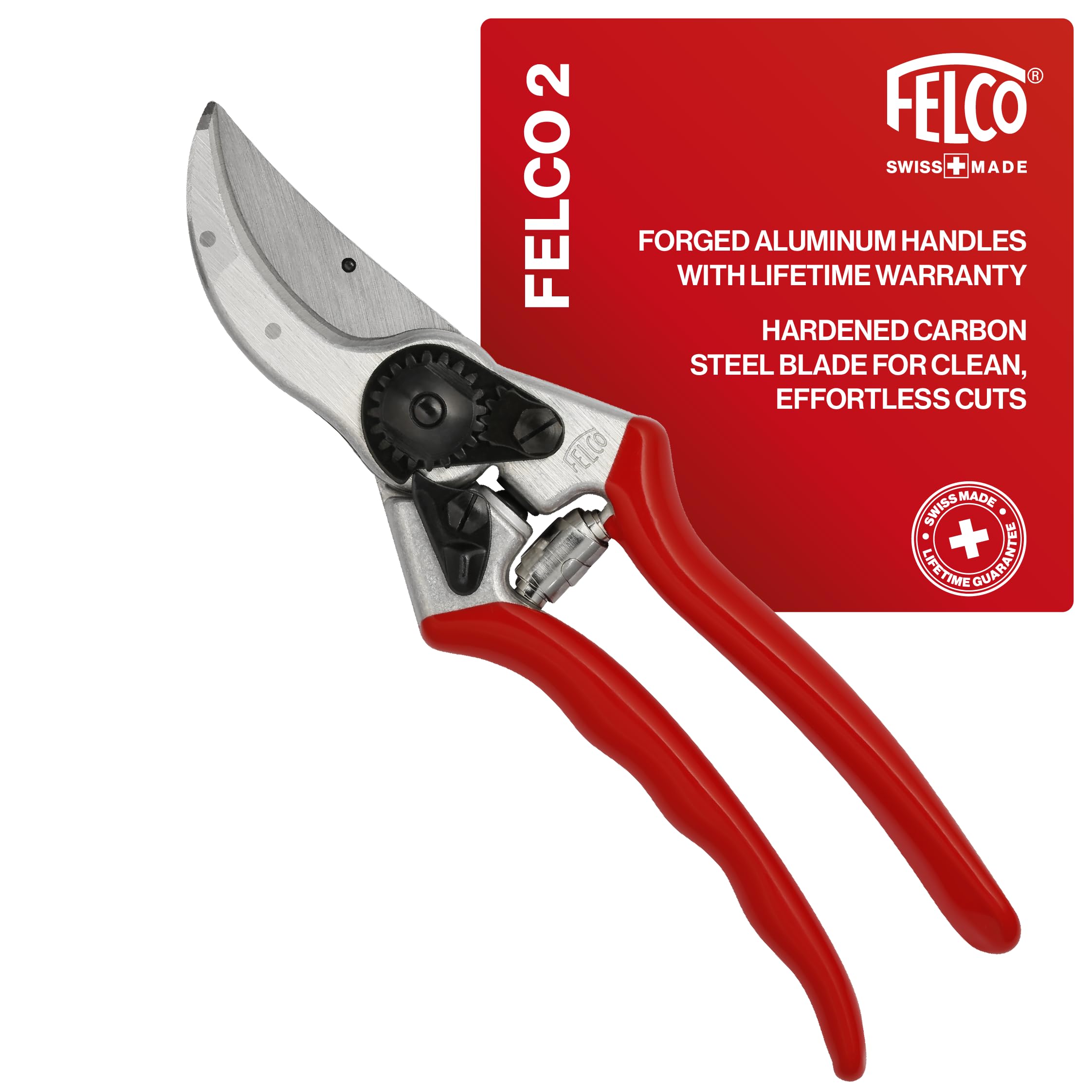
The Felco F2 is the pruner professional vineyard crews carry because it simply does not quit. It cuts through the thickest grape wood you will encounter on a mature vine, thanks to its 1-inch cutting capacity and a 9.25-inch length that gives you good leverage. The hardened carbon steel blade stays razor-sharp for an entire season, so you make clean, smooth cuts that leave vines healthy—not crushed.
What sets the F2 apart from the Saboten is its fully replaceable parts. Every single component—blade, spring, bolt—can be swapped out, so this tool is built for decades, not just one harvest. The forged aluminum body keeps it light, and the ergonomic, non-slip handle is comfortable enough for all-day work. Buyers report it is “the best pruner I have ever owned.”
One real-world trade-off is the right-handed orientation — left-handed users can manage, but the grip is sculpted for righties. If you are a left-hander pruning for hours, the ambidextrous Kimura or Saboten may feel more natural.
The Pros
- 1″ cutting capacity handles thick, woody canes
- All parts are replaceable and easy to maintain
- Forged aluminum body is light yet extremely durable
- Ergonomic grip reduces hand fatigue on long jobs
The Cons
- Designed for right-handed users only
- Owners mention the premium price, though they see it as a long-term investment
Grab these if: you want the professional-grade standard that vineyard workers trust — a spend-once, last-for-decades pruner that handles 1-inch wood with ease.
Think twice if: you are a left-handed user or you only prune a few small vines each year and do not need the replaceable-part longevity.
2. Kimura 8″ Pro Pruning Scissors
Razor-sharp Japanese steel that glides through stems without straining your wrist.
The Kimura Pro brings the kind of precision that grape vines love. Forged from Japanese SK5 high-carbon steel and heat-treated to 59 HRC, these shears deliver extremely sharp blades for clean, precise cuts with little effort—exactly what customers note. The 15 mm (0.6 inch) cutting width is ideal for the majority of grape canes you will encounter, and the PTFE (polytetrafluoroethylene, a non-stick coating) keeps sticky sap from gumming up the blade action.
Comfort is a real strong suit here. The lightweight aluminum frame combined with non-slip vinyl-coated handles makes the Kimura a joy to hold, even for owners with stiff hands or arthritis. It is ambidextrous, so whether you lead with your right or left, the grip works. The locking strap is simple and secure — a light push open up it, a thumb press locks it.
The 15 mm bite is plenty for vineyard maintenance, though it does not match the Felco F2’s 1-inch capacity for the thickest older wood. Its lifetime warranty adds confidence. For the price, it delivers a level of finish and cutting performance that feels far more expensive than it is.
The finishing edge: The quality and sharpness are the top reasons owners pick these — quality gets 68 mentions, sharpness 53 — and the consensus is that they are tough enough for thick blackberries yet precise enough for delicate stem work.
3. Saboten Japanese Pruning Shears 7.9″
The nimble 7.9-inch body that punches above its weight on thick wood.
The Saboten offers more cutting power than its compact size suggests. It cuts up to 20 millimeters (around 3/4 inch), which gives it a 33% wider bite than the Kimura Pro—making it better suited for those gnarly, older grape canes that have gotten away from you. The heat-treated carbon steel blade with a fluorine coating (a non-stick coating that repels sap and resin) means you are not constantly wiping the blade mid-job.
The rubber grip is a particular favorite among gardeners with smaller or arthritic hands, as the 7.9-inch length gives you fine control without the tool feeling unwieldy. The safety lock is easy to operate one-handed, and the bypass blade action makes clean cuts that do not crush the vine’s living tissue. A florist who uses these daily simply put it: “I love them!!!!”
At 0.24 kg (0.53 lbs), it is slightly heavier than some ultralight options, like the SUIZAN at 7.4 oz, but the weight distribution is excellent. The trade-off for that generous 20 mm cut is a slightly shorter blade stroke, so you may need to position carefully on very thick wood.
Why It Works
- 20 mm cutting capacity — widest of any Japanese pruner here
- Fluorine coating stops sap from sticking to the blade
- Comfortable rubber grip suited for small hands
The Catch
- Over half a pound, so not the lightest option for all-day use
- Shorter blade stroke than longer shears
Reach for these if: you need a compact, sap-resistant pruner that can still handle 20 mm wood without a struggle.
Look elsewhere if: weight is your primary concern and you prefer the featherlight feel of an all-aluminum tool.
4. TONMA Pruning Shears 8″

Japanese SK5 steel with a 1-inch cut — a rare combination at this price point.
The TONMA bypass pruner is a serious tool that pulls no punches. Made with Japanese SK5 steel hardened to 59 HRC (the hardness scale that indicates how well the edge holds), it cuts through 1-inch diameter branches with the kind of ease that makes you look forward to pruning day. Owners consistently praise its smooth, precise action and note that it is “VERY sharp right out the box.” The bypass design ensures clean, smooth cuts that help your vines heal faster, which is crucial for preventing disease.
The ergonomics here are thoughtful. The 8.3-inch length is balanced for all hand sizes, and the full clear vinyl coating on the aluminum handles provides a secure, comfortable grip. The safety lock has a tight clip that stays put, so you will not accidentally snip a pocket or a finger. One experienced owner noted it is one of the best pruners they have ever used, impressed enough to buy a spare.
The design is not fully stainless, so it takes a little care to prevent rust. Wiping the blade dry and a light oiling after each session keeps it in peak condition. It is not the lightest option at 244 grams (8.6 oz), but the power-to-weight ratio is impressive. It competes closely with the Felco F2 on cutting capacity at a lower price.
The verdict: If you want Japanese blade quality with the full 1-inch cutting capacity of a Western professional pruner, the TONMA delivers. It is a top-tier performer that feels like it costs twice as much.
5. SUIZAN Bypass Pruning Shears 8″

Crafted in a town with 250 years of blade-making history — and it shows.
The SUIZAN pruners are proof of traditional Japanese blade craftsmanship. Made in a region renowned for its cutlery since the Edo period (1603–1868), these shears combine old-world technique with modern steel. At 7.87 inches long and weighing just 7.36 ounces (210 grams), they are exceptionally light and nimble, making them perfect for those long afternoons working through rows of grape vines—less arm fatigue than the 9.6 oz Corona.
The bypass blade design makes crisp, accurate cuts that do not damage the vine’s vascular system (the internal tubes that carry water and nutrients). Owners highlight the sharpness, noting it stays that way through a lot of use, and the comfortable rubberized handles fit well in both small and large hands. The steel closure and heavy-gauge spring add a feeling of solidity that belies its light weight.
Durability gets mixed feedback from the community — while most owners say they last a long time, a few report issues with blade corrosion if not cared for. Like all high-carbon steel tools, these require a wipe-down and a bit of oil after each use. The 15 mm (0.6 inch) cutting capacity is also a bit limited for very thick, old canes compared to the Saboten’s 20 mm.
Best for: the vintner who values lightweight precision and wants to feel a connection to a centuries-old craft tradition.
Skip if: you need to routinely cut canes thicker than 5/8 inch or you prefer a stainless blade that can handle moisture without immediate care.
6. Corona Tools BP 6250 MAXFORGED
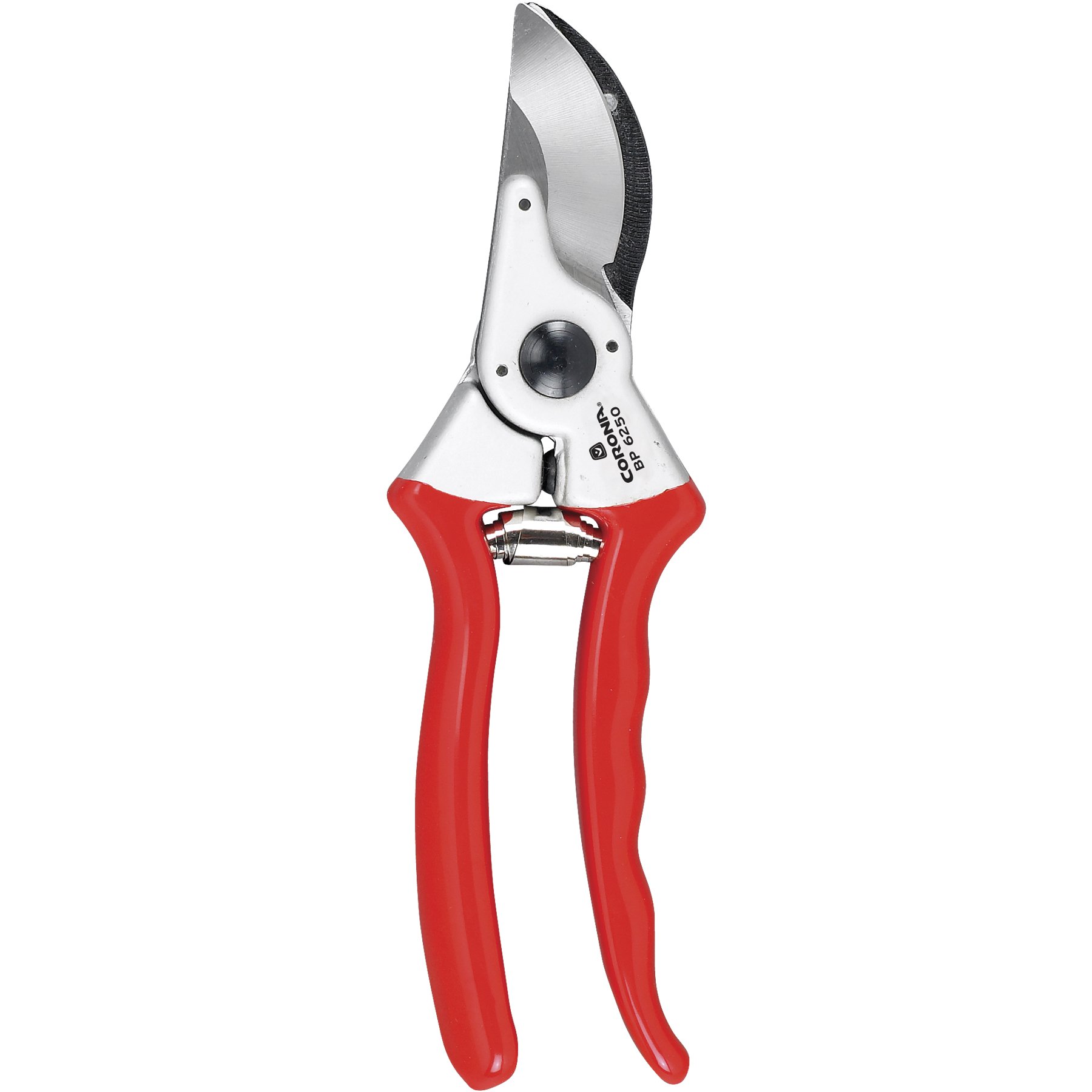
The budget-friendly pruner that punches at the level of Swiss-made rivals.
The Corona BP 6250 offers a 1-inch cutting capacity, a replaceable forged steel blade, and lightweight aluminum handles that reduce fatigue—all at a lower price than the Felco F2. The consensus among owners is that this pruner equals the performance of the Felco F-2 at half the cost. It cuts through 1-inch branches easily, and the non-slip red grips are easy to spot if you drop one among the vines.
The design includes professional features you would expect at a higher price: a self-cleaning sap groove (a channel that keeps debris from clogging the blade) that keeps the blade action smooth, a wire-cutting notch for trellis repair, a shock-absorbing bumper (a cushion that reduces impact on your hand), and an easy-to-use thumb lock. One 5-star review noted no hand fatigue even after 4 hours of continuous pruning — a strong test for any tool.
The only real catch is that it ships dry. It will need a clean and oiling before first use, and regular maintenance is required to prevent rust on the carbon steel blade. But for the value it delivers — professional-grade cutting power at an entry-level price — it is tough to top.
The Strong Points
- 1-inch cut capacity rivals premium models
- Replaceable carbon steel blade
- Very comfortable for long sessions, even with arthritis
The Weak Points
- Needs cleaning and oiling from the start
- Not the lightest at 9.6 oz
Choose this if: your budget is a priority but you refuse to compromise on a 1-inch cut and professional build quality.
Pass on it if: you prefer a tool that is ready to use immediately with zero prep.
7. Bahco BAHPX-M2 Pruner PX Medium
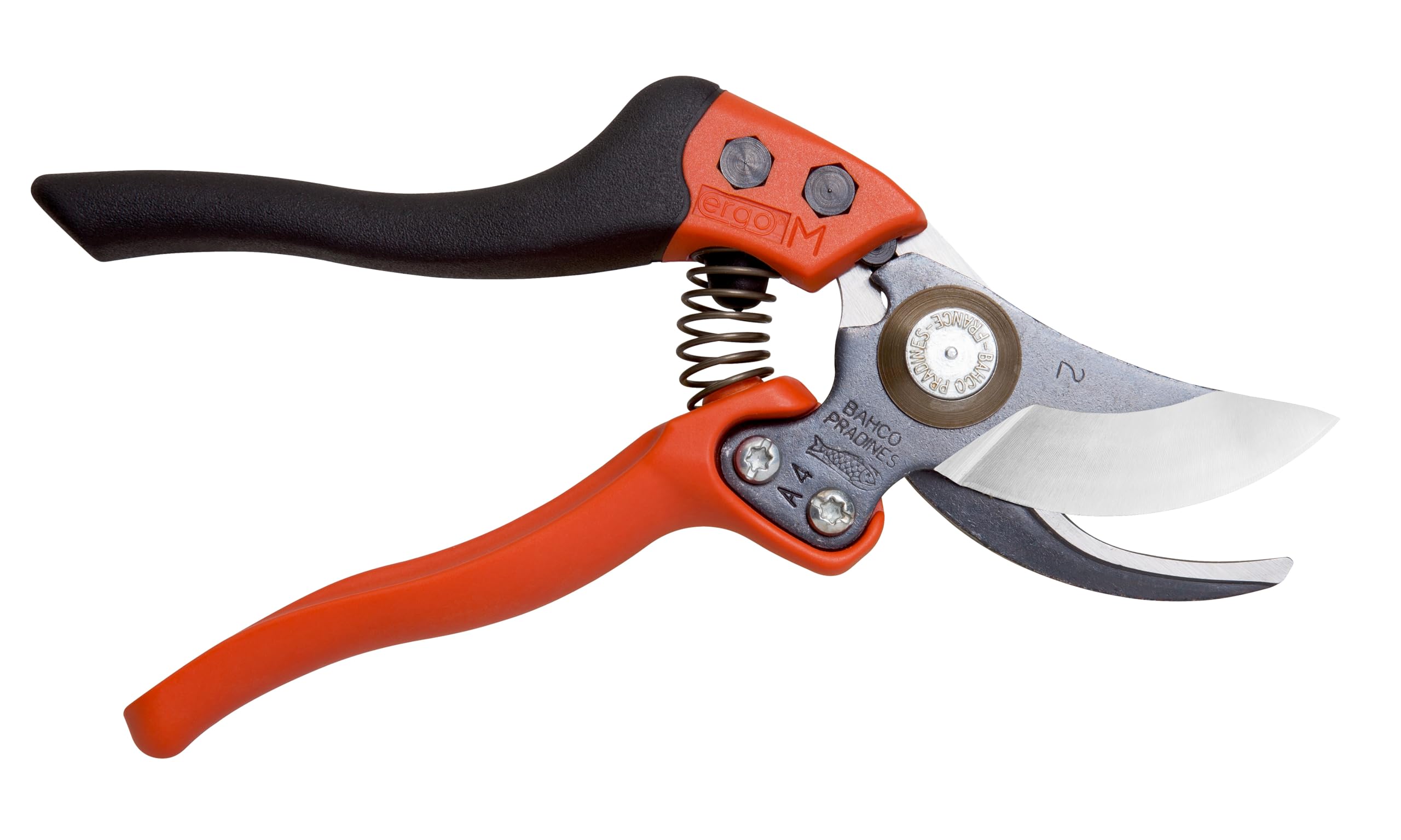
A Slicing Cut blade that channels energy into clean snips, not crushed fibers.
The Bahco PX-M2 is built for the landscape professional who prunes daily and needs to minimize fatigue. Its key feature is the Slicing Cut blade technology, which channels cutting energy into a clean, efficient snip rather than a crushing motion. This is vital for grape vines — the cleaner the cut, the healthier the plant. It handles soft wood up to 3/4 inch and hard branches up to 1/2 inch with minimal effort.
The ERGO handle (an ergonomically shaped handle) is shaped to support a natural wrist position, and many owners say it is noticeably more comfortable than rival models, including the Felco F2. At 9.2 inches in length, it gives good reach, and the lightweight design reduces strain during those marathon pruning sessions. One 5-star review put it simply: “Cuts small branches & twigs easily and is very comfortable even when using them for an hour or more.”
Durability is a mixed point — most owners say they last for years, but a few report breakage within two months if neglected. This tool requires regular cleaning and an initial tension adjustment. The lock release is also a bit harder to operate one-handed than some competitors, which can be a minor annoyance.
The bottom line: If ergonomics and wrist health are your top concern, the Bahco PX-M2 is an excellent choice. Its slicing action is genuinely gentler on plants, and the comfort over a long day is hard to match. Just be ready to give it the care it needs.
8. ARS HP-VS8R Rotating Handle Hand Pruner
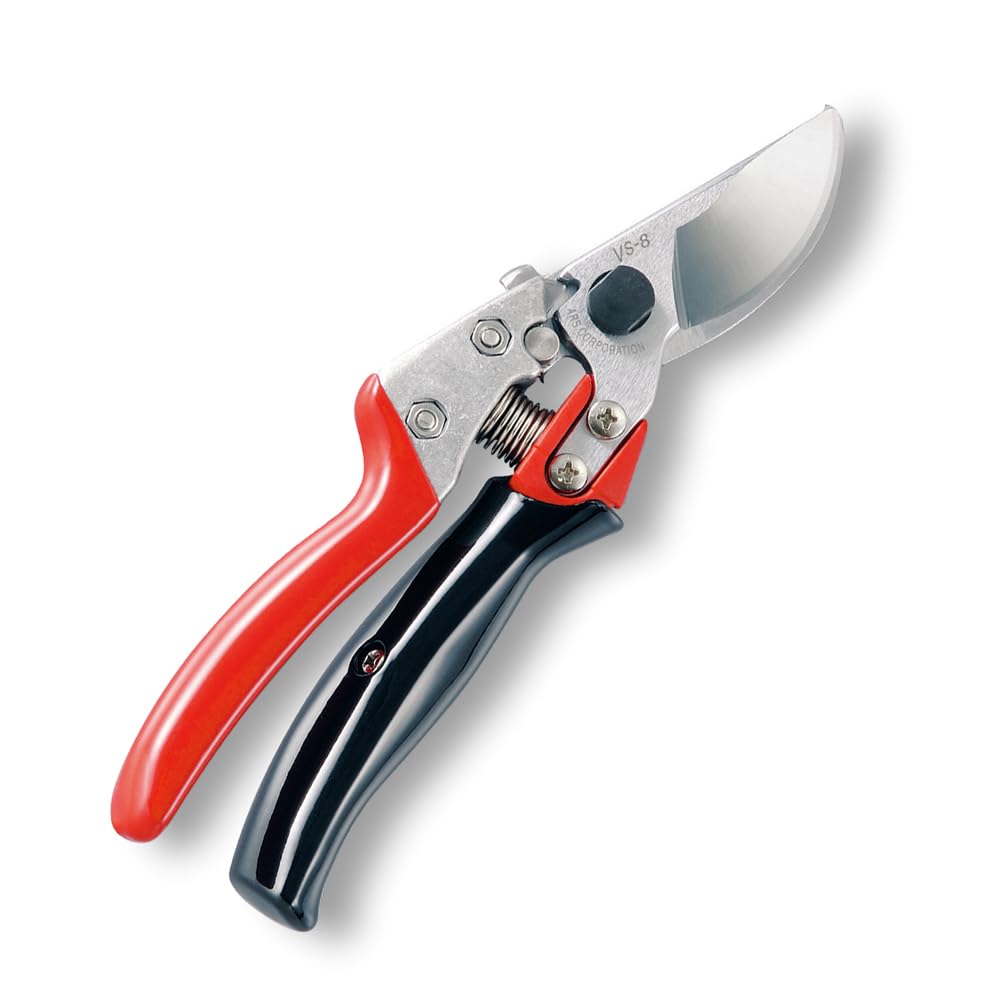
The rotating handle moves with your hand, not against it — a lifesaver for wrists.
The ARS HP-VS8R is the tool you turn to when your wrists start complaining. Its signature feature is a rotating handle (a handle that pivots in your hand as you cut) that keeps your wrist in a neutral position and reduces strain. This is especially beneficial for preventing and managing carpal tunnel syndrome (a condition causing wrist pain and numbness) — a common issue for anyone who prunes heavily. As one owner put it, they are “hands down the most comfortable, sharpest, and efficient pruners” they have ever used.
The blades are made from top-quality alloy steel and hold an edge for a long time. They cut through finger-width branches cleanly, and the lock/open up mechanism is easy to use with one hand. The 8-inch size and balanced feel make this pruner a favorite for all-day vineyard work. Owners note that after a break-in period, the action becomes exceptionally smooth.
There is a design nuance to be aware of: when the handle rotates, it can occasionally jam your fingers in between the moving parts. Wearing a glove while pruning is the recommended fix. The 15 mm (0.6 inch) cutting width is also on the smaller side compared to the Saboten’s 20 mm, so very thick canes may require an extra pass or a different tool.
The Highlights
- Rotating handle reduces wrist and hand strain dramatically
- Stays sharp for an exceptionally long time
- Well-balanced and comfortable for 4+ hour sessions
The Drawbacks
- Rotating mechanism can pinch fingers occasionally
- 15 mm cut is not ideal for very thick, old canes
Pick these if: you have wrist pain or arthritis and need a pruner that moves with you. The rotating handle is a genuine standout.
Avoid if: you mostly prune very thick wood over 15 mm or you are sensitive to the occasional pinch from the rotating joint.
9. Felco F 14 Pruning Shears – 7.1″

The compact Felco built specifically for smaller hands — no more oversized grips.
The Felco F 14 solves a common problem: the standard pruner is just too big for your hand. At 7.09 inches long and weighing only 6.72 ounces, this is the smallest, lightest Felco model, and it is designed intentionally for people with petite hands or who struggle with heavy tools. It is built with the same Swiss precision as the larger F2 but scaled down for comfort and control.
The carbon steel blades cut through branches up to 18 mm (about 3/4 inch), which covers nearly all grape vine pruning tasks. The bypass action is smooth and easy, and the forged aluminum handles come with a lifetime guarantee. The micrometric adjustment mechanism (a fine-tuning dial for blade tension) allows for easy blade replacement when it does eventually dull. Reviewers point out that after years of use, the Felco F 14 still feels like new.
The trade-off for the smaller form is that the shorter blades do not wrap around thicker branches, unlike the 1-inch capacity of the Felco F2. If you have larger hands or often prune wood over 18 mm, you will be better served by the Felco F2 or the TONMA. The locking mechanism also requires a firm squeeze to engage, which a few owners found stiff initially.
The Strengths
- Perfectly proportioned for small hands and a comfortable fit
- Very light at 6.7 oz — minimizes fatigue
- All parts replaceable; Swiss build quality
The Limitations
- Shorter blades limit the branch diameter you can cut
- Lock requires a firm squeeze to engage
Best for: vintners with small hands or anyone who finds standard pruners too bulky. This is the fit you have been looking for.
Not for: users with large hands who need to cut branches thicker than 18 mm.
Understanding the Specs
Cutting Capacity (mm / inches)
This spec tells you the maximum branch thickness the shears can slice through in a single clean cut. A 15 mm (0.6 inch) capacity, found on the Kimura, SUIZAN, and ARS, handles most routine grape vine canes. A 20 mm (0.8 inch) or 1-inch capacity, found on the Saboten, Felco F2, TONMA, and Corona, is better for older, thicker wood that has been left to grow. Always match this to the thickest cane you expect to work with — overshooting means extra effort, undershooting means crushing the wood.
Bypass vs. Anvil Mechanism
A bypass blade (a scissor-style blade that slides past a lower jaw) makes a clean cut that leaves the vine’s living tissue intact, which speeds up healing. An anvil blade (a blade that crushes the stem against a flat surface) is fine for dead wood but risky for live grape canes where crushing can invite disease and rot. For grape vine pruning, bypass is the only safe choice so your vines recover quickly.
FAQ
What is the ideal cutting capacity for grape vine pruning?
Should I use bypass or anvil shears for grape vines?
How do I keep my pruning shears sharp for years?
What handle material is best for long pruning sessions?
Are Japanese pruners better than Swiss pruners for grape vines?
How do I clean sap off the blades?
Can I use these shears for other tasks besides grape vines?
What is a good weight for grape vine pruning shears?
Final Thoughts: The Verdict
For the majority of shoppers, the best grape vine pruning shears is the Felco F2 because it combines a sturdy 1-inch cut with a fully repairable design that lasts decades. If you want Japanese precision at a more accessible price, grab the Kimura Pro. And for the budget-conscious grower who still needs pro-grade performance, the Corona BP 6250 is the one to reach for. Whichever you choose, you