
Specs are compiled from manufacturer listings and verified buyer reviews and can change over time — please confirm the key details on the product page before buying.
Standing over a patch of crabgrass with a sore back and a dull tool is the fastest way to kill a Saturday. The difference between a chore that drags and a job that feels good depends on exactly which tool you grab — the right one lifts roots cleanly, matches your height, and handles the specific grass you are fighting.
I’m Rikta — the founder and writer behind Lawn Gear Lab. This guide is built by comparing the manufacturers’ published specifications and the patterns across verified customer reviews, so you get each pick’s real strengths and trade-offs instead of marketing spin.
if you need a full hand-tool set for the flower beds or a long-handled stand-up weeder to save your knees, the garden tools for grass you choose must match both your body and the depth of the roots you are chasing — and these nine picks cover every scenario.
Our Picks at a Glance
How To Choose The Best Garden Tools For Grass
Not every tool fits every yard. The choice depends on how your back feels, what kind of grass you are fighting, and how much ground you need to cover. Here are the three factors that matter most.
Handle Length and Your Posture
A short handle forces you to bend or kneel — fine for a small flower bed, brutal for a full lawn. Long-handled stand-up weeders (typically 43 to 60 inches) let you keep your spine straight while you pull, which changes the whole experience if you have a large yard or achy knees. Look for adjustable handles so the tool fits your exact height.
Blade and Head Material
High carbon steel and cast steel are the terms to watch. High carbon steel resists rust and holds a sharp edge longer, which matters for cutting tools like shears and sickles. Cast steel is tougher against rocky soil and resists deformation, making it the right choice for weed pullers and hoes that take a beating. Avoid anything that says “stamped steel” — it bends.
Root Removal vs. Surface Cutting
Some grass problems sit on the surface, like annual bluegrass or moss. Others, like dandelions and thistles, send taproots deep. A weed puller with claws or a slide-release mechanism grabs the whole root so it does not grow back. A sickle or grass shear handles the top growth only. Match the tool to the enemy underground.
Quick Comparison
| Model | Best For | Handle Length | Head Material | Weight | Amazon |
|---|---|---|---|---|---|
| WORKPRO 6-Piece Set★ Best Overall | Hand-tool versatility | Short (hand tools) | High Carbon Steel | 1.32 kg | Amazon |
| WELLOPLO 2-in-1 Weed PullerPremium Pick | Stand-up weeding | 16″–60″ adj. | Cast Steel | — | Amazon |
| LAWFYMORI Weed PullerBest Value | Budget weeding | 17″–60″ adj. | Cast Steel | 0.84 kg | Amazon |
| YEELOR Weeding Sickle | Overgrown areas | 21.5″–51.7″ adj. | Stainless Steel | 1.6 lb | Amazon |
| Kimura Pro Grass Shears | Precision edging | 15″ (fixed) | Japanese SK5 Steel | 0.34 kg | Amazon |
| Stand-Up Weed Puller (Slide-Release) | Deep-root removal | 43″ (3-section) | Forged Steel | 3.61 lb | Amazon |
| Bluesea Lawn Aerator | Soil aeration | T-handle | Reinforced Steel | 2.83 kg | Amazon |
| BlumeTrec Leveling Rake | Soil leveling | 6.7 ft | Alloy Steel | 3.45 kg | Amazon |
| Dremmt Leveling Rake | Large-area leveling | 72″ | Stainless Steel | 4.65 kg | Amazon |
In‑Depth Reviews
1. WORKPRO 6-Piece Garden Tool Set
Our pick — over 4.5★ from 500+ verified ratings; the strongest balance of quality and price.
Six tools that replace a whole shed of junk — the trowel, rake, hoe, and weeder you actually use
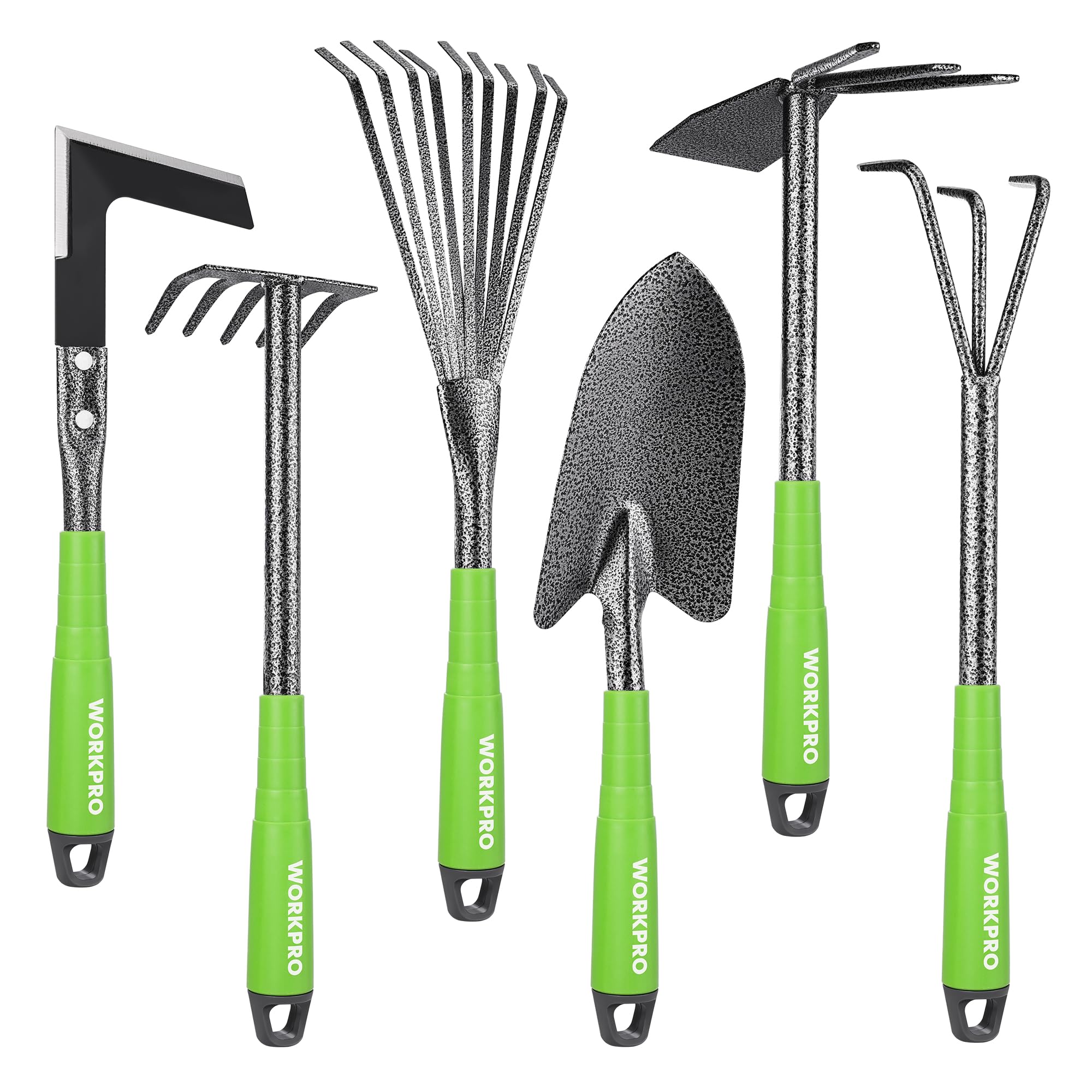
The thing everyone raves about here is build quality — and the numbers back it up, with quality mentioned more than any other trait. Each tool is forged from high carbon steel, which means it resists rust and will not bend or break during normal use. The set includes a garden trowel, a 5-tine rake, a 9-tine leaf rake, a double hoe with 3 prongs, a cultivator, and a crack crevice weeder — and that weeder is the surprise star. Buyers report it removes moss from sidewalk cracks better than anything they have tried.
The rubber handles are contoured to fit your palm, which cuts down on hand fatigue during longer sessions. The whole set weighs 1.32 kg, so it is easy to carry from bed to bed. Durability earns the second-most praise among owners, with the general feeling that these tools feel built to last — one owner summed it up: they are “going to last” and “feel like they will handle a lot of abuse.”
The honest trade-off for a hand-tool set is that nothing here reaches your back — you will still be kneeling or bending. And on rare occasions the weed remover arrives without a sharp edge and needs a quick touch-up with a file or bench grinder. But for under six bucks per tool, the quality-per-dollar ratio is hard to match.
The Tools That Stand Out
- Crack crevice weeder handles sidewalk moss and tight joints superbly
- 3-prong cultivator loosens soil better than a standard claw and pulls entire weed roots
- Small leaf rake clears debris between shrubs without damaging plants
Two Things to Know
- No tool here lets you stand upright — all require bending or kneeling
- The weed root remover blade may need sharpening from the start on some units
Reach for this if: you want one complete set that handles weeding, digging, tilling, and raking without spending tool-by-tool.
skip it if: you already own a full set of hand tools or you only need a single stand-up weeder for the lawn.
2. WELLOPLO 2-in-1 Weed Puller Tool
The stand-up weeder that grabs deep taproots and saves your spine — adjustable from 16 to 60 inches
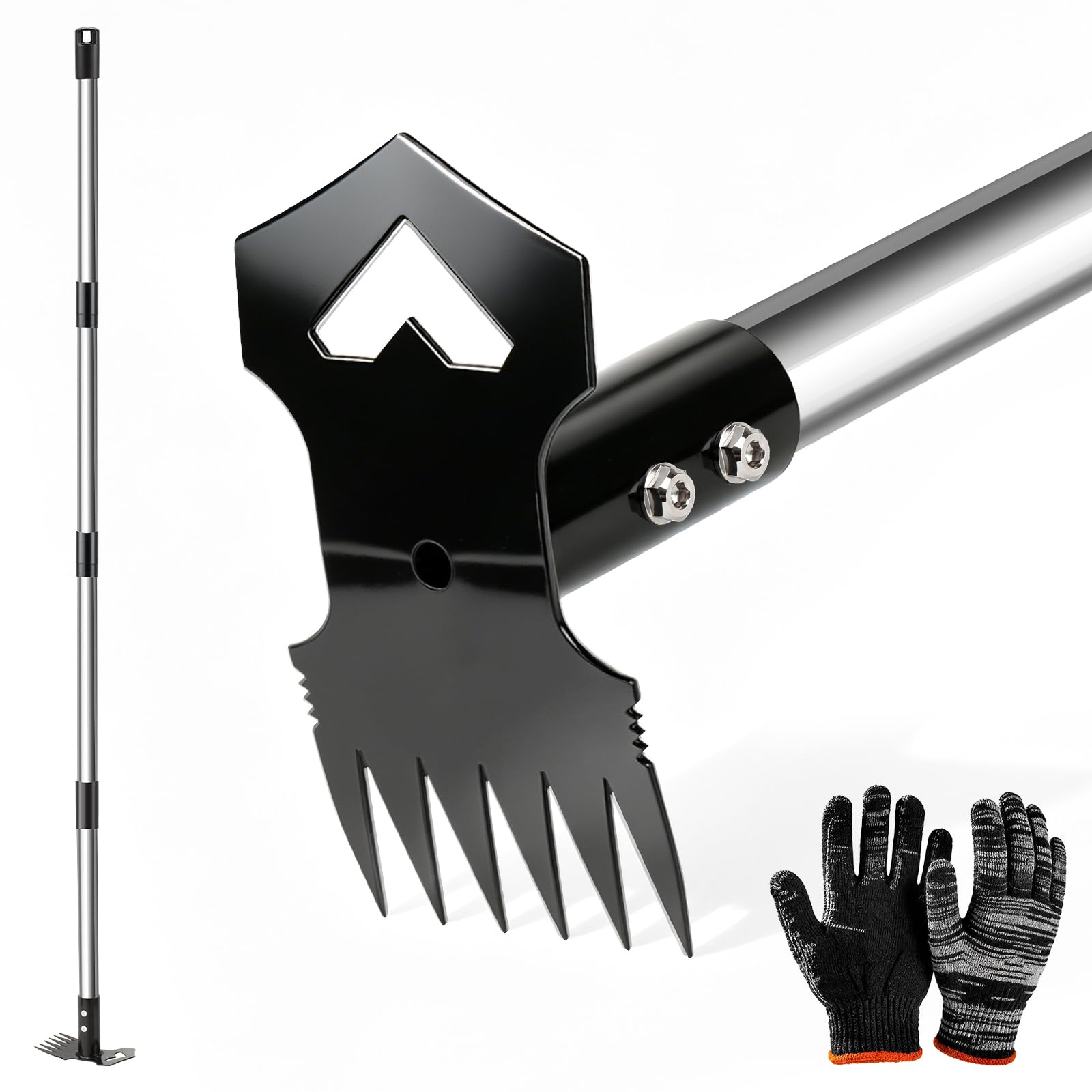
This is the tool to grab if your yard is full of dandelions and crabgrass with roots that go deep. The head is cast steel — significantly tougher than standard carbon steel, according to the maker — and it comes in a 2-in-1 design: a 6-tine rake side for uprooting deep weeds and a hoe blade for loosening soil and leveling ground. The four-section stainless steel handle adjusts from 16 inches up to 60 inches, so you can set it exactly for your height and never bend over.
Buyers consistently call it effective at grabbing multiple weeds at once, including both surface weeds and deep taproots. The stand-up design is the headline — owners specifically mention it saves their back and knees, and that it feels sturdy enough for heavy use. Assembly is simple, and the modular design breaks down for compact storage in a shed or car trunk.
The one catch: at this price the cast steel head is solid, but the 1mm thickened stainless steel handle means it is not built for prying up boulders. Stick to weeds and soil, and it performs beautifully. A pair of gloves is included to protect your hands during longer sessions.
The defining feature: the adjustable 60-inch handle eliminates bending entirely — owners call it “back-saving” and note it works on dandelions, crabgrass, and tough weeds without leaving roots behind.
Confident choice for: anyone whose lawn is overrun with deep-rooted weeds and who wants to finish the job standing up.
Think twice if: you only have small flower beds where a hand weeder is faster — the long handle can feel oversized in tight corners.
3. LAWFYMORI 60″ Weed Puller Tool
A budget-friendly stand-up weeder that matches the premium design at a fraction of the cost
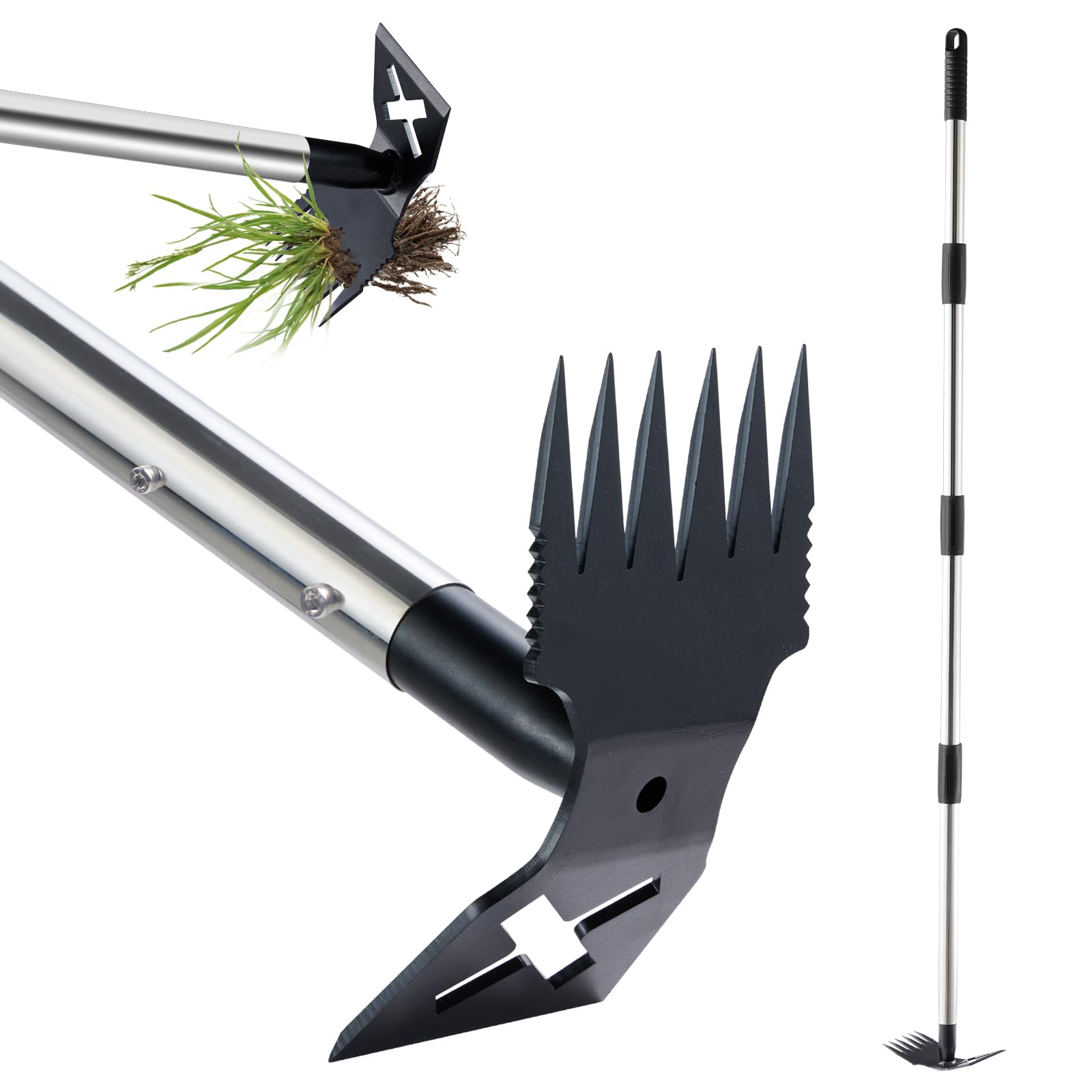
The core idea is the same as the premium picks: a long handle that keeps you upright and a cast steel head that digs in and pulls. The LAWFYMORI delivers four adjustable lengths — 17, 31, 45, and 60 inches — so it fits everyone from a shorter gardener to someone over six feet tall. The 2-in-1 head works as both a weed rake with 6 tines and a garden hoe with a flat edge.
The biggest praise among owners is how the long handle eliminates bending and kneeling, especially for taller users. One reviewer noted they are over six feet tall and no longer need to kneel. The tool is “very efficient for removing weeds and grass quickly,” and the adjustable handle is called a “big plus.” At 0.84 kg, it is noticeably lighter than the WELLOPLO, which some may prefer for long sessions — though that lower weight also makes it feel slightly less substantial when prying out tough roots.
The honest limitation: a few owners note the handle sections can feel a little flimsy until you really tighten the spacers. Once snugged down properly, it holds well. For the price, it is a genuinely effective stand-up weeder that puts the 2-in-1 design within reach of anyone.
Best for: a budget-conscious buyer who wants a stand-up weeder with an adjustable handle and does not need the heaviest-duty build.
Grab it if: you are tall (over six feet) and want a weeder that adjusts to your height without spending premium money.
Pass if: you regularly work in rocky, compacted soil — the lighter build may flex more than you would like.
4. YEELOR Weeding Sickle
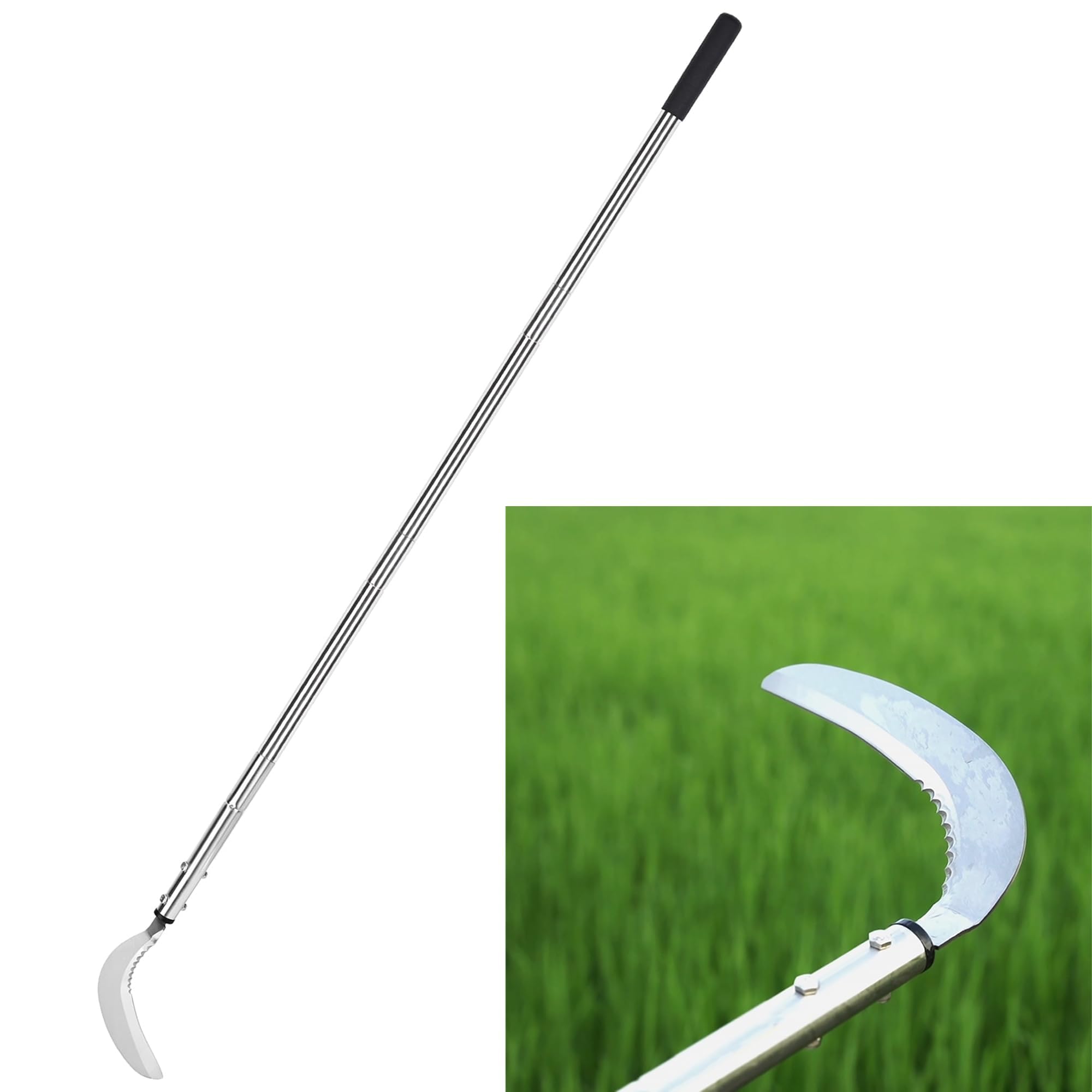
A 51-inch sickle that slashes through dense weeds with a single swing — serrated on one side, straight on the other
This is not a weeder that pulls — it is a scythe-style tool that cuts. The YEELOR sickle features a 2-in-1 blade: the straight edge glides through soft weeds like dandelion seedlings without getting stuck, while the wavy edge slices through tougher growth like thistles and reeds with minimal effort. The sharp tip also lets you pry out deep-rooted weeds like crabgrass without switching tools.
At just 1.6 pounds, it is remarkably light for a tool that stands up to 51.7 inches fully extended. The handle adjusts to three lengths — 21.5 inches for flower beds, 37.3 inches for medium gardens, and 51.7 inches for standing work in large yards or farms. Owners call it “sharp and effective,” particularly on tall grass, vines, and clover, and one buyer over six-foot-seven found the reach perfect.
The recurring feedback is that the screw-together handle sections can loosen during use. A few owners solved it with thread-locking adhesive on the joints. The blade also arrived with small burrs on some units, easily fixed with a quick sharpening. It is not a tool for short grass — it excels on overgrown patches where a string trimmer would struggle.
The real selling point: the 2-in-1 blade design lets you cut soft weeds with the straight edge and tough weeds with the serrated side, all while standing up.
Best suited for: anyone with overgrown areas, vines, or tall weeds that need to be cleared without firing up a gas trimmer.
Hold off if: your primary need is removing individual taproots — this sickle cuts tops, not roots.
5. Kimura Pro Grass Shears

These 15-inch grass shears cut with Japanese SK5 steel and rotate 360 degrees — precision for edging and trimming
For the finishing work around walkways, borders, and garden beds, the standout is a quality pair of grass shears. The Kimura Pro stands out because of its blade steel: Japanese SK5 high carbon steel holds an edge noticeably longer than the standard stainless found on cheaper shears. The PTFE coating (a low-friction layer) helps the blades glide through grass without sap sticking or rust forming.
The 360-degree rotating swivel head is the standout feature — it offers 16 cutting positions, so you can trim at any angle without twisting your wrist. The non-slip TPR-coated handles (a soft, grippy rubber) are comfortable even for users with arthritis, as several owners with hand trouble have noted. The shears weigh only 0.34 kg, making them easy to maneuver for longer sessions. Quality is the most-praised aspect, and the blades arrive sharp enough to cut immediately out of the package.
A small number of owners noted the red plastic handle guard can break if dropped on concrete — treat it with care. The blade rotation mechanism is not immediately intuitive; some owners needed to look up instructions online. But the lifetime warranty takes the sting out of any defect.
What Owners Appreciate Most
- Smooth, clean cutting action — “best grass clippers I’ve found in a long time”
- Lightweight enough for arthritic hands to grip and use comfortably
- 16 cutting angles from the rotating head make edging easy
Minor Gripes
- Plastic hand guard is not built for rough drops
- Rotating head function is not clearly explained in the packaging
Perfect for: precise lawn edging and trimming around flower beds where a line trimmer is too clumsy.
Not for: cutting large swaths of overgrown grass — the blades are 15 inches and designed for detail work.
6. Stand-Up Weed Puller with Slide-Release Ejection
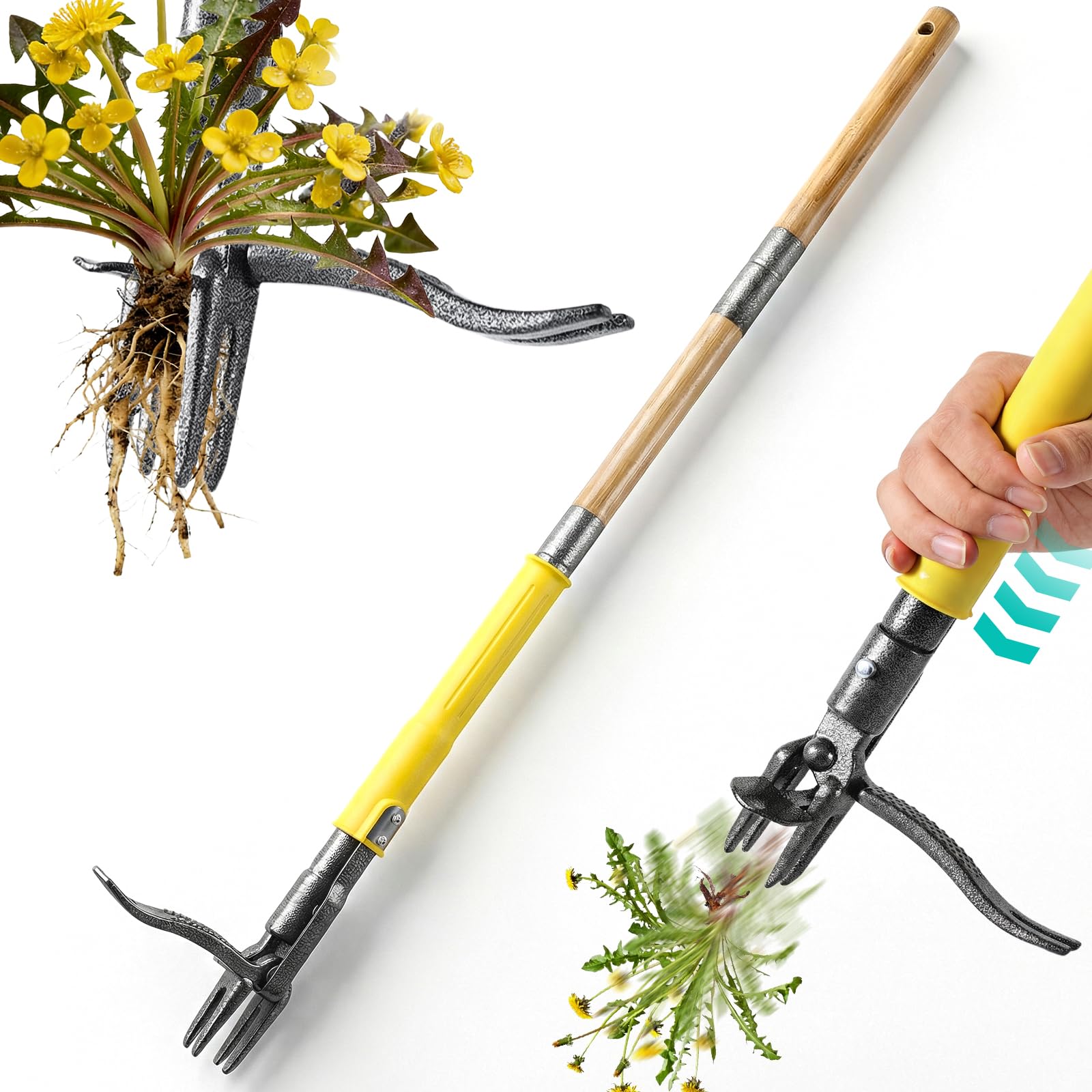
A slide-release mechanism ejects the whole weed and root without you ever touching the dirt
This is the tool that makes weeding almost satisfying. The unique slide-release system lets you eject the entire weed — root and all — with a simple push of a sleeve, so your hands stay clean and you never have to bend down to pick up the pulled weed. Four hardened steel claws dig 3.2 inches deep into the soil, grab the core of the weed, and lift the entire root system to prevent regrowth.
The reinforced construction includes a forged steel footplate and a reinforced connection that resists bending. The 43-inch ergonomic handle breaks into 3 sections for storage. Owners consistently call it effective on dandelions and thistles, with one calling it “the most satisfying way to weed.” The ejection mechanism works best on larger weeds with thicker stems; small, thin weeds can slip through the claws on the first try.
There is a short learning curve — it takes a few pulls to get the foot placement and angle right. On wet ground it works even better, as the soil gives way more easily. For anyone tired of kneeling and prying, this is a genuine upgrade to the weeding experience.
Why it stands out: the slide-release ejection is genuinely fun to use — you step, pull, and push, and the whole weed pops out. Owners call it “fast and fun.”
Ideal for: anyone fighting dandelions and thistles in a lawn and who wants a clean, no-touch weeding process.
Avoid if: most of your weeds are tiny seedlings — the claws are sized for thicker-stemmed weeds.
7. Bluesea Lawn Aerator Tool
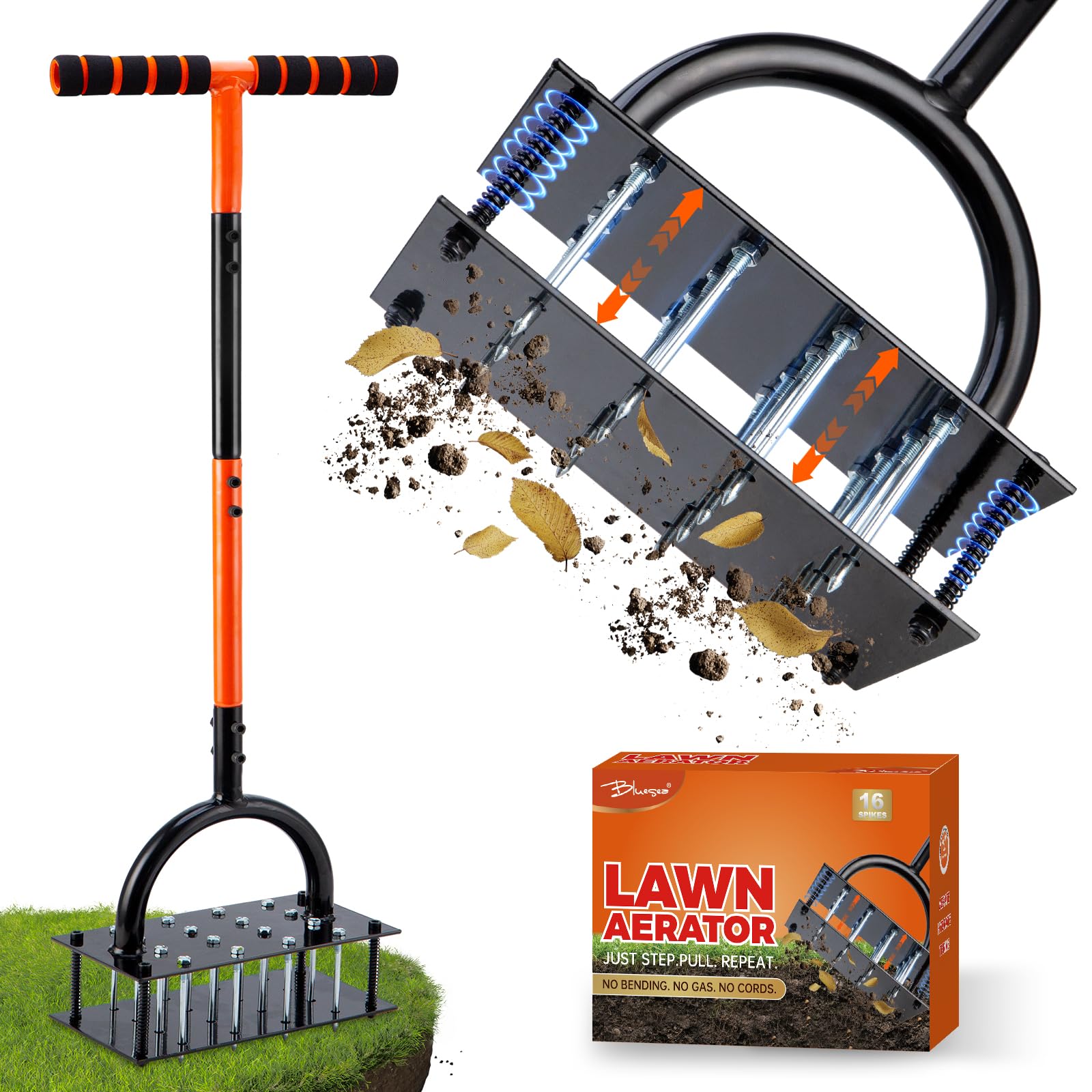
Sixteen iron spikes punch 3.5 inches into compacted soil and a spring shakes the dirt off automatically
Aeration is one of those chores that makes everything else easier — and the Bluesea aerator turns it into a simple stomp-and-lift process. The 16 spikes are arranged in a 4×4 grid pattern, each 3.5 inches long, and they punch through compacted soil to let air, water, and nutrients reach the grass roots. The double-layer spring mechanism automatically shakes off soil and debris after each step, so you are not constantly clearing stuck dirt.
The build is industrial-strength: 2mm reinforced steel plates joined with argon arc welding, and an anti-corrosion coating to prevent rust. The ergonomic T-handle is wrapped in TPE (a durable, soft-touch rubber) for a comfortable grip. Owners note it is “sturdy” and “easy to assemble,” with the self-cleaning feature being a real time-saver. The tool is effective on compacted soil, and regular use leads to a visibly healthier lawn.
The honest trade-off: a small number of owners experienced the metal handle breaking after about a month of regular use, and a few lost spikes because they did not check that every spike was fully tightened before starting. Make sure all 16 spikes are snug before each session. The tool also requires the soil to be moist but not muddy — hard, dry soil makes penetration difficult.
The practical benefit: a spring-loaded ejector clears the spikes automatically between steps, saving you from manually picking clay off each tine.
Best for: anyone wanting to improve lawn health through regular aeration without renting a heavy machine.
Hold off if: your soil is heavy clay and constantly dry — you will need to water it 1–2 days ahead to soften it enough for the spikes to penetrate.
8. BlumeTrec Lawn Leveling Rake
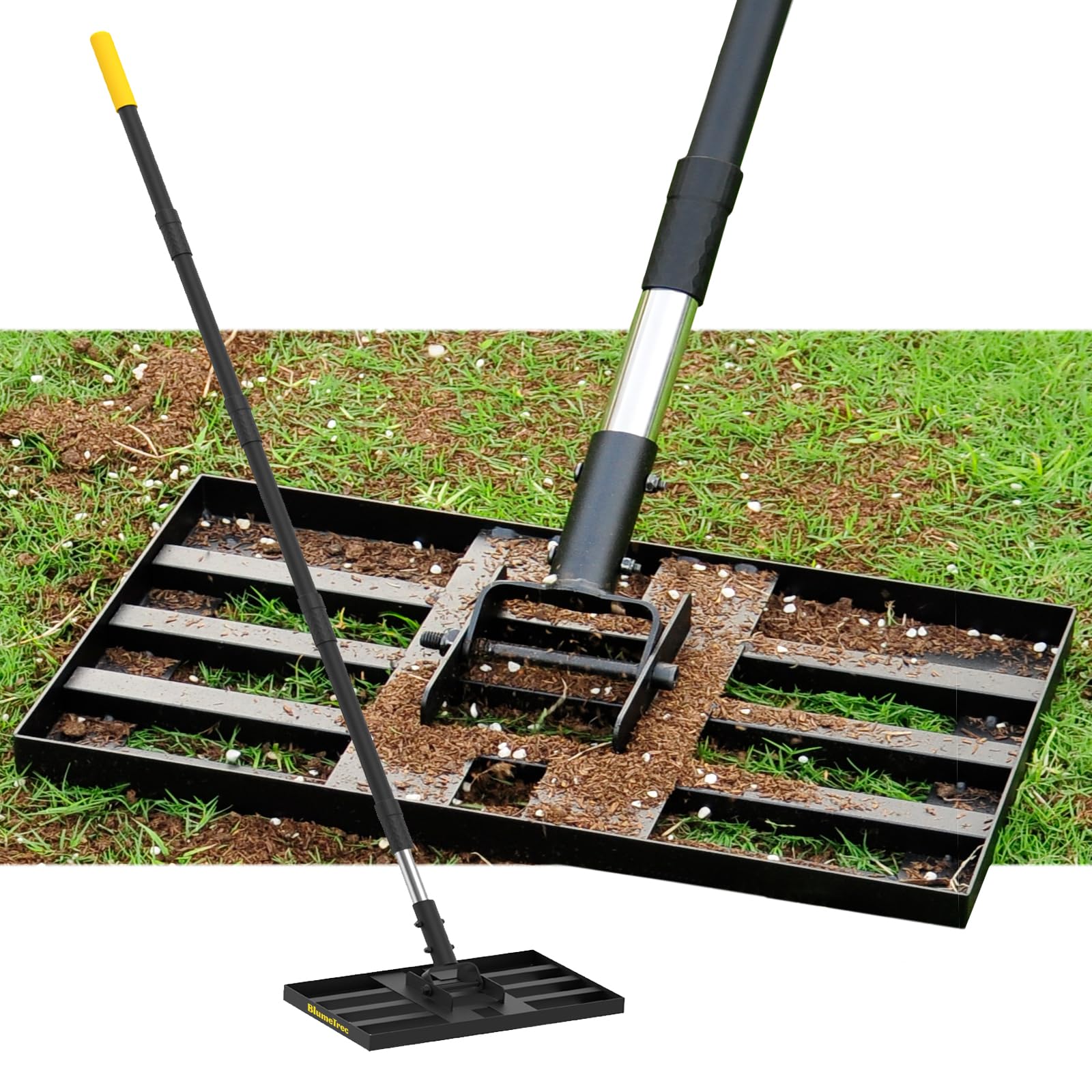
A 17×10-inch leveling head on a 6.7-foot handle — for spreading soil, sand, and compost across the lawn
If your lawn has low spots where water pools after rain, a leveling rake is the fix. The BlumeTrec uses a 17″x10″ alloy steel head with full welding at the joints to prevent loosening or breakage. The 6.7-foot stainless steel handle lets you cover ground without bending, and the head angle adjusts from 0 to 90 degrees so you can work along edges and in tighter spaces.
Functionality is the most-praised aspect, with owners describing it as “heavy duty” and “solid” for re-soiling and re-seeding projects. It handles soil, sand, compost, gravel, and even works as a golf rake for sand traps. The powder-coated finish adds rust protection. Assembly is straightforward with the included tools and instructions.
The biggest practical concern is weight — at 3.45 kg, this is a heavy tool to drag around for an entire afternoon. One owner noted it is “a little heavy and the handle could be shorter.” A few others mentioned that for a standard home lawn, the 17-inch head is the right size; the larger 30-inch or 45-inch options move more material but are harder to control. If you have a genuinely large yard, the weight is a sign of quality. For a small patch, it may wear you out.
The honest take: this is a genuinely effective leveler that feels built to last, but the weight means you will feel it after an hour of dragging.
Good for: homeowners tackling a medium-to-large yard leveling project with topsoil, sand, or compost.
Better choices if: you have back issues or a small yard — the weight will be a burden on shorter sessions.
9. Dremmt Lawn Leveling Rake 30×10

The 30-inch head and 72-inch handle turn leveling into a one-pass job — and it works both ways
This is the heavy hitter of lawn leveling. The Dremmt features a 30″x10″ stainless steel plate that is 2mm thick, which is enough mass to stay flat on the ground and not skip over clods like thinner alternatives. The 72-inch handle lets you stand fully upright while covering large areas, and an ergonomic curve in the handle reduces fatigueby translating your push-pull force into smooth gliding motion.
The most-praised feature is that the rake works in both directions, which owners say makes moving and spreading material into low spots much faster. At 4.65 kg, the weight is actually an advantage here — it presses down high spots as you drag it, so you are leveling and compacting in a single pass. The kit includes premium gloves and assembles in minutes. Owners consistently call it “sturdy and professional,” with one noting it is “cheaper than the ones out there” while still feeling like a professional tool.
The one real limitation: at 30 inches wide, this is not a tool for small, tight gardens or narrow flower beds. It is designed for open lawn areas, pastures, and golf-course-style leveling. A few owners mention it is too long for small spots, but that is by design — it is a wide-area tool for people who care about efficiency.
Why Owners Love It
- Works in both directions — speeds up spreading and filling low spots dramatically
- Heavy 2mm stainless steel plate stays flat and presses down high spots during use
- Sturdy enough for professional-level results, and assembly is simple
The Size Reality
- 30-inch head is too wide for tight flower beds or small decorative gardens
- At 4.65 kg, it is heavy — that heft helps leveling but can tire you over long sessions
The ideal buyer: someone with a large lawn, pasture, or garden who wants to level soil, sand, or compost quickly and efficiently while standing up.
Pass if: your yard is mostly flower beds and narrow strips — a smaller leveling rake will serve you better.
Understanding the Specs
Blade Steel and Head Material
High carbon steel (like Japanese SK5 in the Kimura shears) holds a sharp edge for a long time and resists rust. It is the right choice for cutting tools. Cast steel is tougher and less likely to deform when prying out deep roots, making it the standard for weed puller heads and hoes. Stainless steel is rust-resistant but tends to be softer — fine for occasional use, not for heavy-duty root removal.
Handle Length and Adjustability
Short handles (under 20 inches) force you to kneel or bend. Long handles (43 to 72 inches) let you stand upright, which saves your back and knees over long sessions. Adjustable handles are a major plus because they let the tool fit different users and different tasks — you might want the full 60 inches for open lawn and a shorter setting for working around flower beds.
Weight and Stability
A heavier tool (over 3 kg) provides stability — it stays on the ground and does not skip over clumps when leveling or aerating. Lighter tools (under 1.5 kg) are easier to carry and maneuver for detail work but may feel flimsy when prying out tough roots or dragging through compacted soil. Choose weight based on the task: heavier for broad-leveling and aeration, lighter for precision weeding and cutting.
Special Mechanisms: Ejection Systems and Rotating Heads
A slide-release ejection mechanism on a weed puller lets you drop the pulled weed without touching it — a huge convenience if you have a lot of dandelions. A 360-degree rotating head on grass shears gives you 16 cutting angles, so you can trim along edges and curves without twisting your wrist. These features add mechanical complexity but genuinely improve the daily experience of using the tool.
FAQ
Can I use a weed puller on wet grass?
What is the difference between a hand weeder and a stand-up weed puller?
How deep do weed puller claws typically go?
Are grass shears useful if I already have a string trimmer?
How often should I aerate my lawn?
What does a lawn leveling rake actually do?
Can I use a lawn leveling rake on gravel or stone?
Should I buy a set of hand tools or individual tools?
How do I maintain grass shears to keep them sharp?
Do I need a weed puller or a sickle for my yard?
Final Thoughts: The Verdict
For most buyers, the garden tools for grass winner is the WORKPRO 6-Piece Set because it delivers six genuinely useful tools in high carbon steel at a price that beats buying individually — and the quality earns the highest praise among owners across the board. If you want a stand-up weeder that saves your back, grab the WELLOPLO for its 60-inch adjustable handle and cast steel head. And for precision edging around beds and walkways, the Kimura Pro Grass Shears with Japanese SK5 steel and a 360-degree rotating head is the one to reach for.
How We Picked
We do not accept paid placement. Every pick is matched to a real buyer and a real use-case; we do not hands-on test units.
Sources & Methodology
Specifications: manufacturer listings and product documentation. Review insights: verified customer reviews, as of July 2026. Pricing: not shown on this page (it changes often); check the current price via the retailer link.
As an Amazon Associate, Lawn Gear Lab earns from qualifying purchases. This does not affect which products we feature.