
Specs are compiled from manufacturer listings and verified buyer reviews and can change over time — please confirm the key details on the product page before buying.
Japanese maples are the quiet royalty of any yard — delicate, slow-growing, and quick to show when their soil is off. The trouble is, most general-purpose fertilizers are built for hungry lawns or tomatoes, not for a tree that evolved in the understory of Japanese woodlands where the soil runs acidic and the nutrient load is gentle. Feed them the wrong thing, and you’ll see leaf burn, leggy growth, or that dreaded browning at the tips. The good news: a handful of fertilizers are formulated to match exactly what these trees crave — low pH, slow-release, and balanced for roots and branch structure rather than a burst of green.
I’m Rikta — the founder and writer behind Lawn Gear Lab. This guide is built by comparing the manufacturers’ published specifications and the patterns across verified customer reviews, so you get each pick’s real strengths and trade-offs instead of marketing spin.
This guide weighs seven options head-to-head on the specs that matter most to your tree — nitrogen sources, N-P-K ratios, and release speed — to help you find the best fertilizer for japanese maple tree for your yard.
Our Picks at a Glance


How To Choose The Best Fertilizer For Japanese Maple Tree
Your Japanese maple doesn’t need a heavy dose of anything. It wants a light, consistent, acidic feed that matches the pace of its roots. Here are the three decisions that will keep it healthy.
N-P-K Ratio and Nitrogen Source
The three numbers on a bag — nitrogen, phosphorus, potassium — tell you the nutrient weight. A Japanese maple prefers a lower first number (nitrogen) because too much nitrogen pushes soft, fast growth that burns easily in sun or frost. Slow-release nitrogen from organic sources like fish bone meal or cottonseed meal is better than a synthetic quick-release that hits the roots all at once. A ratio like 4-3-4 or 4-3-6 is a reliable range; a spike with a 16-4-4 is much more intense and should be used carefully.
Form Factor: Spikes vs. Granules vs. Liquid
Spikes are the easiest — you push them into the soil at the drip line twice a year and they do their work steadily. Granules give you more control over how much you spread and where, which is useful for container trees or young saplings. Liquid fertilizers like the TPS Nutrients option offer the fastest visible results (some buyers report leaf color changes within two weeks), but they require monthly mixing and watering in. For an established tree in the ground, spikes or granules usually mean less work over the season.
Soil Microbes and Ingredients
The health of a Japanese maple starts below ground. Some fertilizers add mycorrhizal fungi and beneficial bacteria that help the roots pull water and nutrients more efficiently. This is especially valuable for a container tree where the soil can become compacted or depleted. Organic and OMRI-listed products guarantee that you are not adding synthetic salts that can build up in the root zone and cause leaf burn over time.
Quick Comparison
| Model | Best For | N-P-K Ratio | Form | Weight | Amazon |
|---|---|---|---|---|---|
| Jobe’s Spikes★ Best Overall | Set-and-Forget Feeding | 16-4-4 | Spike | 16 oz | Amazon |
| FoxFarm Happy FrogAlso Great | Container & Bonsai Trees | 4-3-4 | Powder | 4 lb | Amazon |
| TreeHelp Premium | Maple-Specific Granules | — | Granule | 3 lb | Amazon |
| Dr. Earth Acid Lovers | Organic & Pet-Safe | — | Granule | 1 lb | Amazon |
| Down To Earth Acid Mix 15 lb | Multi-Plant Acid Lovers | 4-3-6 | Powder | 15 lb | Amazon |
| TPS Nutrients Liquid | Quick Leaf Color Results | — | Liquid | 128 fl oz | Amazon |
| Down To Earth Acid Mix 25 lb | Large Properties | 4-3-6 | Granule | 25 lb | Amazon |
In‑Depth Reviews
1. Jobe’s Slow Release Tree and Shrub Fertilizer Spikes
Our pick — over 4.5★ from 11,000+ verified ratings; the strongest balance of quality and price.
Push a few spikes into the soil twice a year and skip the measuring and mixing entirely.
Jobe’s spikes are the easiest route to feeding a Japanese maple if you dislike fussing with scoops and buckets. Each spike is pre-measured with a 16-4-4 N-P-K ratio and delivers nutrients directly below the surface where the active roots are growing. There is no runoff, no mess, no odor — and because it is slow-release, there is virtually no risk of over-fertilizing the tree.
Owners who use these on their maples and other acid-loving trees report that the results are visible within weeks and that the trees look stronger every season. One long-term user notes that neighbors who did not use spikes have smaller trees in both height and circumference after twenty years. The 5-count package handles one medium tree or two smaller trees per application, and Jobe’s recommends applying in early spring and again in late fall.
The 16-4-4 ratio is significantly higher in nitrogen than most Japanese maple specialists would recommend — typical advice is a single-digit first number. For a well-established, large maple in decent soil, this is generally fine when used as directed. For a young sapling or a delicate dwarf variety, this spike may be too intense. Some users also note that when the soil is very hard or dry, the spikes can crumble during installation rather than sliding in cleanly.
Set and forget: you have a mature Japanese maple and you want the absolute minimum effort per year. Two installs, done.
Immediate results: your tree is young, small, or in a container — consider a gentler granular option instead to avoid root burn.
2. FoxFarm Happy Frog Japanese Maple Fertilizer
This 4-3-4 powder brings soil microbes into the picture and the fastest proven trunk growth.
The FoxFarm Happy Frog is the pick that owners of container and in-ground Japanese maples rave about most. It comes as a fine powder with a mixing ratio of 2 tablespoons per 1 gallon of water, making it simple to feed a potted tree or a full landscape planting. The N-P-K is a gentle 4-3-4, which matches the low-nitrogen needs of a slow-growing ornamental — no risk of forcing weak green shoots that will scorch in the afternoon sun.
What sets this product apart is the inclusion of beneficial microorganisms and mycorrhizal fungi. Those microbes increase root efficiency, meaning your tree pulls more moisture and nutrients from the same soil. The formulation also supports strong branch development through phosphorus and potassium — useful if your maple is still building its shape. The reported growth is dramatic: one owner put in a 1-foot tall maple and, after two years of this feed, reports a tree that is over 7 feet tall and 5 feet round. Multiple owners mention it helped revive poorly pruned or neglected maples, with comments like “brought one plant back to life.”
The only real trade-off is the form — because it is a powdery mix rather than a pellet, you need to apply it close to the soil to keep the wind from blowing it away. It is also intended for monthly feeding throughout the growing period, which is a bit more hands-on than a twice-a-year spike.
Acid-loving formula
- 4-3-4 ratio is ideal for low-pH feeders like Japanese maples
- Beneficial soil microbes and mycorrhizal fungi increase root efficiency
- Owner results show dramatic height and fullness gains over two seasons
Needs frequent reapplication
- Powder form requires careful soil-level application to avoid wind drift
- Needs monthly feeding rather than a seasonal single dose
Acid lovers: you want a living-soil approach with measurable trunk and branch gains, especially for a container or young maple.
Quick fix: you prefer a total hands-off, low-maintenance fertilizer — the monthly schedule may feel like too much.
3. TreeHelp Premium Fertilizer for Maple

A 3-pound granular feed built only for maples, with slow-release nitrogen for one full season.
Your Japanese maple gets steady, gentle feeding all season with the TreeHelp Premium, a rare fertilizer that names maples right in its title. Its slow-release nitrogen (a form that feeds gradually, not all at once) keeps working for months, so you do not have to reapply every month. One 3-pound bag treats one large tree or two to three smaller or newly planted maples — plenty for most single-tree yards.
Reviewers consistently report that their trees look better than neighbors who planted identical trees at the same time. One buyer put it plainly: “I used it sparingly and our trees look better than the neighbors who we purchased the trees at the same time.” Another owner noted a young red maple grew “huge and full” within a year after two applications. The granules are simple to sprinkle at the drip line (the circle under the outermost branches), and the bag includes complete instructions.
The honest trade-off is that this product is designed specifically for maples — it is not a general-purpose acidifier for blueberries, hydrangeas, or roses. If you have a mixed bed of acid-loving plants, a broader formula like the Down To Earth Acid Mix may give you more versatility for the same money.
Targeted maple care: This pairs perfectly with a young red maple or a newly transplanted sapling. The slow-release nitrogen guards against root burn while the tree establishes. If you have a single maple and nothing else, this is the cleanest one-bag solution.
Maple specific: a single maple tree, especially a young one that needs gentle, season-long feeding.
Budget pick: you also need to feed blueberries, azaleas, or other acid-loving plants — you will need a second product for them.
4. Dr. Earth Acid Lovers Azalea, Camellia, Rhododendron & Maple Fertilizer

An OMRI-listed, Non-GMO Project Verified organic formula that goes easy on roots and soil.
The Dr. Earth Acid Lovers is the only pick in this list that carries the Non-GMO Project Verified badge. It is handcrafted from human and feed-grade ingredients — no synthetic chemicals, no GMO-infested chicken manure, no toxic additives. The granular mix is enriched with multi-minerals, proteins, carbohydrates, humic acids, and trace elements that build healthier soil rather than just pumping nitrogen into the tree.
The results speak to revival stories. One rhododendron owner reports that after two years without blooms, “I applied it to my rhododendron (which hadn’t bloomed for two years) and bam! It sprang to life and was covered with huge pink flowers in no time.” Gardenias, azaleas, and camellias all get the same enthusiastic feedback. Owners describe simply tossing the granules around the base and watering in — no digging, no complicated measuring.
The catch is the price-per-pound; the bag is modestly sized at 1 pound, and several buyers flag it as expensive relative to the quantity you get. For a single small Japanese maple in a pot, the 1 pound will last. If you have a bed of acid-loving shrubs and multiple trees, the cost adds up quickly.
Multi-plant: an organic, pet-safe, people-safe feed that treats the soil as much as the tree. Ideal for a container maple on a patio where kids or dogs hang out.
Sensitive noses: you need to cover a large area or multiple trees — the bag size means you will reorder often.
5. Down To Earth All Natural Fertilizers Organic Acid Mix, 15 lb
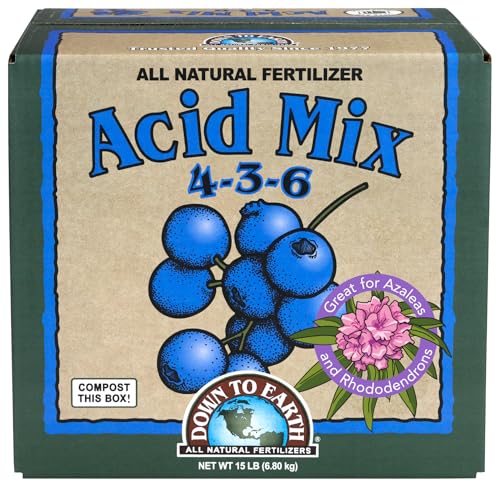
A 15-pound bag of down-to-earth, all-natural granules that feeds your maple and every other acid lover.
Down To Earth’s Acid Mix is the broad-spectrum organic option for a yard that has more than just a Japanese maple. The 4-3-6 formulation is blended for acid-loving plants like blueberries, raspberries, azaleas, camellias, and hydrangeas. If you have a mixed border, one bag does it all. The slow-release formula provides a steady supply of nutrients over time, which reduces how often you need to reapply.
Blueberry growers are the most vocal fans, reporting healthier plants and higher fruit production. The all-natural ingredients mean you can use it anywhere without worrying about synthetic salt buildup in the root zone. Fall applications help promote root growth and boost winter hardiness, which is a nice extra for maples in colder zones.
The bag is 15 pounds, which is heavy and requires storage space. A few owners note that the box and plastic inner bag are durable but should be kept off a wet floor to avoid moisture damage. The smell is earthy but mild — noticeable only when you are close to the pile.
Organic choice: you have a half-dozen acid-loving plants sharing the same bed. One bag feeds them all.
Fast acting: your only tree is a single small Japanese maple in a pot — 15 pounds will take years to use.
6. TPS Nutrients Japanese Maple Fertilizer – Liquid Plant Food, 1 Gallon
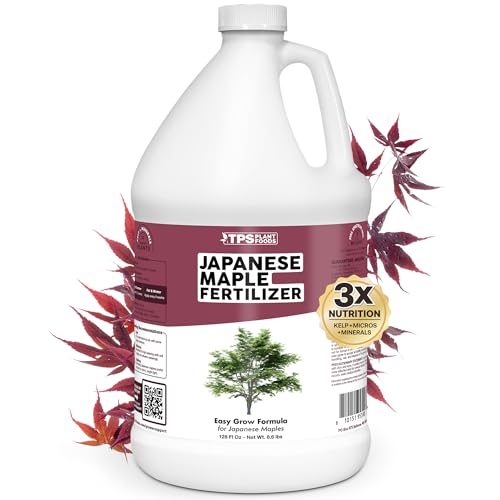
A 1-gallon liquid feed designed to boost leaf vibrancy and root strength in weeks, not months.
The TPS Nutrients liquid fertilizer is the one you turn to when your Japanese maple looks pale, the leaves have lost their red edge, or you just want to see a response fast. Customers note that within two weeks of the first application, the foliage turns visibly more vibrant and the tree pushes out new growth. One dwarf maple owner used it to save a 20-year-old tree that had “burnt-looking leaves” — after a few doses, the tree was doing wonderfully again.
Liquid feeding gives you precision. You can adjust the concentration and frequency to match the tree’s exact needs. The 128-ounce bottle covers a full growing season for most single trees, and the product is made in the USA. Because it is water-soluble, the nutrients reach the root zone instantly, which is helpful for a tree that is already stressed or showing signs of deficiency.
The downside is the same as any liquid fertilizer: you have to mix and water on a regular schedule. The bottle is large, and a few Amazon deliveries arrived without the lid fully secured, which can cause spills. A couple of buyers mentioned it is an “awesome product” but the packaging at the warehouse needs better attention.
Quick uptake: a quick revival — if your maple has lost color, has burnt-looking leaves, or has not pushed new growth in a full year.
Low maintenance: you prefer a granular feed you can forget about for months; liquid requires your calendar.
7. Down To Earth All Natural Fertilizers Organic Acid Mix, 25 lb
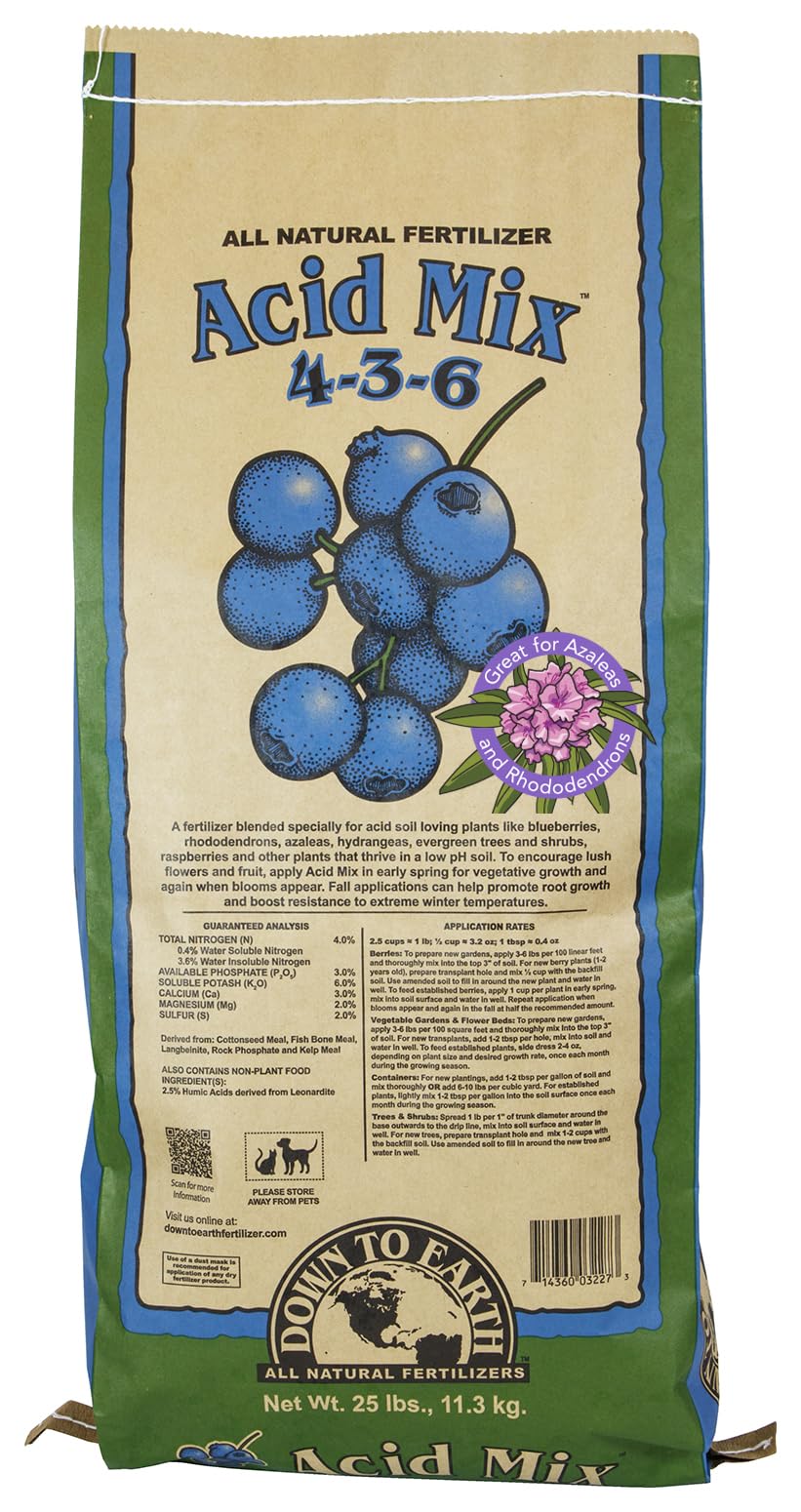
A 25-pound bag of the same 4-3-6 acid mix for properties with multiple trees and beds.
This is the larger sibling of the 15-pound Down To Earth Acid Mix, and the math is simple: if you have multiple maples, a row of blueberries, and a rhododendron hedge, the 25-pound bag saves you from reordering mid-season. The 4-3-6 formulation (4% nitrogen, 3% phosphorus, 6% potassium) is identical — blended from cottonseed meal, langbeinite, fish bone meal, rock phosphate, humates, and kelp meal. The slow-release nature means you apply it in early spring for vegetative growth and again when blooms appear, or in the fall to help root development and winter hardiness.
Long-term buyers of this bag report using it for years on their berry bushes and rhododendrons. One owner describes feeding “Rodys, raspberry plants, and 8 blueberry bushes” and notes the larger bag is cheaper per pound and lasts a couple of seasons. Another reviewer revived TopHat blueberries in 5-gallon buckets that had stopped growing — after two weeks, the leaves were healthier, with new growth appearing across the plant.
The weight is the main consideration here. 25 pounds of granular material requires dry, dedicated storage. The bag is sturdy, but if left on a wet garage floor, the granules can clump or the paper exterior can deteriorate over time.
Garden quantity: the established gardener with several acid-loving trees and shrubs. The cost-per-pound is the most efficient in this guide.
Small spaces: you own one small maple — you will be storing 24 pounds of excess fertilizer for years.
Understanding the Specs
N-P-K Ratio
The three numbers on a fertilizer bag stand for nitrogen, phosphorus, and potassium — the primary nutrients every plant needs. For Japanese maples, a lower first number (around 4 to 6) is safest because too much nitrogen forces tender green shoots that can sunburn or frost-damage easily. The second number (phosphorus) supports root and branch strength, and the third (potassium) boosts overall health and disease resistance. A ratio like 4-3-4 or 4-3-6 is the balance for these slow-growing ornamentals.
Slow Release vs. Quick Release
Slow-release fertilizers (spikes and some granules) meter out nutrients over weeks or months. That keeps the root zone’s chemistry stable and reduces the chance of salt burn. Quick-release liquid fertilizers deliver nutrients immediately — useful for a tree that is visibly struggling, but risky if over-applied. The general rule: established in-ground maples do best with slow-release; a stressed or container tree may need the fast boost of a liquid feed.
Soil Microbes and Mycorrhizae
Some fertilizers include beneficial bacteria and mycorrhizal fungi. These microorganisms attach to the root system and effectively expand its reach, helping the tree absorb water and nutrients more efficiently. This is particularly helpful in compacted or container soils where the root system is limited. It is an extra benefit that reduces how often you need to fertilize because the tree is making better use of what is already there.
Form Factor: Spikes, Granules, Liquid
Spikes are the lowest-effort — hammer them into the soil at the drip line twice a year. Granules give you spread control and work well for mixed beds. Liquids require monthly mixing but produce the fastest visual response. Your choice depends on how many plants you are feeding and how much time you want to spend. For a single maple in a pot, liquid or small granules work best. For a row of trees in the ground, spikes or a large granular bag are more practical.
FAQ
Can I use a general-purpose fertilizer on my Japanese maple?
When should I fertilize my Japanese maple each year?
How do spikes compare to granular fertilizer for a Japanese maple?
Will a liquid fertilizer burn my Japanese maple roots?
Do I need to check my soil pH before buying a fertilizer?
How much fertilizer should I use on a young Japanese maple?
What is the difference between the Down To Earth 15 lb and 25 lb bags?
Are organic fertilizers really better for Japanese maples?
What do the numbers 4-3-4 or 4-3-6 mean on a bag?
Can I use Jobe’s 16-4-4 spikes on a dwarf Japanese maple in a pot?
Final Thoughts: The Verdict
If you want a single bag that combines proven growth results, beneficial soil microbes, and a gentle 4-3-4 ratio built for Japanese maples, the FoxFarm Happy Frog Japanese Maple Fertilizer is the strongest all-around pick. It has the owner stories to back it up — 7-foot trees from 1-foot starts — and the formula feeds the soil as much as the tree. If you prefer the simplest routine, the Jobe’s Slow Release Tree and Shrub Spikes let you fertilize twice a year with zero mixing; just watch the nitrogen level for young or dwarf trees. And for a yard full of acid-loving plants where the maple is one among many, the Down To Earth Acid Mix 15 lb offers the most efficient cost per pound with a proven organic formulation.
How We Picked
We do not accept paid placement. Every pick is matched to a real buyer and a real use-case; we do not hands-on test units.
Sources & Methodology
Specifications: manufacturer listings and product documentation. Review insights: verified customer reviews, as of July 2026. Pricing: not shown on this page (it changes often); check the current price via the retailer link.
As an Amazon Associate, Lawn Gear Lab earns from qualifying purchases. This does not affect which products we feature.