
Specs are compiled from manufacturer listings and verified buyer reviews and can change over time — please confirm the key details on the product page before buying.
Pulling weeds from a flower bed or gravel path feels like a game you can never win. Landscape fabric blocks sunlight so seeds never germinate, while still letting water and air reach the soil beneath. The challenge is sorting the fabrics that hold up for years from the ones that tear, fray, or let weeds sneak through in a single season.
I’m Rikta — the founder and writer behind Lawn Gear Lab. This guide is built by comparing the manufacturers’ published specifications and the patterns across verified customer reviews, so you get each pick’s real strengths and trade-offs instead of marketing spin.
You want to stop weeds from sprouting through your mulch or gravel without turning your soil into a swamp. Here is the honest breakdown of the best landscape fabric weed barrier options that block sunlight but still let water and air reach your plant roots.
Our Picks at a Glance

How To Choose The Best Landscape Fabric Weed Barrier
The numbers (3.2 oz, 5 oz, 8 oz) tell you the fabric weight per square yard — heavier means tougher. “Woven” fabrics are made like a plastic mesh (strong but can fray), while “non-woven” fabrics are felt-like (great for filtering water). “Geotextile” is just the engineering term for any fabric used in soil. Here is how to match the right type to your project — garden bed, gravel path, or drainage trench.
Fabric Weight and Durability
The ounce rating tells you how much the fabric weighs per square yard. A 3.2oz fabric is a solid middle-ground pick for most flower beds and mulched areas — it blocks light well but stays permeable enough for water. If you are putting fabric under gravel for a driveway or a path that gets foot traffic and wheelbarrows, stepping up to a 5oz or even 8oz fabric gives you much better puncture resistance and a longer life. The heavier the fabric, the harder it is for weed roots and sharp rocks to push through.
Woven vs Non-Woven Construction
A woven fabric is made of polypropylene strands crisscrossed like a basket. It feels like a thin, flexible tarp and is the standard choice for weed control and soil stabilization because it is strong and lets water pass through the weave itself. Non-woven fabric looks and feels more like felt — it is made of fibers bonded together with heat or needles. It offers excellent filtration (great for french drains and drainage projects because it stops soil from washing through while letting water flow), but it is usually less tear-resistant than woven fabric for general landscaping.
Water Permeability and UV Stabilization
You want a fabric that blocks sunlight for weed control but does not trap water against the soil. A good fabric will have a permeability rate listed in liters per square meter per second (L/m²/s) — a rate like 10-20 L/m²/s means the fabric drains freely and your plants’ roots can breathe. UV stabilization is equally important: fabrics that are not UV-stabilized can become brittle and crack after a season or two in direct sun, so look for fabrics specifically labeled for long-term outdoor exposure if your project is not completely covered by mulch or gravel.
Quick Comparison
| Model | Best For | Weight | Size | Construction | Amazon |
|---|---|---|---|---|---|
| VIVOSUN Premium 3ftx50ft★ Best Overall | Overall Champion | 5 oz | 3 ft x 50 ft | Dual-Layer (Woven + Non-Woven) | Amazon |
| CFTEL 3x100FTBudget Champion | Budget Value | 3.2 oz | 3 ft x 100 ft | Woven Polypropylene | Amazon |
| Rohuis 4ft x 100ftBest Coverage | Coverage per Dollar | 3.2 oz | 4 ft x 100 ft | Woven Polypropylene | Amazon |
| VEVOR 3ft x 100ft 8 oz | Heavy-Duty Drainage | 8 oz | 3 ft x 100 ft | Non-Woven Needle Punched | Amazon |
| GRASSCLUB 3ft x 300ft | Massive Coverage | 3.2 oz | 3 ft x 300 ft | Woven Polypropylene | Amazon |
| Rintea 4FTX300FT | Large Area Premium | 3.2 oz | 4 ft x 300 ft | Woven Polypropylene | Amazon |
| Vanver 4ftx300ft | Value Jumbo Roll | 3.2 oz | 4 ft x 300 ft | Woven Polypropylene | Amazon |
| VEVOR 13x115FT | Giant Area | 3.5 oz | 13 ft x 115 ft | Woven Polypropylene | Amazon |
In‑Depth Reviews
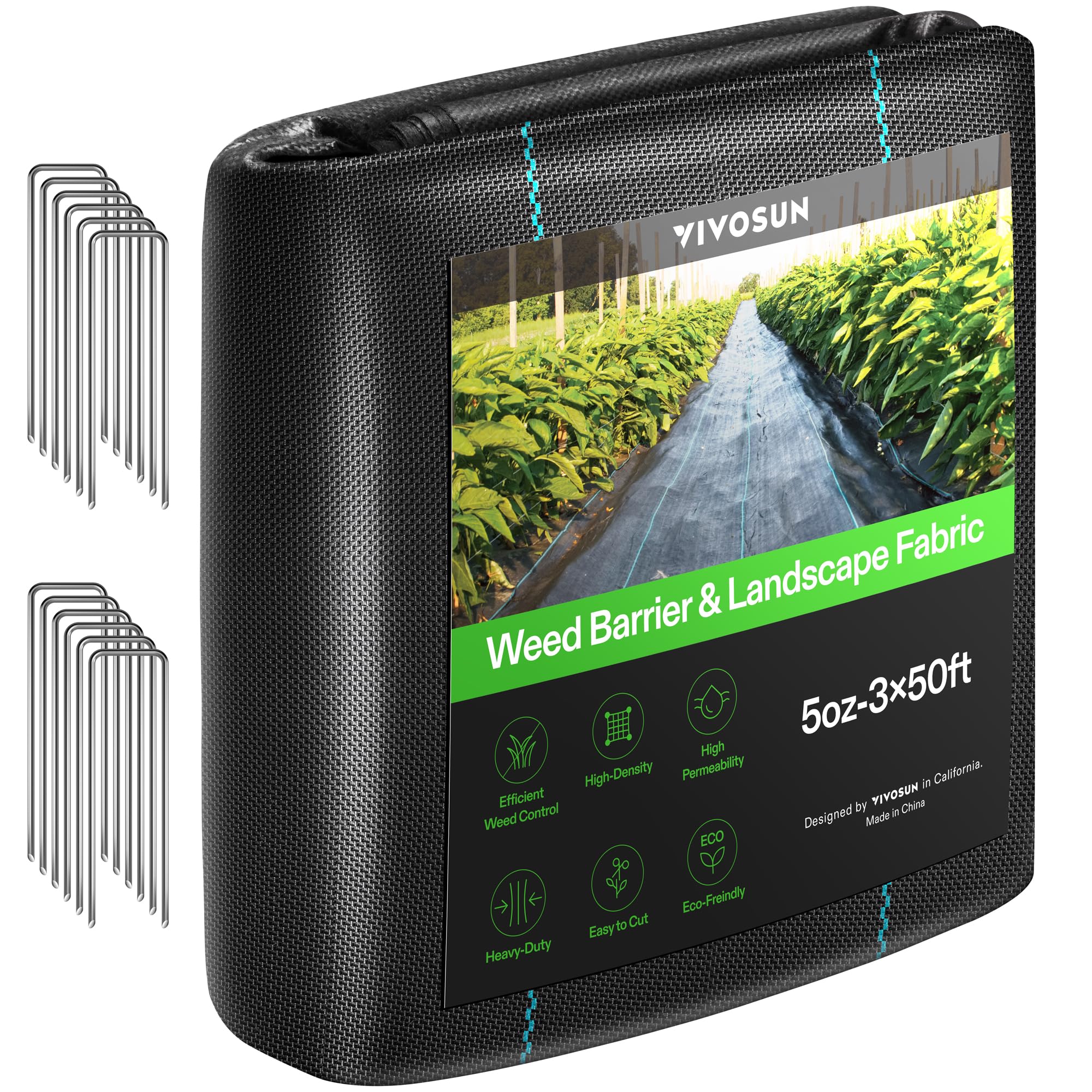
1. VIVOSUN Premium Weed Barrier Landscape Fabric Heavy Duty 3ftx50ft
Our pick — over 4.5★ from 900+ verified ratings; the strongest balance of quality and price.
This is the weed barrier that actually earns its “heavy-duty” label with a smart dual-layer design.
What wins people over is the build quality — 76 owners single out the sturdy feel. The VIVOSUN uses a 5 oz needle-punched construction that combines a non-woven layer on the bottom with a woven top layer. The woven side has small holes, and the non-woven fibers underneath act like tiny wicks, pulling water down through molecular attraction. That means your plant roots get plenty of air and moisture without the surface staying soggy. The brand claims water permeability is 6 times higher than traditional woven ground covers, so even heavy rain drains fast.
A smart touch is the green line guides printed every foot across the roll, making plant spacing a simple visual task. The 3 ft x 50 ft size is practical for smaller to medium beds. Many buyers mention the fabric holds up well to daily foot traffic in garden paths, and the material resists fraying better at the cut edges than standard woven fabrics. The only recurring note is that the cut edges can still unravel somewhat — a quick pass with a lighter or heat source on the cut line solves that.
What wins people over
- 5 oz dual-layer construction feels noticeably sturdier than standard 3.2 oz fabrics
- Water drains 6 times faster than traditional woven covers, keeping soil healthy
- Green line guides make plant alignment simple and fast
- Holds up to foot traffic and wheelbarrows without tearing
The honest trade-off
- Cut edges can unravel — plan to seal them with a heat pass for a clean finish
- The 50-foot length covers less area than the jumbo rolls offered by other brands
Your best bet if: you want a premium fabric that balances weed blocking strength with root-friendly water flow for flower beds and vegetable gardens.
Think twice if: you need to cover hundreds of feet — the 50-foot roll means more joins for larger projects.
2. CFTEL 3x100FT Weed Barrier Landscape Fabric Heavy Duty 3.2oz
A 100-foot roll that keeps the cost low without skimping on the basics that make a fabric useful.
The 3.2 oz woven polypropylene construction is the industry standard for general landscaping — thick enough to block sunlight effectively, but open enough to let rain soak straight through. The CFTEL fabric is built with a high tensile strength and resists tearing during installation. Buyers repeatedly mention that it is “thick, breathable fabric blocks sunlight and allows water drainage” — exactly the combination you want. It stops weeds from germinating while keeping your soil from turning into a dry, compacted layer.
At 5.94 pounds for the whole roll, the fabric is light enough to handle and position alone. The 3-foot width and 100-foot length give you good coverage for a series of raised beds or a long gravel path without needing to seam multiple small rolls together. Owners note the material is easy to cut with scissors — you just unroll, trim, and pin. The honest trade-off mentioned in the reviews is that the material quality feels more like plastic than traditional cloth to some hands. It works perfectly for its purpose, but it does not have the premium “fabric” handfeel of a heavier, needle-punched roll like the VIVOSUN above. It is a fantastic gateway into better landscaping for a very accessible spend.
A reliable, no-fuss roll: picks up where flimsy hardware-store fabrics fall short — cuts clean, blocks light, and drains water without fuss.
Reach for this if: your project calls for a long, inexpensive roll — it covers three 4×8 beds with leftovers to spare.
Consider another pick if: you are laying fabric under heavy gravel for a driveway — a 3.2oz woven will work, but an 8oz non-woven offers better puncture resistance.
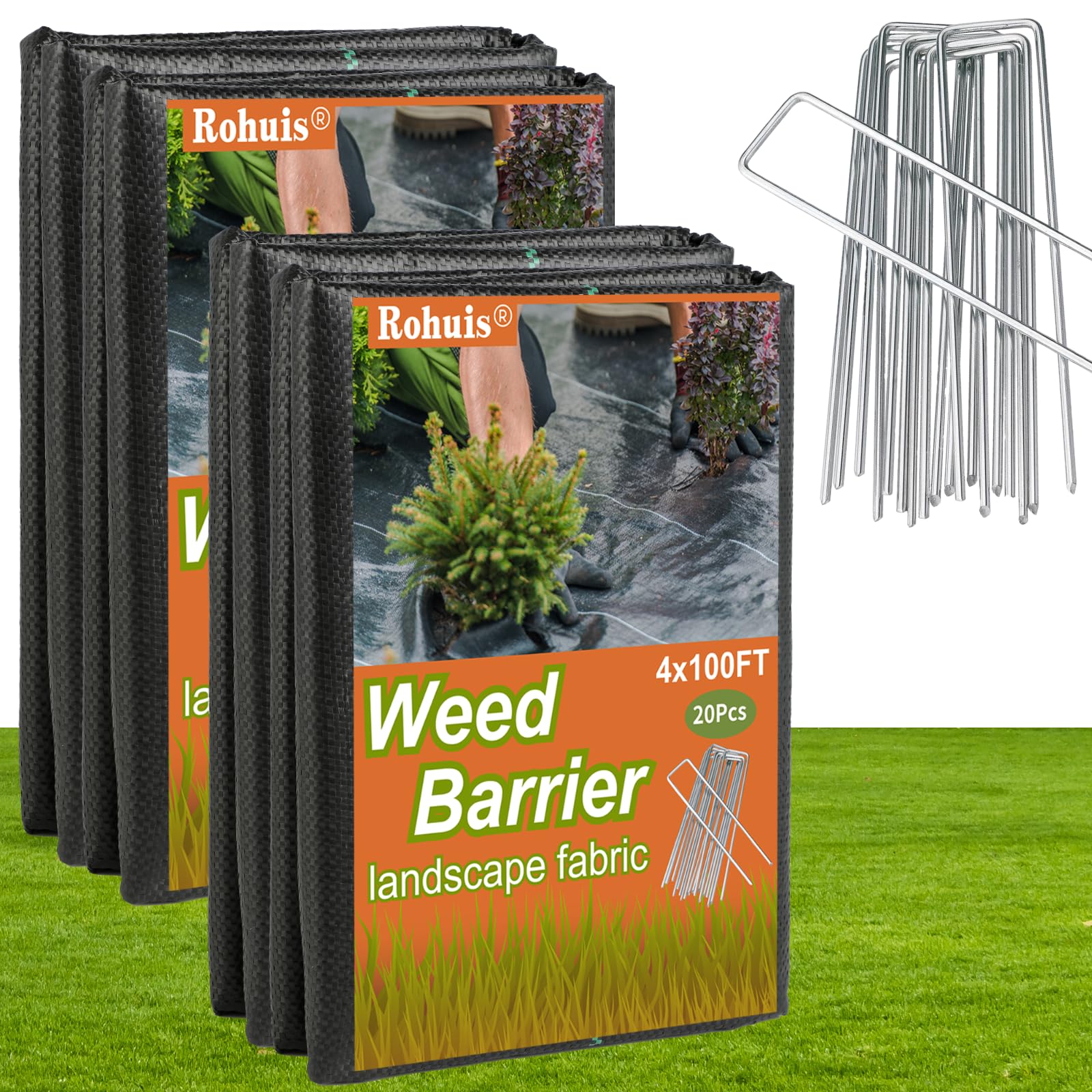
3. Rohuis Weed Barrier Landscape Fabric 4ft x 100ft Geotextile Fabric Mulch Mat
A 4-foot-wide roll that lays down fast over wide beds and gravel paths, and it comes with 20 ground pins to hold it all in place.
The extra width is the headline here — 4 ft as opposed to the standard 3 ft means you cover 4 ft of ground per strip instead of 3 ft of ground per strip, which cuts down on the number of seam overlaps you need to manage. The 3.2 oz woven polypropylene is UV-stabilized to resist degradation from harsh sunlight, and the manufacturer rates it for 5+ years of reliable service. The fabric lets water pass at a rate of 10-20 L/m²/s, which is in the excellent zone for garden beds — your soil stays hydrated without the fabric turning into a pool liner.
Owners note that the weed resistance is strong — 20 buyers mention it positively. The fabric has held back nearly all foliage for over two years in one reviewer’s experience. The included 20 U-shaped pegs are a nice touch, though several owners mention wishing more were included for bigger projects. The main practical catch is that the fabric can shred a bit at the cut lines if you are not careful, leaving small plastic debris. Using sharp scissors and sliding a straightedge under the cut line helps dramatically. The fabric also has an initial smell that dissipates — nothing unusual for a new polypropylene roll. At 6.96 pounds, it is a shade heavier than the CFTEL equivalent despite being the same ounce rating, which likely reflects the denser weave and UV stabilization.
Compared to the CFTEL above: the Rohuis gives you that 4-foot width advantage and the included pins, making it the better pick if you want faster installation and a more complete starter kit.
Grab this for: building out a new garden bed section — that extra foot of width lets you straddle a 4×8 bed in one pass with minimal overlap.
skip it if: you need the lowest upfront cost — the CFTEL roll is the leaner budget option.
4. VEVOR Geotextile Landscape 3ft x 100ft 8 oz Non-Woven PP Drainage

At 8 oz with a 350N tensile strength, this is the serious stuff for drainage projects and heavy-duty ground stabilization.
Unlike the woven fabrics above, the VEVOR is a non-woven needle-punched geotextile. That means it is made of polypropylene fibers that are mechanically tangled together, which creates a felt-like material that excels at filtration. Its job is not just to block weeds — it is designed to let water pass through freely while stopping soil particles from washing into your gravel drainage trench. The specs back that up: 350N tensile strength and 440 N load capacity, so it can handle the weight of retaining wall stone or heavy gravel without tearing.
Quality and durability are the standout aspects, with 72 and 64 mentions of each. The fabric thickness gets mixed reactions — some owners find it delightfully thick, while others were expecting something closer to carpet padding. The reality is that an 8 oz non-woven is thicker and softer than a woven fabric, but it is not rigid. It works perfectly for its intended use — as a filter layer behind a retaining wall, as a french drain wrap, or as a rugged weed barrier under pathways with heavy foot traffic. A flower farmer uses it in new beds and notes “nothing is growing through this.” It is heavier and harder to cut than woven fabric, and you will want a sharp utility knife and a straightedge rather than scissors.
If you are comparing this to standard garden fabrics: skip it for a simple mulch bed (the woven options are cheaper and easier) but reach for it when the project involves gravel, drainage, or load-bearing ground.
Use this when: you are building a french drain, a retaining wall, or a gravel driveway that needs a true geotextile underlayment — nothing in this list filters better.
Pass on it for: a simple flower bed where a woven fabric is cheaper, easier to cut, and works just as well for weed blocking.
5. GRASSCLUB 3ft x 300ft Weed Barrier Landscape Fabric Heavy Duty

Three hundred feet of 3.2 oz fabric means one roll can handle a massive yard or project without a single splice.
The GRASSCLUB delivers 900 square feet of coverage from a single 3 ft x 300 ft roll. That is enough to run the length of a long gravel driveway or cover a large vegetable garden with room to spare. The fabric is 3.2 oz woven polypropylene with an advertised 400 lbs tensile strength — enough to stabilize soil under gravel or stone. It is designed to be eco-friendly, helping to prevent soil erosion while allowing moisture and air to circulate.
The fabric unrolls easily and stakes down without resistance. The long, heavy roll weighs 13.77 pounds, so you will want a second pair of hands or a hand truck to move it from the driveway to the yard. The main thing to be aware of — and this applies to all the 300-foot rolls — is that the sheer length makes precise cutting more important. A mis-cut wastes a lot of fabric, so measure twice before cutting.
The honest trade-off for this much fabric: at 3.2 oz it is a standard mid-weight cloth, not an 8 oz geotextile, so do not expect it to stop aggressive rhizome weeds like bamboo or mint on its own.
Perfect for: big projects — a long driveway, a sprawling flower bed network, or a community garden where one roll does the whole job.
Overkill if: you are just freshening up a single 4×8 bed — the VIVOSUN 50-footer is easier to handle and stores away smaller.
6. Rintea 4FTX300FT Weed Barrier Fabric, 3.2oz Landscape Fabric

A full 4-foot width by 300 feet, plus 20 U-shaped pegs, for a massive, ready-to-lay ground cover solution.
Rintea’s 3.2 oz woven polypropylene fabric combines both width and length to cover a staggering 1,200 square feet per roll. That is roughly the size of a large suburban driveway. The included 20 pegs help get the job started immediately. Buyers describe it as “thick and sturdy” and note that “weeds won’t penetrate this.” The fabric allows water and nutrients to flow through to the soil, keeping plants healthy while stopping unwanted growth. The green guide lines on the fabric make plant alignment fast, and the material is easy to cut with regular scissors.
The roll is heavy at 23.1 pounds, so moving it around on your own is a two-step process — unroll it where you need it or recruit a helper. The manufacturer recommends burning the cut edges after cutting to prevent fraying, which is a common suggestion for woven fabrics. Most owners find the fabric holds up well under foot traffic and even wheelbarrow loads of mulch. The honest mixed feedback is around the material feel — some owners find it to be decent, while others feel it is not what they expected as “fabric.” That is typical for a polypropylene woven, which feels more like a plastic mesh than a soft textile.
Where it shines: covering a large, continuous area — a long gravel path, a wide rock bed, or a big flower border — where fewer seams mean fewer weak points.
Buy it for: the sheer volume — at 4×300 ft you can do what would take multiple smaller rolls from other brands, saving time on joining seams.
Better to avoid if: you are working in a tight, small garden — handling a 300-foot roll in a 10×10 space is awkward and wasteful.
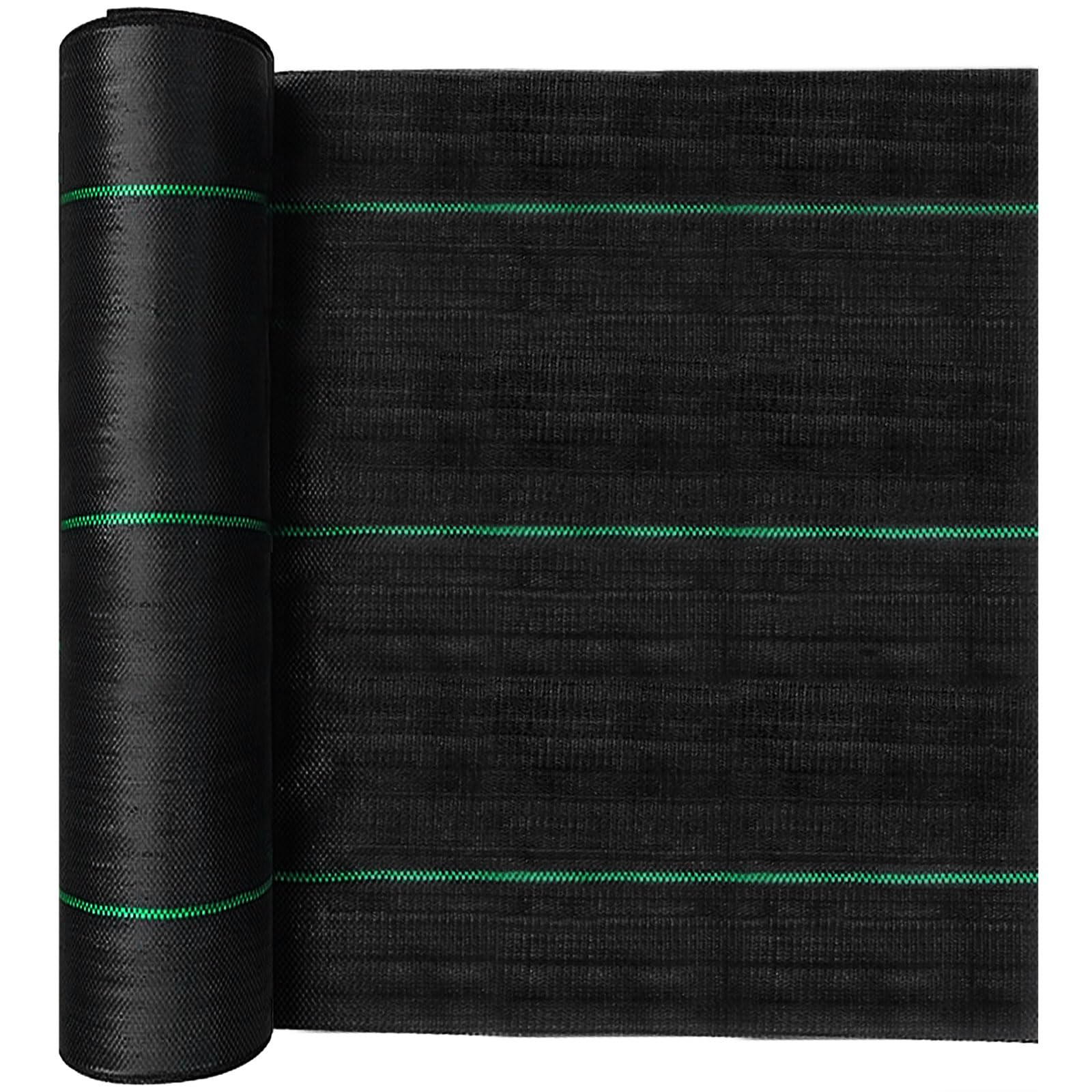
7. Vanver 4ftx300ft Garden Landscape Fabric Weed Barrier
Another big 4×300 roll that focuses on keeping the price aggressive while still delivering solid weed control performance.
The Vanver uses the same foundational 3.2 oz heavy-duty woven polypropylene as the Rintea above, but at a lower entry spend. The fabric includes an anti-aging material to extend its lifespan under sun exposure, which is a useful addition for uncovered applications. It is a 100% polypropylene fabric woven in warp and weft — the classic basketweave construction that allows a slow exchange of air, water, and nutrients while blocking light. Functionality is the highest praise from owners, with 27 positive mentions.
The roll is heavy (25.3 pounds), and the material is well-suited for use under decomposed granite, river rock, mulch, or in raised beds. Buyers often contrast it with the big-box store brands, saying “this would cost 3X as much at Home Depot.” The most recurring note is that the fabric is effective — it kept weeds at bay through an entire summer for one reviewer. The mixed feedback focuses on the material feel (plastic vs fabric) and thickness (some find it thick enough, others want more). Like any woven fabric, cut edges can fray — scissors work better than a knife for clean lines, and a heat source seals the edge.
How it differs from the Rintea: the Vanver is more of a pure value play — the same specs and a similar quantity of fabric, but usually offered at a slightly lower spend, making it the choice if your budget is the main constraint on a big area.
Pick this if: you need to cover a very large area and the priority is maximum coverage for your budget — the fabric itself is perfectly capable for standard weed blocking.
Think twice if: you want a premium-feel fabric and the assurance of the best possible UV resistance — the VIVOSUN 5 oz dual-layer is the more sturdy product.
8. VEVOR 13x115FT 3.5oz Weed Barrier Fabric Heavy Duty
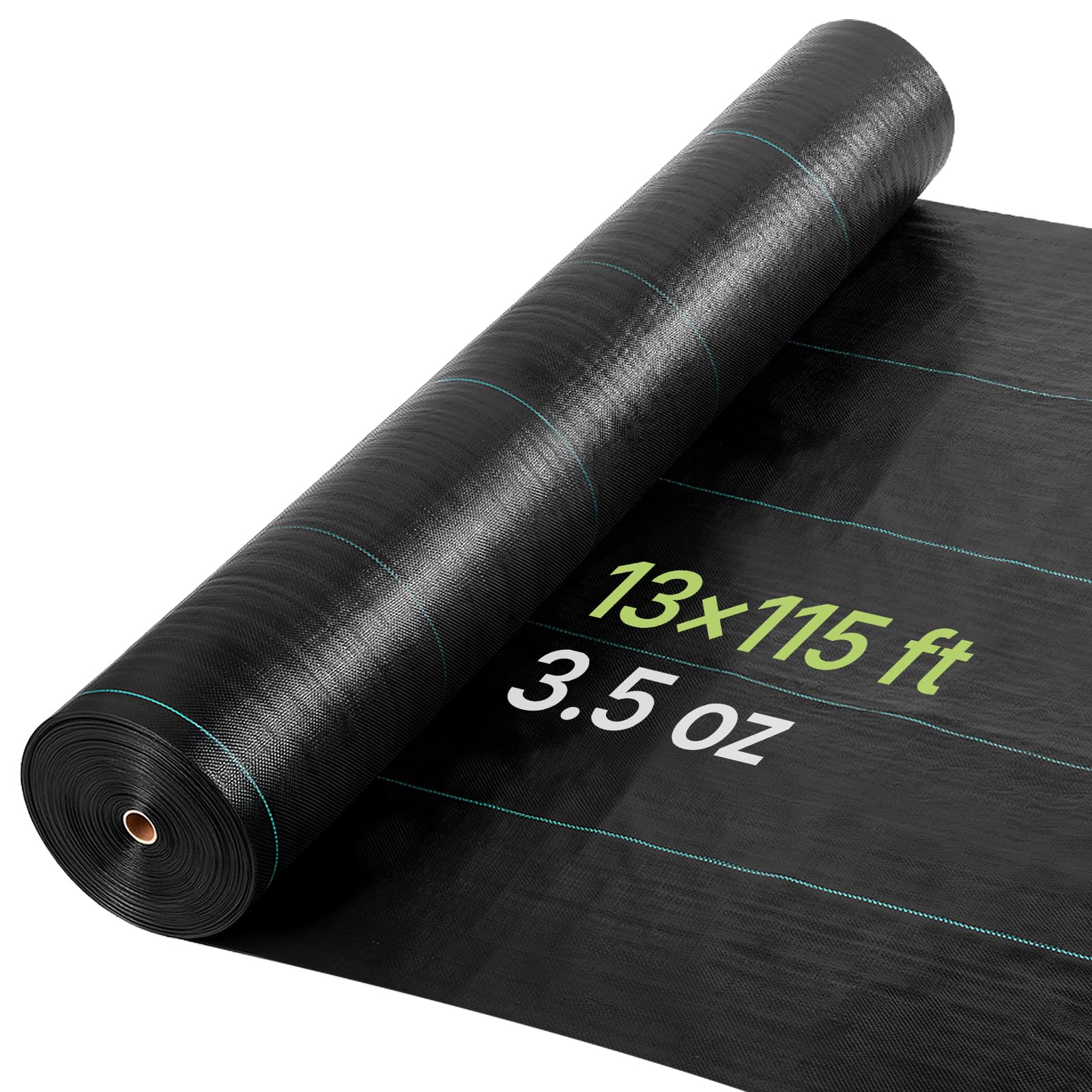
A massive 13-foot-wide sheet that covers nearly 1,500 square feet — the only pick here that truly spans the width of a driveway in one piece.
Everything about the VEVOR is big. The 3.5 oz weight sits just above the typical 3.2 oz standard, giving it a denser weave and a slightly higher level of weed root penetration resistance. The fabric is woven polypropylene with a dense structure designed to stay stable under gravel, stones, or high-pressure outdoor surfaces. The size is the primary use case: at 13 ft wide and 115 ft long, it covers about 1,495 ft². That makes it an ideal choice for a standard two-car driveway, a large vegetable farm row, or a greenhouse floor where you want a single sheet with zero seams.
Weed resistance and quality top the positive feedback (50 and 49 mentions each). One owner calls it “my forever” landscape fabric, saying that after cutting slits and adding hay on top, “no maintenance needed” and their vegetables “produced abundantly.” The fabric handles sun exposure, rainfall, and snow melt without cracking or deforming. It includes green guidelines for plant alignment. The main practical catch is that the fabric ravels into long streamers when cut into narrow rows, which can then tangle in the wind. For large, open areas it sits flat and stays put with just a few pins. At 30.9 pounds, the roll is the heaviest in the roundup — definitely a two-person lift or a cart job.
What it does best
- class-leading 13-foot width eliminates the need for multiple seams on wide driveways and large beds
- 3.5 oz density provides a small edge in puncture resistance over standard 3.2 oz fabrics
- Stays flat under wind and weather with minimal pinning on open areas
- Effective weed control that one owner describes as “my forever” fabric after a full season of use
What to watch for
- Cutting into narrow rows causes heavy raveling — plan for full-sheet or wide-sheet installations
- At 30.9 pounds, handling the roll solo is a real challenge
This is the right pick for: a long driveway, a large greenhouse, or a big vegetable plot where a single, seam-free sheet saves you hours of overlap work.
Look elsewhere if: your project is narrow rows — this fabric is at its best in wide-open spaces, and the raveling in narrow strips is a genuine annoyance.
Understanding the Specs
Fabric Weight (oz)
This is the number that tells you the density of the fabric per square yard. A higher number (like 5 oz or 8 oz) means a thicker, heavier cloth that resists punctures and blocks more light. A 3.2 oz fabric is the standard weight for most home garden and path applications — it is strong enough to stop weeds and let water through, but light enough to cut and handle easily.
Water Permeability (L/m²/s)
This measures how fast water drains through the fabric. A fabric with high permeability (like 10-20 L/m²/s) lets rain and irrigation pass freely, which prevents puddling and helps your plant roots breathe. If the permeability is too low, water pools on top of the fabric and can lead to root rot in your garden beds.
FAQ
Can I lay landscape fabric directly over existing weeds?
Which side of the fabric faces up — woven or fuzzy?
Will landscape fabric hurt my plants?
How long does landscape fabric last outside?
Can I use landscape fabric under gravel for a driveway?
Does weed barrier fabric let water through?
What is the difference between woven and non-woven landscape fabric?
Can I walk on landscape fabric after it is installed?
Final Thoughts: The Verdict
For the majority of shoppers, the landscape fabric weed barrier winner is the VIVOSUN Premium because its 5 oz dual-layer construction strikes the best balance between weed blocking, water flow, and long-term durability — and the crowd — with a strong 4.6-star consensus among nearly a thousand owners — backs that up. If you are covering massive, open areas where seams are your enemy, grab the VEVOR 13x115FT for its single-sheet coverage. And for hardcore drainage projects like french drains and retaining walls, the VEVOR 8 oz non-woven is the filtration specialist you need.
How We Picked
We do not accept paid placement. Every pick is matched to a real buyer and a real use-case; we do not hands-on test units.
Sources & Methodology
Specifications: manufacturer listings and product documentation. Review insights: verified customer reviews, as of July 2026. Pricing: not shown on this page (it changes often); check the current price via the retailer link.
As an Amazon Associate, Lawn Gear Lab earns from qualifying purchases. This does not affect which products we feature.