
Specs are compiled from manufacturer listings and verified buyer reviews and can change over time — please confirm the key details on the product page before buying.
You walk out to your cabbage patch one morning, and the leaves look like lace. Tiny green worms — cabbage loopers, imported cabbageworms — are shredding your hard work overnight. The right spray stops them dead without poisoning your dinner plate, but the wrong choice wastes time while they keep eating. This guide cuts through the noise to the five sprays proven to work.
I’m Rikta — the founder and writer behind Lawn Gear Lab. This guide is built by comparing the manufacturers’ published specifications and the patterns across verified customer reviews, so you get each pick’s real strengths and trade-offs instead of marketing spin.
Here is exactly what works for every garden size, every budget, and every philosophy — your honest shortlist for the best insecticidal soap for cabbage worms, backed by what real buyers have learned through a full season of spraying.
Our Picks at a Glance

How To Choose The Best Insecticidal Soap For Cabbage Worms
Not all sprays work the same way, and using the wrong type on cabbage worms is like bringing a water pistol to a fire. You need to match the active ingredient to your garden size and how hands-on you want to be.
Contact Kill vs. Ingestion Kill
Insecticidal soaps (potassium salts of fatty acids) kill on contact — they dissolve the waxy outer layer of soft-bodied pests like aphids and small cabbage worms on the spot. The catch: you have to spray directly onto the worm, and it offers no future protection. Bacteria-based sprays (Bt and Spinosad) must be eaten. The worm chews a treated leaf, stops feeding within hours, and dies a couple of days later. Bt targets only caterpillars and is harmless to bees and ladybugs, making it the go-to for organic growers who want pinpoint precision.
Ready-to-Use vs. Concentrate
A ready-to-use bottle screws onto a trigger sprayer and is instantly in your hand — ideal if you have a few raised beds and want zero mixing, zero mess, and zero measuring errors. A concentrate costs less per treatment and can cover a large vegetable patch or an entire orchard through a hose-end sprayer. The trade-off is you must mix it with water at the correct ratio (typically 2 oz per gallon), so a measuring cup and a clean sprayer are non-negotiable.
Resistance Management: Why You Need Two Sprays
Worm populations can build resistance if you hit them with the same chemistry every time. Smart gardeners keep one Bt-based spray and one Spinosad-based spray on the shelf. Alternate them every second application throughout the growing season. The result: the worms never adapt, and your cabbage stays hole-free without resorting to harsh synthetics. Buyers report that this simple rotation keeps their gardens productive year after year.
Quick Comparison
| Model | Best For | Active Ingredient | Form | Volume | Amazon |
|---|---|---|---|---|---|
| Bonide Captain Jack’s Deadbug Brew★ Best Overall | Heavy infestations & large gardens | Spinosad | Concentrate | 32 oz | Amazon |
| Bonide Captain Jack’s BtBest for Pollinator Safety | Organic growers & bee safety | Bt | Ready-to-Use | 32 oz | Amazon |
| Fertilome Spinosad Soap | Contact + ingestion combo | Spinosad + Soap | Ready-to-Use | 32 oz | Amazon |
| Summit Caterpillar Control | Tree & shrub worm control | Bt | Hose-end Concentrate | 32 oz | Amazon |
| Bonide Insect Soap 3-Pack | Small garden & spot treatment | Potassium Salts | Ready-to-Use | 96 oz (3×32) | Amazon |
In‑Depth Reviews
1. Bonide Captain Jack’s Deadbug Brew, 32 oz Concentrate
Our pick — over 4.5★ from 5,500+ verified ratings; the strongest balance of quality and price.
The Spinosad concentrate that turns a bad infestation into a one-season memory.
This is the heavy hitter. The active ingredient is Spinosad — a naturally occurring soil bacterium that worms ingest when they chew a sprayed leaf. Once inside, the worm stops feeding within minutes and dies over the next couple of days. Owners mention that it “also stopped caterpillars on my desert roses,” which means it covers more than just cabbage worms: bagworms, borers, beetles, codling moth, spider mites, thrips, and leaf miners are all on the kill list. Because it works by ingestion rather than contact, you can spray the foliage thoroughly and let the worms poison themselves.
The concentrate format gives you massive value. At 2 oz per gallon of water, that 32-ounce bottle makes 16 gallons of spray — enough to blanket a large vegetable patch, an orchard, or a flower border multiple times. It mixes instantly with water and works in trigger, hand-held, backpack, or hose-end sprayers. The owner consensus is clear: this is the stuff for the gardener who wants one bottle to handle nearly every chewing pest all season.
The only realistic limit: Spinosad can harm bees if sprayed directly on blooms while they are foraging. Apply in the evening when pollinators have gone home, and you are safe. The label warns not to use it more than six times per season, which is easy to manage if you alternate with a Bt product every other spray.
What wins people over
- Spinosad is a broad-spectrum bacteria that kills cabbage worms, caterpillars, thrips, spider mites, and beetles in one pass.
- 16 gallons of spray from one bottle (2 oz per gallon) means you treat a half-acre without buying refills.
- Approved for organic gardening — no harsh synthetics on your food.
The honest trade-off
- You must mix it with water and have a clean sprayer — not grab-and-go.
- Spray in the evening to protect bees; direct contact on open blooms is a no-go.
Grab it for: the gardener with a large vegetable garden or orchard who wants maximum coverage per dollar and one weapon that handles nearly every chewing pest.
Think twice if: you prefer a grab-and-spray bottle with zero mixing — reach for the ready-to-use Bt instead.
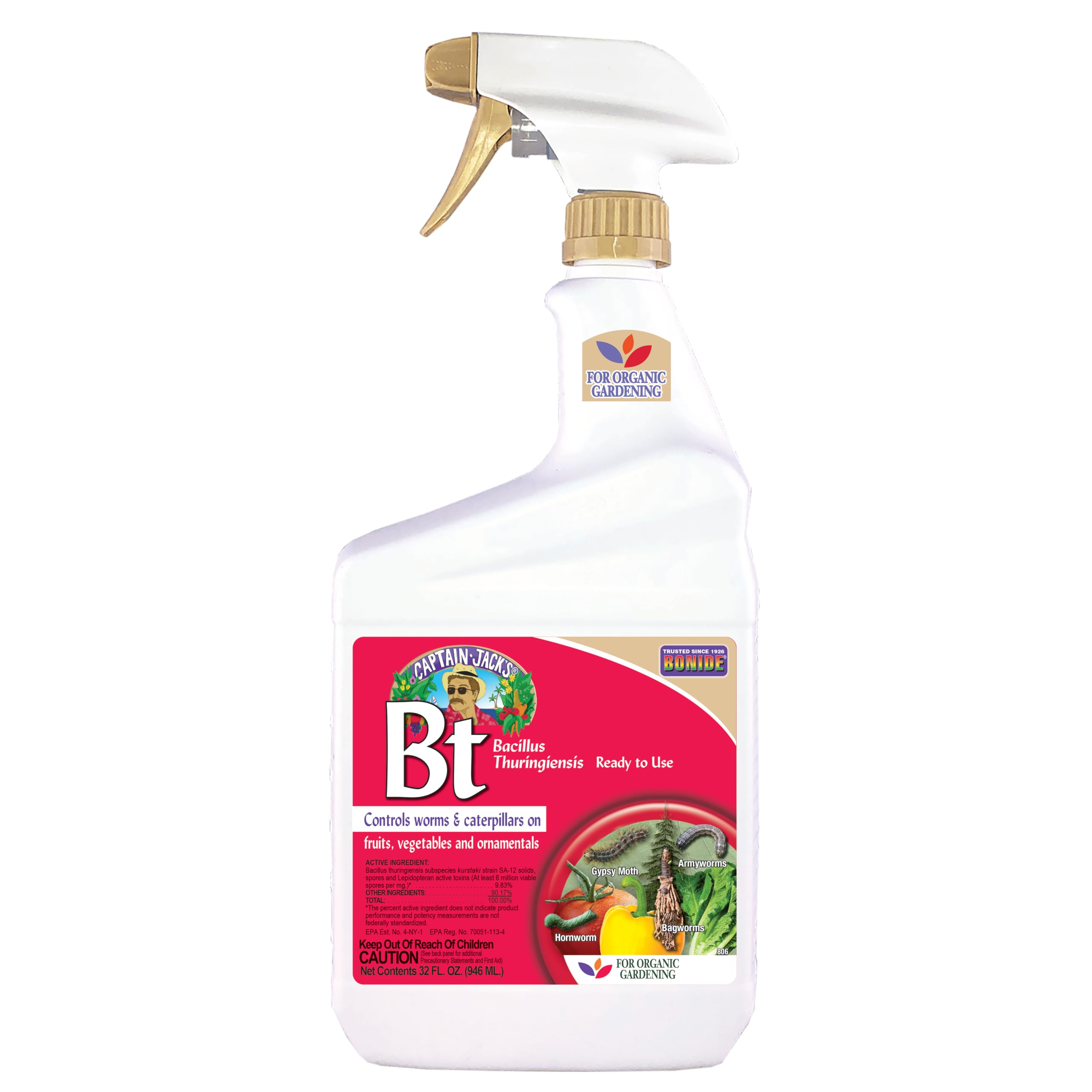
2. Bonide Captain Jack’s Bacillus Thuringiensis BT, 32 oz Ready-to-Use
The caterpillar-only killer that leaves your bees, ladybugs, and earthworms completely alone.
If you grow a pollinator garden alongside your cabbage and broccoli, this is your spray. Bt (Bacillus thuringiensis) is a bacterium that targets only worm and caterpillar-stage insects. When a cabbage looper or hornworm eats a treated leaf, it stops feeding almost immediately and dies within 2-3 days. Honeybees, ladybugs, birds, and earthworms are not affected at all — the bacterium simply does not interact with their biology. The review pages sum it up: “two applications 5 days apart restored decimated petunias” without harming any of the beneficial insects buzzing around.
The ready-to-use trigger sprayer means zero mixing. You unscrew the cap and start spraying. This eliminates measuring errors and makes it the easiest pick for the home gardener with a few raised beds. It covers broccoli, cauliflower, kale, mustard greens, eggplant, pepper, melons, tomatoes, and cabbage — essentially every brassica and fruiting vegetable you likely planted. At 32 oz and 2.3 Pounds, it is slightly heavier than the Deadbug Brew concentrate (2 Pounds), but that weight is all ready-to-use liquid, not concentrated payload.
The fine mist sprayer is a real asset for reaching under leaves where worms hide. Customers note it “noticed less leaf damage within days” of application. Reapply after rain since the bacteria washes off. The only recurring note from owners: Bt has a strong, musty odor. It fades once dry, but you will smell it while spraying.
Why it stands out
- Selective caterpillar control — zero harm to bees, ladybugs, birds, or earthworms.
- Grab-and-spray trigger bottle, no mixing or measuring required.
- Approved for organic gardening and safe to use on vegetables up to harvest day.
One thing to know
- Musty odor during application — it fades quickly once dry but is noticeable while spraying.
- Not instant knockdown; worms die over 2-3 days after they stop feeding.
Best for: the organic grower who needs pinpoint caterpillar control without collateral damage to pollinators or beneficial predators in the garden.
Look elsewhere if: you need to also control aphids, mites, or beetles — Bt targets only caterpillars, so a Spinosad product is a better broad-spectrum match.
3. Fertilome (16076) Spinosad Soap Insecticide Ready to Use, 32 oz
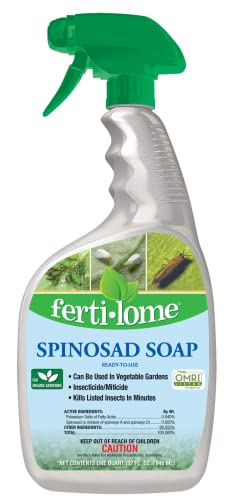
Two modes of attack in one bottle — contact kill from the soap plus ingestion kill from the Spinosad.
This is the only product on the list that combines a true insecticidal soap (Potassium Salts of Fatty Acids 0.940%) with Spinosad (0.005%). The soap kills soft-bodied cabbage worms and aphids on contact the instant the spray hits them. The Spinosad provides the lasting punch — any worm that chews a leaf after the spray dries still ingests the bacteria and dies. This dual action means you see results faster than a stand-alone Bt, and you get a wider target list that includes ants, armyworms, Colorado potato beetles, earwigs, fruit flies, and lace bugs.
OMRI-listed for organic gardening, it comes ready to use in a spray bottle. Reviewers point out it “worked remarkably well – right on contact first use” and that it eliminated caterpillars and beetles on Cleveland pear trees after two applications spaced one week apart. The experience shows it covers four trees and surrounding plants with a single bottle. One owner advises alternating with a separate oil-based spray “due to insect resistance,” which confirms this is a smart rotation tool — hit with the soap + Spinosad one week, switch to a Bt the next.
The 32 oz size is right for small-to-mid gardens. The weight is 32 Ounces (the bottle itself), so it is light enough to carry around the garden with one hand. The formulation is an oil-based liquid, so shake it well before each use and avoid spraying in direct midday sun.
What makes it different
- Potassium salts provide instant contact kill — you see worms drop on the spot.
- Spinosad adds ongoing ingestion protection after the spray dries.
- Very broad target list including Colorado potato beetle, earwigs, and fruit flies.
A consideration
- Because it combines two actives, you should alternate with a Bt product to prevent resistance over a long season.
- Oil-based formula requires thorough shaking before each spray.
Perfect if: you want the instant gratification of contact kill plus the residual protection of Spinosad, all in one ready-to-use bottle — especially for smaller gardens where you see the worms first.
skip it if: you have a very large vegetable patch and want maximum coverage per dollar — the separate concentrate (Deadbug Brew) gives you 16 gallons for less.
4. Summit Caterpillar and Webworm Control-Hose End, 1 Qt Concentrate

A hose-end concentrate that blankets tall trees and sprawling gardens in minutes.
This is for the gardener with scale. Rather than pumping a hand sprayer a hundred times, you screw this quart of Bt concentrate onto your garden hose, turn the dial, and walk the perimeter. The hose-end system automatically mixes the right ratio of concentrate to water as you spray, covering a huge area without fatigue. Shoppers say it saved pine trees covered in bag worms — “killed 2 tree before i ordered this and sprayed all the others down.” That is the kind of rescue you can only pull off with a hose-end applicator when you are facing an infestation across multiple mature trees.
The active ingredient is Bt, so it is the same caterpillar-targeting bacteria as the Bonide ready-to-use above, completely human-safe and safe for birds and pets. One buyer notes it is “perfectly safe to use on veggies up to and including day of harvest. It just paralyzes their digestive system.” The effectiveness earned 49 positive mentions from owners, with safety as the second most-discussed aspect. The bottle weighs 2.2 Pounds and holds 32 fluid ounces of concentrate — a quart that dilutes to many gallons of finished spray.
The honest limit: because it uses a hose-end system, you cannot precisely control spray coverage on individual small plants the way you can with a trigger sprayer. It is best for covering large areas, tall trees, or long rows. For detailed work on a few raised beds, a ready-to-use bottle is more targeted.
The big advantage
- Hose-end system covers huge areas — trees, shrubs, long garden rows — without fatigue.
- Bt active ingredient is completely harmless to humans, birds, and pets; safe up to harvest day.
- Effective against bagworms, webworms, armyworms, tomato hornworms, and cabbage caterpillars.
The trade-off
- Less precise on individual small plants — not ideal for spot-treating a single kale plant.
- Requires a standard garden hose connection, so no spraying from a rain barrel or bucket.
Reach for this if: you have a larger property with multiple trees, long rows of vegetables, or a serious bagworm/webworm problem that needs wide-area coverage fast.
Stick with a trigger sprayer if: you garden in a few raised beds and want to spot-treat individual plants — a ready-to-use Bt gives you better control.
5. Bonide Products INC 912102 652 Ready-to-Use Insect Soap, Quart, 3 Pack
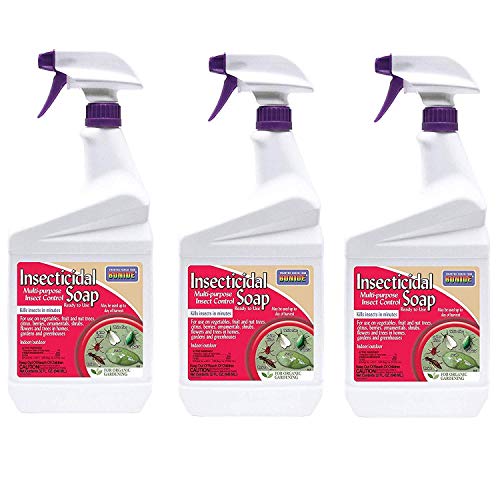
A pure soap that kills on contact — simple, organic, and harmless to the environment by the day of harvest.
This is the purest insecticidal soap on the list. The active ingredient is potassium salts of fatty acids derived from plants — no bacteria, no added chemicals. It kills cabbage worms, aphids, and other soft-bodied pests by breaking down their outer protective layer on contact. There is no ingestion waiting period: if the spray hits the worm, the worm is done. Because the formula does not persist in the environment, you can use it right up to the day of harvest without worrying about residue on your vegetables. Buyers report it “has helped with any bugs on the plants/flowers” and that after a few days of spraying, “the flowers are now lush and gorgeous.”
The 3-pack gives you three 32-ounce quart bottles — 96 total fluid ounces of ready-to-use spray. This is enough to cover a small garden for an entire season if you are spot-treating. The bottles are light and easy to carry, and the trigger sprayer lets you target worms precisely. It contains no flammable solvents and no animal fatty acids, keeping it fully plant-based. The packaging is the one practical downside: owners mention that “ALL 3 of the bottle caps leaked and soaked the box” during shipping, so open the outer box over a sink or tub just in case.
Because it is pure soap with no bacteria, it offers zero residual protection. A new worm can crawl onto a leaf an hour after you spray and feed unaffected. You must stay vigilant and reapply every few days, especially after rain. This is the right product for the gardener who checks their plants daily and wants a gentle, low-toxicity tool.
What you get
- Instant contact kill — no waiting for the worm to eat and digest.
- Three bottles (96 oz total) cover a small garden for a full season of spot treatments.
- Plant-based potassium salts; contains no animal fatty acids or flammable solvents.
What to watch for
- Zero residual protection — new worms can feed an hour after spraying; you must reapply often.
- Bottle caps can leak in transit — open the box carefully over a sink.
Good for: the daily gardener who inspects plants often, wants a gentle organic spray, and is fine with frequent reapplication to keep worms off.
Not for: anyone who wants a “spray and forget” solution — the soap kills only what it hits at that moment, so you cannot skip a week and expect the worms to stay gone.
Understanding the Specs
Spinosad vs. Bt — The Two Bacteria
Both are naturally occurring soil bacteria approved for organic gardening, but they work differently. Spinosad affects the nervous system of a broad range of insects (caterpillars, beetles, thrips, spider mites, leaf miners) and kills within days. Bt (Bacillus thuringiensis) produces a protein crystal that only dissolves in the alkaline gut of caterpillar-stage insects, so it is perfectly selective — it kills only worms and leaves bees, ladybugs, and birds untouched. Pick Spinosad for a broad-spectrum cleanout; pick Bt when protecting pollinators is your top concern.
Contact Kill — Potassium Salts of Fatty Acids
True insecticidal soap uses potassium salts of fatty acids to break down the waxy outer cuticle of soft-bodied pests like aphids, small cabbage worms, and mite nymphs. It works only on direct contact — the spray must hit the pest — and has no residual activity once dry. This makes it the gentlest option for your plants and the environment, but it demands thorough coverage and frequent reapplication. Products that combine soap with Spinosad (like the Fertilome option) give you the instant contact kill plus lasting bacterial protection.
FAQ
Will insecticidal soap kill cabbage worms on contact?
Can I use Bt (Bacillus thuringiensis) and Spinosad together?
How often should I spray for cabbage worms?
Is insecticidal soap safe for bees?
What is the difference between ready-to-use and concentrate?
How long does Bt take to kill cabbage worms?
Can I spray insecticidal soap on the same day I harvest my cabbage?
Why do my cabbage worms keep coming back even after I spray?
Will Spinosad harm earthworms or beneficial soil life?
Final Thoughts: The Verdict
For most gardeners, the insecticidal soap for cabbage worms winner is the Bonide Captain Jack’s Deadbug Brew because Spinosad is the broadest one-bottle solution — it kills cabbage worms, caterpillars, thrips, and beetles with a single concentrate that makes 16 gallons of spray. If you want to protect every bee and ladybug in your garden, grab the Bonide Captain Jack’s Bt for its perfectly selective caterpillar-only action in a grab-and-spray bottle. And for the instant contact kill plus lasting bacterial protection in one ready-to-use bottle, the Fertilome Spinosad Soap is the one to reach for.
How We Picked
We do not accept paid placement. Every pick is matched to a real buyer and a real use-case; we do not hands-on test units.
Sources & Methodology
Specifications: manufacturer listings and product documentation. Review insights: verified customer reviews, as of July 2026. Pricing: not shown on this page (it changes often); check the current price via the retailer link.
As an Amazon Associate, Lawn Gear Lab earns from qualifying purchases. This does not affect which products we feature.