
Specs are compiled from manufacturer listings and verified buyer reviews and can change over time — please confirm the key details on the product page before buying.
You want a healthy, leafy canopy and strong root systems without hauling heavy bags of granular food around your yard. Fertilizer spikes solve that problem. You hammer them into the soil around the drip line (the outer edge of the tree’s branches where water drips off). Over weeks, the nutrients break down and travel straight to the root zone — no mixing, no runoff, no guessing.
I’m Rikta — the founder and writer behind Lawn Gear Lab. This guide is built by comparing the manufacturers’ published specifications and the patterns across verified customer reviews, so you get each pick’s real strengths and trade-offs instead of marketing spin.
This is the complete scouting report for picking the right fertilizer spikes for trees — every option is ranked by real-world owner feedback, and each pick gets an honest breakdown of who it works for and where it falls short.
Our Picks at a Glance


How To Choose The Best Fertilizer Spikes For Trees
Not all spikes feed the same way. Three key decisions decide whether your tree gets exactly what it needs or just a shot of nitrogen it can’t use.
Understand the NPK Code
Every spike carries three numbers (nitrogen, phosphorus, potassium). A high first number (15 or 16) pushes leafy green growth — ideal for an established shade tree that needs a boost. A balanced formula like 8-8-8 or 13-3-3 gives roots, flowers, and foliage equal attention, which suits fruit trees and flowering ornamentals better.
Spike Count vs. Tree Size
A single box of 12 spikes works for a handful of young trees. If you have a large yard with mature oaks or maples, you will need 30 spikes or more per application. The bulk 160-count boxes make sense for acreage, but a 15-pack is plenty for a suburban front yard.
Durability Matters During Installation
Some spikes crumble under a hammer, especially in hard clay. The better designs — often called TruSpikes — are dense enough to be driven with a mallet or a rubber hammer. If you have rocky or compacted soil, a spike that stays intact is worth the extra dollar or two per box.
Quick Comparison
| Model | Best For | NPK Ratio | Unit Count | Spike Weight | Amazon |
|---|---|---|---|---|---|
| Jobe’s 16-4-4 (30 Count)★ Best Overall | Best Overall | 16:4:4 | 30 Count | 8.5 Pounds | Amazon |
| Miracle-Gro 15-5-10 (12 Count)Fast Greening | Fast Greening | 15-5-10 | 12.0 Count | 3.78 Pounds | Amazon |
| Old Farmer’s Almanac 13-3-3 (12 Count)Unbreakable Spike | Unbreakable Spikes | 13:3:3 | 12.0 Count | 3 Pounds | Amazon |
| SimplyGro 8-8-8 (12 Count) | Balanced Feeding | 8:8:8 | 12.0 Count | 3 Pounds | Amazon |
| Miracle-Gro 15-5-10 (24 Count) | Acid-Loving Plants | 15-5-10 | 24.0 Count | — | Amazon |
| Old Farmer’s Almanac 13-3-3 (24 Count) | Premium Coverage | 13:3:3 | 24 Count | 6 Pounds | Amazon |
| Lutz Iron Chlorosis 8:10:10 (40 Count) | Iron Deficiency | 8:10:10 | 40.0 Count | — | Amazon |
| Jobe’s 15-3-3 (160 Count) | Bulk Value | 15-3-3 | 160 Count | 0.6 Pounds | Amazon |
In‑Depth Reviews
1. Jobe’s Tree Fertilizer Spikes, 16-4-4 Time Release (30 Count)
Our pick — over 4.5★ from 600+ verified ratings; the strongest balance of quality and price.
The heavy hitter that feeds a yard of mature trees without any mixing or measuring.
This is the biggest standard box in the lineup at 30 spikes and 8.5 pounds, and it is the clear crowd favorite with an excellent owner score. The 16:4:4 mix leans hard into nitrogen (the first number that drives green leaf growth) — perfect for pushing dark green foliage on established oaks, maples, and dogwoods. The slow-release formula means you hammer them in once and they feed all season without any risk of burning the roots, which buyers report is a real confidence booster for first-time spike users.
The thing owners praise most is raw effectiveness — the count runs high, and owners mention the results are visible. As one owner put it, the spikes proved “effective for drought-stressed trees; tree recovered after one year.” A second season on shrubs kept everything thriving. The only preparation you need is a hammer (or a metal rod to pre-drill a hole if your soil is rocky). At 30 spikes, this box easily covers a handful of medium trees, giving it a significant edge over the 12-count boxes for roughly the same money.
What Wins People Over
- High 16:4:4 nitrogen ratio pushes strong leaf and branch growth.
- 30-count box covers more ground than most competitors at this tier — 2.5x the unit count of 12-packs.
- Slow release means no burn risk and zero mixing hassle.
The Practical Trade-Off
- Requires some muscle to drive in; a pre-drilled pilot hole makes installation easier in compacted soil.
Reach for this if: you want a high-nitrogen, season-long feed for multiple trees in one box without paying for premium branding.
Think twice if: you need a balanced NPK for flowering trees — the low phosphorus (4) does less for blooms than an 8-8-8 spike will.
2. Miracle-Gro Fertilizer Spikes for Trees and Shrubs, 12 Pack (15-5-10)
The fastest color turnaround you will see in a spike — weeks, not months.
Miracle-Gro’s 15-5-10 formula is built for dramatic, visible results. Customers note it “reversed yellowing in weeks” and kept shrubs lush green through a Texas summer with 12+ hours of direct sun. The 15% nitrogen drives rapid foliage growth, while the 5% phosphorus supports root development. The analysis is 88% higher in phosphorus than the 8-8-8 balanced spikes, so it gives flowering trees a real boost as well.
The main downside is volume: at 12 spikes per box, you are going to need multiple boxes for anything beyond a couple of small trees. The difference in unit count compared to the 30-count Jobe’s selection is a 2.5x gap, which is noticeable when you start working a full yard. That said, for a targeted treatment on a single struggling tree or a row of shrubs, the speed of greening is tough to top. The broad owner consensus confirms quality and ease of use, and the brand recognition adds a layer of trust for cautious first-timers.
Best For Quick Results: If you have a tree that is yellowing and you want it green again this season, this spike acts faster than any 8-8-8 blend in the list.
The Catch: The 12-count box runs out fast — budget for a second box if you are feeding more than two medium trees.
Grab it for: a single tree or a group of shrubs where you need fast, visible greening and don’t mind buying more spikes per season.
Skip it for: a large property with many trees — you will save money going to a bulk 30-count or 160-count box.
3. The Old Farmer’s Almanac Tree & Shrub Fertilizer Spikes (12 Count, 13-3-3)
The spike that refuses to crumble — even under a rubber mallet in clay.
If you have ever hammered a cheap spike into hard soil only to watch it shatter, this is the solution. The 5-inch TruSpike design is dense and durable, and it carries a guarantee that it will not break, crush, or smash during installation. Owners confirm this: one reviewer hammered them “real good with my rubber mallet” into the ground and came away impressed that none broke. The 13:3:3 ratio gives you 13% nitrogen for color and growth, plus 3% phosphorus and 3% potassium for roots and blooms.
The most dramatic owner story describes a struggling dogwood that was revived after driving six spikes in a 10-foot ring. The result was “explosive white blooms and lush green foliage” the following spring. That kind of turnaround builds trust quickly. At 3 pounds for the box of 12, the Old Farmer’s Almanac option is noticeably lighter than the Jobe’s 8.5-pound box — a 2.8x weight gap — but the durability advantage justifies the trade-off if you fight rocky soil.
The Standout Feature: The TruSpike construction is genuinely tough — you can hammer it into clay without pre-drilling, which saves time on every spike.
The Minor Complaint: Ease of use gets a mixed verdict in reviews; a few owners find the soil needs to be saturated first for the spike to go in smoothly.
Best for: homeowners with dense clay or rocky soil who break ordinary spikes on the first tap.
Not for: someone who wants a high-phosphorus bloom booster — the 3% phosphorus is lower than the 8% in a balanced spike.
4. SimplyGro Tree & Shrub Fertilizer Spikes (12 Count, 8-8-8)
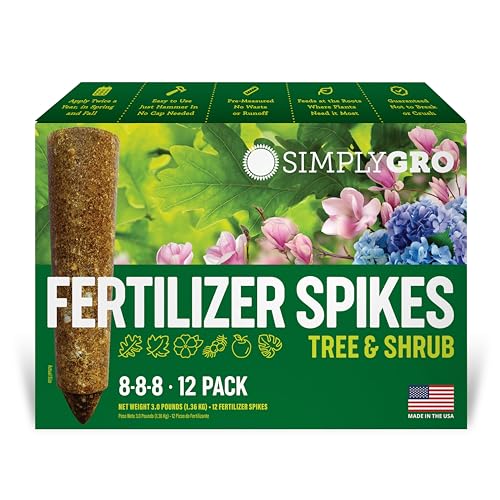
the just-right choice — equal parts nitrogen, phosphorus, and potassium for everything.
Most spikes lean heavy on nitrogen because that is what pushes green leaves fastest. The SimplyGro 8-8-8 formula takes the opposite approach: it gives your deciduous (trees that lose leaves each year), coniferous (cone-bearing evergreens), flowering, and fruiting trees an even dose of all three macronutrients. That makes it a smart pick if you have a mixed yard with ornamentals, fruit trees, and evergreens. Owners who used it on crepe myrtles reported the trees jump-started into bloom in just three to four weeks — an impressive turnaround for a balanced feed.
The ease of use is a consistent highlight in the reviews. The spikes are thick and durable (the same TruSpike construction as the Old Farmer’s Almanac), and they disappear once inserted. The main difference versus the 13-3-3 Old Farmer’s Almanac is that you get more phosphorus and potassium at the expense of a lower nitrogen percentage — a trade-off that makes sense for fruit set and root depth rather than pure leaf mass.
Why It Stands Out: The 8-8-8 balance is the most versatile ratio in the whole list — it works on fruit trees, flowering shrubs, evergreens, and shade trees without overdoing any one nutrient.
One Caveat: With only 12 spikes per box, you will need to order multiple boxes for a yard with more than a couple of trees.
Reach for it if: you have a mix of tree types and want one spike that suits everything without having to track different formulas.
Consider another if: your primary goal is greening up a nitrogen-starved shade tree — the 8% nitrogen is half what a 16-4-4 spike delivers.
5. Miracle-Gro Tree & Shrub Plant Food Spikes (24 Count, 2-Pack)
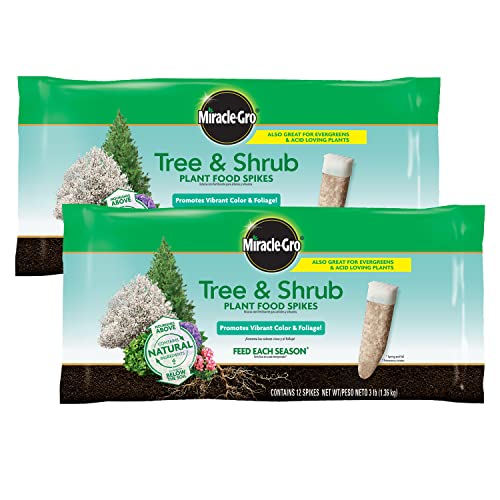
Twice the spikes, same fast-acting formula — and it handles acid lovers like hydrangeas.
This is the same 15-5-10 formula as the standard Miracle-Gro 12-pack, but you get double the count in a single purchase. The box also labels itself for evergreens and acid-loving plants such as hydrangeas, so it is more versatile than the standard tree-and-shrub label. Owners say it is effective enough that they buy it year after year, and the included rubber cap for hammering makes installation noticeably cleaner compared to spikes that leave your mallet head covered in fertilizer dust.
There is one quirk to be aware of: some packs ship without the plastic driving cap, which forces you to dig a hole or pre-drill to get the spike in. If you get a complete box, the cap works well. The spikes are larger than you might expect and will turn black on exposure to air, so use them promptly once you open the package. For the price, the 24-count box is a strong mid-point between a single 12-pack and the behemoth 160-count bulk boxes.
The Best Use Case: A medium yard with a mix of shade trees, evergreens, and a few hydrangea bushes — one box covers the whole property.
The Occasional Annoyance: The plastic driving cap is missing from some shipments, turning a one-tap job into a small excavation project.
Pick it for: the convenience of 24 spikes in one box and the versatility of a formula that works on acid-loving ornamentals.
Look elsewhere if: you need a low-nitrogen balanced feed for fruit trees — the 15% nitrogen is too aggressive for some fruiting varieties.
6. The Old Farmer’s Almanac Tree & Shrub Fertilizer Spikes (24 Count, 6 Lbs, 13-3-3)
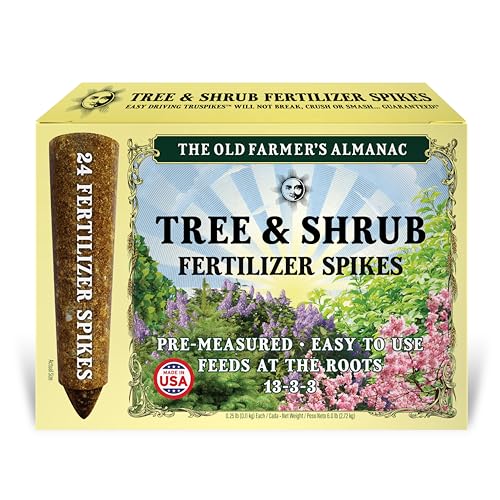
Double the spikes, double the durability — the bulk TruSpike box for serious tree feeding.
If the 12-count Old Farmer’s Almanac impressed you with its tough-as-nails TruSpike design, the 24-count box is the natural upgrade. At 6 pounds, it covers twice the ground with the same 13:3:3 formula. Reviewers point out that these spikes stay intact even in heavy clay soil when driven with a mallet. The real-world results are compelling: one owner fed a Japanese Stewartia and a fountain beech and noticed the Stewartia produced more flowers than ever before, while the beech filled out with leaves sooner.
The 13% nitrogen content is slightly lower than Jobe’s 16:4:4, but it is still high enough to drive strong growth. The 3% phosphorus and 3% potassium support bloom and root health without pushing the tree into excessive leaf growth. The only recurring complaint is that in very hard clay, a few spikes crack during installation — the solution is to soak the ground the day before or use a pre-drilled hole. The box also includes natural ingredients like molasses, which helps feed soil microbes.
What Owners Love
- TruSpikes resist breaking better than most competitors — even in clay.
- 24 spikes give real coverage for a yard with five or more medium trees.
- Contains natural molasses for soil microbe health.
The Practical Issue
- Some units arrive with cracked spikes if the box is mishandled during shipping.
- Hard clay soil may need pre-softening with water before driving.
Buy it when: you have multiple trees and want durable spikes that won’t disintegrate during installation — the 24-count box is the most cost-effective way to get that reliability.
Skip if: you want an even NPK ratio for flowering trees — the 3% phosphorus is lower than the 8% in a balanced spike like the SimplyGro 8-8-8.
7. Lutz Corporation Iron Chlorosis Tree Fertilizer Spikes (40 Count, 8:10:10)
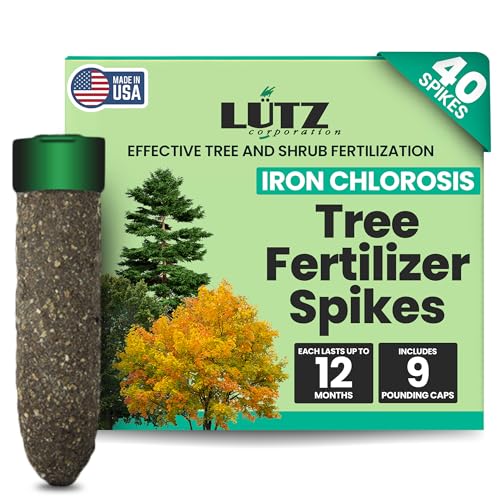
The specialist spike that tackles yellowing leaves at the root — with iron and a full year of feeding.
Most fertilizer spikes focus on the big three macronutrients. The Lutz spike is different: it is designed specifically for iron chlorosis (a condition where leaves turn yellow while veins stay green, caused by iron deficiency). The formula delivers 4.8% sulfur and iron alongside an 8:10:10 NPK mix. Shoppers say that it “turned our trees back beautiful” and that planting them every spring keeps deciduous and evergreen trees dark green. The slow-release technology means a single spike feeds for up to 12 months — twice the duration of most other spikes in this guide.
The box contains 40 spikes, which is generous compared to the 12-count boxes, and at this count you can treat a whole row of maples or oaks in one session. The spikes are also well-packaged with a sturdy cardboard divider to prevent breakage during shipping. One owner noted the iron helped with chlorosis but did not clear the problem entirely, which is a fair reminder that severe iron deficiency may need a soil test first. For anyone dealing with yellowing leaves that resist regular fertilizer, this is the most targeted solution available.
The Defining Advantage: The 12-month feed duration means you apply once and forget about it — no reapplication in the fall like every other spike in this guide.
The Honest Caveat: If your soil has an underlying pH issue, the iron alone may not fully resolve chlorosis; a soil test is a smart first step.
Use it for: oak, maple, birch, and pine trees showing classic yellow-leaf chlorosis that regular 16-4-4 spikes haven’t fixed.
Not for: general-purpose feeding — the 8:10:10 ratio is specialized for iron-deficient soils, not a balanced maintenance feed.
8. Jobe’s Slow Release Tree and Shrub Fertilizer Spikes (160 Count, 15-3-3)

The 160-spike monster box for owners with acreage and dozens of trees to feed.
If you are maintaining a property with 20, 30, or more trees, individual 12-count boxes become an expensive recurring chore. This Jobe’s bulk box of 160 spikes changes the math entirely. The 15-3-3 formula hits a high nitrogen level that suits acid-loving trees such as oaks, maples, dogwoods, and boxwoods. One owner in a semi-arid location said trees that had languished since 2019 responded “startlingly well” after using these spikes for two years, feeding twice yearly.
The box comes with plastic caps to protect the top of each spike during hammering, though several owners recommend skipping the caps and using a 16-ounce rubber mallet instead. The main complaint is the packaging: the cardboard box sometimes arrives split with loose fertilizer powder inside. A few owners suggest transferring the spikes to a plastic bag or bucket immediately. For the per-spike cost, this is the most economical way to feed a large property, especially if you plan to use them twice a year as directed.
Why This Makes Sense
- 160 spikes cover a large property for a full year at a significantly lower per-spike cost.
- High 15% nitrogen drives strong leaf growth on acid-loving trees.
- Works for a wide range of species: oak, maple, dogwood, boxwood, and more.
The Real Frustration
- The cardboard box is not strong enough for the weight; loose spikes and powder spill during transit.
- Not suitable for small yards — the 160-count will take years to use and may degrade.
Buy it for: acreage owners or serious gardeners who need a full property’s worth of spikes for the lowest cost per spike.
Steer clear if: you have fewer than five trees — a 12-count or 30-count box suits your needs better and keeps the spikes fresh.
Understanding the Specs
NPK Ratio — The Three Numbers
Every fertilizer spike displays three hyphenated numbers (like 16-4-4 or 8-8-8). The first is nitrogen (N), which drives green leaf and stem growth. The second is phosphorus (P), which supports flowers, fruit, and root development. The third is potassium (K), which strengthens the tree’s overall health and disease resistance. A high-first-number spike (16-4-4) is best for shade trees where you want a thick canopy. A balanced spike (8-8-8) suits mixed plantings with fruit or flowering trees.
Slow-Release Technology
Most tree spikes are engineered to break down gradually over several weeks or months, releasing nutrients directly into the root zone. This prevents the “burn” that can happen when you over-apply liquid or granular fertilizer. A standard spike feeds for 8 to 12 weeks; a few specialized spikes (like the Lutz chlorosis spike) claim up to 12 months of continuous feeding. The trade-off is that slow-release formulas take longer to show visible results compared to fast-acting liquids.
FAQ
How many spikes do I need per tree?
Can I use tree spikes on fruit trees?
Do fertilizer spikes expire?
Will spikes work in clay or rocky soil?
When is the best time to apply tree spikes?
Can I use spikes on evergreens and conifers?
What happens if I use too many spikes?
How deep should I drive the spike?
Are spikes better than granular fertilizer for trees?
Can I use spikes for potted or container trees?
Final Thoughts: The Verdict
For most buyers, the fertilizer spikes for trees winner is the Jobe’s 16-4-4 (30 Count) because it delivers the highest nitrogen content in the largest standard-size box, backed by a strong owner score and proven results on drought-stressed trees. If you want the fastest visible greening on a single tree or shrub line, grab the Miracle-Gro 15-5-10 (12 Pack) — owners say yellowing reverses in weeks. And for a large property with dozens of trees, the Jobe’s 160 Count Bulk Box is the one to reach for, giving you the lowest per-spike cost by a wide margin.
How We Picked
We do not accept paid placement. Every pick is matched to a real buyer and a real use-case; we do not hands-on test units.
Sources & Methodology
Specifications: manufacturer listings and product documentation. Review insights: verified customer reviews, as of July 2026. Pricing: not shown on this page (it changes often); check the current price via the retailer link.
As an Amazon Associate, Lawn Gear Lab earns from qualifying purchases. This does not affect which products we feature.