
Specs are compiled from manufacturer listings and verified buyer reviews and can change over time — please confirm the key details on the product page before buying.
A hard frost doesn’t have to mean the end of your winter greens or tropical collection. The right heater for your greenhouse isn’t about blasting the most heat — it’s about delivering steady, stable warmth that keeps your plants thriving through the night without shocking your electric bill. With options ranging from simple fan-forced units to smart, app-controlled PTC (Positive Temperature Coefficient) heaters that adjust to your VPD (Vapor Pressure Deficit), the choice depends on your space size, your climate, and how much control you want over the microclimate.
I’m Rikta — the founder and writer behind Lawn Gear Lab. This guide is built by comparing the manufacturers’ published specifications and the patterns across verified customer reviews, so you get each pick’s real strengths and trade-offs instead of marketing spin.
Whether you are a weekend seed-starter or a year-round grower, finding the right gear starts with the facts that matter, and this rundown of the best on the market is built to help you spot the greenhouse heating system that keeps your plants safe, your temperature stable, and your energy use under control.
Our Picks at a Glance

How To Choose The Best Greenhouse Heating System
Picking a heater for your greenhouse or grow tent isn’t as simple as grabbing the cheapest unit. You need to match the heater’s output to the size of your space, decide how much control you want over the temperature, and consider the humidity your plants create — not every heater is built to handle that kind of moisture safely.
Wattage and Coverage Area
The wattage of the heater directly tells you how large a space it can handle. A good rule of thumb is that you need about 10 watts per square foot in a well-insulated greenhouse. A 1500W heater covers roughly 120 square feet, while a 530W unit is better suited for a smaller 4×4 grow tent. Buying a heater that is too weak means it will run constantly to keep up, and buying one that is too powerful can cause temperature swings.
Type of Heating Element: Coil vs. PTC
Standard coil (convection) heaters work but get dangerously hot on the surface. PTC (Positive Temperature Coefficient) heaters are the newer, smarter choice — they self-regulate their temperature, so they never overheat, and they are safer in a humid greenhouse because the element itself doesn’t get as hot. Most modern grow-tent heaters use PTC for this reason.
Thermostat Control and VPD
A basic heater with a simple dial thermostat will keep your space warm, but it might fluctuate by 5-10 degrees. If you are starting seedlings or growing tropical plants, you want a digital thermostat or a unit with VPD (Vapor Pressure Deficit) control, which manages both temperature and humidity to keep your plants in their ideal growth zone. Smart models let you set a day and night temp schedule.
Quick Comparison
| Model | Best For | Heat Output (Watts) | Max Temp | Safety Rating | Amazon |
|---|---|---|---|---|---|
| AC Infinity THERMOFORGE T3★ Best Overall | Precision VPD Control | — | 140°F | — | Amazon |
| Rui Cheng 1500W RedBest Value | Budget-Friendly Coverage | 1500W | 108°F | IPX4 | Amazon |
| Spider Farmer 530WEnergy Efficient | Energy-Saving Efficiency | 530W | 140°F | — | Amazon |
| GRPWWT 1500W Kit | Reliable Cold-Weather Protection | 1500W | 120°F | — | Amazon |
| AC Infinity THERMOFORGE S7 | AC Infinity Ecosystem Builders | 1000W | — | ETL Certified | Amazon |
| VIVOSUN AeroFlux 700W | App-Driven Smart Growing | 700W | 86°F | V0, Tip-Over | Amazon |
| Bio Green PAL 2.0/US | Proven Durability for Larger Greenhouses | 1500W | 185°F | IPX4 | Amazon |
| BioGreen PALMA Digital | Reliable Workhorse for Small/Medium Greenhouses | 1500W | 185°F | IPX4 | Amazon |
| Bio Green PHX 2.8/US | High-Output Heating for Large Spaces | 2800W | 79°F | — | Amazon |
In‑Depth Reviews
1. AC Infinity THERMOFORGE T3
Our pick — over 4★ from 650+ verified ratings; the strongest balance of quality and price.
The smartest controller for growers who obsess over VPD and temperature stability.
This is the first heater designed from the ground up for precision grow-room control, not a repurposed space heater. It uses advanced PTC (Positive Temperature Coefficient) plate technology with 10 distinct heat levels managed by PWM (Pulse Width Modulation) — which means it can finely tailor output instead of just blasting full power or being off. The onboard controller and corded sensor probe let you set VPD and temperature triggers, timers, and cycles so the environment stays exactly where you want it.
The flexible 4-foot extension hose lets you duct heat directly into a specific area of your grow tent, avoiding direct blasts on delicate leaves — a feature owners consistently praise as a standout for layout. It integrates with AC Infinity’s UIS (Universal Intelligent System) controllers for WiFi app connectivity and deeper automation. It is also surprisingly quiet and well-built, which adds to the appeal for indoor setups.
The catch is that while the control is superb, some units struggle to raise temperatures in a 4×4 tent from a cold ambient — one reviewer noted needing more heat output than provided. The brand’s customer service is strong, quickly replacing any defective units, but the technology and reliability keep it as the top contender for serious growers who demand precision. The item measures 5.94″D x 11.49″W x 12.12″H — a 2x difference in depth versus the Spider Farmer.
What Wins People Over
- 10-level PTC heating for precise, stable temperature control
- Flexible ducting to direct heat precisely where needed
- smooth integration with the AC Infinity ecosystem for advanced automation
The Real Trade-Off
- Some units struggle to reach a target temp in a 4×4 tent from a very cold ambient
- Higher amperage draw (5 Amps) compared to some competitors
Best for: The dedicated grower who wants app-controlled, VPD-driven climate precision and already uses or plans to use the AC Infinity ecosystem.
Skip if: You have a large, unheated structure in a very cold climate and need raw BTU output to maintain a large temperature differential.
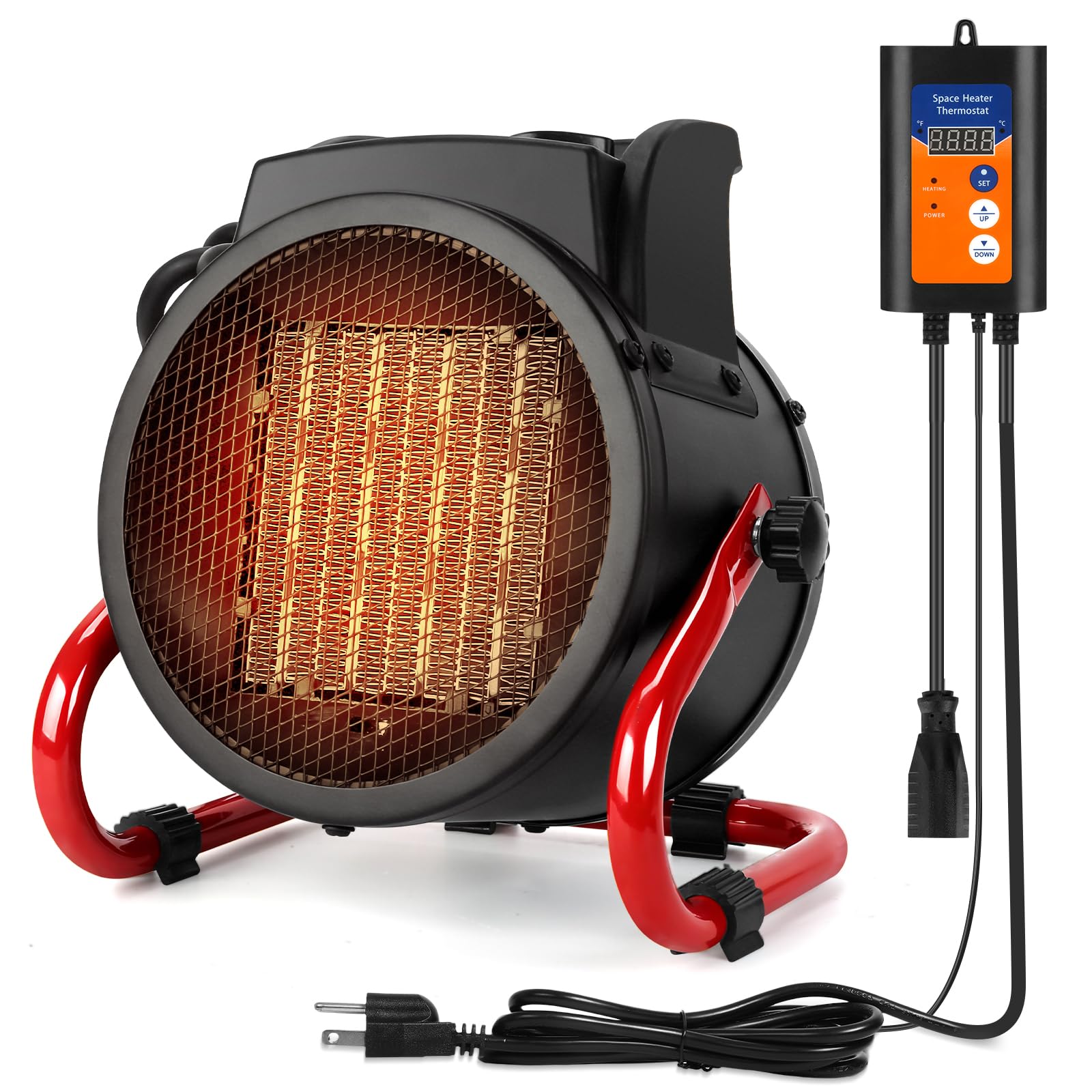
2. Rui Cheng 1500W Red
A powerful, splash-proof workhorse for small to medium greenhouses on a budget.
With a full 1500W of power and a heating coverage of up to 215 square feet, this little red heater packs a significant punch. The digital thermostat lets you set a precise temperature range from 40°F to 108°F, and it includes three power modes (High at 1500W, Medium at 750W, and Low at 20W) so you can scale energy use depending on the season and time of day. The sturdy handle and stable base make it easy to move between your greenhouse, garage, or patio.
Safety is a major highlight here. The housing is rated IPX4 (splash-proof), meaning it can handle the humidity and condensation of a greenhouse without issue. It also has built-in overheat protection for confidence. The high-strength stainless steel housing is designed to resist corrosion. One owner with a small 8×5 greenhouse confirmed it works well in the cold Wisconsin spring to start garden plants, keeping the space warm through chilly April nights.
The big trade-off? The digital thermostat uses a soil seed mat sensor, which some owners feel is not ideal for controlling an air heater. One buyer flagged a warning in the manual stating the heater is not designed for humid spaces, contradicting the IPX4 listing. It also runs at 1500W, so it’s a 2.8x power jump compared to a 530W unit like the Spider Farmer, which means it will consume more energy if run continuously. The item dimensions are 10″D x 7″W x 9.8″H.
Smart buy for: The DIY greenhouse owner who needs reliable, powerful heat for a small-to-medium structure and appreciates an IPX4 splash-proof rating and multiple power modes for energy flexibility.
Who should think twice: Anyone with a very large space needing consistent heat, as the sensor accuracy and potential for non-greenhouse-use warnings are concerns to check.
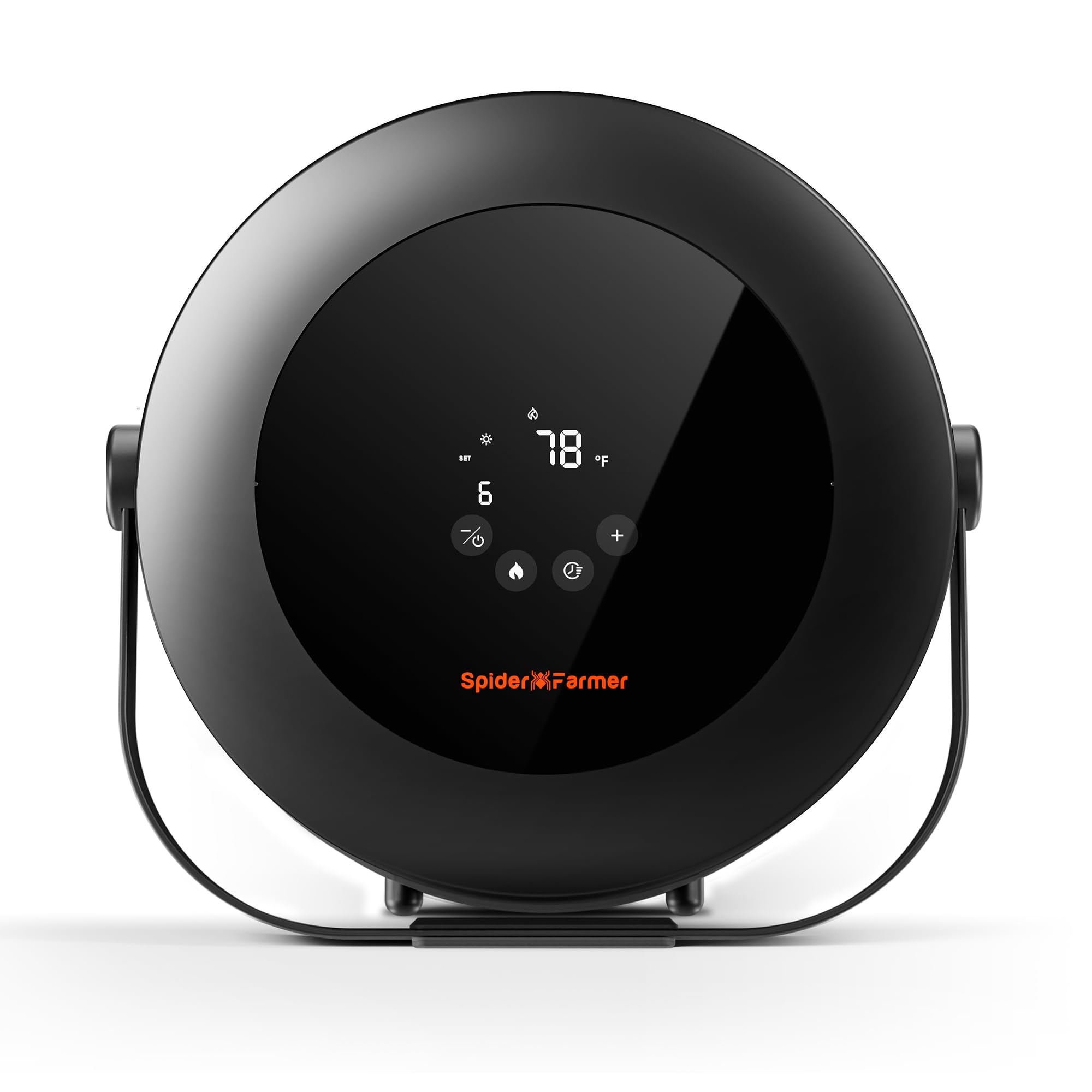
3. Spider Farmer 530W
A compact, energy-sipping heater with gentle air for smaller grow tents.
This heater stands out for its efficiency. At 530 watts, it uses dramatically less power than a 1500W unit — in fact, it operates at a 2.8x lower wattage — making it a perfect choice for a small 4×4 or 5×5 tent where you need to keep costs down. It uses advanced PTC (Positive Temperature Coefficient) heating technology and PWM (Pulse Width Modulation) control, offering 10 adjustable levels for both temperature and fan speed. The temperature range is impressive, from a low of 32°F up to 140°F.
The smart temperature control includes a built-in customized sensor that monitors the space in real time. It has four distinct modes: Normal Open, Temperature All-day, Temperature Daytime, and Temperature Night Mode. The 24-hour countdown timer gives you flexible scheduling. A 160cm hose (about 63 inches) directs air away from your plants, preventing leaf burn. One buyer with a small greenhouse described it as “perfect” and noted the air coming out is “not harsh hot air… very gentle & adjustable.” At 5.4 pounds and measuring 12″D x 12″W x 6.3″H, it is compact and easy to place.
The limitation is that it may struggle in larger setups or very cold climates. Buyers report that you need to crank it up to high to warm the space quickly. It also has a minimum temperature setting of 32°F compared to the 40°F of the Rui Cheng, giving it a broader operating range.
Reach for this if: You want an energy-efficient, gentle-heat system for a small tent or greenhouse that won’t blast your plants with harsh, dry air.
Look elsewhere if: You need to heat a large greenhouse (over 100 sq ft) in freezing winter conditions.
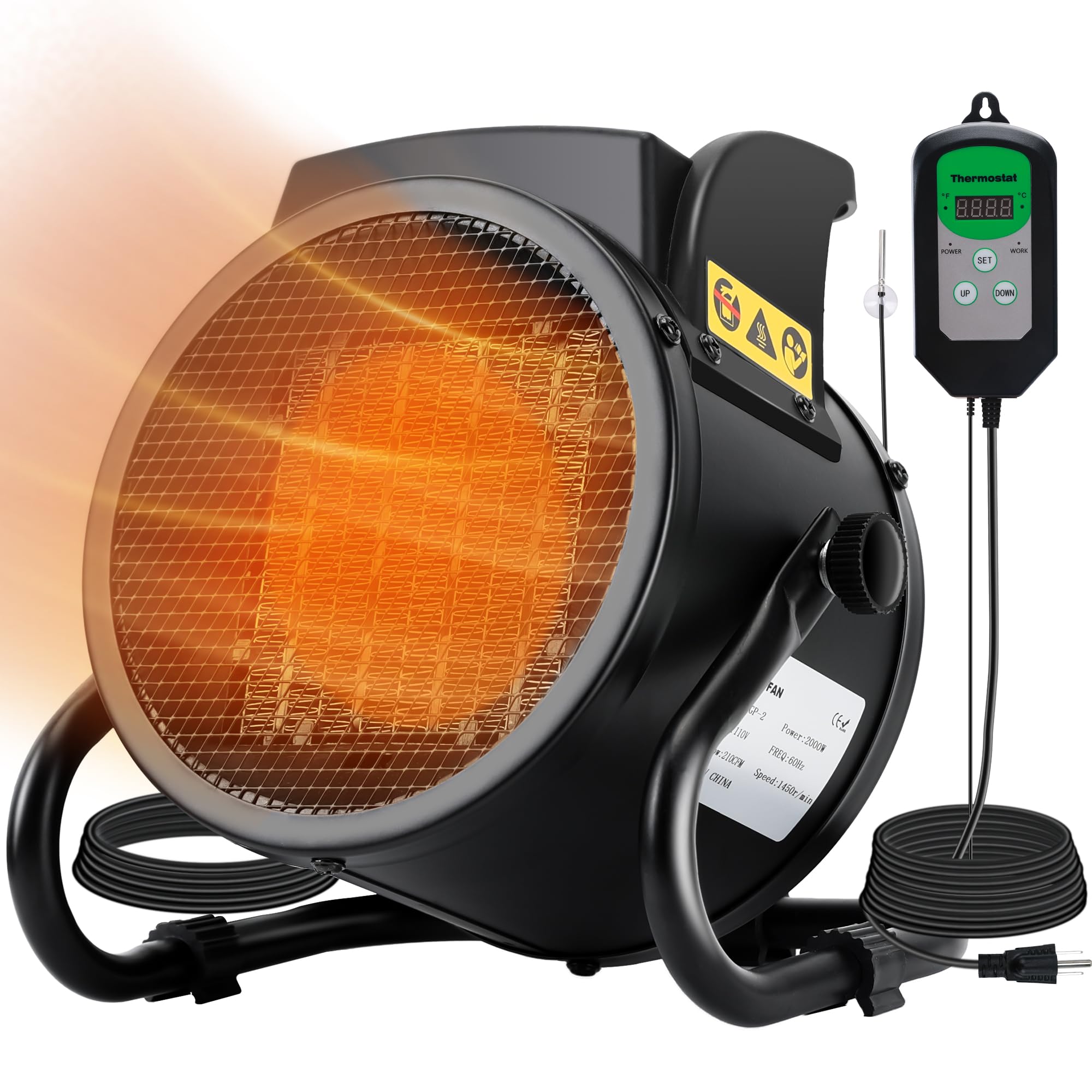
4. GRPWWT 1500W Kit
A reliable, fast-heating kit that owners credit with saving thousands of dollars in plants.
This kit bundles the heater with a separate, precise digital thermostat for automatic on/off control, which is a big step up from a simple dial. The heater itself outputs 1500W and hits full heat in just 3 seconds, efficiently covering up to 120 square feet. The adjustable ventilation ensures consistent air circulation, which is crucial for preventing hot and cold spots that can stress plants.
The real-world reliability here is backed by owners who have put it through harsh winters. One user in a sub-20°F climate with heavy snow reported it maintained 50°F in their greenhouse, protecting 7-8 bonsai trees. The owner credited it with “saving thousands of dollars” in valuable plants. The separate thermostat is a key feature — it constantly monitors the temperature and turns the heater on or off, which is far more energy efficient than having the heater’s own internal sensor trying to do the job.
The honest downsides are the lack of a tip-over safety shutoff, which some owners note as missing, and the fact that the heater is rated for 120 sq ft, so it may be underpowered for a very large structure. The max temperature setting is 120°F. The overall build quality and reliability get very strong marks from the majority of owners, who trust it to keep their plants alive through winter.
Strong choice for: The grower who needs a reliable, auto-controlled heater that can keep a small greenhouse above freezing through sub-20°F weather while staying affordable.
Check first: It lacks a tip-over shutoff, so it’s not ideal for a space where it could be easily knocked over by animals or people.
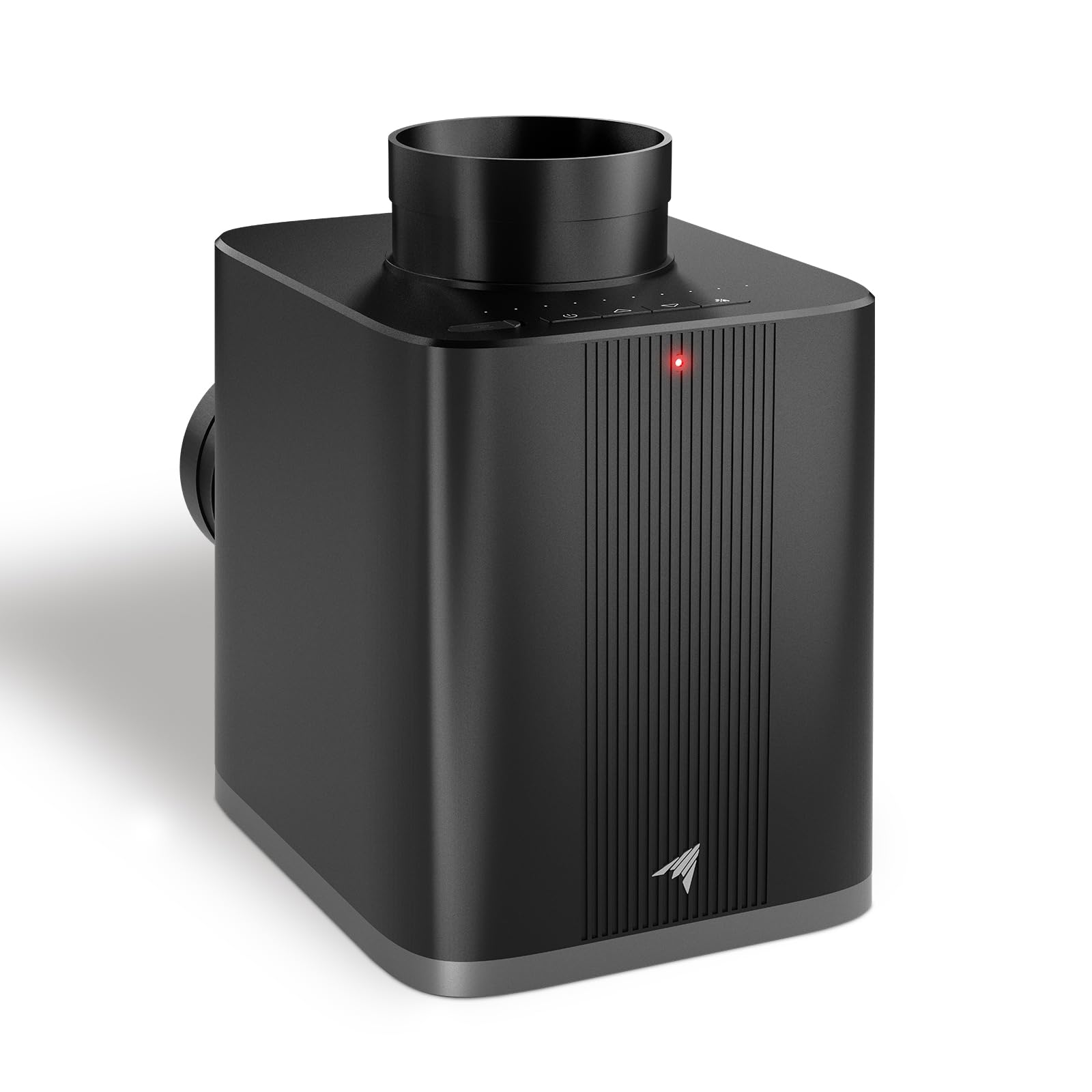
5. AC Infinity THERMOFORGE S7
A powerful, ductable 1000W heater for those already in the AC Infinity ecosystem.
Stepping up from the T3, the S7 delivers 1000 watts of heating power without a listed max temperature, making it a stronger choice for larger spaces. It also uses individual PTC (Positive Temperature Coefficient) plates with PWM (Pulse Width Modulation) control for 10 true heat levels. Its unique advantage is the dual-port design that allows you to duct directly into your grow space or create a closed-loop setup for maximum efficiency (ducting not included). It also has a fresh air intake mode, so it can pull in outside air to cool the space.
This is an ETL-certified (a safety standard mark) unit with tip-over alarms, flame-retardant materials, and overheat protection with auto-restart. It also connects to the AC Infinity ecosystem for WiFi app control, data tracking, and advanced automations via UIS (Universal Intelligent System) controllers. The floor-mount cabinet form factor is very different from the T3’s tower shape. It measures 8.66″D x 7″W x 10″H. One owner using it for tropical plants in Oklahoma praised it as a must-have for automating a tropical tent.
The main criticism is that the fan speed is not variable — it runs on full blast regardless of the heat level selected. One owner with a small cactus tent found this constant airflow too much for their space. Another noted it outlasted two pricier models from other brands that failed after their warranty ended, speaking to its build quality despite the minor fan complaint.
Great pick for: The committed AC Infinity user who needs more power than the T3 and values the dual-duct flexibility and full ecosystem integration.
Consider the downside: The constant high-speed fan can be disruptive in a small, delicate grow space and may not suit every plant’s environment.
6. VIVOSUN AeroFlux 700W
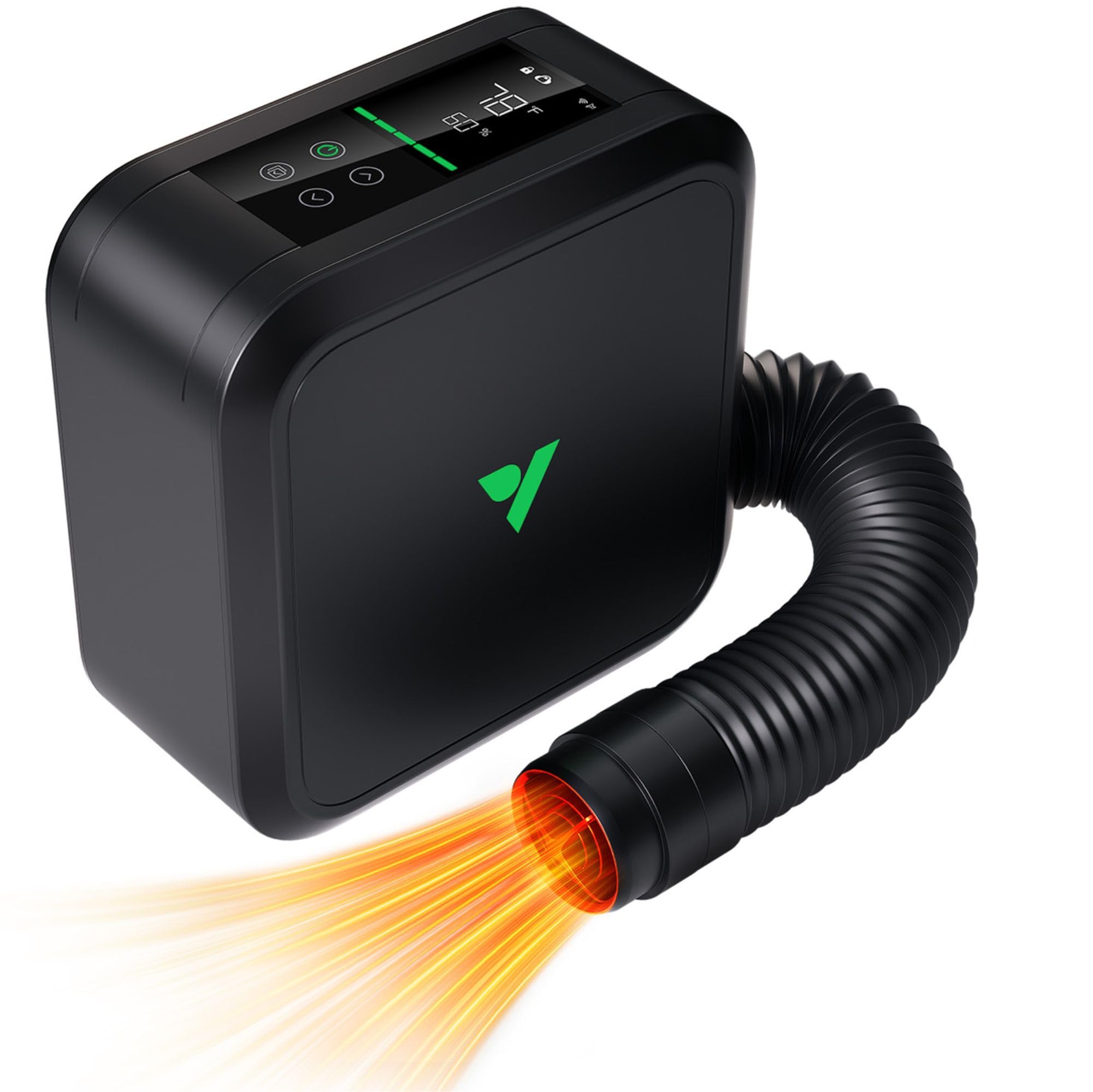
A compact, app-driven heater that brings advanced VPD control to your grow tent.
This is the most tech-forward heater on the list for its size. At 700W, it is 40% stronger than standard models, according to the brand, yet its compact form factor (9.45″D x 4.72″W x 9.45″H) saves precious floor space. It uses advanced PTC (Positive Temperature Coefficient) heating and PWM (Pulse Width Modulation) precision control, offering 5 adjustable heat levels. The high-precision sensor tracks temperature and VPD (Vapor Pressure Deficit) changes in real time, auto-adjusting heat output to support your plants’ transpiration rate.
The app control is the standout feature here. You can set your desired temperature, customize the minimum temperature, and target a specific VPD. The Recipe feature lets you program Day/Night Mode for a stable environment year-round. Safety features include V0-rated flame-retardant materials, tip-over protection, and overheat shutoff. Owners mention it maintains a very tight temperature range, with one noting their 4×4 tent stayed within 67.9-69.1°F of the setpoint. Another praised it for not changing their electric bill at all.
The trade-offs are that some find it a bit noisy for a compact heater, and the WiFi connectivity and value for money are areas of mixed feedback. The maximum temperature setting is relatively low at 86°F (30°C), which may not be sufficient for everyone. While it reliably heats a 4×4 tent, some users feel it doesn’t heat up fast enough for larger spaces. The VIVOSUN brand name also commands a premium that some question relative to the 530W output.
Reach for this if: You want the convenience of full app control and precise VPD management in a compact, space-saving heater for a small to medium grow tent.
Look elsewhere if: You need a high max temp (above 86°F) or prefer a completely silent operation in a small space.
7. Bio Green PAL 2.0/US
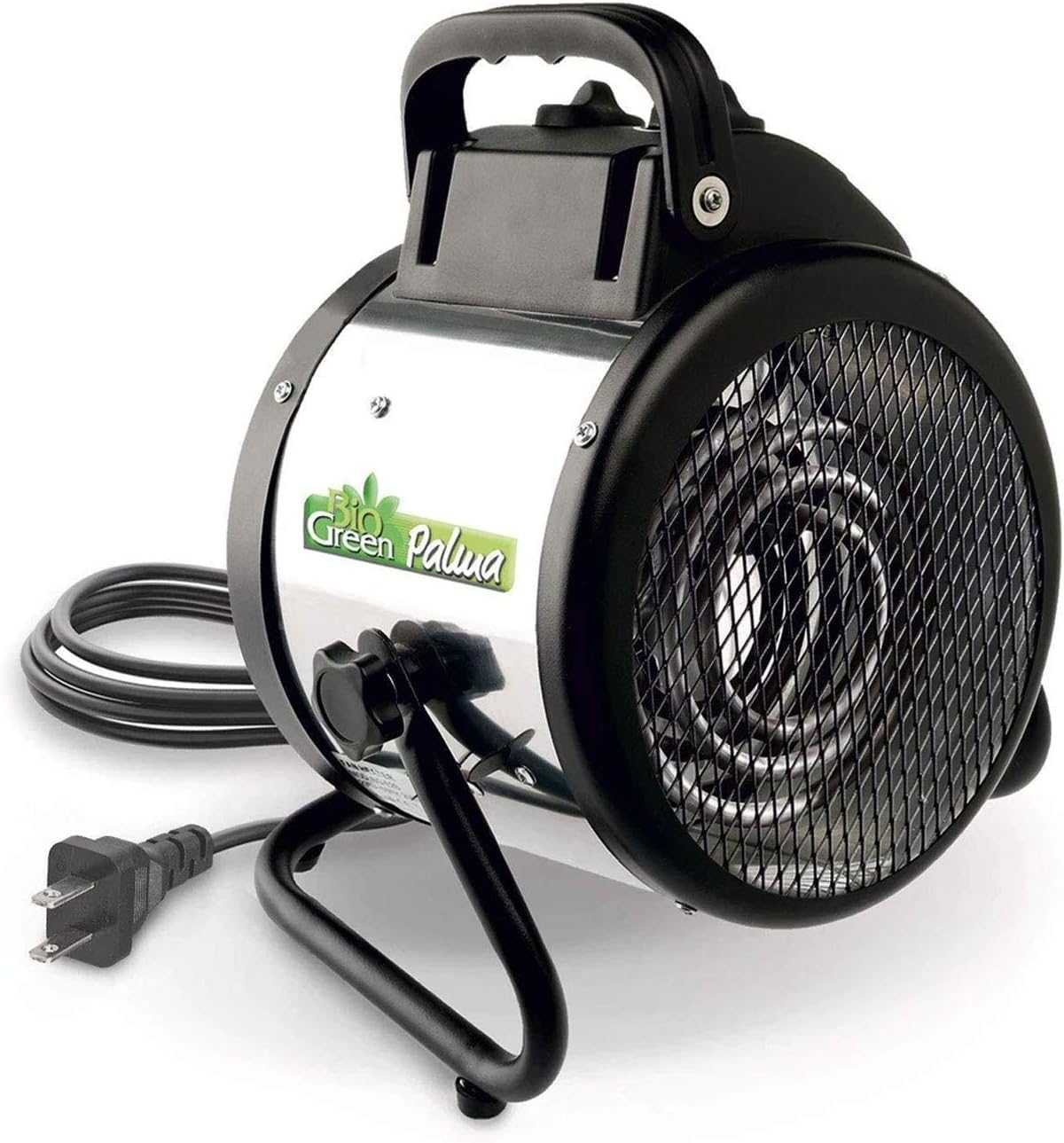
A legendary, simple workhorse that many greenhouse owners have trusted for over five years.
This heater is built around a straightforward, proven design. It has two separately adjustable heating elements that give you 2560 BTU or 5120 BTU of power, making it ideal for rooms up to 120 sq ft. The steplessly adjustable thermostat has a wide range from 32°F to 185°F, giving you incredible flexibility. It also has a dedicated air circulation mode — just turn it into a fan without the heat, which is great for preventing heat buildup and stale air around your plants.
The IPX4 splash-proof rating means it can get sprayed with water from irrigation or rain without failing. It is a fan-forced unit that circulates up to 4317 cubic feet of air per hour, meaning the heater doesn’t have to run as long. Owners with orchid and vanilla greenhouses swear by them, with one mentioning their first Palma has been running for over 5 years. They specifically buy these to avoid cheaper heaters with auto-shutoff that can kill plants during a cold night when they trip incorrectly.
The reliability is the biggest concern here. While many units last for years, the feedback on reliability is mixed. Some units arrive dead on arrival or stop working after just 5 minutes or a few months. The built-in thermostat is also reported to be uncalibrated by some owners, who recommend using a separate external digital thermostat instead. It draws a high 12.5 Amps, so it may trip a 15A breaker if other lights or equipment are on the same circuit.
Best for: The greenhouse owner who values durable, simple, splash-proof construction and wants a heater with a proven track record that can also function as a circulation fan.
The catch: Mixed reliability from the start and a high amperage draw can cause electrical issues if your greenhouse circuit is shared.
8. BioGreen PALMA Digital
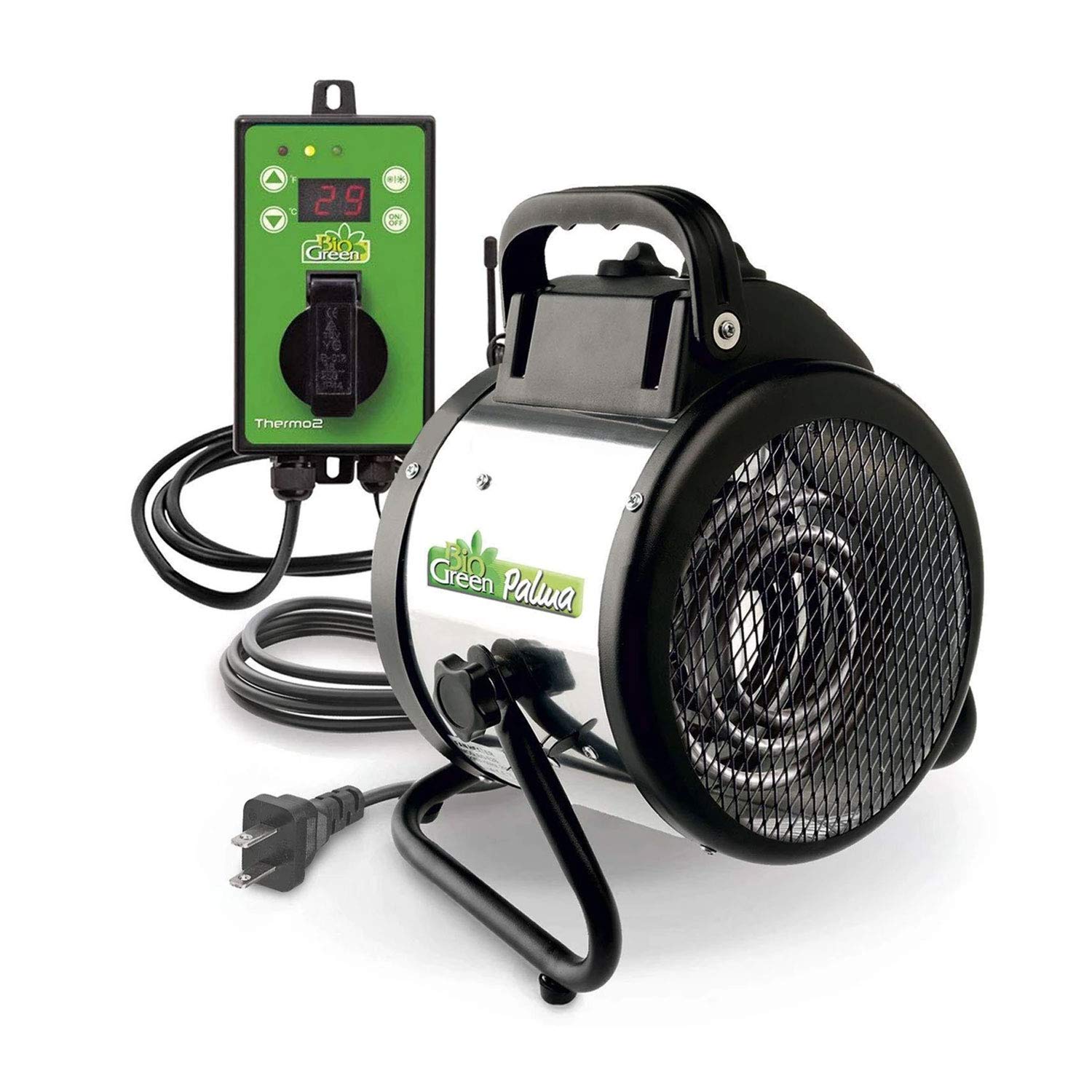
The most popular BioGreen model, with a digital thermostat for more accurate control.
This is the digital version of the classic BioGreen Palma heater, and it is overwhelmingly their most reviewed model. It offers the same 1500W / 5100 BTU heat output for spaces up to 120 sq ft, but with a precise digital thermostat that you can set to a specific temperature rather than just a dial. The temperature range is from 32°F to 185°F. It also includes the fan-only air circulation mode that moves up to 5800 cubic feet of air per hour — a significant jump from the non-digital Palma’s 4317 cu ft/hr.
Owners consistently praise the compact size and ease of use for small greenhouses (8×12 is a common size mentioned). It is splash-proof (IPX4) and built for the humidity of a greenhouse. The quality is generally praised as excellent for the price. The large user base means there is ample data on its performance, and many owners find it a reliable 4-star workhorse that keeps their plants alive through winter.
The primary issue is reliability. While many users have great experiences, a significant minority report units arriving damaged, failing after a few months, or blowing cold air. One owner went through three units in a row, with the third tripping the GFI breaker. On the positive side, BioGreen’s customer service is frequently cited as outstanding — one owner’s unit failed after 2 years and the company sent a replacement in under 2 weeks with just an Amazon screenshot. The cord can also be slightly loose in the base, causing intermittent power issues for some.
Solid pick for: The greenhouse owner who wants a compact, digital, and well-loved heater with good customer service backing it up, despite some reliability variance.
Check your tolerance: The reliability lottery means you may get a perfect unit or a defective one that needs a quick replacement from the great customer support.
9. Bio Green PHX 2.8/US Phoenix

A beast of a 2800W heater with massive airflow for the largest greenhouses.
This is the heavy lifter of the group. The Bio Green Phoenix uses two separately adjustable heating elements (1000W or 1800W — combined 2800W) for a massive 9553 BTU output suitable for rooms up to 215 square feet. It is a forced-air unit that circulates an enormous 16,000 cubic feet of air per hour, which means it can heat a large space quickly and evenly. The stainless steel housing is built to last and can be placed on the floor or hung up with the included chains.
The thermostat is steplessly adjustable but has a limited max temperature of 79°F, which is lower than other models. This suggests it is designed for maintaining frost-free conditions rather than tropical heat. The temperature range goes from -58°F to 79°F, and it includes a frost detection mode. One owner with a 10×20 greenhouse reported it keeps the space at 65°F when it is 12°F outside, calling it very effective. A 27-year greenhouse veteran rated it the “best quality” heater they have ever used, praising its high fan volume for eliminating cold spots and its accurate thermostat.
The limitations are significant. First, it requires a 220-240V (volt) power connection — a standard 110V household outlet will not work. It draws 13 Amps, which is very high. The heat output is also mixed in reviews; some find it not enough for extremely cold climates. The unit is large at 8.66″D x 12.99″W x 16.14″H. Finally, a few customers note the heating element failing after about two years or a unit arriving with a broken plug, with customer service over the weekend being non-existent.
Apex pick for: The serious greenhouse owner with a large space (up to 215 sq ft) who has a 240V circuit available and prioritizes high airflow and rugged build quality.
Not for everyone: Requires a 220-240V outlet, has a low maximum temperature of 79°F, and the occasional reliability issue means you need a backup plan for very cold nights.
Understanding the Specs
Wattage and BTU
The most critical spec for a greenhouse heater is its heat output, usually measured in Watts or BTU (British Thermal Units). A higher number means more heat. For an electric heater, 1 Watt equals about 3.41 BTU. For a small grow tent (4×4), 500-700W is often enough. For a standard 8×10 greenhouse, you’ll likely need 1500W (about 5100 BTU). For larger structures, 2800W (about 9500 BTU) units exist. The rule is that you need enough power to overcome the heat loss through your greenhouse walls on the coldest night you expect.
PTC vs. Coil Heating
PTC (Positive Temperature Coefficient) heating elements are the safest modern choice for greenhouses. Unlike a standard metal coil that gets red-hot and stays hot, a PTC element self-regulates. As it gets hotter, its electrical resistance increases, which naturally limits its temperature. This means it cannot overheat and is much safer near humidity and flammable materials. PTC heaters also tend to last longer and are more energy-efficient because they only use as much power as needed to maintain the set temperature.
IP Rating (Water Resistance)
An IPX4 rating is the minimum you should look for in a greenhouse heater. The “IP” stands for Ingress Protection, and the “X4” means the heater is protected against splashing water from any direction. Since greenhouses are naturally humid places where you may be watering plants or where condensation drips, a heater without this rating could short out or become a shock hazard. Many standard space heaters lack this protection and should not be used in a greenhouse.
VPD (Vapor Pressure Deficit) Control
VPD is a measure used by advanced growers to manage the relationship between air temperature and humidity. A VPD controller on a heater works with a sensor to adjust the temperature (and sometimes a fan) to keep your plants in their ideal “sweat zone” — where they can transpire (release water vapor) at a healthy rate. If you are growing high-value plants like cannabis or tropicals, a heater with smart VPD control can dramatically improve growth rates and prevent issues like mold or wilting.
FAQ
Can I use a regular space heater in my greenhouse?
How many watts do I need for an 8×10 greenhouse?
What is the advantage of PTC heating in a grow tent?
Will a 1500W heater trip my breaker?
How often do greenhouse heaters need to be replaced?
What does VPD control mean on a grow tent heater?
Can I run a heater in my greenhouse 24/7?
Is the Bio Green PHX worth the higher price?
How do I install a ducted greenhouse heater?
What is the difference between a convection heater and a forced-air heater?
Final Thoughts: The Verdict
Across the board, the greenhouse heating system winner is the AC Infinity THERMOFORGE T3 because it combines cutting-edge PTC technology with VPD control, quiet operation, and ducting for precise placement — it is the undisputed favorite among serious growers. If you want a budget-friendly but powerful splash-proof heater for a small to medium greenhouse, the Rui Cheng 1500W Red is a strong, affordable choice. And for the large, dedicated greenhouse with a 240V outlet, the Bio Green PHX 2.8/US Phoenix delivers class-leading power and airflow to chase away even the deepest frost.
How We Picked
We do not accept paid placement. Every pick is matched to a real buyer and a real use-case; we do not hands-on test units.
Sources & Methodology
Specifications: manufacturer listings and product documentation. Review insights: verified customer reviews, as of July 2026. Pricing: not shown on this page (it changes often); check the current price via the retailer link.
As an Amazon Associate, Lawn Gear Lab earns from qualifying purchases. This does not affect which products we feature.