
Specs are compiled from manufacturer listings and verified buyer reviews and can change over time — please confirm the key details on the product page before buying.
If your lawn is more pancake than sponge — water pools on top, fertilizer slides off, and grass roots can’t breathe — you are dealing with compacted soil. The only real fix is a hollow tine aerator that physically pulls a plug of soil out of the ground, not one that jabs a spike in. That difference is the entire ballgame: a spike just makes a hole, while a hollow tine removes a core, giving roots the room to spread deep.
I’m Rikta — the founder and writer behind Lawn Gear Lab. This guide is built by comparing the manufacturers’ published specifications and the patterns across verified customer reviews, so you get each pick’s real strengths and trade-offs instead of marketing spin.
Whether you are dragging a rig behind a tractor or working a small patch by hand, the right hollow tine aerator matches your yard size, your machine, and how much sweat equity you are willing to invest.
Our Picks at a Glance


How To Choose The Best Hollow Tine Aerator
The right hollow tine aerator is the one that actually matches the size of your lawn and the machine you own (or your own muscle). Three quick decisions narrow the field fast.
Tow-Behind vs Manual: Who does the work?
A tow-behind aerator hitches to a riding mower or ATV and does the heavy lifting while you drive. These are the right call for lawns over a quarter-acre — they are heavy, wide, and pull dozens of cores in a single pass. Manual aerators (step-and-tilt or rolling drum) put the work on your legs but cost far less and work great on smaller or oddly shaped patches.
Plug Depth and Tine Material
The depth of the soil core matters. Most good aerators pull plugs between 2 and 3 inches deep — enough to relieve compaction where grass roots actually live. Look for heat-treated or galvanized steel tines; they hold an edge longer and resist bending when you hit a dry patch or a hidden rock.
Weight Tray Capacity
A tow-behind aerator needs ballast to drive the tines deep. The weight tray rating tells you how many cinder blocks or sandbags you can stack on it. A model that handles 125 to 150 pounds will dig into tough clay; anything less may skid across the surface on dry ground.
Quick Comparison
| Model | Best For | Plug Depth | Weight | Tray Capacity | Amazon |
|---|---|---|---|---|---|
| Brinly PA-403BH-A3★ Best Overall | Best Overall Tow-Behind | Up to 3 in | 63.9 lbs | 150 lbs | Amazon |
| Step ‘N Tilt SNT4Top Performer | Best Manual Step Aerator | 3.4 in | 21 lbs | — | Amazon |
| Agri-Fab 45-0474 | Best Value Tow-Behind | Up to 3 in | 29 lbs | — | Amazon |
| Landzie Fork | Best Manual Hand Fork | Up to 4 in | 5.6 lbs | — | Amazon |
| Suchtale LTA-005A | Budget Tow-Behind | Up to 2 in | 55 lbs | 125 lbs | Amazon |
| Landzie AeroCore | Best Manual Roller | Undisclosed | 50.8 lbs | — | Amazon |
| Craftsman CMXGZBF7124213 | Premium Tow-Behind | Up to 3 in | 78.8 lbs | 140 lbs | Amazon |
In‑Depth Reviews
1. Brinly Tow Behind Plug Aerator with Universal Hitch, 40″ – Flat Black
Our pick — over 4★ from 950+ verified ratings; the strongest balance of quality and price.
A 63.9-pound brute that pulls 3-inch plugs without breaking a sweat — or your wallet.
The Brinly is the tow-behind that owners keep coming back to. It uses 24 heat-treated, 16-gauge steel spoons (the actual business end that cuts the cores), and each spoon is narrower than most with sharpened ends to sink into hard ground with less weight. The all-steel frame and fully enclosed weight tray hold up to 150 pounds of ballast — cinder blocks, sandbags, whatever you have — so you can dial in penetration depth as the soil changes across your yard.
Buyers report it “creates ~2.5″ plugs” and call it “well-built.” One owner assembled it in about an hour — even a 70-year-old woman managed it solo and described the directions as superb. The 10-inch semi-pneumatic tires roll easily across driveways, and a single transport lever lifts the tines clear when you cross sidewalks or turn tight corners. The three independently rotating tine sections track uneven ground better than a solid bar, which minimizes the turf-tearing that cheaper rigs cause on turns. At 63.9 pounds it is a serious piece of steel — noticeably heavier than the Agri-Fab at 29 pounds, which gives it the weight to dig in before you even add ballast.
The recurring gripe is assembly: some owners say the multi-unit instructions cause a little head-scratching, and a few mention extra hardware in the bag. But the praise heavily outweighs the setup fuss. The Brinly is the crowd favorite for good reason — it just works.
What wins people over
- Heat-treated steel spoons pull real cores up to 3 inches deep
- 150-pound weight tray lets you add serious ballast for clay soil
- Three independently rotating tine sections reduce turf damage on turns
- Single lever raises tines for transport across hard surfaces
The honest trade-off
- Assembly takes a patient hour even with clear instructions
- At nearly 64 pounds, it is a beast to lift or move by hand
- Plastic wheels are for transport only — not meant to support heavy loads on pavement
Reach for this if: you have a riding mower or garden tractor and a lawn of any size — the Brinly is the proven workhorse that out-pulls almost everything in its price tier.
Look elsewhere if: you only need to aerate a tiny patch near the house or you have no way to haul a 64-pound steel frame around.
2. Step ‘N Tilt Core Lawn Aerator Version 4 Kit (3.4 Inch Standard Length Coring Tines with Soil Core Container)
A manual aerator that makes real cores without making you hate your lawn.
You get deep, clean plugs without bending over or straining your back. Step onto the platform, tilt the handles back, and the tines pull a 3.4-inch-deep, 0.79-inch-diameter plug of soil. The patented tilting motion then ejects the core onto the ground behind you automatically. That design makes it noticeably easier on your shoulders and back than a standard jab-style aerator.
Owners aerated a front yard in an hour with this thing, even in clayish damp soil that caused some jams (the included clearing tool handles that). The unit weighs 21 pounds and breaks down into a manageable shape for storage. It is designed for operators between 4 feet and 6 feet 5 inches tall, with a recommended minimum weight of 80 pounds to drive the single set of tines. The case-hardened tines can be sharpened or replaced when they wear, and the optional soil core container lets you collect plugs to fill ruts instead of raking them.
The thing that gets the most praise is the performance — it is the best manual aerator many owners have used, pulling nice cores with no clogging and very low effort. It is not for a multi-acre spread (that would take serious time), but for a quarter-acre or a patchy lawn you are rehabbing before seeding, it is tough to beat.
Tilt-and-go design: the step-and-tilt motion is gentler on your body than a jab-style fork, and the self-ejecting tines mean you are not raking after every pass.
Small-yard best friend: ideal for lawns up to about a quarter-acre or for spot-aerating compacted areas a tow-behind cannot reach.
Best for: the homeowner who wants real core aeration without renting a machine or spending + on a tow-behind.
Skip if: your lawn is larger than half an acre — you will want a rolling or tow-behind aerator to save your legs.
3. Agri-Fab 45-0474 SmartLink Plug Aerator, Black, 40 Inch

A 29-pound SmartLink rig that swaps attachments in minutes and pulls plugs like a pro.
The Agri-Fab SmartLink system is built around a simple idea: one platform, many tool heads. The plug aerator is one of those heads, with 24 rustproof knives that loosen soil plugs up to 3 inches deep. It hitches to the SmartLink frame (sold separately or bundled) and swaps with a spike aerator or dethatcher in seconds — no tools required — so you can go from coring to thatch removal in the same session. Owners mention “easy 30-min assembly with video” and call the materials sturdy and the tines sharp.
At 29 pounds (the aerator head alone), it weighs 29 pounds compared to the 63.9-pound Brinly, so the SmartLink platform is easier to lift and store. The trade-off: you need to add ballast. Owners commonly place three cinder blocks on it to get good penetration on moist soil, and one reviewer noted aerating 3 acres of varying soil without issues. The 3-year limited warranty backs it, and the made-in-USA build quality shows in the thick castings and welds.
The downside: some customers note packaging damage or missing hardware (a trip to the hardware store solved it), and there are a few durability concerns with weld breakage over time. It is a solid value if you already own or plan to buy into the SmartLink ecosystem — otherwise the standalone Brinly is a simpler, heavier-duty choice.
SmartLink ecosystem: the ability to switch between plug aerator, spike aerator, dethatcher, and roller on one platform is a genuine time-saver if you do full lawn renovation.
Packaging gamble: some units arrive with scuffed boxes or loose hardware — inspect the contents before you start assembly.
Grab this if: you want a modular system that does more than just aerate, or you need a lighter tow-behind you can lift without a second person.
Think twice if: you want the heaviest-duty single-purpose aerator — the Brinly’s 63.9-pound all-steel frame pulls deeper cores with less added weight.
4. Landzie – The Original Hollow Tine Lawn Aerator Tool – 42 Inch Core Aerator and Grass Aeration Tool
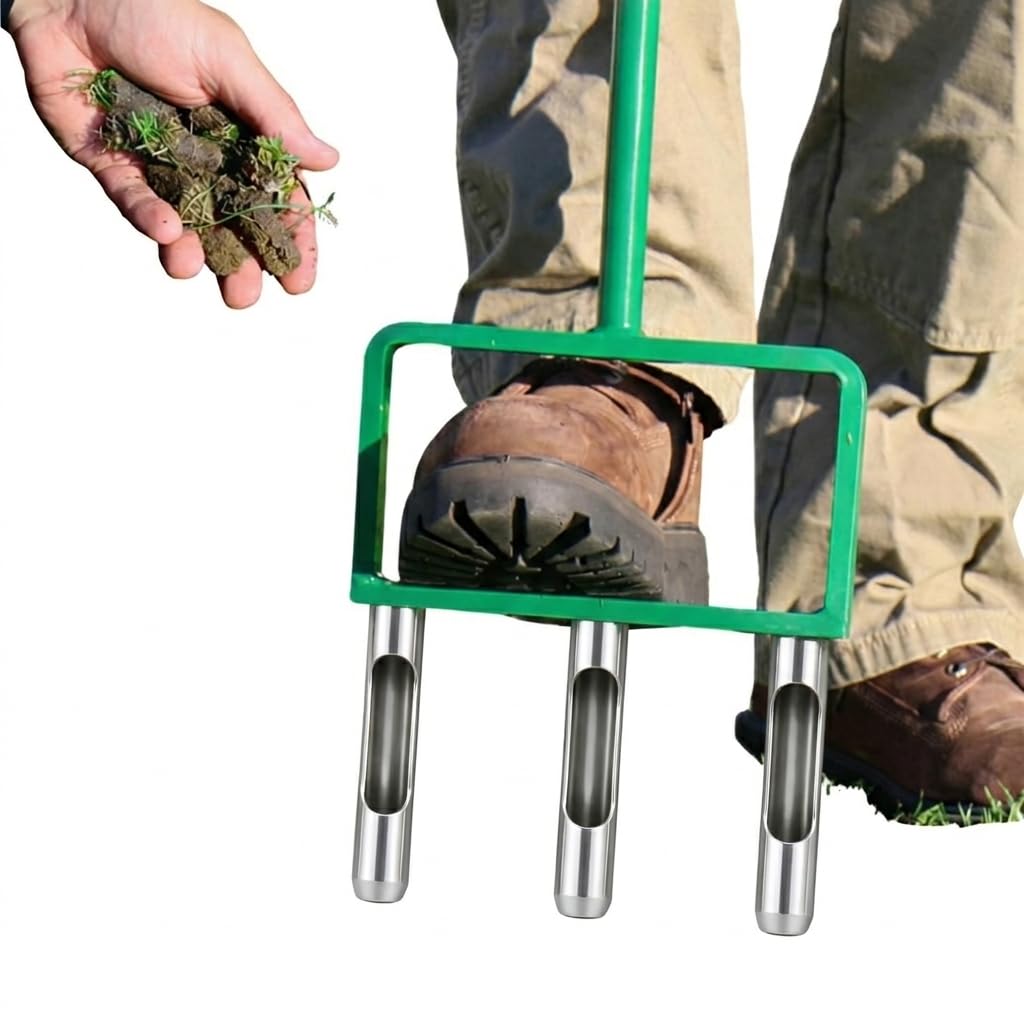
A 5.6-pound stainless steel fork that pulls 4-inch cores in tight spots and needs zero assembly.
The Landzie Fork is the simplest hollow tine aerator on this list: three stainless steel tines on a 42-inch handle, ready to go right from the start. There is nothing to screw together, no hitch pin, no wheels. You just step on the foot bar and press. The beveled tines are designed to eject the core as you lift — owners describe it as “self-cleaning” — so you do not spend half your time unclogging the tool.
It works best on damp soil. The consensus across dozens of owners is that moist ground is the key: after a good rain, the tines sink in easily and produce 4-inch plugs. On dry, baked clay it is a different story — some describe it as “brutal” and recommend renting a power machine for a first-time, heavily compacted lawn. But for an annual maintenance aeration on a small to medium yard (say, up to 2,500 square feet), it is a genuine alternative to renting a tow-behind. One owner did 2,200 square feet in about 4 hours and called it a workout, but appreciated the quality construction and the fact that the tines are replaceable.
The foot bar can get slippery when wet — a minor ergonomic complaint — and the physical demand is real if you have a large area or hard soil. But for a manual tool that feels built to last a lifetime, the Landzie Fork delivers on its promise.
No-fuss simplicity: the tines are already fitted and the tool is ready to use as soon as you unpack it. Replaceable tines keep it going for years.
Soil moisture is everything: on dry ground this turns into a punishing workout — water the lawn the day before or wait for a good rain.
Reach for this if: you have a small to medium lawn and want a quality manual tool that stores flat and requires zero maintenance.
Look elsewhere if: your soil is rock-hard clay or you need to cover more than a quarter-acre — your back will thank you for a power-driven alternative.
5. Suchtale 40-Inch Tow Behind Plug Aerator with Universal Hitch

A budget-priced tow-behind that digs 2-inch cores and holds 125 pounds of ballast for under.
The Suchtale is designed to deliver tow-behind aeration at a price that undercuts the big names. It packs 24 heat-treated plugs and an all-steel frame that weighs 55 pounds — not as heavy as the Brinly, but solid enough to feel substantial. The 2-piece steel draw bar with a universal hitch pin connects to most lawn tractors and ATVs, and the transport handle lets you raise the tines when crossing a driveway. The weight tray holds up to 125 pounds, so stacking a few cinder blocks is easy.
Reviewers point out it works well on clayish soil after a quarter-inch of rain, and one described aerating several acres with ease. The design uses 6 mm thick steel for the adjust handle — thicker than the usual 4 mm, which addresses a common weak point on cheaper rigs. Assembly takes about 90 minutes to two hours, and the instructions are decent though some owners found a few bolts missing (Amazon support resolved those quickly). The biggest caution in the reviews is that on hard surfaces the tines can bend or break if you drag it across pavement, so lift the transport handle before you hit the driveway.
The honest trade-off is longevity. A few owners describe it as “built weak” and say it fell apart after a season — though many others report heavy use without issues. The Suchtale is a solid entry-level buy, but if you plan on aerating every season for the next decade, the extra money for the Brinly or Craftsman buys proven durability.
Bang for your buck: you get a full-size 40-inch tow-behind, 24 tines, and a 125-pound weight tray at a price that beats most competitors by a wide margin.
Reliability is a coin flip: some units work flawlessly for years; a few fail quickly. Inspect it carefully and avoid dragging it over pavement.
Best for: the budget-conscious owner with a riding mower and a medium lawn who wants a functional tow-behind without spending +.
Skip if: you need a machine that will survive rocky soil or heavy clay season after season — pay up for the heavier steel of the Brinly or Craftsman.
6. Landzie AeroCore Rolling Lawn Aerator – Manual Core Plug Aerator with Chamfered Hollow Tines
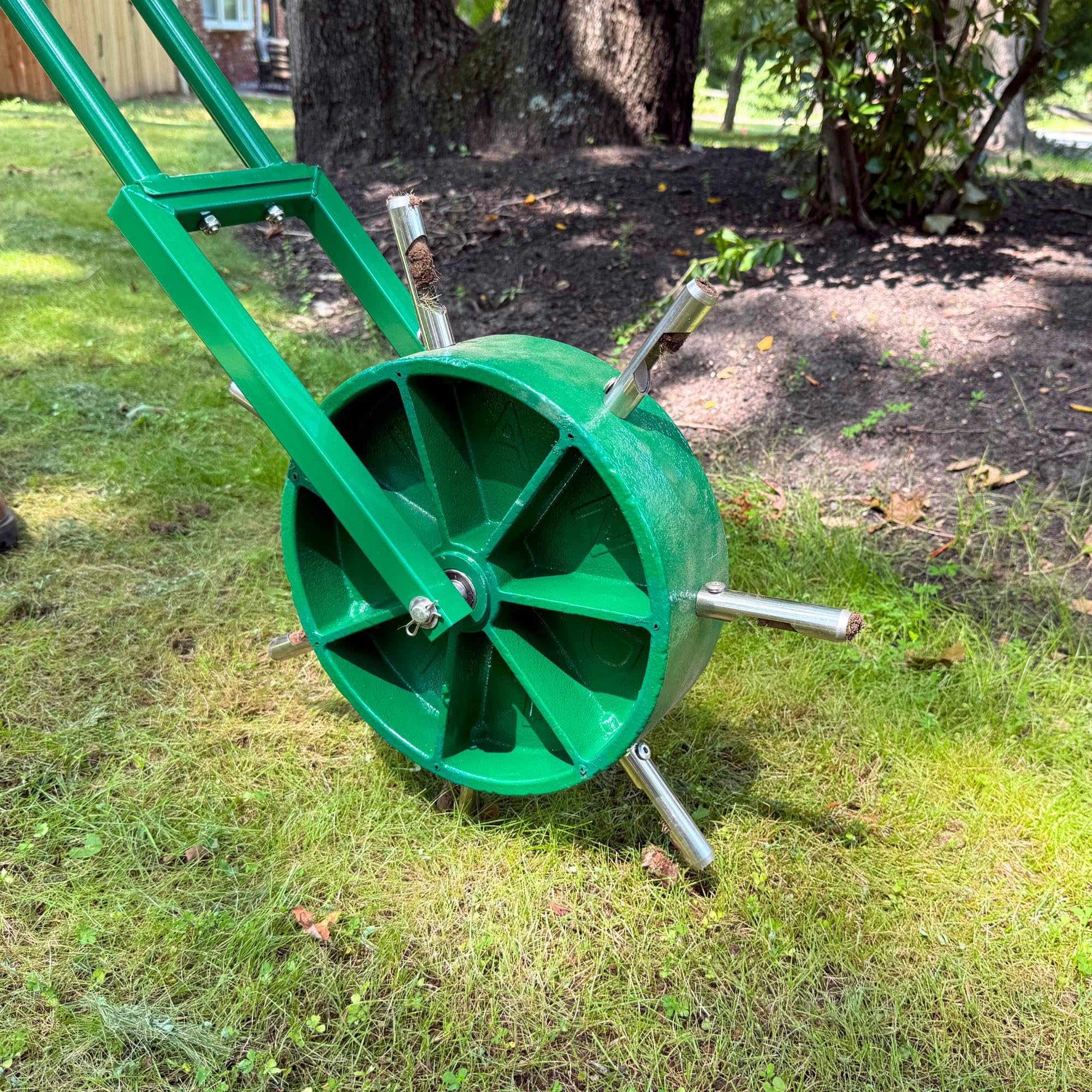
A 50.8-pound rolling drum that self-ejects cores as you push — no stooping, no clearing.
The Landzie AeroCore is the push-along answer to the manual aerator problem. Instead of stepping and tilting, you simply roll the drum forward. Seven stainless steel hollow tines with chamfered (beveled) edges penetrate the soil, pull a core, and eject it back onto the lawn as the drum rotates — so you never stop to clear the tines. At 50.8 pounds, it has enough mass to dig into moderately compacted soil without needing extra weight, but it is still light enough to maneuver by hand.
Owners describe it as “very effective” and a “great economical investment.” The build quality impressed buyers: laminated instructions and wrenches included, and the powder-coated heavy-duty steel frame feels built for the long haul. One owner did 4,500 square feet in about 2 hours with 6-inch passes and preferred it over renting a powered aerator. The rolling design is far easier on the body than a jab-style fork, though it is still a genuine workout — think of it as productive yard cardio.
The tines are replaceable, and the Landzie lifetime guarantee covers the frame. The main drawback is the price — it sits in the premium manual category, and some buyers hesitated before using it. After use, most said it was worth the cost. Assembly is straightforward (use thread locker on the tine bolts), and the whole unit disassembles easily for storage. This AeroCore is for the manual owner who wants rolling efficiency without a tow-behind, not for someone on a tight budget.
Roll-and-go efficiency: the self-ejecting design means no raking and no bending — just push and let the drum do the work.
Heavy but manageable: at 50.8 pounds it has the mass to dig in, but you will feel it on slopes or when moving across hard surfaces without the tines engaged.
Reach for this if: you want a manual aerator that covers ground faster than a step-and-tilt and spares your lower back.
Look elsewhere if: your soil is heavy clay that requires serious ballast — the rolling drum may not penetrate deep enough without repeated passes.
7. Craftsman 40 Inch Tow Behind Lawn Plug Aerator with 24 Galvanized Steel Coring Points and 140 lb Weight Tray

A 78.8-pound sled of galvanized steel that pulls 3-inch cores on 1.5 acres without flinching.
The Craftsman tow-behind is built by Agri-Fab in Sullivan, Illinois, and it is the heaviest rig on this list at 78.8 pounds. That heft translates directly into penetration: you need less additional ballast to get the 24 galvanized steel coring points to dig in. The weight tray supports up to 140 pounds, so if you do face dry or rocky soil you can stack serious weight on it. The tines pull plugs up to 3 inches deep, and the flat-free tires roll smoothly across lawn terrain without going flat.
Owners praise it for handling 1.5 acres of property and describe it as “hardy” — it pierces hard, rocky soil that broke a cheaper model on first use. The lift-handle release system makes transport straightforward, and the whole unit stores vertically against a wall to save garage space. Assembly is the main time investment: most owners spend 2 to 3 hours putting it together. The instructions have a known error in step 12 (an incorrect bolt length), and the engagement lever can pop out on bumpy rides — a bungee cord solves it.
The Craftsman is essentially a rebadged Agri-Fab with a red paint job and a slightly higher price. If you value the Craftsman brand and the 3-year limited warranty, it is a solid buy. But the core machine is the same construction as the Agri-Fab SmartLink system, so you are paying a small premium for the name and the color. It is a heavy-duty, proven design that will handle large lawns and tough conditions for years.
Heavy frame, deep cores: the 78.8-pound all-steel construction and 140-pound tray capacity mean you can pull 3-inch cores in even stubborn soil without adding much weight.
Know the flaws: the instructions have a bolt-length error, and the engagement lever may need a bungee to stay locked on bumpy terrain — small fixes for an otherwise excellent machine.
Best for: owners of large properties (1+ acres) with riding mowers who want a heavy-duty aerator that will last through years of seasonal use.
Skip if: you are on a tight budget or do not have a tractor strong enough to tow 78.8 pounds plus ballast — the lighter Brinly or Agri-Fab is a better fit.
Understanding the Specs
Plug Depth (The Number That Matters Most)
The depth of the soil core an aerator pulls is the single most important spec. A 2-inch plug relieves compaction in shallow-rooted grass, but a 3-inch or deeper plug reaches where the root mass really lives after a season of foot traffic and mower passes. Manual tools like the Step ‘N Tilt pull 3.4-inch cores; tow-behinds typically max out at 3 inches. Deeper is almost always better, but only if your machine can actually penetrate that far — which depends on soil moisture and added weight.
Weight Tray Capacity
Tow-behind aerators rely on ballast to drive the tines into compacted soil. The weight tray rating tells you how much you can stack on: 125 pounds (Suchtale), 140 pounds (Craftsman), or 150 pounds (Brinly). More capacity means you can add cinder blocks or sandbags to push the tines deeper in dry or clay soil. If the tray is too small or missing, the coring points may just skid across the top, especially on a lightweight machine.
FAQ
How often should I aerate my lawn with a hollow tine aerator?
Can I use a hollow tine aerator on wet soil?
Will a hollow tine aerator work in clay soil?
How deep should the plugs be for good aeration?
What is the difference between a spike aerator and a hollow tine aerator?
Can I pull a tow-behind aerator with any riding mower?
How long does it take to assemble a tow-behind aerator?
Do I need to remove the soil plugs after aeration?
Can I use a manual hollow tine aerator on a large lawn?
Will a hollow tine aerator kill my grass?
Final Thoughts: The Verdict
For the majority of shoppers, the hollow tine aerator winner is the Brinly Tow Behind Plug Aerator because it combines a 150-pound weight tray, 3-inch plug depth, and proven 63.9-pound all-steel construction at a price that undercuts heavier-name competitors. If you want a manual option that actually works without destroying your back, grab the Step ‘N Tilt — its tilting mechanism pulls 3.4-inch cores with surprisingly little effort. And for the budget-conscious with a riding mower, the Suchtale 40-Inch delivers functional aeration at a price that leaves room in your wallet for seeding and fertilizer.
How We Picked
We do not accept paid placement. Every pick is matched to a real buyer and a real use-case; we do not hands-on test units.
Sources & Methodology
Specifications: manufacturer listings and product documentation. Review insights: verified customer reviews, as of July 2026. Pricing: not shown on this page (it changes often); check the current price via the retailer link.
As an Amazon Associate, Lawn Gear Lab earns from qualifying purchases. This does not affect which products we feature.