
Specs are compiled from manufacturer listings and verified buyer reviews and can change over time — please confirm the key details on the product page before buying.
You used to have to gamble on who would water your plants when you traveled — and whether they’d drown your ferns or forget your succulents entirely. A drip irrigation system for indoor plants takes that worry off your hands. It delivers a slow, steady supply of water directly to each pot’s root zone, on a schedule you set once and trust for weeks. This guide cuts through the dozens of similar-looking kits to find which ones actually keep your plants healthy while you’re away.
I’m Rikta — the founder and writer behind Lawn Gear Lab. This guide is built by comparing the manufacturers’ published specifications and the patterns across verified customer reviews, so you get each pick’s real strengths and trade-offs instead of marketing spin.
Whether you own a single peace lily or a shelf of picky calatheas, the right system changes everything — and we’ve done the sorting so you can find the best drip irrigation for indoor plants without the guesswork.
Our Picks at a Glance

How To Choose The Best Drip Irrigation For Indoor Plants
A drip irrigation kit replaces manual watering with a pump, timer, and tubes that run to each pot. The challenge is picking the right features so the system fits your home instead of becoming a leaky headache.
Pump Power and Power Source
Some run on AA batteries, some on USB-C, and a few on solar panels. Battery-powered units (like those lasting 2–3 months on a set) are the simplest to place anywhere. USB-C lets you plug into a wall adapter or a power bank, which helps if you’re away for longer than battery life allows. Solar kits add flexibility for a sunny windowsill but still need a USB fallback for winter days.
Number of Plants and Expandability
Each kit supports a stated range — typically 10 to 20 pots. The number of pieces in the box (15, 37, or 41) tells you how many tees, elbows, and emitters you get. More pieces usually mean more flexibility to route tubing around obstacles. If you have a mix of large and small pots, adjustable emitters let you give each plant a different flow rate, which prevents overwatering a succulent next to a thirsty fern.
Timer Flexibility and Watering Modes
A good timer lets you set watering duration (10 seconds to 30 minutes) and frequency (every 8 hours to every 30 days). Some kits add a manual override for extra drinks, a delay function for rainy periods, or a cycle-and-soak mode that breaks the water into several short pulses so the soil absorbs moisture fully before the next burst.
Anti-Siphon Protection
If your water bucket sits higher than the plant pots, gravity can keep pulling water through the tubes even after the pump stops — a siphon effect that floods the lowest plant. A built-in anti-siphon valve or a note to keep the water source below the plants prevents this. Several kits include that valve; a few don’t, and they require careful placement.
Quick Comparison
| Model | Best For | Plants Supported | Power Source | Timer Features | Amazon |
|---|---|---|---|---|---|
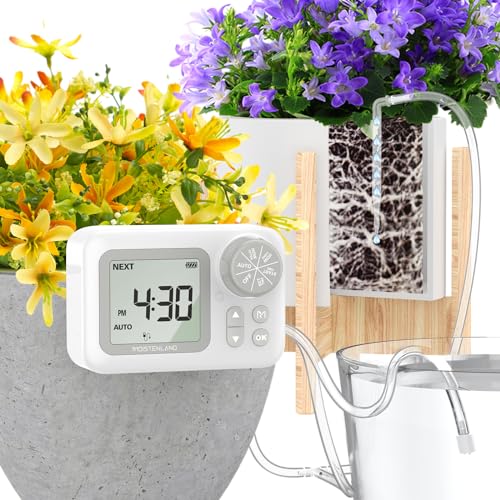
| Moistenland WPS015★ Best Overall | Overall best balance | Up to 15 | Battery / USB-C | Custom schedule, internal clock | Amazon |
| Raddy WS-6Best Value | Budget-friendly reliability | Up to 15 | Battery / USB-C | Start time, duration 0–30 min, interval 1h–30d | Amazon |
| RAINPOINT IK153-NF | Cycle-and-soak precision | 10–15 | USB-C / Rechargeable Battery | Cycle & Soak, delay 24/48/72h, 20s–20min duration | Amazon |
| RAINPOINT ITP159 | Beginner-friendly dials | 10–15 | Battery / Plug-in | Dial-set duration 15s–20min, frequency 6h–14d | Amazon |
| Beday Solar | Solar-powered flexibility | Up to 15 | Solar / USB-C | 490 modes (14 freq × 35 durations), humidity sensor | Amazon |
| DAOTAILI Dual Pump | Two-zone watering | Up to 20 | USB-C / AA Battery | Separate schedules per pump | Amazon |
| LetPot LP-D3-GN | App control and Wi-Fi | 10–20 | USB (adapter included) | App-based schedule, up to 5 tasks, low-water alert | Amazon |
In‑Depth Reviews
1. Moistenland WPS015 — Automatic Watering System, 15 Potted Indoor Plants
Our pick — over 4★ from 250+ verified ratings; the strongest balance of quality and price.
You get 33 feet of tubing and support for up to 15 pots — enough to run across a living room or onto a balcony — but the real reason this kit wins is its internal clock timer that lets you set a precise start time rather than just a repeating interval.
Buyers report it handled a two-week trip without issue, with one buyer saying “my plants look great” after returning. The kit uses battery or USB-C power, so you aren’t stuck hunting for an outlet. Setup takes about 15 minutes according to the maker.
There is one crucial placement rule: because the pump does not have an internal anti-siphon valve (a small device that stops gravity from pulling water through the tubes after the pump shuts off), you must place the water bucket lower than the lowest dripper. The maker claims up to 70% water savings over hand-watering by delivering water slowly at the root zone rather than spraying the leaves.
What wins people over is the ease of programming and the reliable pressure. The digital display is paired with a simple analog knob, and the pump puts out enough flow for two tubes if your layout needs a split. Some LCD units had segment failures after two weeks, so test yours before a long trip.
Where It Shines
- Easy USB-C or battery power
- Reliable for 2-week absences
- Ample pressure for dual-tube setups
One Trade-Off
- No built-in anti-siphon valve — bucket must sit below plants
- Some LCD units had segment failures after two weeks
Bottom line: if you don’t mind the bucket placement rule, this is the most proven, balanced kit for 15 plants that won’t break your budget. skip it if you need siphon protection from the start.
2. Raddy WS-6 — Automatic Plant Waterer for 15 Potted Plants
The water shortage alarm (which goes off when the bucket runs dry) and the included anti-siphon valve make this the safest bet for anyone who wants to walk away and not think about placement rules — unlike the Moistenland, which needs the bucket below the plants.
The timer lets you set a start time (from 12:00 AM to 11:59 PM), a watering duration up to 30 minutes 59 seconds, and an interval anywhere from 1 hour to 30 days — giving you fine control for everything from thirsty tropicals to dormant succulents. Owners consistently call it “very easy to set up” and report happy plants even after month-long trips.
The forced test run immediately after programming is a mild irritation for some — it can overwater if you don’t intercept it quickly. And the LCD is small enough that anyone with vision trouble may need a second pair of eyes.
Smart safety features: the water shortage alarm and anti-siphon valve are exactly the kind of thoughtful extras that prevent ruined floors and dead plants.
One quirk to plan for: that initial test run dumps more water than you want — be ready to shut it off manually.
Ideal for: the traveler who wants a self-contained kit with protections that work without any placement guesswork.
Consider skipping if: the small screen is hard for you to read, or you dislike any post-setup fiddling.
3. RAINPOINT IK153-NF — Indoor Large Display Automatic Plant Waterer Kit
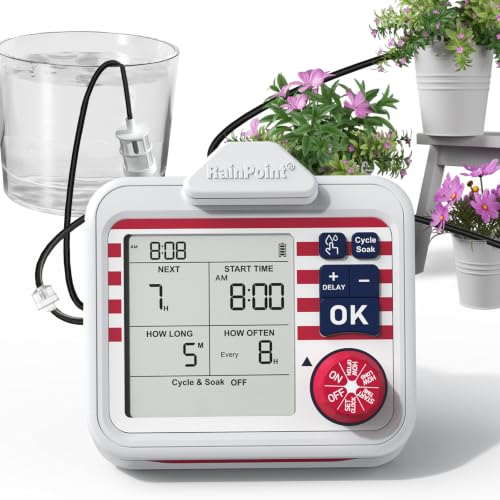
Its Cycle & Soak mode is the only one here that breaks water into short pulses with waiting periods — giving dense potting soil time to absorb each burst before the next one arrives so heavy-feeding plants get fully saturated without runoff.
The maker claims this saves up to 30% water and can boost yields by 18%. The 37-piece kit includes tubing, a main line, branch lines, and 10 drip emitters (a drip emitter is the small plastic tip that releases water one drop at a time right at the soil). It’s designed for 10 plants from the start, but you can expand to 15 with an additional accessory pack. The frequency can stretch from every 8 hours to once every 30 days, and duration runs from 20 seconds to 20 minutes.
The biggest note from the review pages is the water distribution is mixed — some owners mention very even delivery, while others found plants near the pump got more than distant ones. The anti-backflow valve helps, but tubing routing matters. Changing any setting (even the clock) resets the entire schedule, which is a frustration when you just want to adjust for a rainy week.
Standout feature: Cycle & Soak is genuinely useful for gardeners who want to boost absorption and reduce waste — no other kit at this price offers it.
One annoyance: any setting change wipes the schedule, so dial in your timing once and don’t touch it until you return.
Perfect for: the detail-oriented plant parent who wants advanced watering techniques without paying app-connected prices.
Not the best fit if: you need to tweak settings frequently or have plants spread out across very different distances from the pump.
4. RAINPOINT ITP159 — Easy-Setup Automatic Plant Waterer Indoor
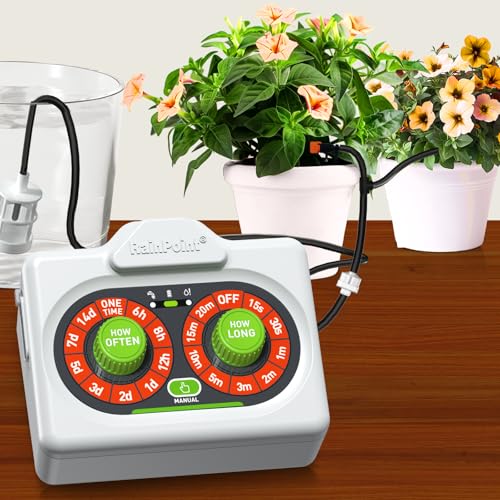
Two dials and no digital screen — you twist one for duration (15 seconds to 20 minutes) and the other for frequency (every 6 hours to every 14 days) — so there is zero menu navigation to learn.
The IP54 weather resistance (splash-proof but not fully waterproof) means you can use it on a covered balcony without worry. The adjustable emitters let you dial the flow per plant from a trickle to a steady drip — useful when you have a jade plant next to a thirsty fern. A low-water LED indicator and automatic shut-off protect the pump when the reservoir runs dry. Owners praise how it saved their plants during 5 to 21-day vacations.
A recurring complaint involves the tubing folding and causing leaks, which often depends on keeping the hose straight during install. Some owners also found uneven water flow, with certain plants getting flooded while others stayed dry.
Why Newbies Love It
- No programming steps — just turn two dials
- Low-water auto shut-off protects the pump
- Adjustable emitters for different plant needs
The Catch
- Fewer fittings limit complex routing
- Cheap tubing can kink and cause uneven flow
Best for: anyone who wants automatic watering without learning a manual — just dials, water, and go.
Remember to: keep the tubing runs as straight as possible and test flow to every emitter before you leave.
5. Beday Solar Drip Irrigation System — 490 Timer Modes, 50FT

It offers 14 frequencies (every 1 hour to every 7 days) and 35 durations (10 seconds to 30 minutes) — that is 490 combinations — plus a soil moisture sensor (a probe that checks if the ground is still wet) so you can automate a 10-second splash for a succulent or a 30-minute soak for a ficus on one schedule.
The dual charging is the practical hero here: during sunny weeks the solar panel keeps the battery topped up, but when winter clouds roll in you can charge via USB without changing the unit’s position. The 50-foot hose gives you more reach than most other kits (like the Moistenland’s 33 feet), which is a significant advantage for a sprawling indoor garden or a long balcony.
Reliability is what owners praise most — with 140 positive mentions, it’s the clear standout. But a minority report units failing within 2–3 weeks, and the maximum interval of 7 days (not 30 like the RAINPOINT) means some dormant winter plants may get too much water.
Best independence: solar plus USB means this system keeps running through seasons without you touching it.
Worth checking before your trip: run it for a few days at home — most units are rock-solid, but a small batch showed early failures.
Ideal for: plant owners with a sunny window or balcony who want to avoid any power cord running across the room.
Where it falls short: the 7-day max interval won’t suit every plant’s winter dormancy, and non-standard tubing is hard to extend.
6. DAOTAILI Dual Pump Automatic Watering System — Up to 20 Plants

Two self-priming pumps (pumps that can pull water upward from a lower reservoir) each run their own timer — so you can water succulents every 10 days on pump A while pump B delivers daily drinks to a row of herbs, all from one unit.
The kit supports up to 20 plants and includes PTC connectors (small fittings that lock tubing in place more securely than plain barbed connectors). The pump draws from any household container — bucket, bottle, or jug — and runs on USB-C or 4 AA batteries. Owners say the dual-zone design prevents overwatering and that the pump “delivers water quickly” for balcony flower boxes and tomatoes. One buyer summed it up: “my plants were well taken care of while I was away.”
The mixed feedback centers on the timer itself. A few units arrive with an unresponsive control panel that won’t let you set the day or time, making the system effectively useless. That seems to be a quality-control issue rather than a design flaw, but it’s worth testing the programming the day it arrives.
what separates it
- Two pumps with separate schedules
- Supports up to 20 plants
- PTC connectors for leak-resistant tubing
Honest Downsides
- Timer control can be unresponsive on some units
- Heavier than single-pump kits at 1.14 kg
Pick this if: your plants have two very different watering schedules that a single pump can’t handle.
Check carefully: test the timer programming immediately — a small number of units fail here, and you want to know before you leave.
7. LetPot LP-D3-GN — Wi-Fi & App Controlled Drip Irrigation Kit

It connects to your home Wi-Fi so you can adjust watering from anywhere through the app — a feature no other kit here offers — and the German-imported silent pump is quiet enough for a bedroom.
You can set up to 5 watering tasks, each with its own schedule, frequency, and duration. The app also sends low-water alerts so you know when the bucket is empty. The IP66 waterproof rating (strong water resistance — better than the RAINPOINT ITP159’s IP54 splash rating) means you can use it outdoors on a balcony without worry. The 41-piece kit includes 10 meters of tubing and supports 10 to 20 pots, with adjustable drippers for individual flow control. The maker recommends soaking the pipe ends in warm water above 70°C for easier assembly.
Reliability and easy setup are the most-praised aspects (85 and 71 positive mentions respectively). But connectivity is a mixed bag — while many connect smoothly, some struggle with Wi-Fi pairing. The emitters are also hard to adjust compared to other kits, and a small number of owners reported the hose slipping off the pump barbs, leading to water on the floor.
Smartest system here: app control, silent pump, and IP66 weatherproofing make this the most polished all-in-one package.
Be ready for: potential Wi-Fi hiccups during initial setup, and fittings that demand a firm push — particularly for smaller hands.
Grab this for: the tech-savvy plant lover who wants to monitor and adjust from anywhere, especially with a mix of indoor and balcony plants.
Consider something simpler if: you don’t want to depend on an app and Wi-Fi for basic watering, or if the connect-first approach feels like extra friction.
Understanding the Specs
Watering Duration and Frequency
Duration is how long the pump runs each session (from 10 seconds up to 30 minutes). Frequency is how often that session repeats (from every 1 hour to once every 30 days). A shorter duration with a higher frequency (e.g., 2 minutes every 12 hours) mimics natural rainfall. A longer duration with a lower frequency (e.g., 20 minutes every 7 days) gives deep-rooted plants a thorough soak. The right combination depends on pot size, plant type, and room temperature — no single setting works for everything.
Cycle and Soak Mode
Instead of dumping all the water in one continuous run, Cycle and Soak splits the total watering time into several short bursts with waiting periods in between. The soil absorbs each burst fully before the next one arrives, which means less runoff and deeper root penetration. It is particularly useful for dense potting mix that tends to shed water when poured fast. Only a few kits (notably the RAINPOINT IK153-NF) offer this as a dedicated mode.
Anti-Siphon Valve
If your water bucket sits higher than the drip emitters, gravity can pull water through the tubing even after the pump stops — this is the siphon effect. An anti-siphon valve (or anti-backflow valve) breaks that suction so water stays in the bucket. Some kits include one in the box; others rely on you placing the bucket below the lowest emitter. Always check whether your unit has the valve or requires deliberate positioning.
Number of Pieces and Expandability
The piece count includes everything in the box: the pump, tubing, tees, elbows, emitters, end plugs, and any filter or valve. A 41-piece kit gives you more fittings to route around obstacles than a 15-piece kit. If your plant layout is complex — multiple shelves, corners, or pots at different heights — a higher piece count is worth the extra upfront cost. Most kits are expandable with separately sold accessory packs.
FAQ
Will a drip irrigation system work for a single plant on my desk?
Can I use tap water or do I need distilled water?
How do I prevent the pump from sucking air when the water runs low?
Can I use a drip irrigation system for outdoor balcony plants?
What is the difference between a drip emitter and a sprinkler stake?
How often should I clean the drippers and tubing?
Can I run two separate watering schedules with a single pump?
Will the system work with a water reservoir larger than 5 gallons?
Is a Wi-Fi connected system worth the extra cost?
What happens during a power outage?
Final Thoughts: The Verdict
For most buyers, the drip irrigation for indoor plants winner is the Moistenland WPS015 because it balances USB-C or battery power, reliable scheduling, and a proven track record with 15 plants — all at a price that doesn’t strain your budget. If you want the simplicity of two dials and zero programming, grab the RAINPOINT ITP159. And for full app-based control, silent operation, and weatherproof build that suits both indoors and out, the LetPot LP-D3-GN is the one to reach for. Every kit in this list will keep your plants alive while you’re away — the right choice depends entirely on how much control you want over the details.
How We Picked
We do not accept paid placement. Every pick is matched to a real buyer and a real use-case; we do not hands-on test units.
Sources & Methodology
Specifications: manufacturer listings and product documentation. Review insights: verified customer reviews, as of July 2026. Pricing: not shown on this page (it changes often); check the current price via the retailer link.
As an Amazon Associate, Lawn Gear Lab earns from qualifying purchases. This does not affect which products we feature.