
Specs are compiled from manufacturer listings and verified buyer reviews and can change over time — please confirm the key details on the product page before buying.
A green pond is a tough thing to fix by tossing in chemicals or swapping pumps. The real answer is a filtration system matched to your pond’s volume — something that traps muck, grows good bacteria, and zaps algae with UV light all at once. We dug through the owner reports on seven models rated for 1,300 gallons and up to find which ones actually deliver clear water without becoming a maintenance nightmare.
I’m Rikta — the founder and writer behind Lawn Gear Lab. This guide is built by comparing the manufacturers’ published specifications and the patterns across verified customer reviews, so you get each pick’s real strengths and trade-offs instead of marketing spin.
Whether you keep a small koi pond or manage a larger backyard water garden, this roundup helps you identify the right large pond filtration system for your specific setup and water conditions.
Our Picks at a Glance


How To Choose The Best Large Pond Filtration System
Picking the wrong filter usually means one of two things: a pond that stays green despite your best efforts, or a filter that clogs so often you dread the weekend. Three key specs separate effective filters from frustrating ones: gallon rating, UV wattage, and filtration stages.
Match the gallon rating to your actual pond volume (with a buffer)
Filter makers rate each unit for a maximum pond size in gallons. That number assumes an average fish load and moderate sun exposure. If you have a heavy fish load (koi produce a lot of waste) or your pond bakes in direct sunlight, step up to a filter rated for double your pond’s actual volume. A filter for a 1,500-gallon pond on a shaded 1,200-gallon pond with a few goldfish will work fine. Put it on a sunny 1,000-gallon koi pond, and you will be fighting algae all summer.
UV clarifier wattage is the green-water killer
A UV light (measured in watts) zaps free-floating algae cells that turn water pea-soup green. Once you cross into the 3,000-to-4,000-gallon range, a 24-watt or 36-watt lamp becomes essential. If the UV wattage is too low for your pond volume, algae outpace the bulb and the water stays green.
Mechanical vs. biological filtration — you need both
Mechanical filtration traps leaves, fish waste, and debris with sponges, foams, or bead media. Biological filtration grows beneficial bacteria on a surface area (bio-balls, lava rock, or bead media), and those bacteria break down ammonia and nitrites from fish waste. A filter with only sponges handles mechanical debris but skips the biological stage that breaks down fish waste. Look for a multi-stage system that includes both a mechanical stage and a biological stage.
Quick Comparison
| Model | Best For | Max Pond Size (gal) | UV Wattage | Item Weight (lb) | Amazon |
|---|---|---|---|---|---|
| Laguna PF3000★ Best Overall | Heavy-duty all-in-one performance | 3000 | 24W | 26 | Amazon |
| TetraPond Bio-ActiveBest Value | Budget-friendly bio-filtration | 1500 | — | 9 | Amazon |
| VIVOHOME Bio Pressure | Fast filtration with UV | 2600 | 13W | 14.3 | Amazon |
| Flexzion Bio Pressure | Large pond on a budget | 3200 | — | 16.6 | Amazon |
| Half Off Ponds 4000 Gal | Big algae outbreaks | 4000 | 36W | 23 | Amazon |
| Aquascape UltraKlean 2000 | Low-maintenance operation | 2000 | 14W | 11.5 | Amazon |
| EasyPro PBF6000 | Huge ponds with heavy fish loads | 6000 | — | 69 | Amazon |
In‑Depth Reviews
1. Laguna PF3000 24W Pressure Flo Filter
Our pick — over 4★ from 250+ verified ratings; the strongest balance of quality and price.
A 26-pound European-built tank that drops green water overnight and backwashes without drama.
This is the unit that keeps coming up in owner accounts as the one that finally cleared a pond after years of trying other filters. The three-stage approach — foam mechanical filtration, bio-lava rock for bacteria growth, and a 24-watt UV lamp — attacks particulate, ammonia, and algae all at once. The pond size rating is 3,000 gallons, and the included 3,200 grams of Bio-Lava Rock gives beneficial bacteria a substantial surface area to colonize.
The real-world payoff is speed: buyers report visible clarity improvements within a day. Owners mention water clarity improvement “noticeable overnight” and ponds that had been “terribly dirty and green for years” turning clear for the first time. At 26 pounds, this is a hefty unit — at 26 lb versus the TetraPond Bio-Active filter’s 9 lb — and that bulk reflects the stainless steel construction and the volume of media packed inside. The patented backwash system gets a lot of praise for making cleaning simple without disassembly.
Nearly 300 ratings consistently praise filter quality, ease of use, and value. A small number of customers note UV lamp issues, so it pays to check the bulb connection during setup.
What wins people over
- Filter quality draws by far the most praise — a clear owner consensus
- Backwash system is genuinely easy; a turn does the job
- Water clarity in as little as 24 hours according to multiple reports
The honest trade-off
- At 26 lb it is the heaviest filter in this roundup by a wide margin
- A few owners hit UV lamp failures; inspect on arrival
Reach for it if: you have a pond up to 3,000 gallons and want a filter that owners say works fast and cleans easily — this is the most consistently recommended unit in the list.
Think twice if: weight and bulk are a concern for your setup, or you want a filter you can partially bury to hide it.
2. TetraPond Bio-Active Pressure Filter
A lightweight, budget-friendly bio-filter that proved effective on ponds far beyond its 1,500-gallon rating.
One owner ran this on a 2,200-gallon pond and reported that it cleared algae and stopped pump clogs within ten days. That is a telling result for a unit rated for 1,500 gallons. The bio-activator media provides the biological surface area, and the backflush valve makes cleaning straightforward. The total weight is only 9 pounds, making it the lightest pressure filter here by a significant margin — at 9 lb versus the Laguna PF3000’s 26 lb.
The trade-off is that this filter is purely biological and mechanical — there is no UV clarifier built in. If green water from suspended algae is your primary problem, you will need a separate UV unit. The owners point out that the 2-inch fittings are large; you may need reducers if your tubing is 1 inch. Functionality and filter quality lead the owner consensus as the most-discussed strengths.
Durability gets the most negative mentions. A small number of reviewers point out the O-ring splitting or the unit failing after a few months. Given the very low purchase price, consider it a strong seasonal performer rather than a decade-long investment.
Perfect entry point: a low-cost way to add biological filtration without a UV system. Buy it if you already have a UV clarifier or your pond stays clear of green water.
Know this going in: shoppers say that spare parts can be hard to find, so you may be replacing the whole unit if something breaks.
3. VIVOHOME Bio Pressure Pond Filter with 13W Light

A multi-stage filter that handles up to 2,600 gallons with a built-in 13W UV — at a mid-range price point.
The filtration train here is more layered than most: two blue 20 PPI (pores per inch) sponges for coarse trapping, two yellow 25 PPI sponges for finer capture, and a chamber of bio-balls for biological breakdown. The 13-watt UV lamp runs on an 8,000-hour rated life (roughly one season of continuous use) and handles green-water algae effectively in most ponds up to the 2,600-gallon ornamental rating or 1,300-gallon fish-stocked rating. The maximum flow rate of 2,630 GPH (gallons per hour) pairs well with most submersible pumps in that size class.
Owner feedback splits: water clarity earns praise, while durability and leakage draw the most complaints. One buyer in Michigan using a heated pond reported the UV unit stopped working after a year because water seeped past a missing seal. The filters themselves are easy to access — the modular lid comes off, and the sponges lift out — but the red float indicator that signals cleaning time can rise quickly in a heavily stocked pond.
VIVOHOME includes four hose adapter sizes (3/4, 1, 1.25, and 1.5 inches) which solves the fitting mismatch problem that frustrates owners of some competing brands.
What stands out
- Four-layer sponge setup catches debris progressively, from coarse to fine
- Four hose adapters included — fits most pump sizes from the start
- Red float indicator takes the guesswork out of cleaning timing
What to watch for
- Durability concerns are the most common negative thread; some units fail within a year
- UV lamp seal appears vulnerable to water ingress in cold climates
Best fit for: a pond owner who wants sponges that are easy to wash and a UV light included, without spending premium money.
skip it if: you need something that will run reliably through harsh winters without seal issues, or you dislike troubleshooting warranty claims.
4. Flexzion Bio Pressure Pond Filter with UV-C Light Clarifier
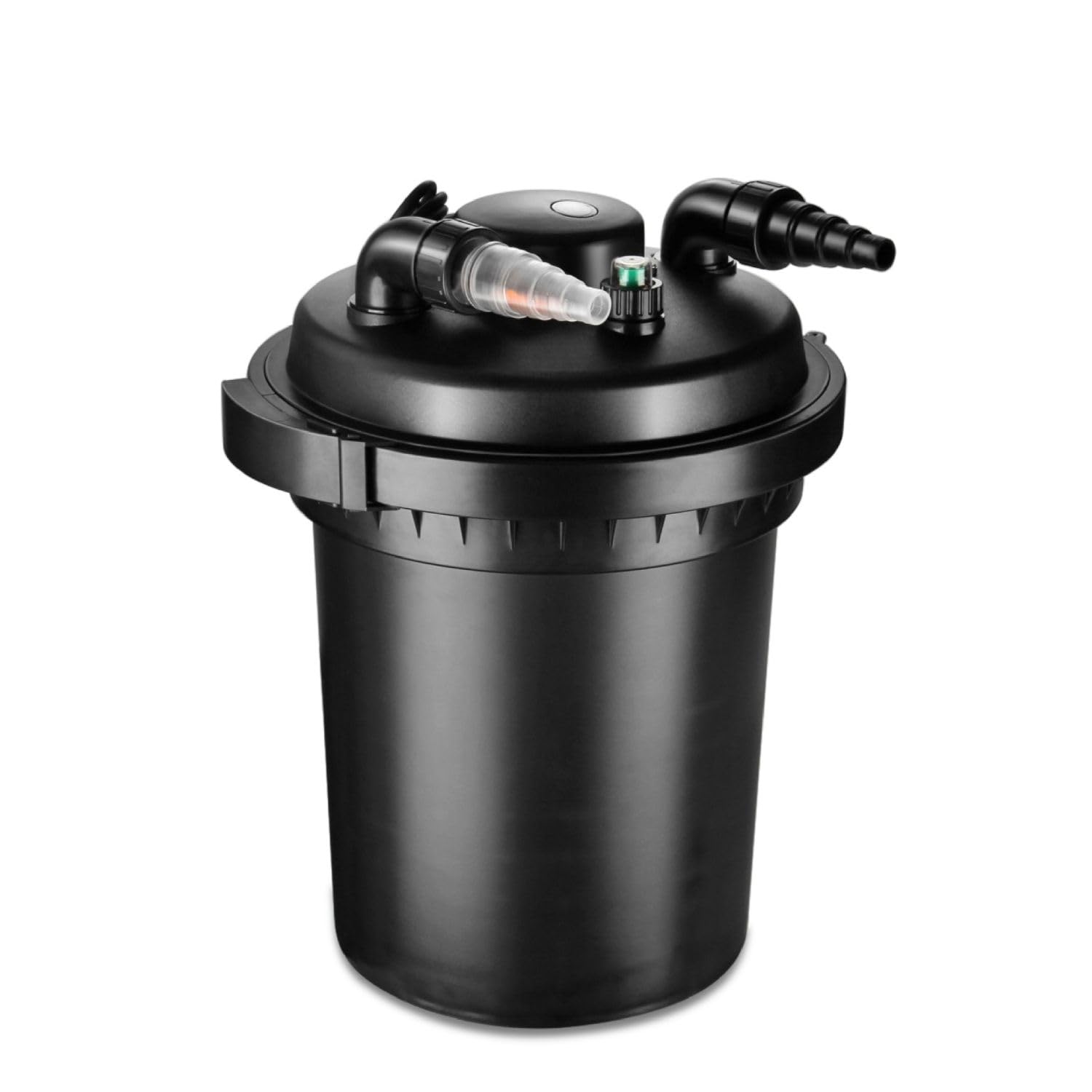
Rated for up to 3,200 gallons, this entry-level pressure filter cleans quickly but has a weak spot in the UV assembly.
Buyers report that this unit clears cloudy, rain-stirred water in about a day and fully clears a 2,000-gallon pond in full sun within a week. The multi-stage setup uses four removable sponges (two blue coarse, two yellow finer) plus a bio-ball chamber for biological filtration. Installation runs about 30 minutes and the kit includes everything except hose clamps. At roughly 16.6 pounds, it is manageable for one person to position.
The drawback that keeps this from being a top pick is the UV light durability. Multiple owners mention the UV clarifier failing within a month or two, and the replacement process sometimes requires returning the whole unit first — leaving the pond unfiltered for days. A buyer whose unit leaked from the top received a replacement that worked well with a 3,200 GPH pump, but the pattern of early UV failure appears too often to ignore. Owners note excellent value but flag UV reliability as a genuine concern.
Honest take: for the rated capacity and the price, this filter punches above its weight — but plan on the UV clarifier being a potential first-season casualty. If you can accept that and treat the UV as a bonus rather than a given, the mechanical and biological stages do solid work.
5. Half Off Ponds 4000 Gal Pressure Filter with 36W UV Clarifier
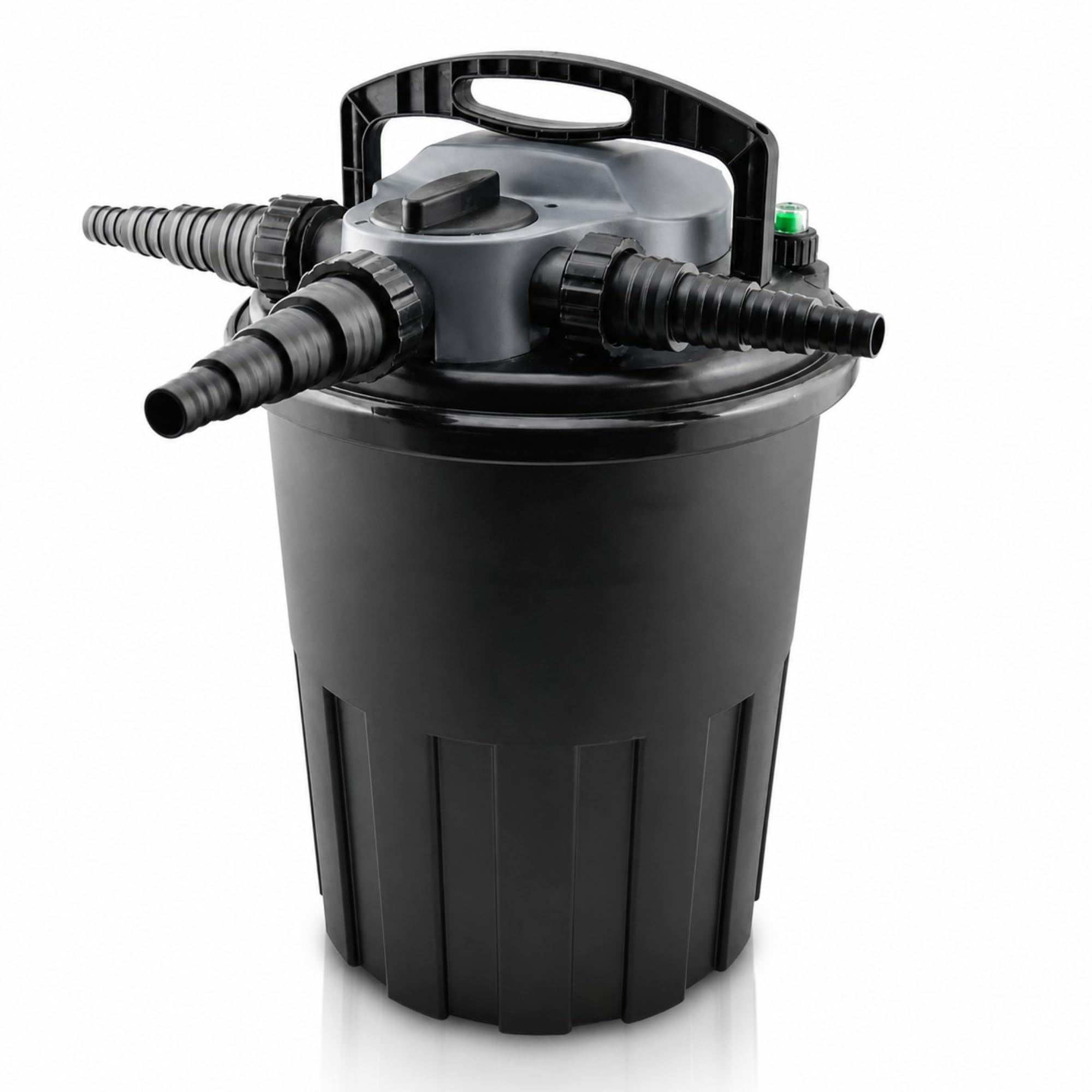
The most powerful UV in this lineup — a 36W clarifier — takes on ponds up to 4,000 gallons with serious algae problems.
When nothing else kills the green, a 36-watt UV bulb is a convincing hammer. The Half Off Ponds filter pairs that heavy-duty lamp with a two-stage mechanical filtration system (coarse then fine particulate removal) inside a watertight, buryable housing. The pump flow rate range of 2,000 to 4,100 GPH accommodates most external pumps. A glowing monitor on the unit confirms the clarifier bulb is running, and a visible indicator tells you when the filter needs backwashing.
Owner reports are dramatic: one buyer saw a 5,000-gallon pond turn crisp after three weeks. One buyer with a 5,000-to-6,000-gallon pond that had already killed koi from severe algae saw the water turn crisp after three weeks with this filter — after failing with UV lights, bio filters, and chemicals. Another saw fish become visible in five days and full clarity in just over a week. The backwash lift handle gets praise versus twist-handle designs on other brands. However, a notable minority reports that internal plastic components broke when switching from pump mode to clean mode, and the manufacturer was unhelpful about replacement parts.
At 23 pounds and dimensions of 17 x 18 x 27 inches, this is a large unit. It can be partially buried, which helps conceal it in a landscape setting.
The big win
- 36W UV is the most powerful clarifier here — tackles algae that weaker bulbs cannot touch
- Backwash indicator and lift-handle cleaning are genuinely convenient
- Many owners saw clarity in days, even on very large, neglected ponds
The catch
- Plastic internal parts broke for some owners on the first clean cycle
- Instructions are sparse; support line is reportedly helpful
- Seal requires careful alignment to prevent drips
Reach for this if: you have a pond over 3,000 gallons with stubborn green water and you want the strongest UV you can buy at this price.
Look elsewhere if: you want metal internal parts and a manufacturer that stocks replacement components readily.
6. Aquascape UltraKlean 2000 Gallon Biological Pressure Filter

A sponge-free, bio-bead design that backwashes in minutes and makes UV bulb swaps tool-free.
The UltraKlean deliberately avoids foam sponges. Instead, it uses floating bio-balls that tumble during the backwash cycle, shaking debris loose without ever opening the housing. The backwash itself takes less than five minutes by turning a dial. The 14-watt UV clarifier twists off for bulb changes — no tools, no disassembly. The unit is rated for ponds up to 2,000 gallons with a maximum flow rate of 2,700 GPH.
Owners who pair this with a skimmer (pre-filter for leaves and large debris) report the best results. Without a skimmer, the bio-balls can struggle with heavy particulate load because the design is tune for biological filtration rather than trapping leaves. One owner saw green water turn crisp within three days running the UV on a 6-hour cycle. The UV bulb lifespan, however, ran closer to 3-4 months for some owners rather than the full season, which is a common pattern across many brands.
The 11.5-pound weight is modest for this class, and the 13-inch cube footprint fits into tighter spaces than most pressure filters. The lack of a separate UV model from TetraPond means this is a direct alternative if you want biological + UV in one unit without sponges to replace.
Best for the low-touch owner: the dial-flush and twist-off UV make this the least labor-intensive filter on the list. You give up some mechanical filtering power compared to a multi-sponge design, so pair it with a skimmer if your pond gets leaves.
7. EasyPro PBF6000 Pressurized Bead Filter

A 69-pound bead filter for 6,000-gallon ponds that does both mechanical and biological work without restricting pump flow.
Bead filters are a different animal from sponge-and-bio-ball units. The EasyPro PBF6000 uses polyethylene bead media that traps free-floating particles mechanically while simultaneously hosting beneficial bacteria for biological filtration. The key advantage is that the beads create very little back pressure on the pump — unrestricted flow is a specific design goal here. The 3-year warranty on the heavy-duty polyethylene body reflects the build quality expected at this level.
The owner with a 15x12x5 koi pond reports it works great, and another who spent 30 years replacing cheaper filters every few years says their pond has “never been so clear.” The backwash line includes a clear section so you can watch the cleaning cycle and stop when the water runs clear — a nice touch for precision. At 69 pounds and a gravity-fed installation type, this is not a weekend DIY project for most people. The control head works similarly to a pool filter and often requires two people to handle.
A recurring installation note: do not fill the bead media before inserting the top control module. Insert the top first, then add the medium through the side. Some owners also note that the K2 media can escape through the outlet and clog pipes downstream, which requires checking the outlet fitting during setup.
The serious upside
- Handles 6,000-gallon ponds — by far the highest capacity here
- Bead media creates minimal pump resistance vs. foam filters
- 3-year warranty on the tank body
The serious caveats
- 69 pounds and requires two people to install the control head
- Occasional media migration through the outlet has been reported
- Premium price point — this is a long-term investment, not a trial purchase
Buy this if: you have a large pond (4,000+ gallons) with a heavy fish load and you want a bead filter that will last years with proper maintenance — the owners who made the switch say it is the clearest their pond has ever been.
Pass on this if: your pond is under 3,000 gallons, you have a tight budget, or you want a filter one person can lift and install alone.
Understanding the Specs
UV Clarifier Wattage
The number on the bulb (13W, 14W, 24W, 36W) tells you how much ultraviolet energy is hitting the water. A 36W bulb kills algae cells faster and in larger volumes than a 13W bulb. For a pond under 2,000 gallons, 13W to 14W is usually enough. For 3,000 to 4,000 gallons, step up to 24W or 36W, especially if the pond gets full sun or has a heavy fish load.
GPH Flow Rate
Gallons per hour measures how much water the filter can process each hour. A higher GPH means the entire pond volume cycles through the filter more times per day. A good rule is to turn the pond over at least once every two hours. So a 2,000-gallon pond needs a system rated for at least 1,000 GPH of sustained flow. The pump you pair with the filter matters just as much as the filter itself.
Mechanical vs. Biological Media
Mechanical media (foam sponges, pads) physically trap leaves, algae clumps, and fish waste. Biological media (bio-balls, lava rock, bead media) provides surface area for beneficial bacteria that convert toxic ammonia and nitrites into less harmful nitrates. A good filter includes both stages. A filter with only sponges will strain out debris but will not process the invisible chemical waste that stresses fish.
Backwash System
A backwash valve lets you reverse the water flow through the filter to flush trapped debris out a waste port, without opening the unit and removing media by hand. Some designs use a dial or handle (Laguna, Aquascape), some use a lift handle (Half Off Ponds). An effective backwash system is the difference between a 5-minute weekly chore and a 30-minute messy disassembly. The cleaning indicator (red float or pressure gauge) tells you when it is time.
FAQ
How often should I clean my pond filter?
Can I bury a pressure filter to hide it?
What size filter do I need for a 2000-gallon koi pond?
How long do UV clarifier bulbs last?
What is the difference between a pressure filter and a gravity-fed filter?
Do I still need a UV clarifier if my pond is shaded?
How do I know when the filter needs backwashing?
Can I run a pond filter in winter?
What size hose do I need for my pond filter?
Is a bead filter better than a sponge filter for a large pond?
Final Thoughts: The Verdict
For most buyers, the large pond filtration system winner is the Laguna PF3000 because it combines proven water-clearing speed with an easy backwash system and a 24W UV lamp — backed by the strongest owner consensus in this group. If you want a lightweight bio-filter on a budget, grab the TetraPond Bio-Active. And for a monster pond over 4,000 gallons where nothing else will do, the EasyPro PBF6000 is the one to reach for.
How We Picked
We do not accept paid placement. Every pick is matched to a real buyer and a real use-case; we do not hands-on test units.
Sources & Methodology
Specifications: manufacturer listings and product documentation. Review insights: verified customer reviews, as of July 2026. Pricing: not shown on this page (it changes often); check the current price via the retailer link.
As an Amazon Associate, Lawn Gear Lab earns from qualifying purchases. This does not affect which products we feature.