
Specs are compiled from manufacturer listings and verified buyer reviews and can change over time — please confirm the key details on the product page before buying.
Getting a pepper plant to survive is easy. Getting it to produce a cascade of fiery fruit that actually tastes hot — that is the real trick. The difference between a sad, flower-dropping stem and a bush laden with habaneros depends on one thing: the right nitrogen-to-potassium ratio. You need a formula that fuels foliage early, then flips the switch to fruit and capsaicin (the compound that gives peppers their heat) production when it counts.
I’m Rikta — the founder and writer behind Lawn Gear Lab. This guide is built by comparing the manufacturers’ published specifications and the patterns across verified customer reviews, so you get each pick’s real strengths and trade-offs instead of marketing spin.
Every fertilizer here was chosen for its ability to meet the specific demands of Capsicum (scientific name for pepper) plants, from the vegetative stretch through harvest. These are the picks that earn a spot in any serious gardener’s shed, and finding the right one is what this guide to the best hot pepper fertilizer is all about.
Our Picks at a Glance


How To Choose The Best Hot Pepper Fertilizer
Hot peppers are heavy feeders, but they hate being over-fed at the wrong time. The key is matching the N-P-K ratio (nitrogen, phosphorus, potassium) to the plant’s life stage. Too much nitrogen early on gives you a giant, leafy bush with zero fruit. Too little potassium later on, and your pods will lack heat and substance.
Nitrogen for Leaves, Potassium for Heat
Look for a fertilizer where the middle number (phosphorus) and the last number (potassium) are higher than the first (nitrogen) once the plant starts flowering. Potassium is especially critical for peppers — it drives the production of capsaicin (the compound that gives peppers their burn). A 5-10-10 or 11-11-40 ratio is far better for fruiting than a balanced 5-5-5 lawn feed.
Granular vs. Liquid: Timing is Everything
Granular, slow-release fertilizers are a low-maintenance solution for in-ground plants. You mix them into the soil at planting and reapply monthly. Liquid and water-soluble powders act fast, making them perfect for container plants or correcting a nutrient deficiency in days — but they require more frequent mixing and application.
Micronutrients and Calcium
Blossom-end rot (black, sunken spots on the bottom of peppers) is a classic pepper problem. It happens when the plant cannot transport calcium fast enough to developing fruit. A fertilizer with added calcium (like the 5% calcium in Espoma’s Garden-tone) or a formula with chelated micronutrients (like the EDTA-chelated iron, manganese, zinc, and copper in Greenway Biotech) prevents this and keeps your pods flawless from tip to stem.
Quick Comparison
| Model | Best For | N-P-K Ratio | Form | Weight/Volume | Amazon |
|---|---|---|---|---|---|
| FoxFarm Happy Frog 5-7-3★ Best Overall | All-around plant health & soil life | 5-7-3 | Granules | 4 lb | Amazon |
| Growth Technology Chili FertilizerPremium Pick | High-yield liquid feeding | 1:200 mix | Liquid | 100 mL | Amazon |
| Cz Garden 5-10-10Top Performer | Fruiting stage boost | 5-10-10 | Granules | 4 lb | Amazon |
| Espoma Garden-tone 3-4-4 | Organic feeding for peppers & tomatoes | 3-4-4 | Granules | 4 lb (2-pack) | Amazon |
| Down To Earth 4-6-2 | Gentle all-organic garden feeding | 4-6-2 | Granules | 5 lb | Amazon |
| Espoma Plant-tone 5-3-3 | All-purpose organic growth | 5-3-3 | Granules | 4 lb (2-pack) | Amazon |
| Greenway Biotech 11-11-40 | Max capsaicin & heat production | 11-11-40 | Powder | 1 lb | Amazon |
| TPS Nutrients Pepper Fertilizer | Quick rescue for stunted plants | — | Liquid | 32 oz | Amazon |
In‑Depth Reviews
1. FoxFarm Happy Frog Tomato & Vegetable Fertilizer 5-7-3
Our pick — over 4.5★ from 600+ verified ratings; the strongest balance of quality and price.
This 5-7-3 granular fertilizer includes mycorrhizal fungi and added calcium, making it the one bag that reliably carries peppers from seedling to harvest.
If you want one bag of granules that works from seedling through harvest without you having to think too hard, this is it. The 5-7-3 ratio provides a balanced profile that supports vegetative growth and strong flower development without causing a nitrogen overdose. But what really sets Happy Frog apart from the Cz Garden 5-10-10 is the mycorrhizal fungi (beneficial soil organisms that attach to roots and improve water and nutrient uptake) included in the mix — those beneficial organisms dramatically improve water and nutrient uptake, giving you a bigger root system below ground for a bigger harvest above.
Buyers report a zucchini that went from “not thriving” to covered in blooms after a single application. The 4-pound bag is a generous size that easily covers several planting rows or a container garden of six to eight pepper plants. And because it comes as dry granules, there is no mixing, no measuring of liquid concentrate, and no pump sprayer required — you scratch it into the soil and water it in.
The dedicated calcium content is a smart preventative against blossom-end rot (the dreaded black spots on the bottom of peppers). At 4.8 out of 5 stars, this stuff is effectively a consensus pick among home gardeners who grow tomatoes and peppers side-by-side.
What wins people over: The plant health results are the most-discussed aspect by a wide margin — the testimonials back up the claim that this fertilizer materially improves bloom counts and fruit quality.
The honest trade-off: It is formulated for vigorous feeders like tomatoes and peppers, so if you are growing more delicate herbs alongside, you might need a lighter hand with the application rate.
Reach for this if: You want a single, reliable granular feed that covers peppers, tomatoes, berries, and leafy greens without guesswork.
Look elsewhere if: You need a high-potassium finisher specifically for super-hot peppers — the 5-7-3 ratio is more of a generalist than a heat specialist.
2. Growth Technology 05-210-100 Chili Fertilizer
With a 1:200 mixing ratio, this liquid fertilizer is the only one designed specifically for chili plants — not a relabeled tomato feed — so your harvests get a precision nutrient boost.
Growth Technology makes the only liquid nutrient solution on the market that is designed explicitly for chili and pepper plants. The 1:200 mixing ratio means you add just five milliliters (about one teaspoon) to a liter of water, making the small 100-milliliter bottle significantly more concentrated than standard tomato feeds. This is a professional-grade product for people who treat their pepper garden like a laboratory — you mix fresh at every watering and use it from the very start.
Buyers who use it on jalapeños, bell peppers, and ghost peppers report a huge increase in fruit set and flavor. The 4.1-star rating across over 800 reviews reflects its effectiveness: the harvest feedback is consistently positive, with repeat buyers ordering four times or more. The catch is the bottle size. A single 100 mL bottle goes fast if you have many plants, and the liquid concentrate is less economical per plant than a 4-pound bag of granules.
Some growers find it depletes too quickly for heavy feeders like ghost pepper plants in 5-gallon pots. For a dedicated super-hot grower, the larger 300 mL or 1-liter bottles make more sense.
The Yield Advantage
- Specifically formulated for chilies and peppers — not a re-labeled tomato feed
- Balanced nutrition you use from the start, supporting healthier plants and juicier fruits
- Buyers who reorder describe harvests as “amazing” and “very fruitful”
The Size Reality
- 100 mL is very small for a heavy-feeding pepper garden; expect to buy the larger bottle
- Requires mixing at every watering — less convenient than a slow-release granular
This is for: The hobbyist who enjoys the ritual of mixing nutrients and wants a precision formula for pots or hydroponics.
skip it if: You want a low-maintenance granular for a large in-ground garden — this needs constant attention.
3. Cz Garden 5-10-10 Tomato & Vegetable Fertilizer
With a 5-10-10 ratio that doubles phosphorus and potassium over nitrogen, this granular feed is built to push pepper plants into heavy fruit production once they start flowering.
Once your pepper plant has established a canopy of leaves, you want to switch to a low-nitrogen, high-phosphorus-and-potassium formula like this 5-10-10 blend. The middle number (phosphorus) and last number (potassium) are double the nitrogen, which tells the plant to stop growing leaves and start setting fruit. This Cz Garden fertilizer adds a 2% iron plus a full suite of micronutrients, so your peppers stay vibrant green and productive deep into summer.
Buyers who have used it for years say it “has never burned my plants” and produce what they call “huge tomatoes” and, by extension, massive peppers. It comes in a heavy-duty resealable pouch instead of a box, which is a small but appreciated detail — you can pour out exactly one to two tablespoons per plant and seal the rest away from moisture. The Effectiveness aspect is the most-praised by a wide margin, with owner feedback consistently pointing to vigorous fruiting results.
The main thing to know is that this is a fruiting-stage feed, not an all-season formula. You would want a higher-nitrogen feed for the first month of growth, then switch to this at bloom time.
Why gardeners love it: The bag lasts a long time — owners mention using a single bag per year for a garden that includes tomatoes, peppers, and squash.
Fair warning: Opinions on the value are mixed; some find it expensive relative to generic 5-10-10 blends, so check the cost per pound before buying multiple bags.
Best suited for: The gardener who already has a balanced fertilizer for early growth and wants a phosphorus-rich finisher for August.
Think twice if: You need a single all-purpose feed — this is very specifically a fruiting-booster.
4. Espoma Organic Garden-tone 3-4-4 (Pack of 2)

With 8 pounds total and 5% calcium to fight blossom-end rot, this organic 2-pack gives you more volume than the Down To Earth at a lower cost per pound.
This is a 2-pack of 4-pound bags, giving you 8 pounds total of a respected organic fertilizer for the price of a single bag of some competitors. The 3-4-4 analysis is a gentle, non-burning formula that is perfect for peppers, tomatoes, squash, and melons. It contains 5% calcium, which is a direct line of defense against blossom-end rot — a common frustration for pepper growers. The inclusion of Espoma’s exclusive Bio-tone formula (a proprietary blend of beneficial microbes) provides beneficial microbes that break down organic matter in the soil and make nutrients available to the roots.
Buyers using Garden-tone in Zone 10b (a warm climate zone) reported record harvests: one urban gardener pulled 400 pounds of tomatoes and 100 pounds of carrots in a single season. The feedback consistently calls it a “standout” for extending the productive life of heat-stressed plants. It is approved for organic gardening and carries a registered Organic Input Material designation, so there is no guesswork about compliance.
The trade-off is that the 3-4-4 ratio is very light on nitrogen. It will not give you explosive leafy growth in early spring the way a 5-7-3 or a fish emulsion would. You want to use it monthly throughout the growing season, which means you need to stay on schedule.
Why This is a Bargain
- 2-pack provides 8 lbs of organic fertilizer — enough for a full-season pepper and tomato garden
- Contains 5% calcium to prevent blossom-end rot without extra supplements
- Bio-tone formula feeds soil microbes, improving long-term soil health
The Limitation
- Low nitrogen (3) means you need a separate starter feed for the first 4 weeks
- Some owners describe the smell as unpleasant, though it fades after watering in
Grab this if: You run a certified organic garden or just prefer natural inputs and want 8 pounds of effective, slow-release nutrition.
Pass if: You want a high-nitrogen all-season feed — you will need a different product for the vegetative stage.
5. Down To Earth All Natural Fertilizers 4-6-2

Made from fish bone meal, blood meal, and rock phosphate, this OMRI-listed (certified for organic use) 5-pound box feeds the soil itself over the long term, not just the plant for a season.
This is the fertilizer for gardeners who think of feeding their soil as a long-term investment. The 4-6-2 formula comes from a blend of fish bone meal, blood meal, feather meal, rock phosphate, langbeinite, greensand, humates, and kelp meal. That is a serious ingredient list — each component brings a different macro or micronutrient, and together they build soil fertility and microbial activity over time. It is OMRI-listed for organic production, meaning you can use it without worry if you are growing for a farmers’ market or a strict organic kitchen garden.
Buyers describe it as a replacement for “15 separate products” in their shed. The 5-pound box lasts a long time: one owner with an active garden said it lasts nearly a year. The thing everyone praises is the quality — 46 buyers single it out as the top aspect. The consensus is that it revives pale, flimsy plants within two weeks and produces very healthy vegetables. It is a gentle, non-burning formula, so you can use it around transplants and seedlings without fear.
Honestly, the main complaint is the odor. It has an unpleasant, fishy smell that some owners find off-putting, and if you do not work it into the soil, it can attract raccoons. The smell dissipates in a couple days, but the initial application is not a pleasant experience.
What wins people over: The ingredients list is transparent and high-quality — you can see exactly what you are applying, no mystery fillers.
The honest trade-off: The odor is the most-discussed negative; apply it on a breezy day and water it in immediately to minimize the smell.
Reach for this if: You are an organic purist who wants a single-box solution for vegetables, herbs, flowers, and container plants.
Look elsewhere if: You are sensitive to smells or garden in a tight space where the odor might be a nuisance.
6. Espoma Organic Plant-tone 5-3-3 (Pack of 2)

With 8 pounds total and a higher nitrogen count than Garden-tone, this all-purpose feed handles pepper plants alongside your roses and maple trees without needing a separate bag.
Plant-tone is the broader, more general cousin of Garden-tone. The 5-3-3 analysis provides a higher nitrogen count that supports all plants — flowers, vegetables, trees, and shrubs. This is the fertilizer you use if you have a diverse landscape and want a single bag to feed your pepper patch, rose bushes, and front-yard maple. The natural organics break down slowly, creating a long-lasting reservoir of nutrients that does not wash away in heavy rain. It also contains 5% calcium, offering the same blossom-end rot protection as Garden-tone.
Buyers in the landscaping business use Plant-tone for their professional plantings. One owner runs a gardening business and applies it to every new perennial, noting that it gives plants a healthy start and strong spring growth. The 2-pack gives you 8 pounds of fertilizer, which is a substantial amount for the price. It requires no mixing — you simply sprinkle it around the drip line of the plant and water thoroughly.
The smell is a recurring note in reviews. It is described as “foul smelling as chicken poop,” and owners advise standing upwind when applying. If you are purely growing peppers in containers on a patio, the odor might be a deterrent. For in-ground garden beds, it dissipates quickly and is a non-issue.
Why It Stands Out
- 8 lbs total for less than many single 4-lb bags — exceptional value per pound
- Bio-tone formula feeds the soil food web, improving long-term fertility
- Works on everything from peppers to perennials to shade trees
What to Know
- The odor is strong; apply upwind and water in thoroughly
- Higher nitrogen (5) means it is not tune for the fruiting stage of super-hots
Best for: The gardener with a mixed yard who wants one organic feed to cover flowers, vegetables, and shrubs.
Not ideal for: The super-hot enthusiast looking for a bloom-specific high-potassium finish.
7. Greenway Biotech Pepper & Herb Fertilizer 11-11-40
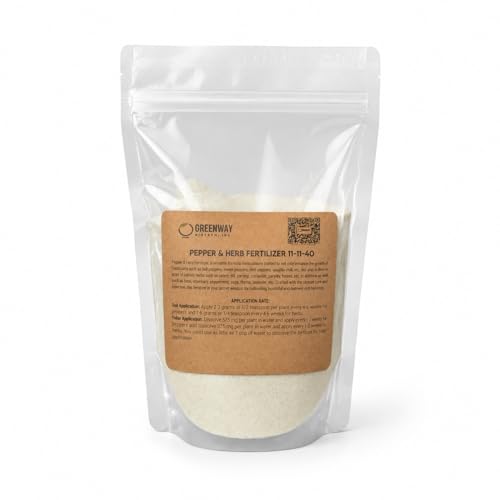
The 40% potassium (K) in this water-soluble powder forces pepper plants into extreme capsaicin production, making it the go-to for ghost peppers and Carolina Reapers — sharper than the FoxFarm Happy Frog for heat.
If your goal is a ghost pepper or Carolina Reaper that truly hurts, this is the fertilizer you need. The 11-11-40 ratio is unlike anything else on this list: it delivers an ultra-high potassium content (40% K) specifically to drive capsaicin production in hot peppers and essential oil concentration in herbs like basil and oregano. The balanced 11-11 nitrogen and phosphorus support vigorous overall growth, but the real story is the potassium — it signals the plant to channel energy into chemical defense compounds, which is what makes a pepper hot.
The powder is 100% water soluble and dissolves completely in room-temperature water, making it ideal for soil drenches, foliar sprays, drip irrigation, and even hydroponic systems like NFT (nutrient film technique), DWC (deep water culture), and Dutch bucket setups. Greenway also adds a complete micronutrient package with iron, manganese, zinc, and copper in EDTA-chelated form (chemically bonded so nutrients stay available from pH 4 to 9). Chelation means these nutrients remain plant-available across a wide pH range of 4 to 9, so you do not get nutrient lockout in alkaline or acidic water. One pound of powder makes up to 200 gallons of fertilizer solution at the recommended 0.5 pounds per 100 gallons rate.
Buyers saw results “within the first couple days of application” — slow-growing pepper plants took off and produced a heavy harvest. The productivity aspect is the most-praised, with owners noting increased blossoms and fruit size on both in-ground and container plants. The 4.6-star rating reflects a product that performs exactly as promised for its specific niche.
The thing everyone raves about: The speed of visible results — plants that were stalled show new growth and buds in a matter of days.
The honest trade-off: This is a specialist tool, not a general-purpose feed. The ultra-high potassium ratio is wrong for the vegetative stage; you need a high-nitrogen starter first.
This is for: The serious chili head growing super-hots in containers, hydroponics, or a controlled garden environment.
Not for: Casual gardeners who just want one bag for everything — this requires stage-specific feeding and careful measurement.
8. TPS Nutrients Pepper Fertilizer Liquid 32 oz

This 32-ounce liquid concentrate acts in days to reverse yellowing, flower drop, and stalled growth — one reviewer says it rescued “severe yellowing, flower drop, and die-off” in both sweet and hot peppers.
Sometimes your pepper plants just stop. The leaves turn pale, the flowers drop off, and nothing seems to help. That is exactly the scenario this 32-ounce liquid formula was built for. TPS Nutrients designed it specifically to support strong root development, healthy foliage, and steady plant growth — then push the plant into flowering and fruit production. It works on both hot peppers and sweet peppers, making it versatile for garden beds and containers alike.
The feedback from owners is about rescue and recovery. One grower watched their bell peppers turn “dramatically” green and start blooming after a different brand had failed. Another described it as reversing “severe yellowing, flower drop, and die-off” in both sweet and hot peppers. The plant growth aspect is the most-praised by a wide margin, with the pepper performance aspect close behind. For anyone whose plants are struggling, this is a fast-acting intervention you can apply at the next watering.
The main criticism is the price point — owners acknowledge it “works great” but find it a little pricey for a quart of liquid. Since it is a liquid concentrate, you will use it faster than a granular bag, so factor that into the long-term cost if you have many plants.
Why It Saves the Day
- Fast-acting liquid — you see results in days, not weeks
- Works for both hot peppers like chili and sweet bell peppers
- Promotes strong roots and foliage while also driving flowering and fruiting
The Downside
- Liquid concentrate runs out faster than granular; cost per feeding is higher
- Some owners find it pricey for the 32-ounce bottle size
Best for: The gardener with a few struggling pepper plants who needs a quick, effective fix to get them back on track.
pass on it if: You have a large in-ground pepper patch and want the lowest cost per plant — stick with a granular option.
Understanding the Specs
N-P-K Ratio
Every fertilizer label shows three numbers separated by hyphens, like 5-10-10. These stand for Nitrogen (N, fuels leaf and stem growth), Phosphorus (P, supports root development and flower formation), and Potassium (K, drives fruit quality, disease resistance, and capsaicin production). For hot peppers, you want a ratio where the K number is higher than the N number once the plants start flowering.
Slow-Release vs. Liquid
Granular fertilizers like FoxFarm Happy Frog and Espoma Garden-tone break down gradually over weeks, providing a steady supply of nutrients. They are ideal for in-ground gardens because you apply them once a month. Liquid fertilizers, like the Growth Technology Chili Fertilizer and TPS Nutrients, are absorbed immediately by the roots and leaves. These are better for container plants, hydroponics, or correcting a nutrient deficiency quickly.
FAQ
Can I use tomato fertilizer on my hot peppers?
How often should I fertilize my pepper plants?
What is the best N-P-K ratio for hot peppers?
Do I need to use an organic fertilizer for peppers?
How do I prevent blossom-end rot on my peppers?
Can I use these fertilizers on pepper plants in containers?
What does chelated mean in fertilizer?
Is a 5-10-10 fertilizer good for all pepper varieties?
Final Thoughts: The Verdict
For most people, the best hot pepper fertilizer winner is the FoxFarm Happy Frog 5-7-3 because it delivers reliable, all-season nutrition with mycorrhizal fungi and calcium for a wide range of pepper varieties without guesswork. If you are specifically after max heat and capsaicin production, grab the Greenway Biotech 11-11-40. And for the budget-conscious organic gardener, the Espoma Garden-tone 2-pack is the one to reach for.
How We Picked
We do not accept paid placement. Every pick is matched to a real buyer and a real use-case; we do not hands-on test units.
Sources & Methodology
Specifications: manufacturer listings and product documentation. Review insights: verified customer reviews, as of July 2026. Pricing: not shown on this page (it changes often); check the current price via the retailer link.
As an Amazon Associate, Lawn Gear Lab earns from qualifying purchases. This does not affect which products we feature.