
Specs are compiled from manufacturer listings and verified buyer reviews and can change over time — please confirm the key details on the product page before buying.
You load a tray with damp soil and a dozen precious seedlings, lift it by the edges, and watch the whole thing sag, flex, and nearly dump your work on the floor. That wobbly plastic is the biggest headache in seed starting. The solution isn’t tricky — you need a tray thick enough to carry the weight without bending, and built to survive season after season of water, heat, and handling.
I’m Rikta — the founder and writer behind Lawn Gear Lab. This guide is built by comparing the manufacturers’ published specifications and the patterns across verified customer reviews, so you get each pick’s real strengths and trade-offs instead of marketing spin.
Whether you are starting tomatoes under a grow light or running a microgreens operation on wire shelves, the difference between a flimsy pan and a truly rigid base makes or breaks your setup. This guide cuts through the noise to find the best heavy duty seed starting trays that actually hold up under real growing conditions.
Our Picks at a Glance

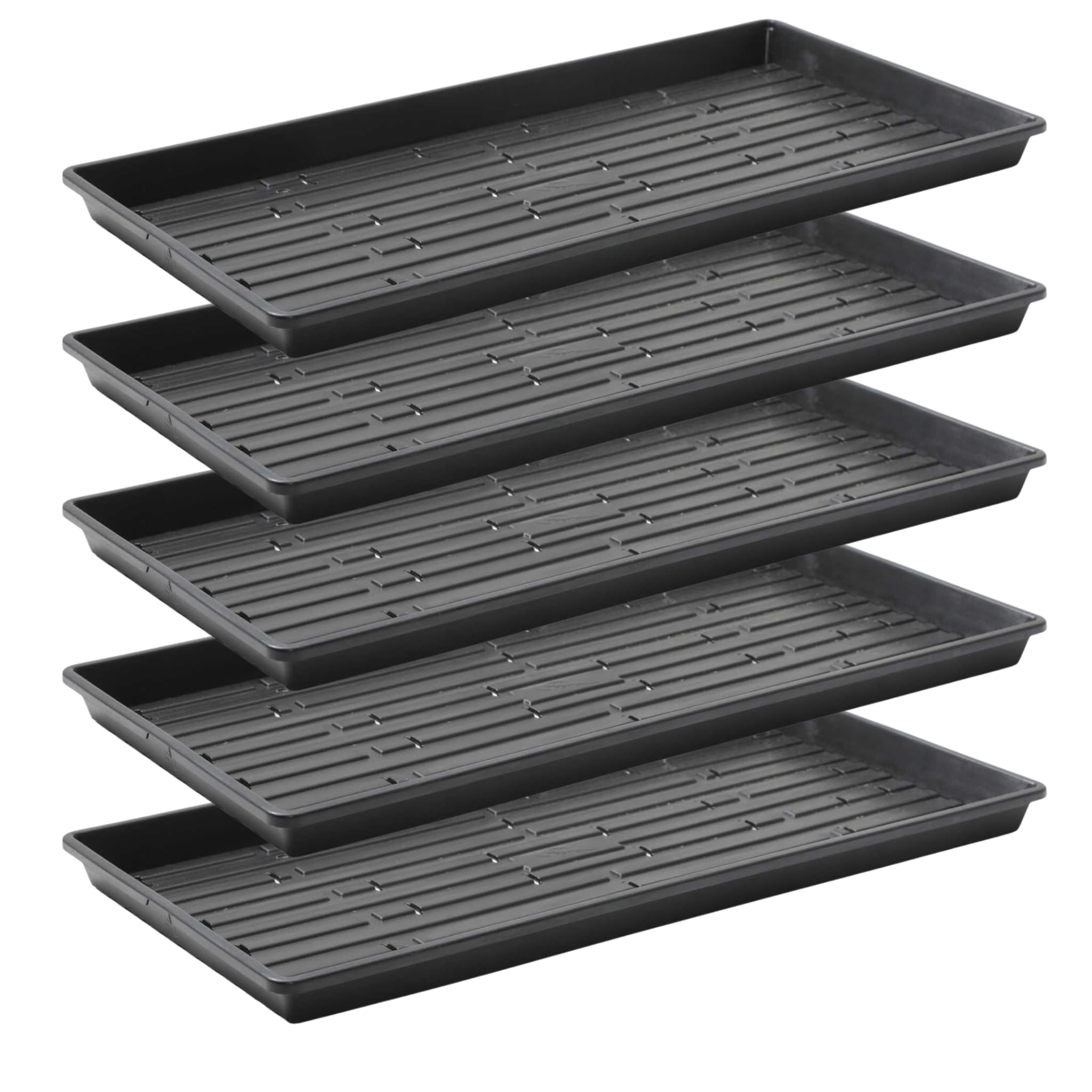

How To Choose The Best Heavy Duty Seed Starting Trays
Almost all cheap trays use thin plastic that cracks after one season. A truly heavy duty tray is defined by a few concrete, measurable features. Here is what actually matters.
Plastic Thickness (The Real Number)
A “heavy duty” label means nothing without a thickness measurement. Look for trays that list their wall thickness in millimeters. A tray at 1.2mm or thicker will not flex when you lift it full of soil, whereas standard 0.4mm trays buckle under the same load. Thicker plastic also resists cracking when exposed to temperature changes from heat mats or cold garages.
Solid Bottom vs Drain Holes
No-hole trays let you water from the bottom — you pour water into the tray and the soil wicks it up, keeping leaves dry and reducing the risk of damping-off disease. Trays with holes are better if you are using them as a flat to hold individual cell inserts, where you want excess water to drain away freely. Many serious growers keep both types on hand.
The 1020 Standard Fit
The industry standard for seed starting trays is roughly 10 inches by 20 inches. A “1020” tray will fit most wire shelving units, humidity domes, and cell inserts. Non-standard sizes are fine as long as you know what you are buying, but if you want your new trays to work with all your existing gear, 1020 is the safe bet.
Quick Comparison
| Model | Best For | Thickness | Material | Drain Holes | Amazon |
|---|---|---|---|---|---|
| Hemlock Home 1020 5-Pack★ Best Overall | Best Overall | 1.2mm | Polypropylene | No | Amazon |
| Bootstrap Farmer 1020 5-PackPremium Pick | Commercial Grade Flat | Thick PP | Polypropylene | Yes | Amazon |
| RooTrimmer 1020 10-PackTop Performer | Heavy Duty No-Hole Bulk | 1.8mm | PS | No | Amazon |
| Germinator 6-Pack | Compact Microgreens | 1.5mm | Polysterene | No | Amazon |
| Mr. Pen 10-Set Kit | Complete Starter Kit | Durable Plastic | Plastic | Yes | Amazon |
| Epic Gardening 6-Cell | Root-Friendly Cells | UV-Treated Plastic | Recycled Plastic | Yes (slots) | Amazon |
| SOLIGT 10-Pack | Value Multi-Pack | Extra Thick | Plastic | No | Amazon |
| RooTrimmer 54-Cell 10-Pack | Deep Root Cells | Thickened | PS | Yes (cells) | Amazon |
| Bootstrap Farmer 72-Cell 5-Pack | Cell Insert Toughness | Thick Plastic | Recycled Plastic | Yes (cells) | Amazon |
In‑Depth Reviews
1. Hemlock Home Brewing 1020 Seed Starting Trays (5-Pack)
Our pick — over 4.5★ from 450+ verified ratings; the strongest balance of quality and price.
The tray that ended the search for thickness — 1.2mm that laughs at flimsy alternatives.
You can feel the difference as soon as you pick one up. The plastic is thick enough that it does not flex under the weight of a dozen full nursery pots. Buyers report it as “1.2mm vs 0.4mm for flimsy jiffy trays,” and in practice that means you can fill it with soil, saturate it with water, and carry it one-handed without the bottom sagging or the sides bowing outward.
The solid, no-hole design is ideal for bottom-watering — you pour an inch of water into the tray and let the pots wick it upward, keeping the foliage dry and reducing the chance of damping-off. Owners mention holding water for deep watering sessions, a real plus for seedlings that need consistent moisture. The green color is a small but appreciated detail that makes it easy to grab the good tray instead of the cracked black ones.
With a 4.8-star score across a wide pool of verifiable buyers, the honest trade-off is the upfront cost — it is not the budget option — but as one buyer put it after buying them twice, “they don’t flex much, they hold water for deep watering, and they last.” The 5-pack delivers five standard 21 x 10.75 x 2.5 inch flats that are built to serve for multiple seasons of heavy use.
The Real Edge: At 1.2mm thick, this tray is three times the thickness of cheap alternatives, and the polypropylene construction resists cracking even when stored stacked in a cold garage.
The Honest Caveat: The price has crept up according to some repeat buyers, and there are no drainage holes, so these are strictly for bottom-watering or as a catch tray — not a direct propagation flat with holes.
Reach for this if: You want one set of trays to last for years and you bottom-water your seedlings.
Look elsewhere if: You need trays with drainage holes or you are on a strict entry-level budget.
2. Bootstrap Farmer Extra Strength 1020 Trays (5-Pack, with Holes)
The shallow flat that microgreen growers swear by — thick PP that does not twist.
Bootstrap Farmer is the brand that serious microgreen growers reach for. These trays are 1.25 inches deep, which is deliberately shallow to make harvesting microgreens easier — you can run a knife across the entire tray without the sides getting in the way. The polypropylene construction is BPA-free, food-safe, and dishwasher safe, so you can sanitize between batches.
The durability is the headline. The official data confirms these are made to withstand heat mats and humidity domes without warping. Buyers consistently praise the thick PP construction, noting it “prevents twisting and folding” and handles the daily cycle of heavy watering and harvesting. The cross-channel drainage pattern on the bottom is also a smart upgrade over standard trays, allowing more even water distribution.
The honest discussion among owners centers on whether the price is worth it compared to thinner trays that need replacing every year. The consensus from hundreds of ratings is clear: this is an investment in a tool that lasts seasons, not months. For anyone running a microgreens setup or a serious propagation schedule, the shallow depth and rugged build make this a top-tier choice.
The defining feature: Shallow 1.25-inch depth is specifically designed for easy microgreen harvest — no more digging into a deep tray.
The trade-off: Not the best choice for deep-rooted seedlings that need more soil volume for extended growth before transplanting.
Perfect for: Microgreen growers who need a durable, dishwasher-safe flat they can use daily for high-volume harvests.
Not for: Starting tomatoes or peppers that will live in the tray for weeks before transplanting.
3. RooTrimmer 10 Pack 1020 Trays (No Holes, 1.8mm Thick)
At 1.8mm thick, this is the thickest standard tray in the roundup — built to shrug off abuse.
RooTrimmer pushes the thickness further than most. The trays are made from PS (polystyrene) material with a reinforced 1.8mm wall thickness, which the company states resists twisting and bending even under heavy loads. The bottom features deeper concave-convex stripes that add structural rigidity and also hold more water for longer-bottom watering sessions.
The 10-pack counts as the most trays you get in one premium bundle, and each measures a standard 1020 size (roughly 10 x 20 inches interior) that fits most nursery shelves and humidity domes. Because there are no drainage holes, these work as catch trays for your existing cell inserts or as standalone microgreens flats. Owners consistently note the thick plastic holds up “even when filled with seedling cells full of soil and water.”
One recurring observation from verified buyers is that the fit of older gear can be slightly off — one owner found that their older 1020 inserts did not sit perfectly inside these new trays. Worth checking your specific inserts for compatibility. Aside from that, the durability feedback is overwhelmingly positive, with multiple owners describing them as a multi-year purchase for greenhouse use.
The headline stat: 1.8mm thickness is the highest confirmed measurement in this guide — noticeably stiffer than standard 1020 trays.
What to watch: Some owners mention fit issues with older 1020 inserts; verify your cell trays are designed for this specific sizing.
Best for: Greenhouse operators who need a bulk pack of the thickest possible no-hole trays for bottom-watering and long-term reusability.
Consider another if: You rely on a specific set of older cell inserts that may not nest perfectly into these trays.
4. SOLIGT Extra Thick Heavy Duty Seed Starting Trays (10-Pack)
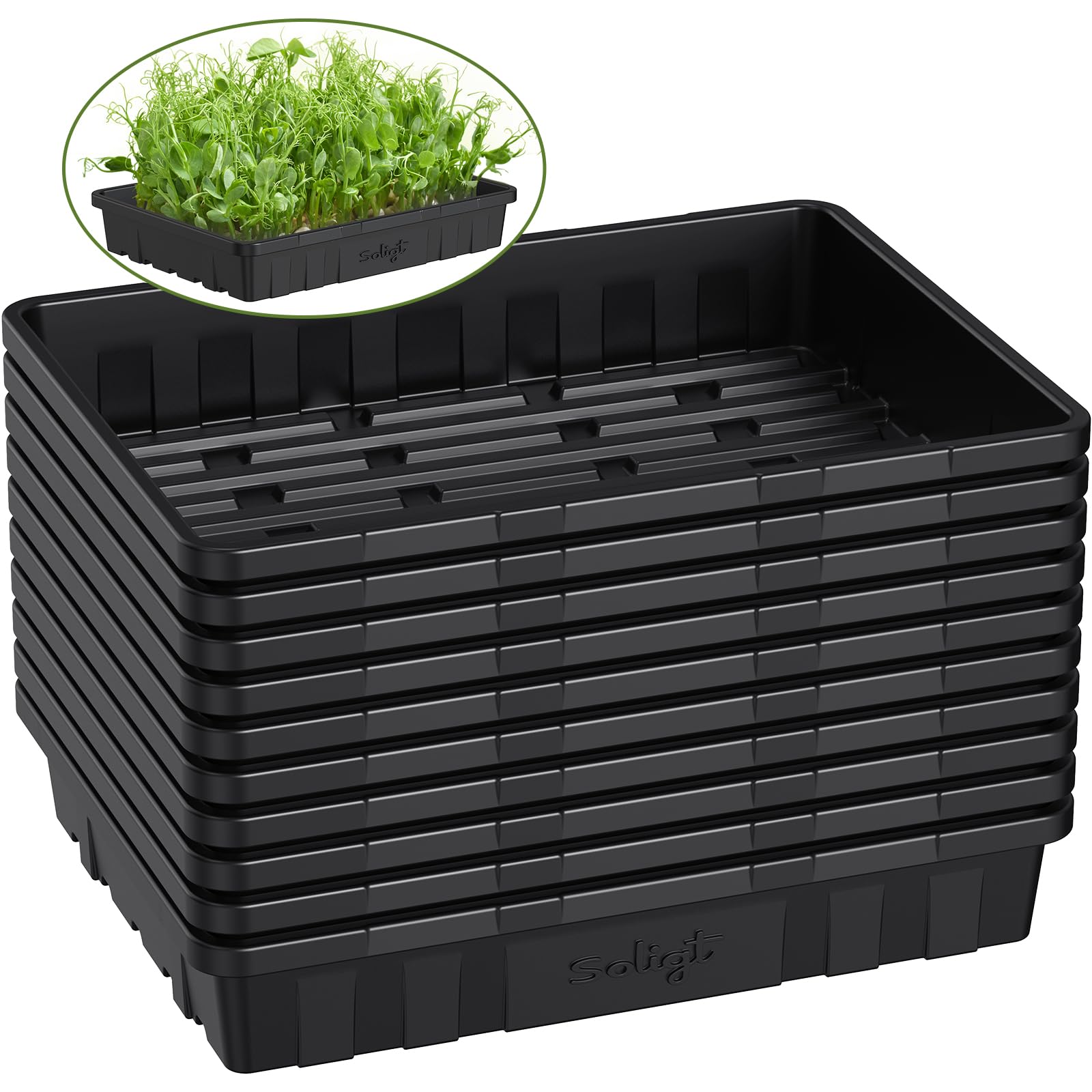
A ten-tray pack of thick, no-hole flats that beat out flimsy standard trays by a wide margin.
SOLIGT hits a balance in the value-to-strength ratio. You get 10 trays, each measuring 14 x 10.8 x 2.3 inches — a size that is a bit more compact than the full 1020 standard but still large enough for most home setups. The material is described as durable, lightweight, and reusable, with a no-hole design that prevents leakage and keeps your indoor growing area clean.
Buyers who made the switch from standard 10×20 trays report these are “stronger, lighter, non-bending, and easy to handle and bottom water.” One owner gave them a serious stress test, noting they “withstood months of 90-100°F heat with only minor discoloration.” That kind of heat resistance is uncommon in entry-level trays, which typically warp or become brittle under a heat mat or summer sun.
The lack of drainage holes is a deliberate choice for bottom-watering. The raised ridges on the bottom improve pots slightly above the water level, so the soil draws moisture upward without sitting in standing water. This design also means you can water from the top without water running straight through and out onto your table. One practical tip from an owner: do not lift a fully loaded tray with one hand, as the weight can stress the plastic over time.
The value read: Ten quality trays at a price that undercuts most premium 5-packs; the per-tray cost is very competitive for the build quality.
A fair warning: The 14-inch length is shorter than standard 1020 trays, so your existing inserts and domes may not fit perfectly.
Choose this if: You want a bulk pack of solid, durable trays for bottom-watering seedlings and microgreens without spending a premium.
skip it if: You need standard 1020 dimensions to fit existing shelving or humidity domes.
5. Germinator 6-Pack Premium Quality Seedling Trays (1.5mm)

The thickest small tray on the list — 1.5mm of polysterene that fits microgreens perfectly.
These trays are built to a different scale. They measure 9.3 x 15 x 1.7 inches, which is about 2.3x smaller than a standard 1020 tray (21 x 10.75 x 2.5 inches), and that compact size is actually an advantage for specific uses. They are ideal for home microgreen growers who want something small enough to fit on a kitchen counter or a single shelf in a cabinet.
The 1.5mm thickness is notable — it is thicker than most standard 1020 trays on the market. Owners confirm the build quality directly, with one stating “I can easily carry a tray of seedlings with one hand because they don’t bend and wobble like cheaper trays.” The flat, level bottom is another plus mentioned in reviews, as many trays have a bulge in the middle that sits unevenly when watered.
The no-drainage-hole design makes them perfect for bottom-watering microgreens or seed starting. However, the non-standard size is the main catch. Some owners noted they had to cut coconut coir pads to fit, and they do not accept standard 1020 humidity domes or cell inserts. If you value portability and extreme durability over universal compatibility, these are a fantastic choice.
Biggest win: The 1.5mm wall thickness makes this tray virtually unbendable at its size — a true heavy duty product in a small package.
Key limitation: The smaller size means it cannot accept standard 1020 inserts or domes, so it works best as a standalone flat for direct sowing or microgreens.
Ideal for: Home microgreen enthusiasts who want a thick, indestructible tray that fits on a kitchen counter or small shelf.
Not for: Anyone who needs standard 1020 compatibility for cell inserts or a large propagation setup.
6. Mr. Pen Seed Starter Tray Kits (10-Set, 150 Cells)
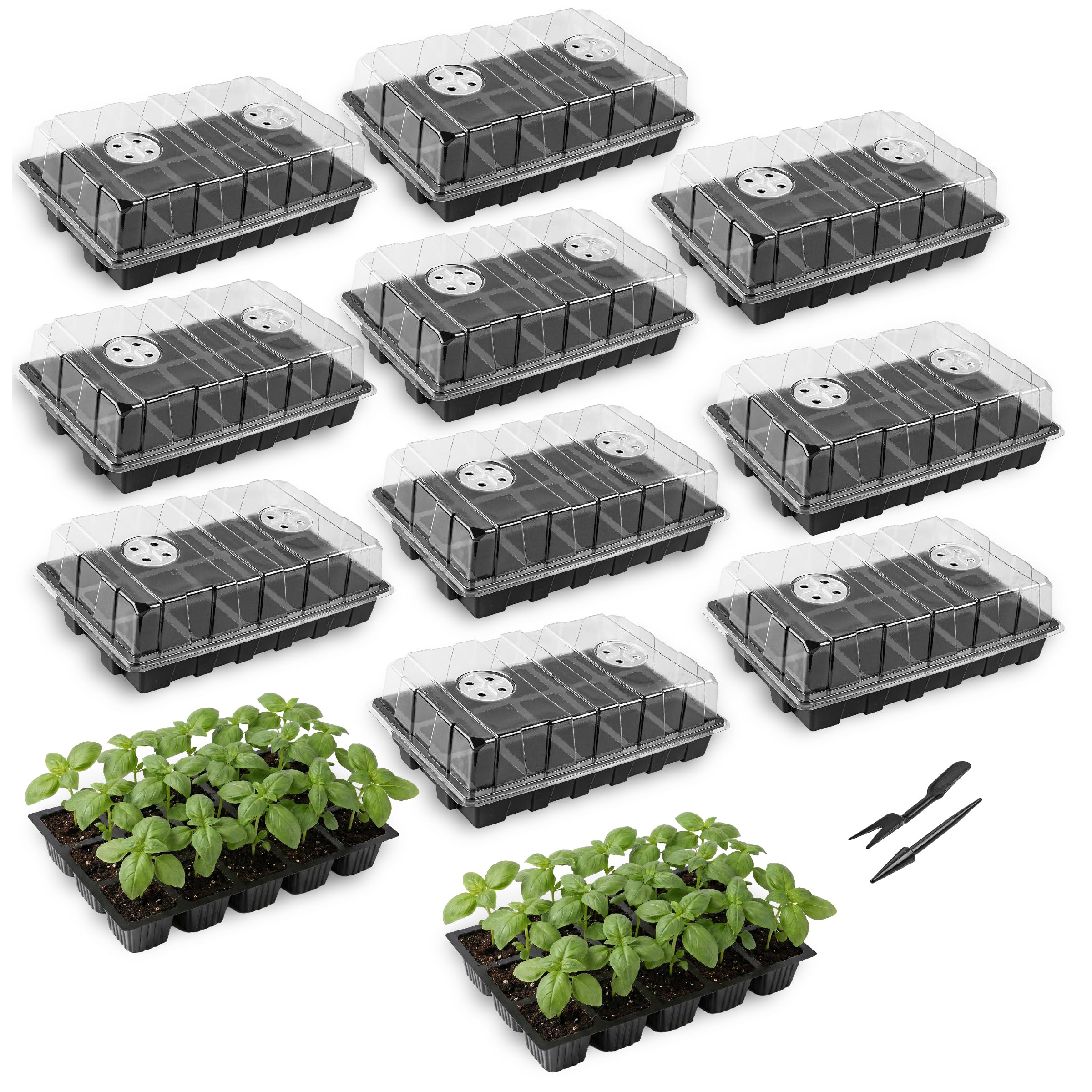
A 10-pack kit with 150 cells, humidity domes, and tools — everything but the soil.
This is not just a tray — it is a complete seed starting system. The Mr. Pen kit includes 10 sturdy black trays, each with 15 individual cells for a total of 150 cells, plus humidity domes with adjustable ventilation, a drip tray for bottom-watering, and a dibber and widger for precise sowing and transplanting. The idea is that you open the box and have everything you need to start seeds indoors immediately.
The trays and domes are made of durable plastic that owners confirm is thick enough to last multiple seasons. The 15-cell layout is well-suited for starting several vegetable varieties at once, and the domes feature adjustable ventilation to fine-tune humidity levels as seeds germinate. Owners praise the quality-to-price ratio, with one noting the set “feels worth double the price.”
The honest downside that multiple buyers mention is that the domes do not lock to the base — they simply sit on top, which means they can slide off if bumped. For a stable setup on a dedicated grow shelf this is a minor inconvenience, but if you need to move trays around frequently it can be frustrating. The cells also have slightly larger drainage holes than some competitor models, which is great for drainage but may allow small soil particles to escape during watering.
What you actually get: 10 trays / 150 cells total + 10 humidity domes + 10 drip trays + 2 tools — enough hardware for a full spring propagation push.
The recurring gripe: The domes sit loosely on the trays with no locking mechanism, so they can be knocked off in a crowded grow area.
Best for: New seed starters who want a complete, ready-to-use system with trays, domes, cells, and tools in one box.
Consider another if: You need a larger cell size for slow-growing plants that will stay in the tray for a month or more.
7. Epic Gardening Reusable Seed Starter Tray (6-Cell, Sage Green)
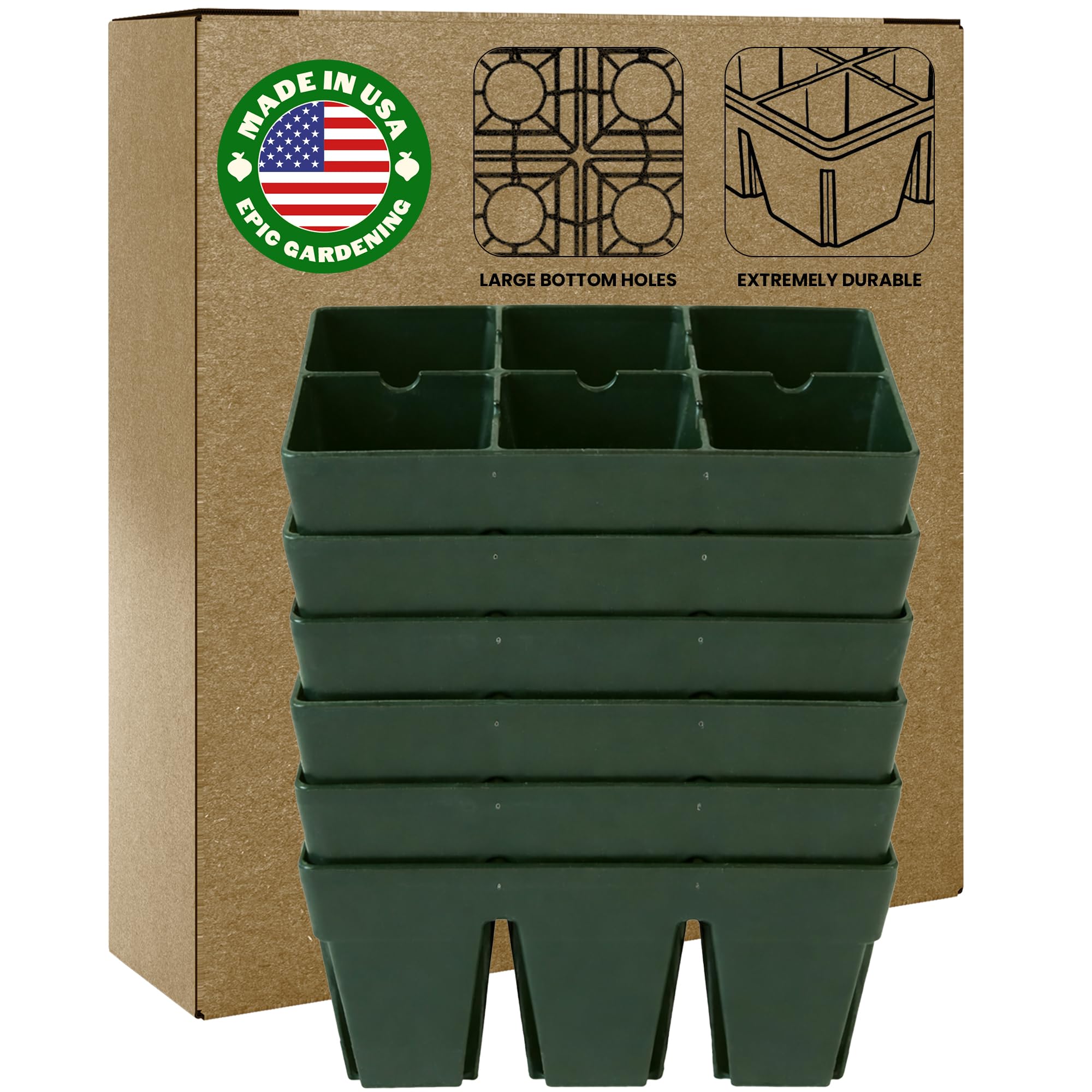
A thoughtfully designed cell tray that prioritizes root health and stress-free transplanting.
This is not a flat tray — it is a 6-cell insert that fits inside a standard 1020 nursery tray. Each cell measures roughly 1.5 inches square and 2.25 inches deep, with air pruning slots on the corners and an open base. Air pruning prevents roots from circling inside the cell, forcing them instead to stop at the air gap and branch out, which creates a stronger root ball that transplants faster and with less transplant shock.
The standout feature here is the large finger hole at the bottom of each cell. Instead of digging a seedling out with a tool and risking root damage, you simply push through the hole with your finger and the whole root mass pops up cleanly. Owners rave about this design, calling it a standout for anyone who has battled to remove delicate sprouts from tight cells. The trays themselves are UV-treated and made from recycled American plastic, with a sage green color that is easy to spot.
The honest caveat is the cell size. At 1.5 inches square, these are ideal for the first 3-4 weeks of seedling growth (perfect for tomatoes, peppers, brassicas), but larger or slower-growing plants will need to be up-potted into larger containers before they outgrow the cell. The set includes 6 individual cell trays, so you can manage different seed types independently.
The design win: The finger-hole ejection system eliminates the need for a tool or a scraper to remove seedlings, minimizing root damage.
The honest constraint: The 1.5-inch cell size limits growth to about 4 weeks for most plants before they need up-potting into larger containers.
Perfect for: Gardeners who want to reduce transplant shock and appreciate thoughtful engineering in a small cell tray for early-stage seedlings.
Better options for: Late-stage propagation or plants that need deeper soil before transplanting into the garden.
8. RooTrimmer 54 Cell Seed Starter Trays (10-Pack, 2.8″ Deep)
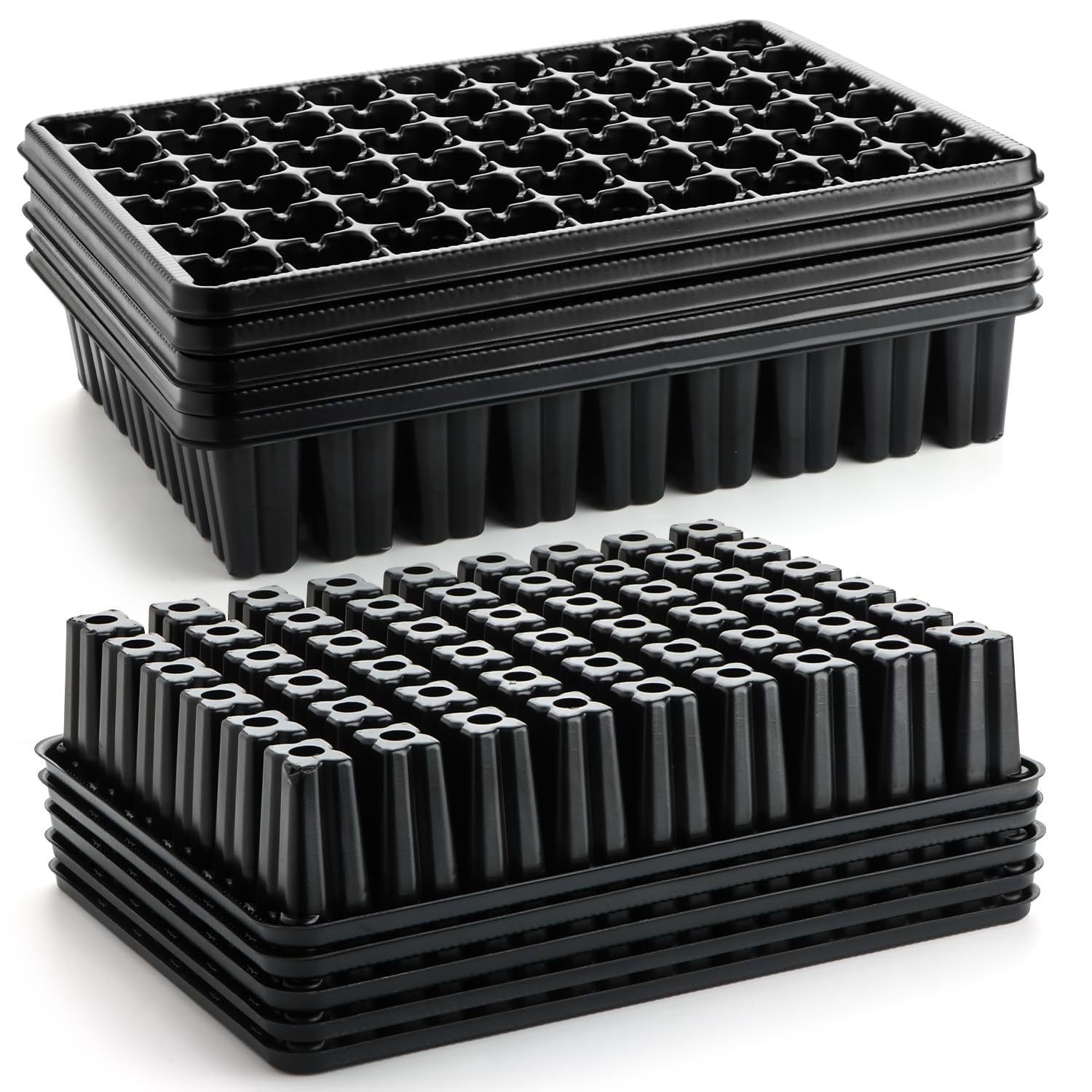
Deep 2.8-inch cells that give roots room to stretch before the big move to the garden.
Most seed starting trays have cells that are around 1.5 to 2 inches deep. The RooTrimmer 54-cell tray pushes depth to 2.8 inches, which is a meaningful advantage for anyone starting long-rooted plants like tomatoes, peppers, or squash. The deeper cell holds more soil volume, retains moisture longer, and delays the need to up-pot before transplanting day.
The trays are made from thickened PS (polystyrene) plastic and are built to be reusable across multiple seasons. The cell shape tapers slightly, with a hole large enough that you can push seedlings upward with a stick or pencil from below — a trick owners appreciate for gentle removal. The outer dimensions are approximately 14.6 x 11.14 inches, so they do require a flat or shelf that fits that size, but they are not too unwieldy for home use.
Buyers highlight the balance between sturdiness and depth, calling these “perfect for deep root growth and sturdier than shallow trays.” The fact that the 10-pack comes as a full set of trays means you can start a large number of plants at once. The only shortcoming mentioned by a few owners is the difficulty of washing the deeper cells by hand, but a bottle brush handles the job quickly.
The key spec: 2.8-inch deep cells versus the typical 1.5 to 2 inches — this gives roots about 40 percent more vertical space to develop.
The practical note: The non-standard outer size means you will want to measure your shelf space or existing flats before ordering; they are not 1020 standard.
Reach for this if: You start plants with long taproots or want to delay up-potting by a week or two.
Think twice if: You need standard 1020 compatibility with existing domes and shelves.
9. Bootstrap Farmer 72 Cell Seed Starter Tray (5-Pack)
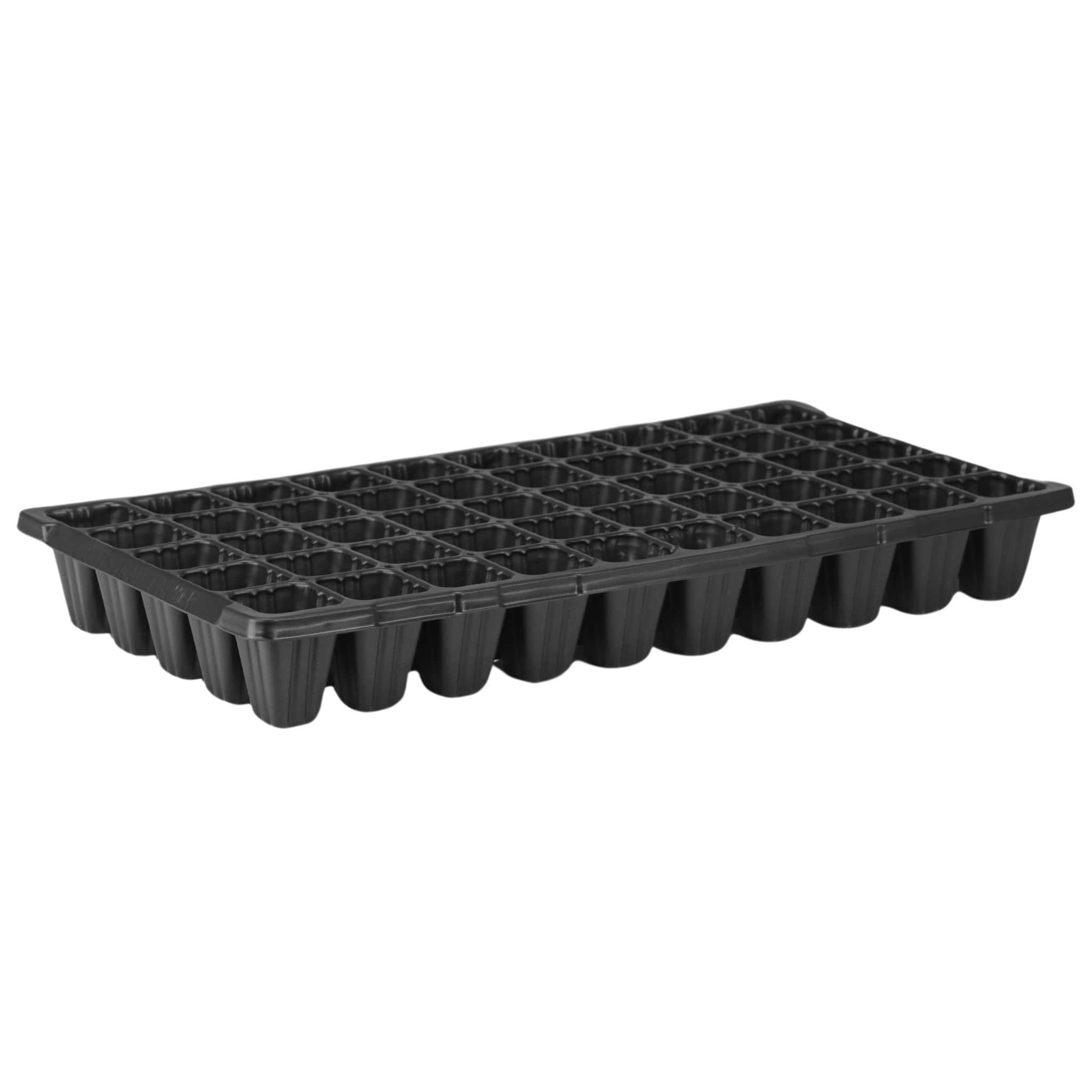
The standard 72-cell plug tray that serious gardeners turn to for its unbreakable build.
This is a 72-cell insert designed specifically to fit a standard 1020 tray (such as the Bootstrap Farmer 1020 trays above). Each cell measures 1.5 inches square by 2.25 inches deep, and the entire insert is built from food-safe recycled plastic that is notably thicker than the mass-market alternatives found at big-box hardware stores. Owners confirm this is “3.36x heavier than Jiffy trays,” and the weight difference correlates directly to a noticeable difference in rigidity.
The drainage hole at the bottom of each cell is functional for both water flow and aeration, though some owners noted that a slightly larger hole would allow for easier finger-pushing of seedlings. As it stands, you will likely need a small dowel or pencil to push the root ball up. The cells are designed with a slight taper, which helps the root mass slide out cleanly when you push from below.
The 5-pack includes five full 72-cell inserts, giving you 360 total cells for a serious propagation season. The material is thick enough that these have survived multiple years of continuous use in many owner-reported experiences. The recurring advice from those who have used them long-term is that the trays fit Bootstrap Farmer 1020 flats perfectly, but may have slight fit variation with other brands’ standard 1020 trays.
The durability stat: Weighs 300g vs 89.3g for standard Jiffy trays — a 3.36x weight advantage that translates into a rigid, long-lasting cell tray.
The minor trade-off: The 0.25-inch drainage hole is small enough that you will need a tool to push seedlings out, rather than using your finger.
Choose this if: You need a bulk supply of ultra-durable 72-cell inserts for a high-volume seed-starting operation and you already own 1020 flat trays.
Consider alternatives if: You want a more flexible, all-in-one tray with larger cells or a built-in bottom tray.
Understanding the Specs
Plastic Thickness (Measured in mm)
The single most important number on a heavy duty seed starting tray. A 1.2mm thick tray (like the Hemlock Home 5-pack) is about three times thicker than a standard 0.4mm tray, meaning it will not sag or bow when filled with wet soil. Higher-end models like the RooTrimmer 10-pack reach 1.8mm, which is borderline commercial grade. Thicker plastic also resists cracking from heat mats and winter storage temperatures.
1020 Standard Sizing
A “1020” tray refers to the industry standard of approximately 10 inches by 20 inches. This size is used by nearly all commercial greenhouse suppliers, so it will fit standard wire shelving, humidity domes, and cell inserts (such as the 72-cell or 50-cell plug trays). If a tray is not 1020, your existing gear may not fit — always check the stated dimensions against your equipment before ordering.
Drainage Holes vs Solid Bottom
Solid-bottom trays allow you to water from below (bottom-watering), which keeps seedling leaves dry and reduces fungal disease. They also prevent leaks onto your table or floor. Trays with drainage holes are better used as a flat to hold individual cell inserts — the holes let excess water escape freely so roots are not sitting in stagnant water. Many growers keep both types on hand for different stages of propagation.
Cell Depth (for Trays with Individual Cells)
Deeper cells (2.5 inches or more) hold more soil and moisture, giving you more time before seedlings need transplanting. Shallow cells (under 2 inches) are better for starting seeds that will be moved quickly — like lettuce or microgreens. The depth directly determines how long a seedling can develop a healthy root system before it becomes root-bound in its cell.