
Specs are compiled from manufacturer listings and verified buyer reviews and can change over time — please confirm the key details on the product page before buying.
Nothing ruins a perfect rose bloom faster than a colony of aphids or a swarm of Japanese beetles. You need a spray that hits hard, protects your blossoms, and won’t turn your garden into a chemical wasteland. The right insecticidal soap for roses does exactly that — it kills the pests on contact without harming your prize-winning plants.
I’m Rikta — the founder and writer behind Lawn Gear Lab. This guide is built by comparing the manufacturers’ published specifications and the patterns across verified customer reviews, so you get each pick’s real strengths and trade-offs instead of marketing spin.
The best way to keep your roses healthy and pest-free all season is to choose the right insecticidal soap for roses that matches your garden’s specific threats and your personal approach to plant care.
Our Picks at a Glance


How To Choose The Best Insecticidal Soap For Roses
The wrong spray can burn your leaves, miss the bugs entirely, or cost you a fortune in repeat applications. Here is what actually matters when you are staring down an infestation on your roses.
Form: Ready-To-Use vs Concentrate
A ready-to-use spray comes in a bottle with a trigger — you point and spray. It is convenient for a handful of rose bushes and requires no measuring. A concentrate, on the other hand, saves money over time and lets you treat a larger garden. You mix it with water in your own sprayer. If you have more than a few bushes, the concentrate route pays off quickly.
Active Ingredients: Soap, Oil, or Both
Insecticidal soaps rely on potassium salts of fatty acids. They dissolve the waxy outer layer of soft-bodied pests like aphids and spider mites. Neem oil, by contrast, works as both a contact killer and a repellent while also tackling fungal diseases like powdery mildew. Some products blend both for a broader punch. For roses, you want something gentle enough to not burn the petals but strong enough to handle a multi-pest attack.
Coverage & Persistence
Most soap sprays have no residual effect once they dry — they only kill what they hit. This means you need to reapply every 5-7 days while pests are active. Some synthetic options claim up to 4 weeks of protection through systemic action. The trade-off is straightforward: natural soaps are safer for pollinators and you, but they demand a regular schedule.
Quick Comparison
| Model | Best For | Form | Volume | Active Ingredient | Amazon |
|---|---|---|---|---|---|
| Ortho Rose & Flower★ Best Overall | All‑around rose care | Ready‑to‑Use | 24 oz | Dual‑action (contact + systemic) | Amazon |
| Safer Soap ConcentrateBest Value | Budget organic value | Concentrate | 16 oz | Potassium salts of fatty acids | Amazon |
| Neudorff Garden Spray | Broad‑spectrum organic | Ready‑to‑Use | 32 oz | Pyrethrins + Canola Oil | Amazon |
| NATRIA Insecticidal Soap | Multi‑pack convenience | Ready‑to‑Use | 48 oz (2 × 24 oz) | Potassium salts of fatty acids 1% | Amazon |
| Safer Soap w/ Seaweed | Gentle, rose‑scented care | Ready‑to‑Use | 32 oz | Potassium salts of fatty acids | Amazon |
| Bonide Rose Rx | 4‑in‑1 disease + pest control | Concentrate | 16 oz | Cold Pressed Neem Oil | Amazon |
| Bonide Insect Soap 3‑Pack | Large garden coverage | Ready‑to‑Use | 96 oz (3 × 32 oz) | Potassium fatty acids | Amazon |
In‑Depth Reviews
1. Ortho Rose and Flower Insect Killer, 24-Ounce
Our pick — over 4.5★ from 850+ verified ratings; the strongest balance of quality and price.
The crowd favorite that keeps on working even after a downpour, thanks to its dual-action formula.
This is the one that rose lovers keep coming back to — and the reviews prove it. It kills over 100 listed insects both by contact and through systemic action, meaning the plant itself helps fight off pests from the inside. That also explains the standout claim of protection lasting up to 4 weeks, which is rare for a soap-based spray. While most insecticidal soaps wash off in the first rain, buyers report this one holds its own: as one long-time owner puts it, “I don’t need to reapply after a heavy rain (even though I do just to be safe).”
The 24-ounce ready-to-use bottle makes it grab-and-go simple. No measuring, no mixing — just spray when you see the first holes in your rose leaves. The consistency of the feedback is remarkable: effectiveness is the single most-discussed trait, and the overwhelming take is that this product saved roses that were nearly stripped bare.
That said, the duration of effectiveness does get mixed notes. Some find it lasts the full 4 weeks; others feel it fades faster. The bottle is on the smaller side for a large rose garden, so heavy-duty growers may burn through it quickly. But for the typical gardener with a few bushes, this is the most trusted all-rounder on the shelf.
What wins people over
- Kills 100+ insect types on contact and systemically
- Protects up to 4 weeks — longer than most soap sprays
- Won’t harm blooms or the plant itself
The trade-off to know
- Duration gets mixed feedback — some users want longer residual effect
- Small 24-oz bottle may require frequent repurchase for larger gardens
Reach for this if: you want one reliable spray for your roses that keeps working even after a heavy rain and protects against a wide range of bugs.
Look elsewhere if: you strictly want an organic-only active ingredient — this uses a synthetic dual-action formula.
2. Safer 5118-6 Insect Killing Soap Concentrate
The organic gardener’s secret weapon that turns a tiny 16-ounce bottle into a season’s worth of spray.
This is a concentrate, which is the single most important thing to know. While the bottle itself holds only 16 fluid ounces, you mix 2.5 ounces per gallon of water — so one bottle makes roughly 6 gallons of finished spray. That is a massive amount of coverage for the money, easily outpacing any ready-to-use bottle in value. It is OMRI Listed, meaning it is approved for organic gardening, and it targets soft-bodied pests like aphids, spider mites, whiteflies, and mealybugs.
The kill speed is the headline here: owners mention that a severe aphid infestation saw 90% dead by day one and completely gone by day three. The active ingredient — potassium salts of fatty acids — works by breaking down the insect’s outer shell, causing dehydration on contact. The formula is gentle on most plants, including roses, and can be used right up until the day of harvest.
There is a learning curve, though. You need to mix it correctly, and the concentrate can solidify if stored in cold temperatures (though it melts back quickly). Over-application or spraying in direct sun can burn leaves, so timing matters. Also, while the efficacy against listed pests is top-tier, the product’s value for money gets mixed feedback — some wish it were even cheaper given that it is a concentrate. Still, for the serious organic rose grower who wants to cover a lot of ground, this is easily the most economical path.
Smartest organic buy: This concentrate stretches further than any other pick here, and the knockdown power against aphids is proven across thousands of buyers.
Grab it for: large rose gardens where you need cost-effective, organic pest control that you mix yourself.
skip it if: you prefer a grab-and-spray bottle or worry about getting the dilution ratio wrong.
3. Neudorff Garden Insecticide Spray for Roses and Flowers, 32 oz
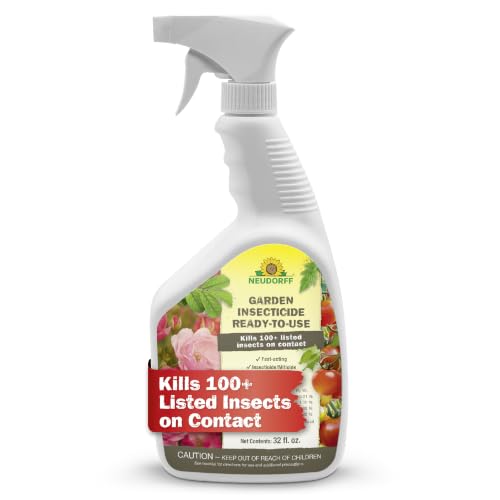
An organic spray that attacks bugs at every stage — including eggs, larvae, and adults — all in one 32-ounce bottle.
This is a different kind of organic weapon. Most soap sprays rely on fatty acids alone, but Neudorff combines pyrethrins (a plant-derived insecticide) with canola oil. The result is a broad-spectrum contact killer and ovicide — meaning it kills eggs, not just the crawling bugs. It targets over 100 listed insects including fruit flies, fungus gnats, beetles, caterpillars, and more. It is labeled for roses and flowers, and you can use it up to the day of harvest.
The 32-ounce ready-to-use bottle is larger than the Ortho, giving you more volume per purchase. Effectiveness earns the most praise from buyers, and the general sentiment is that this works well on roses when applied early in the morning at the first sign of damaged leaves. For organic gardeners who also battle fungus gnats or fruit flies around their roses, this dual-action formula covers ground that plain soap cannot touch.
The durability of the sprayer nozzle is the consistent weak spot. Multiple customers note that the bottle cap broke in transit or leaked half the solution. It is not a problem with the formula itself — the product inside is well-liked — but the packaging QC is unreliable. If you get a good bottle, it is excellent. If you don’t, you may need to transfer the liquid to a sturdier sprayer.
The catch: The sprayer nozzle is fragile. Buy it knowing you might need to pour the liquid into a separate bottle.
Best for: organic rose gardeners who want a single spray that handles eggs, larvae, and adults of a very wide range of pests.
Think twice if: you do not want to deal with potential packaging defects.
4. NATRIA Insecticidal Soap, 24 oz (Pack of 2)
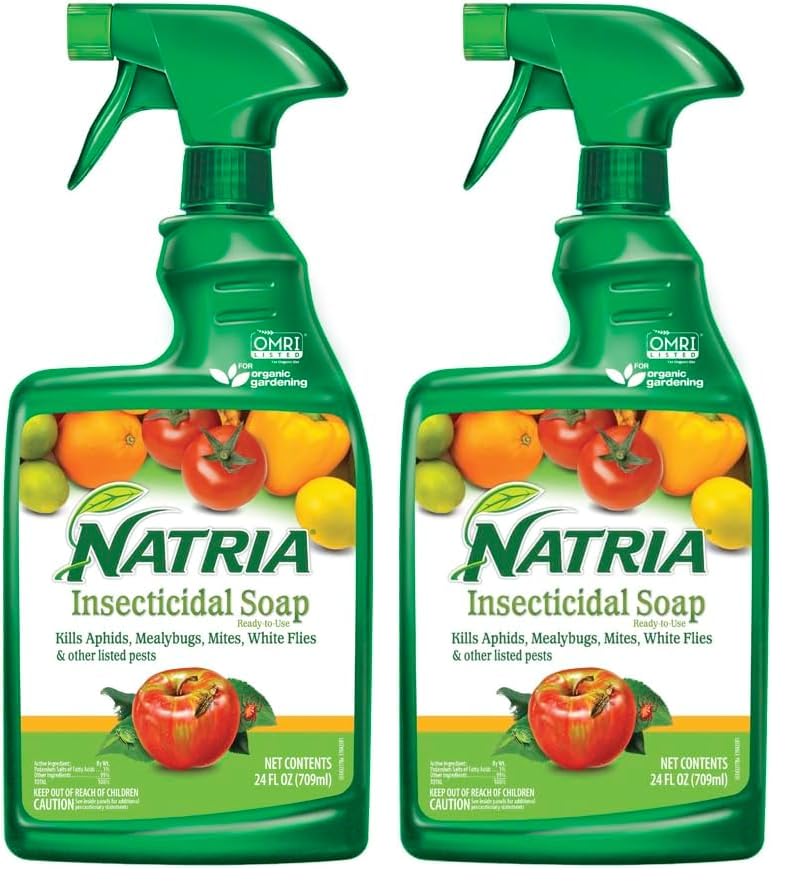
A no-nonsense two-pack that gives you one bottle for the cabinet and one for the garden shed.
NATRIA keeps it simple: 1% potassium salts of fatty acids, ready to spray, no mixing, no fuss. You get two 24-ounce bottles, totaling 48 fluid ounces — a generous amount for a reasonable mid-range outlay. It targets aphids, mealybugs, mites, whiteflies, and other listed soft-bodied pests. The key strength here is ease of use and the complete absence of harsh smell. Buyers regularly mention it as pet-safe, which is a major plus if your roses are near where your dog runs.
The practical feedback is solid. One buyer with a severe mealybug infestation on their plants sprayed every other day and saw visible bugs gone in two weeks. It also works on the tiny black bugs that attack lemon and lime trees. Effectiveness against mites is the most-discussed positive trait.
The sprayer bottle itself is the recurring frustration. Several reviewers point out that the trigger mechanism fails partway through the bottle, forcing them to transfer the remaining liquid to a different sprayer. This is an annoying flaw in an otherwise well-formulated product. If you can live with a potential mid-bottle transfer, the formula itself is widely trusted.
What works
- Two-pack gives you backup supply right away
- No harsh chemical smell — safe feeling around pets
- Effective on mealybugs and mites after consistent application
The weak spot
- Sprayer nozzle often fails before the bottle is empty
- Some users report mediocre results against indoor gnats
Best pick for: rose growers who want a gentle, low-odor spray and like having a spare bottle on hand.
Not ideal if: you need one perfect sprayer that lasts the whole bottle without issues.
5. Safer Insect Killing Soap With Seaweed Extract, 32 oz
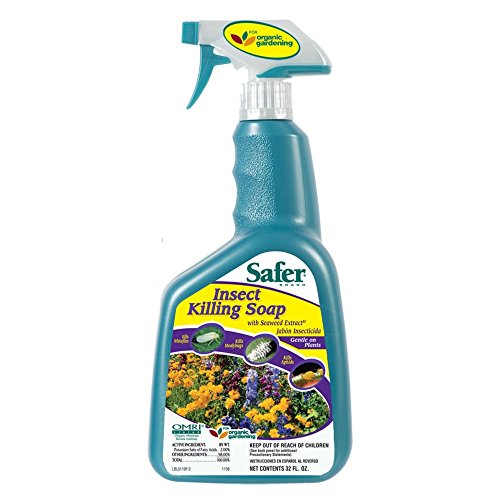
A ready-to-use spray that actually smells pleasant, thanks to seaweed extract that also feeds the foliage.
This one stands out for two reasons. First, it contains seaweed extract, which shoppers say promotes lush green foliage while the soap kills the bugs. Second, it has a fresh rose scent — a rare quality in a category where most sprays smell like chemical soup or plain soap. The 32-ounce bottle is ready to use, meaning no mixing, and the spray pattern is easy to direct onto infested leaves and stems.
Buyers find it effective against whiteflies, gnats, mites, and grasshoppers. The typical approach is two applications: an initial spray, a three-day wait, then a rinse and a second spray. Users specifically note that it does not burn plants, which is a common worry with more concentrated soaps. The seaweed extract seems to offset the drying effect that pure soap can have on foliage.
The trade-off is that it sometimes requires multiple applications to fully eradicate a stubborn infestation. Some pests, especially in heavy numbers, are controlled but not eliminated in one go. The pleasant scent is a genuine perk, but it won’t matter if you are dealing with a full-scale invasion — you will still need persistence and reapplication.
Why this stands out: seaweed extract is a smart add — it softens the soap’s impact on leaves and encourages regrowth at the same time.
Reach for this if: you want a pleasant-smelling, gentle spray that nourishes your rose leaves as it kills pests.
pass on it if: you need one-and-done knockout power against a heavy infestation — this works best with follow-ups.
6. Bonide Captain Jack’s Rose Rx 4-in-1, 16 oz Concentrate
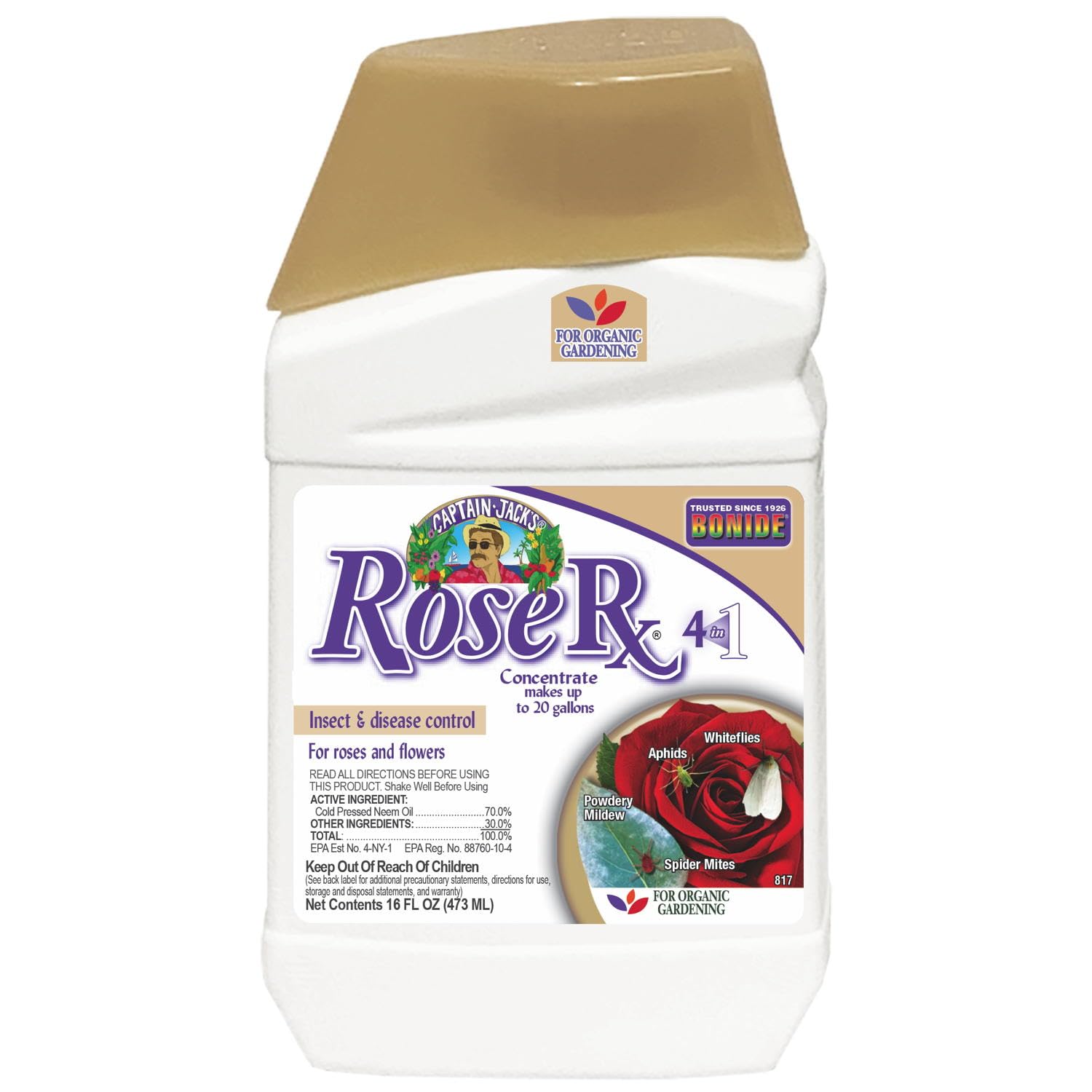
The 4-in-1 concentrate that kills bugs, repels more, and fights rust and powdery mildew all at once.
This is not a soap — it is a cold-pressed neem oil concentrate, and that distinction matters. Neem oil works as a contact insecticide, a repellent, a miticide, and a fungicide. It handles common rose diseases like rust and powdery mildew while controlling aphids, beetles, caterpillars, and fruit flies. The 16-ounce concentrate mixes with water to create gallons of spray, and it is approved for organic gardening up to the day of harvest.
The results are unusually fast. The feedback from rose growers is emphatic: “my roses responded so fast to this product, I doubt I will use anything else.” The quality score is the highest praised aspect, with effectiveness close behind. The formula is designed specifically for roses and flowers, and it can also be applied as a soil drench for systemic protection.
The only real limitation is that neem oil requires more careful application than soap sprays. It needs to be mixed correctly and applied at the right time of day to avoid leaf burn in direct sun. But for the rose grower who is also fighting black spot or mildew alongside insect pests, this 4-in-1 approach eliminates the need for a separate fungicide.
Standout spec: 4 products in 1 — insecticide, miticide, repellent, and fungicide — from a single concentrated bottle.
Perfect if: your roses battle both bugs and fungal diseases, and you want one concentrate to tackle both.
Not for you if: you want a simple ready-to-use soap without the extra steps of mixing and timing.
7. Bonide Products INC 912102 652 Ready-to-Use Insect Soap, Quart 3-Pack
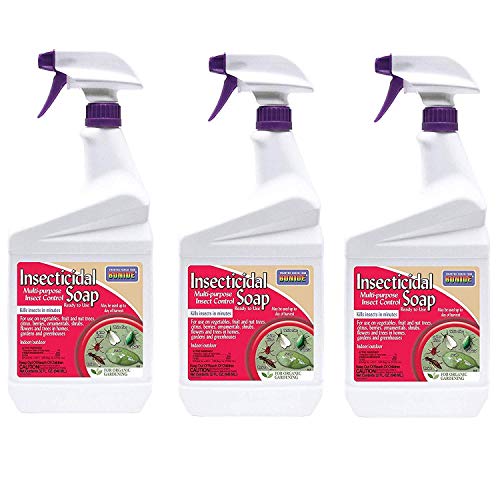
Three full quarts of ready-to-use spray — enough volume to drown an army of caterpillars across a whole rose bed.
When you have a large garden, the last thing you want is to run out of spray halfway through the job. This 3-pack gives you 96 total fluid ounces of ready-to-use insecticide soap across three quart bottles. The active ingredient is potassium fatty acids derived from plants, and it contains no flammable solvents or animal fatty acids. It is approved for use up to the day of harvest on flowers, fruits, vegetables, and houseplants.
Real-world feedback is positive for the core function: it stops little caterpillars from eating flowers and handles general garden bugs. One buyer notes that spraying every few days turned their chewed-up flowers back into lush, gorgeous blooms. The product is preferred by organic gardeners and does not persist in the environment after it dries.
There are two practical downsides. First, the number of bottles — three quarts — is a lot of product, and some buyers feel it is too much for a single small rose bush. You might end up with bottles sitting around for a while. Second, packaging in transit is a known problem: multiple buyers report that all three bottle caps leaked during shipping, soaking the box. The product works, but the delivery experience can be messy.
The big upside
- 96 ounces total — by far the largest volume on this list
- Plant-derived formula, no harsh solvents
- Effective on caterpillars and general garden pests with regular application
The messy side
- Bottle caps frequently leak during shipping
- Too much product for a single small rose bush
Best suited for: gardeners with multiple rose bushes or a large flower bed who want to buy once and not worry about running out.
Think twice if: you only have a couple of plants — the three-bottle commitment may be more than you need.
Understanding the Specs
Potassium Salts of Fatty Acids
This is the scientific name for what makes insecticidal soap work. These are the same compounds found in ordinary soap, but refined and concentrated. When you spray them on a soft-bodied pest like an aphid or a spider mite, the salts dissolve the insect’s waxy outer cuticle. Without that protective layer, the insect loses moisture rapidly and dies from dehydration. The key thing to remember is that this only works on contact — once the spray dries, it has no residual effect. That is why you need to reapply every 5-7 days while pests are active and why you must spray the undersides of leaves where bugs hide.
Ready-to-Use vs Concentrate
A ready-to-use spray comes in a bottle with a trigger. You pull it from the start and spray — no measuring, no mixing, no extra equipment. This is the convenient choice if you have a few rose bushes and want to treat them immediately. A concentrate, on the other hand, is a small bottle of potent liquid that you dilute with water in your own sprayer. The 16-ounce Safer concentrate, for instance, makes roughly 6 gallons of finished spray. Concentrates are more economical per dose and let you customize the strength, but they require a separate sprayer and careful ratio measurement.
FAQ
Will insecticidal soap harm my rose blooms?
How often should I spray my roses with insecticidal soap?
Does insecticidal soap kill beneficial insects like ladybugs?
Can I use insecticidal soap on roses that have powdery mildew?
What is the difference between pyrethrin and soap sprays for roses?
Is it safe to use insecticidal soap on roses around pets?
Which spray is best for a severe aphid infestation on roses?
Can I mix insecticidal soap with other garden chemicals?
Final Thoughts: The Verdict
For most rose growers, the insecticidal soap for roses winner is the Ortho Rose and Flower Insect Killer because of its dual-action formula that keeps working for weeks and protects against over 100 insects. If you want an organic concentrate that stretches your dollar through the whole season, grab the Safer Insect Killing Soap Concentrate. And for roses battling both bugs and disease at the same time, the Bonide Captain Jack’s Rose Rx is the one to reach for with its 4-in-1 neem oil formula.
How We Picked
We do not accept paid placement. Every pick is matched to a real buyer and a real use-case; we do not hands-on test units.
Sources & Methodology
Specifications: manufacturer listings and product documentation. Review insights: verified customer reviews, as of July 2026. Pricing: not shown on this page (it changes often); check the current price via the retailer link.
As an Amazon Associate, Lawn Gear Lab earns from qualifying purchases. This does not affect which products we feature.