
Specs are compiled from manufacturer listings and verified buyer reviews and can change over time — please confirm the key details on the product page before buying.
You want strong plants, not a bigger electricity bill. But grow-light specs — wattage claims, spectrum charts, coverage areas — quickly turn into a jumble of letters and numbers. This guide cuts through that noise by explaining each spec in plain English right next to the fact that matters: what it does for your plants.
I’m Rikta — the founder and writer behind Lawn Gear Lab. This guide is built by comparing the manufacturers’ published specifications and the patterns across verified customer reviews, so you get each pick’s real strengths and trade-offs instead of marketing spin.
The goal is straightforward: find you a light that delivers the right intensity without turning your electricity bill into a second mortgage. These are the best grow lights for plants across different budgets and setups, from a seed-starting station on a kitchen counter to a full tent build.
Our Picks at a Glance


How To Choose The Best Grow Lights For Plants
Start with what you are growing and where. A 2×2 foot tent full of flowering peppers needs a lot more light punch than a shelf of pothos cuttings. The single most useful number is not wattage — it is PPFD (Photosynthetic Photon Flux Density, which tells you how many useful photons hit a square meter every second).
Coverage Area vs. Light Intensity
Every light has a balance. A panel rated for a 3×3 foot veg space will struggle to flower that same area because flower-stage plants demand roughly double the light intensity. Look for the manufacturer’s recommended coverage for both veg and bloom separately — a light good for both will list two different dimensions.
Full Spectrum vs. Blurple
Full-spectrum lights (white-looking light containing all visible wavelengths) are easier on your eyes and let you spot pest or deficiency issues early. Blurple lights (red and blue only) can be slightly more efficient per watt, but the purple glow makes inspection harder and can be disorienting in a living space.
Dimmability and Controllability
An adjustable intensity dial lets you ease young seedlings into strong light and crank it up during flowering. A built-in timer (4/8/12 hour cycles) automates your day/night schedule so you don’t have to remember to flip a switch. Smart app control adds remote adjustment but often requires a separate hub purchase.
Quick Comparison
| Model | Best For | Wattage | Dimensions | Light Output | Amazon |
|---|---|---|---|---|---|
| VIPARSPECTRA XS1500 Pro★ Best Overall | Serious Tent Growers | 150W | 14.2″ x 11.4″ x 3.1″ | 747 PAR | Amazon |
| VIVOSUN AeroLight A100Premium Pick | Integrated Airflow | 100W | 13″ x 13″ x 1.77″ | Max PAR | Amazon |
| AC Infinity IONBEAM S16Top Performer | Supplemental Canopy Light | — | 16.02″ x 1.08″ x 0.62″ | 3000 Lumens | Amazon |
| FECiDA 2026 4Head | Desktop Seed Starting | 36W | 16″ x 4″ x 3.2″ | 4000 Lumens | Amazon |
| BlumWay Seed Starter Tray Kit | All-in-One Germination | — | 9.45″ x 14.96″ x 4.72″ | 80 LED Beads | Amazon |
| Yehsence 500 LED 10-Head Tripod | Large Shelf Collections | — | 6″ x 4″ x 15″ | 500 LEDs | Amazon |
| TYAGMAM T8 4-Pack | Greenhouse/Seedling Racks | 180W | 46″ x 2.3″ x 1.5″ | 1080W Equivalent | Amazon |
| SANSI Dual Gooseneck | Targeted Desktop Lighting | 20W | 7.72″ x 7.17″ x 2.99″ | 2000 Lumens | Amazon |
| Uallhome 200W Panel 2-Pack | Budget Tent Coverage | 200W | 12″ x 12″ x 1″ | 4x4ft Coverage | Amazon |
In‑Depth Reviews
1. VIPARSPECTRA XS1500 Pro
Our pick — over 4.5★ from 900+ verified ratings; the strongest balance of quality and price.
Tent growers who demand edge-to-edge PAR (Photosynthetically Active Radiation, the light plants use) without burning a hole in the monthly budget.
This light draws 150W of actual power and delivers what buyers call “excellent PAR levels,” specifically 747 at half intensity and 13 inches — the kind of canopy-penetrating punch that makes pepper and tomato plants thrive. The optical lenses concentrate light with minimal loss, producing uniform PPFD (Photosynthetic Photon Flux Density, or how many useful photons land on a square meter each second) across every corner of a 2×2 foot flowering space or a 3×3 foot veg area.
The dimming dial is a real win for mixed-stage grows: you can dial back intensity for seedlings and crank it up during bloom without swapping hardware. Up to 20 of these units daisy-chain together for unified dimming in larger setups. The full spectrum includes white 3000K (a warm white), 5000K (a neutral white), red 660nm (deep red, for flowering), and IR 730nm (infrared, for germination cues) LEDs — covering the whole cycle from seed starting to flower. Buyers report it is heavy at roughly 6 pounds, but the included ratchet hangers make positioning straightforward.
Compared to the 20W SANSI below, the XS1500 Pro draws 150W of actual power — making this one better suited for flowering plants that benefit from a redder spectrum.
powerful full-spectrum
- Exceptional PAR readings (747 at 50%/13″) for uniform canopy coverage
- Adjustable intensity dial protects seedlings from scorching
- Daisy-chain up to 20 units for a commercial setup
- Does not overheat — runs cool even after 12 hours at full power
higher price point
- No physical on/off switch — must be unplugged or use a timer
- At roughly 6 pounds, heavier than many panel lights in its class
- Color tone skews warmer than some users prefer vs the 100W model
strong growth: You need serious light penetration for a 2×2 or 3×3 tent and value a dimmer for stage-by-stage intensity control.
tight budget: You only have a small desktop setup — this much light in a 1×1 space is overkill.
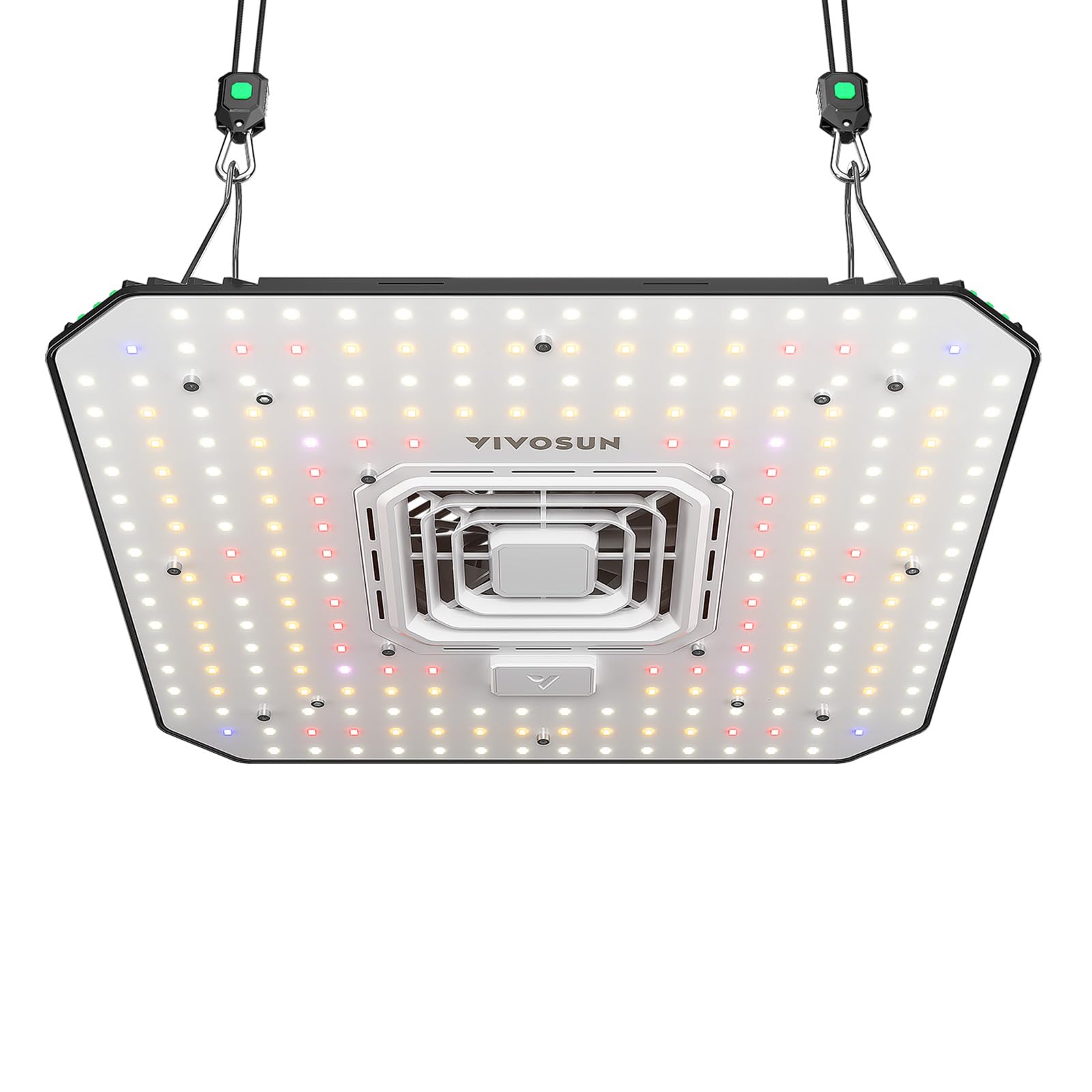
2. VIVOSUN AeroLight A100
A light that also moves air — one less fan hanging in your tent.
The standout feature here is the centrally located circulation fan integrated directly into the LED panel. It pushes air into the canopy where traditional oscillating fans cannot reach, which is a genuine space-saver in a 3×3 or 4×4 tent. The full-spectrum lighting covers 390nm (ultraviolet) to 730nm (infrared) with 3000K and 5000K white LEDs, and buyers consistently report faster growth compared to previous lights they owned.
The 100W light uses a unique hollow design that lets air circulate efficiently through the panel itself. The special air-guiding angles direct wind uniformly across the plant canopy. For smart-home growers, this unit works with the Vivosun GrowHub Controller and App (sold separately) to automate day/night schedules and switch between light modes. Buyers specifically praise the wings for coverage flexibility and the low noise from the industrial-grade dual ball-bearing fan.
A notable catch: the controller is not included and is not internal Wi-Fi — you need a separate Growhub Controller (E42A/E25) for app features. Some units have arrived without screws for the H-brackets, which is an occasional quality-control miss.
space-saving design: If you are tight on tent space and want one device that lights and ventilates, this is the most efficient combo on the list. skip it if you do not want to fuss with a separate hub for full control.
3. AC Infinity IONBEAM S16
Side-lighting bars that penetrate the lower canopy so your bottom buds get fat too.
These four 16-inch LED bars are not meant to be your primary light — they are designed for inter-canopy or supplemental lighting to reach areas your main fixture misses. Each bar uses Samsung LM301H EVO diodes (the chip that produces the light) rated at 3.14 µmol/J PPE (Photosynthetic Photon Efficacy, a measure of how efficiently the diode turns electricity into usable plant light), which is top-tier efficiency. The included digital controller (model 77) offers ten intensity levels and a programmable daily schedule with a sunrise/sunset timer, making it feel like a premium add-on rather than an afterthought.
Mounting is flexible: magnetic bars let you attach them to steel tent poles or the canvas itself using the included steel bars. The bars output 3000 Lumens total (a measure of the total visible light emitted), and buyers highlight how well they boost side branching and canopy penetration. Setup takes under 15 minutes and the magnetic hold is described as strong on poles, though feedback on magnet strength is mixed when mounting to fabric alone. The connecting cables between bars run short, so you may need separate extension cables for wide tents.
targeted light bar: Perfect for growers who already own a powerful overhead light and want to eliminate shaded lower buds. Not a standalone light for a whole tent.
4. FECiDA 2026 4Head Table Top
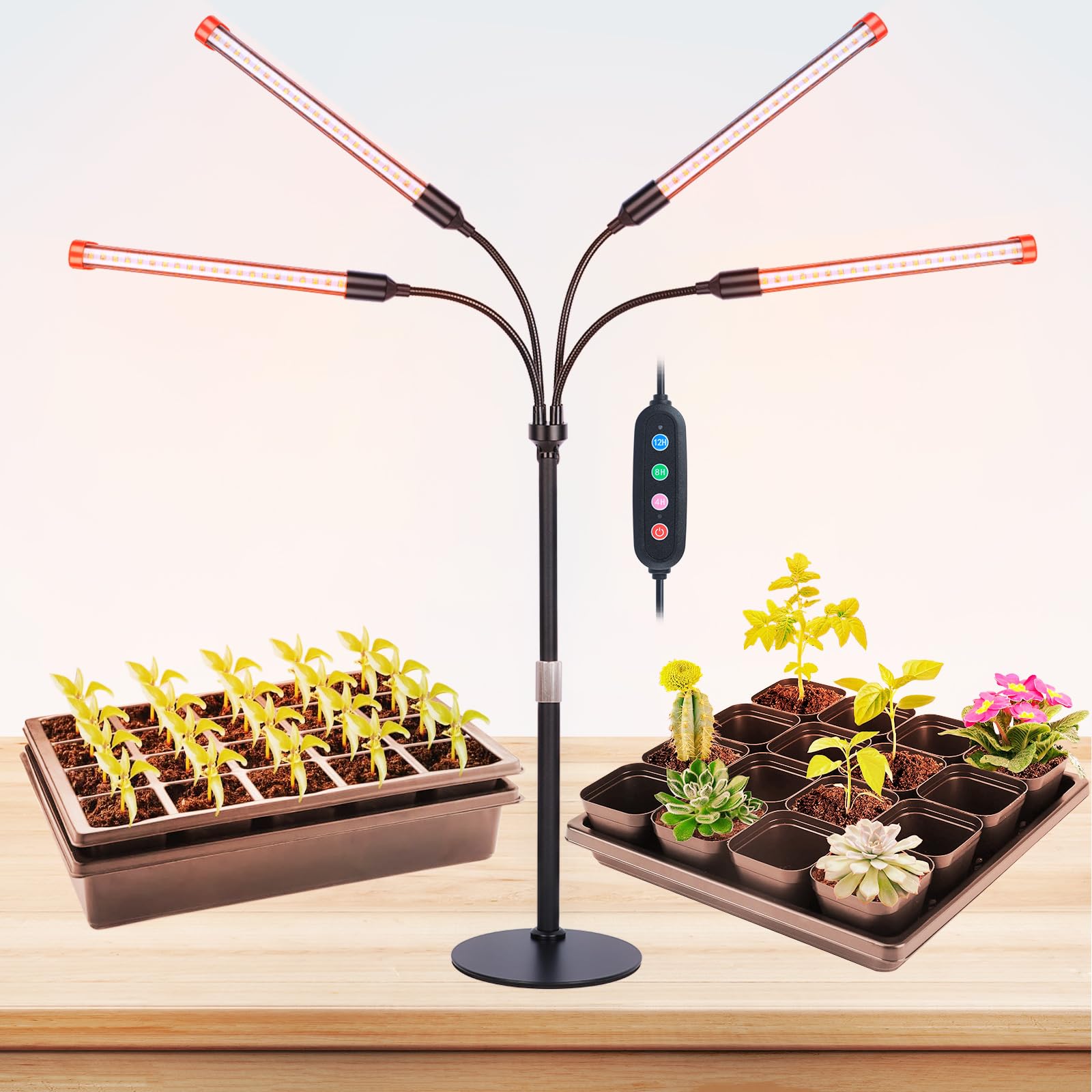
A desktop workhorse that turned around a struggling pothos in weeks.
This 36W tabletop light pumps out 4000 Lumens, while the SANSI unit below outputs 2000 Lumens — making it genuinely bright for a small fixture. The 168 high-quality LEDs produce natural full-spectrum light that plants and eyes both tolerate comfortably. Buyers specifically mention increased variegated leaves on their hoyas and the recovery of a struggling pothos and wandering dude plant.
The built-in timer offers five settings (4, 8, 12, 16, and 20 hours) by pushing combinations of the 4 and 8 buttons — a compact trick that avoids a cluttered interface. The base is stable on a desk, the height adjusts from 16 to 24 inches, and each of the four heads tilts independently. At 16 inches long and just over 3 inches tall, it slips easily onto a shelf or table corner. The 12-month warranty adds confidence at this price tier.
What wins people over is the brightness — 58 buyers single it out — and the plant happiness that follows. The main trade-off reported is stability; some find the base less sturdy than they would like, so it is best on a flat, steady surface rather than an uneven shelf.
seedlings: You want an affordable, bright desk light for seed starting or a few houseplants.
flowering: You need a light for a full grow tent — the coverage is tabletop-scale.
5. BlumWay Seed Starter Tray Kit

Everything you need to start seeds indoors, all in one tidy package.
This 2-pack kit combines 80-cell seedling trays with a humidity dome that has four full-spectrum LED strips built right into the lid. The 360-degree spectrum includes white and blue light that accelerates germination — owners mention seeds sprouting faster and stronger than seedlings started in window light. The dome has adjustable vent holes for humidity control, and the lights offer three timing functions (3H, 6H, 12H) and five brightness levels.
The setup powers via either USB (a Universal Serial Bus port, standard on most chargers) or a standard AC adapter, which gives flexibility for placement on a kitchen counter or a utility shelf. The ABS plastic (Acrylonitrile Butadiene Styrene, a tough, lightweight plastic) construction is lightweight (1.1 pounds per kit) and easy to clean for reuse. Buyers specifically call out the moisture retention during germination and the convenience of the remote control for adjusting the lights without opening the dome.
The honest feedback: the vent hole covers feel cheaply made with stems too short to click in place securely, and some users found the lights not strong enough for tomatoes, resulting in leggy seedlings. The bottom tray could be thicker, and there is no dedicated hole for a heat mat thermostat probe.
starting seeds: Beginner seed-starters who want a self-contained germination station with light and humidity control in one box.
durable use: Anyone growing past the seedling stage — these lights lack the intensity for veg or flower.
6. Yehsence 500 LED 10-Head Tripod
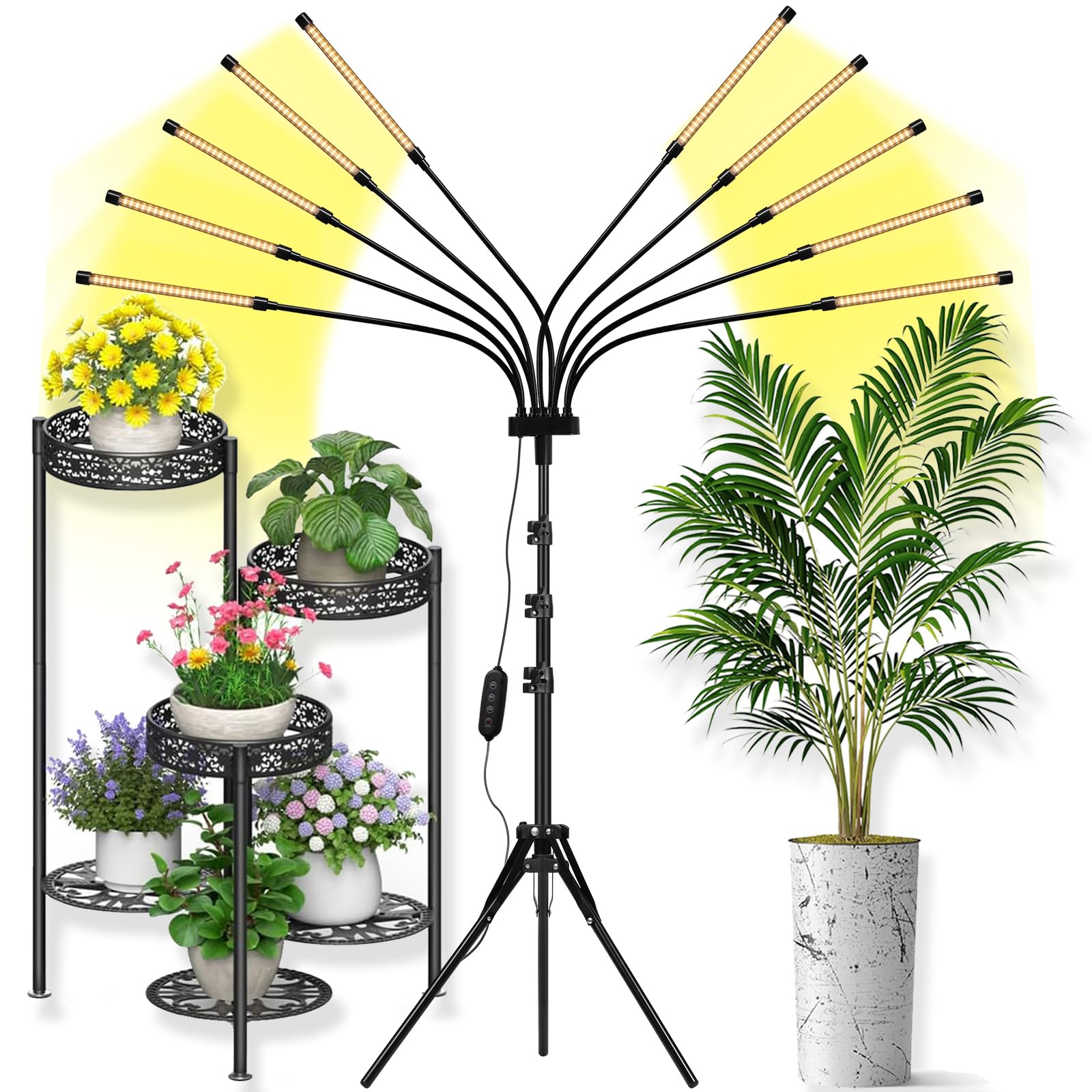
Ten flexible heads on a stable tripod — like having ten mini spotlights for your plant shelf.
With 500 LEDs split across 10 independently adjustable heads, this tripod light delivers wide coverage for a large collection of houseplants. Each head measures 8.3 inches long and connects via a 15-inch flexible gooseneck, so you can aim each one at a different plant. The full-spectrum light blends into a soft white that is comfortable for living-room use — no harsh purple glow. Customers note it promotes new growth and healthier leaves, and the auto on/off timer works reliably on a 24-hour cycle.
The tripod is professionally reinforced and buyers confirm it does not tip over or lose height over time. The 95 CRI (Color Rendering Index, or how accurately colors appear under the light) means colors look natural under this light — helpful for spotting pests or leaf issues. The warm 3500K color temperature mimics a cozy daylight that works well in a living space.
The trade-off: at 3 pounds it is not lightweight, and the sheer number of heads means it occupies a decent footprint. A few buyers found the auto-timer less intuitive than expected upon first setup.
bright multi-head
- 10 individually positionable heads for directed light on each plant
- Sturdy tripod base that stays put
- Soft white light blends into your decor
unstable stand
- Takes up more floor space than a clip-on or bar light
- Timer setup may require a trial run to get right
7. TYAGMAM T8 4-Pack

Long bars that light up a whole greenhouse shelf without generating heat.
These four T8 LED bars each measure 46 inches long, making them ideal for standard wire shelving units or greenhouse benches. The total draw is 180W (45W per bar) but they claim equivalence to 1080W of conventional light, with over 95% of the light energy usable by plants. The integrated reflector boosts efficiency by 20% and the full aluminum shell provides effective heat dissipation — buyers confirm the bars run cool enough that seedlings thrive without heat damage.
Installation is genuinely simple: plug and play, with included connecting cords to daisy-chain up to four bars. You can mount them with clips to the ceiling, cable-tie them to a stand, or use hang rings. The 5000K color temperature delivers a bright, neutral white that mimics natural sunlight for all growth stages from seedling to flower.
One honest measured observation from buyers: each bar draws 20-22W in practice rather than the 45W label, and PAR readings at 11 inches land between 67-82. There is no built-in timer, so you will need a separate outlet timer for automation. The light has a slight pinkish hue (listed as “Pink” color), not a pure white.
cost saving: Growers lighting a multi-shelf seedling rack or a small greenhouse with a budget-friendly, low-heat solution.
high light: You need a single high-intensity light for a deep canopy — these are spread-out bars for even coverage, not a focused panel.
8. SANSI Dual Gooseneck Clip Light

A tiny, focused spot that clips onto a shelf and punches above its wattage class.
At just 20W with 2000 Lumens output, this dual-head clip light is designed for precision — two goosenecks deliver light exactly where you need it, and the 4000K color temperature is a cool, clean white. The bulbs are replaceable (E26 base, a standard screw-in socket; PAR20 shape, a small reflector bulb), and SANSI backs them with a lifetime free replacement guarantee — a rare promise that takes the sting out of a burnt-out diode. Buyers confirm the clips hold securely and the goosenecks stay put after adjustment.
The auto on/off timer offers three settings (4, 8, or 12 hours based on a 24-hour cycle), which is convenient for consistent daily light schedules. The light saves 90% on electricity versus a 300W equivalent traditional bulb, so running it daily costs practically nothing. Reviewers point out excellent results with ponytail palms, desert rose, and overwintered outdoor plants in a dark garage.
The honest trade-off: at 7.72 inches by 7.17 inches for the base, this is a compact unit compared to the FECiDA 4-head which measures 16 inches by 4 inches by 3.2 inches. The clip strength gets mixed feedback — strong enough for thin surfaces but may slip on thicker ledges. The bulbs can get hot during extended use, so buyers advise keeping leaves clear of the lens to avoid burning.
targeted spot: A single shelf or desk where you want focused light on a few small plants without a big fixture.
full canopy: Large collections or anything taller than 12 inches — each head covers a limited area.
9. Uallhome 200W Panel 2-Pack

Two panels for the price of one premium light — a solid budget entry into tent growing.
This 2-pack delivers two 200W equivalent full-spectrum panels that include UV (ultraviolet) and IR (infrared) wavelengths plus red and blue LEDs, covering a claimed 4×4 foot area. Each panel measures 12 inches square and just 1 inch thick — ultra-slim and easy to hang. The included hanging kit and 6-foot power cord make setup simple: plug in, hang, and go. Shoppers say using them successfully through two winters to keep plants alive, and note that plants look healthy and green when moved out from under the pinkish-purple glow.
The advanced LED technology runs cooler than traditional 200W HID (High-Intensity Discharge) fixtures, and buyers confirm the heat output is acceptable even after 6 months of daily use. A buyer specifically mentions these eliminated seedling yellowing that occurred under a previous too-strong LED, calling them “fantastic lights, at an excellent price.” The panels work well for cannabis seedlings, tropical plants, and greenhouse supplemental lighting.
The limitations: there is no built-in timer, so you need an external outlet timer for automation. The short hanging hardware can cause glare at certain angles, and the cord weight prevents a perfect hang from some setups. The pinkish-purple light color makes plants look a bit dead underneath, though they are actually healthy when viewed in normal light.
large panel area
- Two panels for budget-friendly coverage of a 4×4 area
- Runs cool and quiet with no fan noise
- UV and IR wavelengths included for fuller spectrum
bulky setup
- No timer — requires an external outlet timer
- Short hanging hardware and cord weight make perfect positioning tricky
- Pinkish-purple light makes leaf inspection harder
Understanding the Specs
PAR & PPFD — The Real Light Numbers
PAR (Photosynthetically Active Radiation) measures the light wavelengths plants actually use, from 400 to 700 nanometers (nm, or billionths of a meter). PPFD (Photosynthetic Photon Flux Density) takes it further — it tells you how many useful photons land on a square meter every second. A light that claims 747 PAR at 13 inches, like the VIPARSPECTRA, is delivering dense usable light. Without a PPFD map, wattage alone is a poor guide: two 150W lights can have very different coverage.
Full Spectrum vs. Blurple
Full-spectrum lights (white-looking light) contain all visible wavelengths and let you see true leaf color — helpful for spotting nutrient deficiencies or pests. Blurple lights emit only red and blue wavelengths, which plants use efficiently but which cast a purple glow that can hide problems and be disorienting in a living space. A 4000K full-spectrum light like the SANSI gives a clean, neutral white that works well in a home office or living room.
Daisy Chain & Dimmability
Daisy-chain capability lets you connect multiple lights (up to 20 with the VIPARSPECTRA) and control them from a single dimmer or timer. This is critical for tent setups where you want uniform intensity across the whole canopy. Dimming is equally important: seedlings need lower light intensity to avoid stress, while flowering plants need full power. A light with a dimmer saves you from buying separate lights for different growth stages.
Heat Management
LEDs generate heat, and how a light handles it determines how close you can place it to plants. Passive cooling (aluminum heatsinks) is silent and reliable — the TYAGMAM T8 uses a 100% aluminum shell for this. Active cooling (a built-in fan, like the VIVOSUN AeroLight) allows higher-power densities but adds noise and a moving part that can fail. A light that stays cool to the touch after 12 hours, like the VIPARSPECTRA, is a good sign of efficient thermal design.
FAQ
How close should I place a grow light to my plants?
How many hours should I run a grow light each day?
Can I use a grow light in a regular lamp socket?
Will a grow light work for succulents and cacti?
What is the difference between veg and bloom spectrum?
Do I need a special timer for a grow light?
How do I know my light is powerful enough for flowering?
Can I daisy chain different brands of grow lights together?
What does IP rating mean for a grow light?
Is a 20W grow light enough for tomatoes?
Final Thoughts: The Verdict
For the majority of shoppers, the best grow lights for plants winner is the VIPARSPECTRA XS1500 Pro because it combines tent-worthy PAR levels (747 at 50%/13″), a dimmer for stage-by-stage control, and the ability to da