
Specs are compiled from manufacturer listings and verified buyer reviews and can change over time — please confirm the key details on the product page before buying.
You spot tiny fuzzy cotton balls clustering on your branches and stems, and you know you have woolly aphids. The damage they cause is anything but soft — they suck sap and weaken your plants fast. Your best weapon is a spray that dries out these pests on contact without scorching your greenery, fruit trees, or vegetables. The right insecticidal soap does exactly that.
I’m Rikta — the founder and writer behind Lawn Gear Lab. This guide is built by comparing the manufacturers’ published specifications and the patterns across verified customer reviews, so you get each pick’s real strengths and trade-offs instead of marketing spin.
Below you will find three trusted sprays. One kills 90% of an infestation in a single day, according to reviewers. This review covers everything you need to choose the best insecticidal soap for woolly aphids.
Our Picks at a Glance

How To Choose The Best Insecticidal Soap For Woolly Aphids
Woolly aphids have a waxy, cottony coating (a natural shield) that makes them harder to kill than regular green aphids. You need a product with potassium salts of fatty acids — the active ingredient that breaks down the aphid’s outer shell and dries it out from the outside, so it works in hours.
Concentrate vs Ready-to-Use
A concentrate (you mix a small amount with water) gives you many spray bottles from one jug. This saves the most money for a large garden or recurring infestations. A ready-to-use spray costs more per ounce but needs no measuring — it is for small jobs or indoor houseplants.
Plant Safety and Organic Compliance
Soap can burn leaves if you spray under direct afternoon sun or mix it too strong. An OMRI Listed product (checked by the Organic Materials Review Institute for organic gardening) is your best sign it has no harsh synthetics. Always test a small section of the plant first and wait a day before treating the rest.
Quick Comparison
| Model | Best For | Active Ingredient | Product Form | Size | Amazon |
|---|---|---|---|---|---|
| Safer 5118-6★ Best Overall | High-volume organic gardens | Potassium Salts of Fatty Acids | Concentrate | 16 oz | Amazon |
| Ferti-lome Natural Guard | Targeted pest control | Potassium Salts of Fatty Acids | Spray | 16 oz | Amazon |
| Safer 5110 | Quick, no-mix application | Potassium Salts of Fatty Acids | Ready-to-Use Spray | 32 oz | Amazon |
In‑Depth Reviews
1. Safer 5118-6 Insect Killing Soap Concentrate
Our pick — over 4★ from 6,000+ verified ratings; the strongest balance of quality and price.
The garden workhorse that wipes out a woolly aphid invasion nearly overnight.
This gets the top spot because it kills fast. Buyers report “90% dead by day 1, all gone by day 3.” That speed matters when aphids are coating your new growth in fluffy white wax. The active ingredient, potassium salts of fatty acids, attacks on contact — it penetrates the waxy coat and dries the insect out without chemical poison.
It is a concentrate. You mix 2.5 oz of this 16 oz bottle with 1 gallon of water. That single bottle lasts most of a full growing season. That makes it far more economical than the ready-to-use Safer 5110, especially for multiple shrubs or a vegetable patch. It is OMRI Listed for organic use, so you can spray it on herbs and fruit trees right up to harvest day. Owners note that at the right dilution it does not burn leaves and leaves beneficial pollinators unharmed after the spray dries.
The trade-off is the smell. It has a strong, soapy odor that fades quickly. The bottle looks smaller than you might expect from the product photos, and the soap can solidify in cold storage. But a half-hour in the sun or a warm water bath melts it back to liquid with no loss of effectiveness.
What Makes It the Top Pick
- Effectiveness wins people over — over 750 owners praise its pest-killing power
- Kills a huge range of soft-bodied insects: aphids, whiteflies, spider mites, mealybugs, leafhoppers, and more
- Safe to use on flowers, vegetables, herbs, houseplants, trees, and shrubs
- Can be used up until the day of harvest with no safety concern
Know Before You Buy
- The concentrate needs careful mixing — too strong a ratio will burn leaf edges
- The strong odor is noticeable during application, though it dissipates
Reach for this if: You have a large garden or a persistent infestation and want the most bang for your buck from a single bottle.
Look elsewhere if: You prefer a grab-and-spray bottle with zero mixing — the ready-to-use Safer 5110 will suit you better.
2. Safer Insect Killing Soap With Seaweed Extract Spray 32 oz
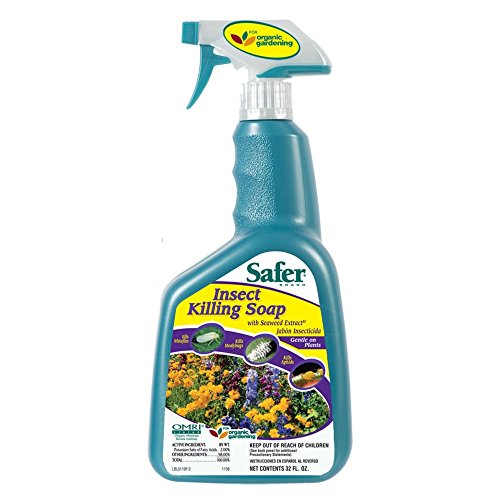
Zero measuring, zero waiting — just point and spray on your woolly aphids.
This is the easiest option here. It is ready-to-use in a 32 oz spray bottle. There is no mixing, no measuring, and no risk of burning your plants with too much concentrate. For a small backyard tree, a potted rose bush, or indoor houseplants with a light case of woolly aphids, it is the simplest route to clean greenery.
It includes seaweed extract, which owners say leaves foliage looking “lush green” after treatment — a noticeable difference from plain soap sprays. It also has a rose scent, so your garden smells fresh after spraying. Buyers fighting whiteflies and gnats report that two applications (left on for three days, then rinsed) eliminated the problem completely.
The catch is the price per ounce. Because it is ready-to-use, you pay more per quart than mixing the Safer 5118-6 concentrate yourself. It also needs patience — aphids do not drop dead instantly. Most owners needed two to three spray sessions a few days apart to break the life cycle fully.
Best for small-scale use: Simple, smells good, and doubles as a gentle leaf feed thanks to the seaweed. Not the cheapest route if you have acres to cover.
Grab this for: Quick treatment of potted plants, a single fruit tree, or indoor houseplants without the hassle of mixing.
skip it if: You are facing a large, multi-plant infestation — you will save time and money with the Safer 5118-6 concentrate instead.
3. VPG Fertilome Natural Guard Insecticidal Soap

A targeted contact spray that tackles specific tough pests without the heavy price tag.
If the Safer 5118-6 concentrate feels like too much product for your needs, this is a smaller, more focused option. It is a contact spray that targets lace bugs, spiders, mites, aphids, leafhoppers, and earwigs on fruit trees, vegetables, ornamentals, and citrus. The active ingredient, potassium salts of fatty acids, is designed to be gentle on plant tissue while still killing soft-bodied insects.
The feedback here is more mixed than the other two picks. Many owners found it effective on their gardenia and other ornamental plants, especially when combined with neem oil. However, one owner reported: “Even applying half the recommended dosage, the product severely damaged the crop of spinach!” Another buyer said the spray turned the grass around their plant brown without showing signs of actually killing the pests.
Because of these reports of plant damage, this soap needs more caution than the Safer options. You must test a hidden leaf first, avoid strong sun when spraying, and follow the mixing instructions exactly.
Know the risk: Works well on flowers and shrubs for many buyers, but sensitive leafy greens like spinach may burn even at half-strength. Stick to sturdy ornamentals and fruit trees with this one.
Choose this for: Roses, citrus, and ornamentals that can handle a contact spray.
Think twice if: You plan to spray delicate vegetables or seedlings — the Safer 5118-6 concentrate or the Safer 5110 ready-to-use spray is a safer bet for edibles.
Understanding the Specs
Potassium Salts of Fatty Acids
This is the active ingredient in every true insecticidal soap. It works by breaking down the insect’s outer shell (cuticle), which causes the pest to dehydrate and die. It is non-toxic to people and pets because it attacks the insect’s physical structure, not its nervous system like chemical pesticides do.
OMRI Listed
OMRI (Organic Materials Review Institute) reviews products to confirm they meet USDA organic standards. An OMRI Listed soap has no synthetic chemicals, so you can use it on edible crops right up to harvest day without losing your organic gardening certification.
FAQ
Will insecticidal soap kill woolly aphids on contact?
How often should I spray insecticidal soap for woolly aphids?
Will insecticidal soap burn my plants?
Can I use insecticidal soap on edible vegetables and herbs?
Is insecticidal soap safe for beneficial insects like ladybugs and bees?
What is the difference between a concentrate and a ready-to-use spray?
Can I use insecticidal soap to prevent woolly aphids, or only to treat them?
How long does a 16 oz bottle of concentrate last?
Final Thoughts: The Verdict
For the majority of shoppers, the best insecticidal soap for woolly aphids is the Safer 5118-6 Concentrate. It delivers near-instant results (90% dead by day one at the right dilution, per reviewers) and stretches across the whole garden season from one 16 oz bottle. If you want a no-mix, grab-and-spray for a few houseplants or a single tree, get the Safer 5110 Ready-to-Use with Seaweed Extract. For a targeted, budget-friendly option for rugged ornamentals and fruit trees, the VPG Fertilome Natural Guard works — just test a leaf first.
How We Picked
We do not accept paid placement. Every pick is matched to a real buyer and a real use-case; we do not hands-on test units.
Sources & Methodology
Specifications: manufacturer listings and product documentation. Review insights: verified customer reviews, as of July 2026. Pricing: not shown on this page (it changes often); check the current price via the retailer link.
As an Amazon Associate, Lawn Gear Lab earns from qualifying purchases. This does not affect which products we feature.