
Specs are compiled from manufacturer listings and verified buyer reviews and can change over time — please confirm the key details on the product page before buying.
Turning over a garden bed by hand is back-breaking work. After the first few rows with a shovel, your lower back is screaming and the dirt still looks like concrete. A handheld tiller cultivator changes that completely—it does the digging for you, so you can prep soil, pull weeds, and mix in compost in a fraction of the time.
I’m Rikta — the founder and writer behind Lawn Gear Lab. This guide is built by comparing the manufacturers’ published specifications and the patterns across verified customer reviews, so you get each pick’s real strengths and trade-offs instead of marketing spin.
The right handheld tiller cultivator saves your back and your weekend, cutting through packed soil without the noise and fumes of a gas engine.
Our Picks at a Glance

How To Choose The Best Handheld Tiller Cultivator
Picking the right tiller depends on three things: your garden size, the soil you are dealing with, and if you want to be tied to an outlet. Here is what matters most.
Match the Power to Your Dirt
A light, sandy bed can be turned by a 2.5-amp motor or a 280–360 RPM battery tool. Heavy clay or rocky soil needs more muscle — look for a 10-amp motor spinning at 430 RPM. The stronger the motor and the faster the tine rotation, the easier it slices through compacted ground.
Width and Depth Define Your Workflow
Tilling width (the strip you chew up each pass) ranges from about 6 inches to 12 inches. A wider width means fewer passes across a big plot. Depth (how far the tines dig down) usually runs 6 to 8 inches. You need at least 6 inches for healthy root vegetables like potatoes and carrots. A narrower, shallower tiller is fine for weeding between rows or aerating raised beds.
Battery vs. Corded: The Real Trade-Off
Battery-powered tillers let you roam anywhere without a cord, and they run quietly without fumes. The catch is runtime — most give you 20–30 minutes per battery before you need to swap or recharge. Corded electric tillers have unlimited run time as long as you have an extension cord, and they tend to deliver more raw power. But you are always dragging a cord, which gets annoying once you move away from the house.
Quick Comparison
| Model | Best For | Tilling Width | Tilling Depth | Power / RPM | Amazon |
|---|---|---|---|---|---|
| Saker 22V Cordless★ Best Overall | Small gardens & raised beds | 9 inches | 6.3 inches | 360 RPM / 22V Motor | Amazon |
| MZK 12-Inch CordedDigging Champion | Breaking up tough soil | 12 inches | 8 inches | 430 RPM / 10 Amp | Amazon |
| QESOO (Dewalt-Compatible)Tool-Free Dewalt | Dewalt battery owners | 8.9 inches | 7.1 inches | 280 RPM / 800W Motor | Amazon |
| ONEVAN Cordless | Long runtime with 2 batteries | 9.5 inches | 6.7 inches | 360 RPM / 550W Motor | Amazon |
| Earthwise 20V Cordless | Light weeding & edge work | 7.5 inches | 6 inches | 20V Motor | Amazon |
| Westinghouse Corded Mini | Tight flower beds | 6.3 inches | 6 inches | 300 RPM / 2.5 Amp | Amazon |
| DEGGE Cordless | Quiet, fume-free tilling | 9 inches | 6.7 inches | 48 Steel Tines | Amazon |
| IncwBo Corded Tiller | Large garden plots | 12 inches | 8 inches | 10.5 Amp | Amazon |
| MZK 20V Cordless | Raised bed maintenance | — | — | 360 RPM | Amazon |
In‑Depth Reviews
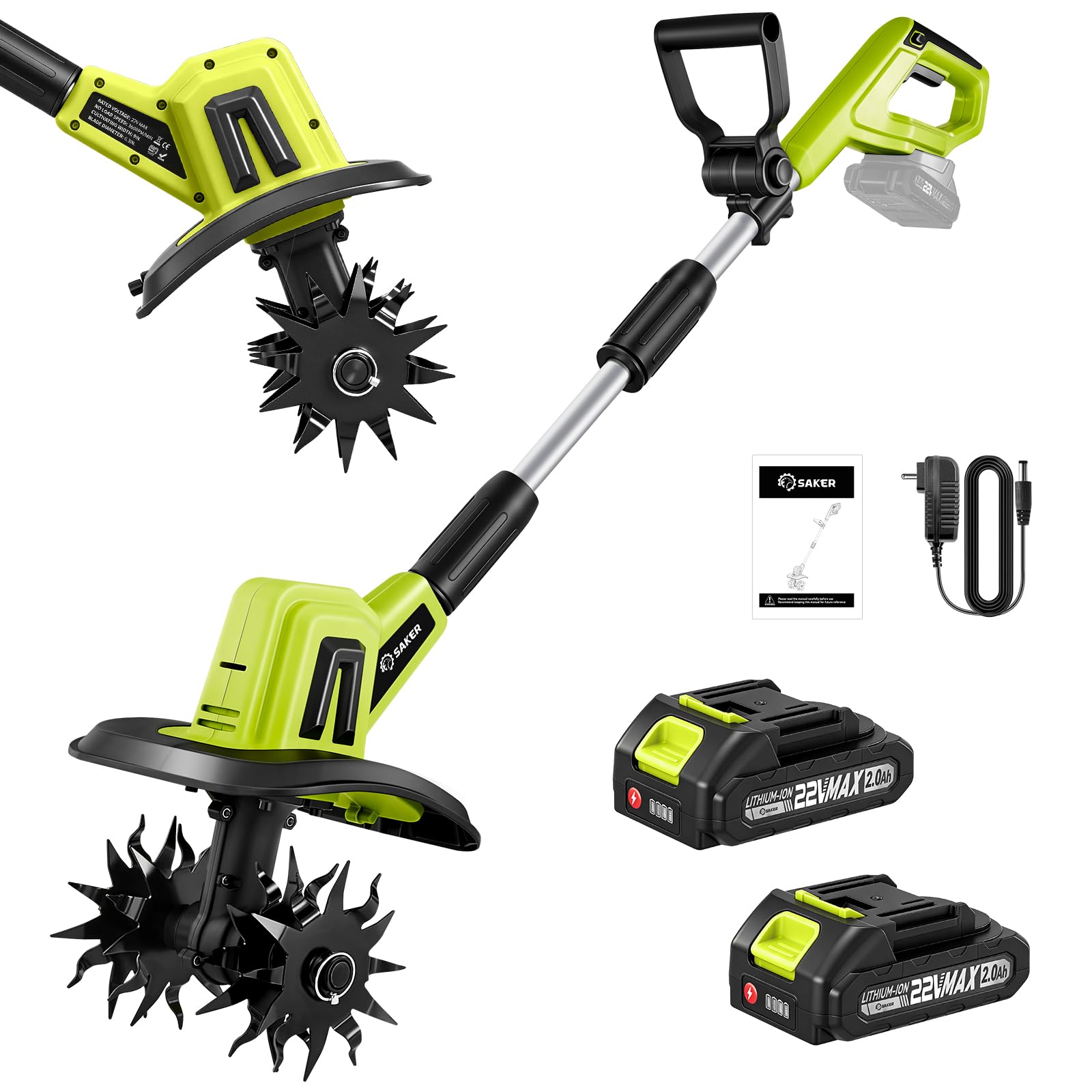
1. Saker 22V Cordless Electric Garden Tiller Cultivator
Our pick — over 4.5★ from 300+ verified ratings; the strongest balance of quality and price.
The cordless lightweight that eats through dirt without burning your back.
This cultivator delivers a 9-inch tilling width and a 6.3-inch depth, driven by a motor that spins the four steel tines at 360 RPM. The big draw is the battery system — you get two 22V 2.0Ah lithium-ion packs, each offering up to 30 minutes of runtime. Swap one for the other and you can keep going without waiting for a charge. Buyers report it handles sandy soil beautifully and reaches the perfect depth for planting potatoes. The consensus is that performance is the star here, with buyers consistently praising how well it turns over earth.
Safety is handled by a dual-button start: you have to press a safety button and the trigger at the same time, which prevents any accidental spin-up when you are carrying it or storing it. The adjustable auxiliary handle lets you find a comfortable grip whether you are tall or short, and the whole unit stays light enough for a gardener of any strength to maneuver. The trade-off is that tough clay soil gives it trouble — multiple passes help, but this is not the tiller for breaking new ground in hard-packed Southern clay. As buyers put it, “Easy assembly, works great on sandy soil,” and it is widely called a “little workhorse.” The crowd favorite shows a strong 4.6-star rating from hundreds of owners.
What Owners Love
- Strong 360 RPM motor with durable steel tines
- Two 22V batteries provide extended runtime
- Lightweight frame reduces fatigue during use
- Easy to assemble in minutes
A Fair Warning
- Struggles with hard, compacted clay soil
- No rear guard can mean debris kicks up
Reach for this if: you have sandy or loamy garden beds and need a cordless machine that runs long enough to finish a small-to-medium plot on one charge cycle.
Think twice if: your soil is heavy, rocky clay or you are breaking sod — this tool needs softer ground to shine.
2. MZK 12-Inch 10 Amp Corded Electric Tiller
The corded powerhouse that turns hard clay into soft soil without breaking a sweat.
This is the tiller you reach for when the ground has not been touched in years. With a 12-inch tilling width, at 12 inches versus the QESOO’s 8.9 inches, you finish a garden bed in fewer passes. Owners who battled red clay and rocky dirt report the MZK chews through it all, leaving fine, aerated soil behind. The effectiveness is the most-discussed trait here, and the praise is near-universal.
There is no battery to charge, no gas to mix. You plug it into an extension cord and go until the job is done. Assembly is famously fast — one reviewer noted they had it together in ten minutes. The 4 rust-resistant blades (with 16 cutting edges total) stay sharp season after season. At 430 RPM this thing generates some vibration, but the payoff is that even neglected soil breaks apart on the first pass. The main limitation is the cord itself: you need a long, heavy-duty extension cord to reach the far end of the yard, and you have to watch you do not run over it. Owners call it “small but mighty” and the product holds a superb 4.7-star average from nearly a hundred ratings.
Why It Wins
- Powerful 10-amp motor at 430 RPM handles tough clay
- Widest tilling width here at 12 inches — fewer passes needed
- No battery or fuel worries; runs as long as the cord reaches
- Extremely easy assembly, often under 15 minutes
One Thing to Know
- You are tied to an outlet and need a quality extension cord
- Tangled roots and weeds can wrap around the tines
Best for: medium-to-large gardens with compacted or rocky soil where you want unlimited runtime and raw digging power.
skip it if: your garden is far from an outlet or you hate managing a cord — the Saker cordless is a better fit for that scenario.
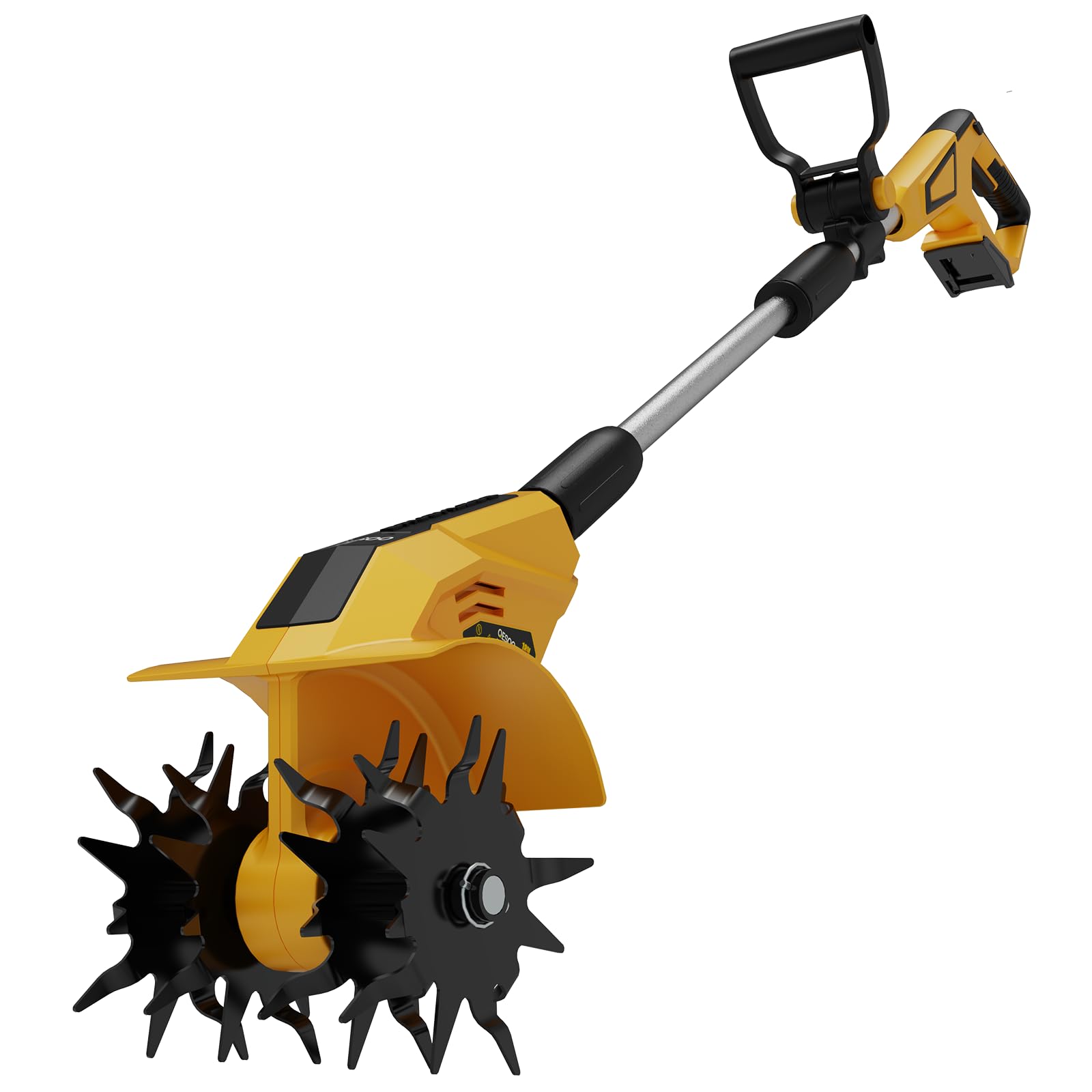
3. QESOO Cordless Tiller Cultivator (Dewalt-Compatible, Tool Only)
The smart pick for anyone who already owns Dewalt 20V Max batteries.
If your shed is stacked with yellow and black batteries, this cultivator slides right into your existing system. It is a “tool only” unit, meaning you bring your own Dewalt 20V Max battery — no extra charger or battery cost if you already have them. An 800W brushless motor drives 48 steel tines at up to 280 RPM, cutting an 8.9-inch wide and 7.1-inch deep path. The brushless design runs quieter and the manufacturer claims a longer service life compared to standard motors, backed by a 5-year warranty. Owners say it works best when pulled toward you and praise the build quality.
The weight is a talking point — at 10 pounds it is slightly heavier than some cordless rivals, but the weight helps the tines dig in rather than bounce off hard ground. The adjustable auxiliary handle lets you shift your grip for better leverage. One buyer mentioned that the retaining pins holding the blades can fall out during use, so it is worth checking them before each session. For raised-bed tilling and weeding soft soil, this is a strong performer that earns a 4.7-star rating from nearly a hundred users. It covers narrower ground than the MZK corded — 8.9 inches versus 12 inches — but the cordless freedom more than makes up for it when you are moving between beds.
The Perks
- Works with existing Dewalt 20V Max batteries (if you own them)
- Brushless 800W motor is quiet and efficient
- 48 steel tines dig a solid 7.1-inch depth
- Backed by a 5-year warranty
The Catch
- Battery and charger sold separately — adds cost if you are not already in the Dewalt ecosystem
- Some owners mention tine-retaining pins can come loose
A perfect match if: you already own Dewalt 20V tools and want a cordless tiller that uses the same batteries without buying a new platform.
Not ideal if: you are starting from zero — the Saker or ONEVAN bundles batteries for less hassle.
4. ONEVAN Cordless Tiller Cultivator with 2×3.0Ah Batteries

Long runtime from two batteries that keeps you working instead of waiting.
This one comes with two 20V 3.0Ah batteries (higher capacity than the 2.0Ah packs in the Saker) and a 1.5A fast charger, which means less downtime between sessions. The 550W motor spins 48 steel tines at 360 RPM, cutting a 9.5-inch wide and 6.7-inch deep trench. Customers note that a single battery runs about 25–30 minutes of continuous tilling, and the second one gets you through larger jobs. One reviewer cleared a 2,000-square-foot area for sod installation and said the tiller “worked beautifully” the whole time. The performance on compacted clay soil surprised many who were skeptical about battery power.
The adjustable auxiliary handle and safety dual-button start mirror the Saker’s design, so it feels familiar if you have used other cordless tillers. The tines are detachable, making it easier to clean out tangled weeds. The biggest positive buyers flag is the battery life — they appreciate not running out of juice mid-row. At 6.99 kg (about 15.4 pounds), it is on the heavier side for a cordless model, but the weight helps it bite into harder ground. The product logs a 4.7-star rating with over a hundred ratings, with size and ease of use earning frequent shout-outs.
Why It Stands Out
- Two 3.0Ah batteries offer longer runtime than most competitors
- Comes with a 1.5A fast charger for quicker recharges
- 48 steel tines at 360 RPM handle packed soil well
- Easy to clean after use with removable tines
A Trade-Off
- Heavier than some cordless rivals at about 15 pounds
- Not designed for breaking new ground in thick grass or sod
Grab this if: you have a medium garden and want the longest possible battery runtime between charges — the two 3.0Ah packs are a real advantage.
Look elsewhere if: you need the absolute lightest tool for a small flower bed — the Saker is lighter.
5. Earthwise Power Tools 20V Cordless Garden Tiller Cultivator

The featherweight that glides through raised beds without tiring you out.
At just over 9 pounds with a 7.5-inch tilling width and 6-inch depth, this Earthwise is purpose-built for small gardens and flower beds. The 20V 2.0Ah battery and fast charger come in the box, so you are ready to go immediately. The four durable steel tines work best in loose or already-turned soil — think spring bed prep, mixing in compost, or weeding along the edges of the yard. Owners consistently say it makes short work of compacted soil and saves hours compared to a shovel or hoe. Effectiveness is the most-cited strength, and the lightweight design gets consistent praise from gardeners who struggle with heavier tools.
The honest trade-off is battery life: at 84 mentions, it is the most-discussed aspect and carries a MIXED verdict from Amazon. Some owners get about 45 minutes of runtime, which is fine for a single small plot but falls short if you are tackling multiple beds. Weeds can also wrap around the tines, though they are easy to clear. This is a straightforward, no-fuss cultivator that earns a solid 4.3-star rating from over 700 owners — making it among the most-reviewed picks here. It is the entry-level-simple option that works perfectly for the gardener with a single raised bed or a few flower boxes.
The Highlights
- Very lightweight and easy to maneuver for any user
- Battery and fast charger included
- Effective at weeding and mixing soil in raised beds
- Large number of ratings (over 700) confirm its reliability
The Limit
- Battery runtime is modest — expect roughly 45 minutes
- Narrow 7.5-inch width means more passes for larger areas
Ideal for: a gardener with a small vegetable patch or a few flower beds who wants a light, simple tool that does not cost much and is easy to store.
Not enough for: big gardens or breaking new ground — the ONEVAN or MZK corded will finish the job faster.
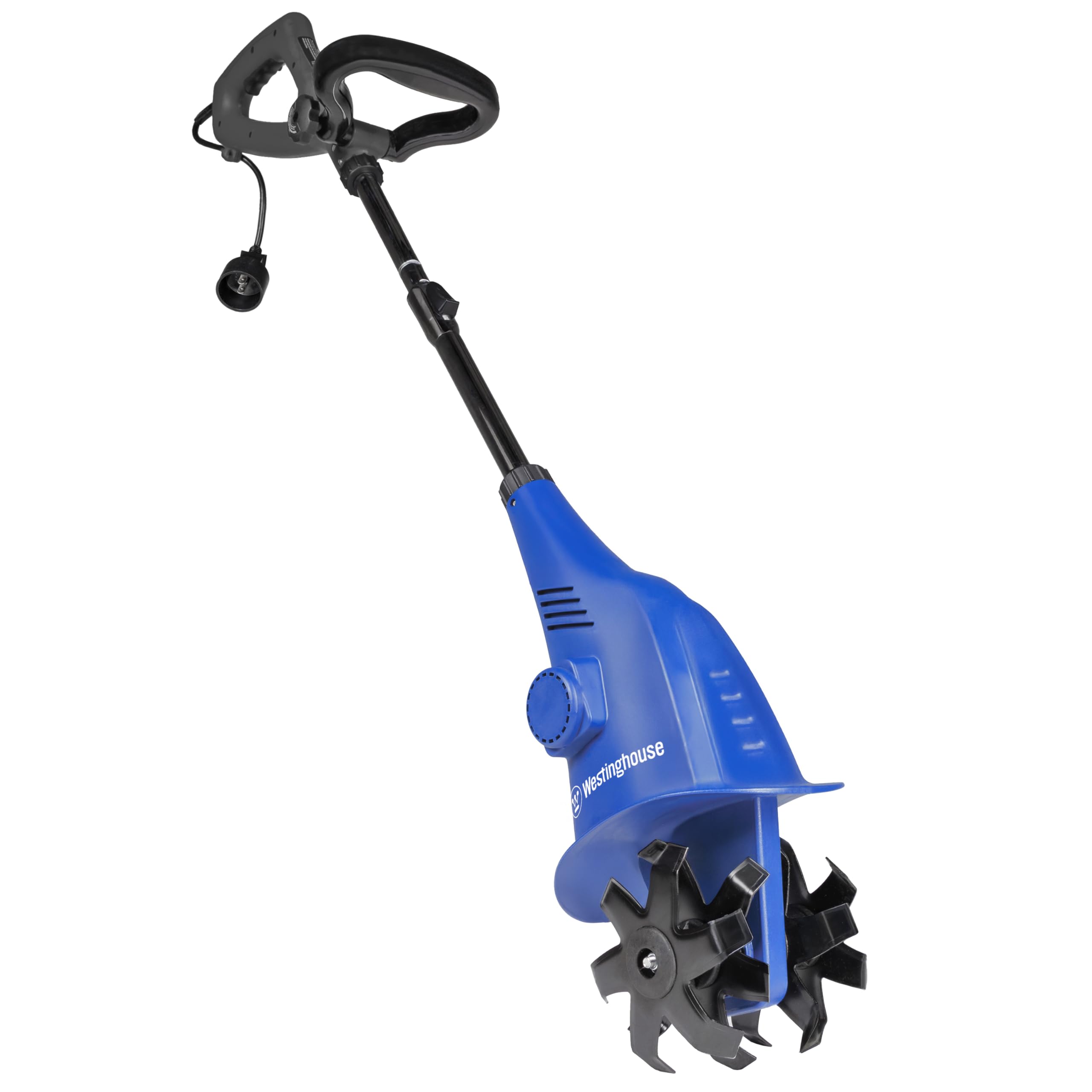
6. Westinghouse 6-Inch Corded Electric Mini Tiller Cultivator
The ultra-narrow cultivator that squeezes into tight flower beds where nothing else fits.
With a 6.3-inch tilling width and a 2.5-amp motor spinning at 300 RPM, this Westinghouse is the smallest and most maneuverable corded option here. It weighs just 9.9 pounds and its narrow profile fits between rows of established plants without damaging roots. The four heavy-duty steel blades break up compacted soil and improve aeration, reaching a depth of 6 inches. Owners say it handles rocky soil surprisingly well and works best when you pull it backward on the first pass. The compact dimensions — 6.3 x 6 x 53 inches — mean it tucks away in a small corner of the shed.
The catch is durability: at 23 mentions, it is the most-discussed aspect and gets a MIXED verdict. Some reviewers point out bent tines or other issues after a few months of use, especially when hitting buried objects like landscape fabric or roots. The motor also runs hot during extended sessions, so it is better suited for short bursts of 15–20 minutes. The extension pole design feels a bit light to some buyers, and the trigger is not ambidextrous — a left-handed user will find it awkward. Still, for a gardener who needs to cultivate a narrow raised bed or a line of flower boxes, this machine is perfectly sized. The 4.4-star rating across over 250 owners reflects that most buyers are happy with the trade-off of power and portability.
Where It Excels
- Ultra-narrow 6.3-inch width fits in tight garden spaces
- Light and easy to carry at under 10 pounds
- Handles rocky soil better than expected
- Quick setup — no assembly required
Watch Out For
- Durability is a mixed subject — some tines bend on hard hits
- Motor can overheat during long, continuous use
Right for: tight, established garden beds and flower boxes where a wider tiller would damage surrounding plants.
Not for: breaking new ground or large vegetable patches — the MZK corded is sturdier for heavier work.
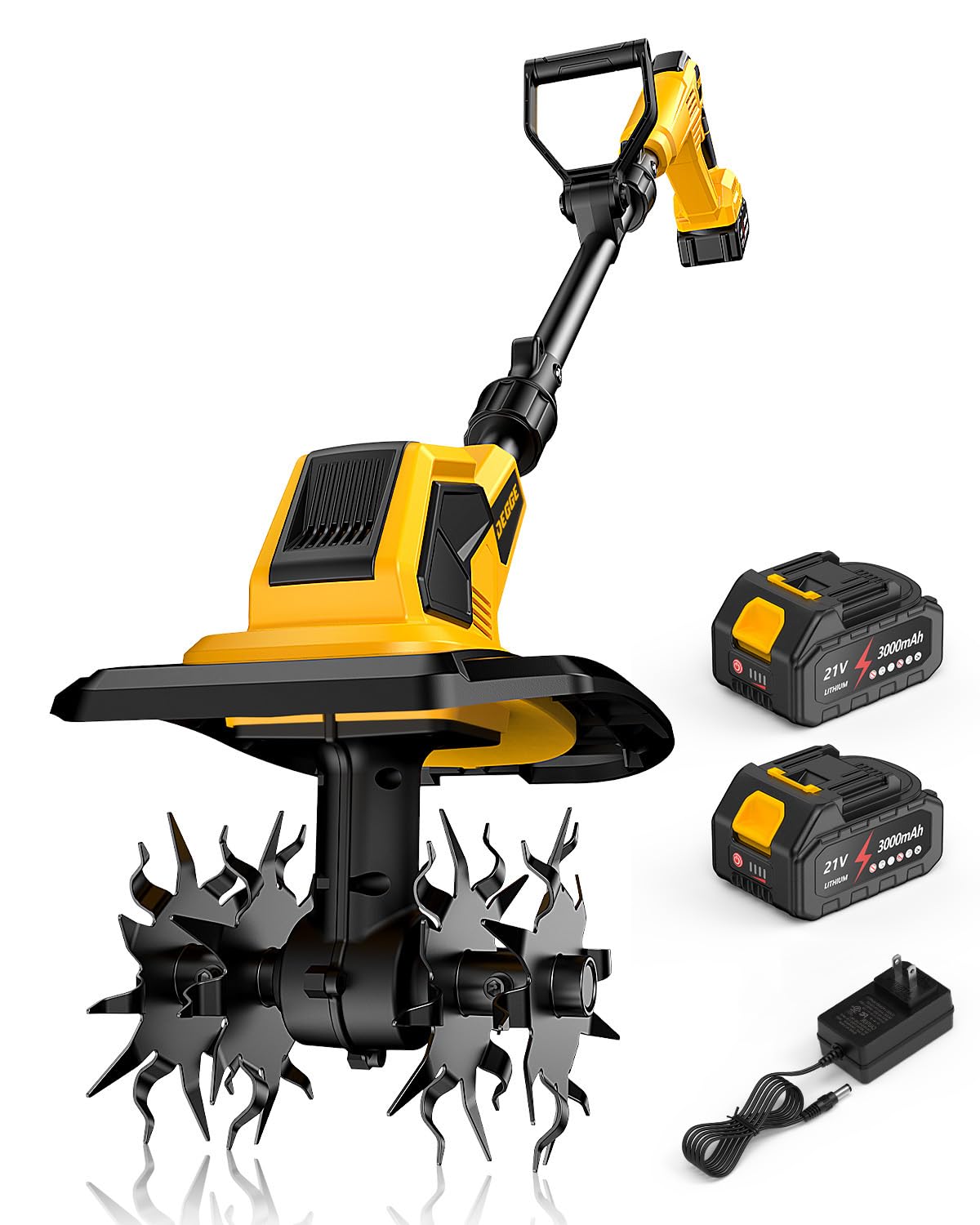
7. DEGGE Cordless Tiller Cultivator with 48 Steel Tines
The crowd darling that packs surprising power into an easy-to-assemble frame.
This is the best-rated cordless tiller in the lineup, carrying a stellar 4.8-star average from dozens of owners. It pairs 48 hardened steel tines with two 21V 3.0Ah batteries, giving you a combined 9-inch tilling width and 6.7-inch depth. The battery system is generous: each pack runs for about 25 minutes, and they charge in roughly 3 hours. Owners consistently say the batteries last through a full day of moderate work — one buyer described it as having “a ton of power” that kept going through a big job. The adjustable auxiliary handle and lightweight build make it easy for seniors or anyone with limited strength to operate without fatigue.
Assembly is straightforward — instructions are clear and most owners have it together in under 20 minutes. The dual-button safety start prevents accidental activation, a feature that matters when you are storing it in the garage. The tiller also makes zero fumes and runs quietly, so you are not annoying the neighbors. It works best when you spray the soil lightly a day before tilling if it is hard-packed. The only real sacrifice versus a corded model is raw torque — you will not rip through heavy clay as fast as the MZK corded, but for maintained garden beds this is a joy to use. As the reviews put it, “you can’t go wrong with this one.”
What Makes It Great
- The highest star rating here at 4.8 out of 5
- Two 21V 3.0Ah batteries deliver long, consistent runtime
- 48 steel tines dig through soil efficiently
- Very easy to assemble with clear instructions
The Fine Print
- Not as powerful as a corded electric for breaking hard clay
- Batteries take 3 hours to fully recharge
Choose this if: you value a top-rated, quiet, and fume-free experience for regular weeding and soil prep in established beds.
Consider something else if: you are often tackling new, unworked ground or heavy clay — the MZK corded is better suited for that.
8. IncwBo Electric Rototiller Garden Tiller (10.5 Amp, 12-Inch)

The budget corded tiller that punches well above its price on clay soil.
Sharing the same core specs as the MZK — a 10.5-amp motor, 12-inch tilling width, and 8-inch depth — this IncwBo is a near-twin in raw capacity. Where it differentiates itself is with a few thoughtful extras. It includes a soil spur (a small metal prong that digs into the ground to help control forward speed) and an overload protection system that automatically shuts off the motor if the tines jam on a rock or root. That mechanical overload safety is a smart addition if your soil is littered with hidden obstacles. Owners praise its ability to tear through hard clay dirt — one reviewer called it “speechless” at how easily it split North Carolina clay.
Like the MZK corded, this is a plug-and-go machine; no batteries to manage, no fuel to smell. The 4 rust-resistant blades (with 16 total cutting edges) make short work of a garden patch up to about 200 square feet. Functionality is the most-praised aspect here, with over 140 buyers mentioning it positively. The handle assembly uses hardware that can loosen during use — a few owners mention the left handle bolt works itself free and needs periodic tightening. At 10.84 kg (about 24 pounds), it is noticeably heavier than cordless models, but that weight keeps the tines biting deep on the first pass. With over 800 ratings, it is among the most popular picks here, earning a 4.5-star average.
what separates it
- Soil spur helps control forward speed for deeper tilling
- Mechanical overload protection prevents motor damage
- Wide 12-inch cut and 8-inch depth for efficient coverage
- Huge number of ratings (over 800) confirm broad satisfaction
A Minor Issue
- Left handle hardware can loosen during use — check before each session
- Heavier than cordless options at about 24 pounds
Go with this if: you want the raw power of a 10.5-amp corded tiller at a competitive price and appreciate the safety features.
Pass if: you need portability between beds — the Saker or ONEVAN cordless models are easier to carry.
9. MZK 20V Cordless Tiller Cultivator with Steel Tines

The cordless lightweight from a trusted brand, best for maintaining already-soft beds.
MZK’s cordless entry runs at 360 RPM using four steel tines, powered by a 20V battery system that includes two packs. Performance is the most-discussed aspect here with over 200 positive mentions, and owners say it is surprisingly strong for its weight. It chews through soil quickly without bogging down, and the lightweight frame makes it easy to lift into raised beds. The two-included batteries give you enough runtime for a standard garden session — a good call for weeding between rows or mixing in fresh amendments. The battery life also earns strong praise, clocking over 120 positive mentions, suggesting most owners find the runtime sufficient.
The catch: reports of the unit failing to power on after a period of storage exist. A small number of owners mention that after a year or two in the shed, the unit would not start even with charged batteries — something to consider if you put tools away for the winter expecting them to work the next spring. The 4.2-star rating from over 800 owners shows that the overwhelming majority have a positive experience, but that storage issue is the main reason this sits lower in the list. It is a fine choice for regular use in soft, well-maintained soil, especially if you already own other MZK tools and want battery compatibility. For heavy clay or infrequent use, the Saker or DEGGE cordless models are safer bets.
Why Owners Like It
- Lightweight and easy to handle, even in raised beds
- 360 RPM motor with steel tines does the job on soft soil
- Comes with two batteries for extended runtime
- Very popular with over 800 ratings
An Honest Risk
- Some units fail to power on after long-term storage
- Struggles with hard, compacted soil without added pressure
Best for: light, frequent tilling in soft garden beds where the convenience of cordless outweighs the need for brute force.
Think twice if: you only use a tiller once or twice a year and expect it to start after months in the garage.
Understanding the Specs
Amp Rating & Motor Power
For corded tillers, the amp rating tells you how much electrical current the motor can draw. A 2.5-amp motor is fine for light weeding and soft soil. A 10.5-amp motor gives you the torque to break through hard clay and packed earth. For cordless models, the motor wattage (like 550W or 800W) or the battery voltage (20V or 22V) gives you a similar sense of power, though battery voltage alone does not tell the full torque story.
Tilling Width vs. Depth
Tilling width (inches across) determines how much ground you cover with each pass — a 12-inch width means fewer passes than a 6.3-inch width. Tilling depth (inches down) determines how deep the tines penetrate. Six inches is enough for most vegetables. Eight inches is better for root crops like potatoes or for loosening deep-compacted soil. Always match the depth to what your garden actually needs.
FAQ
Can a handheld tiller cultivator handle rocky soil?
How long does a cordless tiller battery typically last?
Should I buy a corded or cordless tiller cultivator?
What is the best tilling depth for a vegetable garden?
Can I use a handheld tiller to remove weeds?
How do I maintain a handheld tiller cultivator?
Will a smaller tiller work in raised garden beds?
What does RPM mean for a tiller cultivator?
Can I use a tiller cultivator in wet soil?
Is it safe to use a corded tiller in light rain or dew?
Final Thoughts: The Verdict
For most buyers, the best handheld tiller cultivator is the Saker 22V Cordless because it strikes the best balance of battery runtime, digging power, and ease of use for everyday garden jobs. If you are breaking up tough clay and have access to an outlet, the MZK Corded delivers more torque and a wider cut. And for the highest-rated cordless experience with exceptional battery life, the DEGGE Cordless is the one to reach for.
How We Picked
We do not accept paid placement. Every pick is matched to a real buyer and a real use-case; we do not hands-on test units.
Sources & Methodology
Specifications: manufacturer listings and product documentation. Review insights: verified customer reviews, as of July 2026. Pricing: not shown on this page (it changes often); check the current price via the retailer link.
As an Amazon Associate, Lawn Gear Lab earns from qualifying purchases. This does not affect which products we feature.