
Specs are compiled from manufacturer listings and verified buyer reviews and can change over time — please confirm the key details on the product page before buying.
A birdhouse that sits empty isn’t a birdhouse—it’s garden clutter. The difference between a house that fills with a nest within a week and one that collects cobwebs depends on just a few things: the right entrance hole size, solid construction that keeps rain out, and a design predators can’t crack. What follows is a tight list of the houses that meet those marks, built from what thousands of buyers report actually works in their yards.
I’m Rikta — the founder and writer behind Lawn Gear Lab. This guide is built by comparing the manufacturers’ published specifications and the patterns across verified customer reviews, so you get each pick’s real strengths and trade-offs instead of marketing spin.
if you want a house for a single wren or a multi-pack for a whole songbird trail, this roundup of the top options for a garden bird house focuses on the ones that attract residents, hold up in weather, and clean out fast enough that you will actually do it.
Our Picks at a Glance


How To Choose The Best Garden Bird House
Buying a bird house seems simple—wood box, hole, hang it up. But the difference between a house that attracts birds and one that sits empty is in the details. Here is what actually matters when you are shopping.
Entrance Hole Size is Everything
The diameter of the front hole is a gatekeeper. A 1-1/8 inch hole is perfect for wrens and chickadees—it is too small for sparrows and starlings to squeeze through. A 1-1/2 inch hole opens the door to bluebirds, swallows, and larger songbirds. Pick the wrong size and you either exclude the birds you want or invite the bullies you do not.
Material Determines Lifespan
Cedar and New Zealand pine are naturally rot-resistant and breathe well, making them the standard for wood houses. Recycled plastic or poly lumber is newer to the category and comes with a big upside: it never rots, warps, or splits, though it can trap more heat inside during direct summer sun. Fir or composite-plywood houses are cheaper but often delaminate after one season.
Built-in Safety Features
A metal predator guard around the hole stops squirrels and raccoons from chewing the opening wider. Interior climbing grooves (sometimes called fledging kerfs) let baby birds scramble up to the exit hole—without those, chicks can get trapped. Drainage holes in the floor and ventilation gaps near the roof keep the inside dry and cool.
Quick Comparison
| Model | Best For | Entrance Hole | Material | Weight | Amazon |
|---|---|---|---|---|---|
| SISTERBIRD Wren House★ Best Overall | Small songbirds (wrens/chickadees) | 1-1/8″ | Cedar Wood | 1.5 lbs | Amazon |
| Kingsyard Wooden Wren HouseTop Performer | Wrens & chickadees | 1″ | New Zealand Pine | 2.1 lbs | Amazon |
| Glitzhome Cottage House (9″H)Most Charming | Decorative appeal + small birds | 1.18″ | Solid Wood | 1.1 lbs | Amazon |
| Gtongoko 2-Pack Bluebird House | Bluebird trails & DIY projects | 1-1/2″ | Solid Wood | 1.5 kg (3.3 lbs) | Amazon |
| Glitzhome Green Hand Painted | Garden decor & charm | 1.18″ | Solid Wood | 1.76 lbs | Amazon |
| Fitraho 2-Pack Cedar House | Multiple houses, great value | 1.5″ | Carbonized Cedar | — | Amazon |
| Kingsyard Recycled Plastic House | Low-maintenance, all-weather | 1.5″ | Recycled Plastic | 1.22 kg (2.7 lbs) | Amazon |
| MEWANG Rustic Cottage | Garden gift & curb appeal | — | Wood | 0.93 kg (2.05 lbs) | Amazon |
| Kingyard Poly Lumber House | Bluebird specialists & viewing | 1.5″ | Recycled Poly Lumber | — | Amazon |
In‑Depth Reviews
1. SISTERBIRD Wren Bird House
Our pick — over 4.5★ from 550+ verified ratings; the strongest balance of quality and price.
The cedar house that wrens move into the same day you hang it.
This one wins top spot because it keeps bully birds out and wrens in. The 1-1/8-inch entrance hole is the key—it is just wide enough for wrens and chickadees to slip through but too small for house sparrows and starlings to follow. Cedar construction resists rot naturally, and the hanging hook is made from 304 stainless steel, so it will not rust mid-season. Owners mention that “had wrens nesting as soon as I put it up.”
The interior has five fledging kerfs (small grooves that help baby birds climb to the exit) and six drainage holes at the bottom to keep nests dry. Three vents near the roof provide airflow. The U-shaped bottom mimics a natural nest shape.
What Wins People Over
- Quality is the most-discussed aspect by far—over 130 owners single out the build and material.
- The 1-1/8″ hole keeps sparrows and starlings out effectively.
- Upgrade metal door latch is more secure than a simple L-screw found on other models.
The One Caveat
- The latch can theoretically be jostled open by a determined squirrel; some owners wrap it with a small wire for confidence.
Reach for this if: You want a ready-to-hang house designed specifically for wrens and chickadees, with strong predator protection and easy seasonal cleaning.
Look elsewhere if: You need a house for bluebirds (the 1-1/8″ hole is too small for them) or want a post-mounted box rather than a hanging one.
2. Kingsyard Wooden Wren House with Predator Guard
Thick New Zealand pine with a roof that pops off for cleaning—no tools needed.
This is the heaviest wood house you can buy at 2.1 pounds, because it uses thick, solid stock that feels durable. Buyers describe it as “really well made, thick sturdy wood, nice materials.” The 1-inch entrance is made for wrens exclusively, and the metal predator guard around the hole stops squirrels from chewing it wider. The standout feature is the roof—it lifts off completely for cleaning yet locks back securely.
The royal blue roof looks cheerful, but owners are split on long-term durability. 69 owners flagged it as a concern, with several reporting the roof separating after a couple of weeks. The interior is roomier than the SISTERBIRD at 7.9 inches wide by 7.4 inches tall. It is a house that works beautifully for a season or two, especially if you mount it under some overhead protection.
What Wins People Over
- Construction is praised most—over 100 owners call it well-made and solid.
- Tool-free roof removal for cleaning is the simplest system in this lineup.
- Correct sizing for wrens with a secure predator guard.
The Honest Trade-Off
- Durability gets a negative verdict from owners; some report the roof coming apart within a couple of weeks of outdoor exposure.
Best suited for: Anyone who wants a thick, solid wren house with the simplest possible cleaning design and does not mind replacing it after a year or two if the roof struggles.
skip it if: You need a house that will stand up to multiple seasons of hard weather without maintenance—look at the recycled plastic options instead.
3. Glitzhome Bird Houses for Outside (9″H)
A tiny cottage look that charms gardeners as much as the chickadees.
This 9-inch tall house is the entry-level Glitzhome option with a 1.18-inch entrance hole. Owners rave about the appearance—73 call it charming or well-designed. The hand-painted finish and rustic cottage styling make it a natural fit for a flower bed. It weighs only 1.1 pounds, so it hangs easily from a lightweight branch.
The removable back panel makes cleaning straightforward. The 1.18-inch hole fits bluebirds, wrens, and chickadees. But sturdiness is mixed—some report the roof breaking within a month. The interior is compact at 5.5 inches deep by 4.5 inches wide. This is a decorative accent that also functions as a birdhouse, more than a heavy-duty nesting box. The “Red Roof” color is the most popular.
Why Owners Love It
- Appearance wins the most praise—it genuinely looks like a miniature cottage in the garden.
- Comes ready to hang with a metal hanger included.
- Birds reportedly move in within a day in some gardens.
The Fit Note
- Sturdiness is mixed; some customers note the roof breaks off after a few weeks of weather exposure. Best for sheltered spots.
Best for: Gardeners who prioritize aesthetic charm and want a birdhouse that doubles as decor on a covered porch or patio.
Not for: Anyone who needs a rugged, all-weather box for a fully exposed yard location.
4. Gtongoko 2 Pack Bluebird Houses
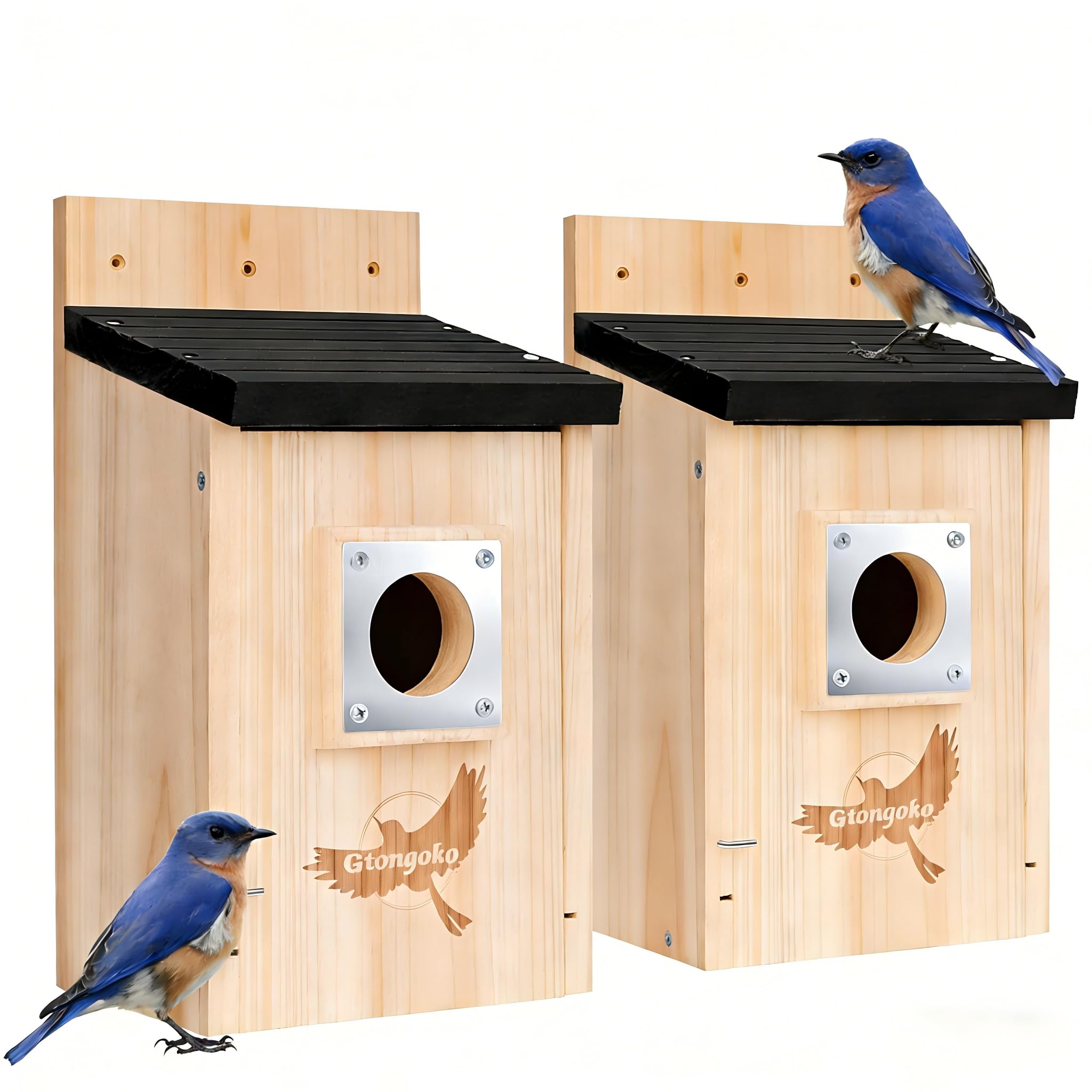
Two sturdy bluebird houses in one box, with assembly that actually fits together.
This two-pack costs less than many single premium boxes. The 1-1/2 inch entrance suits bluebirds, swallows, and chickadees. A metal guard plate protects the hole from squirrels. The houses need assembly, but pre-drilled holes line up correctly—owners say the included screwdriver makes it easy work. Within days of mounting one, bluebirds reportedly returned and nested. Construction quality is praised by 86 owners.
Inside, grooved panels help chicks climb to the exit, and a built-in wire mesh floor improves ventilation and drainage. The front door opens for cleaning. At 1.5 kilograms (3.3 pounds) for the pair, they feel built for the long haul. The wood is unfinished, so you can paint or seal them to match your yard. Durability gets a mixed note, with a few owners reporting cracking over time.
What Makes It a Value Winner
- Two houses for a price that is lower than many single premium boxes.
- Assembly is straightforward and the parts line up as expected.
- Metal plate around the entrance deters squirrels from chewing the hole larger.
Good to Know
- The wood is unfinished—you will want to add paint or sealant for maximum weather protection.
- A small number of owners note cracking in the wood after extended outdoor exposure.
Reach for these if: You are setting up a bluebird trail or want two houses for the price of one, and you enjoy a simple Saturday-morning assembly project.
Think twice if: You want a ready-to-hang house with no assembly required, or you need a 1-1/8″ hole for wrens specifically.
5. Glitzhome Green Hand Painted Bird House

A scooped roof and distressed paint give this one the look of a vintage garden find.
At 11.75 inches tall, this Glitzhome model is the tallest hanging wood house here. The green hand-painted finish with a retro palette looks like something from an English cottage garden. 42 owners mention the appearance positively. One owner called its styling “unique,” noting it looks more expensive than it runs. It hangs via a metal hanger and comes fully assembled.
The 1.18-inch entrance works for wrens, chickadees, bluebirds, and titmice. Weight is moderate at 1.76 pounds. The back door measures 1.57 inches by 2.36 inches for cleaning access. Durability gets a mixed verdict, with a few owners reporting shingles breaking off after a season. The wood is solid but not treated, so mounting it under some overhead cover will extend its life significantly.
Why It Stands Out
- Appearance is the most-praised aspect—this is among the most attractive houses in the lineup.
- Handmade distressed details give it a one-of-a-kind look.
- Generous height of 11.75 inches accommodates a wider range of small bird species.
The Honest Word
- A few reviewers point out that the decorative shingles or roof elements can break off in rough weather.
Best for: Anyone who sees the birdhouse as garden decor first and a nesting box second—this one adds real character to a flower bed or patio.
Think twice if: You need a low-maintenance box that can handle full sun and rain without any risk of parts loosening over time.
6. Fitraho 2 Pack Cedar Bird Houses
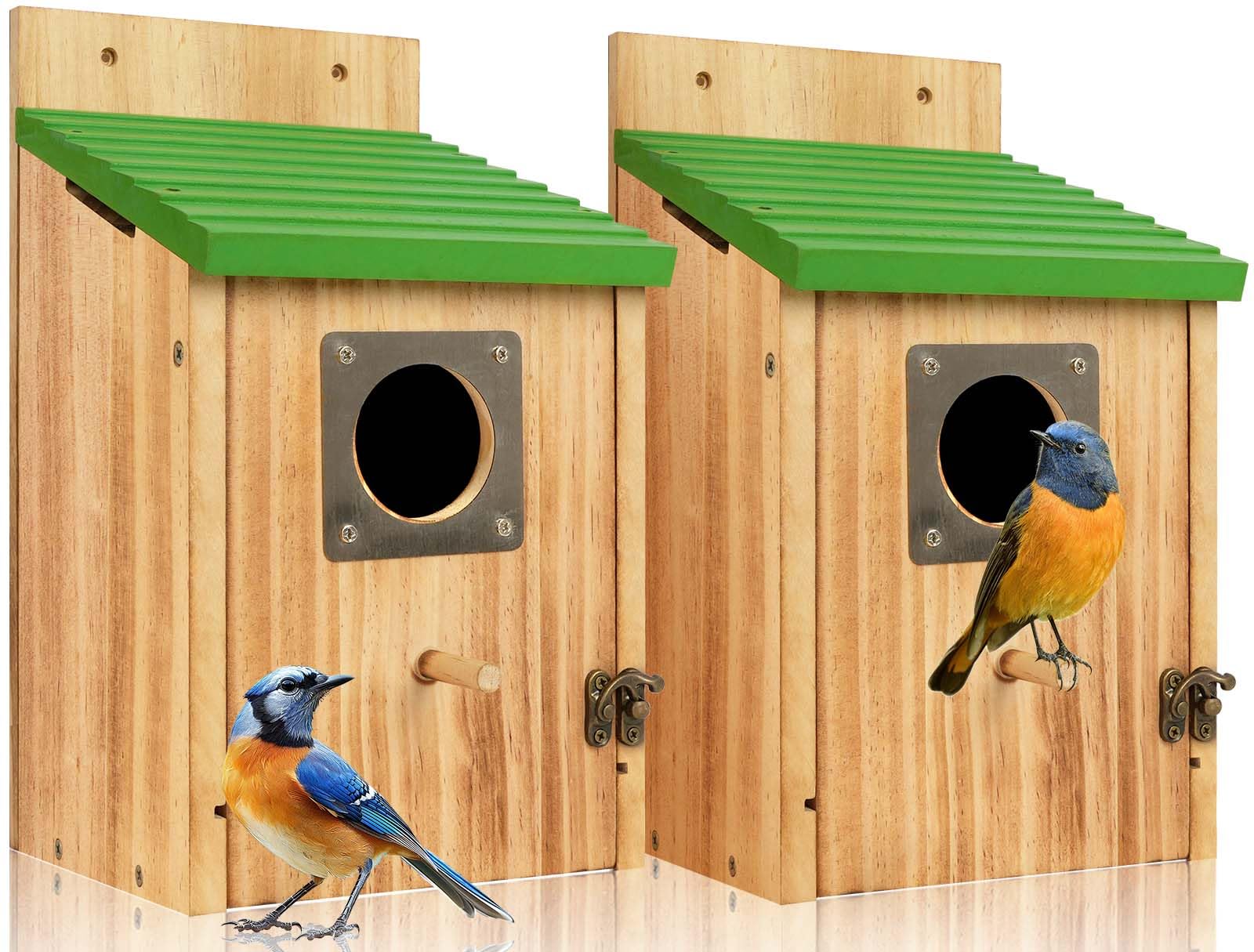
Carbonized cedar wood that weathers naturally without paint or stain.
These houses use cedar that has been carbonized (a process that darkens the wood and makes it more resistant to moisture and rot). The result is a natural texture that needs no paint. Assembly is required, and the pre-drilled holes get consistent praise—143 owners highlight easy assembly as a top feature. A tiny screwdriver comes included with each kit.
The 1.5-inch entrance targets bluebirds, tree swallows, and wrens. A metal predator guard wraps the hole, and interior grooves give chicks a foothold when fledging (leaving the nest). The front-facing door opens for cleaning. Buyers describe them as “sturdy wood” and “easy to do.” One owner flagged that the door clasp started rusting after a few rains, suggesting a stainless steel screw swap might be wise. For the price of two, these represent strong mid-range value.
What Shoppers Love
- Assembly is described as fast and fun—the pre-drilled holes actually line up.
- Carbonized cedar gives a unique, natural look that weathers well.
- Two houses make this a strong deal for bluebird trail setups.
One Thing to Watch
- The door clasp can develop rust quickly after rain exposure; swapping to a stainless screw is an easy fix.
Pick these for: A fun family project that results in two durable cedar houses with clean lines and good predator protection.
Pass if: You want a zero-assembly, fully finished house delivered ready to hang in five minutes.
7. Kingsyard Recycled Plastic Bird House

Composite material that shrugs off rain, snow, and sun without a single crack.
This is the first of two recycled-plastic houses from Kingsyard, designed for bluebirds with a 1.5-inch entrance and a metal predator guard. The material is high-quality recycled plastic—owners describe it as “sturdy as a composite deck board.” It will never rot, warp, or split, which is the major advantage over any wood option like the SISTERBIRD. Durability gets 37 positive mentions.
The house measures 6x6x8.5 inches, a square profile that feels compact but roomy inside. Air vent openings on both sides of the roof provide airflow. The front door opens easily for cleaning. Mounting hardware (2 screws, 2 anchors) is included, but some owners note the mounting setup could be more flexible if you want to hang it rather than post-mount it. One owner had no birds move in yet, but others report the house is “rainproof” and “built to last.”
The Big Advantages
- Recycled plastic construction means zero maintenance—no painting, no sealing, no rot.
- Durability and construction are the most-praised aspects; owners call it sturdy and well-made.
- Easy front-door access for cleaning.
The Trade-Off
- Mounting options are less flexible than a hanging house; some owners wish it came with a hook for hanging on a branch.
Best for: Anyone who wants a low-maintenance bluebird house that will look the same in year five as it did on day one, with no maintenance required.
pass on it if: You need a hanging house for a tree branch, or you prefer the natural aesthetics of real wood in your garden.
8. MEWANG Rustic Wooden Bird House
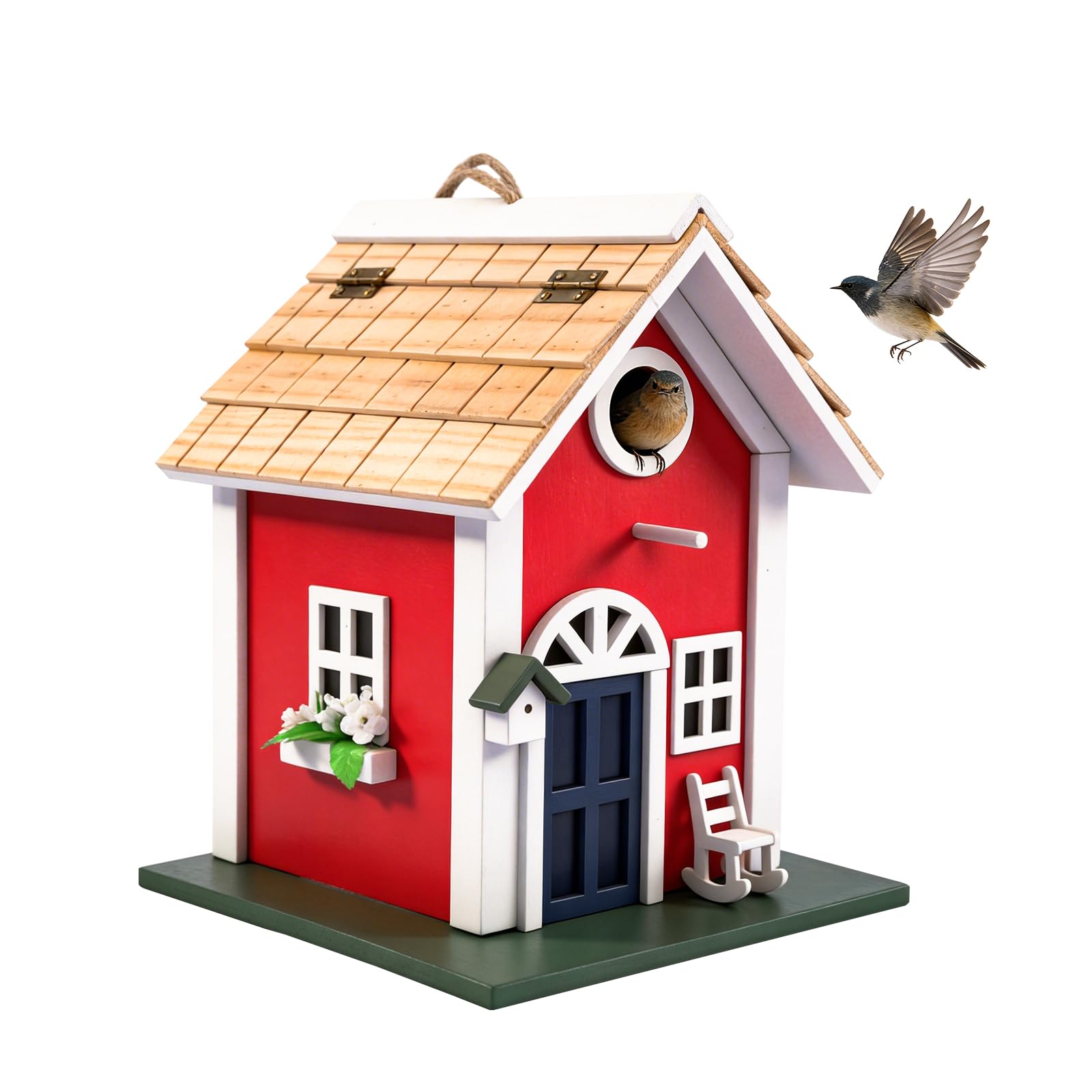
A colorful cottage design that a Bewick wren started nesting in within one day.
This is the most decorative option, covered in bright hand-painted colors with a rustic cottage silhouette. The hinged roof flips up for cleaning. Dimensions are 7.3 x 7.3 x 9.7 inches, suitable for small to medium wild birds. It comes with a jute rope for hanging and requires zero assembly. Appearance is the top praise by far—65 owners call it charming or beautiful. Quality follows at 32 positive mentions.
The data shows a split on durability: 19 owners flag it as a concern. Some report that decorative parts break off after a few weeks outside, and the composite wood is not as weather-resistant as solid cedar. One owner had a Bewick wren nesting inside within a day, illustrating the dual nature: birds love it, but the house itself needs a protected location. Buyers recommend hanging it under a porch overhang or covered patio.
What Makes It Special
- Arrives pre-assembled with a jute hanging rope—hang it up in under a minute.
- Stunning hand-painted design works as garden decor even before birds move in.
- Hinged roof opens for easy seasonal cleaning.
The Important Warning
- Durability is the recurring concern—parts can break off in exposed weather. Best in a sheltered location.
Ideal for: A gift for a garden-loving friend, or as a charming accent for a covered patio where weather is not a direct assault.
Not for: Direct exposure to rain and wind year-round—look at the recycled plastic options if that is your setup.
9. Kingyard Bluebird House (Recycled Poly Lumber)

A bluebird box built from recycled poly lumber with a window so you can watch without disturbing.
This is the most feature-rich house in the lineup. It is made from recycled poly lumber, which is denser and more heat-resistant than standard recycled plastic—it will not rot or fade. The transparent panel on the side door lets you peek at the nest without spooking the birds, owners say. Quality is the most-praised aspect with 97 positive mentions, and construction and durability follow at 85 and 76 respectively.
The 1.5-inch entrance with an extended metal predator guard is designed for Eastern bluebirds. Interior etching gives chicks grip when fledging, and bottom vent holes provide airflow. The house measures 6.3 x 7.6 x 12.2 inches, making it tall and roomy compared to the compact Kingsyard Recycled Plastic house. Assembly is required but minimal. A note from owners: in hot summer areas, you may want to drill a few extra ventilation holes. The side door for cleaning is secure and does not require tools.
The Premium Difference
- Recycled poly lumber resists rot, fading, cracking, and denting better than any other material here.
- Transparent viewing panel is unique in this roundup—genuinely useful for bird watchers.
- Quality, construction, and durability are the three most-praised aspects in that order.
What Owners Suggest
- A few owners wish the house came with pre-drilled ventilation holes at the top for hot climates.
- Mounting hardware is included but some find the single-screw approach less stable than desired.
Go with this one if: You want the longest-lasting, lowest-maintenance bluebird house available, and the viewing panel adds real joy to birdwatching.
Choose a different house if: You are on a tight budget—the premium price reflects the material, but wood houses cost significantly less.
Understanding the Specs
Entrance Hole Size
The diameter of the front opening controls which birds can enter. A 1-1/8 inch hole is the standard for wrens and chickadees, as it is too small for larger aggressive species like house sparrows. A 1-1/2 inch hole invites bluebirds, swallows, and titmice. A 1-inch hole, found on some houses, restricts birds to only the smallest wrens.
Predator Guard
This is a metal plate or ring that wraps around the entrance hole. Its job is simple: stop squirrels, raccoons, and larger birds from chewing or pecking the hole wider to get inside. Every house on this list that has one earns a real safety advantage.
Fledging Kerfs / Interior Grooves
These are small ridges or cuts inside the front wall of the house. Baby birds use them like a ladder to climb from the nest bottom up to the exit hole. Without these, some chicks cannot reach the opening and may die inside the box. Look for “fledging kerfs” or “interior climbing grooves” in the specs.
Clean-Out Access
A birdhouse must be cleaned out after each nesting season to prevent parasites and disease. The best designs have a door, roof, or back panel that opens easily—ideally without tools. A latch that is secure against predators but convenient for you is the balance.
FAQ
What size entrance hole should I choose for my garden bird house?
Is a cedar bird house better than a recycled plastic one?
Do I need a predator guard on my birdhouse?
How often should I clean out a birdhouse?
Will a birdhouse with a 1-1/2 inch entrance attract bluebirds?
What direction should I face the entrance hole?
How high should I mount a bluebird house?
Will a birdhouse with a 1-1/8 inch hole keep sparrows out?
My birdhouse has drainage holes. Are they really necessary?
What is a fledging kerf and why does it matter?
Final Thoughts: The Verdict
For most buyers, the garden bird