
Specs are compiled from manufacturer listings and verified buyer reviews and can change over time — please confirm the key details on the product page before buying.
The single biggest mistake most people make with their first terrarium is picking the wrong shape for their plant. A Venus flytrap needs airflow at the top, a fern wants a sealed moisture bubble, and succulents will rot in a closed jar. This guide walks you through nine glass options that actually match the plant you plan to grow, so you get the right container the first time.
I’m Rikta — the founder and writer behind Lawn Gear Lab. This guide is built by comparing the manufacturers’ published specifications and the patterns across verified customer reviews, so you get each pick’s real strengths and trade-offs instead of marketing spin.
Whether you are raising a carnivorous plant, propagating cuttings, or building a self-sustaining ecosystem, the right indoor plant terrarium is the difference between thriving greenery and a moldy mess you toss in the trash.
Our Picks at a Glance


How To Choose The Best Indoor Plant Terrarium
The wrong terrarium is a death sentence for most plants, but the right choice is nearly easy. Here is what actually matters when you are staring at a shelf of glass containers.
Lid and ventilation design
A sealed jar creates a closed water cycle — the plant drinks, the glass fogs, and moisture drips back down. That is perfect for ferns and mosses that crave humidity above 80 percent. A vented or open top, on the other hand, lets excess water evaporate, which keeps succulents and cacti from rotting. Carnivorous plants like Venus flytraps sit in the middle — they want high humidity but also need fresh air at the crown, so a top air hole is ideal. Choose your lid type based on the plant, not the look.
Glass type and durability
Borosilicate glass resists thermal shock, meaning it can handle a sunny windowsill in summer just as well as a cool shelf at night without cracking. Standard glass is cheaper but more fragile, and it can shatter under sudden temperature shifts. If you plan to place your terrarium near a bright window or under a grow light, borosilicate is the safer bet.
Opening size and access
A terrarium with a narrow neck looks beautiful but makes planting, pruning, and cleaning a chore. Wide-mouth jars and hinged-lid boxes let you work the soil, arrange the moss, and remove dead leaves without a set of tweezers. If you are a beginner, do yourself a favor and get a container you can fit your hand into.
Quick Comparison
| Model | Best For | Volume | Material | Lid Type | Amazon |
|---|---|---|---|---|---|
| NCYP Glass Cloche Dome★ Best Overall | Humidity-loving carnivorous plants | 1.7 L | Borosilicate glass | Air hole | Amazon |
| NCYP Small Glass RectangularBest Access | Small-space display with hinged access | 1.9 L | Glass | Hinged lid | Amazon |
| PYEF CRAFTS DIY Terrarium KitBest Starter Kit | First-time closed ecosystem builder | 34 fl oz | Glass | Cork lid | Amazon |
| Yarlung 6-Pack Wall Hanging | Vertical wall display and propagation | 162.8 cu in | Borosilicate glass | Open top | Amazon |
| Tanzeon Cylinder Jar | Carnivorous plants and tall growing specimens | — | Borosilicate glass | Vented lid | Amazon |
| CYZglass Propagation Station | Desk propagation with decorative wooden stand | — | Borosilicate glass | Open top | Amazon |
| D’Eco Glass House Centerpiece | Tabletop decor and wedding letter box | — | Glass | Hinged roof | Amazon |
| Yimorence Tall Greenhouse | Tall plants and orchid display | 7875 cc | Reinforced glass | Lift-off lid | Amazon |
| YIMORENCE V Large House | Cat-proof succulent display | 474.11 cu in | Reinforced glass | Swing lid | Amazon |
In-Depth Reviews
1. NCYP Glass Cloche Dome with Air Hole and Base
Our pick — over 4.5★ from 350+ verified ratings; the strongest balance of quality and price.
The dome that keeps a Venus flytrap thriving on a sunny sill.
The defining feature here is the single air hole at the top of the borosilicate glass dome. That small vent solves the classic terrarium puzzle — it holds high humidity inside while still letting fresh air circulate at the crown of the plant. Buyers report their Venus flytraps, jeweled orchids, and even tissue-culture Alocasia frydek are visibly thriving under this glass. The 1.7-liter volume is the balance: large enough for a sizeable plant but compact enough to sit on a bookshelf without overwhelming the room.
At 1.5 pounds, the glass feels substantial but not too heavy to lift off for watering. The 8.2-inch total height gives taller plants room to grow, and the included glass base catches any condensation drips. A few owners mention the dome can leak slightly at the seam where the top sits on the base, so a small dish underneath is a wise precaution. The overall feedback is unanimous — this is the terrarium that earns “size” and “appearance” as the two most-praised aspects by a wide margin.
The cloche design also doubles as a display case for small statues or dried flowers, making it a genuinely versatile piece of home decor. If you own one humidity-hungry plant you want to spoil, this is the glass house for it.
The crowd-pleasing strengths
- Air hole at the top provides perfect airflow for carnivorous plants
- Borosilicate glass handles sunny windows without cracking
- Removable dome makes planting and watering easy
The honest trade-offs
- Base-to-dome seam can drip condensation onto the surface below
- 1.7-liter volume is too small for multiple plants at once
Reach for this if: you have one humidity-loving plant — a Venus flytrap, orchid, or fern — that needs a stable, ventilated microclimate on a desktop or windowsill.
Look elsewhere if: you want a sealed terrarium that never requires outside watering; the top hole means you will need to mist occasionally.
2. NCYP 6.7 x 4 x 4.8 Inch Small Glass Terrarium Planter with Lid
The hinged-lid box that makes weekly maintenance a one-hand job.
This rectangular glass terrarium inverts the usual logic — instead of a dome you lift off, it uses a hinged glass lid that tilts open. That is a subtle but meaningful difference when you are watering or pruning every few days. The 1.9-liter volume is 12 percent larger than the cloche dome above, giving you a bit more horizontal space for a small grouping of succulents or a single carnivorous plant.
The black base gives the clear glass a modern silhouette, and the build quality earns consistent praise — “appearance” and “construction” are the top positive aspects owners note. A creative buyer sealed the bottom with aquarium silicone to prevent leaks and now uses it as a fully functional mini wetland. The hinged lid also keeps curious pets and insects out while still allowing air exchange through the natural gap. The catch is the size: several buyers found it “much smaller than expected.” At 6.7 inches long and 4 inches wide, it is truly a desktop-scale container, not a showpiece.
One of the few units in this list that works equally well as a display for a pet snail or a propagation tray for moss. For a small-space terrarium that balances access and looks, this is a solid contender.
Real-world fit: for anyone who wants a hinged lid that stays open while you work — ideal for a child’s first terrarium project or a low-maintenance moss garden on a narrow shelf.
The small-print note: the bottom is not sealed; if you need a watertight base, plan on a thin layer of aquarium silicone before planting.
3. Terrarium Kit for Plants DIY | Starter Pack – Closed Ecosystem – 34 fl oz
Everything but the plant in one box — the ultimate low-friction entry.
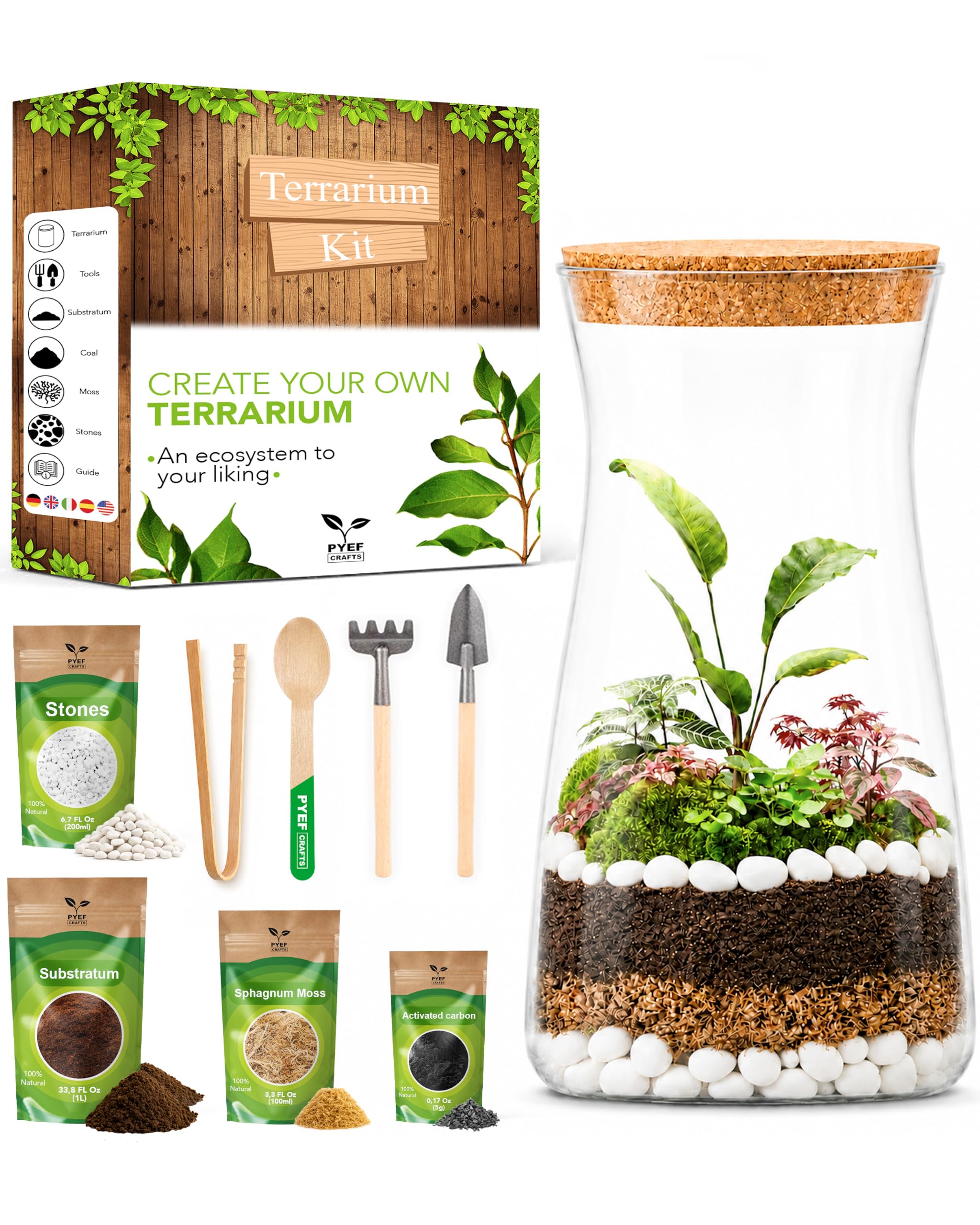
This kit skips the guesswork entirely. The 34-fluid-ounce glass jar comes with pre-measured layers of coconut soil, decorative stones, sphagnum moss, and activated charcoal, plus bamboo tweezers and a spoon for arranging. The idea is that you pick a plant (Fittonia, mini fern, Tillandsia, or moss are the recommended choices), follow the illustrated instructions, and seal the cork lid to create a closed water cycle. The ecosystem, as described, then sustains itself through condensation and evaporation with very little follow-up watering.
The kit’s audience is clearly beginners and busy plant owners — the instruction set is straightforward, and the jar’s 4.33-inch diameter by 8.26-inch height offers a tall, narrow profile that looks elegant on a desk. The most common owner refrain is exactly what you would hope: “easy to set up and looks great.” A few buyers wish the kit included more substrate material, but for a single-jar project, the quantities are well-calibrated. The jar is a full 55 percent taller than the NCYP rectangular box, giving you vertical room for taller moss stems or a trailing plant.
The real value here is the confidence — nothing to buy separately, no guesswork on what goes where, and a glass container that works as a long-term home.
What the kit delivers
- Pre-measured drainage and substrate layers mean zero guesswork
- Cork lid creates a stable, self-watering closed ecosystem
- Tall 8.26-inch profile accommodates plants that grow upward
The honest trade-offs
- Some owners wish the substrate quantities were more generous
- Cork lid limits future access compared to a hinged or removable top
Perfect for: a first-time terrarium builder or a gift for someone who loves plants but has never built a closed ecosystem before.
Think twice if: you already have your own substrate materials and want a larger or wider container for a multi-plant arrangement.
4. Yarlung 6-Pack Wall Hanging Planters Terrarium
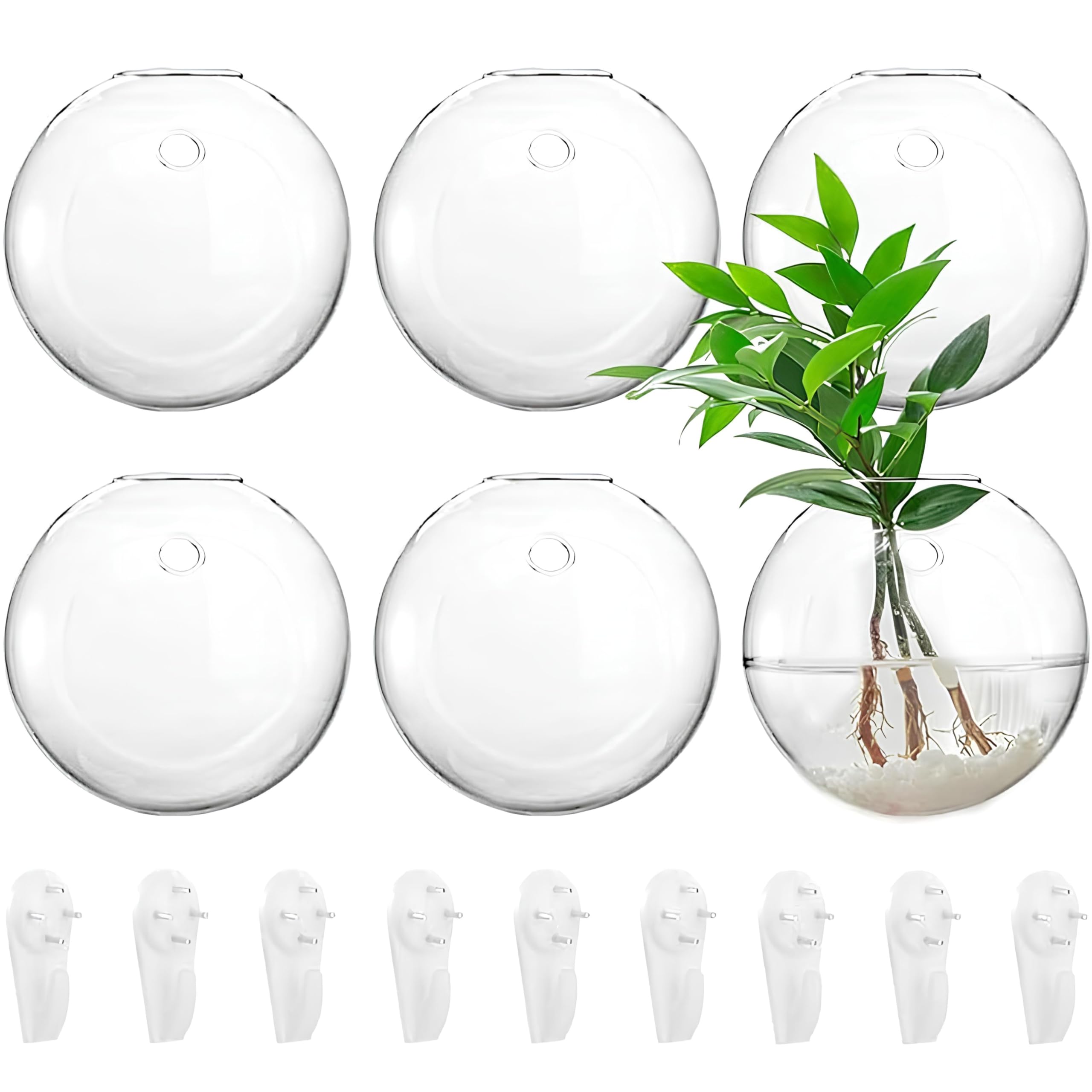
Six oblate glass globes that turn a blank wall into a living art piece.
Each oblate (flattened globe) planter measures 4.7 inches in diameter with a 1.6-inch depth, creating a shallow pocket perfect for hydroponic cuttings, air plants, or small succulents. The glass is high-boron-silicon heat-resistant material, and each planter has a hole at the top for watering plus a smaller hole on the back for wall mounting. The set includes 9 nail hooks, so you have spares for wall spacing experiments.
Appearance is the runaway top positive aspect — 36 owners single it out — and it is easy to see why. Mounted in a vertical cluster, these globes create a clean, modern propagation wall that makes any small apartment feel like a greenhouse. The plants inside root visibly through the clear glass, which adds a scientific-garden aesthetic. The major trade-off is fragility: the glass is thin, and multiple reviews report units arriving shattered or cracking during installation. If you buy these, handle them gently and mount them over a non-carpeted floor just in case. The included hooks are plastic and not heavy-duty, so command strips may offer a safer alternative for renters who cannot drill.
For the price of a single premium terrarium, you get six individual vessels that can each hold a different cutting or plant. That is tough to top for propagation-focused growers.
The defining strength: a six-pack allows one wall to display multiple plants or propagation experiments simultaneously, which no single-container product can match.
The main caution: glass is thin and breakage in transit is a known risk — order with the expectation that you may need to return a damaged unit.
5. Tanzeon Small Glass Terrarium Jar with Lid – 4.7 x 7 Inch

A cylinder jar whose lid is engineered to drip condensation back into the soil.
What sets this jar apart from other closed terrariums is the conical-shaped lid. Normal flat lids let condensation collect on the glass and roll down the sides, but the conical shape here is designed to guide droplets straight back down into the soil layer, keeping the water cycle efficient. For a Venus flytrap or a pitcher plant that demands consistent humidity, that engineering detail matters. The 4.7-inch diameter by 7-inch height gives plants room to grow upward without crowding the glass.
Buyers consistently say this is the right size for small carnivorous plants, and the wide opening makes it easy to arrange soil and plants inside. The lid includes fixed ventilation holes, which is good for air exchange but less flexible if you want full humidity control — a few owners note they have to mist more often because the holes cannot be closed. One creative owner cut a piece of plastic wrap to cover the vents when extra humidity was needed. The borosilicate glass feels premium and arrived intact in nearly every report. For the price, this is a purpose-built carnivorous plant home that looks clean on any desk or shelf.
The design is minimal and modern, and the condensation drip lid genuinely works as advertised.
The engineered advantage
- Conical lid channels condensation back to the soil instead of letting it pool on the glass
- Wide mouth makes planting and maintenance easy
- Compact footprint fits easily on a work desk or nightstand
The fixed-vent limitation
- Ventilation holes are pre-drilled and cannot be closed, limiting maximum humidity
- At 7 inches tall, taller-growing plants may top out sooner than in a larger vessel
Reach for this if: you are keeping a single small carnivorous plant — a Venus flytrap, sun pitcher, or butterwort — and want a self-regulating humidity dome that looks intentional.
Look elsewhere if: you need a sealed environment with zero air exchange for moisture-sensitive tropical plants.
6. CYZglass Plant Terrarium Propagation Stations with Wooden Stand
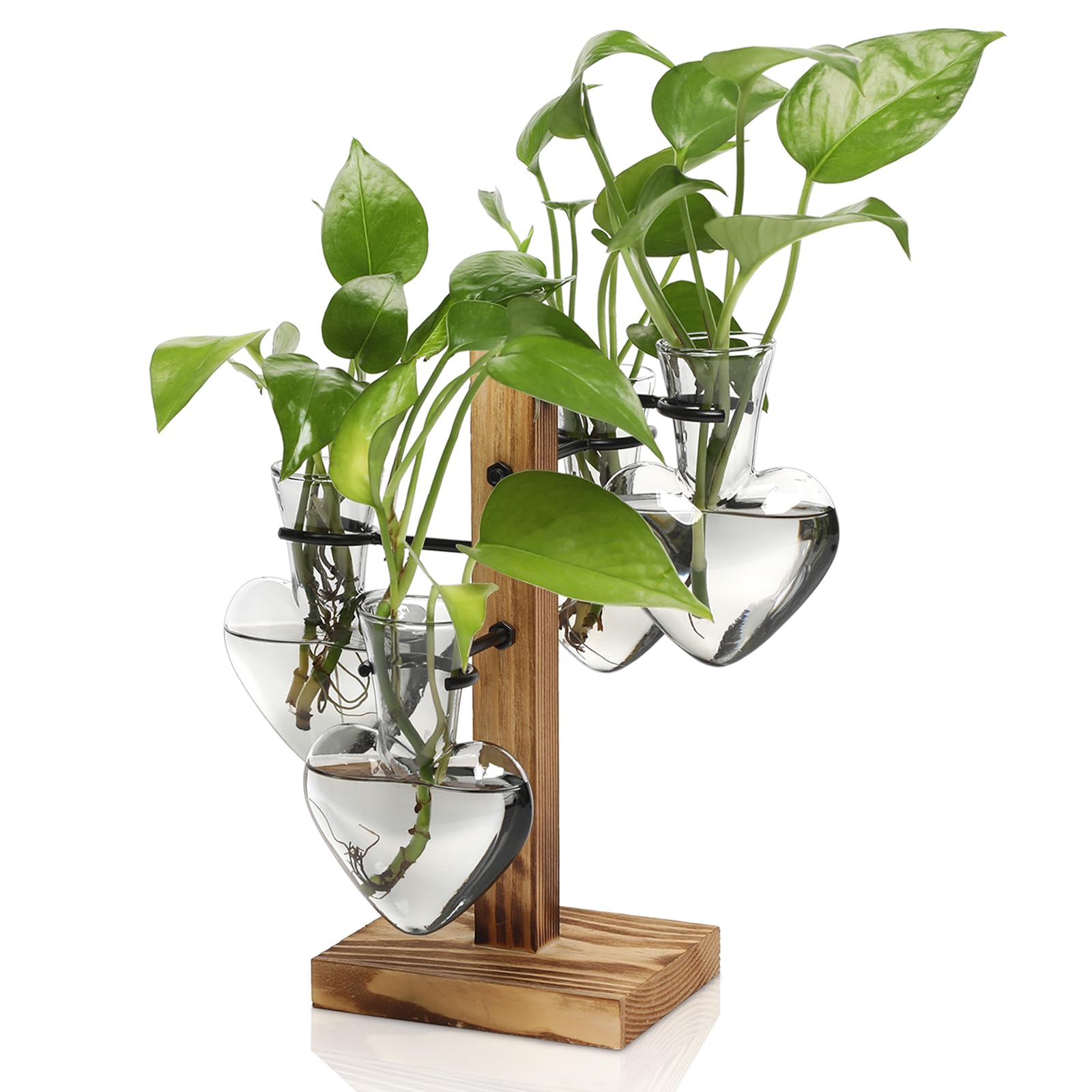
Four heart-shaped glass bulbs dangling from a T-shaped wood stand — propagation as decor.
This is less a terrarium in the traditional sense and more a propagation station designed for water-rooting cuttings. The set includes a T-shaped wooden stand, four C-shaped metal hangers, and four high-borosilicate glass bulbs in a heart shape. You fill each bulb with water, insert a cutting, and watch the roots develop through the clear glass. The stand keeps everything organized on a single footprint, which is a huge upgrade over scattering mason jars across a windowsill.
Appearance is the top positive aspect — 55 owners call it beautiful — and the assembly takes under a minute. Owners mention it makes a “perfect Mother’s Day gift” and that plants “sprout roots quickly” in the clear glass. The design is smart: the C-shaped hangers use the weight of each filled vase to stay horizontal, so you don’t have to tighten anything to death. The two real-world cautions are the fragility of the glass bulbs (the listing warns you directly about this) and the need to not overtighten the screws holding the hangers, which can strip the wood if you overdo it.
If your goal is to propagate pothos, monstera, or philodendron cuttings while having them look like intentional decor, this is the best approach on this list.
Its best use: any desk, shelf, or countertop where you want to display cuttings without the “science experiment” look of random glass jars.
One note from owners: the glass bulbs are fragile — handle the set carefully during assembly and placement, and contact the seller if any arrive broken.
7. D’Eco Glass House Centerpiece (10x6x8)

A house-shaped glass terrarium with gold trim that pulls double duty as a wedding letter box.
At 10 inches long by 6 inches wide by 8 inches tall, this is the largest container in the mid-range group, and the glass-house silhouette with gold accents makes it a natural centerpiece for a dining table or mantle. The hinged roof opens for ventilation and plant access, and the wide-open front and back make it easy to arrange a full succulent garden or a fairy garden scene inside. Owners use it for everything from card storage at weddings to housing small cacti and air plants.
The aesthetic gets by far the most attention — 69 positive mentions on appearance — and at this price point, the size-to-looks ratio is hard to match. The durability verdict is more divided: some find it sturdy, others report it arriving cracked or breaking before first use. The packaging seems inconsistent, so ordering with a backup plan is wise. A few customers note that the glass is not watertight, so it is best suited for air plants or dry arrangements unless you seal the bottom with silicone. For a centerpiece that doubles as a functional plant display, the D’Eco house is the most visually dramatic pick here.
It also makes a thoughtful gift for a plant-loving friend who already owns several standard terrariums and wants something with more personality.
The visual impact
- House shape with gold accents stands out from every other round or rectangular terrarium
- Hinged roof provides easy access for watering and pruning
- Large enough to hold a multi-plant arrangement or a small fairy garden
The honest concerns
- Not watertight — needs silicone sealant if you plan to water directly inside
- Shipping damage is inconsistent; some units arrive with cracks or broken panels
Best for: a decorative centerpiece that doubles as a conversation starter — ideal for dry plants, air plants, or non-plant items like seashells and keepsakes.
Think twice if: you need a waterproof container for a wet soil-based terrarium without DIY modifications.
8. Yimorence Large Tall Plant Greenhouse Terrarium (8.7×5.9×10.6 Inch)

A house-shaped mini greenhouse whose 10.6-inch height fits orchids and tall ferns.
The standout number here is 10.6 inches of vertical space, making this the tallest container on the list. That extra height is the difference between a fern that touches the glass and one that has room to spread. The house shape with black trim resembles a miniature garden window, and the lift-off top gives you full access to the interior. The glass is reinforced, adding weight at 4.4 pounds — noticeably heavier than the other options — but that heft translates to a stable feel on a tabletop.
Owners particularly praise how it “keeps the humidity in great” and that it comes fully assembled. The appearance scores 70 positive mentions, the highest raw count in the list. The trade-offs are size-related: many buyers found it “smaller than expected” despite the tall profile, and the bottom is not waterproof, meaning excess water drains out through the base. A few owners also report a gap at the lid seam that allows some moisture to escape. For a tall, elegant greenhouse that can house a single orchid or a cluster of carnivorous plants, this is the right shape.
The reinforced glass also means it survives being knocked — one owner uses it for an active pet snail, and another keeps their cat grass protected from feline teeth.
Its defining advantage: the 10.6-inch interior height gives tall-growing plants room that short jars cannot provide — ideal for a single orchid, a pitcher plant, or a layered fern arrangement.
The honest trade-off: the base is not sealed, so water drains out; place it on a tray if you plan to water directly inside the terrarium.
9. YIMORENCE V Large Glass Terrarium House Planter (9.8×5.9×7.9 Inch)

The reinforced greenhouse that keeps cats out and moisture in — mostly.
At 9.8 inches wide by 5.9 inches deep by 7.9 inches tall, this is the broadest footprint in the list, giving you real horizontal surface area for a small succulent arrangement or a pair of Venus flytraps. The swing lid props open with a built-in kickstand, which is a thoughtful detail for airing out the terrarium or working inside it with both hands. The reinforced glass panels feel heavy and well-constructed — one owner reports the terrarium surviving multiple moves without issues.
The primary use case expressed by buyers is cat-proofing. The glass enclosure prevents curious felines from chewing on plants, and the heavy panels keep the structure from being tipped over. The moisture retention is strong — almost too strong for succulents, which can rot in the high-humidity environment even with the door open. Some owners found the opening small for arranging plants with large hands, and the spot welds holding the glass together can look rough up close. For the price, the size-to-sturdiness ratio is excellent, but measure carefully: the actual interior space is smaller than the 9.8-inch width suggests because of the thick glass panels.
Appearance and quality are the top-scoring aspects, and the visual appeal of a mini glass house on a coffee table is undeniable.
What wins people over
- Large footprint allows multiple small plants in a single container
- Sturdy reinforced glass resists tipping and survives moves
- Kickstand on the swing lid lets you prop it open for ventilation
The honest trade-offs
- High interior humidity makes it a poor choice for succulents even with the door open
- The opening is narrow relative to the overall size, making planting difficult for large hands
Perfect for: cat owners who need a physical barrier between their plants and their pets, especially for moisture-loving plants like ferns and moss.
Not for: succulents or cacti that prefer dry air — the retained moisture will cause rot within weeks.
Understanding the Specs
Borosilicate glass vs standard glass
Borosilicate glass withstands rapid temperature changes — going from a warm room to a sunny windowsill without cracking. Standard glass is cheaper but more prone to shattering under thermal stress. If your terrarium will sit near a bright window or under a grow lamp, borosilicate is the safer material for long-term use.
Volume and interior height
The volume (measured in liters, fluid ounces, or cubic inches) tells you how much growing space the container offers, but interior height is equally important. A tall jar fits a fern or orchid that grows upward; a wide, shallow globe is better for a spreading succulent arrangement. Match the shape of the container to the growth habit of your plant, not the absolute volume number.
FAQ
Do I need a closed or open terrarium for my plant?
Can I use a terrarium for a Venus flytrap?
How often do I need to water a terrarium?
What is the difference between standard glass and borosilicate glass?
Can I put multiple plants in one terrarium?
How do I clean mold out of a terrarium?
What plants are easiest for a first-time terrarium?
Will a terrarium attract bugs or pests?
How long will a sealed terrarium last without opening it?
Should I choose a wall-mounted or a tabletop terrarium?
Final Thoughts: The Verdict
For most people, the indoor plant terrarium winner is the NCYP Glass Cloche Dome because it strikes the best balance of borosilicate durability, a ventilation hole that matches the needs of carnivorous plants and humidity lovers, and a classic silhouette that fits any decor. If you want a complete all-in-one kit for your first closed ecosystem, grab the PYEF CRAFTS DIY Terrarium Kit. And for a vertical wall display that doubles as a propagation station, the Yarlung 6-Pack Wall Hanging Planters give you class-leading versatility at a price that beats buying individual containers.
How We Picked
We do not accept paid placement. Every pick is matched to a real buyer and a real use-case; we do not hands-on test units.
Sources & Methodology
Specifications: manufacturer listings and product documentation. Review insights: verified customer reviews, as of July 2026. Pricing: not shown on this page (it changes often); check the current price via the retailer link.
As an Amazon Associate, Lawn Gear Lab earns from qualifying purchases. This does not affect which products we feature.