
Specs are compiled from manufacturer listings and verified buyer reviews and can change over time — please confirm the key details on the product page before buying.
Drip tape is the single smartest upgrade you can make for a vegetable garden, row crops, or greenhouse — it sends water straight to the roots instead of spraying it into the air where half evaporates. But not all drip tape is the same: the thickness (measured in mils), the spacing between emitters (the outlet holes that dribble water), and the flow rate per hole determine whether your plants thrive or whether you spend the season patching leaks. This guide cuts through the noise on the seven most capable rolls available right now, from a 100-foot starter line to a 3,281-foot commercial spool.
I’m Rikta — the founder and writer behind Lawn Gear Lab. This guide is built by comparing the manufacturers’ published specifications and the patterns across verified customer reviews, so you get each pick’s real strengths and trade-offs instead of marketing spin.
The goal is simple: help you find the right irrigation drip tape for your garden size, water pressure, and budget — without overbuying on length or underbuying on durability.
Our Picks at a Glance
How To Choose The Best Irrigation Drip Tape
You have three main dials to turn: wall thickness (measured in mils, where 1 mil is one-thousandth of an inch), emitter spacing (how far apart the water outlets are), and flow rate (how much water each hole puts out per hour). A fourth factor — diameter — decides whether the tape fits your existing hose threads or needs an adapter.
Wall Thickness (Mil)
Thicker tape costs more upfront but lasts multiple seasons. An 8-mil tape is light and cheap, good for a single growing season. A 15- or 16-mil tape resists punctures from rocks, tools, and rodents, and it can be rolled up and reused next year. If you are laying tape in a permanent raised bed, 15 or 16 mil is worth the extra dollars.
Emitter Spacing and GPH
Standard spacing is 6 inches — ideal for closely planted vegetables like carrots, lettuce, and onions. A 4-inch spacing (like the Toro Aqua-Traxx offers) works for dense row crops or sandy soil where water spreads fast. Flow rate per emitter is usually between 0.46 GPH and 1.0 GPH. GPH stands for gallons per hour, the amount each outlet releases. Lower GPH is better for heavy clay soil that absorbs slowly; higher GPH suits sandy soil that drains quickly.
Diameter and Fitting Compatibility
Most standard drip tape is 5/8 inch in diameter and connects to 5/8-inch fittings. The 1/4-inch tubing (like the Vikua roll) is a thinner branch line — it works for small raised beds and container gardens but needs an adapter to connect to a 5/8-inch main supply. Make sure your existing adapter, coupler, and end clamp match the tape diameter you choose, or plan to buy a conversion kit.
Quick Comparison
| Model | Best For | Wall Thickness | Emitter Spacing | Flow Rate (GPH) | Amazon |
|---|---|---|---|---|---|
| Irritec P1 5/8″★ Best Overall | Reliable all-season performance | 15 mil | 6″ | 0.46 | Amazon |
| Vikua 1/4″ 100ftBest for Small Beds | Small beds and containers | — | 6″ | 0.5 | Amazon |
| Treela 1000ft 16 Mil | Budget large-area coverage | 16 mil | 6″ | — | Amazon |
| Drip Depot 5/8″ 500ft | Premium reliability | 15 mil | 6″ | 0.79 | Amazon |
| DarkTank 2000ft Silver | Bird-prone and hot climates | 16 mil | 6″ | 0.8 | Amazon |
| Toro Aqua-Traxx 2000ft | Precision uniformity | 8 mil | 4″ | 1.00 (GPM/100′) | Amazon |
| Nalwort 3281ft | Maximum length per dollar | 16 mil | 6″ | 0.75 | Amazon |
In‑Depth Reviews
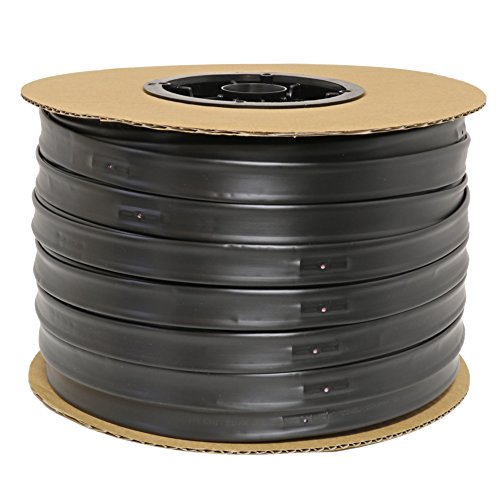
1. Irritec P1 5/8″ Drip Tape 15 mil 6″ Spacing 0.46 GPH 500′ Roll
Our pick — over 4.5★ from 80+ verified ratings; the strongest balance of quality and price.
The 500-foot roll that experienced growers replace their old tape with.
The Irritec P1 tape earns the top spot because its 15 mil wall (about the thickness of two credit cards) resists punctures that destroy thinner 8-mil rolls. Buyers report they “ordered 500ft more to replace inferior drip tape,” meaning the wall thickness alone stops season-ruining leaks. Each emitter delivers a controlled 0.46 GPH (gallons per hour) — perfect for clay or loamy soil where you want slow, deep absorption without runoff.
The dual-screen input on each emitter is a real defense against clogging from calcium-heavy well water, a headache that owners in areas like central Florida specifically call out. A few owners note that seating the tape into the feed line connector can be fiddly — a hole-punch tool solves it — but once connected, leaks are rare and easy to fix by reseating the end. For a 500-foot agricultural-grade spool, the durability is where the value really lives.
What wins people over is the consistency across all 500 feet: straight rows in a vegetable garden get even water from the first emitter to the last, and the 6-inch spacing means carrots, beans, and lettuce all drink evenly. The 0.46 GPH rate also makes this a strong match if your system runs on low water pressure — several owners switched from 1/4-inch drip tubing specifically to get better performance with lower PSI (pounds per square inch, the measure of water force).
What earns the upgrade
- 15 mil thickness handles rough soil and well-water grit.
- 0.46 GPH works beautifully on low-pressure systems.
- Dual-screen emitter inlets resist calcium buildup.
- Owners consistently call it the tape they trust for permanent beds.
The one fiddle factor
- Seating into feed-line connectors takes some care — a hole-punch tool is strongly recommended.
Stick with this if: you want a single roll that will carry your vegetable or flower garden through multiple seasons without pinhole leaks or burst seams.
Think twice if: you only need 100 feet for a couple of raised beds — the 500-foot minimum length is more tape than a small garden requires.
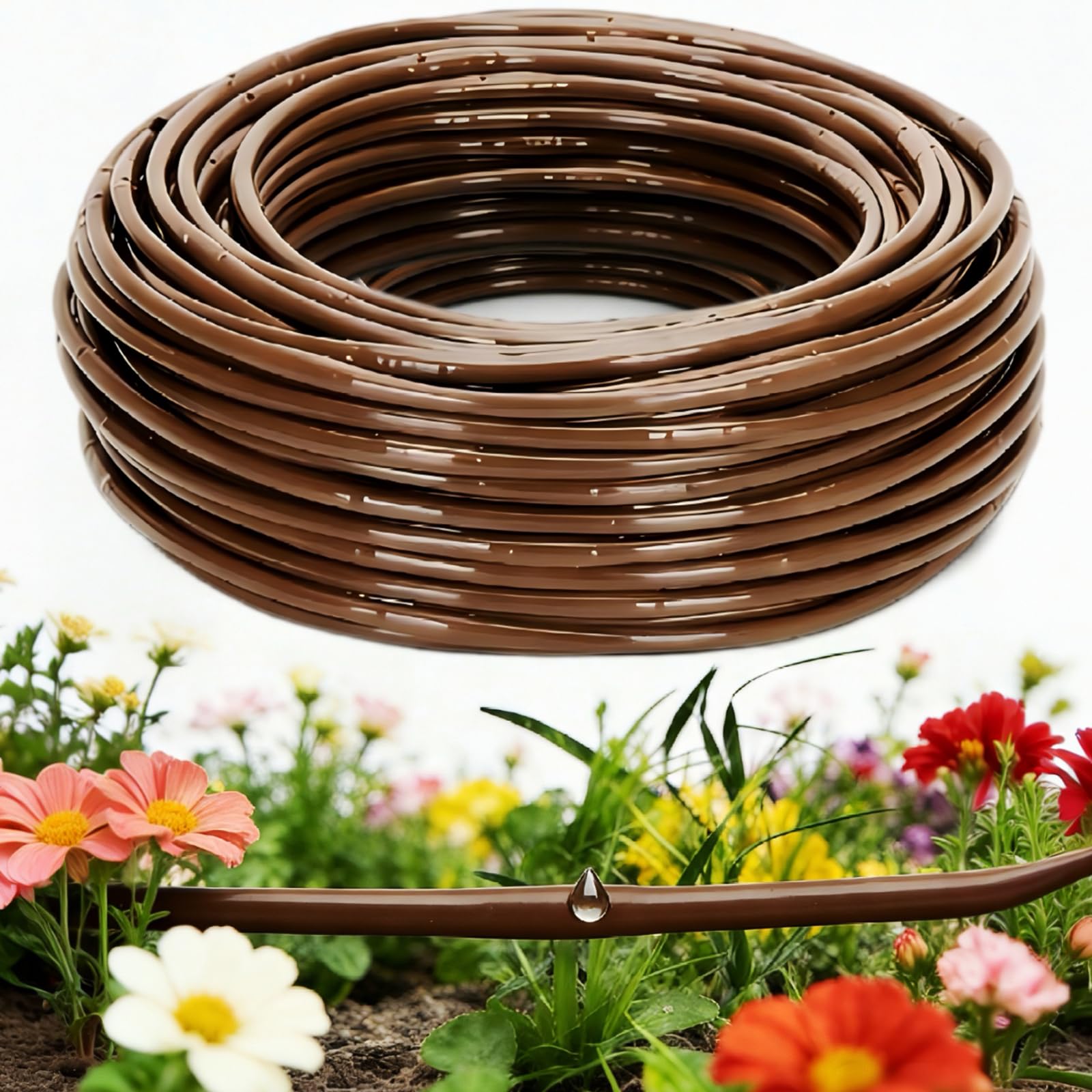
2. Vikua 1/4″ Drip Irrigation Tubing with 6″ Emitter Spacing, 100 Ft Roll
The thin-line option that turns a container garden into a precision watering zone.
This 1/4-inch tubing is fundamentally different from the 5/8-inch rolls above — it is a branch line designed for raised beds, flower boxes, and window boxes where space is tight. Each emitter delivers 0.5 GPH with pre-spaced outlets every 6 inches, meaning you unroll it, connect it to a 1/4-inch adapter, and water starts flowing without punching a single hole.
The LLDPE (linear low-density polyethylene — a flexible, crack-resistant plastic) material is more flexible and more stress-crack resistant than ordinary PVC tubing, which matters when you route it around corners or bury it under mulch. Owners consistently say the drips are even across the full 100 feet — no dry spots at the far end. The brown color blends into soil so the line practically disappears in a flower border. The catch: this is not a main supply line. You need a separate 5/8-inch header hose and a 1/4-inch adapter to connect it, and soaking it in hot water for ten minutes before first use helps the connections seat snugly.
What owners love is the simplicity — the pre-spaced emitters at 6-inch intervals enable fast setup compared to inserting individual button drippers. Several people report switching entirely to this method after a single season, finding it cleaner and more consistent than the old way. For a small garden or greenhouse bench, this is the right diameter.
The compact advantage
- Pre-installed 0.5 GPH emitters at 6″ — no punching or assembly.
- Brown color disappears into soil and mulch.
- LLDPE material resists cracking from sun and bending.
The size reality
- 1/4-inch diameter needs an adapter to connect to a standard 5/8-inch supply line.
- Soaking in hot water before first connection is recommended for a leak-free fit.
Reach for this if: you are setting up drip irrigation for raised beds, containers, or a greenhouse and want a plug-and-play branch line with consistent output.
Look elsewhere if: you need a main supply line for a large in-ground garden — this is a secondary distribution line, not a primary trunk.
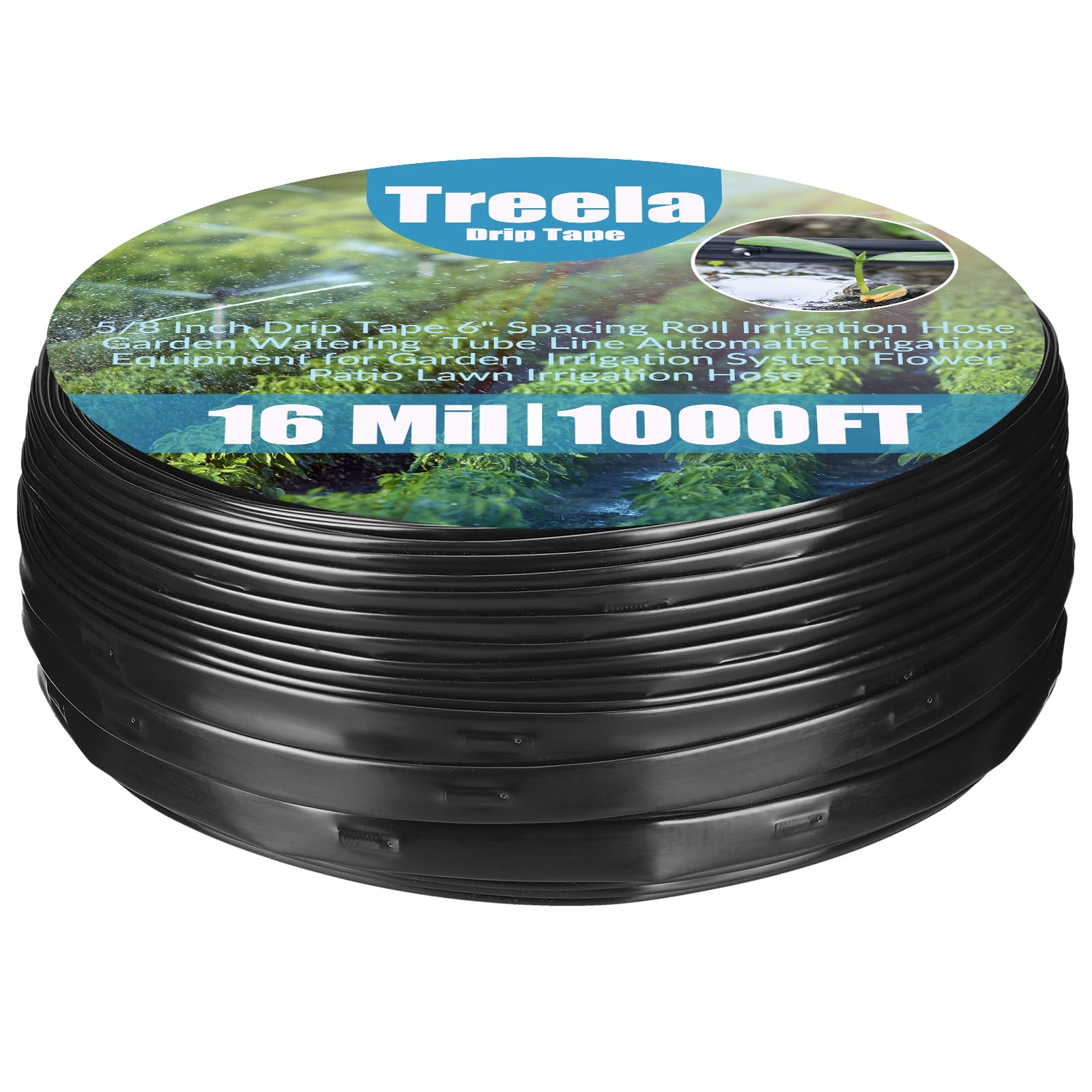
3. Treela 1000ft 5/8 Inch Drip Tape 6″ Spacing Roll 16 Mil
A thousand feet of thick tape at a price that makes large-scale row cropping affordable.
The Treela roll gives you 16 mil wall thickness — the same heavy-duty spec as premium tape — plus 1,000 feet of coverage, all at an entry-level price. The PE (polyethylene — a common plastic for irrigation) material is UV-resistant (designed to not break down in sunlight) and the injection-molded drippers are designed to resist clogging even when the pressure drops low.
Here is the honest picture: the durability feedback is mixed. Some owners used over 1,000 feet with no seam bursts and consistent drip patterns at 10-12 PSI, while a small number report pinhole leaks or burst runs. The seller appears responsive — several buyers who had issues received a replacement roll without hassle. The practical takeaway is to keep your pressure below the 10-15 PSI range that most users found successful, and inspect the first few feet as you unroll. For the length and mil thickness at this price tier, the risk is proportional and often well-managed by the warranty response.
Why the length wins
- 1,000 feet of 16 mil tape covers a huge garden area.
- Works reliably at low pressure (10-12 PSI).
- Seller replaces defective rolls quickly according to owner reports.
The durability gamble
- Some units develop pinhole leaks — inspect on first use and test pressure carefully.
- Mixed reviews on seam strength; not the most consistent build in this list.
Best for: the budget-conscious grower who needs to cover a large area right now and is willing to check connections on the first run.
skip it if: you want a tape you can bury underground and leave for three seasons without worry — the consistency isn’t there yet.
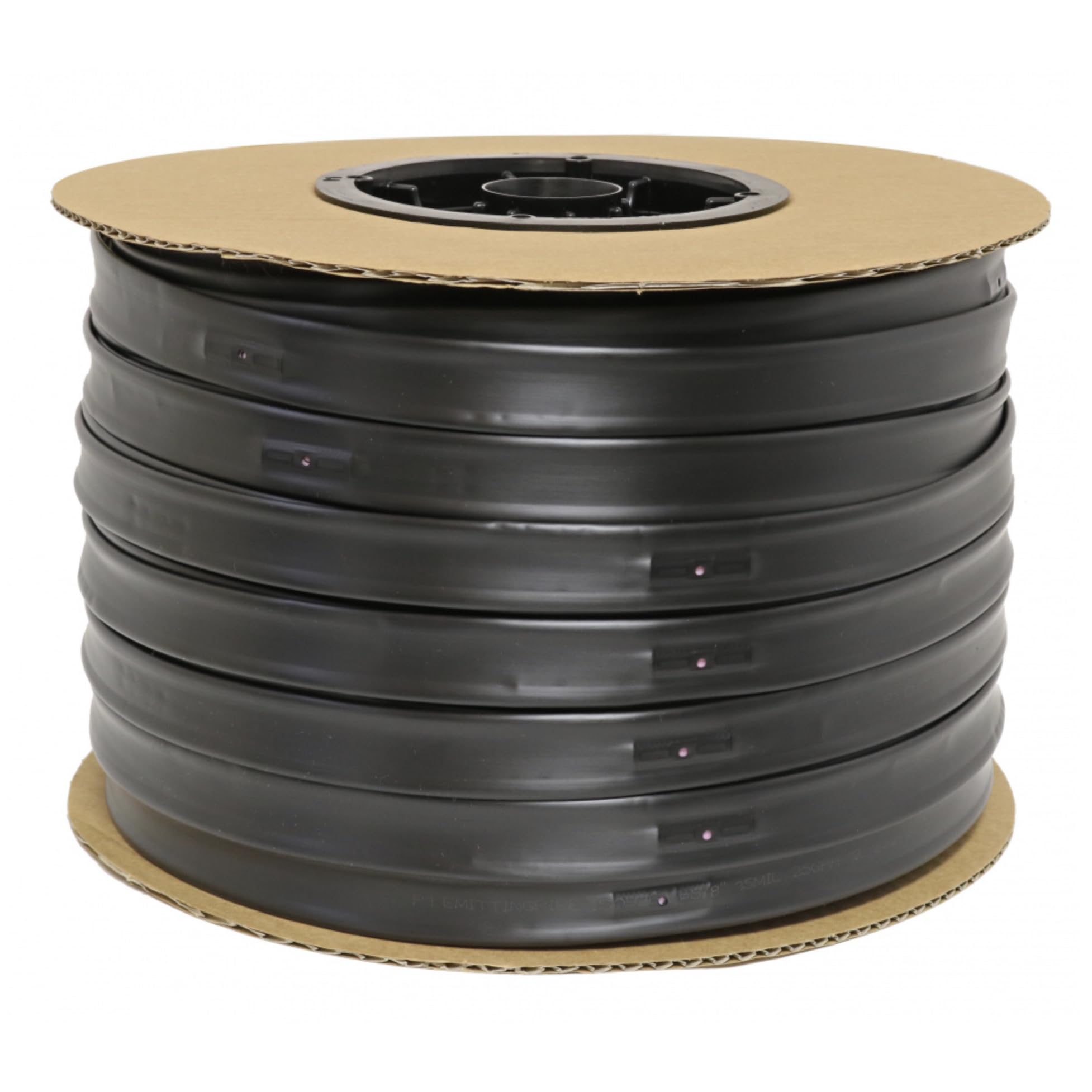
4. Drip Depot Drip Tape — 5/8″ — 15 Mil — 6″ Spacing — 0.79 GPH — 500′ Roll
The tape that repeat buyers come back to season after season.
Drip Depot has built a following among serious home gardeners for one reason: consistent quality across every roll. This 15-mil tape delivers 0.79 GPH per emitter — at 0.79 GPH compared to the Irritec at 0.46 GPH (the Treela’s flow rate is not published) — making it the better choice if you garden in sandy soil or need to water larger plants like tomatoes and peppers quickly. The wider labyrinth passages (the internal channels inside the tape that regulate flow) are designed to resist clogging even when your water source carries sediment.
Every single verified owner review is a five-star rating, and the phrase that keeps coming up is “repeat customer.” Owners mention Drip Depot carries everything they need for their garden irrigation, and the fast delivery means you are not waiting for the tape to show up mid-growing-season. The trade-off is roll length: at 500 feet, it costs more per foot than some longer rolls, but the dependability means you spend less time patching and more time watering.
Why owners stay loyal
- 0.79 GPH is excellent for sandy, fast-draining soil.
- Labyrinth emitter path resists clogging.
- Perfect five-star consensus from all verified buyers.
The cost-per-foot reality
- Higher upfront price per foot than budget rolls of the same mil thickness.
Grab this if: dependability matters more than penny-pinching — you want to install it once and trust it for the whole season.
Think twice if: you are on a very tight budget for a single-season crop and can accept some DIY patching.
5. DarkTank 2000FT 5/8″ Drip Tape, Silver Reflective, 16 Mil
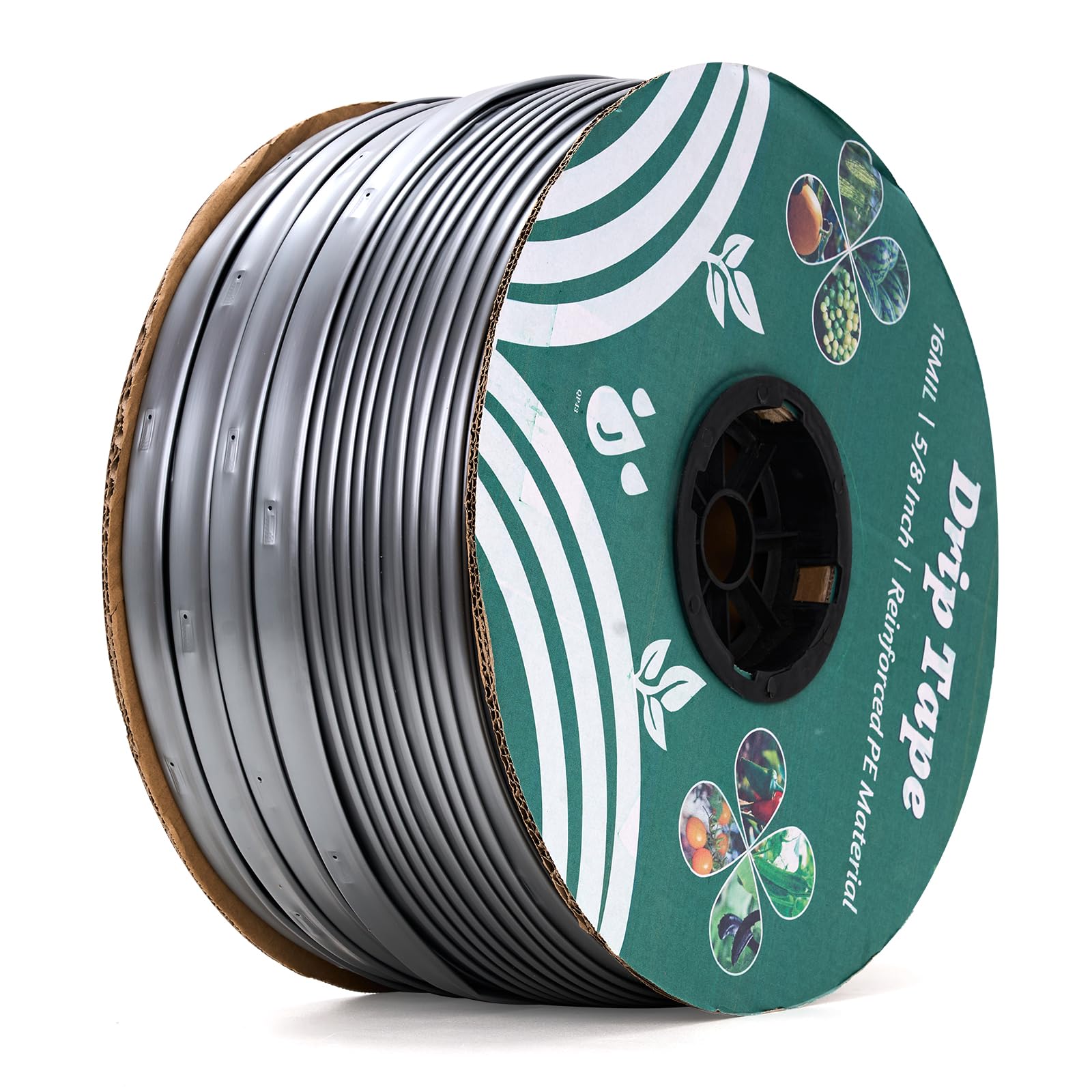
The silver surface that birds ignore and seedlings thank you for.
Standard black drip tape absorbs heat, which can warm the soil around delicate seedling roots on hot days. This DarkTank tape uses a silver reflective outer layer that bounces sunlight away, keeping the root zone cooler. It also solves a specific nuisance: birds and rodents that peck at black tape. The reflective surface disorients them, so you get fewer holes from beaks and teeth. The 16 mil thickness and 0.8 GPH flow rate put it in the heavy-duty, fast-watering category — a similar flow to the Drip Depot 0.79 GPH but with the heat advantage.
With 2,000 feet on a single roll, this is a serious investment in coverage. Owners find it easy to install, and the clog-resistant emitters spaced at 6 inches deliver consistent output. The honest note: some owners measured the wall at 11 mil rather than the advertised 16 mil, though they still found the tape functional and strong. If you need bird protection or heat reduction, this is the only tape on the market that addresses both at once.
The reflective edge
- Silver surface reduces root-zone heat compared to black tape.
- Discourages birds and rodents from pecking holes.
- 16 mil build and 0.8 GPH suit large gardens and sandy soil.
The measured catch
- Some customers note actual thickness measures closer to 11 mil despite the 16 mil label.
- A few units arrived thinner than expected and harder to connect to standard fittings.
Best for: hot climates or areas with bird pressure where a cooler, bite-resistant tape makes a real difference.
Not ideal if: the exact mil thickness is your primary concern — some inconsistency in manufacturing has been noted.
6. Toro Aqua-Traxx 5/8″ Drip Tape, 8 Mil, 4″ Spacing, 1.00 GPM/100′, 2,000′ Roll

The engineering-first choice for growers who need every emitter to deliver the same drop.
Toro is a major name in irrigation, and the Aqua-Traxx line is built around one metric: uniformity. The coefficient of variation (CV) — a measure of how much flow varies from one emitter to the next — is below 3 percent, meaning every 4-inch-spaced outlet along the full 2,000 feet puts out essentially the same volume. That matters for high-value row crops where an under-watered plant is a direct yield loss. The flow rate is rated at 1.00 GPM per 100 feet (GPM stands for gallons per minute, a faster unit than GPH), which is a higher total volume than individual GPH-per-emitter ratings.
The trade-off is wall thickness. At 8 mil, this is a single-season tape — it is thin and light, and owners note it may not survive being rolled up and reinstalled the following year. Kinks and splits can develop at the folds. You also get 4-inch emitter spacing instead of the standard 6-inch, which is ideal for densely planted crops like carrots or beets but may be more emitter than you need for widely spaced tomatoes or peppers. Some owners received tape with 12-inch spacing instead of the advertised 4-inch — confirm your roll before laying it out.
class-leading precision
- Sub-3% CV for near-perfect emitter uniformity.
- 4-inch spacing covers dense row plantings thoroughly.
- smooth construction and multiple inlet filters resist plugging.
The seasonal limitation
- 8 mil wall is thin — expect one season of use, not multiple.
- Some buyers received 12-inch spacing instead of 4-inch; verify your shipment.
Stick with this if: you are a serious row-crop grower who needs every plant watered identically and you are fine replacing tape annually.
Pass if: you want a thicker tape that can be reused across several seasons.
7. Nalwort 5/8″ Drip Tape 3281FT, 6″ Spacing, 16 Mil, 0.75 GPH
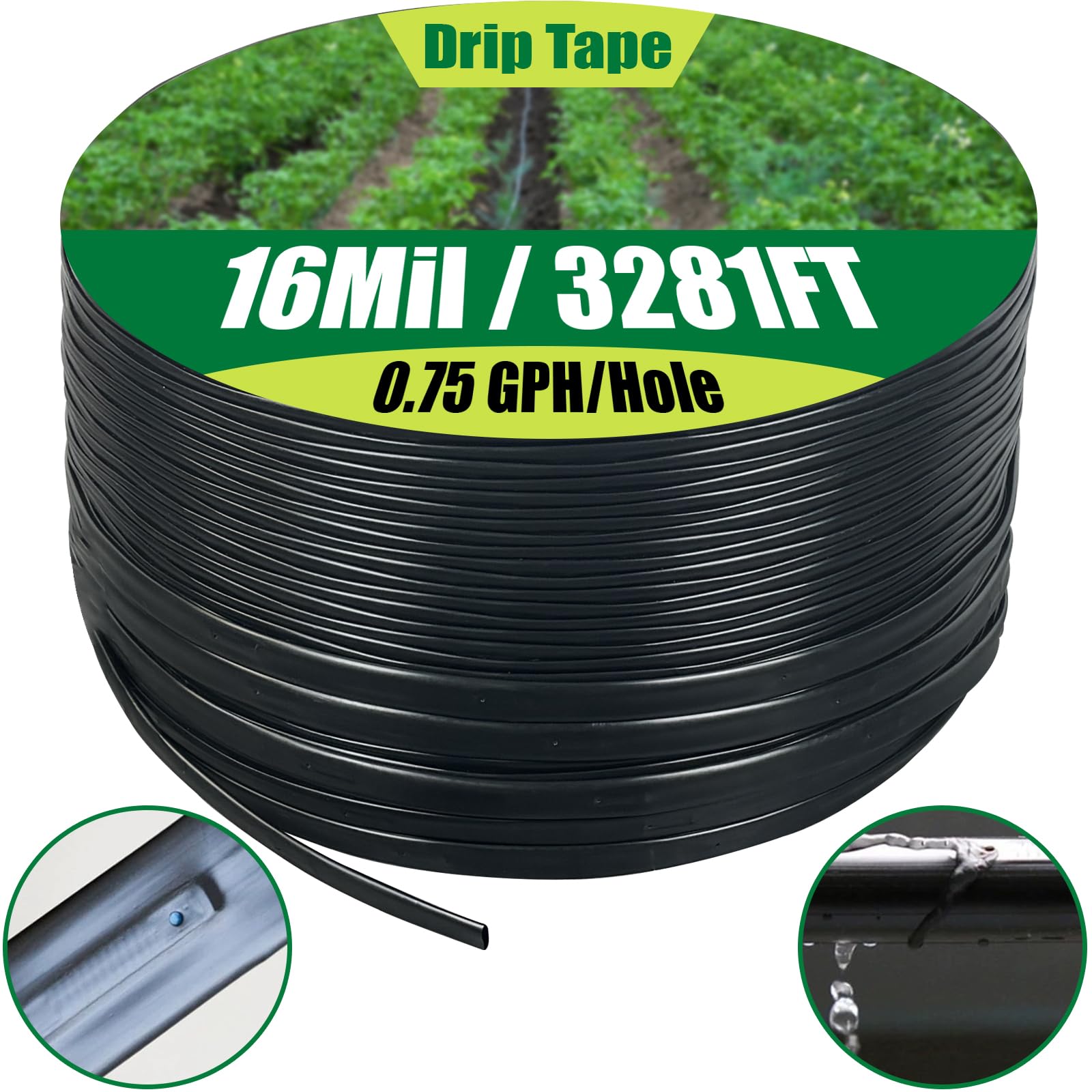
Over half a mile of 16 mil tape for the grower covering serious acreage.
At 3,281 feet (roughly 0.62 miles), this Nalwort roll is the longest single spool on the list — more than six times the length of the Irritec 500-foot roll. It pairs that enormous length with a 16 mil wall and 0.75 GPH per emitter — a heavy-duty spec that suits both large vegetable plots and permanent irrigation layouts. The PE material is UV-resistant and designed to handle mechanical stress, so it can stay in place under the sun for months without degrading.
The feedback is mostly positive: owners say it works well for garden watering, is easy to handle for a drip tape system, and the price per foot beats almost everything else. A small number of owners note that the build looks “cheaply made” at first glance — but several of those same people say that once connected and running, it works perfectly. The seller also has a reputation for replacing defective sections promptly. The key is getting the right fittings and connections before you unroll, and keeping the pressure at or below the recommended 15 PSI.
The length advantage
- Over 3,200 feet covers large fields, orchards, or multiple greenhouses.
- 16 mil wall with UV resistance for long-term outdoor use.
- 0.75 GPH delivers solid flow for sandy or mixed soil.
The build variance
- Some units look flimsy from the start despite functioning well once installed.
- Occasional manufacturing defects (missing emitter locations) reported, though seller replaces them.
Choose this if: your watering area demands the longest uninterrupted run possible and you are comfortable double-checking connections on the first setup.
Skip if: you prefer a more polished, premium-feeling tape or you only need a few hundred feet — the roll is huge and heavy to handle.
Understanding the Specs
Mil Thickness (Wall)
The wall thickness of drip tape is measured in mils, where 1 mil equals one-thousandth of an inch. An 8-mil tape is thin and cheap — fine for a single growing season, but it can kink, split at the folds, or get punctured by rocks. A 15- or 16-mil tape costs more but can survive being rolled up, stored, and reinstalled the following year. If you are laying tape in a permanent garden bed, thicker is cheaper in the long run because you buy it once instead of every spring.
Emitter Spacing and GPH
Emitter spacing is the distance between each water outlet along the tape. Six inches is the standard spacing for row crops like carrots, lettuce, and beans. Four-inch spacing delivers more water to a shorter area — useful for dense plantings or sandy soil that drains fast. GPH (gallons per hour) tells you how much water each emitter outputs. A 0.46 GPH emitter is slow and gentle, ideal for clay soil. A 0.79 or 0.8 GPH emitter puts out nearly twice the water, better for sandy ground or larger plants like tomatoes.
Diameter and Compatibility
Almost all standard drip tape is 5/8 inch in diameter. It connects to 5/8-inch fittings, couplers, end clamps, and supply-line adapters. The 1/4-inch tubing is a different animal — it is a branch line that works for small raised beds and containers but must connect to a 5/8-inch header hose via a reducer or adapter. If you already own a drip system, check your existing fittings before ordering a 1/4-inch roll, or plan to buy a conversion kit.
Pressure Rating
Drip tape is designed for low pressure — usually 10 to 30 PSI (pounds per square inch). Exceeding the maximum pressure will cause the tape to burst at the seams or blow emitters out. Most residential irrigation systems are regulated down to 15-25 PSI with a pressure reducer before the drip lines. A few tape products list a max pressure on the label (like the DarkTank at 30 PSI), but staying at the lower end of that range extends the tape’s life significantly.
FAQ
Can I bury drip tape underground?
How do I stop my drip tape from leaking at the connections?
What PSI should I run through drip tape?
How long does drip tape last?
What is the difference between 0.46 GPH and 0.8 GPH drip tape?
Can I connect 1/4-inch drip tubing to 5/8-inch drip tape?
How do I clean clogged drip tape emitters?
Is silver reflective drip tape worth the extra cost?
How many feet of drip tape do I need for a garden?
Can I use drip tape with a rain barrel or low-pressure tank?
Final Thoughts: The Verdict
For most buyers, the irrigation drip tape winner is the Irritec P1 5/8″ 15 mil because it delivers the thickest wall in the mid-range, a water-saving 0.46 GPH flow that works on low pressure, and a proven track record among owners who replace thinner tapes with it. If you want fast, high-volume watering for sandy soil, the Drip Depot 5/8″ 0.79 GPH is the premium choice with a flawless owner consensus. And for the biggest coverage at the best price per foot, the Treela 1000ft 16 Mil covers a lot of ground if you are comfortable checking for pinholes on the first run.
How We Picked
We do not accept paid placement. Every pick is matched to a real buyer and a real use-case; we do not hands-on test units.
Sources & Methodology
Specifications: manufacturer listings and product documentation. Review insights: verified customer reviews, as of July 2026. Pricing: not shown on this page (it changes often); check the current price via the retailer link.
As an Amazon Associate, Lawn Gear Lab earns from qualifying purchases. This does not affect which products we feature.