
Specs are compiled from manufacturer listings and verified buyer reviews and can change over time — please confirm the key details on the product page before buying.
Nothing turns the joy of a backyard orchard into a headache faster than watching your hard-earned fruit get devoured by insects before you even get a taste. You want a spray that actually works, that won’t harm your tree, and that you’re comfortable using on food you’re about to eat. This guide cuts through the shelf confusion to find the best fruit tree insect repellent for your specific garden, from a simple hose-end spray to a season-long systemic drench.
I’m Rikta — the founder and writer behind Lawn Gear Lab. This guide is built by comparing the manufacturers’ published specifications and the patterns across verified customer reviews, so you get each pick’s real strengths and trade-offs instead of marketing spin.
You’ll find concentrated all-in-one sprays, ready-to-use hose attachments, and targeted soil drenches, all chosen to shield your trees from aphids, caterpillars, and fungal diseases right up to harvest day. This is your data-driven crutch for picking a fruit tree insect repellent that won’t let you down mid-season.
Our Picks at a Glance


How To Choose The Best Fruit Tree Insect Repellent
The right spray depends mostly on three things: how many trees you have, the specific bugs in your area, and how much effort you want to put into mixing and reapplying. A huge orchard needs different economics than a single backyard peach tree.
Concentrate vs. Ready-to-Spray vs. Soil Drench
Concentrates (like the Bonide Captain Jack’s) give you the most control and the best value per gallon of mixed spray. You dilute them with water in a tank sprayer. Ready-to-spray bottles (like the BioAdvanced 3-in-1) screw onto your garden hose — you just turn on the water and spray, but you have less control over the mixture ratio. Soil drenches (like the Monterey systemic) are a different animal: you pour the mix around the base of the tree, and the roots carry the protection up into the leaves and fruit for a whole season.
The Harvest Interval Matters
The most important number on the label is the “days to harvest” or “pre-harvest interval.” This tells you how long you must wait after spraying before you can pick the fruit safely. Some products allow use up to the day before harvest — a huge advantage for trees that fruit continuously. Others require a waiting period of a week or more. If you are dealing with ripening fruit, choose a repellent you can use right up to picking day.
Broad-Spectrum vs. Targeted Control
Some sprays are multi-purpose: they kill insects, mites, AND fungal diseases like powdery mildew and brown rot in one pass. This is ideal for most home orchards because you rarely know exactly what hit your tree. Other products, like the pure garlic concentrate, repel only insects and rely on a different mechanism — they are a deterrent, not a lethal poison. If you have a confirmed specific problem (say, Japanese beetles and nothing else), a targeted formula can be more effective with fewer chemicals.
Quick Comparison
| Model | Best For | Coverage per Unit | Application Method | Harvest Interval | Amazon |
|---|---|---|---|---|---|
| Bonide Captain Jack’s Orchard Spray★ Best Overall | Best Overall | 6.4 gal finished spray | Tank / Hose-end sprayer | Day before harvest | Amazon |
| BioAdvanced 3-in-1 Fruit & NutBest All-in-One Value | All-in-One Ease | 32 oz (ready-to-spray) | Hose-end sprayer | Day before harvest | Amazon |
| BioAdvanced Tree & Shrub KillerFast-Acting Relief | Fast-Acting Relief | 32 oz (ready-to-spray) | Hose-end sprayer | Ornamental focus | Amazon |
| Fertilome Fruit Tree Spray with Neem | Small Orchard Pick | 16 oz concentrate | Tank / Hose-end sprayer | Check label | Amazon |
| Dr. Earth Fruit Tree Insect Killer | Organic Formula | 32 oz (ready-to-spray) | Hose-end sprayer | Check label | Amazon |
| IV Organic 3-in-1 Plant Guard | Protection + Sunscreen | 1 pint concentrate | Brush / Paint on trunk | Not for fruit contact | Amazon |
| Bonide Fruit Tree & Plant Guard | Fruit & Flowers | 16 oz (ready-to-spray) | Hose-end sprayer | Check label | Amazon |
| Monterey Systemic Soil Drench | Set-and-Forget Season | 1 gallon concentrate | Soil drench (pour) | Year-long control | Amazon |
| Garlic Barrier Concentrate | Large Area Repellent | 1 gallon concentrate | Tank / Hose-end sprayer | Safe for edibles | Amazon |
In‑Depth Reviews
1. Bonide Captain Jack’s Citrus, Fruit & Nut Orchard Spray, 32 oz Concentrate
Our pick — over 4.5★ from 950+ verified ratings; the strongest balance of quality and price.
The all-in-one concentrate that stops bugs AND disease before they ruin your harvest.
You are getting a trinity here — fungicide, insecticide, and miticide all in one 32 oz bottle. That means one spray session handles beetles and caterpillars while also preventing powdery mildew and brown rot on your apples, avocados, lemons, limes, and stone fruits. The real-world value comes from the economics: this single pint makes up to 6.4 gallons of finished spray, so it lasts multiple full-coverage passes over a small home orchard.
The crowd favorite — 4.6 stars across 900+ owners — and what wins people over is the visible greening effect. As buyers put it, “the leaf spots on my apple tree are disappearing and it is noticeably greener,” and owners of pear, plum, peach, fig, and mulberry trees all report it works as a first line of defense against blight and chewing insects. The catch is that a 32 oz bottle runs out fast on a large orchard, and you will need to reapply consistently. At 2.3 pounds, this bottle is about 10% heavier than the BioAdvanced Tree & Shrub spray at 2.1 pounds, meaning more product concentrate per bottle.
To apply, you mix as little as 2.5 fluid ounces per gallon of water and use a tank or hose-end sprayer. A huge bonus is the harvest interval — you can spray right up to the day before you pick. The recurring gripe is the measuring: the concentrate can clog your sprayer if you let it sit, so rinse thoroughly after each use.
Why Owners Swear By It
- Controls insects AND fungal diseases simultaneously, saving you from buying two products.
- One pint makes 6.4 gallons of spray — a little goes a long way for the price.
- Safe to use up to the day before harvest, so you don’t have to time your picking.
The Trade-Offs
- Concentrate must be mixed fresh each time; it can clog sprayer if left sitting.
- For a big orchard with many trees, a 32 oz bottle may require multiple refills per season.
Grab this for: The home orchardist who wants one bottle to handle both bugs and disease on everything from apples to lemons, and who doesn’t mind a simple mix.
Think twice if: You have a single large tree with one specific pest — a targeted spray or soil drench might be less work.
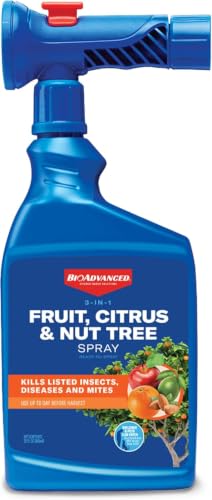
2. BioAdvanced 3-in-1 Fruit, Citrus & Nut Tree Spray – 32 oz Ready-to-Spray
A three-in-one hose spray that kills insects, mites, and disease with zero mixing.
You screw the 32 oz bottle onto your garden hose, pull the lever, and the ready-to-spray formula automatically dilutes as you water your trees. This is the lowest-friction option for anyone with a few fruit trees who wants triple protection against caterpillars, aphids, mites, black spot, and powdery mildew — all in one pass. The formula reaches up to 8 feet high, which covers most standard-sized backyard trees.
The real highlight is the harvest interval: BioAdvanced allows use up to the day before harvest, exactly like the Bonide concentrate. That is a critical decision-maker if your trees are fruiting continuously. Buyers report great results on peach trees, blood orange trees (saving blooms from mealy bugs first try), and apple trees where “the amount of bugs is way down” and wasps stopped coming around. The trade-off is the effectiveness rating itself gets mixed feedback — some owners say it didn’t work on their apples at all. The spray head can also be finicky with water pressure, requiring a good hose connection to work properly.
If you have lime or citrus trees with leaf miners, the improvement is visible after a few weeks. Just note that some leaves may need separate spot treatment because the spray doesn’t always hit every underside perfectly. You spray every 3-4 weeks for the season.
Low-friction choice: The easiest path to triple protection — kills insects, mites, and disease in one hands-off hose spray, but effectiveness varies by region and bug pressure.
Reach for this if: You’d rather not mix concentrates and want a fast, no-mess way to hit everything from aphids to rust.
Look elsewhere if: You need guaranteed results against a heavy infestation; the mixed reviews on effectiveness mean a concentrate might be more reliable.
3. BioAdvanced Tree & Shrub Insect Killer Spray – 32 oz
For when the bugs are visible and you need them dead by tomorrow.
This is not a multi-purpose spray — it is a straight insecticide designed to kill aphids, Japanese beetles, caterpillars, and whiteflies on contact, then keep protecting for up to two weeks after application. The ready-to-spray bottle connects to any garden hose, and owners mention the spray throw is adequate for trees up to 20 feet tall (a silver maple, in one case).
Reviewers are uniformly positive. One owner noted “aphids gone from silver maple” after spraying. Another said their dogwood trees went from dying leaves to bright green and much larger with no bugs, after a late-June treatment. The fast-acting formula is what wins people over — you see results within a day or two, not weeks. At 2.1 pounds, this is the lighter option compared to the Bonide concentrate at 2.3 pounds.
The catch is this is primarily an insect killer, not a disease controller. If powdery mildew or rust is also on your tree, you will need a separate fungicide. It is also labeled for trees and shrubs, not necessarily for use on edible fruit right up to harvest day — the primary use case is ornamental and shade trees.
Best for: A rapid knockdown of heavy pest pressure on non-fruiting trees, or as a supplement when the multi-purpose spray isn’t cutting the insect load.
Not for: The all-in-one orchardist who needs disease prevention too — you’ll need to pair it with a fungicide.
4. Fertilome Fruit Tree Spray With Neem, 16 oz

A neem-based formula boosted with pyrethrin that kills insects and fungal disease.
The standout use case here is deterring birds from fruit. After two applications two weeks apart on sweet cherries, customers note birds stopped eating the fruit entirely. It also repels pests instantly and has a pleasant smell, according to reviews. The label covers fruits, nuts, vegetables, herbs, spices, roses, houseplants, flowers, shrubs, and turfgrass, making it incredibly versatile. Weighing just under a pound at 0.98 pounds, it is the lightest concentrate on this list.
The downside is the packaging discrepancy: some orders ship in a different container than what is pictured on Amazon, though the ingredients are the same. Also, at 16 oz, it is half the size of the Bonide concentrate, so you get less finished spray per bottle.
Neem-plus punch: The PBO additive gives this the edge over basic neem oils for knocking down stubborn pests, and the pleasant smell is a real bonus during application.
Pick this for: A smaller orchard or a single tree where you want neem base with extra knockdown power, and you value a pleasant scent during application.
Skip if: You need bulk coverage — 16 oz will make less finished spray than a 32 oz concentrate.
5. Dr. Earth 8009 32 oz Fruit Tree Insect Killer RTS

An organic spray that smells like herbs and repels moths, whiteflies, and mites.
If you lean organic, this ready-to-spray 32 oz bottle is the simplest choice: no assembly required, just screw onto your hose and spray. It controls a wide range of bugs — aphids, scale, whiteflies, caterpillars, spiders, ants, beetles, leafhoppers, mealybugs, and more — on fruit trees, avocados, and deciduous trees. The formula smells like herbs (tolerable, according to owners) and is safer for beneficial insects and veggies than non-organic alternatives.
After two applications on a nectarine tree, reviewers point out it worked perfectly. An avocado tree owner said, “the best part is how healthy my tree looks after spraying,” noting the leaves grew back healthy and the avocados looked great. The spray hooks up easily and the hose-end lever makes application simple. At 2.1 pounds, it ties the BioAdvanced Tree & Shrub killer for weight, and it’s in the same hose-end category.
The notable negative is the smell after application: some find it tolerable, others not, and it requires frequent reapplication to stay effective. One review specifically noted it “did ok but not good for cherries,” so cherry growers might need a different solution.
Your organic hose-end: Ready-to-spray from the start, controls 15+ insect types, and owners see visible tree health improvements after a couple of applications.
Best for: The organic-focused gardener with a small orchard who wants ready-to-spray convenience and a broad insect list.
Think twice if: You grow cherries (mixed results reported) or need a long-lasting residual — it requires reapplication more often than synthetic formulas.
6. IV Organic 3-in-1 Plant Guard, 1 Pint (Greige)

A trunk paint that fends off insects, rodents, sunburn, and winter scald in one.
This is fundamentally different from every other spray on this list. The IV Organic 3-in-1 Plant Guard is a concentrated paint that you mix and brush onto the trunk of your fruit tree, not a foliar spray. Its three jobs are: repel most insects and rodents, protect from summer sunburn, and shield from winter sunscald. The patented organic formula is healthier than latex or tar-based products and comes in colors including White, Brown, Green, Grey, and Greige so it blends into your garden.
Owners call it “guardian of the greenery” and “magic in a can.” One buyer applied it to 24 young trees (1-2.5 inch trunks) and got nearly a full year of protection from a single pint can. Another used it on trimmed hedges and small trees, preventing die-off from sun, heat, and insects. The concentrated mix requires stirring and takes about 10 minutes to prepare; application with a brush is easy, and cleanup is quick.
The catch is the value. At 14 ounces net weight, the pint can is small, and several owners call it expensive for what you get. One user used a quarter can for just three small trees. It is also not a foliar spray — you cannot spray the leaves with this to kill aphids or caterpillars. It is strictly a trunk barrier against boring insects and environmental damage.
The trunk guardian: If your problem is rodents chewing bark or sun cracking your young saplings, this brush-on barrier is the most targeted solution — but don’t expect it to handle leaf pests.
Best for: Young or newly transplanted trees that need sun protection AND insect/rodent deterrent in one season-long application.
Skip this if: Your primary problem is leaf-eating bugs or fungal disease — you still need a spray for the foliage.
7. Bonide Fruit Tree & Plant Guard, 16 oz Ready-to-Spray

A dependable ready-to-spray for fruit trees and flowering ornamentals.
This 16 oz ready-to-spray bottle is Bonide’s hose-end version for the garden. It controls aphids, Japanese beetles, powdery mildew, scab, leaf curl, and other listed insects and diseases on fruits, vegetables, nuts, ornamental shrubs, trees, and flowers. It is a multi-use product in one convenient spray. To use, you connect the spray bottle to a garden house and spray directly onto the affected plants.
One owner described it as a “very effective plant protection spray” that helped keep bugs and fungus away from their fruit plants. Another found it effective against pear slugs and aphids, noting that the chemicals don’t contact the fruit if sprayed pre-production. The product is perfect for home gardeners who want a simple solution for both fruit and flowering plants without mixing concentrates.
The trade-off is the spray bottle design. Several owners have harsh words: “the bottle is absolute garbage” and “the adjustment nozzle blew off when connecting the hose, spraying liquid everywhere.” The recurring gripe is the packaging, not the formula itself. If you get a defective bottle, the spray mechanism may fail, though the product inside is effective.
Solid formula, clumsy bottle: The chemical mix works well on pear slugs, aphids, and powdery mildew, but the ready-to-spray bottle’s reliability is a consistent complaint.
Best for: The home gardener who wants a straightforward hose-end spray for fruit plants and ornamentals, and is willing to gamble on the spray mechanism.
Not for: Anyone who needs a durable, fail-proof sprayer — you may want to buy the concentrate version instead and use your own tank.
8. Monterey Fruit Tree & Vegetable Systemic Soil Drench, 1 Gallon
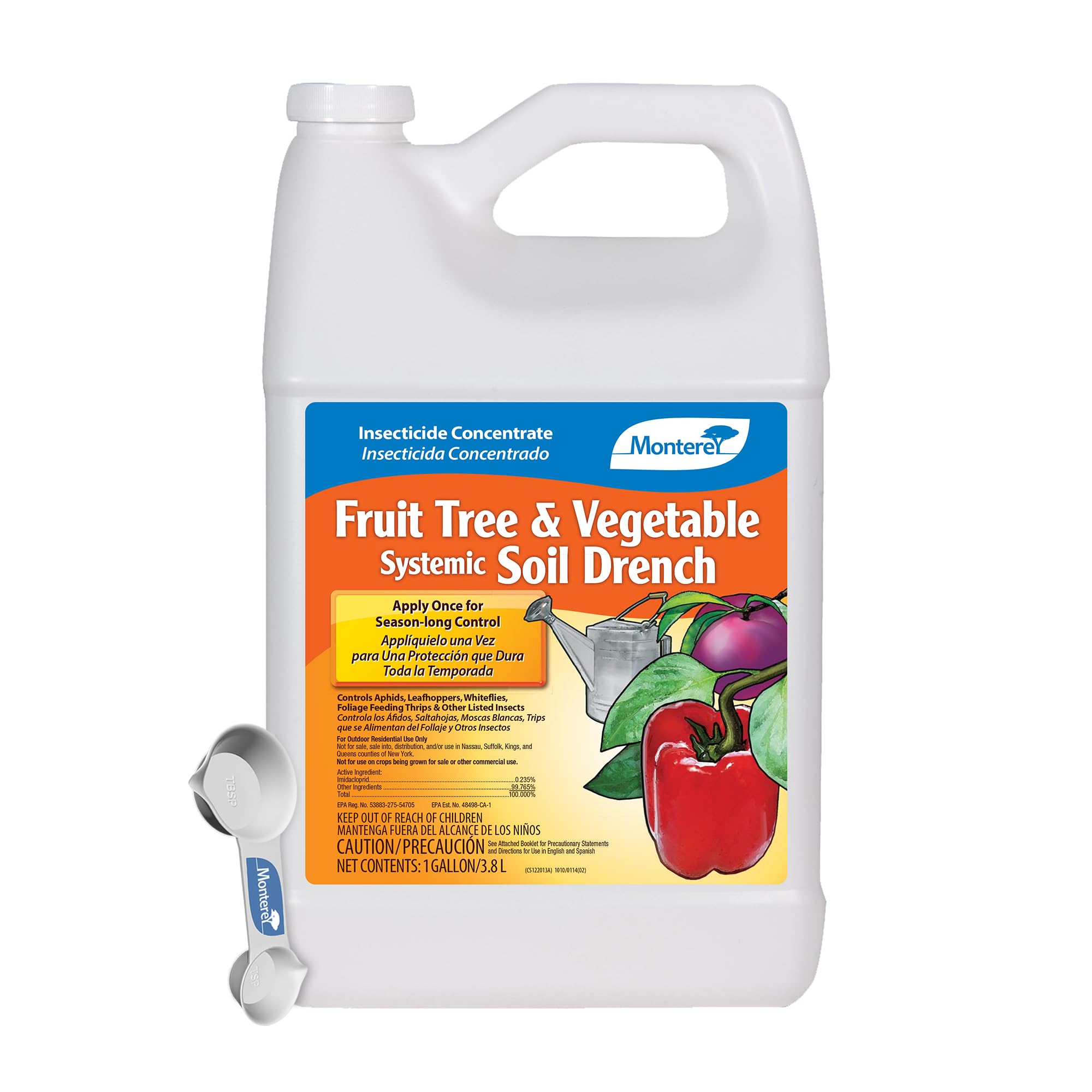
Pour it around the roots once and your whole tree is protected for a year.
This is the ultimate set-and-forget solution. The Monterey Systemic Soil Drench uses imidacloprid, an active ingredient that travels from the roots up through the entire tree, including new growth, providing year-long protection against aphids, flea beetles, leafhoppers, whiteflies, Japanese beetles, and mealy bugs. You do not spray anything — you mix the concentrate with water and pour it over the soil around the base of the tree. The roots do the rest.
The feedback is emphatic. One owner reported it saved a 7-foot avocado tree from a severe lace bug infestation after losing 70 percent of its leaves; neem and soap had already failed. Another called it “better than spraying” and uses it as their annual go-to. The product covers an impressive range: bananas, citrus, grapes, berries, pome fruits, stone fruits, cashews, pistachios, chestnuts, walnuts, avocados, mangos, herbs, and vegetables.
The major concern is the active ingredient itself. Imidacloprid is a powerful systemic insecticide, and some owners worry about eating vegetables treated with it. One reviewer noted their “veggies are stunningly beautiful” but they feared eating them due to toxicity concerns. This is a product you should research thoroughly if you are worried about chemical uptake in food crops, though it is labeled specifically for fruit and nut trees.
The heavy artillery: The standout is this for low-maintenance season-long protection — pour once and forget about it — but the systemic imidacloprid raises legitimate questions for the organic or cautious grower.
Reach for this if: You have a large orchard, hate the chore of spraying, and are comfortable with systemic insecticides for serious infestations.
Think twice if: You grow food you intend to eat immediately after harvest and want to minimize chemical exposure — this merits careful label reading.
9. Liquid Garlic Insect Repellent Concentrate, 1 Gallon – Garlic Barrier

A commercial-strength garlic concentrate that repels both insects and birds from your orchard.
This is not a poison — it is a deterrent. Garlic Barrier is a highly concentrated liquid garlic extract (1 gallon, 128 oz) designed for farms, orchards, and large gardens. When mixed with water and sprayed, the strong garlic scent repels a wide range of insects (aphids, beetles, caterpillars, mites, thrips, whiteflies, leafhoppers) and also discourages birds from feeding on ripening fruit. The OMRI Listed formula is suitable for organic agriculture, and the odor typically dissipates within a day after application without leaving a garlic taste on the crops.
Owners with large properties love this. One says it “certainly does help to keep the bugs away from the area I sprayed” and finds it pet-friendly and easy to apply. Another reports it is effective against both mosquitoes and mammals (deer, rabbits, squirrels) on vegetation and fruit trees, and notes it is long-lasting. The scent fades quickly and doesn’t stain or affect garden food taste.
The effectiveness gets mixed reviews on mosquitoes — some report mosquito-free areas, others say it did nothing in high-pressure areas like Arizona. The garlic smell during application is strong, though most find it tolerable and note it disappears. At 9.4 pounds for the gallon jug, this is the heaviest product on the list and designed for serious coverage, not spot treatment on a single tree.
The big-acre solution: Perfect for the orchardist with many trees who wants an organic, ORI-listed repellent that also keeps birds and deer away — but results vary by region and bug pressure.
Best for: Large orchards, farms, or serious gardeners who want a pet-safe, organic repellent that covers insects, birds, and mammals in one product.
Skip if: You have one or two trees — a smaller concentrate or ready-to-spray is more practical, and the garlic smell during application may be off-putting.
Understanding the Specs
Concentrate vs. Ready-to-Spray
A concentrate (like the Bonide Captain Jack’s and Fertilome) means you dilute it with water yourself, usually 2-4 ounces per gallon. This gives you the most flexibility and the most spray for your money — one pint bottle can make over 6 gallons. A ready-to-spray (like the BioAdvanced 3-in-1) bottle screws onto your garden hose and mixes automatically. The convenience is huge, but you pay more per ounce of product and get less finished spray.
Harvest Interval
The single most practical spec for fruit growers. The harvest interval is the minimum number of days you must wait between spraying and picking the fruit. Products labeled “use up to day before harvest” (like the Bonide and BioAdvanced) give you enormous flexibility — you can spray even as the fruit is ripening. If you ignore this number, you risk chemical residue on your harvest. Always check the label for the exact interval.
Systemic vs. Contact
A contact spray (every hose-end and foliar spray on this list except the Monterey) kills insects it directly touches. If you miss the underside of a leaf, that aphid lives. A systemic (like the Monterey soil drench with imidacloprid) is absorbed by the roots and travels throughout the tree. Any bug that eats any part of the tree — even new growth — gets the chemical. Systemics are incredibly effective for serious infestations but require more caution with food crops.
Organic vs. Conventional
Organic formulas (the Dr. Earth, the Fertilome with neem, and the Garlic Barrier) use naturally-derived active ingredients like neem oil, pyrethrin, and garlic extract. They break down faster in the environment and are often safer for bees and beneficial insects after the spray dries. Conventional formulas (including imidacloprid and some synthetic pyrethroids) tend to be more potent and longer-lasting but have stricter precautions for pollinator safety and food use. OMRI Listed products (like the Garlic Barrier) meet strict organic agriculture standards.
FAQ
Can I use fruit tree spray on vegetables too?
How often should I spray my fruit trees?
Are these sprays safe for bees and pollinators?
What is the difference between insecticide and fungicide?
Can I mix two different sprays together?
Will the garlic spray make my fruit taste like garlic?
What is a soil drench and how is it different from spraying?
Which spray kills Japanese beetles on fruit trees?
How do I know if my tree has a fungus vs. an insect problem?
Is it safe to use these sprays on young or newly planted trees?
Final Thoughts: The Verdict
For the majority of shoppers, the fruit tree insect repellent winner is the Bonide Captain Jack’s Orchard Spray because it combines insect killer, fungicide, and miticide in a concentrated formula that is economical for the home orchard — one pint makes over 6 gallons of spray, and you can use it right up to the day before harvest. If you want absolute hands-off convenience, grab the BioAdvanced 3-in-1 and screw it onto your hose. And for a truly set-and-forget season, the Monterey Systemic Soil Drench is the one to reach for — pour it around the roots once and let the tree protect itself for a full year.
How We Picked
We do not accept paid placement. Every pick is matched to a real buyer and a real use-case; we do not hands-on test units.
Sources & Methodology
Specifications: manufacturer listings and product documentation. Review insights: verified customer reviews, as of July 2026. Pricing: not shown on this page (it changes often); check the current price via the retailer link.
As an Amazon Associate, Lawn Gear Lab earns from qualifying purchases. This does not affect which products we feature.