
Specs are compiled from manufacturer listings and verified buyer reviews and can change over time — please confirm the key details on the product page before buying.
Fish hydrolysate fertilizer is the closest thing to feeding your garden a whole-food meal instead of a multivitamin. Made by cold-processing whole fish (not just scraps), it delivers the full spectrum of amino acids, enzymes, and micronutrients that synthetic blends cannot touch. The trade-off is the smell — real fish fertilizer smells like the ocean floor, and that is actually the sign it is working.
I’m Rikta — the founder and writer behind Lawn Gear Lab. This guide is built by comparing the manufacturers’ published specifications and the patterns across verified customer reviews, so you get each pick’s real strengths and trade-offs instead of marketing spin.
You want stronger vegetables and more flowers from your garden, but the fish hydrolysate fertilizer you pick depends on three things: its NPK ratio (the balance of nitrogen, phosphorus, and potassium), how the fish was processed, and whether you can handle the smell long enough to see results.
Our Picks at a Glance


How To Choose The Best Fish Hydrolysate Fertilizer
The goal is to match the fertilizer’s strengths to what you are actually growing. Leafy greens want more nitrogen; flowers and fruit need phosphorus and potassium. Understanding a few key variables makes the choice straightforward.
Understand the NPK Ratio
Every bag or bottle carries three numbers separated by dashes — nitrogen, phosphorus, and potassium. A 2-3-1 mix, for instance, leans into phosphorus for root and bloom support, while a 5-1-1 pushes leafy growth. You want a ratio that aligns with your plant’s current stage. High-nitrogen formulas work wonders for early growth, but switch to a balanced or bloom-focused mix when flowers set in.
Liquid vs. Dry Powder
Liquid hydrolysate is ready to dilute and apply — you just measure, pour, and water. It is the standard for both soil drenches and foliar sprays. Dry powder concentrates, on the other hand, are lighter to store and often have a longer shelf life, but they require more careful mixing to avoid clumps. The real difference is convenience versus shelf stability.
Watch the Odor
Real fish hydrolysate smells like the sea. That smell means the product has not been heat-stripped of its beneficial compounds. Some brands use deodorizing methods to make the experience more pleasant, but you should plan to use these fertilizers outdoors or in well-ventilated spaces. If a product claims to be odorless, check whether it is still a true hydrolysate or just a diluted emulsion.
Check the Source
The quality starts with the fish. Look for products made from wild-caught, ocean fish rather than lake or farmed fish. Cold processing is the hallmark of a true hydrolysate because it preserves the amino acids and enzymes that heat breaks down. Brands that are OMRI-listed for organic use give you an extra layer of confidence that the ingredients meet strict standards.
Quick Comparison
| Model | Best For | Size | NPK | Form | Amazon |
|---|---|---|---|---|---|
| The Grow Co 1 Gal★ Best Overall | All-around garden use | 128 fl oz | 2-3-1 | Liquid | Amazon |
| Bush Doctor Wholly MackerelTop Performer | Fast nutrient uptake | 1 Pint | 3-1-0 | Liquid | Amazon |
| Heirloom Roses Founder’sBest for Roses | Roses and tomatoes | 32 fl oz | — | Liquid | Amazon |
| Monterey Fish & Grow | Large garden coverage | 1 Quart | 9-6-2 | Liquid | Amazon |
| Alaska Morbloom 0-10-10 | Blooms and root growth | 128 fl oz | 0-10-10 | Liquid | Amazon |
| Neptune’s Harvest 2-4-1 | Soil improvement | 946 ml (Quart) | 2-4-1 | Liquid | Amazon |
| Flowerbird Soil Love | Odor-free indoor feeding | 4 oz (powder) | 2-1-4 | Powder | Amazon |
| Alaska Fish 5-1-1 | Leafy green growth | 115 fl oz | 5-1-1 | Liquid | Amazon |
| Lilly Miller 2-Pack | Gardening on a budget | 2 x 1 Quart | 5-1-1 | Liquid | Amazon |
In‑Depth Reviews
1. The Grow Co Organic Fish Emulsion Fertilizer (1 Gallon)
Our pick — over 4.5★ from 600+ verified ratings; the strongest balance of quality and price.
The one-gallon workhorse that smells like the sea and feeds like a feast.
This is the bottle you reach for when your vegetable patch needs a steady, natural boost across the whole season. The 2-3-1 NPK ratio is deliberately balanced — higher in phosphorus than many fish formulas — so it encourages strong roots and plentiful blooms without overwhelming the soil with nitrogen. Every bottle is hydrolysate made from sustainably sourced fish, cold-pressed to keep the vitamins and amino acids intact.
The thing owners come back to again and again is the value: one 128-ounce bottle covers 160 gallons of mixed solution when you follow the 1:100 mixing ratio. That means the upfront cost translates into months of weekly feedings for a good-sized garden. The consistency is thin and pours easily, which makes it simple to measure into a watering can or hose-end sprayer.
Let us be honest about the smell — it announces its presence. As one long-time owner put it: “Stinks! This is good because it’s supposed to stink.” That odor is the hallmark of an authentic, unprocessed fish product, and it fades after the soil absorbs it. The crowd favorite here holds a top rating with over 600 reviews, and the consensus is clear: this is among the most effective and versatile fish fertilizers on the market.
Thin consistency, thick results: The low-viscosity formula mixes instantly and spreads evenly through soil, but a few owners note it is not the dark, molasses-like texture they expected — that is by design, not a flaw.
The honest catch: This is strictly an outdoor product. The aroma is potent enough that using it on houseplants will fill a room fast. Stick to garden beds and container plants on the patio.
Reach for this when: you want an all-purpose hydrolysate that delivers reliable growth across flowers, vegetables, and fruiting plants without having to buy separate formulas.
Look elsewhere if: you need a low-odor option for indoor feeding, or you prefer a smaller bottle for a compact balcony garden.
2. Bush Doctor Wholly Mackerel Fish Fertilizer (1 Pint)
The fast-acting nitrogen punch that makes stalks thicken overnight.
FoxFarm has been in the fertilizer game since 1984, and this pint-sized bottle carries their signature approach: a 3-1-0 ratio built for immediate nutrient uptake. The nitrogen-heavy profile targets leafy growth and stem strength, which is exactly what you want when your pepper plants are looking spindly or your greens need a surge. The instructions are simple — mix a tablespoon per gallon of water every other week — and the results, as buyers report, can be visible the very next morning.
What wins people over is the vigor this stuff kicks off. Vegetable gardeners describe it as “night and day” difference in height and growth after a single dose. The mix is thick and dark, so it dissolves thoroughly when you shake it with water. At just a pint, this is a concentrated option that goes further than the bottle size suggests — each tablespoon per gallon stretches it across many feedings.
The honest trade-off is the same one that comes with all true fish fertilizers: the odor is unmistakable. The 714 ratings on this product tell a story of plant benefits being the top praise, followed closely by effectiveness. Some owners find the smell intense enough to limit it to outdoor use only, but no one disputes that their plants respond.
Best paired with: a hose-end sprayer or a dedicated watering can so you can apply it evenly across in-ground beds and container gardens. The thin liquid mixes quickly with no clumping.
The size note: The pint is perfect for small to medium gardens or for testing the product before committing to a gallon-sized jug.
Grab this for: nitrogen-hungry plants like leafy greens, brassicas, and young seedlings that need a fast structural boost.
Think twice if: your garden is heavy on blooming flowers or fruiting plants — the 0 in potassium means you will need to supplement with a bloom booster later in the season.
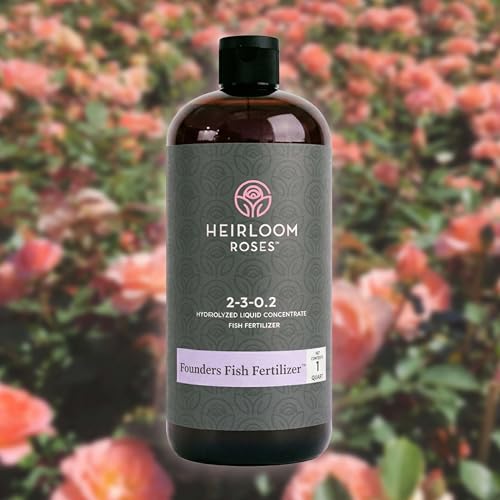
3. Heirloom Roses Founder’s Fish Fertilizer (32 fl oz)
The rose-specific hydrolysate that keeps blooms coming from spring through fall.
This is a targeted formula for the gardener who treats their roses like family. Made from acidulated fish solubles stabilized with phosphoric acid, it uses multiple fish species for richer soil mineralization. The mixing guideline is straightforward — four ounces per gallon of water — and one gallon of that solution is enough to feed two to three rose bushes. It is designed to keep the plant structure intact between waterings so the blooms keep coming.
Effectiveness is the top praised aspect by a wide margin across 692 ratings, and the results show up in the flowers. The founder’s blend is formulated specifically to support mycorrhizae — the beneficial fungi in the soil — which in turn helps the roots take up nutrients more efficiently. One Virginia gardener noted that it keeps rose bushes blooming “from spring through fall.” The smell, as owners acknowledge, is unpleasant but dissipates quickly after application.
The bottle itself is 32 ounces, which puts it at a quarter of the volume of the gallon-sized picks above. That makes it an easy entry point if you only have a few roses or tomato plants to feed. The mixing ratio is easy enough: you simply dilute four ounces into a gallon of water and water the base of each plant.
What blooms best: roses are the star here, but tomato plants also respond well. The formula helps the plants stay nourished and structurally sound through the heat of summer.
The odor reality: at 44 mentions as a negative aspect, the smell is the main drawback. Use it outdoors and let the soil absorb it; the scent fades much faster than standard fish emulsion.
Ideal for: dedicated rose gardeners or anyone growing a small bed of tomatoes who wants a bloom-focused organic feed without committing to a huge bottle.
Not ideal for: large-scale vegetable gardens or indoor use where the smell would linger in enclosed spaces.
4. Monterey Fish & Grow 9-6-2 Fertilizer (1 Quart)
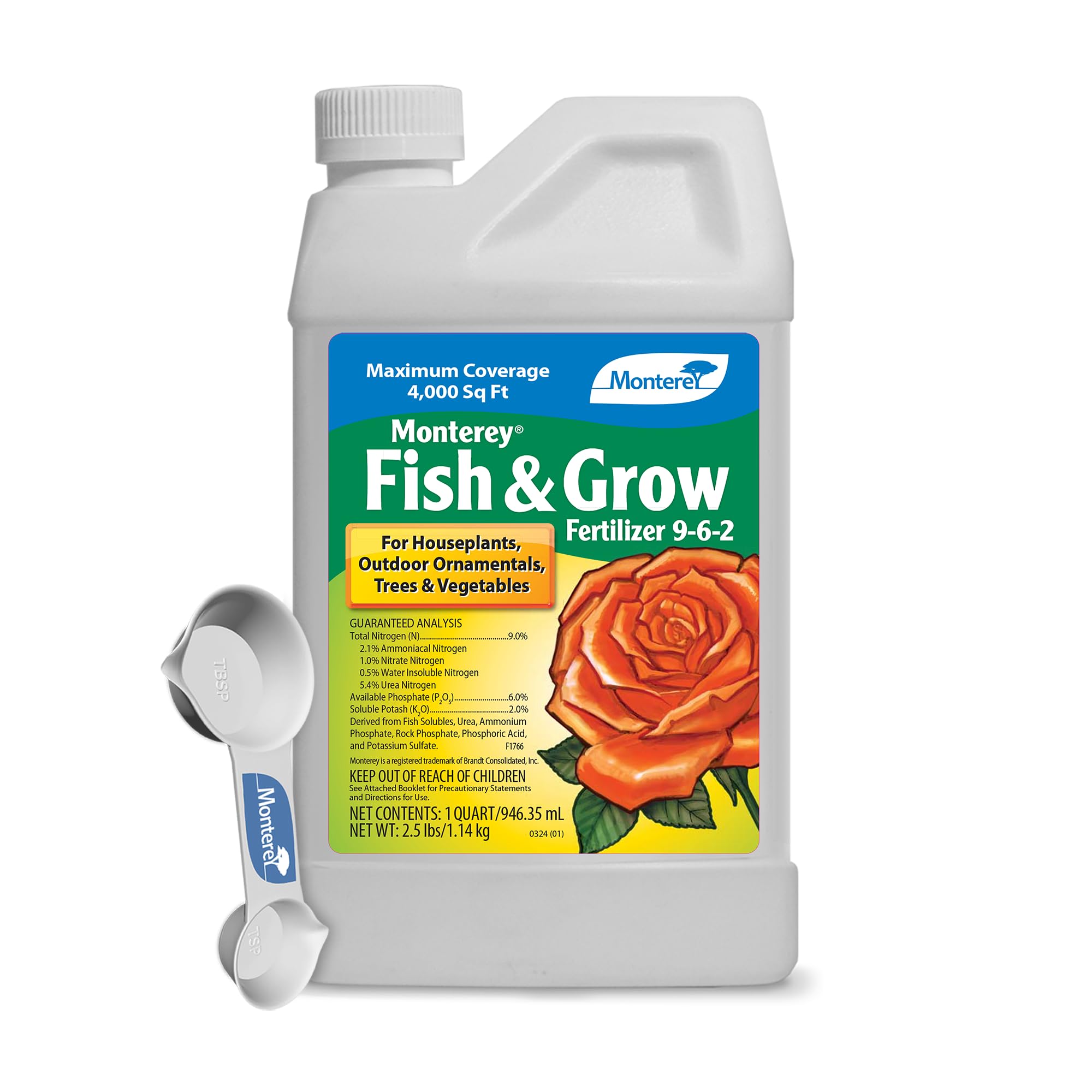
The high-nitrogen quart that covers a quarter-acre garden from a single bottle.
Here is the math that matters: one quart of this concentrate covers up to 4,000 square feet when mixed at half an ounce per gallon of water. That is enough to feed a large vegetable plot, a row of fruit trees, or an entire flower bed for a full growing season. The 9-6-2 NPK ratio is heavily weighted toward nitrogen, making this a go-to for green growth phases — think leafy brassicas, sprawling squash vines, and lush ornamental shrubs.
The formula is versatile in how you apply it. You can use it as a soil drench around the root zone or as a foliar spray on the leaves, which gives you flexibility depending on what your plants need. A measuring spoon is included in the package, which removes the guesswork. Indoor and outdoor plants both respond well, though the strong odor means it is best kept outside or in a well-ventilated greenhouse.
Owners consistently praise the “plant attraction” — the way their plants visibly perk up and grow after application. The one catch is the value perception: while some find the quart size reasonably priced for the coverage, a few note it feels expensive compared to gallon jugs of other brands. If you are covering a large area, the cost per application is actually quite low.
Application tip: use this monthly or every other week during the active growing season. The concentrated 9-6-2 mix is potent, so stick to the half-ounce per gallon recommendation to avoid overfeeding.
The smell factor: this is not a deodorized product. The fish odor is present during mixing but fades once worked into the soil.
Best suited for: large gardens, citrus trees in pots, or any scenario where you need maximum coverage from a compact bottle.
Pass on this if: you primarily grow flowering plants — the high nitrogen will favor leaves over blooms. Switch to a lower-N, higher-PK formula once flowers set.
5. Alaska Morbloom Concentrate 0-10-10 (1 Gallon)
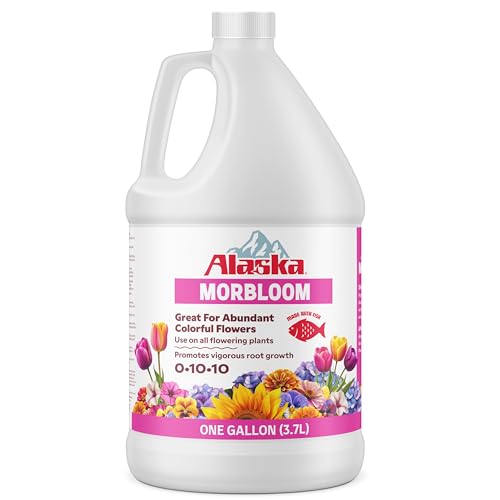
The zero-nitrogen formula that turns a garden into a flower show.
Most fish fertilizers lean hard on nitrogen. This one flips the script entirely — 0-10-10 means there is zero nitrogen, all phosphorus and potassium. That makes it the specialist pick for the bloom phase. When your dahlias, zinnias, or flowering shrubs are about to set buds, switching to Morbloom encourages heavy flowering and vigorous root growth without pushing more leaves. It is made with fish, just like the rest, but the nutrient profile is completely different.
The gallon jug gives you plenty of product for a full season of feeding. Owners rotate it with the standard Alaska fish fertilizer, applying one for leaf growth and this one for flowers. The quality and effectiveness are the top praised aspects across 629 ratings, particularly for flowering plants. The bloom results are described as abundant and colorful, with dahlias and tomatoes showing the clearest improvement.
The main logistical complaint is shipping — the thin liquid concentrate has a tendency to leak if the cap is not sealed tightly for transit. A few owners have received bottles that arrived with the box soaked. Ordering from a seller that double-bags the bottle or tapes the lid can prevent that frustration. Once you have it in hand, however, the product itself delivers exactly what the label promises.
How to use it: rotate between this and a higher-nitrogen fish fertilizer week by week. Use Morbloom when you see flower buds forming and switch back to a balanced feed after the bloom cycle.
A note on pH: the 0-10-10 formula can lower your soil’s pH noticeably, so keep an eye on your buffer if you are growing in containers with sensitive plants.
Perfect for: serious flower gardeners, dahlia enthusiasts, and anyone who wants to boost bloom production in the second half of the growing season.
Not for: young seedlings or leafy greens — without nitrogen, those plants will stall. Save this for the flowering stage only.
6. Neptune’s Harvest Fish Fertilizer 2-4-1 (Quart)
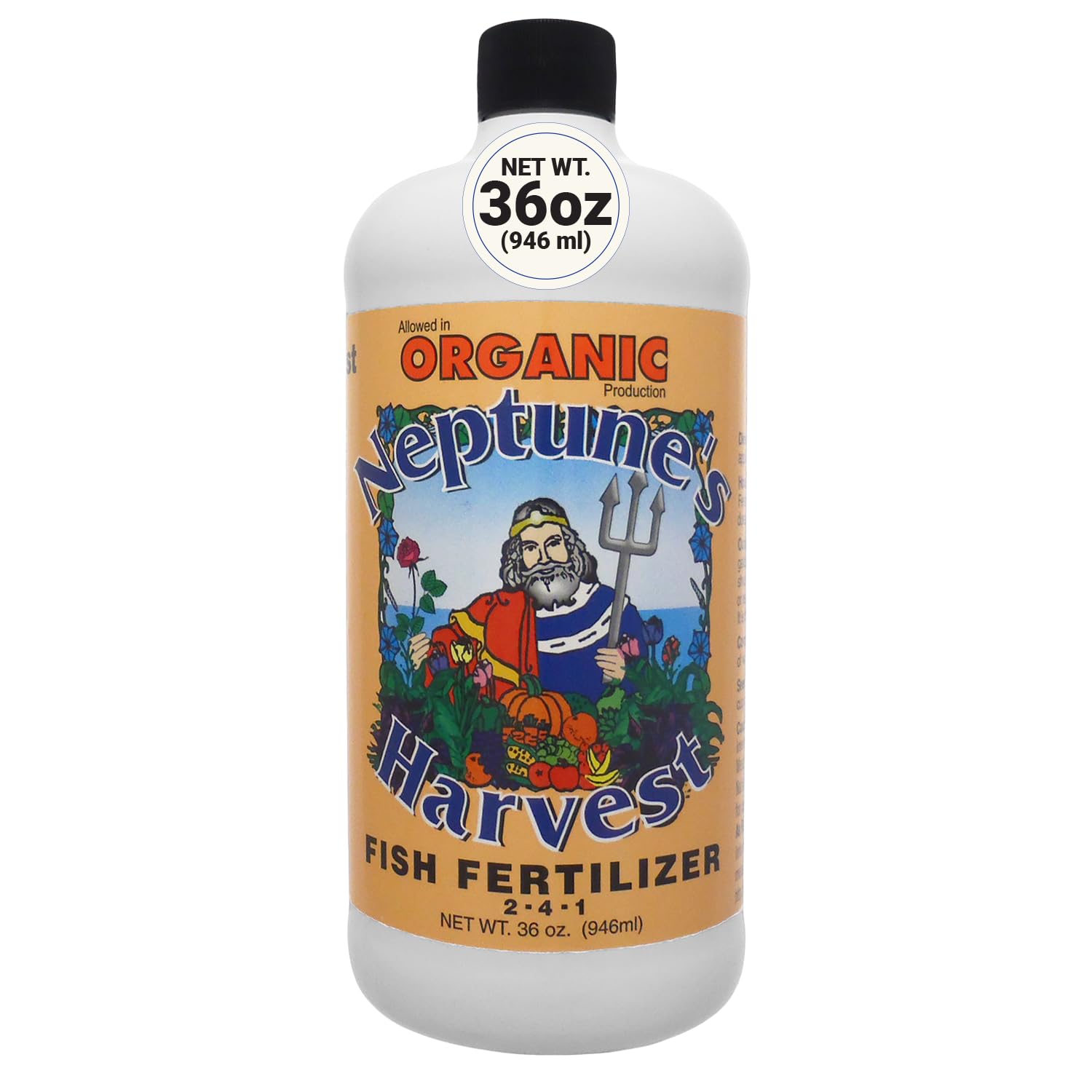
The cult-favorite hydrolysate that feeds the soil food web, not just the plant.
Neptune’s Harvest is the product that experienced organic gardeners recommend to each other. Its 2-4-1 ratio (2% nitrogen, 4% phosphorus, 1% potassium) focuses on phosphorus to boost fruiting and flowering, but the real story is how it improves the soil itself. Made from whole North Atlantic ocean fish using a cold process that preserves amino acids (protein building blocks), enzymes, and growth hormones, it delivers far more than NPK — it supplies micronutrients, trace elements, and omega oils that synthetic fertilizers simply cannot provide.
The mixing ratio is economical: just one ounce per gallon of water, whether you are using it as a soil drench or a foliar spray. That quart bottle goes a long way. The OMRI listing gives organic gardeners confidence, and owners mention that it builds organic matter, feeds beneficial bacteria, and improves soil structure over time. The soil becomes looser, retains moisture better, and drains more effectively. This is the product that some growers call “worth its weight in gold,” despite the extremely foul smell during application.
With over 3,100 ratings and a standout reputation, Neptune’s Harvest is the most-reviewed fish hydrolysate on this list. The recurring advice from owners is to avoid skin contact with the concentrate and apply it early in the morning to let the odor dissipate before you spend time in the garden. The results — healthier plants, better yields, and noticeable soil improvement — make the brief unpleasantness worthwhile.
How it differs: unlike cheaper emulsions, this is a true hydrolysate that has not been heat-treated, meaning the beneficial microorganisms and enzymes survive the bottle. That is why it feeds the soil biology rather than just dosing the plant.
The smell warning: owners are unanimous that this stuff is pungent. Do not mix it indoors, and wash your hands immediately after handling the concentrate.
Choose this for: long-term soil health, raised bed restoration, and gardeners who want to move away from synthetic fertilizers entirely.
Skip if: you are sensitive to strong fish odors or you need a quick-fix nitrogen boost — the 2-4-1 is lower in nitrogen than most fish fertilizers.
7. Flowerbird Soil Love Premium Plant Food (4 oz Powder)
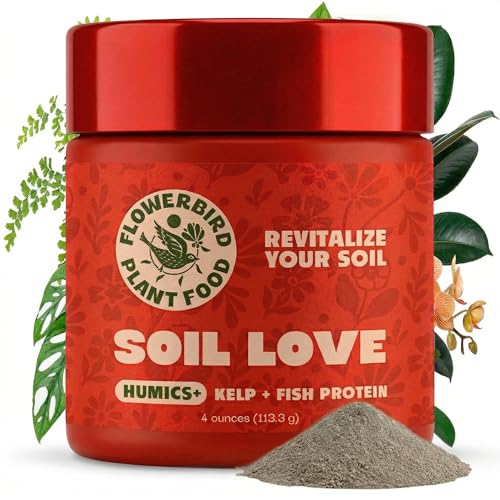
The dry powder that brings fish hydrolysate indoors without stinking up the living room.
This is the entry on the list that solves the odor problem. Flowerbird Soil Love is a concentrated dry powder that combines humics, cold-pressed kelp, and fish protein into a 2-1-4 NPK formula. When you mix it with water, the fish smell is present during mixing but dissipates quickly once applied — customers note no lingering after-smell. That makes it uniquely suited for houseplants, where a liquid fish fertilizer would leave your home smelling like a dock.
The small 4-ounce jar makes 30 gallons of liquid fertilizer, so the concentrate-to-volume ratio is impressive. The powder creates a dark brown solution when mixed, and owners describe the water as messy-looking but highly effective. The 2-1-4 ratio leans into potassium, which supports overall plant health and disease resistance. For indoor gardeners who have been avoiding fish fertilizers because of the smell, this is the workaround.
One caveat: the powder itself can be messy to handle, and a few owners have reported receiving jars where the lid was not fully sealed during transit, causing spillage. The product is pet-safe once diluted, which is a common concern for households with curious cats or dogs that might investigate the soil. The plant response, as owners describe it, is rapid — winter-stressed houseplants revive noticeably within a week or two.
Best use case: mix a small batch for your indoor fiddle-leaf fig, monstera, or pothos. The potassium boost helps with cell wall strength and root development in container plants.
The packaging: the concentrate is potent, so the jar is small. Check that the lid is tight on arrival to avoid powder migration inside the shipping box.
Reach for this when: you want the soil-building benefits of fish hydrolysate without the lingering fish odor in your home.
Not the best fit for: large outdoor gardens — the powder requires mixing each batch, and a liquid concentrate is more convenient for frequent hose-end applications.
8. Alaska Fish Fertilizer OMRI Listed 5-1-1 (115 fl oz)

The ten-year garden staple that delivers gentle nitrogen without burning roots.
The 5-1-1 ratio is nitrogen-forward — ideal for pushing leafy growth in vegetables, herbs, and young transplants. The nitrogen is gentle enough that it will not burn plants when used as directed, which is a common concern with synthetic high-nitrogen feeds.
The 115-ounce bottle provides substantial coverage, and the value is a consistent praise point across nearly a thousand ratings. Owners describe using it on tomatoes, peppers, basil, and cucumbers with noticeable results — stronger stems, more vibrant leaves, and faster growth compared to untreated plants. The formula is cold-pressed to preserve micronutrients, and it feeds the soil microbes alongside the plant itself.
Effectiveness tops the list of praised aspects by a wide margin at 138 mentions, with plant growth and value for money following closely. The main trade-off is the low phosphorus and potassium content. For the flowering and fruiting stages, you will need to supplement with a bloom-boosting formula. The smell is present but described as less intense than some competitors, dissipating within a day after application.
Application tip: apply every three weeks during the growing season for consistent results. Many owners enhance it with a tablespoon of blackstrap molasses per gallon to feed soil bacteria.
Deodorized formula: Alaska uses a deodorizing process that reduces the fishy aroma compared to raw hydrolysates, making it more tolerable for nearby neighbors.
Best for: vegetable gardeners focused on leafy greens, young transplants, and early-season growth when nitrogen demand is highest.
Not for: the bloom stage — the low phosphorus (1) and potassium (1) mean you will need a second product for flowers and fruit set.
9. Lilly Miller Alaska Fish Fertilizer 5-1-1 (2 Quart Pack)

Two quarts of proven fish fertilizer for gardeners who want a backup bottle ready to go.
This is essentially the same Alaska 5-1-1 formula as the single bottle above, but packed as two quart-sized bottles instead of one large jug. The 5-1-1 ratio is the same nitrogen-focused profile that gardeners have relied on for years, providing gentle feeding for vegetables, flowers, and shrubs. The two-bottle format is practical if you garden across two locations or want a fresh bottle while the other is in use.
Tomato growers are especially loyal to this product — one owner reported that using it weekly resulted in “an abundance of tomatoes” the previous season. The mix ratio is simple: two caps per half gallon of milk jug, applied weekly. The 820 ratings on this specific pack reflect consistent satisfaction with the results and the convenience of having a spare bottle.
The smell is the familiar fish aroma, though some owners find the quart-size easier to handle and store without spillage compared to a gallon jug. A few mention that spilled concentrate attracts ants, so wiping the bottle neck after pouring is a good habit. This is strictly an outdoor fertilizer — the lingering smell makes it unsuitable for houseplants.
Storage advantage: two quart bottles take up less vertical space in a garden shed shelf than one tall gallon jug, and you can keep one in rotation while the other stays sealed.
The value angle: buying the two-pack often works out to a better per-ounce price than a single quart bottle of the same formula.
Great for: medium-sized gardens where one quart (32 ounces) lasts a few weeks, and you want a smooth refill without reordering mid-season.
Skip if: you are gardening on a large scale — the two quarts combined still hold less than a single gallon, so heavy feeders will burn through them quickly.
Understanding the Specs
NPK Ratio
The three numbers on every fertilizer label stand for nitrogen, phosphorus, and potassium — in that order. Nitrogen drives leafy, green growth. Phosphorus supports root development, flowers, and fruit. Potassium boosts overall plant health, disease resistance, and water regulation. A 2-3-1 mix is balanced for flowering, while a 5-1-1 is for leaf growth. Choose the ratio based on what your plant needs at its current stage.
Cold Processing vs. Heat Processing
True fish hydrolysate is made through a cold process that preserves the full range of amino acids, enzymes, and growth hormones found in whole fish. Heat-processed fish emulsion breaks down these beneficial compounds, leaving a simpler nitrogen source. A cold-processed product is more expensive but delivers far more to the soil food web and the plant itself.
OMRI Listing
OMRI (Organic Materials Review Institute) listing means the product has been reviewed and approved for use in certified organic production. It is a third-party verification that the ingredients meet organic standards. If you are committed to organic gardening, an OMRI-listed label gives you confidence that the fish source and processing meet strict guidelines.
Mixing Ratio and Coverage
The mixing ratio tells you how much concentrate to dilute per gallon of water. A 1:100 ratio means one part fertilizer to 100 parts water — very dilute and gentle for frequent use. Stronger ratios like 4 ounces per gallon are for less frequent, more potent feedings. Coverage estimates (like “covers 4,000 sq ft”) are based on applying at the recommended rate across the entire area.
FAQ
How is fish hydrolysate different from fish emulsion?
Does fish hydrolysate fertilizer really smell that bad?
Can I use fish hydrolysate on houseplants indoors?
What is the best NPK ratio for tomatoes?
How often should I apply fish hydrolysate fertilizer?
Is fish hydrolysate safe for pets after it is applied to the soil?
Can I mix fish hydrolysate with other fertilizers?
How much does one bottle cover in terms of garden area?
Will fish hydrolysate attract animals or pests to my garden?
How long does an opened bottle of fish hydrolysate last?
Final Thoughts: The Verdict
For most gardeners, the fish hydrolysate fertilizer winner is the The Grow Co 1 Gallon because it delivers a balanced 2-3-1 NPK ratio in a generous 128-ounce bottle, covering 160 gallons of mixed feed for under thirty bucks. If you want a specialty bloom booster for your roses, grab the Heirloom Roses Founder’s Formula. And for an odor-conscious indoor option, the Flowerbird Soil Love powder is the one to reach for.
How We Picked
We do not accept paid placement. Every pick is matched to a real buyer and a real use-case; we do not hands-on test units.
Sources & Methodology
Specifications: manufacturer listings and product documentation. Review insights: verified customer reviews, as of July 2026. Pricing: not shown on this page (it changes often); check the current price via the retailer link.
As an Amazon Associate, Lawn Gear Lab earns from qualifying purchases. This does not affect which products we feature.