
Specs are compiled from manufacturer listings and verified buyer reviews and can change over time — please confirm the key details on the product page before buying.
You want a greenhouse for home use that won’t collapse in winter, and the key difference is the frame, the glazing (the transparent panels), and how it’s anchored. A weak structure can crush under snow, while a solid one protects your seedlings year after year. This guide helps you pick the one that earns its spot in your backyard.
I’m Rikta — the founder and writer behind Lawn Gear Lab. This guide is built by comparing the manufacturers’ published specifications and the patterns across verified customer reviews, so you get each pick’s real strengths and trade-offs instead of marketing spin.
Whether you are starting your first seed trays or protecting tender perennials (plants that survive multiple years) all winter, your greenhouse needs to hold up against wind, snow, and daily use. That way you spend more time growing and less time on repairs.
Our Picks at a Glance


How To Choose The Best Greenhouse For Home
The right greenhouse for your home depends on your climate, the size of your yard, and how much time you want to spend on assembly. A few key specs separate the long-term investment from the temporary shelter.
Frame Material: Wood vs. Aluminum vs. Steel
Wood frames, especially cedar, are naturally rot-resistant and offer a classic look, but they are heavy — the Backyard Discovery Willow weighs over 570 pounds dry. Aluminum frames are lighter, rust-proof, and easier to assemble, but they may flex in extreme winds if not reinforced. Heavy-duty steel is strong and affordable, but it can rust if the coating gets scratched. Your choice also dictates how you anchor the greenhouse: wood frames can be screwed into a base, while aluminum often relies on ground spikes or bolts into concrete.
Glazing: Polycarbonate vs. Polyethylene (PE)
Polycarbonate panels are rigid, impact-resistant, and insulate well. The thickness (4mm or 6mm) and density (measured in g/m², like 580g or 720g) control how much heat the greenhouse holds and how well it resists hail. PE covers (polyethylene, a thin plastic film stretched over a frame) are cheap and let in plenty of light, but they tear easily, degrade in direct sun, and offer very little insulation in freezing weather. For year-round home use, polycarbonate is almost always the better choice.
Snow Load and Wind Speed Ratings
A manufacturer’s snow load rating tells you the pounds per square foot (PSF) or total weight the roof can handle before collapsing. The Backyard Discovery Willow, for example, is rated to withstand up to 30 inches of snow. The wind speed rating (in mph) tells you how strong a gust the frame can take when properly anchored. If you live in a region with heavy snowfall or frequent storms, these numbers are more important than any other spec on the page.
Quick Comparison
| Model | Best For | Frame Material | Size (L x W x H) | Cover Material | Amazon |
|---|---|---|---|---|---|
| Backyard Discovery Willow★ Best Overall | Premium All-Weather Durability | Wood (Cedar) | 114.25″ x 72.75″ x 94″ | Polycarbonate (PC) | Amazon |
| Yardenaler 8×10 FTBest Wood Frame Alternative | Spacious Wood-Frame Build | Fir Wood | 121.4″ x 101.7″ x 90.7″ | Polycarbonate (PC) | Amazon |
| WELYAS 12×10 FTMost Spacious | Large High-Ceiling Structure | Aluminum | 148″ x 117″ x 120″ | Polycarbonate (PC) | Amazon |
| WUKHG 10X12FT | Large Greenhouse with Thermometer | Aluminum | 122.44″ x 144.91″ x 100.39″ | Polycarbonate (PC) | Amazon |
| Jiliusure 6×6 FT | Compact Quality Build | Aluminum | 66.9″ x 66.54″ x 77″ | Polycarbonate (PC) | Amazon |
| Sylviera 6x4FT | Budget-Friendly Starter | Aluminum | 45″ x 67″ x 77″ | Polycarbonate (PC) | Amazon |
| Esimote 6×8 FT | Mid-Size Value | Aluminum | 95.4″ x 70.9″ x 77.2″ | Polycarbonate (PC) | Amazon |
| Outsunny 6′ x 8′ | High-Value Polycarbonate Kit | Aluminum | 99.25″ x 74.75″ x 79.25″ | Polycarbonate (PC) | Amazon |
| Benass 8X12 FT Pop Up | Budget Quick Setup | Steel | — | Polyethylene (PE) | Amazon |
In‑Depth Reviews
1. Backyard Discovery Willow 9′ x 6′ Cedar Wood and Polycarbonate Walk-in Greenhouse
Our pick — over 4.5★ from 100+ verified ratings; the strongest balance of quality and price.
The heavy-duty cedar fortress that laughs at snow and wind.
This greenhouse from Backyard Discovery is rated to withstand up to 2,800 pounds or 30 inches of snow load and winds up to 100 mph when anchored correctly — numbers that put it in a different league from most residential kits. The 54 square feet of interior space comes with 13 linear feet of fixed staging shelves, plus a built-in workstation. What really separates it is the patented PowerPort: three electrical outlets and three USB ports so you can run fans, heaters, or lights without running extension cords through a gap in the door. It also includes exterior and interior hose hook-ups for watering.
The frame is 100% cedar wood, which naturally resists decay. The commercial-grade 4-wall polycarbonate roof and window panels improve heat retention by 30% compared to standard double-wall panels. A temperature-activated exhaust fan handles forced ventilation, with one easy-open window for natural airflow. Owners consistently praise the quality and durability; the crowd favorite is a strong 4.7 stars across over 100 ratings. Buyers report: “That first heavy storm and wind came through and it stood solid.”
Assembly is a project — expect roughly 21 hours solo, or a weekend with two to three people — but the pre-cut, pre-drilled, pre-stained pieces and the interactive BILT app make the process very straightforward. The biggest caveat is the price, which positions this as a premium investment. It comes with a 5-year warranty.
Why it dominates
- Snow load rating of 2,800 lbs (30 inches) — class-leading in this roundup.
- 100% cedar frame with natural rot resistance and a light brown stain.
- Integrated PowerPort with 3 outlets and 3 USB ports.
- Temperature-activated exhaust fan and 5-year warranty.
The honest trade-off
- Premium price point; a serious investment for most home gardeners.
- Assembly is time-intensive; the manual emphasizes careful sealant work.
- Weighs over 570 lbs (259 kg) — requires a solid, level foundation.
Invest with confidence if: You live in a snowy or windy climate and want a greenhouse that will survive real weather for years, and you are comfortable with a multi-day installation project.
Consider a smaller kit if: Your budget tops out well below this range, or you only need a small, temporary space for starting a few trays of seedlings each spring.
2. Yardenaler 8×10 FT Greenhouse Kit with 6MM Thick Polycarbonate
A natural wood look with serious storm survival credentials.
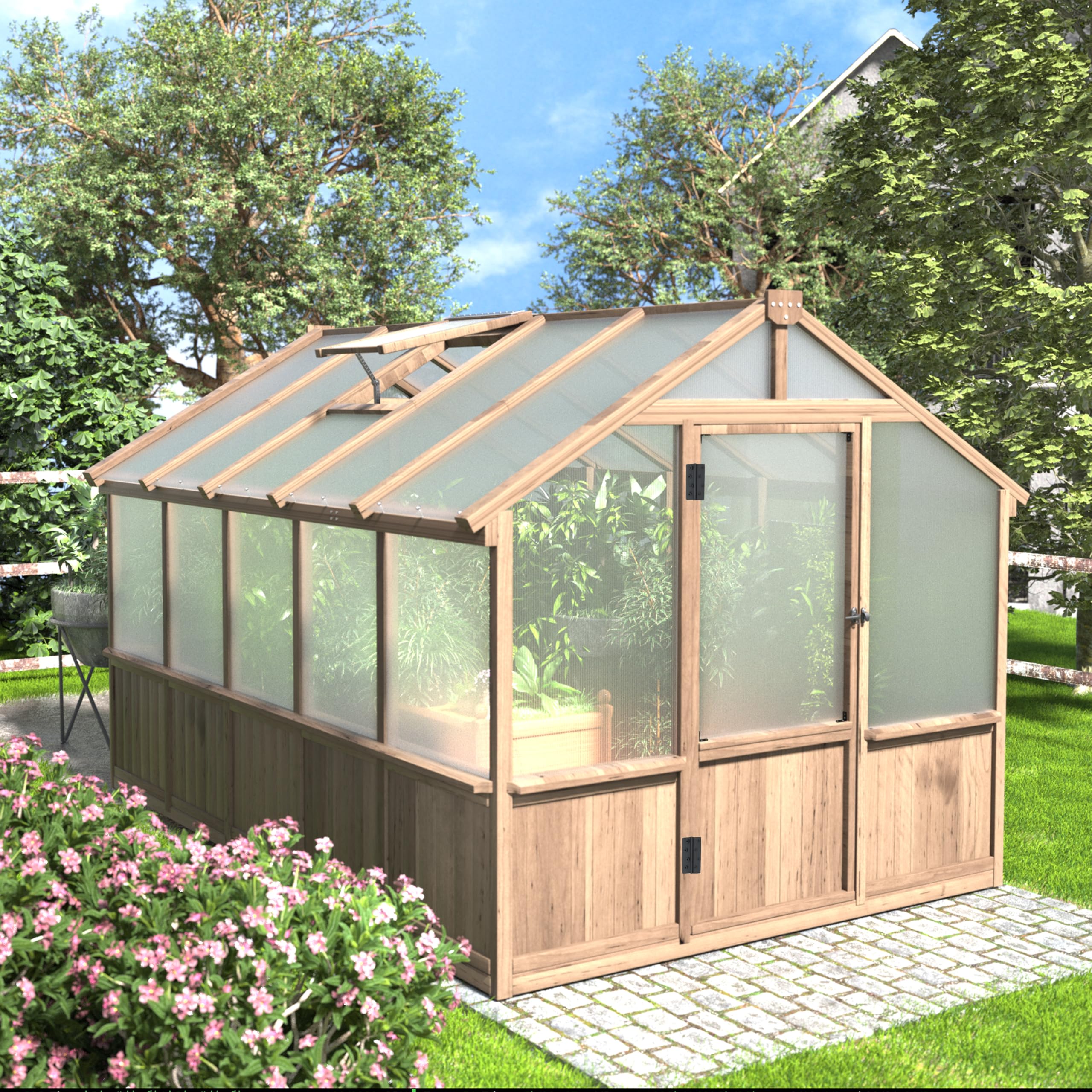
If you want a wooden greenhouse that rivals the Backyard Discovery in spirit but at a different price point, the Yardenaler 8×10 is a compelling choice. It gives you 101.7″ x 121.4″ of floor space with 90.7″ of headroom — enough to store a potting bench, shelves, and still walk around comfortably. The frame is fir wood (painted Light Mocha Brown), and the panels are upgraded 6mm thick multi-layer polycarbonate, the thickest in this lineup.
Owners mention this greenhouse survives serious weather. Customers note that with proper anchoring on a 4×4 base, it has withstood 50+ mph winds and blizzards with no snow getting inside. The adjustable roof vent opens to a maximum angle of 45 degrees, giving you control over hot air release. The door is a standard hinged style at 28.66 inches wide — wide enough for a wheelbarrow, but narrower than a sliding door. Assembly is labor-intensive, but the parts are marked, and the instructions are clearer than most. The primary usability gripe is that the frosted film on the polycarbonate does not always stay adhered long-term.
Weighing 433 pounds, this is a heavy, permanent structure best placed on a level pad or gravel base. The 6mm panels provide noticeably better insulation than the 4mm panels common on cheaper kits.
The real-world take: You get a spacious, attractive wooden greenhouse that holds its own against snow and gales. The trade-off is a build that can take two full days and requires you to caulk every seam for best results.
3. WELYAS 12×10 FT Polycarbonate Greenhouse
Stand-up room and 120 square feet of growing space.
The WELYAS 12×10 stands 120 inches (10 feet) tall at the peak, with 148 inches of length and 117 inches of width — that is roughly 123 square feet of floor space, big enough to add a seating area alongside your plants. The reinforced aluminum frame is rated to withstand snow loads up to 1,000 lbs and winds up to 50 mph, with extra ground screws included. It has two roof vents, each with five adjustable levels, and a swing door that is 6.5 x 6 feet — wide enough for large tools or even a small wheelbarrow.
Assembly is the main hurdle. Owners describe it as challenging, with instructions that are less than clear; it took one two-person team four days. The build itself is sturdy once up, and the transparent panels let in excellent light. The package arrives in two boxes weighing about 100 pounds total. Some owners found the door spring locks non-functional, and a note from the manufacturer warns that buyers in very harsh climates must reinforce the base themselves.
Who this fits: Home gardeners who need maximum interior volume and are willing to put in a careful, multi-day assembly for a structure that feels solid once completed. Not the easiest build, but the space you get is tough to top at this level.
4. WUKHG 10X12FT Enhanced Aluminum Large Greenhouse
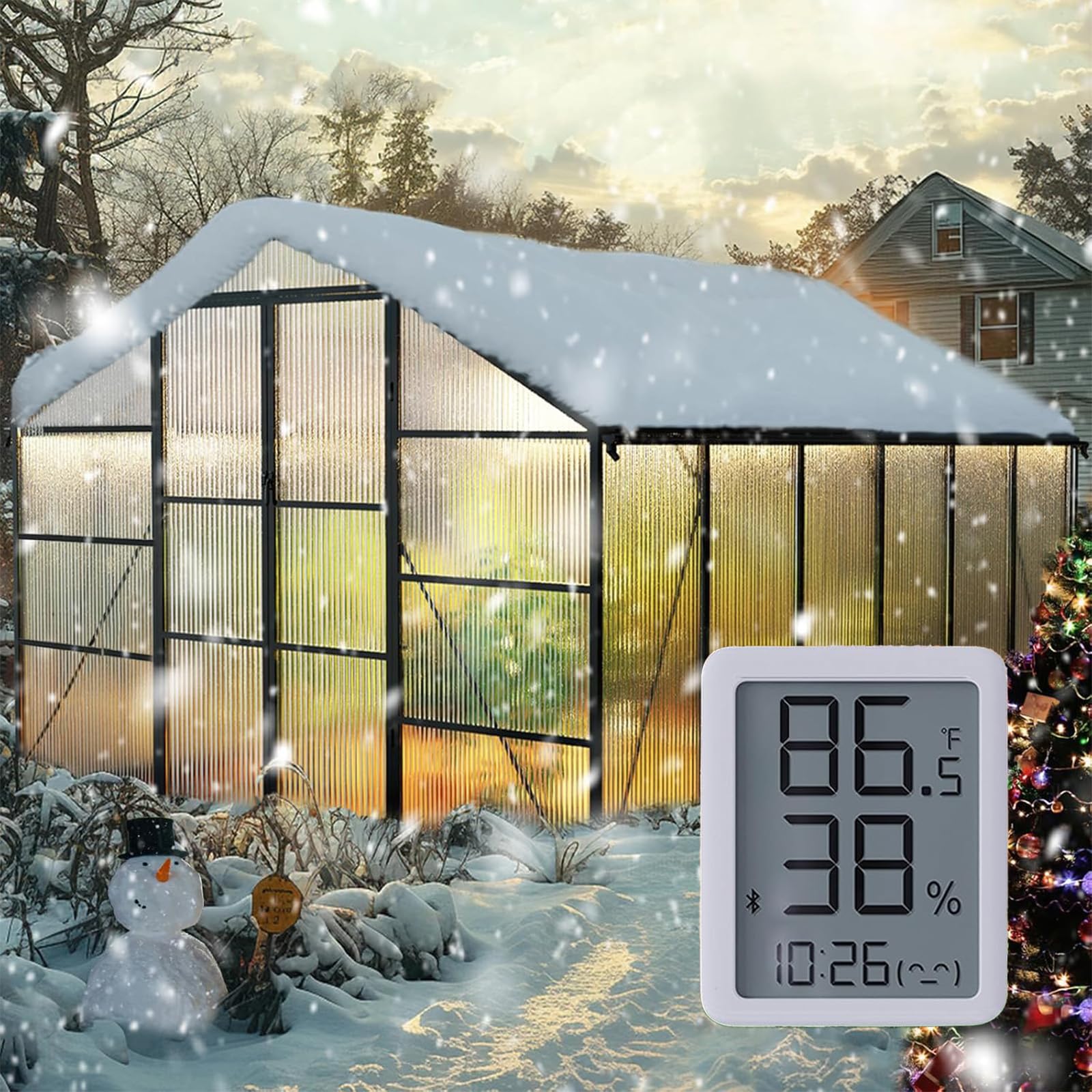
A large, well-featured aluminum frame with a built-in rain gutter system.
The WUKHG 10×12 gives you a 122.44 x 144.91-inch footprint with a 100.39-inch height, plus a built-in gutter system on the roof for collecting rainwater. The frame is reinforced aluminum, and the panels are 720g/m² twin-wall polycarbonate that is 4mm thick. The manufacturer states the structure can withstand 35 mph winds and a 20 PSF snow load. It comes with three vents and a lockable sliding door. An electronic thermometer is included in the box.
One owner noted it heated to 100°F when it was 40°F outside, which is evidence of excellent heat retention — though it also loses heat by midnight, so a small heater may be needed for overnight frost protection. Assembly is a three-person job, and the roof window reportedly blew out on one unit the first night, suggesting the vent hardware may need reinforcement. The parts are marked with symbols, which helps.
Bottom line: A spacious kit with good insulation and the convenience of a rain gutter, but the thin panel edges and window hardware might require some owner modifications to feel fully secure in heavy wind.
5. Jiliusure 6 x 6 FT Polycarbonate Greenhouse
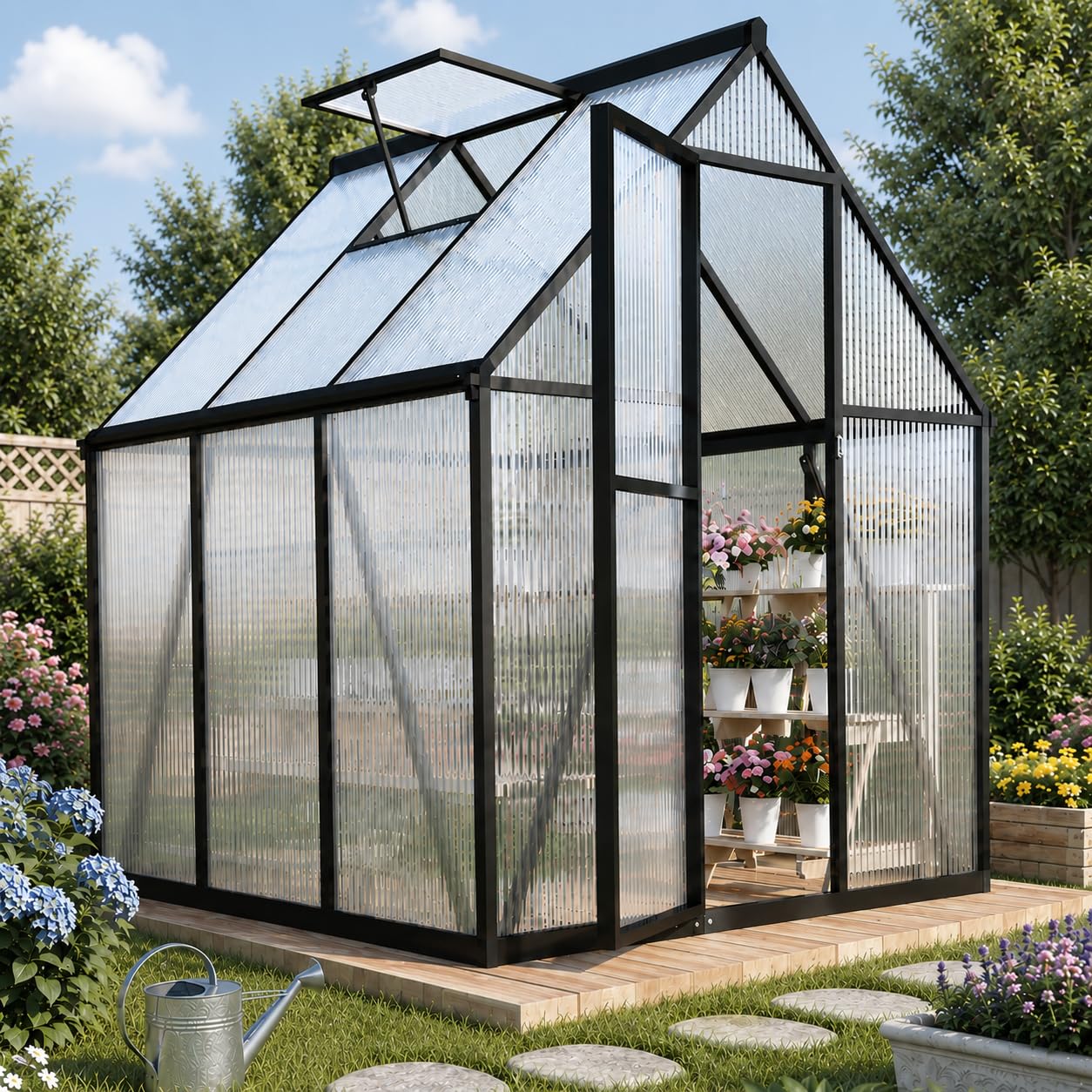
A smaller footprint with upgraded panel density and quick assembly.
The Jiliusure 6×6 FT is a compact unit (66.9″ x 66.54″ x 77″) that packs in features found on larger models. The polycarbonate panels are 720g/m² — the same high-density material used in the larger WUKHG greenhouse above — delivering up to 70% light transmission while blocking over 99.9% of UV rays. The frame is a premium aluminum alloy, and the slide-in panel system is designed to improve installation efficiency. Ground spikes and base mounting options (soil, concrete, or wood) are included.
It has a lockable sliding door, adjustable roof vents, and integrated rain gutters. Owners call it sturdy and great for extending the season, with one noting it held up well through an Appalachian winter assembly is straightforward and doable by one person, though the included tools are fairly basic. The caveat from owners is that the actual dimensions are closer to 5.5 x 5.5 feet, not the full 6×6 advertised, so the inner shelf space is tighter than expected.
Strengths
- High 720g/m² panel density for better insulation.
- Slide-in system speeds up assembly.
- Compact footprint fits smaller yards.
Warning
- Interior dimensions are smaller than the listed 6×6.
- Manual has some unclear sections.
- Panels can crack under accidental hand pressure if over-tightened.
6. Sylviera 6x4FT Greenhouse with Hygrometer
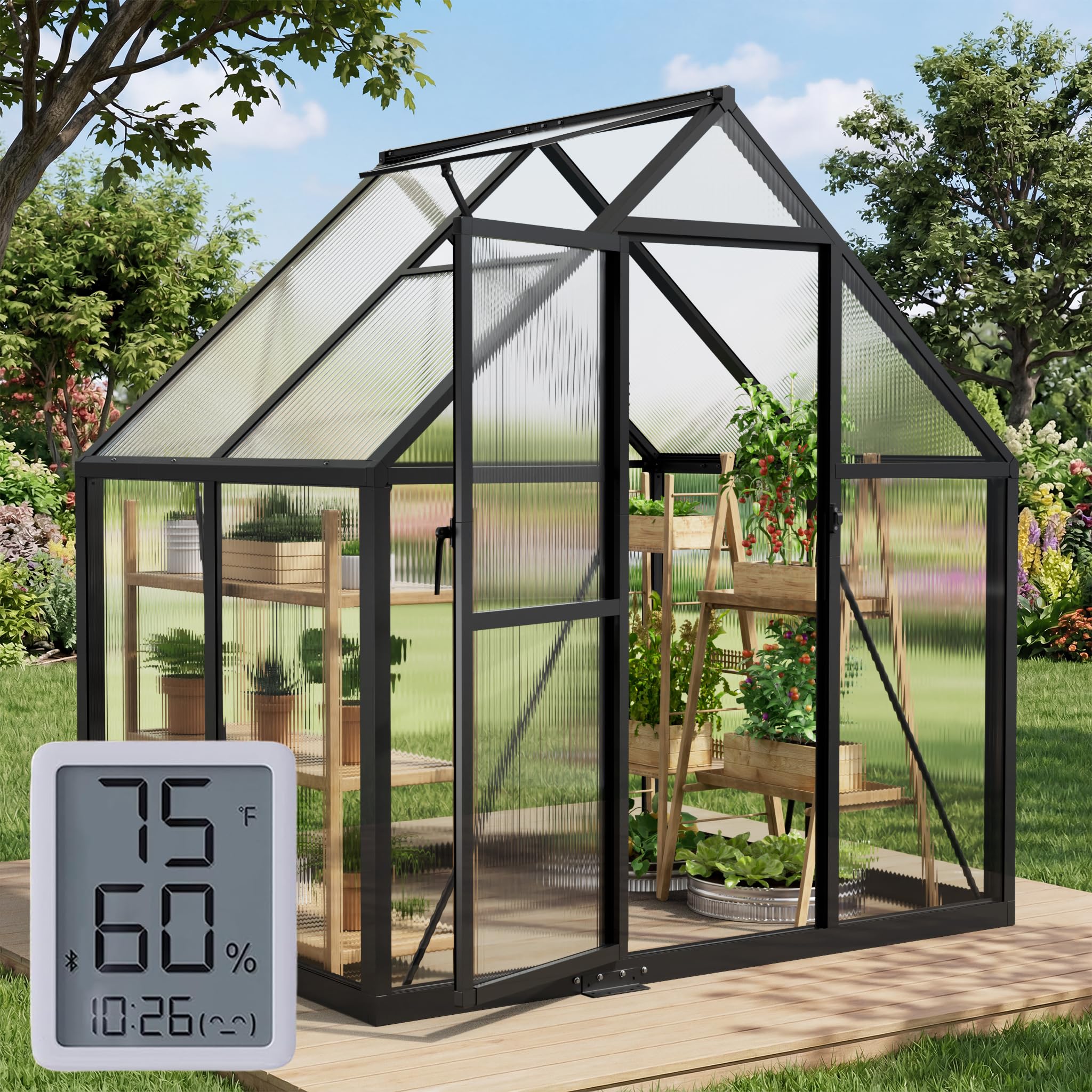
An entry-level polycarbonate greenhouse that actually insulates well.
The Sylviera 6×4 is the smallest and least expensive polycarbonate greenhouse in this list, but it earns its place because it delivers real insulation. The 4mm double-wall polycarbonate panels (580g) retain heat noticeably — one owner measured 93°F inside at 10am on a mild morning. The frame is reinforced aluminum alloy, and the unit includes two roof vents and a lockable door.
Assembly reviews are mixed. Some owners find it straightforward with two people, while others report that the instructions contain errors and that the door frame is not perfectly square. The panels feel thin to the touch and the roof vents need a rubber band to stay open on windy days. The included hygrometer (a device that measures humidity) is a nice bonus. For its price, it is a capable starter greenhouse for a small backyard, though you will want to add an exhaust fan and a winter heater for year-round use.
The honest take: A budget-friendly entry into polycarbonate greenhouses with surprisingly good heat retention. Plan for a full day of assembly with a helper, and budget extra for a fan and heater if you want to use it through a cold winter.
7. Esimote 6×8 FT Polycarbonate Greenhouse

A solid mid-size aluminum kit that stays warm in winter.
The Esimote 6×8 (95.4″ x 70.9″ x 77.2″) fits nicely between a starter unit and a large walk-in. It uses a reinforced aluminum frame and polycarbonate panels, with one adjustable roof vent offering five levels of airflow control. The door is a sliding style with a lock. One owner reported the interior stayed at 40°F when outside temperatures dropped to 9°F, aided by heat lamps — demonstrating the insulation potential.
Assembly time varies. Some owners put it together in about two hours, while others struggled for hours, noting that the side windows use flimsy plastic and that the entry door is short — one 5’5″ owner had to duck to enter. The base should be anchored into concrete or soil; shifting is a risk if the ground is uneven. Despite the mixed assembly experience, owners call it great value for home gardeners who want a reliable season extender.
Who it’s for: Home gardeners who want more space than a starter kit without jumping to a premium price. Be ready for some alignment work at assembly, and consider a short user’s height when planning the layout.
8. Outsunny 6′ x 8′ Polycarbonate Greenhouse
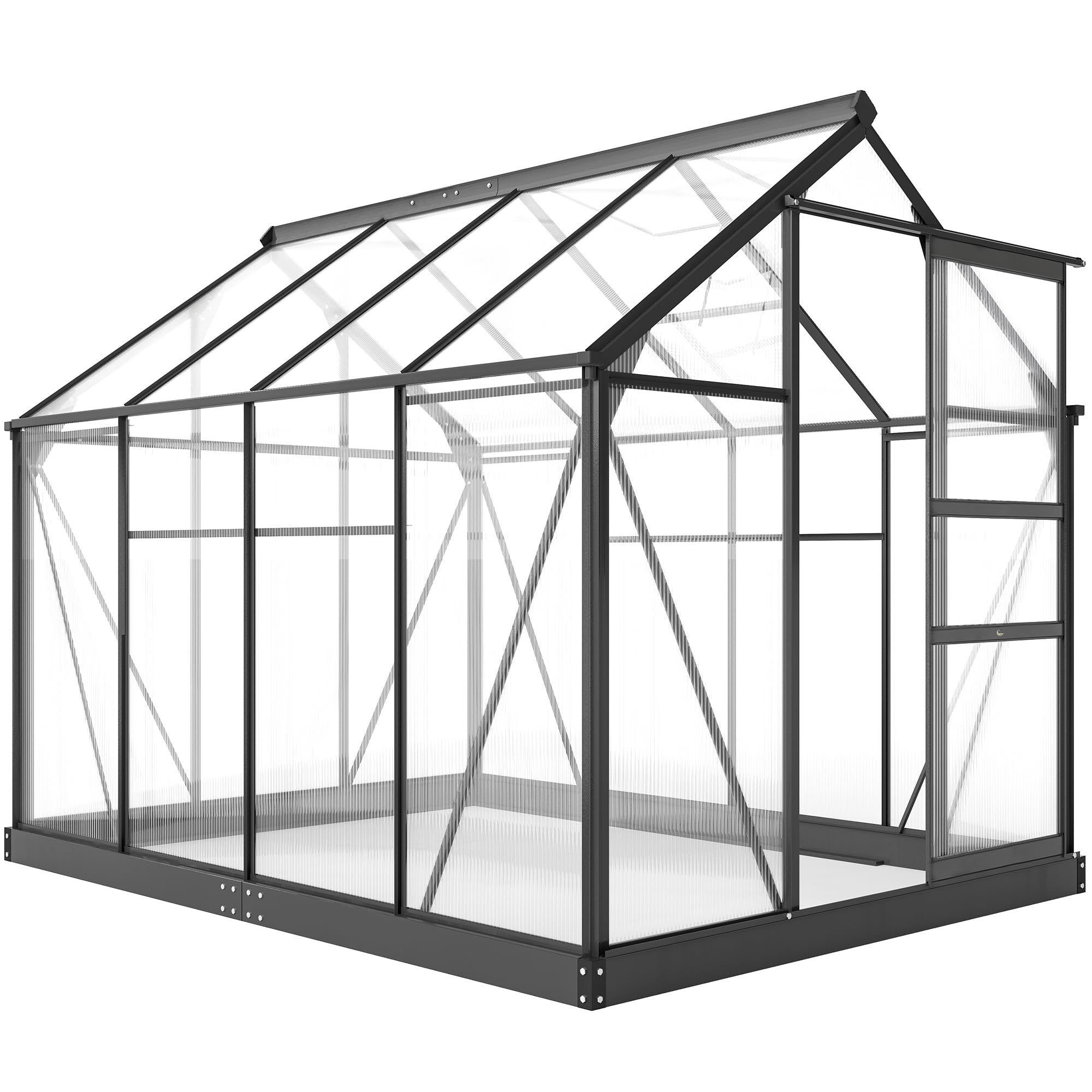
A popular entry-level polycarbonate kit with a frustrating assembly reputation.
The Outsunny 6×8 is among the most-reviewed greenhouses in this roundup, and the feedback is a clear warning: the appearance wins people over, but assembly is the most-discussed challenge, with owners calling the picture-only instructions difficult to follow and noting that the panels are brittle, with some blowing out in breezes over 10 mph. The frame is powder-coated aluminum with a galvanized steel base, and it includes a sliding door, a roof vent, and rain gutters.
If you have built flat-pack furniture before and feel patient, this can be a good value for the money — it is a very affordable way to get a polycarbonate structure in your yard. The manufacturer recommends placing it against a wind-blocking wall and securing it with ground bolts. Some owners have had great success by reinforcing the panels with weather stripping and extra bracing. Others have found the flimsy panel retention and the poor instructions to be deal-breakers.
Why it sells
- Low price for a polycarbonate walk-in greenhouse.
- Sliding door and rain gutter included.
- Good-looking gray and aluminum aesthetic.
The recurring complaints
- Assembly is widely described as a nightmare.
- Polycarbonate panels are thin and pop out in moderate wind.
- Picture-only instructions are hard to follow.
9. Benass 8X12 FT Pop Up Greenhouse
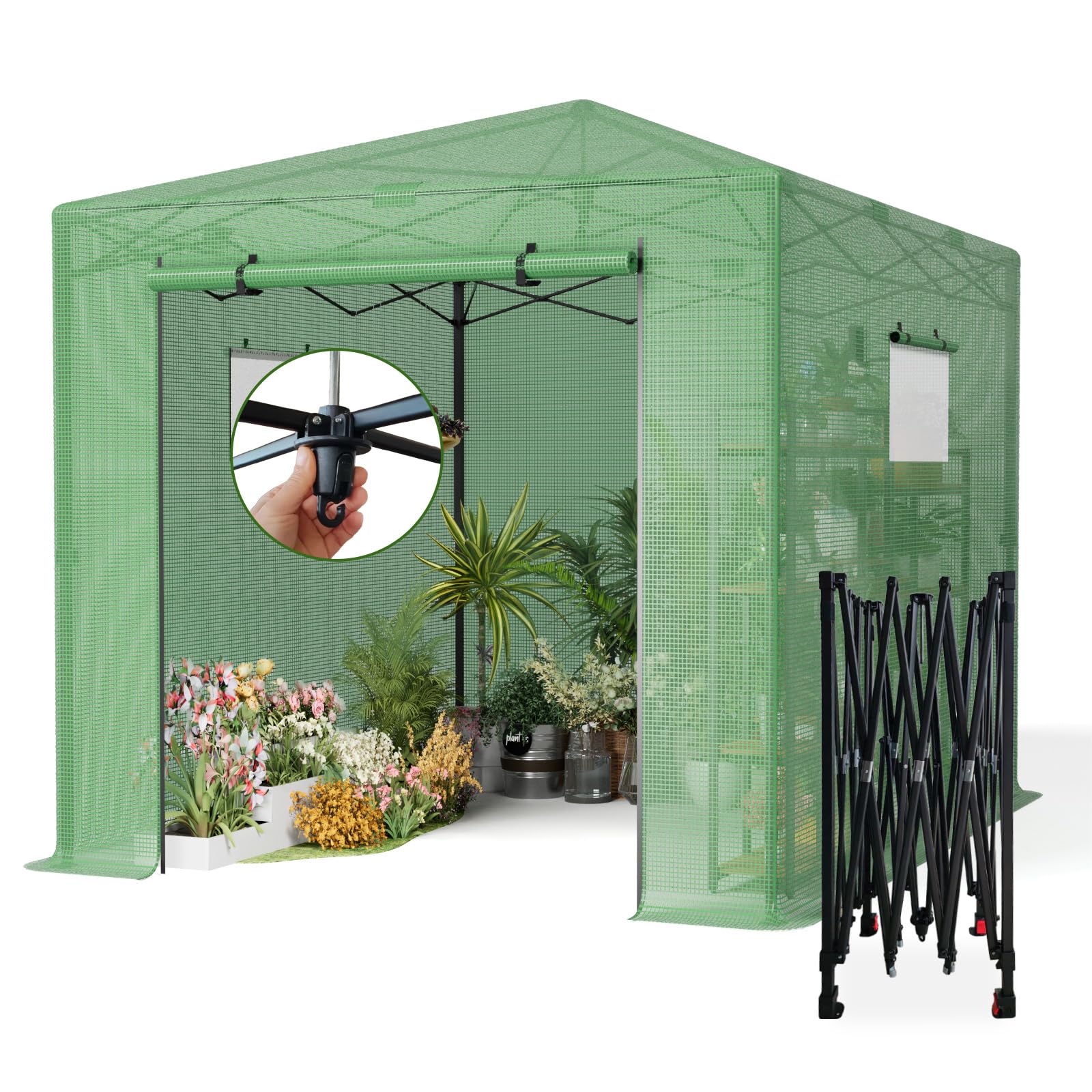
Instant garden shelter for under thirty minutes, but snow is its enemy.
If you need a temporary greenhouse today and do not want to spend a whole weekend assembling it, the Benass 8×12 Pop Up greenhouse goes from box to standing in about 15 minutes with two people. The pre-assembled frame folds open like a tent, the PE (polyethylene) cover goes over the top, and you stake it down. It costs a fraction of the polycarbonate units above and covers a generous 8×12 foot area.
Here is the reality check: the frame is a heavy-duty steel that is rust-resistant, but reviewers point out it collapsed under ice and snow in one winter — the cover stayed intact, but the frame was destroyed. The roof pitch is not steep enough to shed snowfall, unlike sturdier models such as the Backyard Discovery Willow. The stakes and tie-downs that come with it are widely described as unusable; the grommets tear out under tension. The PE cover lets in great light and the roll-up zipper door is convenient, but this is a season extender for mild climates or a hardening-off shelter — not a permanent structure for a heavy snow zone. A buyer report warns: “Collapsed under ice/snow; frame destroyed, cover intact.”
Aspect-count proof: Easy setup (18) [POSITIVE]. The easy setup is real, but the sturdiness (17) [MIXED] tells the full story.
Reach for this if: You need immediate, budget-friendly shelter for spring and fall frost protection, or you have a very mild winter climate with minimal snow.
Look elsewhere if: You need a year-round structure that can survive snow loads. The Benass is a temporary solution, best viewed as a crop tunnel rather than a permanent greenhouse.
Understanding the Specs
Polycarbonate Density (g/m²)
This number tells you how much plastic is packed into each square meter of panel. A 720g/m² panel is denser and heavier than a 580g/m² panel, meaning it traps more air in its twin-wall structure and provides better insulation. The Jiliusure and WUKHG greenhouses both use 720g/m² panels, while the Sylviera uses 580g/m². Higher density also means better impact resistance against hail and flying debris.
Snow Load & Wind Speed Ratings
The snow load rating (measured in PSF or total pounds) tells you how much weight the roof can carry before it collapses. The Backyard Discovery Willow is rated for 2,800 lbs (30 inches of snow) — a benchmark number. Wind speed ratings (in mph) tell you the strongest sustained gust the structure can handle when properly anchored. Always check your local weather averages against these numbers before buying. A greenhouse without a published snow load rating is a gamble in any snowy region.
FAQ
How much snow can a home greenhouse handle?
Is a polycarbonate greenhouse better than a PE (polyethylene) one?
What is the best size greenhouse for a home backyard?
Do I need a permit to install a greenhouse in my backyard?
Should I anchor my greenhouse into concrete or use ground spikes?
How long does it take to assemble a home greenhouse kit?
What does a greenhouse built-in rain gutter do?
Can I keep plants alive in a home greenhouse all winter?
Final Thoughts: The Verdict
If you want one dependable pick, the greenhouse for home winner is the Backyard Discovery Willow 9′ x 6′ because it is the only kit in this roundup with a serious snow load rating (2,800 lbs) combined with a cedar frame, a temperature-activated fan, and a built-in PowerPort. If you want a spacious wood-frame build at a lower price point, grab the Yardenaler 8×10. And if you just need basic frost protection for a single season and value instant setup, the Benass 8×12 Pop Up is the one to reach for — but keep a shovel handy to clear snow off the roof.
How We Picked
We do not accept paid placement. Every pick is matched to a real buyer and a real use-case; we do not hands-on test units.
Sources & Methodology
Specifications: manufacturer listings and product documentation. Review insights: verified customer reviews, as of July 2026. Pricing: not shown on this page (it changes often); check the current price via the retailer link.
As an Amazon Associate, Lawn Gear Lab earns from qualifying purchases. This does not affect which products we feature.