
Specs are compiled from manufacturer listings and verified buyer reviews and can change over time — please confirm the key details on the product page before buying.
That white crust on your faucets, the spotty glasses, the feeling that soap never really rinses off — you are dealing with hard water, and knowing the exact mineral load is the first step toward fixing it. The right hard water testing kit tells you the precise grains per gallon (gpg) or parts per million (ppm) of calcium and magnesium in your water, which means you finally understand whether your water softener is doing its job, or if those frustrating stains are here to stay.
I’m Rikta — the founder and writer behind Lawn Gear Lab. This guide is built by comparing the manufacturers’ published specifications and the patterns across verified customer reviews, so you get each pick’s real strengths and trade-offs instead of marketing spin.
This guide will point you to the right kit for your situation and budget.
Our Picks at a Glance
How To Choose The Best Hard Water Testing Kit
Choose a kit based on the accuracy you need and the extra contaminants you want to detect. A simple strip tells you a range, while a drop-count titration (a method where you add a chemical liquid, drop by drop, until the water changes color) gives a precise number. If you are on a private well, you also need tests for bacteria and heavy metals.
Strips vs. Drop-Count Titration
Test strips are fast — dip, wait, and compare the color. They are great for a quick check, but the color can be subjective in dim light. A titration kit uses a chemical reagent you add drop by drop until the water changes color, giving a specific number (like 10 grains per gallon) rather than a range. The trade-off is a few extra minutes per test for a precise number.
Parameters Tested
If you just want to know if your softener needs regenerating (flushing out the collected minerals), a dedicated hardness-only strip is enough. If you are testing well water for the first time, you want a multi-parameter kit that also checks pH, lead, iron, nitrate, and bacteria — all in one go. The more parameters you test, the fewer surprises from your tap.
Number of Tests Per Kit
The per-test cost drops fast with a bulk kit. A 50-strip bottle costs roughly the same as a 20-strip pack, and a 158-strip kit brings the cost even lower. If you test monthly (plus after every softener adjustment), A big supply avoids the hassle of reordering..
Quick Comparison
| Model | Best For | Test Method | Tests Per Kit | Hardness Range | Amazon |
|---|---|---|---|---|---|
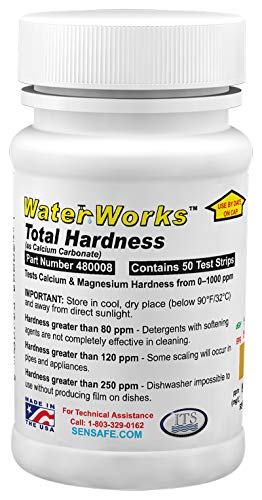
| Industrial Test Systems WaterWorks★ Best Overall | Pure Hardness Accuracy | Single-Parameter Strip | 50 | 0–1,000 ppm | Amazon |
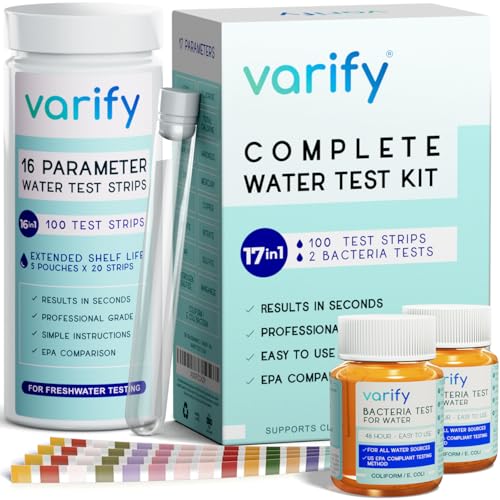
| Varify 17in1Best Value | Comprehensive Value | Multi-Parameter Strip + Bacteria | 100 + 2 Bacteria | 0–1,000 ppm | Amazon |
| All-New AESCULIX 23in1 | Most Strips per Dollar | Multi-Parameter Strip | 158 | 0–1,000 ppm | Amazon |
| HEVEIS 21in1 | Well-Water Screening | Multi-Parameter Strip + Bacteria | 120 + 4 Bacteria | 0–1,000 ppm | Amazon |
| Droplytix 20in1 with App | App-Guided Reading | Multi-Parameter Strip + App | 10 | 0–1,000 ppm | Amazon |
| Hach 5-EP Titration Kit | Precision Lab Numbers | Drop-Count Titration | 100+ | 0–30 gpg | Amazon |
| Tap Score Advanced | Certified Lab Analysis | Mail-in Lab | 1 (116 analytes) | Calculated by Lab | Amazon |
In‑Depth Reviews
1. Industrial Test Systems WaterWorks Hardness Test Strips
Our pick — over 4.5★ from 650+ verified ratings; the strongest balance of quality and price.
The focused hardness specialist that thousands of owners rely on for softener checks.
You get reliable control over softener regeneration (flushing collected minerals) because this kit measures total hardness from 0 to 1,000 ppm using a single dip-and-read strip. The color chart on the bottle lets you match at eight levels (0, 40, 80, 120, 180, 250, 425, and 1,000 ppm), so you see the trend in your water hardness over time rather than just a “soft” or “hard” label. That range covers everything from fully softened water to very hard well supplies.
What owners appreciate most is the strip’s reliability for softener maintenance. Knowing when to regenerate at the 250 ppm mark is the exact scenario these strips were designed for, and owners confirm the results align with actual softener performance. At 50 strips per bottle, you get nearly a year of monthly testing.
Quick hardness check
- No extra parameters to distract — just hardness, so the color chart stays simple and fast to read.
- Made in a USA facility under Good Manufacturing Practices (GMP), with quality checks at every production step.
- Each strip is the same size as a standard lab test, making it easy to match colors accurately.
Limited to hardness
- The color can bleed or wash away if you leave the strip dipped too long, so timing matters.
- If you need a full water-quality panel (lead, bacteria, pH), you will need a separate kit.
Grab for hardness: fast, repeatable hardness checks without interpreting ten other colors.
Skip for full panel: your well water has never been tested and you want a broader contaminant screen.
2. Varify 17in1 Complete Drinking Water Test Kit
The crowd-pleaser that tests 17 parameters and still gives quick, reliable results.
The Varify 17in1 covers more ground than the WaterWorks strips because it checks 17 parameters including hardness alongside lead, chlorine, fluoride, pH, iron, copper, and more — so you get the full picture of your water’s safety, not just the mineral content. It includes 100 strips in five sealed pouches (each holds 20 strips to keep them fresh) plus two separate bacteria test kits. The bacteria tests take 48 hours, but the strip results appear in under a minute.
Buyers consistently say the instructions are clear and the color guide makes results easy to read. The brand also claims that part of the proceeds goes to Water For Good, which fights water poverty in Central Africa.
Comprehensive home panel: Broad enough to catch problems without being overwhelming, and at 100 strips you can run a panel every month for over a year.
Reach for broad test: you want one kit to handle hardness, bacteria, and common contaminants for a family on tap or well water.
Think twice if urgent: you need lab-certified numbers — strips are a screening tool, not a replacement for accredited analysis.
3. All-New AESCULIX 23in1 Drinking Water Testing Kit
Over 150 strips in one box — test weekly without ever running out.
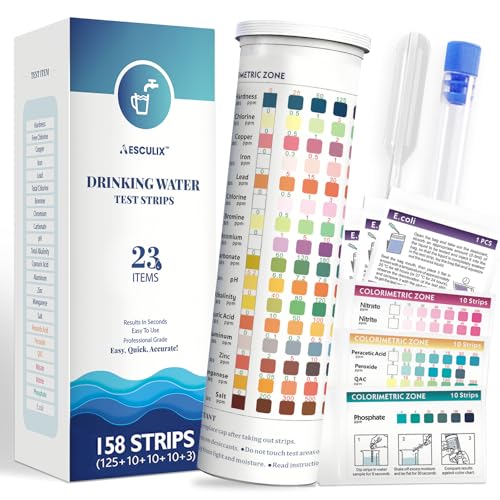
This kit packs 158 test strips into a single purchase, which is more than triple the count of most competitor kits at a similar price. It measures 23 water quality parameters including hardness, residual chlorine (leftover disinfectant), pH (acidity level), total alkalinity, copper, iron, lead, manganese, and nitrate. The process is the same two-second dip and 30-second wait you already know, but the aligned color guide tries to make shade-matching a little less frustrating.
Owners like the confidence of testing for lead and metals at home rather than mailing samples away. The kit includes transfer pipettes and test tubes, which help if you are drawing water from a well or a pond.
Wide contaminant range: The single most cost-efficient way to track water quality over time. Just be aware that with 23 color pads on one strip, reading some of the subtle shades takes good light and patience.
Best for variety: regular weekly monitoring where strip count matters more than pinpoint accuracy on every single parameter.
Skip if no app: you find multi-pad color charts confusing — the simplicity a dedicated hardness strip may suit you better.
4. HEVEIS 21in1 Home Drinking Water Testing Kit

Four bacteria tests and a full chemical panel — the well-owner’s complete starter.
The HEVEIS 21in1 sets itself apart from the Varify kit with four separate total coliform/E. coli tests (common bacterial contamination indicators) rather than just two, giving well owners more chances to recheck after treatment. The 120 strips cover 21 parameters including hardness, lead, iron, fluoride, pH, and copper, and the kit includes an independent color comparison chart plus a record card to log results over time.
The kit also references EPA (Environmental Protection Agency) standards, so you can compare your readings directly against the federal safety benchmarks. Owners find the instructions clear enough that most first-time testers get reliable results on the first try.
Budget-friendly kit: The best value for a private well that has not been tested in a while: four bacteria tests give you the statistical confidence that strips alone cannot deliver.
Reach for value: you own a well, or if your home water has a history of bacterial issues you need to monitor.
Look elsewhere for detail: you only need hardness data and want the cheapest per-strip cost.
5. Droplytix 20in1 Drinking Water Test Kit with Mobile App
The companion app removes the guesswork from reading strip colors.
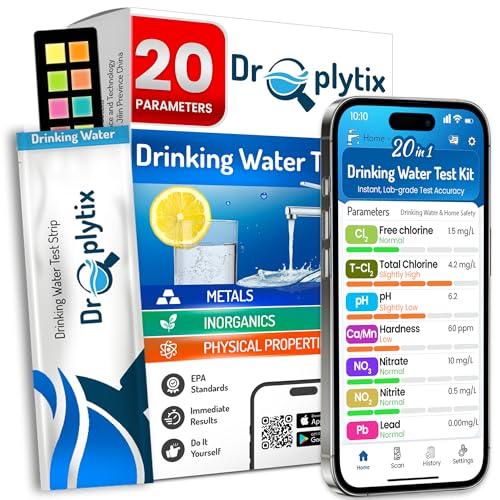
If you ever squinted at a color chart and guessed whether the pad was 180 or 250 ppm, this kit hands that job to your phone. You dip the strip, wait the set time, and then photograph it through the Droplytix app. The app analyzes the color and gives you a digital readout, which eliminates the angle and lighting problems that trip up manual color matching. It tests 20 parameters including pH, hardness, chlorine, nitrate, fluoride, lead, and iron.
The catch is the strip count — just 10 strips per kit, so if you test weekly, you will use it up in under three months. Owners who use it for aquarium management love catching small water quality changes early, and those with pools find the app’s tracking feature helpful for seeing trends.
Smartphone integration: The best choice if you have ever squinted at a color chart and second-guessed the result. The app standardizes the reading across different devices and lighting conditions.
Grab for tech: home or aquarium owners who want digital records and hate color-chart ambiguity.
Skip if offline: you plan to test more than once a month — the per-strip cost is higher and the kit runs out fast.
6. Hach Total Hardness Test Kit, Model 5-EP
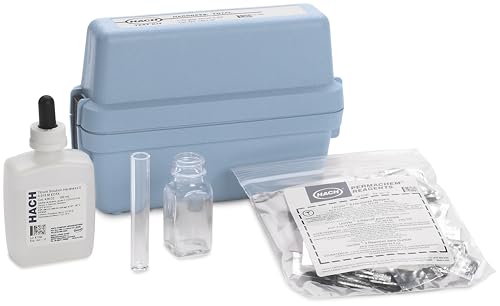
Drop-by-drop titration gives you a number, not a color range — for the true hardness measurement.
When you need to know the exact grains per gallon (gpg) for tuning a softener, the Hach 5-EP delivers a specific value like 10 gpg instead of a range, because it uses drop-count titration — you add a chemical reagent one drop at a time to a water sample until it changes color, then calculate the hardness from the number of drops. It measures from 0 to 30 gpg (covering practically every residential scenario) and can deliver accuracy down to 1 gpg. That level of precision is overkill for a simple spot check but invaluable when you are tuning a water softener system or troubleshooting a commercial application.
Everything comes in a sturdy carry case with reagents, measuring tools, and instructions, making it portable for field use. Owners consistently say it is more reliable than test strips, and many use it to catch softener malfunctions that strip tests missed.
Lab-grade accuracy
- Accuracy down to 1 grain per gallon — strips can only give you a 40–120 ppm window.
- The carry case keeps all reagents organized and protected, so the kit lasts for years of regular use.
- You get more than 100 tests per reagent refill, making the long-term per-test cost lower than most strip kits.
Manual titration
- The initial price is higher than a strip bottle, but owners confirm it “works exactly as described” and lasts much longer.
- You need to follow the titration procedure precisely — it takes a couple of minutes per test, not seconds.
Reach for precision: you are a well owner, service technician, or anyone who needs a provable hardness number for system calibration.
Look elsewhere for ease: you just want to confirm “is my water hard or soft” in 30 seconds with zero fuss.
7. Tap Score Advanced Home Water Test Kit

The mail-to-lab service that tests for 116 contaminants and sends back a PDF you can actually understand.
Test strips are good for a quick read, but if you want the full picture — including heavy metals, bacteria, disinfection byproducts, and organic chemicals — getting a certified lab to analyse your sample is the only way. Tap Score sends you a kit with easy sampling materials and a pre-paid return label. You collect the water, ship it off, and within five business days of the lab receiving it, you get an online report that explains every result in plain language with health guidance and treatment recommendations.
The lab network is EPA, NELAC (National Environmental Laboratory Accreditation Conference), and ISO (International Organization for Standardization) certified, so the results are defensible if you ever need them for a real estate transaction or a dispute. Owners say the report gave them clarity they simply could not get from any strip kit, especially for arsenic, uranium, and trihalomethanes (THMs, a disinfection byproduct). The shelf-life is 12 months from purchase, so you can buy it and test when the seasons change or after a major storm.
Professional analysis: The definitive step for anyone moving into a new home, drilling a new well, or concerned about agricultural runoff. Nothing in the strip world can match the breadth and legal weight of a lab report.
Use for critical: a baseline assessment when you need to know your water’s complete composition, including rare contaminants.
Not for quick check: monthly softener checks — this is a one-time deep dive, not a routine monitor.
Understanding the Specs
Total Hardness (ppm vs. gpg)
Two scales measure the same thing: the concentration of calcium and magnesium. Parts per million (ppm) is the common strip-unit — 0–60 ppm is soft, 120–180 is hard, and above 180 is very hard. Grains per gallon (gpg) is the unit your water softener likely uses; divide ppm by 17.1 to get gpg. A kit that gives you ppm is fine for general use; one that reads in gpg is more useful for tuning a softener.
Titration vs. Test Strips
Test strips use chemical pads that change color when they react with minerals; you compare the shade to a printed chart. They are fast and cheap, but reading the exact midpoint between two colors is subjective. Titration (drop-count) kits use a reagent you add drop by drop until the sample changes colour. The number of drops equals the hardness level, giving a specific value instead of a range — far more accurate for system diagnostics.
FAQ
How often should I test my water for hardness?
Can a hard water test kit also detect lead or bacteria?
What does a reading of 250 ppm mean for my softener?
Are cheap test strips accurate enough for well water screening?
What is the difference between total hardness and carbonate hardness?
Do test strips expire?
Can I use a pool hardness test strip for my drinking water?
How do I get a result in grains per gallon (gpg) from a ppm strip?
Is a 100-strip kit worth it for a single-person household?
What does the Digital Water Tester app actually do?
Final Thoughts: The Verdict
For most people, the WaterWorks Total Hardness Test Strips is the top pick because it gives you the exact hardness range you need to manage a softener without any extra guesswork — its 50-strip bottle covers a full year of monthly testing. If you want the most comprehensive screening for a well or a first-time home check, the Varify 17in1 covers hardness plus bacteria and common metals with 100 strips and two bacteria tests. And for anyone who needs lab-certified precision — for a real estate transaction or because your well sits near farmland — the Tap Score Advanced kit delivers a full 116-analyte report from an EPA/NELAC/ISO certified lab that puts every concern to rest.
How We Picked
We do not accept paid placement. Every pick is matched to a real buyer and a real use-case; we do not hands-on test units.
Sources & Methodology
Specifications: manufacturer listings and product documentation. Review insights: verified customer reviews, as of July 2026. Pricing: not shown on this page (it changes often); check the current price via the retailer link.
As an Amazon Associate, Lawn Gear Lab earns from qualifying purchases. This does not affect which products we feature.