
Specs are compiled from manufacturer listings and verified buyer reviews and can change over time — please confirm the key details on the product page before buying.
The idea is simple: feed your lawn and stop weeds before they sprout, all without spraying synthetic chemicals around your kids or pets. Corn gluten meal is a natural pre-emergent that releases organic nitrogen — it blocks weed seeds from rooting while greening up your grass. The trick is timing (you apply it in early spring) and choosing the right form, because granular and liquid options behave very differently on your lawn.
I’m Rikta — the founder and writer behind Lawn Gear Lab. This guide is built by comparing the manufacturers’ published specifications and the patterns across verified customer reviews, so you get each pick’s real strengths and trade-offs instead of marketing spin.
You want to stop weeds without harsh chemicals, and corn gluten meal does that by blocking seed roots before they sprout. This list of the best lawn corn gluten options helps you pick between a big bag for a large lawn or a liquid bottle for a quick spot treatment.
Our Picks at a Glance
How To Choose The Best Lawn Corn Gluten
Picking the right corn gluten product hinges on three things: how big your lawn is, how you prefer to apply the treatment, and your tolerance for follow-up work. The granular bags are great for covering large areas with a spreader, while the liquid concentrates can feel easier for smaller patches — but they both require the same careful spring timing.
Granular vs. Liquid: Which Spreads Better For You
Granules, like the Espoma and Jonathan Green bags, are designed to be scattered with a drop or broadcast spreader. They sit on the soil until you water them in, which activates the gluten. Liquids, like the Plantco bottle, need to be shaken thoroughly and mixed with water in a sprayer — and owners warn that the gluten particles can clog standard sprayer nozzles, so straining the mix first is a smart step.
Coverage and Cost Per Square Foot
The biggest difference between these products is coverage per bag. The Jonathan Green bag covers 5,000 sq. ft., while the Espoma bag covers 1,250 sq. ft. at the weed-prevention rate. The liquid Plantco bottle covers 1,000 sq. ft. per application. Buyers report that corn gluten needs reapplication every 5-6 weeks during the growing season, so the larger coverage bags tend to offer better value if you have a medium to large lawn.
Safety and Organic Credentials
All four products here are made from corn gluten meal — no synthetic herbicides, no toxic residues. They are safe to use around children and pets as soon as they are applied. The Espoma and Plantco are labeled 100% natural and non-toxic, while the Jonathan Green is also listed as safe around kids and animals. The trade-off is that natural pre-emergents are less potent than synthetic weed killers, so you may still need to hand-pull a few dandelions, as buyers honestly note.
Quick Comparison
| Model | Best For | Coverage | Item Weight | Form | Amazon |
|---|---|---|---|---|---|
| Espoma Turf-Tone★ Best Overall | Organic-only yards, small lawns | 1,250 sq. ft. | 25 Pounds | Granules | Amazon |
| Plantco Liquid Corn Gluten | Small areas, easy liquid spray | 1,000 sq. ft. | 2 Pounds | Liquid | Amazon |
| Jonathan Green 11591 | Large lawns, thick and lush results | 5,000 sq. ft. | 15 Pounds | Granules | Amazon |
| Walt’s Corn Gluten Meal | General fertilizing, ant control | Full | 10 Pounds | Granules | Amazon |
In‑Depth Reviews
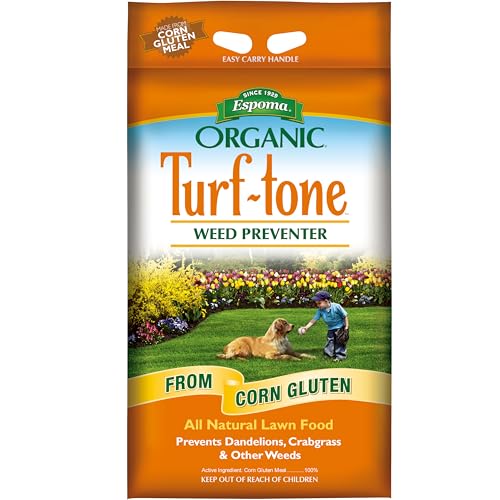
1. Espoma Organic Turf-Tone Weed Preventer Plus Lawn Food
A massive 25-pound bag of pure corn gluten that owners call the dandelion-killer they trust.
This is the bag you reach for when you want nothing but corn gluten meal — no fillers, no synthetic additives. Made from 100% corn gluten, it feeds your lawn with organic nitrogen while preventing common weeds like crabgrass and dandelions from germinating. At the weed-preventer rate, a single bag covers 1,250 sq. ft., but if you use it purely as a lawn food, that same bag stretches to 2,500 sq. ft.
One buyer report says it best: “Spring 2026: zero dandelions/weeds despite neighbor’s weed spread.” That kind of real-world result, without any chemical odor, is the big reason this product earns the top spot. Owners also mention it arrives in a box, so the bag is intact — a small but real relief when you are buying 25 pounds of granules.
The honest trade-off, as several owners note, is that it does take time to work and it won’t eliminate every single weed. One owner said they still had to dig up dandelions, and another found it controlled dandelions but not clover as effectively. Think of this as a strong partner — not a magic eraser — for an organic lawn.
What owners love
- Made from 100% corn gluten meal with no toxic ingredients
- Earns rave reviews for delivering “zero dandelions” after spring application
- Non-toxic and odorless — safe to scatter by hand if you prefer
- Versatile: works as a weed preventer at 20 lb/1,000 sq ft or a feeder at 10 lb/1,000 sq ft
Before you buy
- Coverage at the weed-preventer rate is only 1,250 sq. ft., while the Jonathan Green bag covers 5,000 sq. ft.
- Does not eliminate all weeds; some owners still hand-pull dandelions
Best for the organic purist: If you refuse to put anything synthetic on your lawn and want a single product that prevents weeds and fertilizes at once, this is your bag.
Think twice if: Your lawn is larger than a quarter-acre; you will need several bags, and the Jonathan Green option below covers more ground per dollar.
2. Jonathan Green 11591 Corn Gluten Lawn Fertilizer, 10-0-2 Formula

The big-coverage specialist that turns a 15-pound bag into a thick, crabgrass-free lawn.
This one is built for owners with larger lawns. The 15-pound bag covers a generous 5,000 sq. ft., compared to the Espoma bag’s 1,250 sq. ft. Its 10-0-2 formula provides a solid dose of nitrogen to green up the grass and a little potassium for root health, while the corn gluten works its pre-emergent magic on crabgrass and other weed seeds.
Owners mention exactly the result you hope for. One owner who lives north of New York City says: “Put this all over the lawn in early April. The lawn is now so thick and lush. And no signs of crabgrass yet.” The effectiveness of this product is the most-discussed aspect by buyers, and the consensus is that timing the application correctly in early spring is the key to success.
The catch that owners flag most is the price. While the product itself earns positive marks for quality, several buyers find it expensive for what you get. And one reviewer noted that while it controls crabgrass well, other broadleaf weeds like spurweed may still appear — you might need a secondary product to tackle those.
Best for the coverage-conscious owner: If you have a medium to large lawn and want one bag to do the heavy lifting, this 5,000 sq. ft. coverage dwarfs the competition.
One honest limitation: It is pricier than basic synthetic fertilizers, and some owners feel the value-for-money could be better for a product that works best on crabgrass alone.
3. Walt’s Corn Gluten Meal (10 LB)
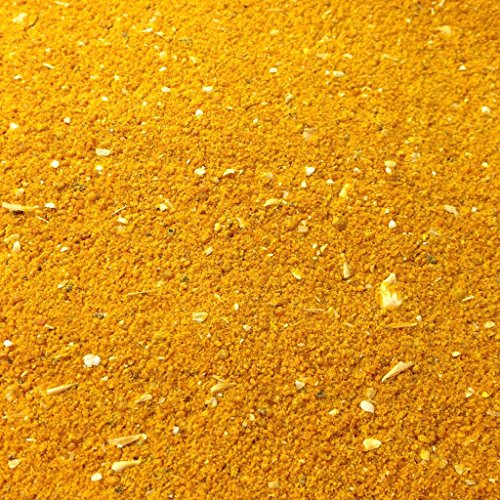
A straightforward, no-frills bag of corn gluten that also doubles as an ant killer.
Walt’s is essentially plain corn gluten meal with a 9-0-0 analysis — high nitrogen, no phosphorus or potassium. It is a simple source of natural nitrogen that works as a lawn fertilizer and soil conditioner. Owners who use it report seeing a “reduction in the number of weeds coming up,” which is exactly what you want from a pre-emergent.
One unexpected use that keeps coming up in reviews: putting it directly on ant hills. The gluten disrupts the ants’ digestion, and customers note that “it kills the whole hill when fed to them.” If you are dealing with ant mounds in your lawn, this product tackles two problems at once.
The downside that several owners mention is the texture — it is very powdery and can be hard to spread evenly with a standard broadcast spreader. It is also on the expensive side for a 10-pound bag. And like any natural product, it needs regular reapplication; one owner admitted it “needs to be reapplied at regular intervals and I didn’t reapply it.”
Best for the multi-tasker: If you want a simple nitrogen source that also helps control ants and weeds, this is a practical, no-nonsense option.
Think twice if: You need a product that spreads easily through a hopper spreader; the powdery consistency may frustrate you.
4. Liquid Corn Gluten Fertilizer, Natural Nitrogen, 1000 Sq Ft Coverage (Plantco)
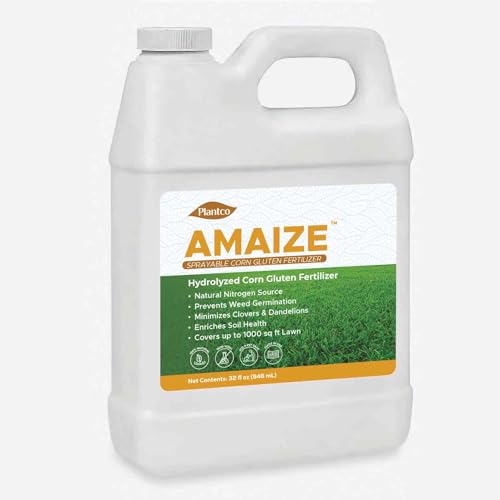
A liquid concentrate that is easy to measure but demands a sprayer that can handle the grit.
This bottle is a 32-ounce liquid concentrate of corn gluten meal. You mix it with 1 gallon of water and spray it over up to 1,000 sq. ft. of lawn. It is GMO-free, non-toxic, and the formula is designed to help minimize clovers and dandelions while thickening grass. For owners with small lawns or patchy spots, the liquid form feels more approachable than lugging a 25-pound bag around.
Buyers who got the application right saw real results. One owner found the lawn greener after just five days and noted clover was dying off. The product is made in the USA and carries a natural nitrogen rating, so it is safe for pets and kids right after it dries.
The big, recurring complaint is about clogging. One owner put it bluntly: “I went through three sprayers, trying to find one large enough to allow the gluten to go through with no success.” The manufacturers themselves recommend straining the liquid before you put it in a sprayer, because the gluten particles can be too thick for standard nozzles. If you buy this, budget for a sprayer with a wide opening or plan to strain the mix through a fine mesh.
Best for the spot-treater: If you only have a small lawn or want to target specific bare patches, the liquid form gives you precise control over where the gluten goes.
One honest hurdle: The spraying process is the weak link — you will likely need to strain the liquid first, and some standard sprayers simply cannot handle the gluten particles.
Understanding the Specs
N-P-K Ratio (Nitrogen-Phosphorus-Potassium)
This is the three-number code on every fertilizer bag. For corn gluten, you typically see 9-0-0 or 10-0-2. The first number is nitrogen — high nitrogen means deeper greening and thicker grass. The zeroes mean there is no phosphorus or potassium, which is fine if your soil already has those; you are buying gluten for the pre-emergent effect, not for balanced feeding.
Pre-Emergent Timing
Corn gluten works by forming a barrier in the top layer of soil that prevents weed seeds from rooting. But it only works before the seeds germinate. The ideal window is early spring, when the soil temperature hits about 55°F and before crabgrass and dandelions sprout. If you apply it after you see weeds, you missed the window — the pre-emergent effect is gone for that season.
Coverage Rate
The bag will tell you two numbers: one for weed prevention (a heavier rate, like 20 lb per 1,000 sq ft) and one for feeding (a lighter rate, like 10 lb per 1,000 sq ft). If you want the full weed-blocking power, you must use the heavier rate. That difference can cut your total coverage in half, so always check which rate you plan to use before buying.
Application Re-Entry
One of the biggest advantages of corn gluten over synthetic herbicides: there is no waiting period. You can let kids and pets walk on the lawn immediately after applying and watering in the granules. The product is non-toxic and considered safe by all the manufacturers listed here. The trade-off is that you may need to reapply every 5-6 weeks during the growing season to maintain the barrier.
FAQ
Does corn gluten meal really prevent weeds or is it a myth?
How long does corn gluten last once applied to the lawn?
Can I use corn gluten on a new lawn or freshly seeded grass?
Will corn gluten harm my pets if they walk on or eat the grass?
How do I apply granular corn gluten — with a spreader or by hand?
Is liquid corn gluten easier to apply than granules?
Why does my lawn still have some weeds after using corn gluten?
Can I use corn gluten on flower beds and vegetable gardens?
Does the brand affect how well corn gluten works or is it all the same?
What happens if I apply corn gluten too late in the season?
Final Thoughts: The Verdict
For the majority of shoppers, the best lawn corn gluten overall is the Espoma Organic Turf-Tone because it delivers verified results against dandelions and weeds with absolutely no synthetic chemicals — just a 25-pound bag of 100% corn gluten. If you have a larger lawn that needs more ground coverage in one go, grab the Jonathan Green 11591 for its generous 5,000 sq. ft. coverage and thick, lush results. And for a simple, multi-purpose nitrogen source that also tackles ant hills, the Walt’s Corn Gluten Meal is the practical one to reach for.
How We Picked
We do not accept paid placement. Every pick is matched to a real buyer and a real use-case; we do not hands-on test units.
Sources & Methodology
Specifications: manufacturer listings and product documentation. Review insights: verified customer reviews, as of July 2026. Pricing: not shown on this page (it changes often); check the current price via the retailer link.
As an Amazon Associate, Lawn Gear Lab earns from qualifying purchases. This does not affect which products we feature.