
Specs are compiled from manufacturer listings and verified buyer reviews and can change over time — please confirm the key details on the product page before buying.
Breaking new ground in a back forty or prepping a small vegetable patch — a gas-powered tiller should be the partner that makes the job feel half as hard, not twice as exhausting. The real trick is finding the one that matches the dirt you actually dig in, not the one that looks toughest on a shelf.
I’m Rikta — the founder and writer behind Lawn Gear Lab. This guide is built by comparing the manufacturers’ published specifications and the patterns across verified customer reviews, so you get each pick’s real strengths and trade-offs instead of marketing spin.
if you need a nimble cultivator for tight raised beds or a rear-tine beast that can chew through packed clay, this roundup of the best gas garden tillers cuts through the hype and gives you the straight dirt on which machine is worth the haul home.
Our Picks at a Glance

How To Choose The Best Gas Garden Tiller
A gas tiller is a serious investment in your garden’s future, and picking the wrong one turns a weekend project into a full-blown workout. Focus on these three things first, and you will land on a machine that handles your dirt without running you ragged.
Engine Size — The Raw Muscle Behind Every Bite
The engine’s displacement, measured in cubic centimeters (cc), is the single clearest sign of how much grunt a tiller can deliver. A small 25cc to 50cc engine is perfect for light weeding and preparing soft, pre-tilled soil in a small patch or raised bed. A 79cc to 99cc engine steps into true mid-range territory — enough to break up sod and work decently hard ground. For full-on, rocky clay or expanding a garden into untouched turf, you want a 200cc-plus engine. More displacement means more torque at the tines, which translates to deeper, faster work without bogging down.
Front Tine vs. Rear Tine — The Design That Decides the Workout
Front-tine tillers have the tines mounted directly under the engine, so the machine’s forward momentum is driven by the spinning tines pulling it ahead. This design is lighter, more maneuverable, and easier to lift into a truck bed—ideal for smaller gardens, established beds, and anyone who wants a manageable machine. The trade-off is that you do more of the walking; front-tine models tend to bounce and wander a bit, so you have to hold on. Rear-tine tillers place the tines behind the wheels, meaning the wheels drive the machine forward while the tines churn independently. The result is much more stable, self-propelled movement that is far easier on your arms and shoulders. Rear-tine machines are heavier and pricier, but they are the right choice for large gardens, breaking new ground, and anyone who values comfort over portability.
4-Cycle vs. 2-Cycle Engines — What You Pour In Matters
Almost every gas tiller sold today uses a 4-cycle engine. You fill the gas tank with straight, unleaded gasoline and pour engine oil into a separate reservoir — no mixing required. A 4-cycle engine is quieter, more fuel-efficient, and produces less exhaust smoke than a 2-cycle. A 2-cycle engine (rare on modern tillers) needs a pre-mixed gas-and-oil blend. While 2-cycle engines can be lighter for their power output, the convenience of a 4-cycle — just grab the gas can and go — is the reason they dominate the category. Always check whether your chosen tiller needs a gas-and-oil mix or straight gas before you fuel it.
Quick Comparison
| Model | Best For | Engine (cc) | Tilling Width | Tilling Depth | Amazon |
|---|---|---|---|---|---|
| Honda FG110★ Best Overall | Small beds & precision work | GX25 | 6-9″ | — | Amazon |
| SENIX 4QLBest Value | Small gardens & value seekers | 46 | 15″ | 8″ | Amazon |
| BILT HARD 46ccTop Performer | Budget-friendly performance | 46 | 16″ | 8″ | Amazon |
| NOVUS 2-in-1 Front Tine | Versatile width adjustments | 79 | 9-17″ | 6″ | Amazon |
| TAZZ 35310 | All-around mid-size gardens | 79 | 11-21″ | 11″ | Amazon |
| Earthquake 20015 | Large gardens & durability | 99 | 11-21″ | 11″ | Amazon |
| Earthquake Victory 39381 | Heavy-duty rear tine work | 209 | 16″ | 10″ | Amazon |
| YARDMAX YT4565 | Big gardens, new ground | 209/212 | 18″ | — | Amazon |
| NOVUS 18″ Rear Tine | Premium gear-driven power | 212 | 18″ | 10″ | Amazon |
In‑Depth Reviews
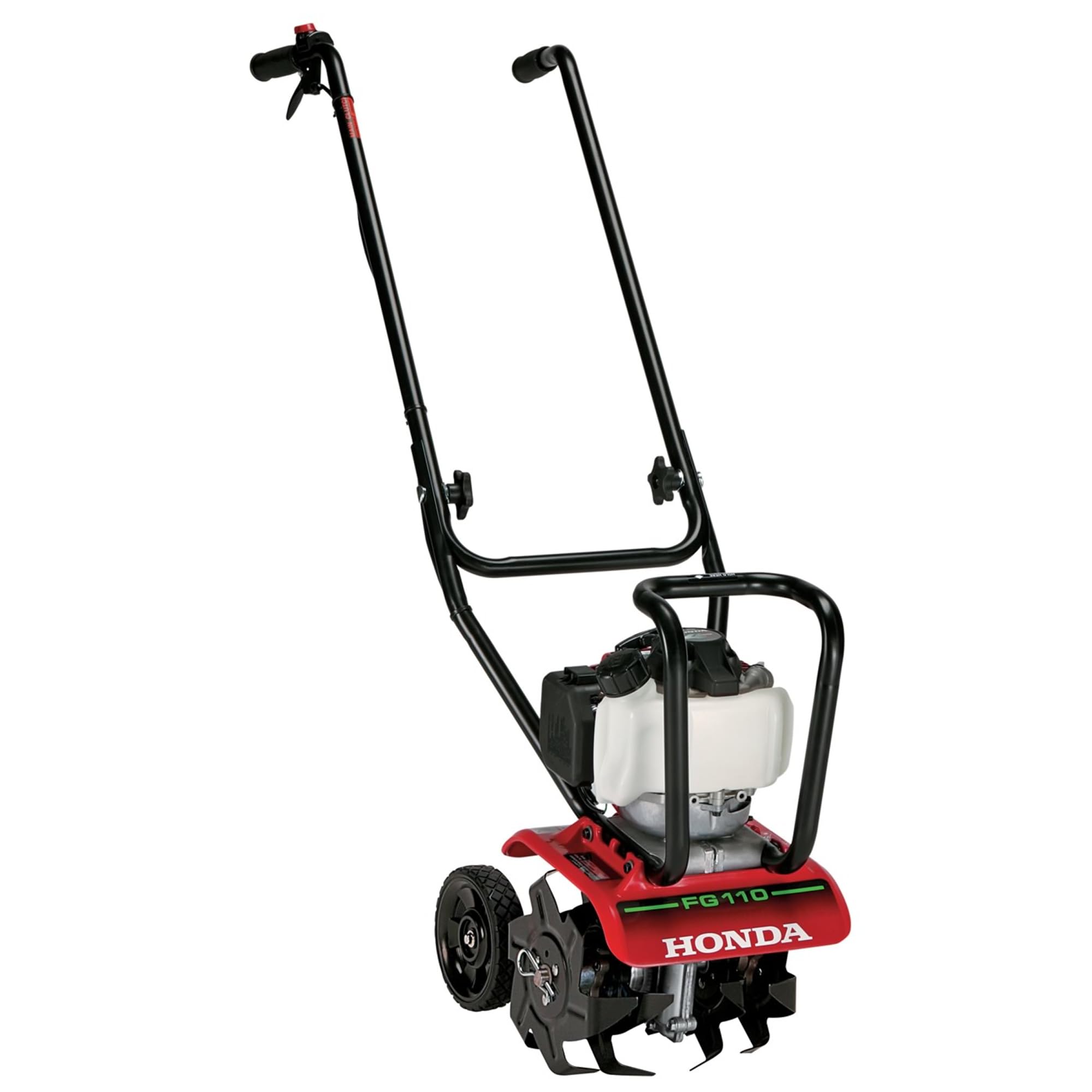
1. Honda FG110 Mini Tiller Cultivator
Our pick — over 4.5★ from 350+ verified ratings; the strongest balance of quality and price.
The featherweight that punches above its weight for precision garden prep.
Where the Honda FG110 truly shines is in the details of its patented hybrid tines — half the blades are angled for digging, the other half for cultivating. So your first pass actually breaks through, and your second pass turns everything into fine, plant-ready soil. The GX25 four-stroke engine (a Honda legend in its own right) runs on straight unleaded gas, with no mixing needed, and buyers report it starts on the first pull every time. One long-time gardener put it bluntly: “I replace my 20 year old Toro cultivator with this and realize now what we should have done 20 years ago.”
At just 28 pounds — lighter even than the 31.7-pound SENIX — you can lift it into a raised bed without groaning. The adjustable depth bar gives you precise control over how fast and deep the rototiller works, and the handle folds for storage that takes up almost no shed space. The white-hot consensus among owners is that the performance and size are the stars here; over 60 reviewers single out both as the reasons they love it.
The catch is real: this is a mini tiller built for soft or pre-tilled soil, not for breaking brand-new, compacted clay ground. On extremely hard earth, the FG110 may only dig in a few inches at a time, and the 6-to-9-inch tilling width means you will cover ground much slower than a wider machine. If your garden is small established beds, raised planters, and light maintenance, this is the closest thing to perfection at this weight.
lightweight Honda power
- Legendary first-pull starting; the GX25 engine is a reliable icon that owners rave about for how easily it fires up.
- At 28 pounds, it is one of the lightest gas tillers you can buy — easy to move, lift, and store in a shed or garage.
- Hybrid tines do double duty: dig and cultivate in one pass, saving you time and effort on each row.
limited soil depth
- Not designed for breaking hard, compacted new ground — it performs best in soil that is already soft or pre-tilled.
- Narrow 6-to-9-inch tilling width means you will need more passes to cover a large garden area.
- The price is notably higher than many front-tine competitors, reflecting the Honda brand premium.
small gardens: your garden is small raised beds, flower borders, or pre-tilled plots and you value easy starting, precision control, and Honda reliability above all else.
heavy clay: you need to break brand-new, rocky, or compacted clay ground — a larger engine and wider tines will save you hours of frustration.
2. SENIX 4QL 4-Cycle Gas Powered Tiller Cultivator
The entry-level bruiser that offers surprising power for its compact footprint.
For the gardener who needs a real gas-powered workhorse without spending a premium, the SENIX 4QL delivers a full crank 46cc four-stroke engine that keeps vibration low. The patented 4QL Technology is the standout feature here — it lets you tilt the tiller in any direction without stalling or oil leakage, a huge advantage when you are working on slopes or uneven ground. The auto-choke and compression release system means you get easy starting with minimal pulling effort.
The six premium steel forward-rotating tines carve out a 15-inch tilling width at an 8-inch depth. That is enough width to make decent progress in a medium vegetable patch, and the foldable handles collapse for storage that fits into tight shed corners. Owners tend to call it exactly what it is: a “little work horse” that packs a punch for weeding between rows but acknowledges it does not like rocks. The 3-year limited warranty provides some confidence at this price tier.
The trade-off is durability in rough conditions. A handful of owners mention the pull cord mechanism failing after limited use, and this machine measures just 8 inches deep and 15 inches wide — making it far smaller than machines like the BILT HARD (41.54 inches deep). The honest bargain is that the SENIX is a capable light-to-medium duty tiller for maintained garden soil, not a tool for busting sod or rocky new ground.
tight spaces: the budget-conscious gardener with established beds who wants a reliable, oil-mixing-free four-stroke that handles slopes without spilling.
large plots: your ground is heavy clay or strewn with rocks — consider a heavier-duty front-tine or rear-tine model instead.
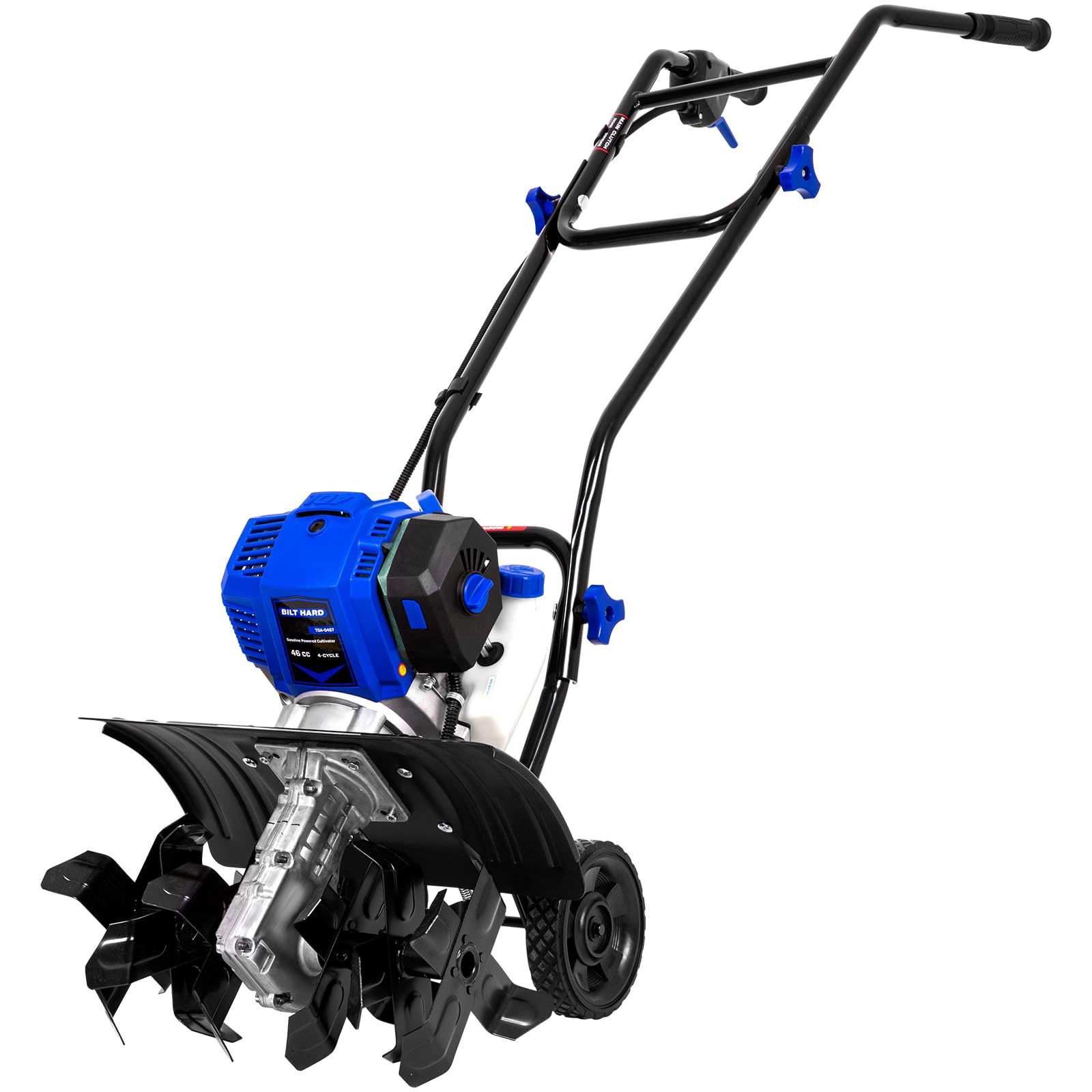
3. BILT HARD 46cc 4-Cycle Gas Powered Tiller Cultivator
The budget-friendly machine that shocked veterans with its hard-soil performance.
At 46cc and 1.9HP, the BILT HARD sits in the same displacement class as the SENIX, but its real-world reviews paint a picture of a tiller that over-delivers. Owners describe it cutting through grass-covered earth with ease and tilling hard, rocky clay soil that had them reaching for much larger machines. The four angled tines combine with six forward-rotating steel blades to create a 16-inch working width and 8-inch tilling depth, and the one-hand control panel with thumb throttle makes operation surprisingly simple for a machine this capable.
Assembly is a consistent highlight — customers note a ten-minute setup with no hassle. The automatic reset choke lever and compression release system help it start reliably, typically on the fourth pull. At 33 pounds (the data does not state weight; the 33 lb figure comes from an owner review), it is light enough for an average-sized person to handle without tiring. One satisfied gardener summed up: “It absolutely exceeded my expectations. At only 33 pounds and 16 inches wide, this guy not only tilled my garden, it chewed through grass covered earth with ease.”
The biggest caveat is the warranty and support experience. The factory warranty is just 90 days from the 3rd-party seller, with 12 months from BILT HARD, and some reviewers point out difficulty getting callbacks for support. The gearbox also requires SAE 80W 90 EP gear oil — a detail not mentioned in the manual. If you are comfortable with basic maintenance and want a tiller that punches above its price, this is a strong value play.
occasional use: the hobby gardener with a medium-sized plot who wants surprising power for the money and does not mind a bit of self-maintenance.
daily tilling: buyers who expect premium phone support or a long factory warranty — the after-sale experience is the weak link here.
4. NOVUS 2-in-1 Front Tine Tiller Cultivator
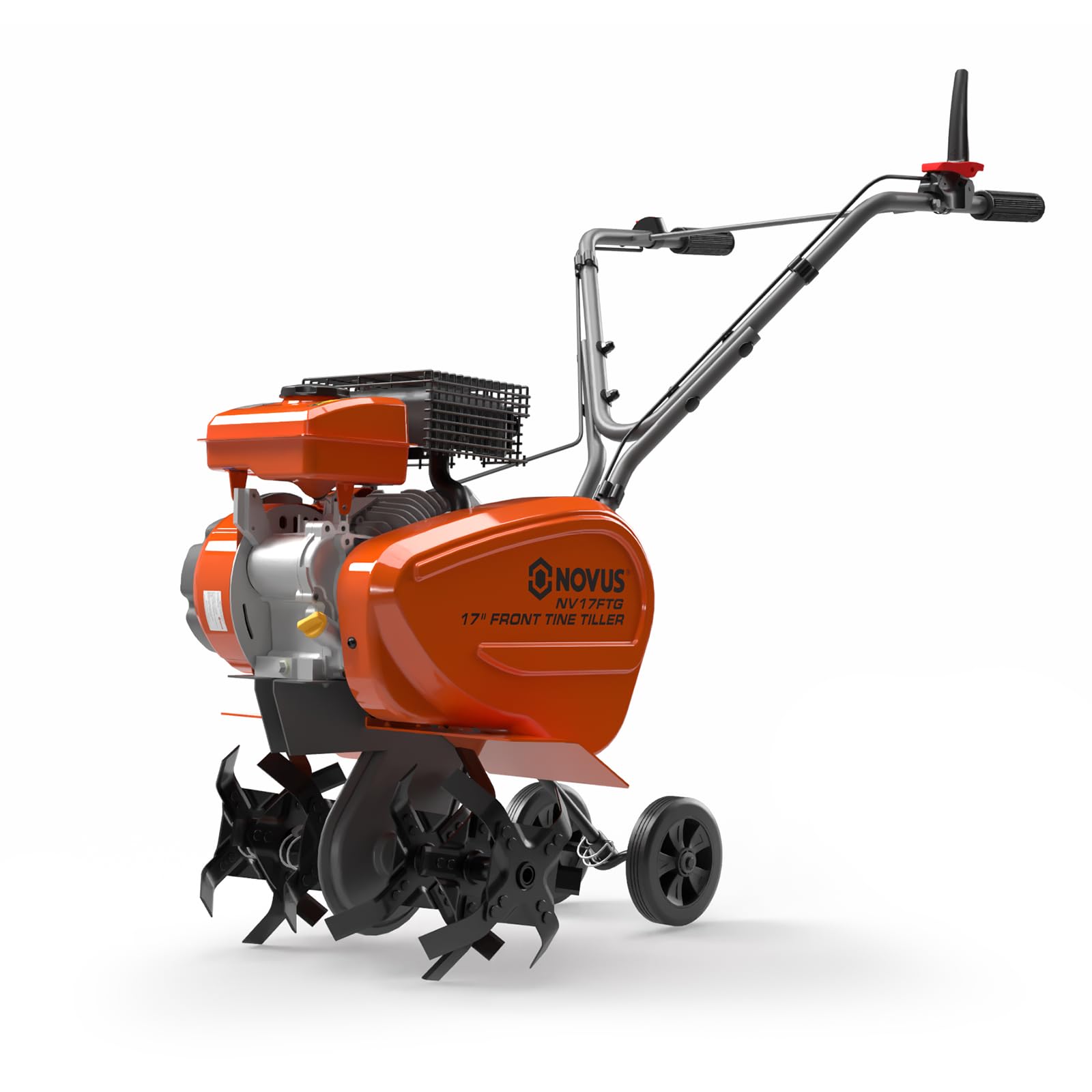
The Swiss Army knife of tillers that adjusts its width in seconds without tools.
The NOVUS 2-in-1 earns its name from the tool-free outer tine removal that lets you switch tilling widths from 9 inches to 14 inches to 17 inches, with a 6-inch working depth. That means one machine handles tight row weeding in the morning and full-scale bed prep in the afternoon. The 79cc four-cycle engine delivers enough power to break through tough soil conditions, and the six-inch airless never-flat wheels roll smoothly over loose dirt without going flat.
What owners come back to most is how easily it starts — one report says it fired up on the second pull after assembly. The reverse gear is a standout feature that gets consistent praise for making tight turns and end-of-row maneuvers far less frustrating. The low center of gravity gives it stable, predictable handling that feels planted even when the tines bite into hard ground. With 24 heavy-duty steel tines on a 75-pound frame, this front-tine tiller is a substantial machine that will handle medium to large gardens well.
A few owners flag that the gas and oil caps can cross-thread easily, and the manual does not perfectly match the machine (missing references to a fuel shutoff and throttle lever). Also, some units arrive missing hex bolts and lock nuts, so check the hardware bag carefully. The NOVUS 2-year warranty and free lifetime technical support are solid backup, but the minor QC issues mean it pays to give everything a once-over before you fuel up.
tough soil: the gardener who needs one versatile machine that can go from narrow-row weeding to wide-bed tilling without reaching for a different tool.
light beds: you prefer a machine with a perfect out-of-box experience and zero chance of minor missing hardware.
5. TAZZ 35310 2-in-1 Front Tine Tiller/Cultivator
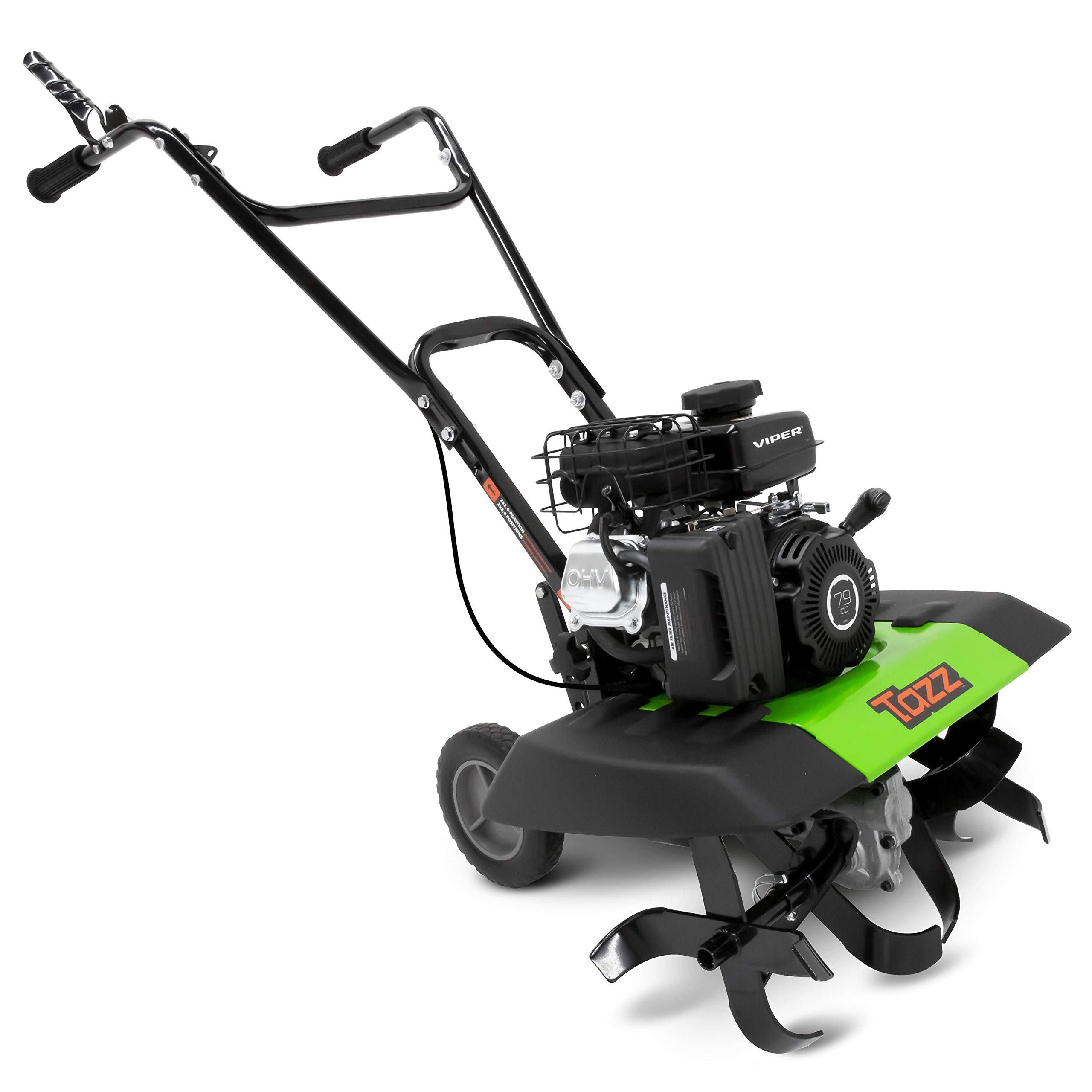
The crowd-favorite 2-in-1 that balances power, width, and a forgiving price.
The TAZZ 35310 is among the most popular front-tine tillers on the market, and for good reason. The 79cc Viper engine pairs with a bronze gear transmission and forged steel tines to deliver durability that season after season. The tool-less outer tine and side shield removal lets you drop from a full 21-inch tilling width down to 16 inches or 11 inches for cultivating between rows — a range that suits everything from initial seedbed creation to ongoing weed maintenance.
Owners routinely praise its performance (the top-mentioned aspect) and ease of use. The four-position adjustable handlebar accommodates different heights comfortably, and the multi-position drag stake adjusts tilling depth up to 11 inches without tools. The low center of gravity makes it stable and easy to turn at the end of a row. One owner noted it “starts first pull with ethanol-free gas” and survived hitting 4-inch rocks without damage.
Assembly instructions are where this pick draws mixed feedback — some owners find the manual confusing and the oil-filling process tedious (you have to lay the tiller on its side). The handles sit low, making transport a bit awkward for some. And while the 3-year limited warranty is solid backing, the 29 people who flagged assembly as tricky are not wrong: set aside an evening and a clear workspace. For the money, though, this delivers more versatility than most front-tine machines at its price.
custom rows: the serious home gardener with a medium-to-large plot who wants a 2-in-1 machine that can handle both initial bed prep and ongoing maintenance while staying affordable.
quick jobs: you are not comfortable with a slightly confusing assembly process or need the absolute easiest oil-fill experience.
6. Earthquake 20015 Versa 2-in-1 Tiller Cultivator

The go-to front-tine bruiser that sinks its teeth into compacted clay and won’t let go.
With a 99cc Viper engine — the largest displacement in the front-tine category in this roundup — the Earthquake 20015 has the torque to chew through tough, compacted soil that would stall smaller machines. The tool-less side shields and outer tines give you an adjustable tilling width from 11 to 21 inches and a depth up to 11 inches, which covers everything from narrow-row weeding to breaking new ground. The onboard wheels make transporting this 78-pound machine a realistic job for one person.
Owners who face hard-packed Colorado clay say it chewed through easily, and the 5-year limited warranty is a vote of confidence you rarely see on front-tine tillers — the Earthquake brand stands behind its build. Functionality and quality are the top-mentioned aspects by a wide margin, with over 110 owners calling out effective performance. Several owners note it starts on the second or third pull even after sitting for a year, which speaks to the reliability of the Viper engine.
The assembly instructions receive genuine criticism — they are described as tough to follow, and the tine bolts use an unusual 15.5mm size that requires an adjustable wrench. A recurring field report is that bolts tend to loosen during use; owners recommend adding larger washers during assembly to prevent the machine from shaking itself apart. The engine sometimes arrives pre-filled with oil that can leak during shipping, so have rags handy. If you can handle a demanding first setup, the performance payoff is significant.
medium gardens: large gardens, heavy soil, or breaking new ground where you need serious torque and a 5-year warranty to back it up.
precision work: you want a simple out-of-box experience or prefer a lighter machine you can lift easily — this one demands assembly effort and weight management.
7. Earthquake Victory Rear Tine Tiller

The rear-tine monster that lets counter-rotating tines do the heavy lifting for you.
Stepping into the rear-tine realm, the Earthquake Victory uses a 209cc Viper engine with counter-rotating tines (CRT) — the tines spin opposite the wheels, which lets them dig into tough clay and compacted soil without the machine lunging forward. The heavy-duty cast-iron transmission with engineered bronze gears is built to last for generations, and the instant reverse handle lets you turn in tight spaces without stopping or shifting. The three-position adjustable handlebar and 2- or 1-handed control help keep footprints out of your seedbed.
The 16-inch tilling width and 10-inch adjustable depth make this a proper ground-breaking machine. Owners describe it as a genuine beast that “shreds roots and debris,” noting it starts on the first pull even after two years of storage. One owner declared it their favorite tiller, ranking it above a BCS, which is high praise from the serious gardening community. The trenching capability is also a frequent highlight — it makes digging irrigation channels or drainage lines surprisingly easy.
Price and maintenance are the real considerations here. The 154-pound weight makes transport a two-person job unless you have a trailer. The drive belts are a known weak point — shoppers say they can snap if rocks get jammed in the tines, and replacement belts are expensive and may be backordered. A few long-term owners have cycled through multiple belts, cables, and even a tire. The 5-year limited warranty is good, but belt replacements are not covered as a wear item. If you treat it gently around rocks, it will serve you well.
long rows: the dedicated gardener or small-scale farmer with large plots, tough clay soil, and a need for a rear-tine machine that self-propels comfortably through the work.
small yards: you have a rocky garden, a small storage space, or are on a tight budget for ongoing maintenance parts like belts and cables.
8. YARDMAX 18 in. 212 cc Rear Tine Tiller
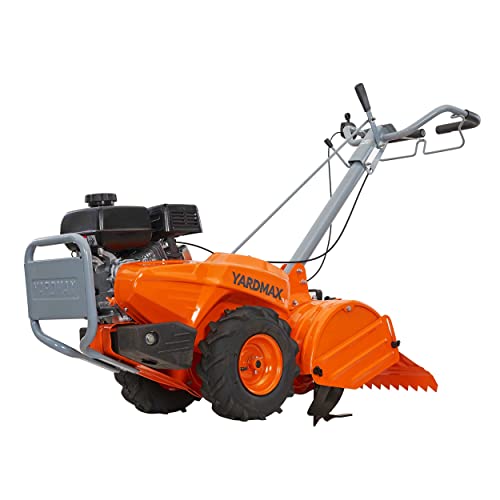
The heavy rear-tine contender that pulverizes soil on a tighter budget.
The YARDMAX YT4565 brings real rear-tine power to a price point far below most equivalents. Its 209cc or 212cc OHV engine (production timing determines which you get) drives dual rotating tines across an 18-inch width, and owners consistently call out how well it pulverizes soil into a fine, plant-ready texture. The forward-and-reverse tine rotation gives you options for deep plowing versus weeding, and a neutral gear allows for moving the machine without the tines spinning.
Assembly is straightforward — buyers report it as easy, with all necessary hardware included. Starting reliability is a highlight, with multiple reports of first- or second-pull starts. At over 208 pounds, this is a machine that stays planted; it does not bounce or wander the way lighter front-tine tillers do. The dual-direction tines mean you can break new ground with the standard rotation, then switch to reverse for thorough soil turnover and weed removal.
The tine rotation mechanism is where the YARDMAX draws the most criticism — many owners mention difficulty shifting between forward and reverse gears. The tilt cut-off safety switch can also trigger on rough ground, forcing you to restart on level terrain. Durability is a split issue: some customers note over 25 hours of trouble-free use, while others have dealt with blown tubes, snapped throttle cables, and bent wheels. The 2-year warranty covers the big parts, but you may want to budget for immediate tire upgrades.
deep tilling: the gardener who needs a large, powerful rear-tine tiller for a big garden at a lower price than premium competitors and is willing to handle some maintenance and gear-shifting fussiness.
shallow beds: you expect a perfectly smooth gear shift, or if long-term durability and dealer support are your top priorities.
9. NOVUS 18-Inch Dual Direction Rear Tine Tiller
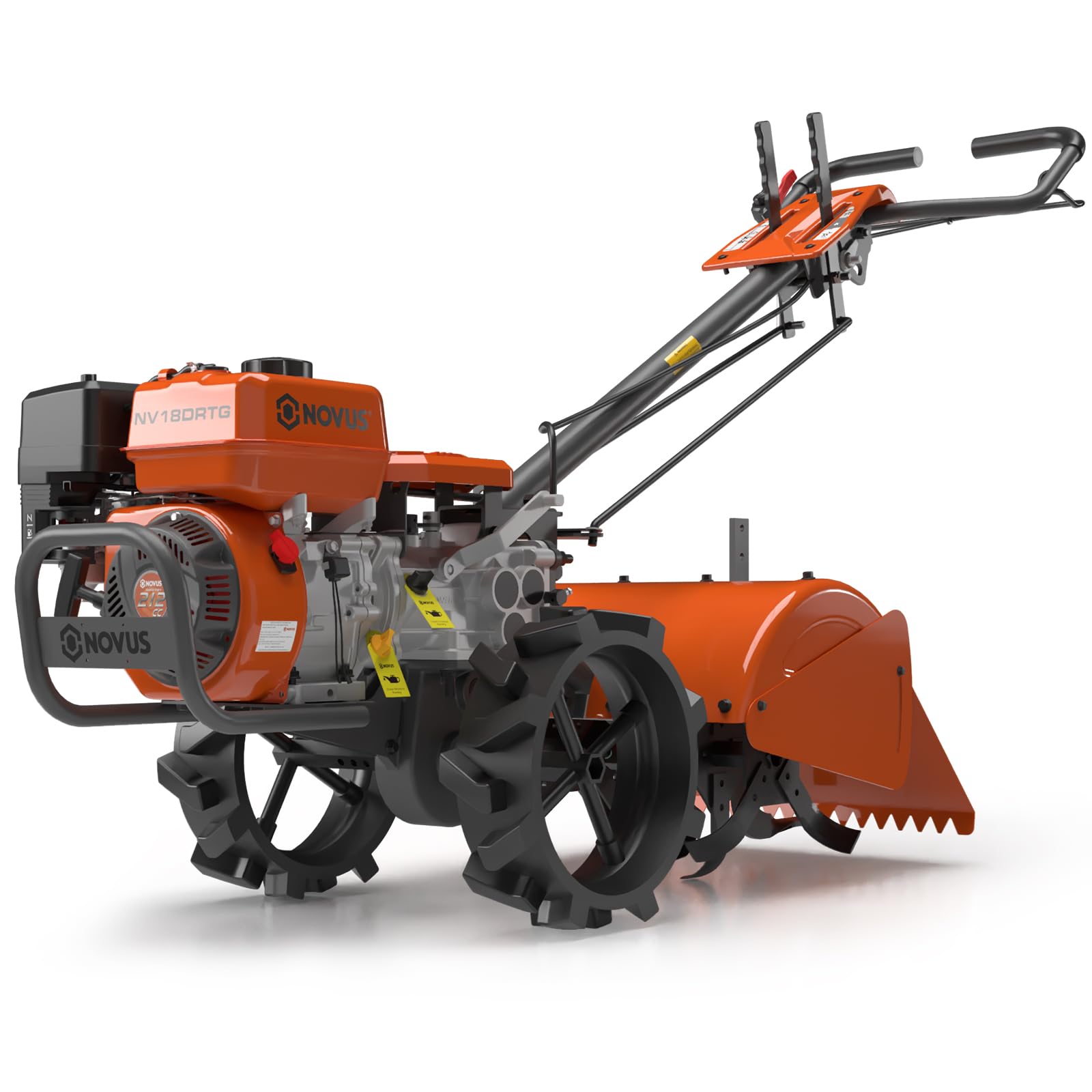
The full-gear-transmission tiller that makes belt-driven models feel like antiques.
The NOVUS 18-inch rear tine tiller sets itself apart with a full gear transmission — no belts to snap, no pulleys to adjust. This is direct-drive power from the 212cc four-cycle gas engine straight to the 16 durable steel tines, meaning maximum torque reaches the soil with minimal maintenance. The 18-inch tilling width and 10-inch adjustable depth let you handle everything from a small vegetable patch to a sprawling new garden expansion. The dual-direction tine rotation gives you standard and counter-rotating modes — standard for breaking tough new ground, counter-rotating for cultivating existing garden soil.
Assembly takes about 20 minutes using the included tools and oil, and owners consistently describe the build quality as outstanding. One review called the seed beds it produces “the prettiest I have ever seen.” The self-propelled, stone-tolerant design means it does not buck or stall when it hits a root or rock, and the dual levers make maneuvering intuitive. The airless, non-flat tires provide reliable stability without the risk of a puncture, outperforming pneumatic tires by a wide margin. With 2 forward speeds and 1 reverse, you have smooth control over tilling and transport.
The price is the most immediate hurdle — this is the most expensive machine in the roundup. The 4.7-star rating from over 40 owners suggests almost everyone who buys it feels it is worth it, but it is a serious investment. The machine is made in Wisconsin, USA, which is a bonus if domestic manufacturing matters to you. The 2-year warranty and free lifetime technical support from a US-based team provide excellent after-sale backup. This is a buy-once, cry-once machine for the serious gardener.
serious gardeners: you want a gear-driven, no-belts rear-tine tiller with superior build quality, easy assembly, and the power to handle the toughest garden soil for years with minimal maintenance.
casual users: your budget does not stretch this far or you only need a light-duty cultivator for small, already-soft garden beds.
Understanding Gas Tiller Specs
Engine Displacement (cc)
The displacement, measured in cubic centimeters, tells you how much air and fuel the engine can draw in per cycle. A larger cc number generally means more torque — the twisting force that lets the tines keep spinning through hard, compacted soil without stalling. For light weeding in soft soil, 25-50cc is plenty. For breaking new ground, look at 79cc and up. For major garden expansion or clay soil, 200cc-plus gives you the muscle to keep moving forward without bogging down.
Front Tine vs. Rear Tine
Front-tine tillers have spinning tines under the engine that pull the machine forward as they dig. They are lighter, cheaper, and easier to lift, but you will do more walking and the machine can bounce on hard ground. Rear-tine tillers place the tines behind the wheels, so the wheels drive the machine forward while the tines churn independently. They are heavier, far more stable, and much easier on your arms — the right choice for large gardens and tough soil, but harder to transport and store.
Counter-Rotating Tines (CRT)
Some rear-tine tillers use counter-rotating tines that spin in the opposite direction of the wheels. This design pulls the tines deeper into the soil rather than pushing the machine forward, making it far more effective at breaking hard, compacted ground and clay. The trade-off is that a CRT tiller can be more aggressive and may require more effort to control in loose soil. Standard-rotation tines are better for maintained garden beds and finer soil preparation.
4-Cycle Engine and Oil
A 4-cycle engine runs on straight, unleaded gasoline with engine oil added to a separate reservoir — no mixing required. This is the standard for nearly all modern gas tillers. The separate oil system means cleaner operation, less smoke, and better fuel economy than older 2-cycle engines. Always check the oil level before each use and use the grade recommended in the manual (often SAE 30 or 10W-30). Running a 4-cycle engine without oil will destroy it in minutes.
FAQ
What size gas tiller do I need for my garden?
Can I use a gas tiller on wet soil?
How do I maintain a gas garden tiller?
What is the difference between a tiller and a cultivator?
How do I start a gas tiller that has been sitting all winter?
Can a gas tiller handle rocks and roots?
How much does a gas garden tiller weigh?
Is a gas tiller better than an electric or cordless tiller?
Can I use a gas tiller on a slope?
What does the depth stake do on a tiller?
Final Thoughts: The Verdict
For most people searching for the best gas garden tillers, the Honda FG110 is the pick because its legendary GX25 engine, lightweight 28-pound frame, and hybrid tines make it easy for small-to-medium established gardens where precision and reliability matter most. If you want a 2-in-1 front-tine machine with adjustable width and a strong reputation, the TAZZ 35310 offers the best balance of power, versatility, and value. And for tackling heavy new ground or large gardens, the gear-driven NOVUS 18-Inch Rear Tine Tiller is the premium investment that will never leave you stranded with a snapped belt.
How We Picked
We do not accept paid placement. Every pick is matched to a real buyer and a real use-case; we do not hands-on test units.
Sources & Methodology
Specifications: manufacturer listings and product documentation. Review insights: verified customer reviews, as of July 2026. Pricing: not shown on this page (it changes often); check the current price via the retailer link.
As an Amazon Associate, Lawn Gear Lab earns from qualifying purchases. This does not affect which products we feature.