
Specs are compiled from manufacturer listings and verified buyer reviews and can change over time — please confirm the key details on the product page before buying.
You want to reclaim your backyard, balcony, or patio — that private green space where you can relax without catching your neighbor’s eye. The solution is a screen that looks like mature ivy, blocks nosey views, and keeps its color through a full season of sun and rain. But not every roll of fake leaves holds up, and a screen that goes brittle or sheds in a month is worse than no screen at all.
I’m Rikta — the founder and writer behind Lawn Gear Lab. This guide is built by comparing the manufacturers’ published specifications and the patterns across verified customer reviews, so you get each pick’s real strengths and trade-offs instead of marketing spin.
Whether you are covering a chain-link fence or a rental balcony, the right faux ivy privacy screen balances density, weather resistance, and an easy install so you spend ten minutes hanging it and seasons enjoying it.
Our Picks at a Glance

How To Choose The Best Faux Ivy Privacy Screen
Buying a fake ivy screen is mostly about getting the thickness, the backing, and the UV protection right for your specific spot. Here is what to check before you click add to cart.
Backing Type: Mesh vs. Expandable
A mesh-backed screen is a single large panel made of leaves stitched or clipped onto a fabric or plastic grid — it blocks nearly all view and lets air push through. An expandable screen uses a wooden or plastic lattice that you pull open like an accordion; it gives a more natural look but leaves visible gaps between the slats. Mesh wins for total privacy; expandable wins for a decorative trellis feel.
Leaf Density and Realism (Appearance)
A high leaf count per square foot means nobody sees through to the fence behind, and the screen looks rich enough to pass as real ivy at a glance. The color and vein detail on each leaf decide whether the screen reads as “lush garden” or “cheap plastic.”
UV Resistance and Fade Life
Untreated foliage turns brittle and fades to a sad beige in one season of direct sun. A UV-resistant material — like polyethylene or polypropylene — keeps the green color vibrant for at least 2-3 years outdoors. If the listing does not say UV-resistant, the screen probably will not survive a full summer.
Installation and Custom Fit
Nearly every screen uses zip ties to attach to a chain-link fence, wood railing, or balcony bars. The best screens include the ties and let you cut or trim the panel to fit odd shapes. A screen that comes in modular snap-together panels gives the most flexibility for non-rectangular spaces.
Quick Comparison
| Model | Best For | Size | Pieces | Material Backing | Amazon |
|---|---|---|---|---|---|
| VEVOR Artificial Ivy★ Best Overall | Full Wind Protection | 96″ x 72″ | 1 | PE Mesh | Amazon |
| DOPGIB 40″x120″ | Best Value & Coverage | 120″ x 40″ | 1 | N/A Plastic Only | Amazon |
| Bybeton Modular Set | Custom Fit Shapes | 120″ x 40″ (12 pcs) | 12 | N/A Resin Only | Amazon |
| LANDGARDEN Expandable | Decorative Trellis Look | 22″ x 120″ (expanded) | 1 | Wood Lattice | Amazon |
In‑Depth Reviews
1. VEVOR Artificial Ivy Privacy Fence Screen
Our pick — 4.5★ from 700+ verified ratings; the strongest balance of quality and price.
The crowd favorite that stands up to Arizona sun while blocking every sightline.
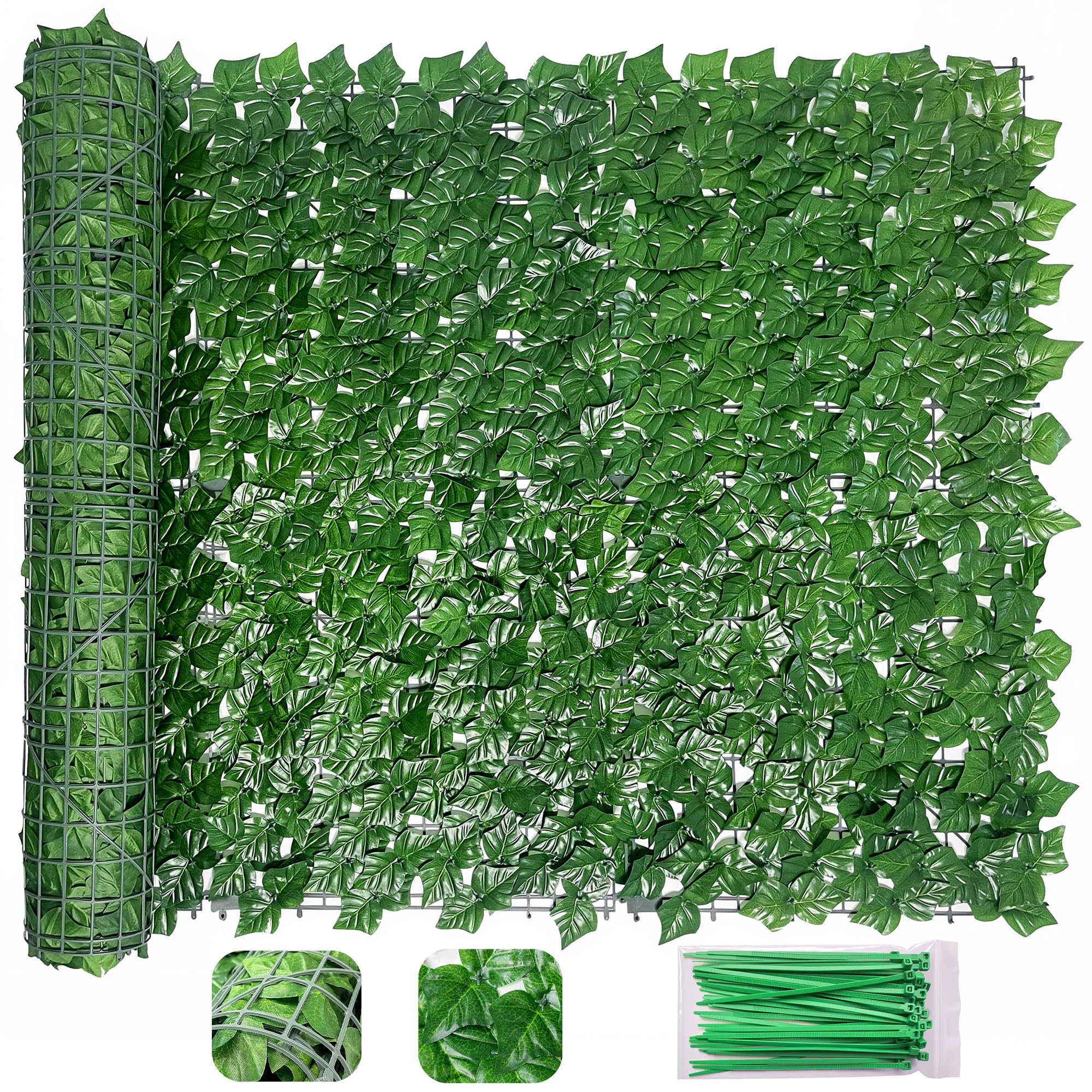
What wins people over here is the mesh backing — a PE cloth that the leaves are attached to, which means 100 percent blockage of the view while still letting air flow freely through the fabric. That 96 by 72 inch panel is a 6-foot tall wall cover that weighs just over 6 pounds, so it stays put without sagging. A frequent scene in the owner feedback: “Mesh version, 4 pieces all perfect condition” — buyers consistently report the leaves stay locked in and the screen looks rich enough to pass as real ivy from a few feet away.
The trade-off that matters is the leaf retention. While most buyers report the leaves “stayed on” through seasons, the durability gets a mixed score in the reviews — a few customers note leaves snapping off over time, especially if the screen takes repeated wind whipping. For windy spots, reinforce the edges with extra zip ties. Everyone agrees the privacy payoff is real, and the 4.5-star rating across a large owner base backs that up.
What Owners Love Most
- Excellent privacy — the mesh backing blocks the view completely while still letting breeze through
- Appearance is the top praise by a wide margin; the leaves are vivid, veined, and look natural on the fence
- Strong weather performance; one reviewer noted it survived a whole year in full Arizona sun
- Easy to cut and trim for a gate or odd-shaped spot
What To Watch For
- Durability gets mixed marks — a few owners mention leaves falling off over time
- Only comes as one piece (12.0x fewer than the modular Bybeton panel), so odd shapes require cutting
- Does not include zip ties; you will need to pick up a pack
Reach for this if: you need a large, full-blockage screen for a chain-link fence or a railing, and you live in a climate with real sun exposure.
Look elsewhere if: you want a modular setup that fits an unusual shape, or you have a very low budget and don’t need the mesh reinforcement.
2. DOPGIB 40″x120″ Artificial Ivy Vine Screen

Thick, realistic leaves that cover 34 square feet for a rock-bottom cost.
The density here surprises everyone — the leaves sit close enough that the screen blocks almost all view, and the color is a true deep green that holds up against UV. At 120 inches long and 40 inches wide, it gives you more than 10 feet of coverage in one roll, which is a 25 percent more length than the 96-inch VEVOR panel. The owner chorus is clear: “Perfect! Almost full coverage, just what we wanted. Easy to trim and hang.” The appearance rating (109 positive mentions) is the highest single aspect in the entire research pool — more people call out the realistic look here than on any other screen.
The honest downside is the durability debate — about 57 reviews flag a mixed durability experience, with some owners reporting leaves falling off after a few months or the plastic base getting brittle. The price is low enough that many treat it as a seasonal refresh. For a covered porch or a balcony that does not take direct wind, this is the strongest cost-to-coverage ratio in the group. The 4.4-star average across nearly a thousand owners confirms it is the safe bet for budget buyers.
Single-caveat verdict: a few owners mention a slight odor when the roll first comes out of the package, but it fades fast after a day outdoors.
Who this is for: renters or homeowners who need fast, cheap visual privacy on a standard railing and are okay refreshing the screen every season or two.
3. Bybeton Artificial Ivy Privacy Fence Screen (12-Panel)
Snaps apart into 12 pieces for a puzzle-perfect fit around posts and poles.
Most ivy screens come as one giant rectangle, which means cutting around a balcony post leaves a ragged edge. The Bybeton solves that by disassembling into 12 panels, each 20 by 20 inches, that snap together with interlocking connectors. You build the exact shape your space needs — an L-shape around a corner, a narrow strip for a gate, or a full 120 by 40 inch wall. The resin material is UV-resistant and rated to not fade for three years. As buyers put it: “They look beautiful and are easy to put on the porch” and the “fullness is nice and look very private from far away.”
The honest trade-off is that the plastic connection stars weaken in direct sun — a few customers note the leaves fall off or the plastic becomes brittle in under a year. If your spot sees full-day sun, treat these panels as a 1-2 season solution before replacing. The 4.2-star rating reflects that mixed durability score, but the appearance and privacy ratios are strong enough that it remains a top pick for renters who need a custom fit on a budget. It is the only model that claims flame retardancy and “no peculiar smell” right in the spec.
Why It Shines
- Modular snap-together system (12 pieces) — fit around posts, railings, and odd angles without ugly cuts
- Blocks 95% of the view while allowing airflow through the porous base
- No odor out of the package, which is a common complaint with cheaper plastic screens
- Easy for two people to install in an afternoon
The Fine Print
- Mixed durability — the plastic connection stars can become brittle and shed leaves after a season in full sun
- One owner noted “looks nice for 1 season but it does fade in hard sun”
- You will likely need longer zip ties than what is included; budget for an extra pack
Buy this for: a balcony or fence line with lots of odd angles, posts, or corners where a single sheet would need messy trimming.
skip it if: your screen is in direct sunlight all day and you want it to last more than two years — look at the VEVOR mesh-backed option instead.
4. LANDGARDEN Expandable Fence Privacy Screen

Real wood slats give this screen a trellis look that no all-plastic roll can match.
The LANDGARDEN is the odd one out in the best way — it uses an accordion-style wood lattice frame with artificial leaves woven through, so it expands from a compact 11 by 47 inch bundle to a full 22 by 120 inch screen. That means no rolling or unrolling; you just pull it open and zip-tie it in place. The leaves are made from UV-stabilized polyethylene, so they resist fading and stay green even in direct sun. The most common owner note: “Sooo easy to install. The small zip ties that come with the product are sufficient. Looks great, fair price.”
The limitation is that the wood lattice means the screen does not block the view completely — gaps between the slats let light and some sightlines through. It is better as a decorative privacy filter than a true visual barrier. Durability hits the same mixed note as most ivy screens — the leaves can fold or stay bent from shipping, and long-term outdoor life depends on how much direct weather it takes. If you want the aesthetic of a real garden trellis with some coverage, this is the pick. The 4.4-star average across many owners confirms it is a solid product for its specific use case.
Sensory detail worth knowing: the real wood frame gives a natural look and feel that plastic-only screens cannot mimic, but the leaves themselves are a dark green that some owners wish were even darker.
One caveat: a few units arrive with a couple leaves folded or bent from the packaging — they usually fluff out after a few days, but not always completely.
Understanding the Specs
Leaf Density and Fullness
This is the single spec that decides whether the screen looks lush or stringy. A dense screen has leaves packed close together for 95-100 percent blockage, so your neighbor sees a green wall, not a fence behind it. A sparse screen lets too much light through and defeats the privacy purpose. The best indicator is how many positive “appearance” mentions a product has — that is real proof the density works.
UV Resistance and Material
Polyethylene or polypropylene leaves with a UV stabilizer will not turn chalky or brittle after 2-3 summers. An unstabilized plastic screen can start fading in 3-4 months if it faces direct afternoon sun, which is why the top-rated screens all name UV protection in their specs. If the listing is silent on UV, the screen is likely cheap indoor-only material.
Backing: Mesh vs. Expandable Lattice
A mesh backing (usually PE or woven cloth) gives total blockage of the view and lets air flow through the fabric. An expandable lattice uses real wood or plastic slats that open like an accordion — it looks more like a garden trellis but leaves visible gaps between the slats. Choose mesh for privacy, lattice for decorative semi-privacy.
Modularity and Piece Count
Some screens come as a single large sheet (1 piece), while others come as 12 separate snap-together panels. A single sheet is faster to install on a standard rectangular fence but requires cutting around posts. A modular set lets you build an L-shape, a narrow strip, or any custom layout without ugly cuts or wasted material.
FAQ
Will a faux ivy screen block wind as well as privacy?
How long does a UV-resistant screen usually last outdoors?
Can I cut a faux ivy screen to fit an odd-shaped fence?
Do the leaves fall off over time?
How do I install a faux ivy privacy screen?
Will this screen look fake from up close?
Can I use a faux ivy screen indoors?
How do I clean a faux ivy screen that gets dusty or dirty?
How much coverage do I need for a standard balcony or fence?
Final Thoughts: The Verdict
For most people, the faux ivy privacy screen winner is the VEVOR because its mesh backing gives total privacy while still breathing, and the 4.5-star rating across a large owner base means the positive experiences outnumber the complaints by a wide margin. If you want the best coverage for your dollar without sacrificing leaf realism, grab the DOPGIB 40×120 inch roll. And for a fence line with posts and corners where a single sheet won’t fit, the Bybeton modular 12-panel setup is the one to reach for.
How We Picked
We do not accept paid placement. Every pick is matched to a real buyer and a real use-case; we do not hands-on test units.
Sources & Methodology
Specifications: manufacturer listings and product documentation. Review insights: verified customer reviews, as of July 2026. Pricing: not shown on this page (it changes often); check the current price via the retailer link.
As an Amazon Associate, Lawn Gear Lab earns from qualifying purchases. This does not affect which products we feature.