
Specs are compiled from manufacturer listings and verified buyer reviews and can change over time — please confirm the key details on the product page before buying.
Yellowing leaves on your prize gardenia or lawn patch signal a cry for help — the plant cannot make chlorophyll, and the culprit is often iron locked in soil your plant cannot tap. A chelated fertilizer is the workaround: it wraps the iron in a form roots absorb on contact, bypassing alkaline or clay-heavy soil that traps plain iron. The trick is picking the right concentration and form, because not every bottle delivers the same punch.
I’m Rikta — the founder and writer behind Lawn Gear Lab. This guide is built by comparing the manufacturers’ published specifications and the patterns across verified customer reviews, so you get each pick’s real strengths and trade-offs instead of marketing spin.
The five products below are the most reliable chelated iron formulas for lawns, ornamentals, trees, and edibles, and this breakdown helps you choose the best iron chelated fertilizer for your garden’s specific pH and plant type.
Our Picks at a Glance


How To Choose The Best Iron Chelated Fertilizer
Walking into the chelated-iron aisle without a plan leads to picking a bottle that either under-delivers or burns your plants. Here is what matters most.
Form: Liquid Concentrate Versus Hose-End Sprayer
Liquid concentrates (like the Fertilome and Liquinox picks) let you mix a precise ratio for foliar spray or soil drench, which matters when you are treating different plant types with different sensitivities. Hose-end sprayer bottles (like the Opulent Blends option) offer instant convenience — twist on, spray, done — but limit your dose control to whatever the dial on the spray head allows.
Concentration and Coverage
A 6.5-percent iron solution delivers a stronger dose per ounce than a 0.2-percent chelate blend, so you apply less volume for the same result. Check the mixing ratio against your square footage. The Opulent Blends product, for example, covers 8,000 square feet from one 32-ounce bottle, while the Carl Pool powder gives you 16 ounces by weight and mixes 1:100 with water for spot treatments.
Target Plant and Soil Type
If your gardenias, azaleas, blueberries, or citrus have yellow leaves, it is because high soil pH locks up natural iron so the plant cannot use it. A fully chelated liquid that drops pH on contact — like the Carl Pool iron chelate, which owners note drops water pH from 6.7 to 3 — open up that iron fast for acid-loving beds, but you need to buffer it with pH up for less acid-sensitive lawns. For general lawn greening without the extra step, a lower-acid formula like the Fertilome works without extra fuss.
Quick Comparison
| Model | Best For | Iron Form | Bottle Size | Mixing Ratio | Amazon |
|---|---|---|---|---|---|
| Fertilome Chelated Liquid Iron★ Best Overall | Lawns & large gardens | Liquid chelate | 1 gallon | 1 tbsp/gal | Amazon |
| Carl Pool Iron ChelateAcid-Soil Specialist | Acid-loving shrubs & trees | Liquid concentrate | 1 lb | 1:100 | Amazon |
| Liquinox 3032 Iron Zinc | Established ornamentals | Liquid chelate blend | 32 fl oz | 4 tbsp/gal | Amazon |
| Opulent Blends Chelated Liquid Iron | Quick hose-end lawn greening | Liquid chelate (6.5% iron) | 32 fl oz | 4-6 oz/1k sq ft | Amazon |
| Bloom City Chelated Liquid Iron | Dwarf shrubs & container plants | Liquid chelate | 32 fl oz | 1-2 tbsp/gal | Amazon |
In‑Depth Reviews
1. Fertilome Chelated Liquid Iron, 1 Gallon
Our pick — over 4.5★ from 550+ verified ratings; the strongest balance of quality and price.
Steroids for grass — a quarter dose greened up St. Augustine in two days flat.
This is the jug you reach for when you want a deep, uniform color across a large lawn or garden without burning the turf. At a mixing ratio of 1 tablespoon per gallon of water, a single gallon bottle goes a very long way. One St. Augustine owner applied 24 ounces per 2,500 square feet (a quarter-strength dose) on July 18, 2020, and reported no burn and full greening within 48 hours. The target list covers potted plants, shrubs, lawns, citrus, shade trees, flowers, and vegetables — basically everything but cacti.
What wins people over is the speed. Owners see darker green within two days, and many note that the effect is faster, more even, and cheaper than granular iron products. One Bermuda grass owner who switched from the popular Southern AG brand found this one delivers identical color at a lower price. The only mixed point in the feedback is value-for-money: the upfront -ish cost feels steep, but the dilution ratio makes it one of the cheapest per-application options available.
Compared to the Liquinox and Opulent Blends below, this Fertilome jug holds 128 ounces versus 32 ounces in the smaller bottles, at roughly the same per-ounce cost. If you have a half-acre lawn or a long row of shrubs, this is the gallon that keeps you from reordering every month.
What owners love
- Greens up in 48 hours with no burn even at reduced doses
- 128 oz versus the standard 32-ounce bottles for a better per-use rate
- Covers lawns, ornamentals, citrus, vegetables, and shade trees
The honest caveat
- Up-front cost is higher than smaller bottles; value is only realized across many applications
- No hose-end sprayer included — you need a sprayer or watering can
The value argument: If you are treating a lawn plus garden beds, the bulk format and 1-tbsp-per-gallon mix make this the most economical long-term bet.
Who should pause: If you only have a few containers or a single small planter, look at the Bloom City or Liquinox options for a smaller, easier-to-store bottle.
2. Carl Pool Iron Chelate 1 Lb
The curry-leaf plant that had not pushed a new shoot in years — this powder brought it back in two months.
This is a liquid concentrate that mixes instantly when diluted at a 1:100 ratio. That means one pound of powder makes a lot of solution. Owners consistently report that bushes green up within one to two days of application, and the results are dramatic: the package lists azaleas, camellias, gardenias, hibiscus, holly, roses, citrus, turf, and field crops as targets. A main selling point is that iron chelate feeds through both roots and leaves, so you can apply it as a foliar spray or as a soil drench.
The real differentiator is the pH effect. A single 5-milliliter scoop in 2 gallons of water drops the pH from 6.7 to 3, according to owners — that acidity open up iron for acid-loving plants, but it also risks leaf burn if you do not buffer with pH up on sensitive species. The container looks half full from the start, but that is normal — it still contains the full 1 lb. One owner in alkaline Northern Virginia soil revived a curry leaf plant that had produced no new shoots for years, with fresh growth appearing in just two months, and reported that it also helped lemongrass, mint, and Holy basil. Another cleared chlorosis (yellowing from iron deficiency) in river birch trees after two applications spaced a month apart.
Iron chelate has a narrower purpose than general lawn liquids, and owners agree that a pH meter and pH up should sit next to this container in your shed. As a spot treatment for specific chlorotic trees and shrubs, it is more powerful than any liquid concentrate on this list — but it demands precision.
Why buyers switch to this
- Dissolves instantly and greens bushes in one to two days
- Powerful pH-lowering action open up iron in alkaline soil
- Feeds through both roots and foliage for faster response
The precision demand
- Drops water pH extremely low (6.7 to 3 in reported tests) — requires buffering
- Liquid form requires measuring and mixing; less handy than a ready-to-use sprayer
Reach for this if: You have chlorotic acid-lovers (gardenias, azaleas, citrus, curry leaf) or river birch in high-pH soil and you are comfortable measuring pH.
Look elsewhere if: You want a grab-and-spray solution for a mixed lawn or your plants do not need the extra acidity.
3. Liquinox 3032 Iron Zinc Chelated Solution

Zinc plus iron for jasmine vines and Indian laurels that refuse to stay green through an Arizona summer.
This 32-ounce bottle pairs fully chelated iron with fully chelated zinc, a combination that helps plants that are deficient in both — something a straight iron product cannot fix. The intended use is correction of chlorosis (yellowing leaves) on ornamentals, hydrangeas, tomatoes, avocado, lime, and other fruit-bearing trees. The Liquinox formula works for both foliar and soil application, making it versatile across a single garden. It contains 0.2 percent iron and 0.2 percent zinc, a low concentration that, as one experienced gardener noted, helps prevent over-application while still delivering results.
Buyers report fast turnarounds. A jasmine vine with yellow leaves came back to life with prolific flowers after application. A 5-year-old Indian laurel tree planted in full Arizona sun, with leaves turning yellow, received 4 tablespoons per gallon watered in, and new growth emerged bright green within a week. An owner who runs a bed of roses uses this throughout the season to stop early-season yellowing. The low zinc concentration also means it is safe to use on a lawn without worrying about zinc toxicity — one owner applied it to a lawn with low zinc and phosphorus and saw new growth at the edges after a few weeks.
The trade-off is the concentration. At 0.2 percent iron, you apply more volume than a 6.5 percent iron product like the Opulent Blends below. That makes this pick better suited for spot-treating ornamentals than greening large turf areas, where the Fertilome or Opulent Blends options deliver more iron per ounce.
Standout spec: Iron and zinc in a single bottle (0.2% each) means one treatment for two common deficiencies.
The honest limitation: At 32 ounces with low iron concentration, large-lawn owners will use the bottle up fast; best as a spot-treatment tool for specimen plants.
Best for: Mixed ornamental beds with chlorotic jasmine, roses, hydrangeas, Indian laurel, and fruit trees — especially where zinc deficiency is suspected alongside iron.
skip it if: You need a heavy iron dose for a full lawn; the Fertilome or Opulent Blends is more economical per unit of iron.
4. Opulent Blends Chelated Liquid Iron (32 oz Hose Sprayer)
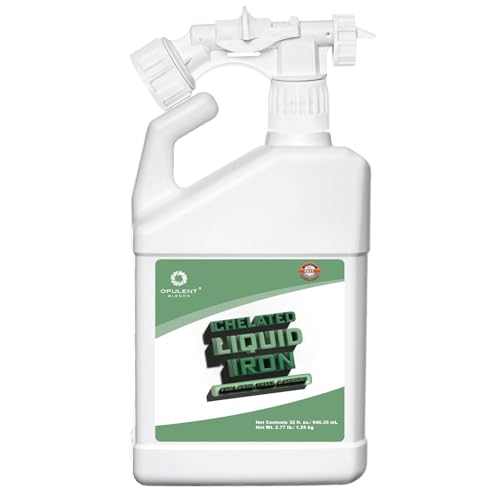
The hose-end sprayer that turns a patchy lawn deep green in a single Saturday morning pass.
This is the easiest entry on the list for the homeowner who wants results without measuring tablespoons into a backpack sprayer. The 32-ounce bottle screws directly onto your garden hose, and the mixing ratio (4 to 6 fluid ounces per 1,000 square feet) means one bottle covers roughly 8,000 square feet at the standard rate. The iron content is 6.5 percent — significantly higher than the Liquinox or Bloom City options, which means a smaller volume drives a stronger color change. The label lists lawns, plants, trees, and shrubs as targets, and an EDTA-free formula avoids the environmental concerns of synthetic chelating agents.
Owners mention that autumn blaze maples in low-iron soil respond dramatically. One owner noted that the fall colors were amazing after using this spray through the root zone. A Carolina Laurel Cherry tree with severe iron deficiency recovered within weeks. That said, the most-discussed issue is the bottle itself: several owners have received units with hairline cracks or leaking caps. The leakage is common enough that some buyers specifically mention it, and a few say they would switch brands solely because of the container defect. The product inside works well — the bottle is the weak link.
At 2.8 pounds for the full bottle, it is heavier than the Liquinox or Bloom City 32-ounce bottles, but the higher iron load means you use less per treatment. A standard 4-ounce dose per 1,000 square feet keeps the jug lasting several spray sessions.
what separates it
- Hose-end sprayer makes application easy — twist on and spray
- 6.5% iron concentration delivers strong color change in one treatment
- One bottle covers 8,000 sq ft at standard rate
The bottle headache
- Frequent reports of leaking caps or hairline cracks on arrival
- No mixing flexibility; you are locked into the hose-end dilution rate
Reach for this if: You want the fastest possible lawn coverage with zero measuring — screw on the hose and go, and you have large trees or shrubs that need deep root-zone spraying.
Think twice if: You are treating specimen plants at precise rates (the sprayer dilution range is broad), or you want a leak-proof bottle from the start.
5. Bloom City Chelated Liquid Iron (32 oz)

The day after treatment, anemic azalea leaves turned bright green — and the blooms followed.
Bloom City positions this as an organic-support supplement for iron deficiency, and the mixing ratio of 1 to 2 tablespoons per gallon makes it suitable for container plants, dwarf shrubs, and raised beds where you need precise dosing. The 32-ounce bottle is a manageable size for small gardens or indoor plant collections. It is made in the USA and targets plant growth, iron deficiency correction, and foliage color improvement. The label says it works on plants and lawns, but owners most commonly use it on ornamentals like gardenias and azaleas.
The story that comes up most often is the gardenia rescue: a transplanted bush that suffered yellow leaves after moving was treated with this liquid and, as one owner put it, “it was like magic.” The bush came back and produced lots of blooms, looking greener than ever. An azalea owner reported that leaves had turned an anemic light green before treatment, and the very next day they were bright green. A slower-acting but still reliable pattern: leaves turned green and shiny after two weeks with continued use, which one owner interprets as a sign of overall plant health. The product does require three applications for full correction — it is not the fastest worker on this list — but the 4.7-star average across verified reviews suggests consistent satisfaction.
The cap is the mild downside here, as with the Opulent Blends product: owners have mentioned leakage on arrival, though less frequently. The lower iron concentration than the Opulent Blends (the data does not give a percentage, but the mixing ratio is 1-2 tbsp rather than 4-6 oz per 1,000 sq ft) makes the Bloom City bottle a spot-treatment tool rather than a lawn-wide solution. For that role, it is excellent — precise, gentle, and fast enough for most home gardeners.
Perfect for: Gardenias, azaleas, roses, and container plants where you want a gentle but noticeable green-up within 24 hours to two weeks.
Not ideal if: You are greening a large lawn — the mixing ratio means a 32-ounce bottle covers only spot areas; the Fertilome or Opulent Blends options stretch further per dollar.
Best for: The container gardener or small-bed owner who wants a Made-in-USA liquid that shows visible results overnight on ornamentals.
Consider alternatives: If you need a higher iron punch per ounce for deep chlorosis, the Opulent Blends 6.5% iron product is stronger; if you prefer a powder you can measure, the Carl Pool chelate is more concentrated by weight.
Understanding the Specs
Chelation
A chelate is a molecular wrapper that protects the iron ion from reacting with soil minerals — think of it as a shield that keeps the iron soluble until the plant root grabs it. Without chelation, iron in alkaline or clay soil quickly turns into a form roots cannot use, which is why standard ferrous sulfate often fails. The Liquinox and Carl Pool products state they are “fully chelated,” meaning the iron is 100 percent protected at the intended pH range.
Foliar vs Soil Application
Foliar spray (spraying the leaves directly) gives the fastest visual green-up because the iron enters through leaf pores and goes straight into chlorophyll production. This is ideal for a quick recovery — the Fertilome and Bloom City owners both report seeing green within 24 to 48 hours by hitting the leaves. Soil drench takes a few days longer but provides a longer-lasting correction because the roots store iron for sustained uptake. Products like the Liquinox and Carl Pool support both methods, so you can do a foliar hit for speed followed by a soil drench for duration.
FAQ
What is the difference between chelated iron and ferrous sulfate?
Will chelated iron burn my lawn or plants?
How often should I apply iron chelated fertilizer?
Can I use iron chelated fertilizer on vegetables and herbs?
Is liquid or powder iron chelate better?
Does chelated iron work on St. Augustine, Bermuda, and Zoysia lawns?
Why do my plants need iron zinc chelate instead of just iron?
Which product is best for container-grown gardenias or azaleas?
Final Thoughts: The Verdict
If you want one dependable pick, the best iron chelated fertilizer overall is the Fertilome Chelated Liquid Iron because one gallon covers more ground per dollar than any other bottle here, and the 1-tbsp-per-gallon mix greens lawns and ornamentals within two days without burn. If your focus is acid-loving shrubs like gardenias, azaleas, or citrus that need the extra pH punch, grab the Carl Pool Iron Chelate liquid — it drops pH fast and revived a curry leaf plant that had not grown in years. And for the homeowner who just wants to screw a bottle onto a hose and see results same week, the Opulent Blends Chelated Liquid Iron 32 oz sprayer covers 8,000 square feet with 6.5 percent iron, as long as you accept the occasional leaky cap.
How We Picked
We do not accept paid placement. Every pick is matched to a real buyer and a real use-case; we do not hands-on test units.
Sources & Methodology
Specifications: manufacturer listings and product documentation. Review insights: verified customer reviews, as of July 2026. Pricing: not shown on this page (it changes often); check the current price via the retailer link.
As an Amazon Associate, Lawn Gear Lab earns from qualifying purchases. This does not affect which products we feature.