
Specs are compiled from manufacturer listings and verified buyer reviews and can change over time — please confirm the key details on the product page before buying.
Walking your yard after a fresh edge is one of those simple satisfactions — that crisp line where lawn meets sidewalk or flower bed, making everything look intentional and cared for. The trouble is getting there without wrecking your back, fighting a weed wacker, or spending half your Saturday on a single straight line. A good manual grass edge tool does the job quietly, cleanly, and with far less strain than you might expect — if you pick the right one.
I’m Rikta — the founder and writer behind Lawn Gear Lab. This guide is built by comparing the manufacturers’ published specifications and the patterns across verified customer reviews, so you get each pick’s real strengths and trade-offs instead of marketing spin.
This guide breaks down the best manual grass edge tool options on the market — from heavy-duty steel edgers that slice through compacted clay to lightweight designs that make quick work of a tidy border — so you can find the one that matches your soil, your stamina, and your weekend schedule.
Our Picks at a Glance


How To Choose The Best Grass Edge Tool
A manual edger is a simple machine — a blade on a handle with a step plate — but a few design details make the difference between a tool you reach for every weekend and one that stays rusting in the shed. Here is what to look for.
Blade Material and Shape
The blade is everything. Stainless steel resists rust and keeps its edge longer, while carbon steel is stronger and often sharper from the start but needs drying after each use. Spring steel offers a flexible bounce that helps it resist bending on hidden rocks. As for shape, a half-moon blade gives you a clean straight cut, while serrated teeth grip and saw through roots and compacted clay rather than skipping across the surface.
Handle Height and Grip
Your height determines which handle length works. A 37-inch handle suits a shorter user; a 41-inch or longer handle saves a taller person from hunching. The grip type also matters — a T-handle lets you twist and rock, a doughnut or O-handle spreads pressure across your palm to reduce fatigue, and a D-handle offers traditional control. Soft rubber or thermoplastic sleeves prevent slipping when your hands are sweaty.
Step Plate and Footrest
The step plate transfers your body weight into the blade. A wider plate (6 inches or more) accommodates any boot size and gives you stable leverage. An improve or forward-positioned step keeps your foot safely above the blade path and lets you drive downward without worrying about the edge catching your toe. Some designs also include a textured or serrated tread for grip in muddy conditions.
Weight and Overall Build
Heavier tools — around 4 to 5 pounds — sink into hard ground more easily but tire you out faster. Lighter tools, around 3 pounds, are easier to maneuver and better for longer sessions. One-piece welded construction avoids the wobble that can develop at a bolt joint over time. Look for a blade that is thick enough to resist warping but thin enough at the cutting edge to slice cleanly.
Quick Comparison
| Model | Best For | Blade Material | Weight | Handle Length | Amazon |
|---|---|---|---|---|---|
| Radius Garden 206 PRO★ Best Overall | Overall Performance | Stainless Steel | 3.5 lbs | 38.4 in | Amazon |
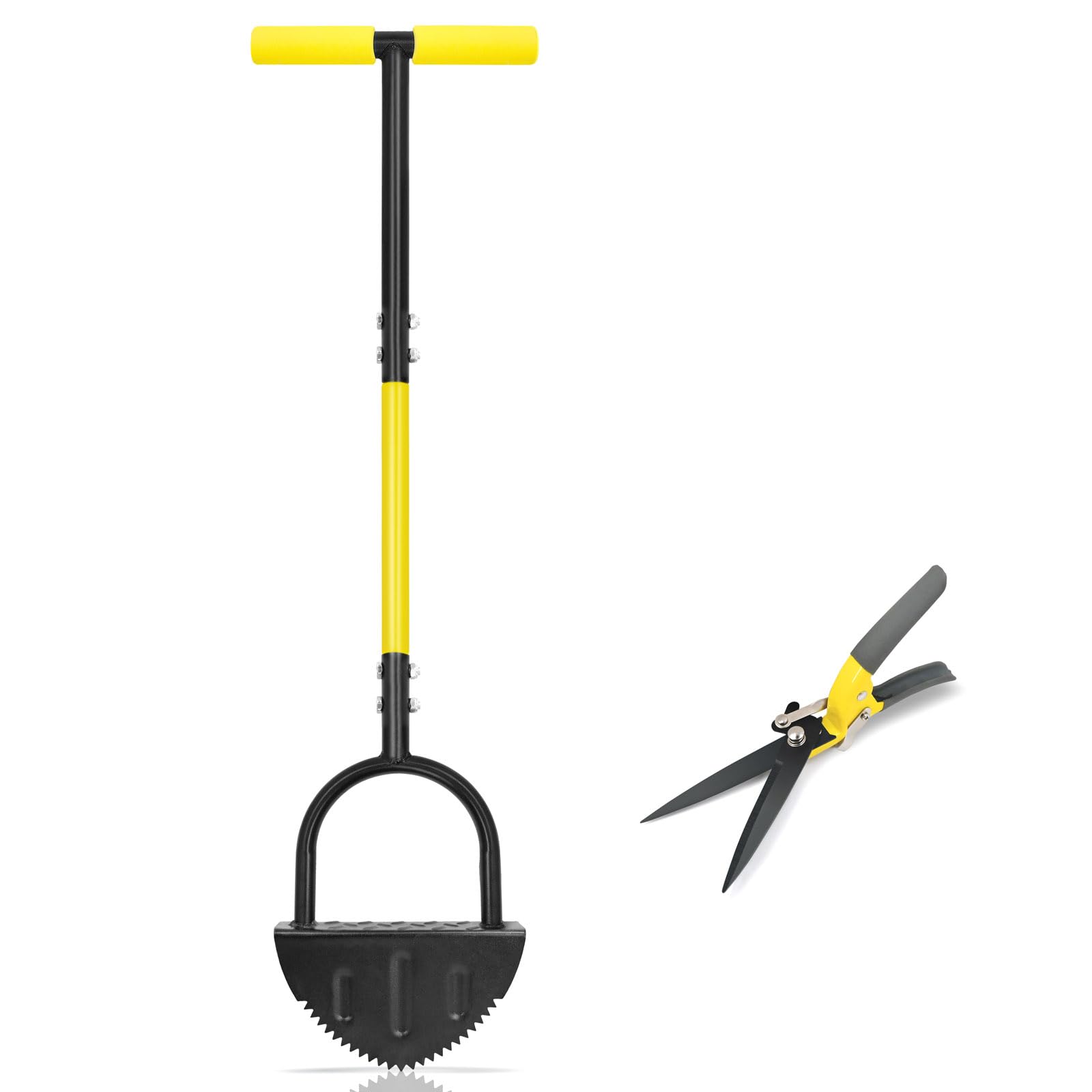
| BARAYSTUS Adjustable EdgerBest Value | Budget Value | Steel | 3 lbs | 37–41 in | Amazon |
| Professional Edge Lawn ToolBest for Heavy Turf | Heavy Turf Cutting | Carbon Steel | — | — | Amazon |
| Colwelt Manual Edger | Deep Root Cutting | Solid Steel | 4.38 lbs | 40 in | Amazon |
| CKLT One-Piece Edger | Ease of Assembly | Spring Steel | 5.24 lbs | 40 in | Amazon |
| Radius Garden 25602 Pro-Lite | Lightweight Ergonomics | Carbon Steel | 4 lbs | 40.25 in | Amazon |
| Bully Tools 12-Gauge Edger | Commercial Durability | 12-Gauge Steel | 3.69 lbs | 39.25 in | Amazon |
| Corona Edge Master | Compact Light Edging | Steel | 4.4 lbs | 34 in | Amazon |
| Root Slayer Serrated Edger | Root Penetration | Carbon Steel | 4.8 lbs | 39.25 in | Amazon |
In‑Depth Reviews
1. Radius Garden 206 PRO Stainless Steel Edger
Our pick — over 4.5★ from 700+ verified ratings; the strongest balance of quality and price.
The crowd-favorite edger that delivers a cleaner edge with less hand strain than any other manual tool we compared.
The Radius Garden 206 PRO earns its top spot because its 3.5-pound stainless steel blade bites into dense clay without bouncing — a problem reviewers report with cheaper, lighter edgers. The patented Natural Radius O-Handle Grip gives you four times the grip surface of a standard D-handle, so it spreads pressure across your palm instead of your fingers. Owners say it “works fine on tough sod growing in dense clay,” and at 3.5 pounds it sinks into hard ground more readily than the 3-pound BARAYSTUS without tiring you out too quickly. The resin-encased carbon steel shaft adds strength without extra heft, and the improve step keeps your foot above the blade. One honest trade-off: some owners note rust forming on the stainless blade despite the label, so you need to rinse and dry it after use. The lifetime guarantee is a solid backstop.
What Owners Love
- Blade quality and sharpness are praised most — owners find it cuts through tough turf and dense clay with ease
- Ergonomic O-handle reduces wrist and hand strain significantly, especially during longer edging sessions
- Sturdy build with a stainless steel blade that holds an edge well and survives accidental concrete strikes
The Honest Caveat
- Some units rust despite the stainless steel claim — regular drying and light oiling are necessary to keep the blade pristine
Reach for it if: You want the single best-balanced manual edger — sharp, comfortable, and built to last — and you don’t mind a quick rinse and dry to prevent surface rust.
Think twice if: You prefer a zero-maintenance blade that never needs wiping down, or you need an adjustable handle to fit multiple users of different heights.
2. BARAYSTUS Height Adjustable Garden Edger
A surprisingly sharp and sturdy edger at a price that undercuts the competition by a wide margin.
The BARAYSTUS is the only edger here with an adjustable handle — two settings at 37 and 41 inches — so it fits both a short gardener and a tall spouse without anyone stooping. Its 3-pound weight makes it the lightest full-size edger in this lineup, which means less lifting between each step. The soft TPE T-grip (a thermoplastic rubber handle) stays comfortable even when your hands are sweaty. The half-moon saw-tooth blade is heat-treated steel with anti-corrosion properties, and the 7.9-inch wide head covers more ground per step than most competitors. Buyers report it “works great really cuts into the soil makes edging easy.” The cast iron blade can chip on a large rock, and the all-metal frame offers less corrosion resistance than stainless steel. But at this price, you get professional-looking edges with zero noise and two handle heights that the Radius Garden 206 PRO does not offer.
Worth the money because: You get two handle heights, a sharp serrated blade, and a sturdy build for an entry-level price that punches well above its tier. The recurring gripe is that the blade may need occasional sharpening or touch-up with a file to maintain peak bite on heavy turf.
Best suited for: The budget-conscious homeowner who wants a reliable, adjustable edger that fits the whole family — and is willing to occasionally touch up the blade edge.
Pass on it if: You need a blade that shrugs off rust without care, or you prefer a heavier tool that does the work of sinking in on its own weight.
3. Professional Edge Lawn Tool
A saw-tooth workhorse that transforms heavy turf and stubborn roots into clean, crisp borders.
This edger’s aggressive saw-tooth design — teeth along a curved half-moon edge — actively bites and cuts rather than pushing through soil like a straight blade. That difference matters when you face heavy clay or established roots that make the Radius Garden 206 PRO skate. The carbon steel construction is weather and rust-resistant, though not rust-proof, so you still need to wipe it dry. A wide footplate accommodates all shoe sizes and gives you leverage for driving the blade downward. One owner who modified the teeth with a grinder said the tool “works fantastic on heavy turf now” — meaning the stock blade is already good, and a file tune-up makes it exceptional. The blade is about 1/8 inch thick from the start, which some buyers find too thick for maximum bite without a light grinding pass. But for the price, this saw-tooth design outperforms flat-blade edgers on neglected borders.
The standout strength: The saw-tooth blade genuinely cuts through dense turf and roots where a straight edge would just push — making this the best pick for neglected or overgrown borders.
Ideal for: Anyone facing heavy clay soil or thick, established grass edges that need a blade that actively saws rather than simply wedging apart.
Not the one if: You want a zero-maintenance blade straight from the box — some owners find the stock edge needs a quick file or grinder pass to reach its full potential on very compacted ground.
4. Colwelt Manual Edger Lawn Tool 40-Inch

A beast of a blade that reaches 5.5 inches deep, tackling roots that leave lesser edgers stranded.
Most half-moon edgers cut 2 to 4 inches deep. The Colwelt cuts a full 5.5 inches down, thanks to its V-shaped serrated blade. That extra reach makes it the right choice for renovating neglected edges, expanding flower beds, or cutting trenches for irrigation lines — jobs where the 4-inch depth of the Radius Garden 206 PRO falls short. The solid steel construction is heavy-duty, and the cushioned T-handle gives you a comfortable grip for twisting and levering. The anti-slip foot tread measures 6.3 inches wide and 6.7 inches high, fitting any boot size. Owners say it saves time and back strain compared to a shovel for making garden beds and trenching around pool decks. The downside: at 4.38 pounds it is heavier than many competitors, and the vertically bolted handle can catch on gloves. The blade often needs sharpening from the start, and some find the handle bolts uncomfortable.
Why It Excels
- Deeper cutting depth than average — the V-shape blade reaches 5.5 inches down, breaking through deep roots with ease
- Versatile for edging, trenching, and creating new flower beds — outperforms a standard spade for clean lines
The Catch
- Blade arrives less sharp than some expect — a quick file session improves cutting performance noticeably
- Protruding handle bolts can be uncomfortable during extended use
Choose this for: Deep renovations, new bed creation, or any job where you need to cut through established root systems and compacted subsoil.
skip it if: You want a tool that cuts straight from the box without any sharpening, or you prefer a lighter edger for quick weekly touch-ups.
5. CKLT One-Piece Manual Edger

A pre-assembled, no-wobble edger that arrives ready to cut right from the start.
Most budget tools develop wobble at the bolt joint over time. The CKLT solves that with one-piece construction — a 1.18-inch diameter manganese steel tube inserted into a thick metal handle, zero bolts or joints. The serrated spring steel blade flexes when it hits a hidden rock rather than denting, and the 40-inch length reduces bending for most users. At 5.24 pounds, this is the heaviest edger in this guide, giving it serious momentum for sinking into hard ground. Owners say it “cuts through sod and roots like butter” and outperforms expensive electric models. The included protective strip covers the blade when not in use. The honest trade-off: the 5.24-pound weight will tire you out faster than the 3.5-pound Radius Garden 206 PRO, especially on longer sessions. But for rattle-free construction that arrives ready to use, this is a superb pick.
The one-sentence takeaway: A heavy-duty spring steel edger that arrives fully assembled and ready to cut — ideal for owners who want maximum durability and zero setup fuss, as long as they don’t mind the 5.24-pound weight.
Great for: Anyone tired of tools that loosen at the joints — the one-piece manganese steel construction will not wobble, rattle, or separate.
Not ideal if: You are looking for a lightweight, easy-to-swing edger for quick weekly borders — the 5.24-pound weight makes itself felt after 30 minutes.
6. Radius Garden 25602 Pro-Lite Carbon Steel Edger

A lightweight step-edger with the same doughnut-handle comfort that made the 206 a classic.
The 25602 Pro-Lite uses the same ergonomic doughnut handle as the 206 PRO — a hole-in-the-center grip that lets you hold it like a dinner plate, reducing wrist strain and giving you 360-degree control for rocking and twisting. The difference from the 206 PRO is the carbon steel blade: it is heat-treated for hardness and arrives razor-sharp, but it requires wiping dry after each use to prevent rust. The fiberglass shaft keeps the overall weight at 4 pounds, and the extra-wide improve step provides safe leverage. Owners praise its clean cut through heavy clay without flex at the joints. The blade measures about 9 by 5 inches, and the total length is 40.25 inches. The trade-off is the carbon steel — it rusts if left wet, unlike the 206 PRO’s stainless blade. Some owners note the edge could be slightly sharper from the factory. For hand comfort, this is a top pick, especially for anyone with arthritis or wrist pain.
The High Points
- Ergonomic doughnut handle is genuinely easier on the hands — one owner called it “much better than trying to use a shovel”
- Fiberglass shaft keeps weight low while resisting flex, even in heavy clay soil
The Low Point
- Carbon steel blade requires immediate drying after use to prevent rust — not a set-and-forget tool
Designed for: Gardeners who prioritize hand comfort and want a lightweight tool that still bites deep into clay — especially those with arthritis or wrist pain.
Better to skip if: You want a stainless blade that you can hose off and leave without worrying about rust spots forming.
7. Bully Tools 12-Gauge Manual Lawn Edger

A 12-gauge steel edger so tough it replaces two Husky tools in three days, according to owners.
The Bully Tools edger is built in Steubenville, Ohio, from 12-gauge extra-thick steel — thicker than the 13- or 14-gauge steel in most consumer edgers. That means the blade resists warping and bending after years of hitting rocks and concrete. The all-steel T-style grip gives you precise control and leverage, and the detachable blade design lets you replace just the blade when it wears out. At 3.69 pounds, it is lighter than the 4.8-pound Root Slayer while being more durable. Owner reviews underline its toughness: one buyer wrote, “after purchasing one like it at Home Depot Husky tool line, I had to get it replaced twice in 3 days of use — I advise anyone to purchase this bully.” The tool works well for edging sidewalks, garden beds, and driveways, and can handle sod cutting and trenching. The rubber handles can loosen and twist off over time — a dab of adhesive fixes that. It comes with a limited lifetime warranty.
One thing to know: The same 12-gauge steel that makes this edger nearly indestructible also means the blade arrives sharp but not razor-finished — a quick pass with a file tune it for your specific soil type.
Best match for: Heavy-duty landscaping tasks, rocky soil, or anyone who has broken cheaper edgers and wants a tool that will genuinely last a lifetime.
Not the right pick if: You want a zero-maintenance blade that never needs sharpening or a handle that stays tight without any DIY fix.
8. Corona Tools LG 3684 Edge Master

A compact, well-built edger that is easier to control in tight spaces and around existing garden beds.
The Corona Edge Master’s 34-inch handle is shorter than the 40-inch handles on most full-size edgers, which makes it more maneuverable around flower beds, curved pathways, and tight corners. The 5.8-inch wide cutting blade gives you precise turf separation, and the tool is solidly built with a sharp edge that owners call “heavy duty.” The shorter handle means less reach but also less leverage required for control — a good fit for smaller yards or detail work. Owners confirm the quality: “very well built and works like a champ” and “nice heavy duty sharp tool.” Some buyers find it sharp enough for clean lines right away, while others note it could be keener for harder soil. At 4.4 pounds, it is solid without being exhausting. If you edge along existing beds and walkways rather than cutting deep into new ground, this compact design is both effective and easy to store — and its 34-inch handle makes it a better fit than the 40-inch Corona for tight spaces.
The defining feature: A 34-inch handle that trades raw leverage for precision control — ideal for smaller gardens or intricate edging around established landscaping where a long handle would get in the way.
Ideal for: Gardeners who edge frequently but in contained areas — think flower bed borders, curved pathways, and patio edges where a 40-inch handle is cumbersome.
Less suitable if: You need maximum reach and leverage for deep cuts in hard, compacted soil — a longer handle will serve you better for those jobs.
9. Root Slayer 22611 Serrated Garden Edger

A serrated half-moon blade with an inverted V tip that chews through roots like a hungry beast.
The Root Slayer’s half-moon blade uses an inverted V-shaped cutting tip and aggressive serrated teeth that grip and slice through compact soil, turf, and shallow root systems — exactly the scenario where the Radius Garden 206 PRO’s straight blade can bounce. The powder-coated carbon steel resists corrosion, and the resin-encased fiberglass shaft provides stability without extra weight. At 4.8 pounds, it is heavier than most, but that weight helps the serrated edge sink into tough ground. The non-latex grip is comfortable for extended use. Owner feedback emphasizes effectiveness: “cuts right through the ground to define your landscape beds” and “cuts roots when edging very easily.” The tool is sturdy enough to stand on like a shovel for curb edging, and many owners expect it to last a lifetime. The honest trade-off is the 4.8-pound weight — one owner reported their family member found it too heavy. If your yard has heavy, root-filled soil, this is the most capable root-slicing edger you can buy.
The Strengths
- Effectiveness is the most-praised aspect — the inverted V tip and serrated teeth slice through roots, clay, and compacted soil with less effort than straight blades
- Build quality and durability are top-tier — powder-coated carbon steel with a fiberglass shaft resists rust and flex
The Limitation
- At 4.8 pounds, it is noticeably heavier than most — some owners find it fatiguing for longer edging sessions or too heavy for smaller-framed users
Reach for this if: Your yard is full of tree roots, thick sod, or compacted clay that makes straight-blade edgers bounce — this tool is built to cut through what stops lesser tools.
Look elsewhere if: Weight is a primary concern or you prefer a lighter tool that you can swing easily for quick weekly borders.
Understanding the Specs
Blade Material
The blade material determines how long the edge stays sharp and how much maintenance you need to do. Stainless steel resists rust and holds its edge well, making it the lowest-maintenance option — you can hose it off and leave it to dry. Carbon steel is harder and can take a sharper edge, but it will rust if you leave it wet; a quick wipe and occasional light oiling keep it in good shape. Spring steel offers a flexible bounce that helps it survive impacts with hidden rocks without bending permanently. For most homeowners, stainless steel offers the best balance of sharpness and low maintenance. If you cut through heavy clay or roots regularly, carbon or spring steel gives you more bite.
Handle Height and Grip Type
Handle height directly affects your posture and comfort. A 34-inch handle suits smaller yards and detail work but will make a tall person stoop. A 40-inch handle works for average heights, and an adjustable 37-to-41-inch handle fits multiple users. The grip type changes how the tool feels in your hands: a T-handle gives you leverage for twisting and rocking motions, a doughnut or O-handle spreads pressure across your palm to reduce fatigue, and a D-handle offers the most traditional feel but concentrates force in your fingers. Soft rubber or thermoplastic sleeves help prevent blisters during longer sessions, and a non-slip texture is useful when your hands get sweaty.
FAQ
How deep should a manual grass edge tool cut?
Is stainless steel better than carbon steel for an edger blade?
How do I sharpen a manual edger blade?
Can I use a manual edger for trenching or digging?
What is the difference between a half-moon edger and a saw-tooth edger?
How long does a manual grass edge tool last?
Should I get an adjustable-height handle?
Can a manual edger replace a string trimmer for edge work?
Final Thoughts: The Verdict
Across the board, the grass edge tool winner is the Radius Garden 206 PRO Stainless Steel Edger because it combines an exceptionally sharp stainless blade, an ergonomic O-handle that genuinely reduces hand fatigue, and a lifetime guarantee — all backed by the highest owner satisfaction in the category. If you