
Specs are compiled from manufacturer listings and verified buyer reviews and can change over time — please confirm the key details on the product page before buying.
Energy-efficient grow lights let you run powerful indoor gardens without the shocking jump in your electric bill or the heat that fries your seedlings. The real trick is reading past the wattage equivalency claims and looking at the actual power draw, the light spread, and whether the fixture can cover your specific space—a 2×2 tent and a 4×4 table need very different tools.
I’m Rikta — the founder and writer behind Lawn Gear Lab. This guide is built by comparing the manufacturers’ published specifications and the patterns across verified customer reviews, so you get each pick’s real strengths and trade-offs instead of marketing spin.
Whether you are starting tomatoes in a chilly basement or pushing peppers into heavy fruit under a tent, choosing the right energy-efficient grow lights means finding the balance between photon output and the watts you pay for every month.
Our Picks at a Glance


How To Choose The Best Energy-Efficient Grow Lights
Energy efficiency in grow lights is not just about a low wattage number. A 40W bulb that shines a narrow beam misses half your plants, while a 150W fixture that spreads light evenly could let you harvest more with fewer hours of operation. Match the light to your growing area and the stage of growth you care about most.
Actual Wattage vs. “Equivalent” Wattage
A light advertised as a “600W equivalent” might draw only 40 to 150 watts from the wall. That is the number you pay for. Ignore the equivalency and look for the stated power consumption in watts — that is your true electricity cost.
Coverage Area and Beam Angle
A narrow beam angle (60 degrees) concentrates light into a small circle, which is great for a single tall plant but poor for a tray of seedlings. A wide angle (120 degrees) spreads light evenly across a flat canopy. Your tent or shelf dimensions dictate which beam shape works best.
Spectrum and Color Temperature
Full-spectrum lights (2800K–5000K plus some red and IR) support every stage from seed to flower. Lights that lean warm (3000K) encourage blooming, while cooler temperatures (5000K) help vegetative growth. A high Color Rendering Index (CRI) over 90 means the light looks natural to your eyes.
Quick Comparison
| Model | Best For | Actual Wattage | Coverage | Beam Angle | Amazon |
|---|---|---|---|---|---|
| VIPARSPECTRA XS1500 Pro★ Best Overall | Best Overall | 150W | 2×2 ft flower / 3×3 ft veg | 120° | Amazon |
| Uallhome 2 Pack PanelBudget Value | Budget Value | 200W (total) | 4×4 ft | — | Amazon |
| SANSI Dimmable BulbSmall Space Champ | Small Spaces | 40W | Single plant | 60° | Amazon |
| TYAGMAM 4FT T8 4-Pack | Shelves & Greenhouses | 180W (total) | Linear 4ft rows | — | Amazon |
| Sunco 4FT 2-Pack | Seedling Racks | 40W (fixture) | Linear 4ft rows | — | Amazon |
| Spider Farmer SF600 | Veg & Low-Light Bloom | 72W | 2×4 ft | 120° | Amazon |
| AC Infinity IONBEAM S16 | Supplemental Canopy Light | — | Inter-canopy / side | — | Amazon |
| Barrina BU2000 | Flowering Power | 200W | 3×3 to 4×4 ft | 60° (per panel) | Amazon |
| Spider Farmer G4500 | Smart App Control | 320W | 2×4 to 3×5 ft | — | Amazon |
In‑Depth Reviews
1. VIPARSPECTRA XS1500 Pro
Our pick — over 4.5★ from 900+ verified ratings; the strongest balance of quality and price.
The XS1500 Pro packs superb PAR uniformity into a compact 150W bar that fits both tents and shelves.
The crowd favorite — rated 4.7 stars across over 900 owners — delivers the kind of PPFD readings enthusiasts rave about. Buyers report an excellent 747 µmol/s/m² at 50% intensity from 13 inches, with consistent readings across the full coverage area so your canopy edges grow as well as the center. The adjustable dial lets you dial the intensity up or down, and you can daisy-chain up to 20 units for unified dimming in a larger setup.
It draws only 150 watts while replacing a traditional 250W HPS fixture, and the 120-degree beam angle spreads light evenly for a 3×3 foot veg footprint or a 2×2 foot flower footprint. The full spectrum includes 3000K warm white, 5000K cool white, deep red at 660nm, and infrared at 730nm, covering the full life cycle from seed starting to flowering. The beam angle is twice as wide as the SANSI bulb’s 60 degrees, making this a far better choice for a tray or tent.
Owners mention it handles heavy feeders: one owner uses three units on a 2×5 foot shelf at 60% to grow tomatoes and beets. The main trade-off noticed by owners is weight — at roughly 6 pounds, you want reliable ratchet hangers, which the kit includes. The color temperature of 3500 Kelvin and a CRI of 75 lean slightly warm compared to the 4000K and CRI of 90 on the SANSI bulb, a detail that matters if you want a truer daylight look in your growing space.
Why It Wins
- 747 PPFD at 13 inches delivers excellent canopy penetration
- 120-degree beam angle covers a 3×3 veg area evenly
- Daisy-chains up to 20 units for large-scale setups
- Runs cool enough for enclosed tents without scorching
The Real Catch
- Relatively heavy at almost 6 pounds — use the included hangers
- CRI of 75 is lower than premium bulbs; colors look less vivid to the eye
- No physical on/off switch — you unplug or use the dimmer at zero
Your best bet if: you want a proven, high-PPFD light for a 2×2 or 3×3 tent that won’t drive up the electric bill and can scale later.
Think twice if: you need a single-bulb screw-in solution or you prioritize a natural daylight look at a high CRI — the SANSI bulb above covers that angle better.
2. Uallhome 2 Pack LED Grow Light Panel
A two-pack that covers a 4×4 foot area without emptying your wallet.
Quality is the top trait owners mention, and these panels earn that praise through simple reliability: they work for seedlings, they work in greenhouses, and customers note they work well on large areas for vegetable seeds. Each panel draws 200W between the two units and replaces a traditional 200W HID setup while running cooler and using less power.
The spectrum includes UV, IR, red, blue, and white LEDs, making them a true full-season light for both veg and bloom stages. The 6-foot power cord and included hanging kit let you set up without extra tools, and after six months of daily use, reviewers point out their plants love them and the heat generation is acceptable. The biggest limitation buyers flag is the lack of a built-in timer — expect to pair these with an outlet timer for consistent cycles. The short hanging hardware can also sit at an awkward angle if you do not add extra paracord or ratchet clips.
Why the Value Works: You get two panels that together light a 4×4 tent for about the same price as a single premium fixture, and the spectrum covers the entire cycle.
The Caution: No dimmer, no timer, and the pinkish-purple light can make healthy plants look strange to your eye — shoppers say the plants are thriving even when they look “dead” under the LEDs.
Reach for this if: your budget is tight and you need to fill a large tent or multiple seedling trays without paying for advanced features.
Look elsewhere if: dimming control, a remote, or a natural light color is important to you — the SANSI bulb or VIPARSPECTRA handle those needs better.
3. SANSI Dimmable Grow Light Bulb
A screw-in bulb that brings remote-controlled dimming, a timer, and natural-looking light to a single houseplant.
At just 40 watts of actual draw (it claims a 600W equivalency), this is the most energy-efficient pick here for a single plant. Brightness is the first thing owners mention — 76 buyers single it out — and with a PPFD of 345 µmol/s/m² at one foot, it pushes serious photons into a snake plant, monstera, or reading corner. The CRI of 90 is a 20% improvement over the VIPARSPECTRA’s 75, meaning colors under this bulb look crisp and natural to your eye.
The remote control lets you set a timer for 4, 8, or 12 hours and dim the brightness from 25% to 100% across four levels, so you never have to unplug the lamp. The 60-degree beam angle is narrow — a 2x gap compared to the 120-degree VIPARSPECTRA — which means you need to position this close to the plant for full effect. Owners confirm it works great as a spotlight but is weaker across a wide tray.
The patented ceramic heat sink replaces the usual aluminum substrate, keeping the bulb cool and extending its life, though a mixed note on lifespan (26 mentions) means some units have burned out after a year. The 5-year warranty backs you up if that happens.
Best trick: screw this into any standard E26 lamp or pendant and you have a smart grow light that looks like a normal bulb — buyers love using it in a hanging pendant fixture for style and function.
The narrow-beam reality: if you need to cover a flat tray of 20 seedlings, the 60-degree beam will leave the edges dark. That job belongs to a panel light.
Your move: grab this for a single potted plant, a reading lamp that doubles as a grow light, or any spot where you want a natural-looking bulb with low-maintenance timing.
skip it if: you need to light a tent, a shelf of multiple plants, or any area wider than about 12 inches — the narrow beam angle limits its reach.
4. TYAGMAM 4FT T8 LED Grow Light (4-Pack)

Four linear T8 tubes that daisy-chain into one long strip, perfect for greenhouse shelves and seedling racks.
Each of the 4-foot tubes draws 45 watts (180W total for the pack) and replaces a 1080W equivalent of older technology, saving you significant energy over fluorescent T8s. Buyers report these work great in greenhouses and are very easy to install, with one owner using them for a full year in a Green Hut with healthy seedlings and no heat damage.
The integrated reflector boosts light efficiency by 20% and the 100% aluminum shell dissipates heat well, protecting the LED chips. You can link up to four units together with the included 36-inch connecting cords, and mount them using clips, cable ties, or the hang rings. At 5000 Kelvin, the color temperature leans cool and blue, which is excellent for vegetative growth and seed starting, though less ideal for flowering. Each tube measured between 20 and 22 watts on a meter, and at 11 inches from the canopy, PAR reads between 67 and 82 — modest numbers compared to the VIPARSPECTRA, but spread across a linear 4-foot row rather than a square tent.
The linear advantage: if you have a multi-tier shelf or a long greenhouse bench, these tubes cover the length evenly — no dark corners. No timer built in, so budget for an outlet timer.
Not extremely bright: owners note these are not blinding; they work for greens and starts but lack the punch for heavy flowering. For that, see the Barrina panel below.
Best for: seed starting on wire shelves, keeping perennial herbs alive through winter, or supplemental side lighting in a greenhouse.
Not for: a dense flower tent or any plant that needs high PPFD to push out heavy buds — choose the VIPARSPECTRA or Barrina for that.
5. Sunco 4FT LED Grow Light (2-Pack)

A lightweight, linkable T8 fixture that seedlings perk up for within hours of hanging it.
Lighting quality and reliability are the top two attributes owners praise — 45 call out the lighting quality and 44 mention the reliability. The fixture draws 40 watts and produces 2000 lumens of red-and-blue spectrum light, and owners mention their plants “perked up within 10 to 24 hours” after installation. The pull chain switch makes it easy to turn off without unplugging.
You can link up to four fixtures together using the included cords, and the 5-year warranty from Sunco gives you confidence that a US-based company will handle any issues. The 50,000-hour lifespan means years of daily use. The finish is painted, not polished aluminum like the TYAGMAM tubes, and the light is described as white rather than pink by some buyers, so do not expect the typical purple glow. The fixture is described as very slender and lightweight, making it easy to hang even on lighter shelving.
What owners love: the ease of setup — everything needed for hanging is included — and the fact that tiny seedlings grow nicely under the bright light. A buyer bought four to keep plants alive in a basement.
The quirk: some fixtures arrive with noticeably bowed bulbs. They still work well, but the curve is visible.
Reach for this if: you are setting up a seedling rack or a basement grow shelf and want a linkable, low-heat fixture that is backed by a long warranty and a US-based brand.
Look elsewhere if: you want a full-spectrum light that includes deep red 660nm for flowering — the Sunco uses a red/blue mix, not a broad full spectrum.
6. Spider Farmer SF600

A low-wattage bar light that runs cool and fits a 2×4 tent with surprising plant growth results.
Draw just 72 watts while pushing 384 LEDs across a 39.3-inch bar that puts out 11,000 lumens. Quality is the top mention from owners — 71 call it out — and the 120-degree beam angle spreads the sunlike full spectrum (warm white, cool white, red 660nm, and IR) evenly over a 2×4 foot area. Customers note switching from fluorescent T5s and seeing their plants thrive better in an unheated greenhouse, growing winter salad greens and keeping tender perennials alive.
The reflector improves light focus, and the LEDs carry an anti-moisture and anti-vulcanization coating for a 50,000-hour lifespan. A 5-year warranty backs you up, with a US-based service center. One owner measured 400 PAR at 12 inches — solid numbers for a 72W fixture — and the surface temperature stays below 80°F, meaning you can place it close to seedlings without heat stress.
The trade-off: brightness gets mixed feedback — 39 owners mention it, some finding it plenty bright, others wishing for more power. For veg growth and micro-dwarf tomatoes, it is excellent. For heavy flowering, the 72W limit shows compared to 150W+ fixtures.
The install tip: the threaded hanger is sleek, but owners recommend using pulley ratchet hangers for easy height adjustment.
Your best bet if: you want a low-power, full-spectrum bar for a 2×4 veg tent, a greenhouse bench, or a shelf of starts — and you value the 5-year warranty.
pass on it if: your main goal is dense flowering buds in a 4×4 tent — you need the higher wattage of the VIPARSPECTRA or Barrina.
7. AC Infinity IONBEAM S16

A magnetic inter-canopy light bar that pushes Samsung diodes into the shadow zones of your tent.
This is not a primary light — it is a supplemental bar designed to slide into the lower canopy where your main light struggles to reach. Each of the four 16-inch bars uses Samsung LM301H EVO diodes rated at 3.14 µmol/J PPE, which is among the most efficient chips on the market. The magnetic mounting system uses included steel bars that attach to your tent frame, so installation takes under 15 minutes.
The digital controller (model 77) offers ten intensity levels and a daily schedule with sunrise and sunset simulation, giving you precise environmental control. Owners call the build quality AAA-grade, noting the solid construction, bright LEDs, and strong magnets. One owner uses it for a propagation tent and praises the easy connection and minimal temperature impact. The main buyer feedback is that the connecting cables between bars are short — some owners had to hunt for extensions.
Where it shines: in a dense canopy where lower leaves get shaded. Slip these bars between plants and watch bottom buds fill out. The programmable timer lets you run them on a different schedule than your top light.
The catch: at a premium price for the wattage, these are an add-on, not a standalone solution. If you do not already have a powerful main light, buy the main light first.
Reach for this if: you have a tall, bushy grow with a thick canopy and want to rescue the lower bud sites that would otherwise stay larfy.
it’s not for you if: you are buying your first light for a small tent — start with a full-coverage panel like the VIPARSPECTRA or Barrina.
8. Barrina BU2000

A 200W panel with 816 LEDs and adjustable wings that can crank PPFD up to 1600 in the center for heavy flower power.
Brightness is the top trait — 92 owners call it out — and it is not hard to see why: the BU2000 pushes 41,000 lumens from 816 LEDs, including blue 5000K, warm white 3000K, red 660nm, and IR 730nm. The two panels are hinged so you can angle them into a V or a flat shape; at a 60-degree angle, center-zone efficiency jumps by over 25%. One long-time grower with 30 years in the hobby reports it outperformed a 400-watt HPS and a CMH bulb in his 3×3 space, with pepper plants exploding in fruit growth at 50% power in 25 days.
The dimming knob adjusts brightness from 10% to 100% with no fan and no noise. The included hanging chains and hooks make setup straightforward, and the 2.02-pound weight is surprisingly light for a fixture with this punch. A 4x4x80-inch tent works well; owners warn it is too strong for a 2×2 space — you will cook seedlings at full power.
What owners rave about: the spectrum and build quality for the price. One buyer tested months of budget options and calls this the best — growing a massive autoflower with no issues and impressive flowering footprint.
The reliability question: 64 owners mention reliability with mixed feelings — some units reportedly stopped working after a few days. The fix is buying from a seller with easy returns.
Your move: grab this for a 3×3 or 4×4 flower tent where you want dense, heavy buds without spending crazy money on a top-brand fixture.
look elsewhere if: you need a set-and-forget light with a proven track record of long-term reliability — the VIPARSPECTRA or Spider Farmer G4500 have stronger durability scores.
9. Spider Farmer G4500
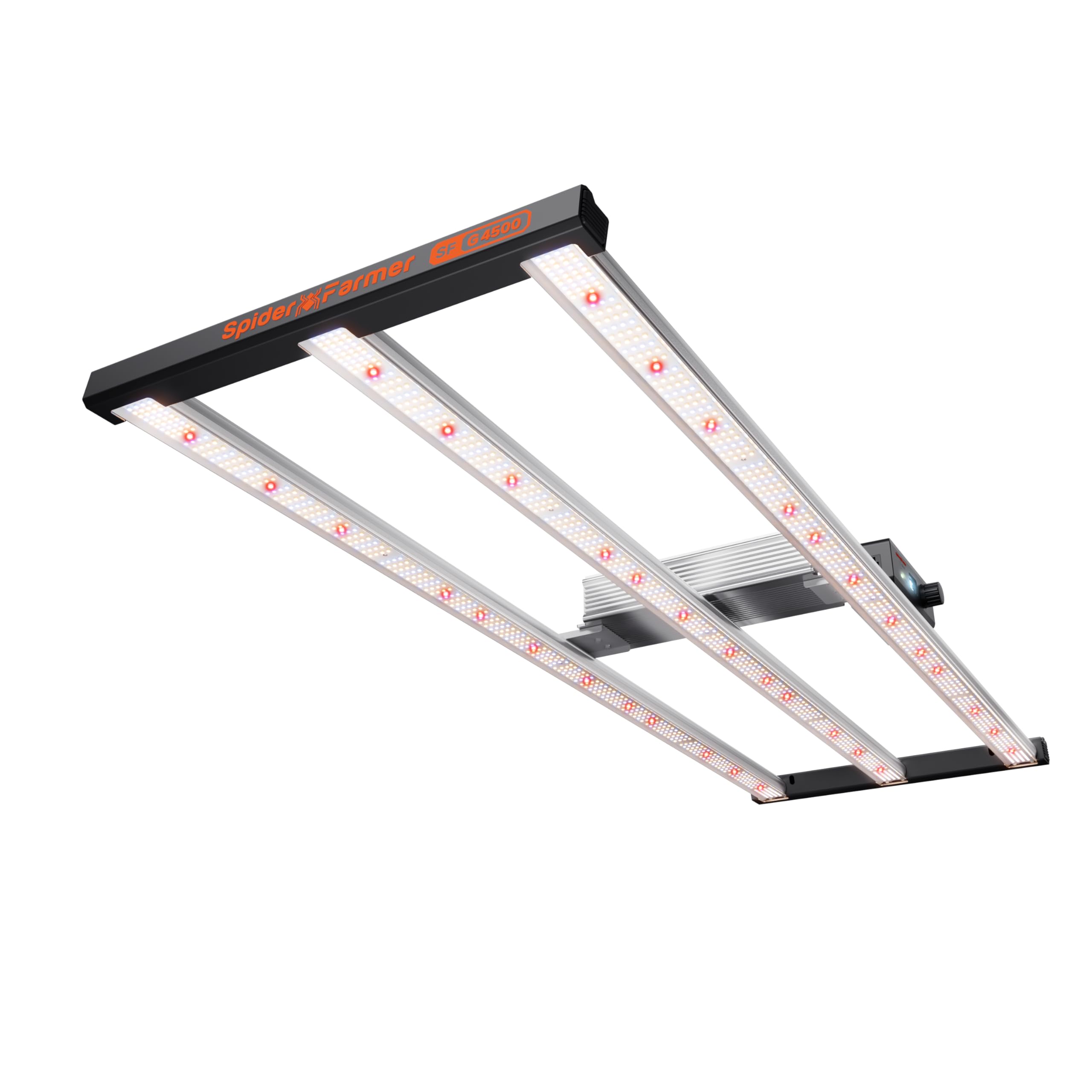
A 320W bar light with smart app control that lets you dial in the perfect spectrum intensity from your phone.
The G4500 earns a stellar 4.7-star rating and uses Bridgelux diodes to achieve a PPE of 2.85 umol/J — that is high efficiency, meaning more photons per watt. The elongated bar design delivers uniform coverage across a 2×4 or 3×5 foot area, with no dim edges. The full spectrum spans 3200-4200K, 4800-5000K, and 650-665nm red, covering the entire cycle from seedling to harvest.
The Spider Farmer App (available on Apple Store and Google Play) gives you custom light schedules, sunrise and sunset simulation, and remote brightness adjustments from 10% to 100%. You can daisy-chain up to 50 units for unified dimming across a large grow room. The 5-year warranty and US-based service center add long-term security. Reviewers point out the light is “20% blinding” even at brightness levels perfect for plant growth — meaning this thing has real power — and they love how easy it is to adjust intensity without moving the light height. One buyer replaced a 1000W light with a G8600 (the bigger sibling) and fixed a deficiency issue immediately by dialing exact PPFD levels.
The standout feature: app-based control means you are not tied to a physical dimmer knob inside your tent. Set sunrise/sunset timers and adjust from the couch or from vacation.
The setup gripe: the included hooks reportedly do not fit some tent pole sizes — a few owners used zip-ties as a workaround. The instructions are also described as poor, though setup is simple enough without them.
Your best bet if: you want the latest smart grow light that combines high-efficiency Bridgelux diodes, app scheduling, and enough power to flower a 3×5 tent — and you want a 5-year warranty behind it.
steer clear if: you do not need app control or grow in a space smaller than 2×4 feet; the VIPARSPECTRA is more compact and costs less while still delivering strong PPFD.
Understanding the Specs
PPFD (Photosynthetic Photon Flux Density)
PPFD measures how many usable photons land on a square meter of your canopy every second. It is the real number for plant growth, stated in μmol/s/m². A seedling needs around 200-300, while flowering plants want 600-900. The VIPARSPECTRA reports 747 at 13 inches, while the SANSI bulb reaches 345 at one foot — a big difference that tells you which light suits which stage.
CRI (Color Rendering Index)
CRI tells you how natural colors look under the light on a scale up to 100. A CRI of 90, like the SANSI bulb, makes your plants look vibrant and true to eye. A CRI of 75, like the VIPARSPECTRA, leans warm and slightly washed out. CRI does not directly affect plant growth, but it matters if you spend time in your grow space and want to spot mold or pests easily.
PPE (Photosynthetic Photon Efficacy)
PPE measures how many micromoles of light a fixture produces per joule of electricity — stated in μmol/J. Higher numbers (2.85 or 3.14) mean more photons reach your plants for every watt you pay for. The Spider Farmer G4500 hits 2.85, while the AC Infinity S16 uses Samsung LM301H EVO diodes rated at 3.14, making them two of the most efficient chips available.
Daisey Chaining
Daisey chaining lets you connect multiple grow lights together using one power outlet and one dimmer control. The VIPARSPECTRA XS1500 Pro supports up to 20 units in a chain, and the Spider Farmer G4500 can daisy up to 50. This matters if you scale from a single tent to a multi-shelf or multi-tent setup and want unified brightness and timing control.
FAQ
How much electricity will an energy-efficient grow light save me compared to older HID lights?
What does full spectrum mean for a grow light and do I need it?
What does PPFD stand for and what number should I aim for?
Can I use a regular dimmer switch to control my grow light?
How close should I hang my grow light to the plants?
Will these lights work in a cold garage or unheated greenhouse?
What is the difference between a 60-degree and a 120-degree beam angle?
How many grow lights do I need for a 4×4 foot tent?
Will a 40W bulb like the SANSI work for a desk plant or an office plant?
Do I need a timer, and can I use an external outlet timer with any of these lights?
Final Thoughts: The Verdict
For most buyers, the best energy-efficient grow light is the VIPARSPECTRA XS1500 Pro because it combines a true 150-watt draw with the daisy-chain dimming and sturdy PAR values that home growers and hobbyists consistently praise — and its 4.7-star crowd rating across over 900 owners is class-leading in this list for reliability and coverage. If you want a smart app-controlled fixture for a larger 2×4 or 3×5 space, grab the Spider Farmer G4500. And for a single houseplant in a desk lamp or a reading nook, the SANSI Dimmable Bulb is the one to reach for — it gives you remote timing and natural-looking light at just 40 watts.
How We Picked
We do not accept paid placement. Every pick is matched to a real buyer and a real use-case; we do not hands-on test units.
Sources & Methodology
Specifications: manufacturer listings and product documentation. Review insights: verified customer reviews, as of July 2026. Pricing: not shown on this page (it changes often); check the current price via the retailer link.
As an Amazon Associate, Lawn Gear Lab earns from qualifying purchases. This does not affect which products we feature.