
Specs are compiled from manufacturer listings and verified buyer reviews and can change over time — please confirm the key details on the product page before buying.
You spot the tiny bugs on your basil leaves. Aphids, whiteflies, or spider mites start taking over. You grab a spray, but you worry about eating those leaves tomorrow. You need something that kills the pests fast while keeping your basil safe to pick and eat — that is where insecticidal soap comes in.
This guide is built by comparing the manufacturers’ published specifications and the patterns across verified customer reviews, so you get each pick’s real strengths and trade-offs instead of marketing spin.
This category is simple: the soap kills soft-bodied insects on contact by breaking down their outer shell, then it breaks down itself with no lasting residue. Every soap here is safe for herbs and vegetables, meaning you can spray today and harvest tomorrow. Here is our take on the best insecticidal soap for basil.
Our Picks at a Glance

How To Choose The Best Insecticidal Soap For Basil
Basil is tender. Its leaves bruise easily, and it grows fast right before your eyes. You want a soap that kills bugs hard but treats the leaves gently. The choice depends on three things: form, ingredients, and when you plan to eat.
Ready-to-Use vs. Concentrate
A ready-to-use spray comes in a bottle. You aim and squeeze — no measuring, no mixing. That is perfect when you spot an infestation mid-season and need to act now. A concentrate costs less per gallon and lets you make as much or as little as you need, but requires a sprayer and a careful hand with the measuring cup. For a small basil pot on the windowsill, ready-to-use wins. For a full herb garden, a concentrate stretches further.
Organic Certification (OMRI)
The OMRI (Organic Materials Review Institute) label means the soap is allowed in certified organic production. No synthetic nasties, no lingering poison. If you are growing basil to eat fresh, this label matters because it confirms the soap breaks down into harmless components that do not hang around on your leaves.
Active Ingredient Strength
Every insecticidal soap works the same way: potassium salts of fatty acids eat through the bug’s waxy shell, drying it out in minutes. The difference is how much is in the bottle. A 1% solution is typical for ready-to-use sprays and works on contact. A concentrate may list the percentage differently because you dilute it yourself. Either way, the real rule is to coat the underside of every leaf where the pests hide.
Quick Comparison
| Model | Best For | Volume | Form | Active Ingredient | Amazon |
|---|---|---|---|---|---|
| Safer 5118-6★ Best Overall | Best Overall (Concentrate) | 16 fl oz | Concentrate | Potassium Salts of Fatty Acids | Amazon |
| NATRIA Insecticidal SoapBest Value | Best Value Ready-to-Use | 48 fl oz | Ready-to-Use | Potassium Salts of Fatty Acids 1% | Amazon |
| Fertilome 40704 | Premium Concentrate | 16 fl oz | Concentrate | Potassium Salts of Fatty Acids | Amazon |
| Safer 5110 | Seaweed-Enriched Spray | 32 fl oz | Ready-to-Use | Insecticidal Soap | Amazon |
| Ecoworm PSC505ED | Large-Volume Concentrate | 34 fl oz | Concentrate | Potassium Soap | Amazon |
| Trifecta Crop Control | All-in-One 3-in-1 Spray | 64 fl oz | Ready-to-Use (Oil) | Plant-Based Essential Oils | Amazon |
In‑Depth Reviews
1. Safer 5118-6 Insect Killing Soap Concentrate
Our pick — over 4★ from 6,000+ verified ratings; the strongest balance of quality and price.
The crowd favorite concentrate that stretches a 16-ounce bottle into gallons of coverage.
This is the concentrate that owners turn into a one-bottle arsenal. You mix 2.5 ounces of the Safer 5118-6 with a gallon of water and fill your pump sprayer. From that one 16-fluid-ounce bottle, you get enough spray to cover basil beds for weeks. It kills aphids, whiteflies, spider mites, mealybugs, and leafhoppers — all the soft-bodied pests that love your basil.
The active ingredient is potassium salts of fatty acids, which dry bugs out on contact. The catch is mixing strength. Too strong, and you risk leaf burn. Dilute exactly per the instructions (around 2.5 oz per gallon), and basil handles it fine. The reviews are clear: buyers report seeing 90% of aphids dead by day one and all of them gone by day three. You can spray right up until the day of harvest, which matters when your basil is ready to pick.
What wins people over is the sheer reach of the bottle. At 16 fluid ounces, the Safer 5118-6 is a concentrate; the NATRIA ready-to-use bottle contains 48 fluid ounces.
Gentle soap concentrate
- OMRI Listed — safe for organic gardening and harvest-day use
- Covers a huge area from one small bottle — one gallon of spray per mix
- Owners mention 90% aphid kill by day one
Needs frequent reapplication
- Must measure and mix carefully to avoid leaf burn
- Bottle is smaller than expected at 16 fl oz (though it goes far)
Gardeners on budget: The gardener with multiple basil plants (or a whole herb patch) who wants the lowest cost per gallon and the flexibility to mix only what they need.
Large infestations: You want to grab one bottle and spray immediately with zero prep — reach for a ready-to-use spray instead.
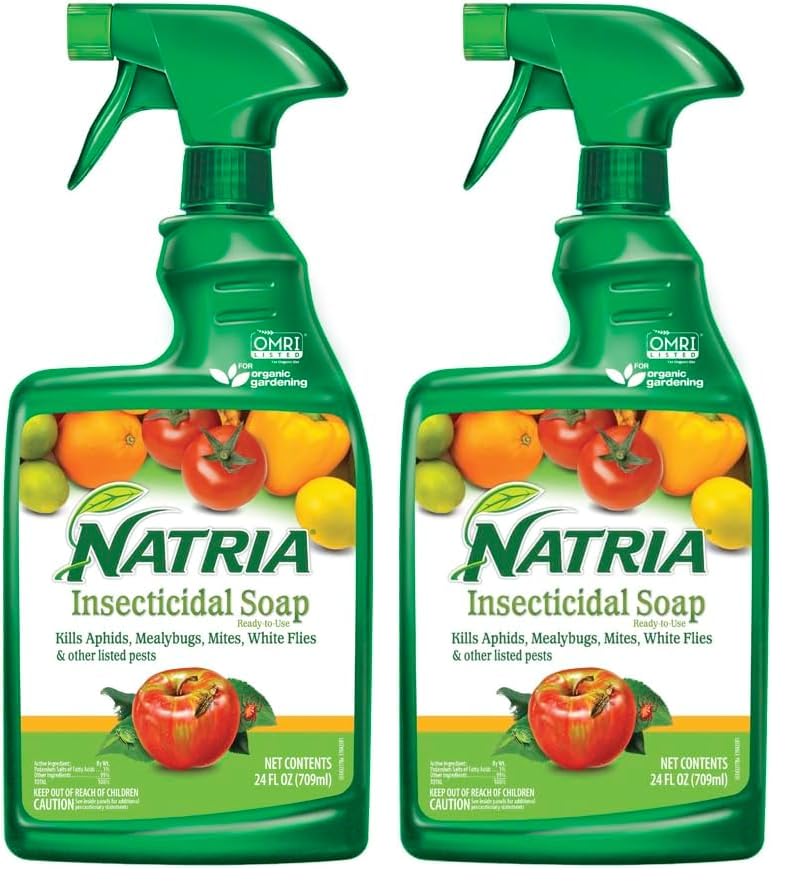
2. NATRIA Insecticidal Soap, Ready-to-Use Garden Bug Treatment, 24 Ounce (Pack of 2)
The no-mix, no-measure spray that lets you fight pests the moment you spot them.
This two-pack delivers 48 total fluid ounces of ready-to-use spray. You pull the trigger, and a 1% solution of potassium salts of fatty acids coats the leaves. It kills aphids, mealybugs, mites, and whiteflies in minutes. No measuring cup, no bucket, no waiting. For a single basil pot on the kitchen sill or a few plants on the patio, that convenience matters.
The active ingredient is exactly what you want — potassium salts of fatty acids at 1%. It works by contact, meaning you have to hit the bugs, not just the leaves. Customers note that spraying the plant and soil every other day cleared visible bugs in two weeks, though full eradication took six weeks of twice-weekly follow-ups. The trade-off: the sprayer bottle itself draws complaints. A common note is that it fails before the bottle empties, forcing a transfer to a different sprayer.
Volume is where this stands out. The NATRIA puts 48 fluid ounces of ready-to-use soap in your hands. Against the Safer 5118-6 concentrate (16 fl oz), the NATRIA looks bigger in the hand. But that 16 fl oz of concentrate makes many gallons of spray, so the NATRIA wins for grab-and-go convenience while the Safer wins for total reach.
Ready-to-use spray: The houseplant and patio gardener who wants to spray immediately without mixing — and who is willing to use a backup sprayer if the original gives out.
3. VPG Fertilome Natural Guard (40704) INSECTICIDAL SOAP

A powerful concentrate that targets lace bugs, spiders, and aphids — but demands your respect with dilution.
This is a 16-fluid-ounce concentrate from Fertilome, a brand gardeners know. It targets lace bugs, aphids, leafhoppers, earwigs, mites, and spiders. The spray is a contact killer that is gentle on the plant but tough on the insect. You can use it on fruit trees, vegetables, ornamentals, and citrus — basil fits right in.
The catch is real. Reviewers point out leaf damage even at half the recommended dosage, with one noting it “severely damaged the crop of spinach.” That suggests this formula is hotter than the Safer concentrate, and basil is a soft-leaf herb. If you use it, start with a weaker mix on a test leaf and wait 24 hours before spraying the whole plant. The small review pool (132 ratings) makes it harder to gauge how often this happens.
Stick with it if you have tough pests like lace bugs or heavy spider mite loads. For routine aphid maintenance on basil, the Safer concentrate is safer on the leaves.
Organic purists: The experienced gardener with tough, hard-to-kill pests on sturdy plants who is comfortable testing dilution on a single leaf first.
Sensitive noses: You have a precious basil plant with tender leaves and zero margin for burn — go with the Safer 5118-6 instead.
4. Safer Insect Killing Soap With Seaweed Extract Multiple Insects Spray 32 Oz
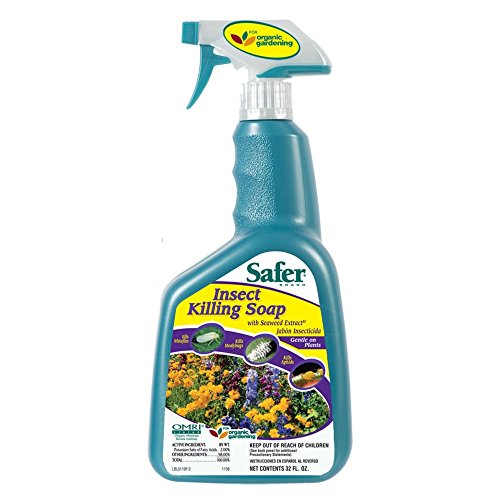
A ready-to-use soap that feeds the leaves while it kills the bugs — seaweed extract does both.
This 32-ounce spray comes straight from the bottle. No mixing, no math. It targets a wide range of insects on contact and is safe for vegetables, houseplants, and ornamentals. The twist is the seaweed extract mixed into the soap. Shoppers say it improves foliage greenness and does not burn plants like some harsher sprays. That matters for basil, where you want clean, green leaves you can actually eat.
One owner treated whiteflies and gnats with two applications: sprayed and left it on for three days, rinsed, then hit it again after two days. The pests were eliminated. Another owner battling a heavy grasshopper infestation found the Safer 5110 did a “pretty good job” — as good or better than anything else they had used, though they noted it was an uphill fight. The seaweed extract seems to help the plant bounce back while the soap does its work.
This is the pick for someone who wants a single bottle with no prep, plus the added benefit of seaweed nutrition for the leaves. It costs more per ounce than the NATRIA two-pack (32 fl oz vs. 48 fl oz), but the leaf-feeding bonus is unique to this bottle.
Plant health boost: You want a spray that both kills pests and greens up the foliage, and you do not want to mix anything.
Immediate results: You have a large area to cover — a concentrate will give you more spray per dollar.
5. Ecoworm Horticultural Soap Concentrate for Plants – Dilutable Plant Leaf Cleaner (34 fl oz)
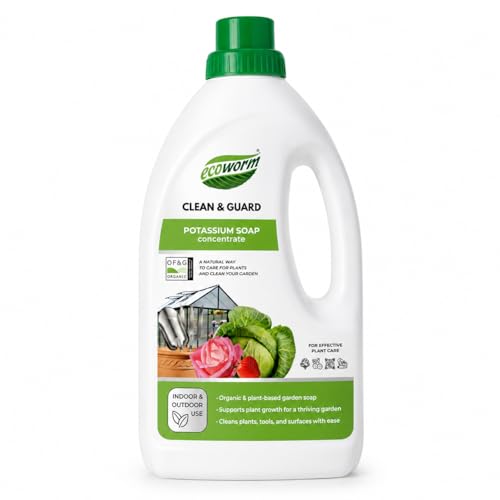
A 34-ounce concentrate that makes gallons of spray — the big-bottle solution for a full garden.
This is a potassium soap concentrate from Ecoworm, selling 34 fluid ounces in one bottle. The Ecoworm concentrate contains 34 fluid ounces, while the Safer 5118-6 concentrate is 16 fluid ounces. You mix it with water at a ratio of 200-600 ml (6.76 to 20.29 fl oz) of soap per 10 liters (338 fl oz) of water. That is a lot of spray. The label says it is suitable for houseplants, vegetables, herbs, flowers, and greenhouse use — basil is right at home here.
Buyers report great results, with one noting that pests disappeared within 24 hours. The soap is biodegradable and designed to wash away dust, residue, and sticky deposits from leaves while killing pests. The catch is the small review base (53 ratings), which gives less data on how consistently it works on basil specifically. Also, the mixing ratio is flexible, so you have to decide the right strength yourself — start at the weaker end for tender basil.
This is a volume play. You get the biggest concentrate bottle on this list. If you have a large vegetable garden with tomatoes, peppers, and basil all needing pest control, one bottle of Ecoworm goes further than any other concentrate here.
High volume use: The big garden owner who wants one bottle to make many gallons of soap and who is comfortable dialing in the dilution.
Small jobs: You have a single basil pot and do not want to store a large bottle for months.
6. Trifecta Crop Control Insecticidal Soap for Plants | All Natural Fungicide, Pesticide, Herbicide (32oz – 2 Pack)

A plant-based essential oil formula that works as an insecticide, fungicide, and miticide in one spray.
This two-pack delivers 64 total fluid ounces of ready-to-use spray. The formula uses plant-based essential oils instead of potassium salts, targeting spider mites, aphids, whiteflies, fungus gnats, and powdery mildew. It claims to be a 3-in-1: insecticide, fungicide, and miticide. That last part — powdery mildew control — is something none of the other soaps on this list address. For basil, which can get mildew in humid conditions, that is a real bonus.
The formula dries quickly and leaves no residue. Owners mention it works great on butterfly bushes and sunflowers, with one noting that “it is what all the canna growers talk about using in organic gardens.” But there is a catch: the ready-to-use formula requires 2 to 4 ounces per gallon of water, and one owner found the 4-ounce bottle did not last a single week of treatment. The 2-pack doubles that, but check the dosage against your infestation size.
This is the premium option for the grower who wants one bottle that covers both insects and fungus. The higher price reflects the essential oil ingredients and the dual-action capability.
Commercial growers: The serious gardener with a history of both pest and mildew problems who wants a natural, residue-free spray in a single product.
Houseplant users: You only need pest control and not fungicide — the simpler soaps above cost less and work just as well on basil pests.
Understanding the Specs
Potassium Salts of Fatty Acids
This is the active ingredient in nearly every insecticidal soap. It works by breaking down the waxy outer shell of soft-bodied insects like aphids and whiteflies. Once the shell is compromised, the insect dries out and dies — usually within minutes. The soap itself breaks down quickly in the environment, leaving no toxic residue. That is why you can spray it on herbs like basil and eat the leaves the same day.
Ready-to-Use vs. Concentrate
A ready-to-use spray comes pre-mixed and goes straight onto the leaves. It is the fastest way to fight an outbreak but costs more per bottle. A concentrate looks like a smaller bottle but makes gallons of finished spray when you add water. For a single basil plant, ready-to-use is convenient. For a whole garden, a concentrate saves money and reduces plastic waste.
FAQ
Can I spray insecticidal soap on basil and eat it the same day?
Will insecticidal soap hurt my basil leaves?
Does insecticidal soap kill aphids on contact?
How often should I spray insecticidal soap on basil?
Is insecticidal soap safe for bees and ladybugs?
Which is better for basil — concentrate or ready-to-use?
What pests does insecticidal soap kill on basil?
Does insecticidal soap expire?
Final Thoughts: The Verdict
For most gardeners, the insecticidal soap for basil winner is the Safer 5118-6 because it gives you the most spray per bottle (a 16-ounce concentrate that makes gallons), carries the OMRI organic label, and buyers confirm it kills 90% of aphids by day one. If you want grab-and-go convenience with zero mixing, grab the NATRIA insecticidal soap two-pack for 48 ounces of ready-to-use spray. And for the gardener fighting both pests and powdery mildew, the Trifecta Crop Control covers both with a single plant-based formula.
How We Picked
We do not accept paid placement. Every pick is matched to a real buyer and a real use-case; we do not hands-on test units.
Sources & Methodology
Specifications: manufacturer listings and product documentation. Review insights: verified customer reviews, as of July 2026. Pricing: not shown on this page (it changes often); check the current price via the retailer link.
As an Amazon Associate, Lawn Gear Lab earns from qualifying purchases. This does not affect which products we feature.