
Specs are compiled from manufacturer listings and verified buyer reviews and can change over time — please confirm the key details on the product page before buying.
You want a garden that looks cared-for without spending every Saturday hunched over a manual tool or wrestling with a gas tank, a pull cord, and earplugs. The right battery-powered tool starts with a button, runs quietly for early morning work, and eliminates fumes and gas station trips. The trick is picking a tool whose motor, battery, and blade match your actual yard chores, not the marketing hype.
I’m Rikta — the founder and writer behind Lawn Gear Lab. This guide is built by comparing the manufacturers’ published specifications and the patterns across verified customer reviews, so you get each pick’s real strengths and trade-offs instead of marketing spin.
From a cordless pruner that spares arthritic hands to a string trimmer that chews through knee-high brush, here are the gardening power tools that earn their spot in your shed with real-world performance, not promises.
Our Picks at a Glance

How To Choose The Best Gardening Power Tools
They now match gas counterparts on torque while weighing less and running quieter. Match the tool type to your specific task—pruning a fruit tree differs from tilling compacted soil or trimming a fence line.
Motor Type: Brushed vs. Brushless
It delivers more torque per watt, runs cooler, and lasts significantly longer because there are no brushes to wear out. Every tool on this list uses a brushless or high-efficiency motor for consistent power without the maintenance of older designs.
Battery System: Voltage and Amp-Hours
Voltage (20V, 40V) dictates raw power—higher voltage handles thicker cuts and tougher soil. Amp-hours (Ah), like a gas tank, determines runtime: a 4.0Ah battery lasts roughly twice as long as a 2.0Ah battery under the same load. If you have several cordless tools, sticking with one battery platform saves money and charging clutter.
Cutting Capacity and Tilling Width
For pruners and saws, look at “cut capacity” (the maximum branch thickness the blade can sever cleanly). For tillers, tilling width and depth tell you how fast you can prepare a garden bed. A wider cutting swath on a trimmer means fewer passes across the lawn.
Quick Comparison
| Model | Best For | Tool Weight | Cut Capacity / Width | Max Reach | Amazon |
|---|---|---|---|---|---|
| DEWALT 20V MAX Cordless Pruner★ Best Overall | Arthritis-friendly pruning | 5.3 lbs | 1.5″ cut capacity | Handheld | Amazon |
| Saker 22V TillerBest Value | Small beds & weeding | 15.1 lbs | 9″ width x 6.3″ depth | — | Amazon |
| TaskStar Cordless Tiller | Raised beds & flower borders | 12.8 lbs | 9″ width x 7″ depth | — | Amazon |
| CRAFTSMAN V20 Multi-Use Tool | Hole digging & planting | 6.8 lbs | 6″ depth (auger) | — | Amazon |
| Autubin 2-in-1 Pole Saw | High branch trimming | 6.9 lbs | 8″ chain length | 16 ft | Amazon |
| SEESII 2-in-1 Pole Pruner | Precision orchard pruning | 6.4 lbs | 1.6″ cut capacity | 9 ft (pole) | Amazon |
| Greenworks 40V String Trimmer | Large yards & brush | 16.12 lbs | 17″ cutting swath | — | Amazon |
In‑Depth Reviews
1. DEWALT Dewalt 20V MAX Cordless Pruner (DCPR320D1), Yellow
Our pick — over 4.5★ from 650+ verified ratings; the strongest balance of quality and price.
The electric pruner that makes arthritis sufferers smile and branches vanish in one squeeze.
This DEWALT pruner weighs only 5.3 pounds—surprisingly light compared to a gas tool or even a heavy manual lopper—yet it delivers a 1.5-inch cut capacity on an anvil-style blade. That means it does not crush the branch; it slices cleanly, which helps plants heal faster. The on-board LED work light is a small touch that makes a big difference when you are pruning into a shady corner or working late in the evening.
Buyers report that with arthritis in their hands, manual clippers have become too hard to use, but this pruner, as one owner put it, “makes it a breeze” and “will easily cut branches over 1″ in diameter.” The battery lasts long enough for over 100 cuts per charge, so a full yard of trimming is well within reach. The safety guard and trigger system are effective, though there is no belt hook or lanyard hole—a minor ergonomic trade-off for a tool that otherwise earns unanimous praise.
The crowd reaction is overwhelmingly positive: 4.8 stars across over 660 ratings backs up the “excellent product” verdict, making this the most reliably loved tool in the lineup
Where It Shines
- One-squeeze cut through branches over an inch thick
- On-board LED for low-light pruning
- Battery handles 100+ cuts per charge
The Trade-Offs
- No belt hook or lanyard attachment point
- Premium pricing for the tool and battery package
Grab it if: you have arthritis or weak grip and still want a clean, efficient prune on branches up to 1.5 inches.
Look elsewhere if: you need a tool for heavy limbing above your head—this is a handheld pruner, not a pole saw.
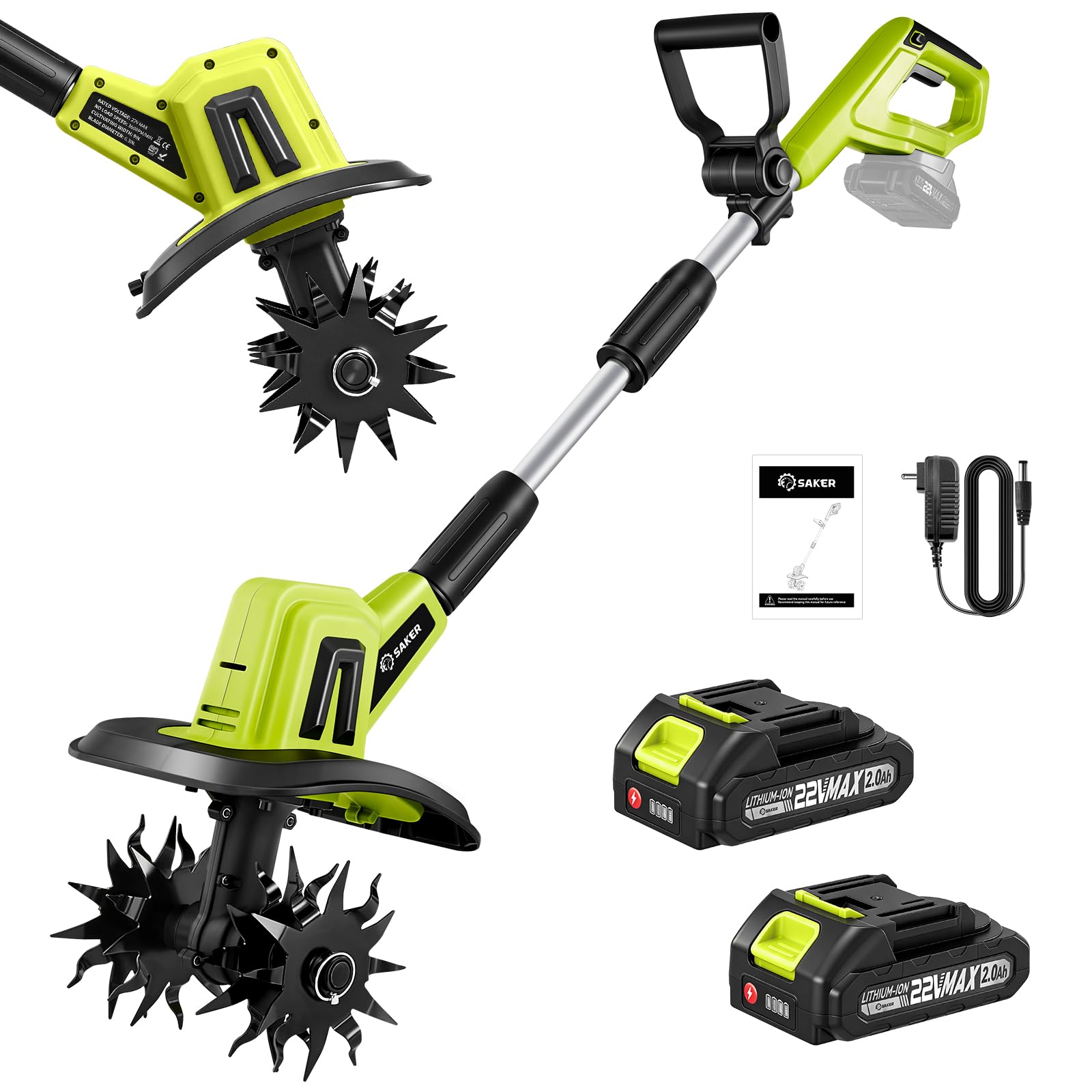
2. Saker 22V Cordless Electric Garden Tiller Cultivator
A lightweight tiller that punches above its weight for small beds and sandy soil.
At 6.85 kilograms (just over 15 pounds), the Saker tiller is manageable enough for a senior gardener to maneuver, yet its high-performance motor spins the tines at 360 RPM. You get a 9-inch tilling width and a 6.3-inch tilling depth—enough to loosen dry, packed soil in a raised bed or prepare a new planting strip. The dual safety protection (a button and trigger that must be engaged together) prevents accidental startup, a thoughtful touch if you have kids or pets around.
Owners consistently praise the power relative to the price, with one commenting that “given the low cost, I wasn’t sure it would do the job” before being impressed. The two 22V 2.0Ah lithium-ion batteries each offer up to 30 minutes of runtime, and swapping them is quick with the tool-free battery change. One repeated note: it works beautifully in sandy soil and loose dirt, but it struggles with hard clay—multiple passes can loosen it, but it is not a substitute for a gas tiller on unbroken ground. The lack of a rear guard means you should be careful when pulling backward to avoid your feet.
Overall, the performance and quality of this tiller earn it 4.6 stars from 300 ratings, and the twin battery system removes any cordless anxiety.
What Wins People Over
- Two batteries included for extended runtime
- Light weight and ergonomic handle reduce fatigue
- Dual-button safety prevents accidental start
The Fine Print
- Not designed for hard, compacted clay soil
- No rear guard—watch your feet when pulling back
Perfect for: a homeowner with a small vegetable patch or flower beds who wants cordless freedom without spending a premium.
skip it if: you need to break new ground in heavy clay—reach for a gas tiller instead.
3. Greenworks 40V 17-Inch Brushless String Trimmer

The 40V brute that handles a half-acre lot without bogging down or smelling like gas.
With a 17-inch cutting swath and a brushless motor that delivers gas-equivalent torque, this Greenworks trimmer is built for serious yard work. The high-visibility guard keeps you from accidentally clipping your flower bed, and the Load-N-Go head lets you reload line in about ten seconds—no bump feed, no manual winding. It uses dual 0.105-inch spiral twist line that cuts cleanly through thick weeds, vines, and brambles, and the 2-speed variable trigger gives you low-speed control for edging or high-speed power for heavy brush.
Owners consistently note that it “cuts knee-high grass, thistle, and brambles” and that it runs over 30 minutes on a 4.0Ah battery through tough vegetation. The included 8Ah battery paired with a rapid charger means less downtime, though the battery life draws a mixed response—some find 20-30 minutes ample, others wish for longer runtime. The trimmer throws debris heavily, so it is best suited for larger properties where you can let the cuttings lie, rather than neat small lots. Despite that, the reliability and quality of this trimmer make it the top pick for anyone with a big lawn who wants to ditch the gas can.
Why It Leads
- 17-inch cutting swath covers ground fast
- Load-N-Go head for instant line reloading
- 8Ah battery provides high capacity and fast recharge
Honest Caveats
- Battery runtime varies; heavy work drains it in 20-30 min
- Throws debris heavily—not ideal for tiny, tidy lawns
Reach for this if: you have a half-acre or larger lot with thick overgrowth and want gas-like power without the fumes.
Think twice if: you have a small, neat lawn where debris kick-up would be a problem.
4. TaskStar Cordless Tiller Cultivator
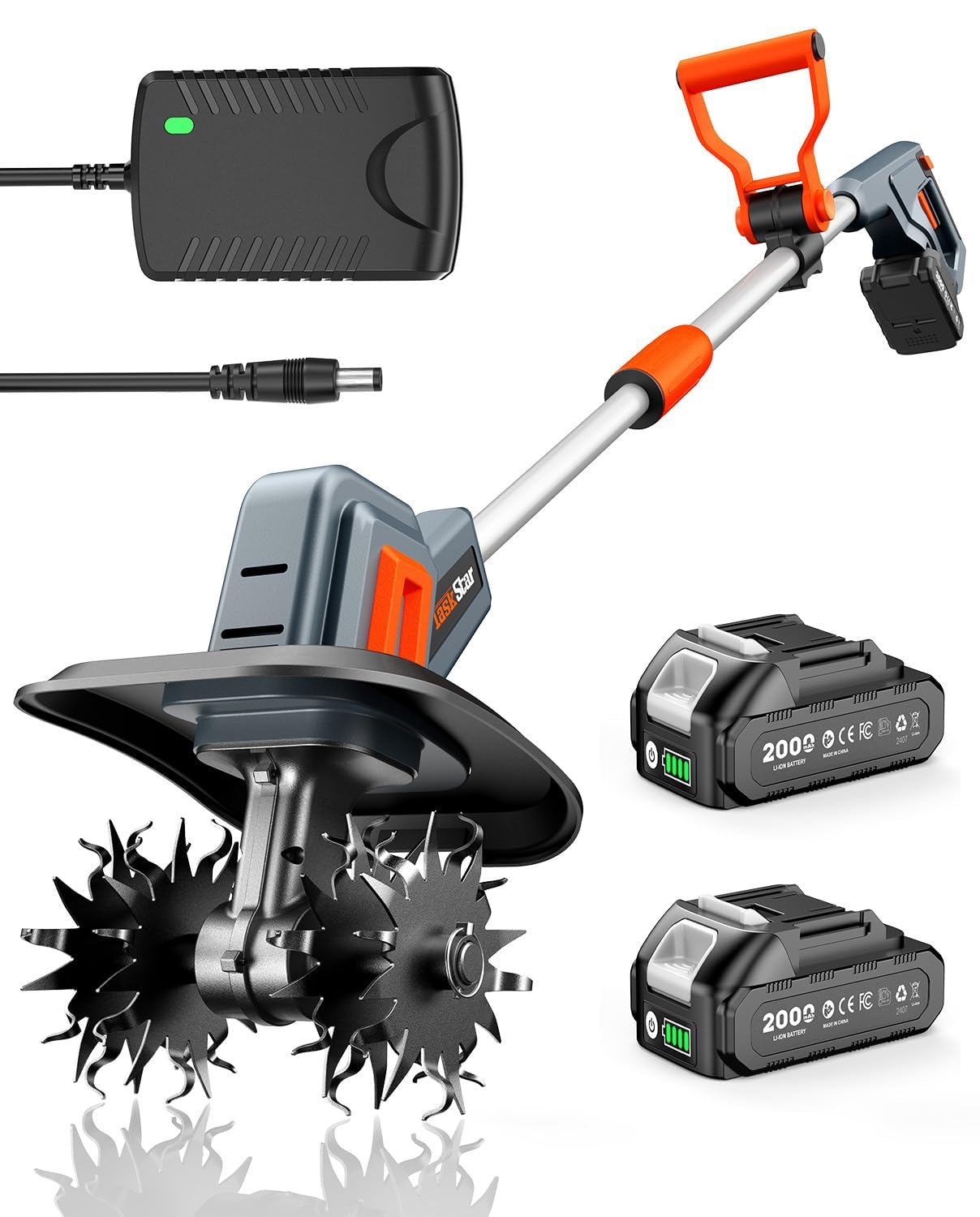
The 12.8-pound tiller with 48 steel tines that turns compacted soil into garden-ready dirt.
Where the Saker tiller is light but needs loose ground, the TaskStar weighs 12.8 pounds and uses 48 heavy-duty steel tines to break ground more aggressively. Its 9-inch tilling width and 7-inch tilling depth make it suited for raised garden beds, flower borders, and vegetable plots, and the 360 RPM motor delivers consistent power without the cord hassle. The orange color is a nice bonus for visibility in the garden.
Owners mention that this “little beast” is “surprisingly powerful” and that it “turns dirt to powder on tilled ground” while managing unbroken ground with multiple passes. The two 2.0Ah batteries (total 4000mAh) each offer 20-30 minutes of runtime, and swap quickly. The main frustration is that weeds and tall grass can tangle in the tines, requiring you to stop and clear them. Assembly is straightforward, though the instructions are sparse—most owners had it together in under five minutes. A solid performer backed by a 3-year manufacturer warranty, it is a versatile pick for anyone who wants a cordless tiller that actually digs in.
Its Strongest Features
- 48 tines provide excellent soil penetration
- Comes with two batteries for continuous work
- 3-year manufacturer warranty offers confidence
The Downsides
- Weeds and tall grass wrap around the tines
- Instructions are not the clearest
Ideal for: gardeners who need a reliable battery tiller for flower beds and small vegetable plots and want a warranty to back it.
Not ideal if: you want a tiller that can rip through heavy weeds without tangling.
5. Autubin 2-in-1 Cordless Pole Saw & Mini Chainsaw
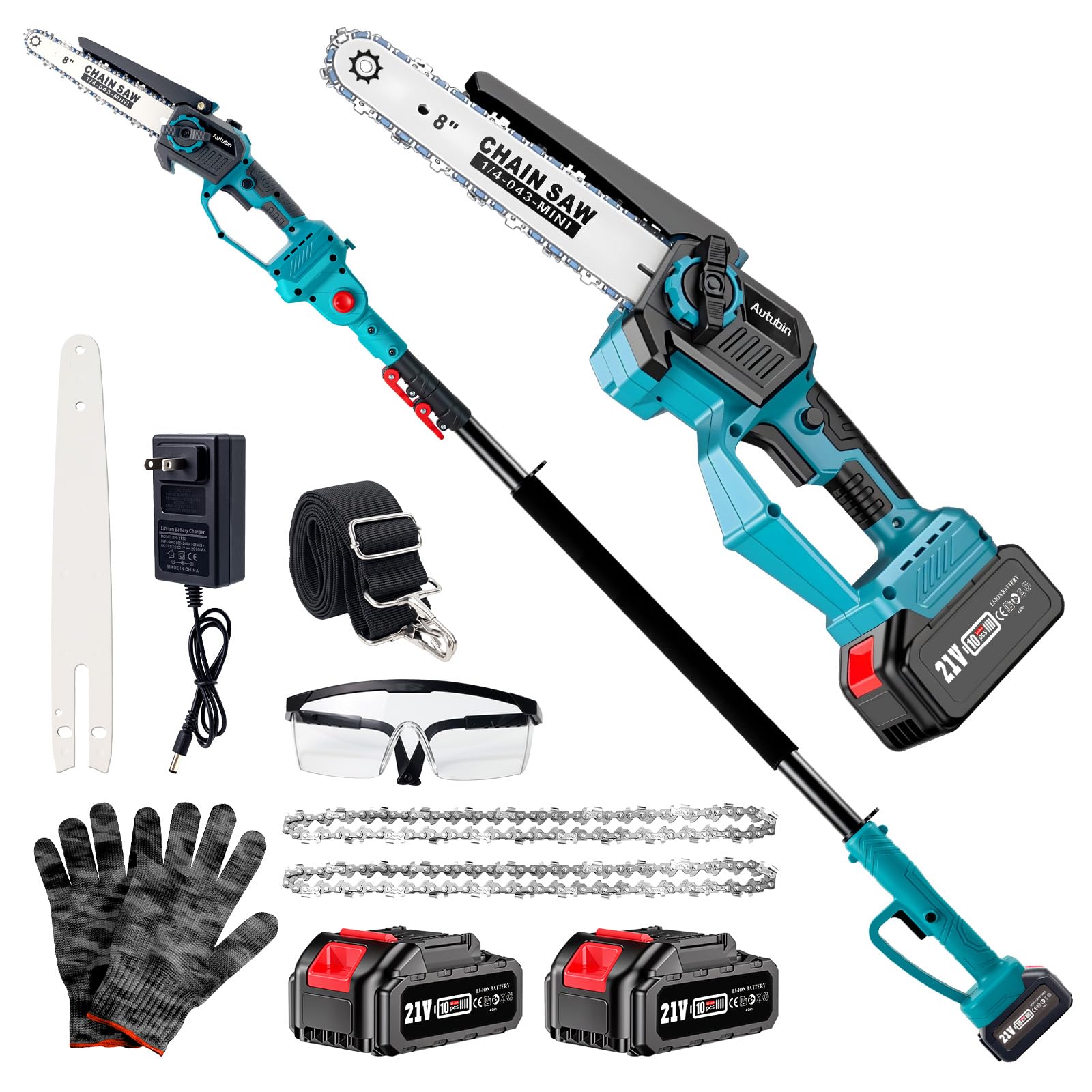
The two-in-one that reaches 16 feet up as a pole saw and cuts in tight spots as a mini chainsaw.
This is the tool for anyone with overhanging branches that require a ladder—or who simply prefers to keep both feet planted on the ground. The Autubin converts from a handheld 8-inch mini chainsaw into a pole saw with an adjustable extension pole that reaches up to 16 feet (based on a 6-foot user). The 5°-175° rotating cutting head lets you position the blade overhead without straining your wrists. A 1200W pure copper brushless motor drives the chain at 26.2 ft/s, and the automatic oiling system keeps everything running smoothly.
Owners say it is “small but mighty” and cuts 2- to 3-inch branches with ease. The two 21V 4.0Ah batteries give a continuous runtime of about 100 minutes, and the visual LED screen shows the remaining power. No lubricating oil is included, and the small oil reservoir needs refilling every 30 minutes—something to keep in mind. It is not a logging tool for big trunks, but for trimming trees and bushes around the yard, it is a lightweight powerhouse at 6.9 pounds.
What Makes It Useful
- Converts between handheld chainsaw and 16-ft pole saw
- Rotating cutting head for overhead angles
- Auto-oiling system for chain maintenance
Points to Consider
- No lubricating oil included in the box
- Small oil reservoir needs refilling every 30 minutes
Get this if: you have lots of high branches that make you drag out a ladder—the pole mode saves time and risk.
pass on it if: you need to fell trees or cut logs thicker than 3 inches.
6. SEESII 2-in-1 Pole Pruning Shears
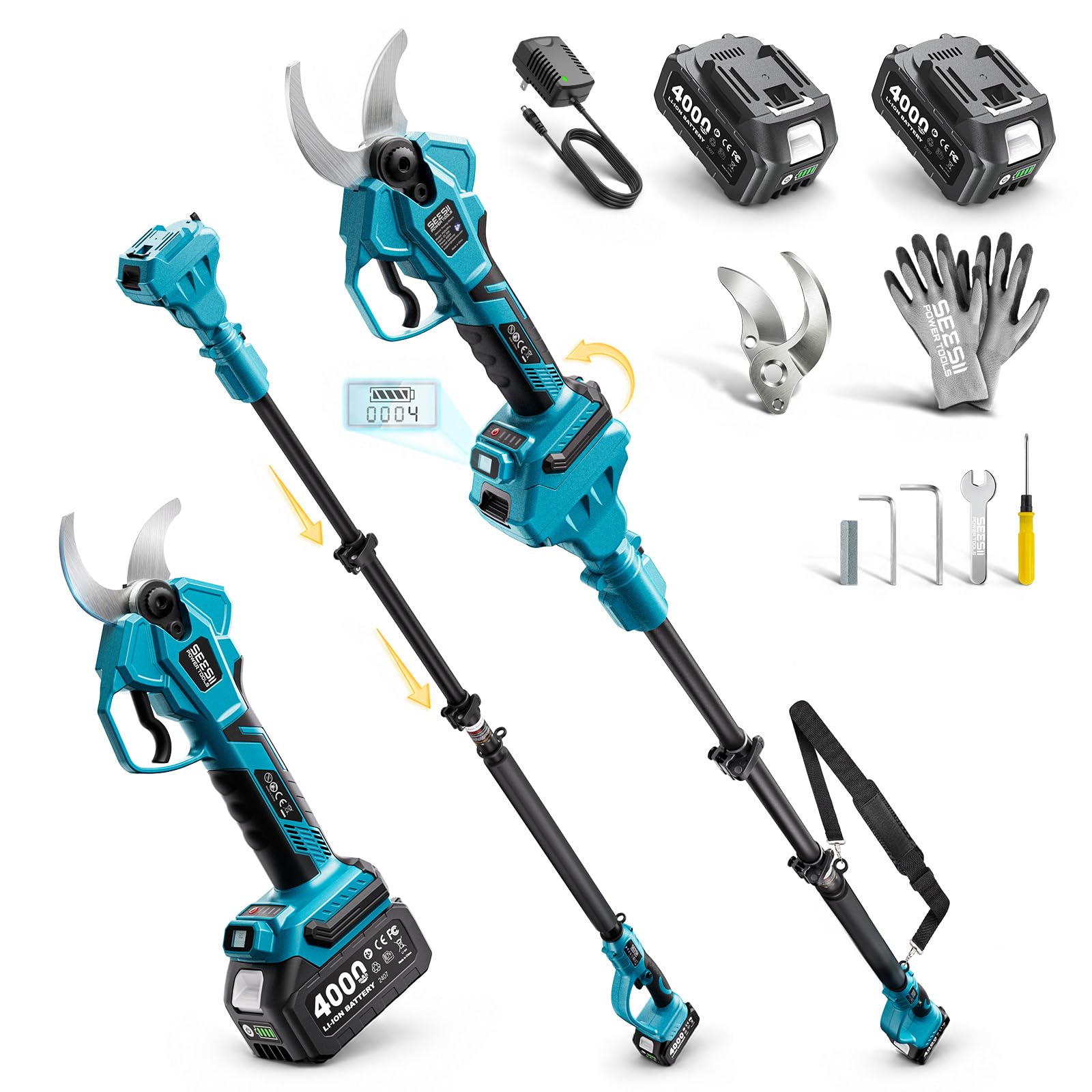
The pruning shears that go through branches like butter and reach 9 feet into the canopy.
This is an electric pruner with a twist: a telescopic pole that extends from 4.9 to 9 feet, so you can trim overhead branches without lifting heavy machinery. The brushless motor drives a bypass blade made of SK5 high-carbon steel that cuts branches up to 1.6 inches thick—about the size of a thick wrist—in one second. The 180° rotating head helps you angle the blade for vertical, side, or overhead cuts without repositioning the entire tool.
Owners consistently praise the four adjustable cutting modes, which let you dial in the force for different branch diameters. The dual 4.0Ah batteries deliver over 2500 cuts per charge, so you can prune an entire orchard in a single session. One owner noted that the “extension pole with adjustable angle” made pruning their crepe myrtle easy, while another pointed out that the included spare SK5 blade is a welcome bonus. The primary minor complaint is that the “storage case” is actually a basic cardboard box, not a hard case. At 6.4 pounds, it is one of the lightest pole pruners available, and with 4.7 stars from 207 ratings, it is clear owners are thrilled.
Why It Impresses
- Cuts branches up to 1.6 inches in one sec
- Four adjustable cutting modes for precision
- Dual 4.0Ah batteries for over 2500 cuts per charge
Where It Falls Short
- Storage case is a cardboard box, not a hard case
- Manual is poorly written
Best for: serious gardeners who prune fruit trees, shrubs, or ornamental trees and want a clean, easy cut without hand fatigue.
Not for: anyone who needs a heavy-duty branch lopper for branches over 1.6 inches.
7. CRAFTSMAN V20 Cordless Multi-Use Garden Tool Kit (1.5Ah)

The inexpensive auger tool that digs up to 25 holes per minute.
If your main gardening task is digging planting holes for bulbs, perennials, or small trees, this Craftsman kit is a bargain. It is essentially a handheld auger powered by a 20V battery. It can dig a 6-inch depth hole up to 25 times per minute, and a single 1.5Ah battery is rated for 165 holes per charge. The alloy steel blade busts through fine roots easily, and the auxiliary handle with three gripping surfaces gives you plenty of control.
On the performance front, customers note that it handles “dense ground, runners, and rocks” but caution that it can torque the wrists unexpectedly if you hit a big root or stone. One reviewer in Arizona dug a 24-gallon tree hole and four 5-gallon holes on a single charge in rocky clay. The battery life draws mixed responses—some wish for longer runtime, but for the price, the value is tough to top. It is light at 6.8 pounds and compact enough for tight spaces like a crawl space. The trade-off is that it is a specialized tool for hole-digging, not a versatile cutter or tiller.
What It Does Best
- Digs up to 165 holes per charge for fast planting
- Lightweight at 6.8 pounds for extended use
- Backed by Craftsman’s brand reputation
The Trade-Offs
- Can torque wrists unexpectedly on dense ground
- Battery life is mixed; second battery recommended
Perfect for: a weekend gardener planting a lot of bulbs, perennials, or small trees who wants to save time and effort.
it’s not for you if: you need a tool for general pruning, tilling, or trimming—this is a hole-digging specialist.
Understanding the Specs
Brushless vs. Brushed Motor
It uses electronic commutation instead of physical brushes, so there is less friction, less heat, and significantly longer lifespan. It also delivers more torque per watt of battery power, meaning the tool cuts or tills harder without bogging down. Almost every top-performing cordless tool now uses a brushless motor. You will see it listed on pruners, trimmers, and pole saws as a mark of efficiency and durability.
Battery Amp-Hours (Ah) and Runtime
The Amp-hour (Ah) rating on a battery tells you its energy capacity. A 4.0Ah battery can deliver twice the runtime of a 2.0Ah battery at the same voltage. For light tasks like pruning small branches, a lower Ah battery is fine. For heavy work like tilling compacted soil or trimming thick weeds, a larger Ah battery (4.0Ah or higher) gives you enough power to finish the job without a mid-task battery swap. Always check the included Ah rating—some tools come with one battery, others with two, which doubles your effective runtime.
Cut Capacity and Tilling Depth
“Cut capacity” (in inches) is the maximum branch thickness a pruner or saw can sever. For garden pruning, a 1.5-inch capacity covers most shrubs and small tree limbs. Tilling depth and width tell you how deep and wide a tiller can break ground—9 inches wide by 6-7 inches deep is standard for home vegetable beds. A wider tilling width means fewer passes across the bed, and a greater depth means better aeration for root systems.
Pole Reach and Rotating Heads
For tools with a pole attachment, “max reach” (in feet) tells you how high you can cut while standing on the ground. A 16-foot reach is enough for most single-story eaves and medium-height trees. A rotating head (often 180° or 5°-175°) lets you angle the blade or cutting head for side branches or overhead cuts without repositioning your body. This is a big deal for ergonomics—it saves your shoulders and wrists from awkward angles.
FAQ
Can a cordless pruner handle branches thicker than 1.5 inches?
How long does the battery last on a cordless tiller?
Is a brushless motor worth the extra cost?
What voltage do I need for heavy-duty garden work?
Will a cordless pole saw reach my second-story tree branches?
Can I use a cordless tiller on unbroken ground?
How often should I sharpen the blades on my pruner or saw?
What is the difference between an anvil blade and a bypass blade?
Do cordless garden tools work in wet conditions?
Can I use a different brand’s battery with my tool?
Final Thoughts: The Verdict
For most people, the gardening power tools winner is the DEWALT 20V Cordless Pruner because it handles the most common garden chore—branch pruning—with easy ease, a 1.5-inch cut capacity, and the highest rating in the lineup. If you want to tackle overgrown weeds and large lawns, grab the Greenworks 40V String Trimmer. And for digging planting holes without a shovel, the CRAFTSMAN V20 Multi-Use Tool is the one to reach for. The crowd has spoken, and the numbers are clear: DEWALT leads on rating, Greenworks on raw power, and Craftsman on value per dollar.
How We Picked
We do not accept paid placement. Every pick is matched to a real buyer and a real use-case; we do not hands-on test units.
Sources & Methodology
Specifications: manufacturer listings and product documentation. Review insights: verified customer reviews, as of July 2026. Pricing: not shown on this page (it changes often); check the current price via the retailer link.
As an Amazon Associate, Lawn Gear Lab earns from qualifying purchases. This does not affect which products we feature.