
Specs are compiled from manufacturer listings and verified buyer reviews and can change over time — please confirm the key details on the product page before buying.
Laying down plastic sheeting should mean one thing: no more weeds poking through your flower beds or gravel paths. But the wrong choice tears on installation, lets sunlight sneak through, or breaks down after one season. You need a barrier that blocks what is below while letting water and air reach your plants, and that holds up under rocks, foot traffic, and the weather. This guide cuts through the noise to find the sheeting that actually delivers on that promise.
I’m Rikta — the founder and writer behind Lawn Gear Lab. This guide is built by comparing the manufacturers’ published specifications and the patterns across verified customer reviews, so you get each pick’s real strengths and trade-offs instead of marketing spin.
Whether you are tackling a garden bed, a gravel driveway, or a retaining wall, the right landscape plastic sheeting has to balance thickness, permeability, and durability to keep your project weed-free for years.
Our Picks at a Glance

How To Choose The Best Landscape Plastic Sheeting
Choosing the right sheeting is not about grabbing the thickest or the cheapest roll. You have to match the material to your project, or you will be pulling up weeds in a month.
Weight and thickness: the ounce-per-yard reality check
The weight of the fabric is measured in ounces per square yard. A 3.2 oz fabric is entry-level — fine for light flower beds under mulch, but it will tear under sharp rocks or heavy foot traffic. A 5 oz fabric, like the VIVOSUN, is genuinely heavy-duty and will take daily walking without ripping. A 6 mil solid plastic sheet is a different beast — it blocks all air and water and is best used as a vapor barrier, not under plants.
Permeability or plastic sheet: what your plants need
The biggest mistake is using a solid plastic tarp (like standard painters’ plastic) under a garden. It traps water, suffocates roots, and creates a swamp. Woven fabrics and dual-layer designs let rain and air pass through while blocking sunlight. If your project involves plants, you need a permeable fabric. If you are covering a driveway or French drain, a heavier, water-passing geotextile is the better choice.
Installation and edge fraying: the hidden frustration
A good fabric is easy to cut but does not turn into a mess of loose threads the moment you make a slice. Woven polypropylene fabrics often fray at the cut edges — some buyers report it worsens over time. The VIVOSUN and the 3FT x300FT commercial roll both get notes about this. A heat-sealed edge or a careful cut with a sharp blade helps a lot. Always plan your cuts and use landscape staples that are long enough (6 inches is the common recommendation) to hold the fabric tight.
Quick Comparison
| Model | Best For | Weight / Thickness | Width x Length | Material | Amazon |
|---|---|---|---|---|---|
| VIVOSUN Premium Weed Barrier★ Best Overall | Best Overall | 5 oz | 3 x 100 ft | Non-woven + woven | Amazon |
| Winisok 4FT x 100FTBest Value | Best Value | 3.2 oz | 4 x 100 ft | Woven polypropylene | Amazon |
| Winisok 3FT x 100FT | Solid all-rounder | 3.2 oz | 3 x 100 ft | Woven polypropylene | Amazon |
| HOOPLE 3FT x300FT | Large projects | Heavy duty | 3 x 300 ft | Woven polypropylene | Amazon |
| DWALE Driveway Fabric 6×300 ft | Driveways / erosion | 3.5 oz | 6 x 300 ft | Polyethylene (PE) | Amazon |
| Farm Plastic Supply 6 mil Sheeting | Vapor barrier / coverage | 6 mil | 10 x 100 ft | LDPE | Amazon |
In-Depth Reviews
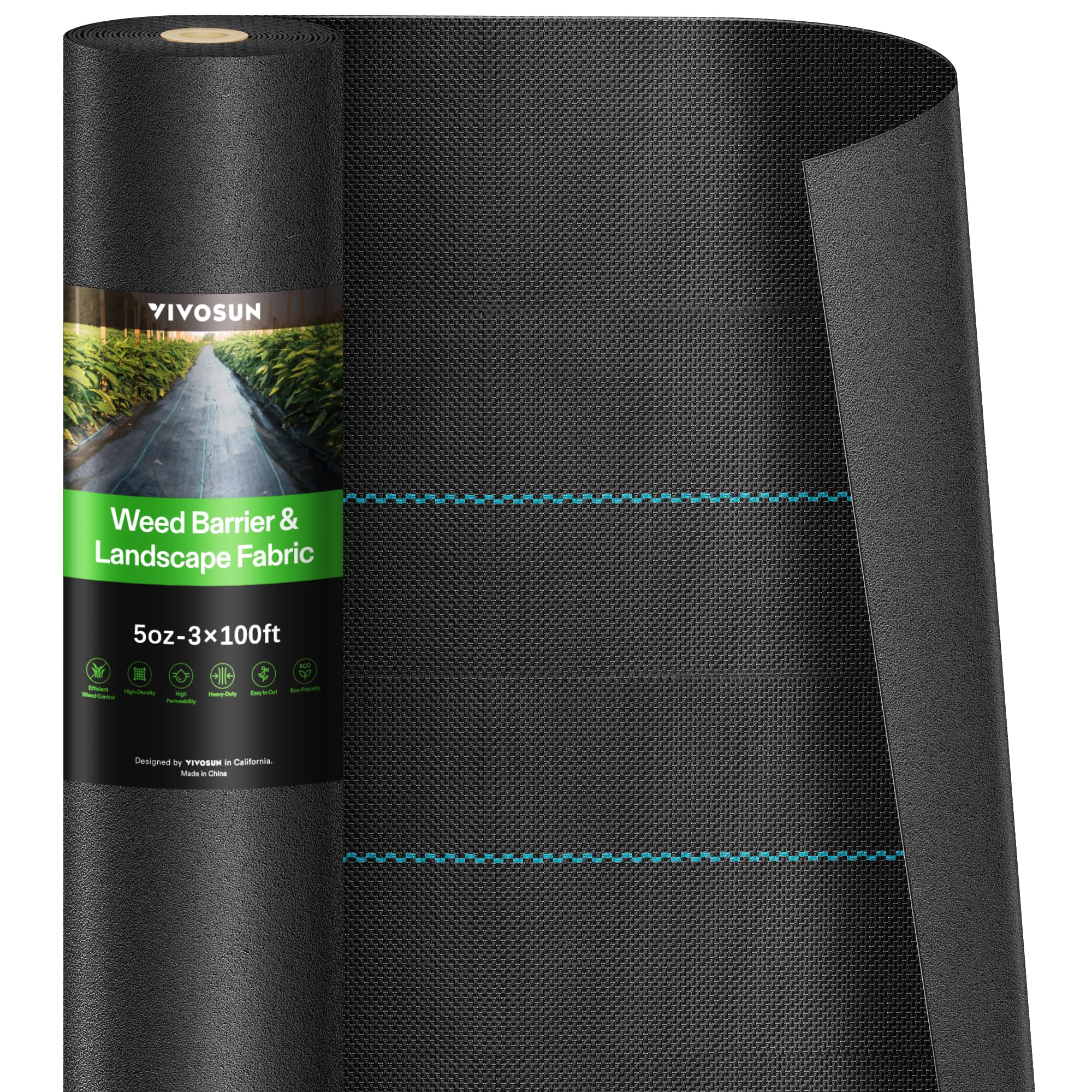
1. VIVOSUN Premium Weed Barrier Landscape Fabric Heavy Duty 3ftx100ft
Our pick — over 4.5★ from 900+ verified ratings; the strongest balance of quality and price.
The 5 oz dual-layer barrier that takes daily foot traffic without giving in.
This is the pick that owners describe as “strong and thick” — and the numbers back it up. At 5 oz, the VIVOSUN is heavier than the 3.2 oz entry-level fabrics (the Winisok options are 3.2 oz). That weight comes from a clever dual-layer construction, combining a non-woven and a woven layer through a needle-punching process. The result is a fabric that lets water pass through at six times the rate of traditional woven ground covers — so rain reaches your roots — while still blocking sunlight and UV rays that feed weeds. Owners mention walking on it every day around garden beds without rips or holes.
The real-world edge here is that the fabric stays put. The green line guides printed every foot make plant alignment simple, and the cut edges fray noticeably less than woven-only rolls, thanks to that bonded construction. Of the 923 ratings, quality and effectiveness are the two most-praised aspects by a wide margin. A recurring sentiment in the reviews sums it up: “excellent quality working great around garden beds, we walk on everyday holding up great.” The catch is that weed resistance gets a mixed response — some owners note that persistent weeds can still push through if the fabric is not covered with enough mulch or stone. That is true of any barrier, but it is worth knowing.
The VIVOSUN is simply a heavier, more substantial sheet that will hold up longer under abuse.
What wins people over: That dual-layer build is the standout. It is thick enough to hold up under heavy stone or foot traffic, but still lets air and water through. The green grid lines are a practical bonus for anyone planting in rows.
One honest limitation: A few owners mention that some weeds still find a way through. Plan for a generous layer of mulch (2-3 inches) on top, and use plenty of landscape staples — 6-inch ones are recommended — to keep the fabric flush against the soil.
Who it suits: Anyone with a garden bed, flower border, or rock path who wants a single fabric that will last multiple seasons and take daily traffic without tearing.
Think twice if: You are on a tight budget or need to cover an enormous area — the 3ft x 100ft size is generous for a home garden but not the cheapest per foot.
2. Winisok 4FT x 100FT Weed Barrier Landscape Fabric, 3.2oz
A wide-format fabric that keeps water moving and weeds out for over five years.
If you need a 4-foot-wide roll to cover a wide bed or path without needing multiple overlapping strips, this is the one. The Winisok 4FT x 100FT is a 3.2 oz woven polypropylene fabric built to last more than five years, according to the manufacturer. Owners confirm it — “strong, but the water still gets through” is a frequent line in the reviews, and that is exactly what you want: a barrier that blocks light for weeds while keeping the soil and roots hydrated. The 801 ratings average out to a solid 4.4 stars, with quality and functionality leading the positives.
Installation is straightforward — no tools required beyond a sharp blade or scissors. The green stripes help with alignment and trimming, and the fabric is designed to sit under mulch, gravel, or stone. The 4-foot width is the real selling point if you are covering a wide area; it means fewer seams and less risk of weeds sneaking through the gaps. The water permeability is praised across the board, with owners noting that their plants are growing well and the garden stays weed-free.
Where this fabric differs from the VIVOSUN is weight and feel. At 7.59 pounds per roll, it is lighter and less dense — it is a 3.2 oz fabric versus the VIVOSUN’s 5 oz. That makes it easier to handle and cut, but it also means it can fray more at the edges. Some owners note that it shreds easily when cut, releasing small plastic strands, so a sharp blade and careful handling matter here.
The biggest praise: The 4-foot width and the fact that water passes through without pooling. Owners say it is “thick and durable” and that their gardens are “weed free” with plants growing great.
The trade-off: Fraying at cut edges is a real issue. Use a very sharp utility knife on a hard surface, and consider a quick pass with a lighter to seal the cut edges if the fraying bothers you.
Reach for this if: You have a wide flower bed, a large vegetable garden, or a path that needs a single 4-foot-wide sheet — it saves you the hassle of overlapping narrower rolls.
Look elsewhere if: You need an ultra-heavy barrier for a driveway or a commercial job with sharp rocks rolling over it — the 3.2 oz weight is better suited to garden soil and mulch.
3. Winisok 3FT x 100FT Weed Barrier Landscape Fabric, 3.2oz
A 3-foot roll that is easy to lay down and stays weed-free long after installation.
This is the narrower sibling of the 4-foot Winisok above, and it holds the same 3.2 oz weight and woven polypropylene construction. The key difference is the width (3 feet vs 4 feet), which makes it a better fit for standard garden beds, narrow paths, and borders. Owners consistently say it was “easy to lay down and trim” and that it has prevented weeds “after over a month of being down” — one buyer even bought it twice to create a base layer for a rock garden, and it is still working perfectly months later. With a 4.5-star average from 721 ratings, it is one of the highest-rated picks in this roundup.
The green alignment lines are a practical feature here too. One owner pointed out that “the straight lines are very helpful when laying out on the ground,” which is a small detail but saves time when you are trying to keep rows straight. The fabric is designed to block sunlight from reaching weeds, and it can be laid directly over existing weeds or on a cleared surface. The water permeability is good enough that plants grow faster, according to owners, and the 3.2 oz weight is light enough to cut with good scissors — though a few owners do warn against using scissors because of fraying.
Compared to the 4-foot version, this is the same 3.2 oz fabric in a 3-foot width. If you do not need the extra width, the 3-foot roll is a smarter buy because the narrower width is easier to manage solo — you can roll it out and staple it without needing a helper to hold the far edge.
What owners love: The straight-line guides for plant alignment and the fact that it works perfectly as a base layer for rock gardens and gravel paths. One owner sums it up: “works perfectly.”
The honest trade-off: Like most woven fabrics at this weight, fraying at cut edges is a recurring note. A sharp utility knife and a steady hand make a big difference. Also, do not plan to reuse it yearly if you move your garden layout around — the fabric is not made for that.
Ideal for: A home gardener or DIYer with a standard-size flower bed, vegetable patch, or narrow path who wants a reliable, easy-to-install barrier without spending on a premium 5 oz fabric.
Not for: Heavy commercial use or areas where sharp-edged stones will sit directly on the fabric — the 3.2 oz weight can puncture under that kind of load. Go up to the VIVOSUN for that scenario.
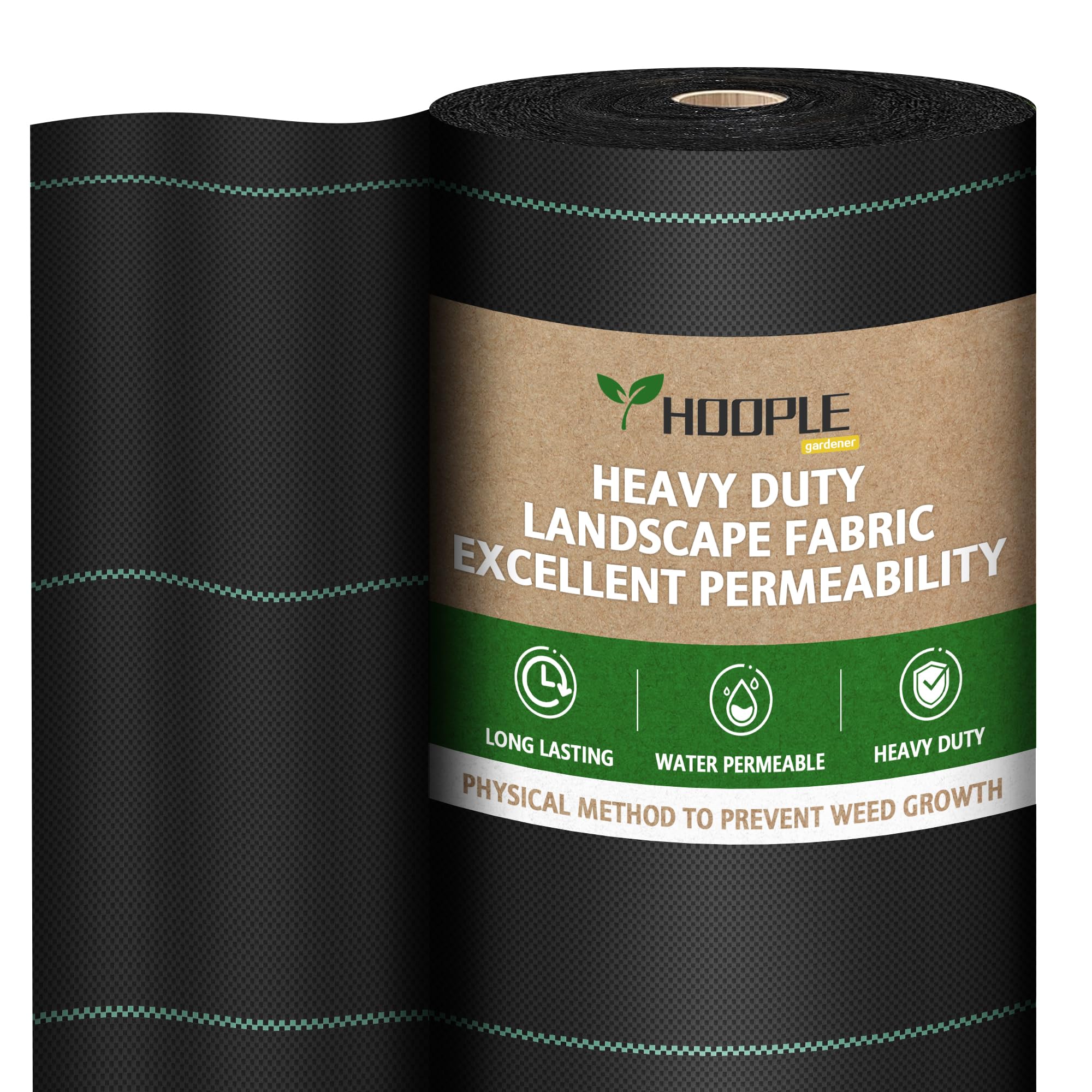
4. 3FT x300FT Heavy Duty Weed Barrier Fabric (HOOPLE)
A massive 300-foot roll built to handle driveways, gravel, and commercial-scale landscaping.
When the project is measured in hundreds of feet — a long driveway, a large commercial bed, or multiple farm paths — a standard 100-foot roll means you are buying three rolls and constantly managing seams. This HOOPLE fabric comes in a single 300-foot roll (3 feet wide) and is made from heavy-duty woven polypropylene designed to withstand vehicle loads and harsh weather. At 906 ratings with a 4.4-star average, it is a crowd favorite for large-scale work. The maker says the woven construction offers high tensile strength and tear resistance, so you can lay gravel or stone on top of it without worrying about punctures.
Owners note that it is “easy to install” and that it does stop weeds effectively. A repeat buyer says: “Repeat purchase. Loved it first time. Love it now. Easy to install. Works well.” The material is a woven plastic, which means it is breathable — air, water, and nutrients can reach the soil below, so it works for garden beds and not just hardscapes. However, the woven nature also means it can shred at cut edges, releasing small plastic fibers.
At 17.01 pounds for the full roll, this is a heavy unit — expect to need a helper or a cart to move it into position. But if you are covering a large area, that is the price of convenience versus buying multiple smaller rolls.
Why it stands out: The 300-foot length is the single biggest advantage — it eliminates seams on long runs, which means fewer places for weeds to sneak through.
The thing to watch for: Fraying at cut edges is the most frequent owner complaint. Use a very sharp blade and cut on a hard surface. A heat source (like a torch or lighter) can seal the edges if you are careful — some owners do this to stop the fraying entirely.
Best suited for: Large-scale projects — long driveways, commercial landscaping, farm paths, or any area where a single, continuous sheet saves time and money.
Pass on it if: You only need 100 feet or less — the 300-foot roll is heavy and bulky to store, and a smaller roll will serve you better.
5. DWALE Driveway Fabric 6×300 ft – Heavy Duty 3.5OZ Geotextile

A 3.5 oz geotextile that handles soil erosion, French drains, and truck loads on a 6-foot-wide sheet.
This is not a garden fabric — it is a geotextile designed for the heaviest jobs: driveways, road stabilization, erosion control, and French drains. The DWALE fabric is 6 feet wide, 300 feet long, and weighs 3.5 oz per square yard, but the key spec here is the 800 LBS tensile strength. That means it can take a vehicle driving over gravel sitting on top of it without tearing. Owners confirm it: “Very heavy duty weed and grass barrier” and “thick 3′ roll unfolds to 6′ for easy coverage.” After eight months under bark, one owner reported no weeds growing through. That is the kind of performance you pay for at this level.
The material is polyethylene (PE), not polypropylene, which gives it a different feel — more plastic-like but still permeable. It is excellent at letting water drain while blocking sediment, which is exactly what you need under a gravel driveway or a retaining wall. The 858 ratings give it a 4.4-star average, and functionality gets consistent praise. That said, the woven threads do come undone at cut edges — it is “expected with the material,” as one owner put it. A professional landscaper recommended this brand to one buyer, who said the cost was more reasonable than buying the same type from Lowe’s.
One practical note: the product is folded in the package, not rolled. When you open it, the 3-foot-wide folded package unfolds to 6 feet wide. This means you have to fully spread it out on the ground and let it flatten before you staple it down. It takes a little more effort than a pre-rolled sheet.
The deciding factor: 800 LBS tensile strength — there is no other pick here that claims that level of durability under vehicle loads. Ideal for real driveway work, not just garden paths.
The ground truth: Threads will loosen at cut edges, which is normal for a woven geotextile. Plan your cuts carefully, and consider using a hot knife or sealing the edges if the loose threads bother you.
Choose this for: Driveway underlayment, erosion control on slopes, French drain wrapping, or any heavy-load area where a garden fabric would fail in a month.
skip it if: Your project is purely a flower bed or vegetable garden — this geotextile is overkill and harder to cut cleanly for small areas.
6. Farm Plastic Supply – Black Plastic Sheeting – 6 mil – (10′ x 100′)

A 6 mil solid sheet that seals moisture out of walls, sheds, and greenhouse flooring.
This is the only non-permeable pick in the guide, and it serves a completely different job. This 6 mil (0.006 inches thick) black LDPE sheet is a true plastic tarp — it blocks 100% of water and vapor. That makes it perfect as a vapor barrier under a shed floor, a greenhouse floor, or inside wall cavities. It is also used as a painters’ tarp for dust containment, or to cover lumber and equipment. At a massive 10 feet by 100 feet, it covers 1,000 square feet in one go, and it weighs 30 pounds on the roll. The 4.5-star rating from 909 ratings confirms this is a quality sheet that does not tear easily.
Owners have used it for vapor barriers in walls and shops, and they all remark on the extreme durability — “very thick (2-3x thicker than cheap rolls)” is a common observation. One clever trick owners mention: the sheet comes with a single fold down the center, so you can split it lengthwise into two 3-foot x 100-foot strips for garden paths under wood chips. That is a nice flexibility for a product that is primarily a vapor barrier. However, a note of caution: returning this roll if you do not need it is nearly impossible — one owner reported that a full roll would cost roughly to return after restocking and UPS fees, so be sure of your measurements before buying.
The critical difference between this and every other pick: it is not permeable. If you put this under a garden bed, water will pool and rot the roots. Use it only where you need a complete seal — under a structure, on a wall, or as a ground cover that will be paved or floored over.
What owners praise: The exceptional thickness compared to standard rolls and the ability to split it into two long strips for projects. Many call it “extremely durable” and praise the value.
The critical distinction: This is a solid plastic sheet — if you lay it under a garden or a flower bed, water cannot escape and your plants will suffer. Stick to permeable fabrics for gardening.
Use it for: Vapor barriers under sheds, greenhouses, or concrete slabs; covering machinery; protecting lumber; or as a heavy-duty painters’ tarp.
Do not use it for: Any place where plants grow, water drainage is needed, or the ground needs to breathe. Choose a woven or dual-layer fabric for landscaping.
Understanding the Specs
Ounces per square yard (oz)
This is the most important number for landscape plastic sheeting. It tells you how heavy and dense the fabric is per square yard. A 3.2 oz fabric is standard for home gardens and light foot traffic. A 5 oz fabric, like the VIVOSUN, is heavy-duty and will hold up under stones and daily walking. Thicker is not always better — you want the minimum weight that handles your specific project because heavier fabric costs more and is harder to cut.
Woven vs Non-woven vs Solid film
A woven fabric (like the Winisok and HOOPLE) is made of interlocking plastic strands — it is breathable and strong but frays at cut edges. A non-woven or dual-layer fabric (like the VIVOSUN) is bonded together with heat or needling — it frays less and is more permeable. A solid film (like the Farm Plastic Supply 6 mil) is a continuous plastic sheet — it blocks all water and air, making it useful only for vapor barriers and containment, never for gardens.
FAQ
Is landscape plastic sheeting the same as weed barrier fabric?
Can I use solid 6 mil plastic sheeting under a garden bed?
How long does landscape fabric last in a garden?
Does landscape plastic sheeting let water through?
How do I stop landscape fabric from fraying when I cut it?
Do I need to put anything on top of the fabric?
What is the difference between a geotextile and landscape fabric?
Can I lay landscape fabric over existing weeds?
Which is better: a 3-foot roll or 4-foot roll of fabric?
How do I choose between 3.2 oz and 5 oz landscape fabric?
Final Thoughts: The Verdict
For most people, the landscape plastic sheeting winner is the VIVOSUN Premium Weed Barrier because its 5 oz dual-layer construction gives you the best of both worlds: it is tough enough to walk on every day, yet permeable enough to keep your plants healthy. If you want a wide, budget-friendly fabric that still lets water through, grab the Winisok 4FT. And for heavy-duty driveway and erosion work, the DWALE Driveway Fabric is the one to reach for, with an 800 LBS tensile strength that no garden fabric can match.
How We Picked
We do not accept paid placement. Every pick is matched to a real buyer and a real use-case; we do not hands-on test units.
Sources & Methodology
Specifications: manufacturer listings and product documentation. Review insights: verified customer reviews, as of July 2026. Pricing: not shown on this page (it changes often); check the current price via the retailer link.
As an Amazon Associate, Lawn Gear Lab earns from qualifying purchases. This does not affect which products we feature.