
Specs are compiled from manufacturer listings and verified buyer reviews and can change over time — please confirm the key details on the product page before buying.
The quickest way to kill a garden is to guess what your soil needs. Fertilizer for the wrong deficiency, a pH adjustment (a measure of how acidic or alkaline your soil is) that misses the mark, or mistaking a pest problem for a nutrient shortage — all of it wastes time and money while your plants struggle. A good soil test kit removes the guesswork by giving you hard numbers on pH, nitrogen, phosphorus, and potassium, so every bag of amendment you buy is the right one.
I’m Rikta — the founder and writer behind Lawn Gear Lab. This guide is built by comparing the manufacturers’ published specifications and the patterns across verified customer reviews, so you get each pick’s real strengths and trade-offs instead of marketing spin.
The goal is to find you the best good soil test kit that delivers reliable chemistry you can act on, whether you manage a vegetable patch, a lawn, or a window box of houseplants.
Our Picks at a Glance

How To Choose The Best Good Soil Test Kit
The right test kit depends on how deep you need to go. A simple probe tells you moisture and pH instantly, which is enough for houseplants. A liquid reagent kit (which uses chemicals that change color in your soil sample) breaks down multiple nutrients. A mail-in lab test gives you a complete prescription, including trace minerals and organic matter (the decomposed plant and animal material in your soil). Match the method to what you are growing.
Probe vs. Reagent vs. Mail-In
A digital probe delivers fast readings for moisture, pH, and sometimes light and temperature (a soil temperature sensor). It is great for quick checks but typically does not measure nitrogen, phosphorus, or potassium separately. Liquid reagent kits require a bit of mixing and waiting, but they give a clear color-coded answer for each nutrient. Mail-in kits involve collecting a sample and sending it away — they return a digital report with recommendations tailored to your specific soil type and crop.
Quick Comparison
| Model | Best For | Test Method | Measurements | Weight | Amazon |
|---|---|---|---|---|---|
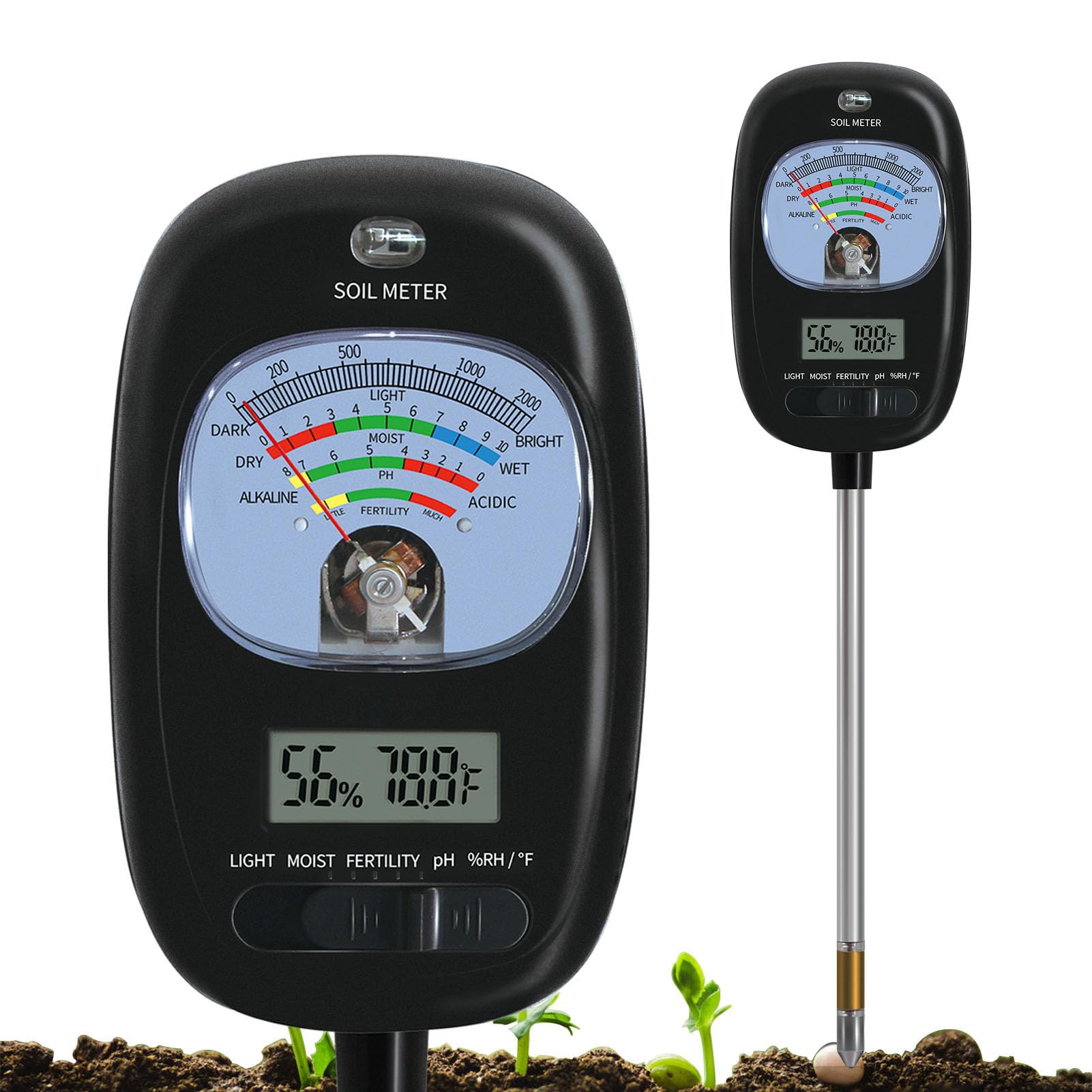
| 7-in-1 LCD Tester (Auduto)★ Best Overall | Instant Digital Readout | Probe | Moisture, pH, Light, Temp, Fertility, Air Temp, Humidity | 5.6 oz | Amazon |
| Luster Leaf RapitestAlso Great | Reliable Nutrient Analysis | Reagent Capsules | pH, N, P, K | — | Amazon |
| SoilKit Mail-In Lab | Professional Lab Analysis | Mail-In Lab | pH, N, P, K, Mg, Ca, B, Zn, Mn, Fe, OM, CEC | — | Amazon |
| 7-in-1 Digital (Buladeke) | Digital Precision & Backlit Screen | Probe | pH, EC, TDS, Fertility, Temp, Moisture, Light | 5.6 oz | Amazon |
| 140-Test Reagent Kit | High-Volume Testing | Reagent Drops | pH, N, P, K, Ammonia | 3.52 oz | Amazon |
| Premium 40-Test Kit | Simple Step-by-Step Testing | Reagent Tablets | pH, N, P, K | 6.4 oz | Amazon |
| Pawfly 4-in-1 | Budget-Friendly Nutrient Check | Strips & Tablets | pH, N, P, K | 6.7 oz | Amazon |
In‑Depth Reviews
1. 7-in-one Soil Test Kit (Auduto)
Our pick — over 4.5★ from 80+ verified ratings; the strongest balance of quality and price.
An LCD display that gives you moisture, pH, light, and temperature in seconds.
Where the Luster Leaf requires mixing and waiting, the Auduto 7-in-1 is pure plug-and-play. You push the metal probes into the soil, and the screen shows you moisture, pH, fertility, sunlight intensity, air humidity, air temperature, and soil temperature. The LCD backlight (a small light inside the screen) means you can read it even in low evening light. It weighs 5.6 ounces, making it lighter than a typical reagent kit, so it is easy to carry from pot to pot.
The consensus is that it removes the guesswork from watering and fertilizing. One owner summed it up: “Measures moisture, pH, light, temperature.” The probes are corrosion-resistant metal, which speeds up readings compared to the cheaper copper-tipped models.
The catch: this is a probe, not a lab test. It does not measure the individual NPK values (separate numbers for nitrogen, phosphorus, and potassium) the way a reagent kit does. If your goal is to dial in exact nitrogen or phosphorus levels, you will need a different tool. But for a quick daily status check on your houseplants and garden beds, it is tough to top for convenience, especially given the data supports 4.6 stars across 88 ratings.
Who it works for: Any houseplant owner or urban gardener who wants instant, easy-to-read feedback on moisture and pH without handling chemicals.
Where it stops short: It cannot separate nitrogen from phosphorus from potassium — you get a combined “fertility” reading only.
2. Luster Leaf Rapitest Soil Test Kit
The crowd-favorite capsule system that has proven itself across thousands of gardens.
The Luster Leaf Rapitest uses a straightforward water-extraction method: you mix a soil sample with water, drop in a pre-filled capsule, and match the resulting color against its comparator chart (a printed card that shows which color means what nutrient level). The results are clear color-coded readings for pH, nitrogen, phosphorus, and potassium. It has earned its reputation with repeat buyers — many owners come back for a second round because the test is simple to conduct and the results are easy to read.
What wins people over here is how well the results hold up. Several owners compared the Rapitest output to professional college lab tests and found them surprisingly close, though not identical. For a home kit that costs a fraction of lab fees, that is a strong vote of confidence. One noted “cheaper than a lab and it works,” and the kit makes a great educational project for kids curious about plant science.
The only real caveat is an occasional hiccup with the nitrogen test — some owners saw a zero reading even in fertilized soil. It is a minority experience, but it suggests you may want to test nitrogen twice or cross-check against a second method if your results look off.
What Makes It a Winner
- Clear color-coded results for pH, N, P, and K with a proven capsule system
- Results correlate well with professional lab analysis, according to multiple owner comparisons
- Simple enough for a beginner, reliable enough for a repeat buyer — many get a second kit
A Fair Warning
- Occasional nitrogen test failure reported, even in enriched soil — run a duplicate if accuracy is critical
Best for this buyer: The gardener who wants reliable, lab-correlated nutrient data without sending samples away.
Think twice if: You need high-volume testing (you will need multiple kits) or you want a digital readout instead of color matching.
3. SoilKit Professional Mail-In Test (Powered by SoilKit)

A real laboratory analysis that returns a custom fertilizer prescription by email.
The SoilKit is an entirely different category from the probes and reagent kits above. You collect a sample of garden soil (not potting soil — the instructions explicitly say this is not for potting mix), put it in the included bag, and mail it using the pre-addressed, postage-paid envelope. The lab runs a Mehlich III soil test (a standard lab method that extracts nutrients from the soil), which measures pH, buffer pH (a measure of how resistant your soil is to pH change), organic matter, Cation Exchange Capacity (CEC) (the soil’s ability to hold onto nutrients for your plants), Estimate Nitrogen Release (ENR) (how much nitrogen your soil will naturally release over the growing season), plus phosphorus, potassium, magnesium, calcium, boron, zinc, manganese, and iron (trace minerals that affect plant health in small amounts).
The results land in your SoilKit365 virtual dashboard, and the company calls you with recommendations tailored to your specific property. One owner said the kit revealed their pH was far higher than their DIY test strips showed, directly contradicting their earlier assumptions. Another mentioned the company replaced a lost sample kit free of charge, which signals solid customer service.
The biggest trade-off is time. Results can take 5 to 11 days depending on mail speed, and the online report formatting has drawn some criticism for being hard to read. If you need an answer this afternoon, this is not for you. But if you want a genuine laboratory baseline — the kind that tells you exactly which fertilizer product to buy and how much to apply — the SoilKit is the only kit here that delivers that depth.
The Gold Standard at Home
- Tests 11+ parameters including trace minerals and organic matter using the Mehlich III lab method
- Prepaid mailer and online dashboard with custom fertilizer recommendations
- Company replaces samples that get lost and provides phone support for interpreting results
Plan Ahead Required
- Results take up to 11 days to return — not for immediate diagnosis
- Dashboard formatting has been described as difficult to navigate by some owners
4. 7-in-1 Digital Soil Tester (Buladeke)
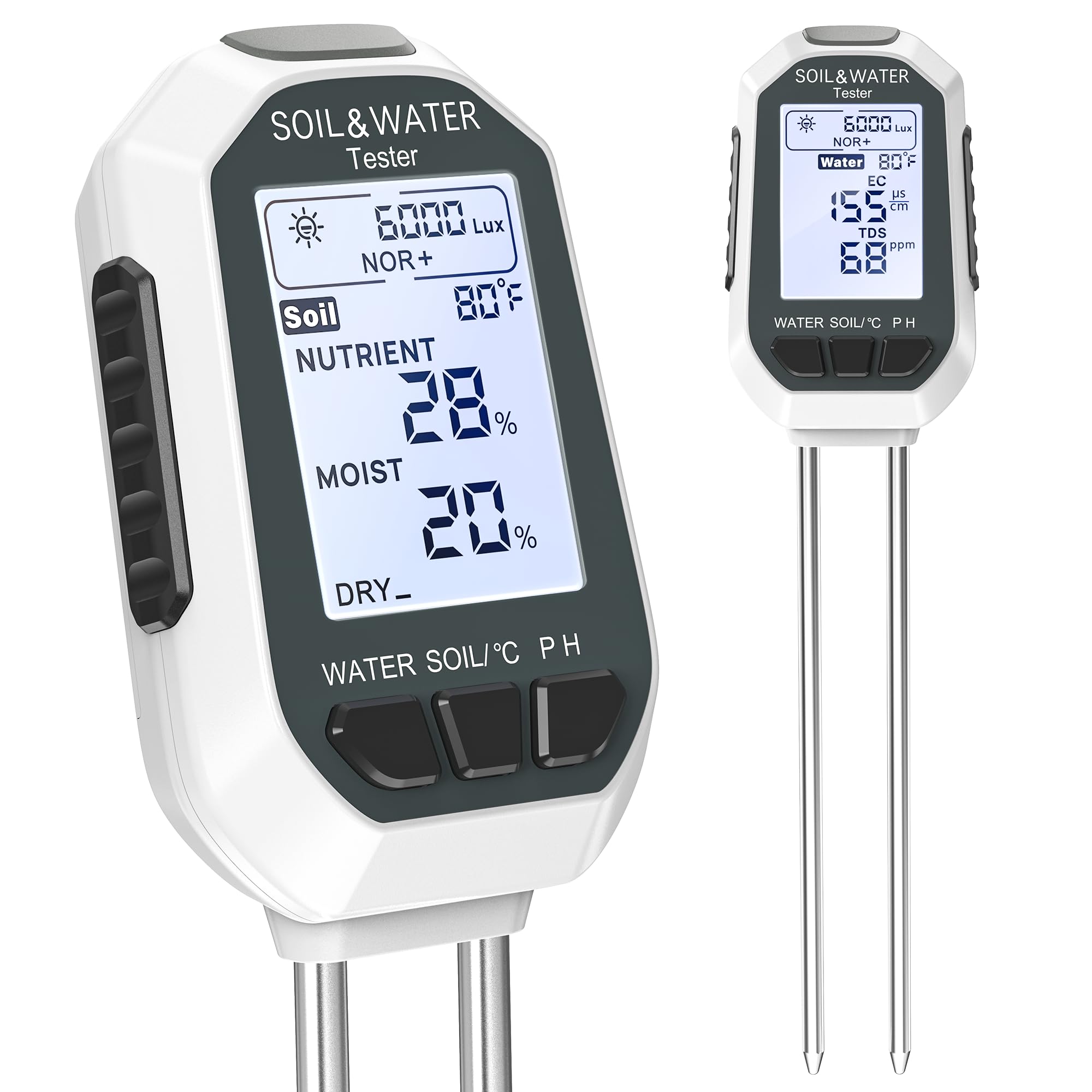
A probe that adds EC and TDS readings alongside the usual moisture and pH.
While the Auduto 7-in-1 covers the basics, the Buladeke 7-in-1 goes a step further by adding EC (electrical conductivity, a measure of dissolved salts) and TDS (total dissolved solids, a combined measure of all minerals and salts in the water or soil) readings — useful for detecting salt buildup in potting soil or evaluating water quality. It also keeps the fertility, temperature, moisture, light, and pH functions, making it among the most feature-rich probe-style kits available. The large screen has a white backlight that works well in dim conditions, and the display uses intuitive symbols and labels.
The screen quality is the standout feature here — six owners single it out as a positive, citing how easy it is to read compared to older needle-style meters. The device is powered by 4 AAA batteries (not included) and warns you when they are low. One owner noted it fits 3-inch pots without trouble, which matters if you test small containers.
The honest limitation: this is still a probe, not a lab. The EC and TDS readings are useful ballpark values rather than precision instruments, and some owners found those numbers required additional research to interpret. But if you want the broadest set of instant soil and water data from a single handheld device, the Buladeke is the clear choice.
Best for: The detail-oriented gardener who wants to compare everything from moisture to salt levels in one reading.
Not for: Anyone who needs a printed color chart for specific NPK values (separate numbers for nitrogen, phosphorus, and potassium) — you will want a reagent kit for that.
5. Soil Test Kit 140 Tests (Dewilde Trading Co)
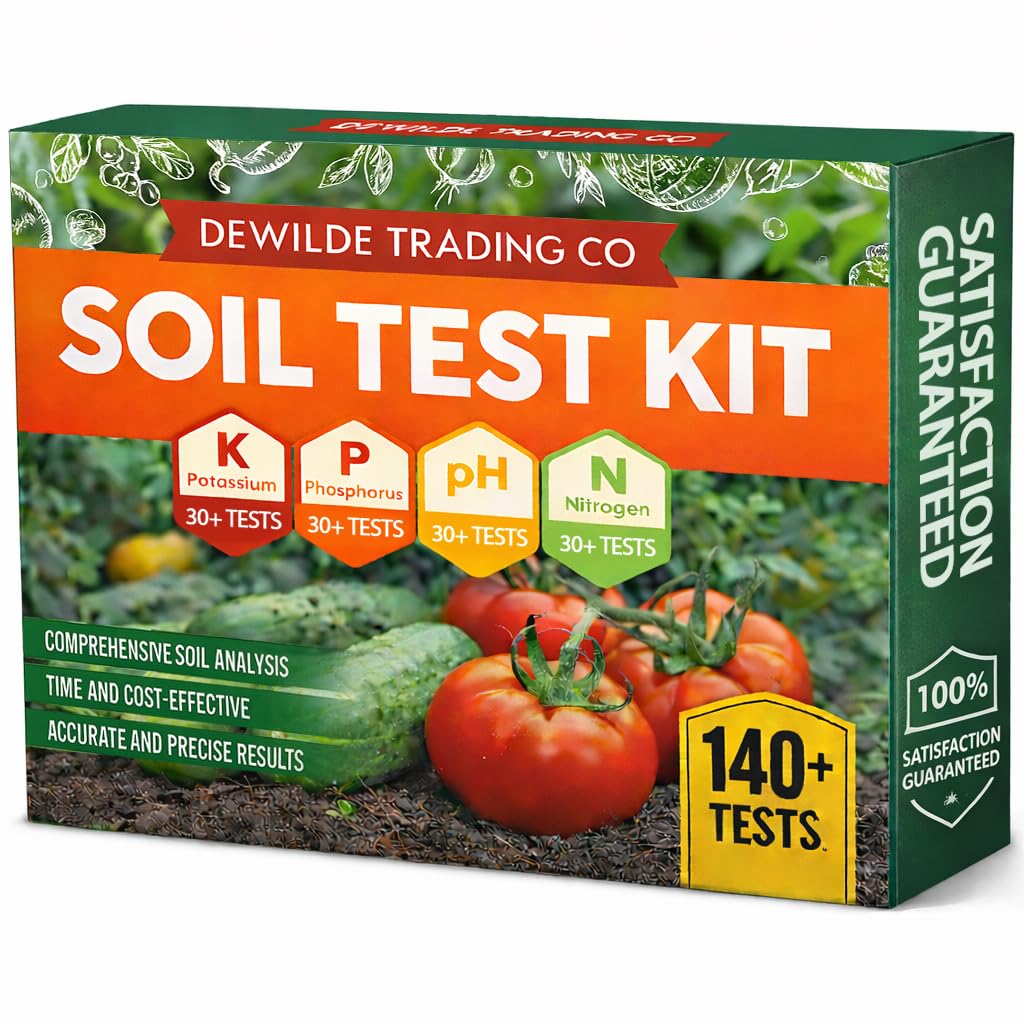
Enough reagent for 140 tests — cover an entire growing season and then some.
This liquid reagent kit from Dewilde Trading Co offers roughly 40 tests each for pH, phosphorus, and potassium, plus about 20 for nitrogen — the manufacturer counts about 140 tests total in the box. That is significantly more volume than the standard 10-test or 40-test kits, and the added ammonia parameter (a form of nitrogen that plants can use) gives you a more complete picture of your soil’s nitrogen availability.
Ease of use gets high marks from many owners. The liquid drops work with small beakers (small glass containers for mixing soil and water), and the color chart is straightforward once you have the hang of it. Those who found the kit helpful mention it helped them identify a high pH problem that was stunting their tomatoes, and they appreciated having so many tests available to track changes over time. At 3.52 ounces, the kit is very lightweight compared to the probe models.
Accuracy is the main point of debate. Some buyers report results that do not match their expectations, and there is a notable criticism about incomplete NPK requirement info on the included chart — users may need to consult an external guide to determine whether their results are high, low, or optimal. The nitrogen test specifically was called disappointing compared to aquarium test kits by one experienced hobbyist.
Value for Volume
- Roughly 140 tests at a budget-friendly price per test — ideal for season-long monitoring
- Includes an ammonia measurement that most kits skip
Read Carefully
- Results and accuracy receive mixed feedback; some owners found the color comparisons inconsistent
- Chart may lack the specific “high/optimal/low” labels, requiring external reference material
6. Premium Soil Test Kit 40 Tests (Dewilde Trading Co)
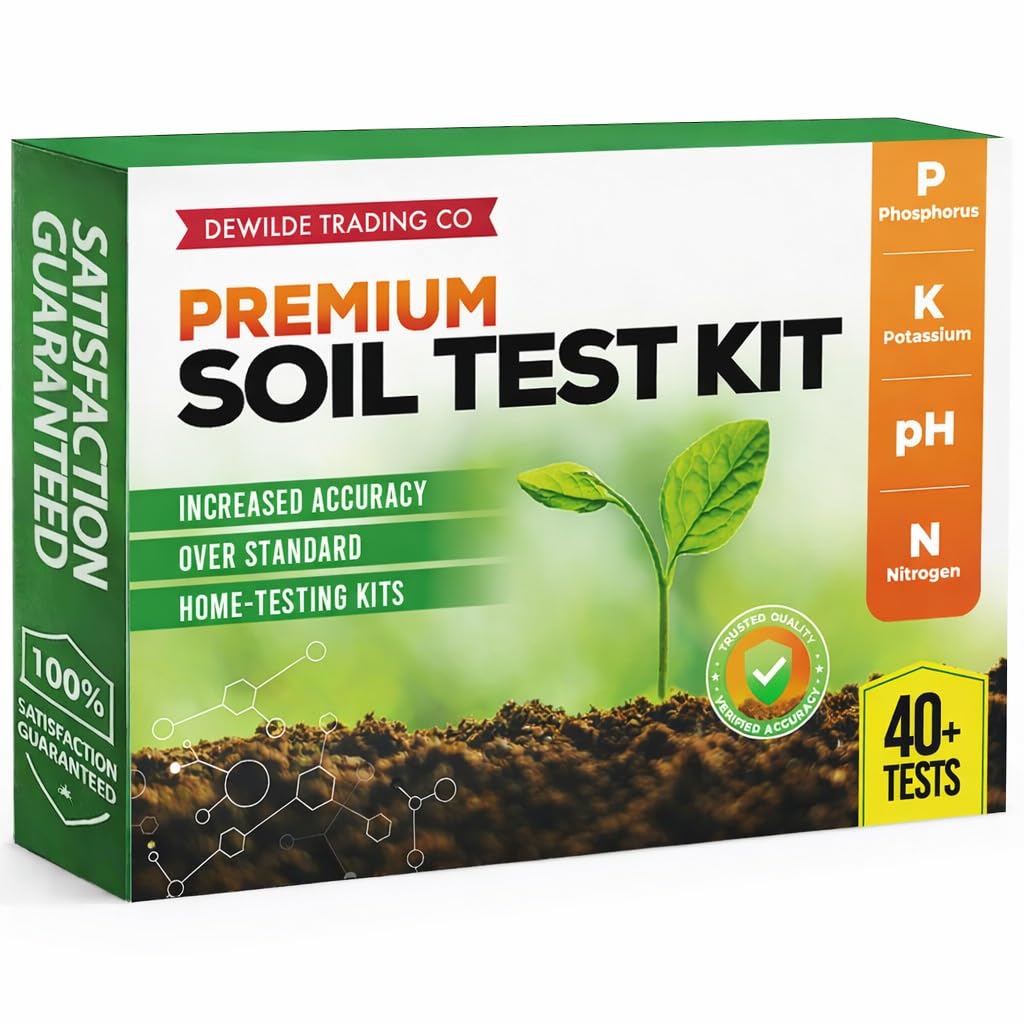
A straightforward 40-test kit that focuses on giving beginners a clear answer.
The Premium Kit simplifies the process with color-changing tablets instead of liquid drops. You add a tablet to your diluted soil sample, wait for the color to develop, and match it to the included card. It covers pH, nitrogen, phosphorus, and potassium with 10 tests for each parameter — 40 total tests. The kit includes two test tubes, a dropper, a stick, and a color card, all packed into a portable box that weighs 6.4 ounces.
What owners appreciate most is how easy the process is. The instructions include a quick guide alongside detailed steps, and even first-time gardeners report getting usable results without confusion. The test accuracy also gets strong marks — 7 owners praise it specifically, and several note the kit identified real nutrient deficiencies (like low nitrogen in a lawn) that matched visible plant stress.
The trade-off is strictly a quantity question: at 40 tests, you will use them up faster than the 140-test kit above, especially if you are testing multiple areas of a large property. But if you want a reliable, repeatable process that does not require a chemistry background, this is the easiest entry point into liquid reagent testing.
Reach for this if: You are new to soil testing and want a simple tablet-based system that is hard to mess up.
Look elsewhere if: You plan to test weekly across multiple garden beds — you will need a higher test count or a probe.
7. Pawfly 4 in 1 Soil Test Kit
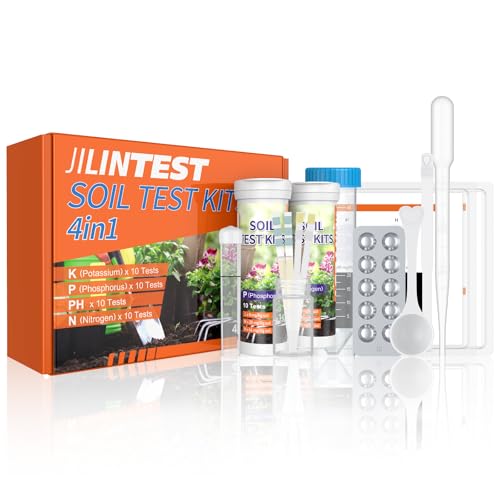
A compact four-parameter kit that trades pre-filled convenience for a lower entry cost.
The Pawfly 4 in 1 uses 20 testing strips and 40 tablets to deliver 10 tests each for pH, nitrogen, phosphorus, and potassium. The test ranges are clearly specified in the listing: pH is 3.5-9 (a wide enough range for any home garden), nitrogen is 40-320 mg/kg (milligrams of nutrient per kilogram of soil), phosphorus is 8-64 mg/kg, and potassium is 40-160 mg/kg. The kit packs all the accessories — centrifuge tubes (small tubes for spinning soil and water apart), a test tube, a glass vial, a dropper, a grinding rod, a sample spoon, a color chart, and an instruction manual — into a compact box measuring 2 x 2 x 0.5 inches and weighing 6.7 ounces.
The testing quality is the strongest positive here, with owners noting it is “great for testing vital nutrients” and that it outperforms simple test strips alone. The combination of strips and tablets gives you two ways to cross-check a result, which is helpful when you are learning.
Ease of use is where the kit divides opinion — it is the most-discussed aspect, and it is flagged as mixed rather than purely positive. Several owners found the instructions confusing, with one calling them “poorly written” and missing crucial details about how to prepare the soil solution correctly. You may need to watch a tutorial or experiment a bit to get repeatable results. The same traits that make it affordable also mean the documentation is less polished than premium kits.
Budget-Friendly Features
- 10 tests per parameter (pH, N, P, K) with clearly stated detection ranges
- Includes both strips and tablets for double-checking results
Documentation Drawbacks
- Instruction manual is vague — expect a learning curve before you get consistent results
- Occasional unusable outcomes if the soil solution is not filtered correctly
Understanding the Specs
pH Measurement Range
This tells you whether your soil is acidic (below 7), neutral (7), or alkaline (above 7). Different plants thrive in different ranges — blueberries want 4.5-5.5, while most vegetables prefer 6.0-7.0. A kit with a wide range, like 3.5-9, will cover almost any scenario you encounter in a home garden or lawn.
Nutrient Parameters Tested
The big three are nitrogen (N) for leafy growth, phosphorus (P) for roots and flowers, and potassium (K) for overall plant health. Some kits also test ammonia (a form of available nitrogen). If your goal is to choose the right fertilizer, you need separate readings for each nutrient — a combined “fertility” number from a probe is not enough to tell you which bag to buy.
FAQ
What is the difference between a probe and a reagent soil test kit?
How many tests do I need for my garden?
Can a soil test kit tell me exactly which fertilizer to use?
How deep should I insert the probe for an accurate reading?
Are liquid reagent tests more accurate than probes?
Will a soil test kit work for potting mix and container soil?
How long do the reagent chemicals stay effective?
Can I test my soil’s ammonia level with a standard kit?
Final Thoughts: The Verdict
If you want instant digital readings for moisture and pH, grab the Auduto 7-in-1 LCD Tester. And for a lab-quality analysis with a custom fertilizer prescription, the SoilKit Mail-In Test is the one to reach for.
How We Picked
We do not accept paid placement. Every pick is matched to a real buyer and a real use-case; we do not hands-on test units.
Sources & Methodology
Specifications: manufacturer listings and product documentation. Review insights: verified customer reviews, as of July 2026. Pricing: not shown on this page (it changes often); check the current price via the retailer link.
As an Amazon Associate, Lawn Gear Lab earns from qualifying purchases. This does not affect which products we feature.